


Luke 24:22
“The Road to Emmaus”Luke 24:13–35
Bible text: King James Version (1769 Blayney text) · Public domain
Bible text: Berean Standard Bible · Public domain
Bible text: American Standard Version (1901) · Public domain
Bible text: World English Bible, Messianic edition · Public domain
Bible text: Geneva Bible (1599) · Public domain
Bible text: Young's Literal Translation · Public domain
- ἀλλὰallaHoweverG235CONJConjunction
- καὶkaialsoG2532CONJConjunction
- γυναῖκέςgunaikeswomenG1135N-NPFNoun Nominative Plural Feminine
- τινεςtinescertainG5100X-NPFIndefinite pronoun Nominative Plural Feminine
- ἐξexout fromG1537PREPPreposition
- ἡμῶνhēmōnusG3165P-1GPPersonal pronoun Genitive 1st Plural
- ἐξέστησανexestēsanamazedG1839V-2AAI-3PVerb 2nd Aorist Active Indicative 3rd Plural
- ἡμᾶςhēmasusG3165P-1APPersonal pronoun Accusative 1st Plural
- γενόμεναιgenomenaiHaving beenG1096V-2ADP-NPFVerb 2nd Aorist Middle Deponent Participle Nominative Plural Feminine
- ὀρθριναὶorthrinaiat dawnG3720A-NPFAdjective Nominative Plural Feminine
- ἐπὶepitoG1909PREPPreposition
- τὸtotheG3588T-ASNDefinite article Accusative Singular Neuter
- μνημεῖονmnēmeiontombG3419N-ASNNoun Accusative Singular Neuter
English is a literal word-by-word gloss of the Greek, not the KJV's wording. Why?
This is the Greek text the KJV’s translators worked from, with each word given its own literal English meaning in this verse. The word-by-word meanings were prepared by scholars at Tyndale House, Cambridge. The KJV translates whole sentences rather than single words, so its wording often differs: one Greek word can become several English words, and the KJV may say “charity” where the word-by-word meaning reads “love”. The two are made for different purposes, and both are faithful to the Greek. To read the KJV’s own wording, switch to the KJV text.
Words in [ ] are added by the English.
Details
See on the biblical-era maps
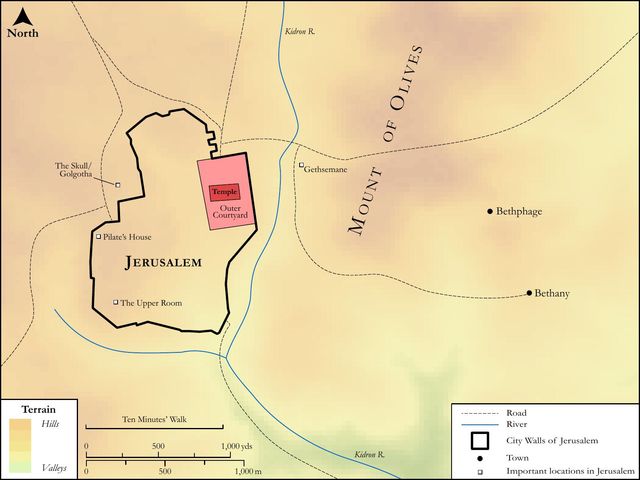
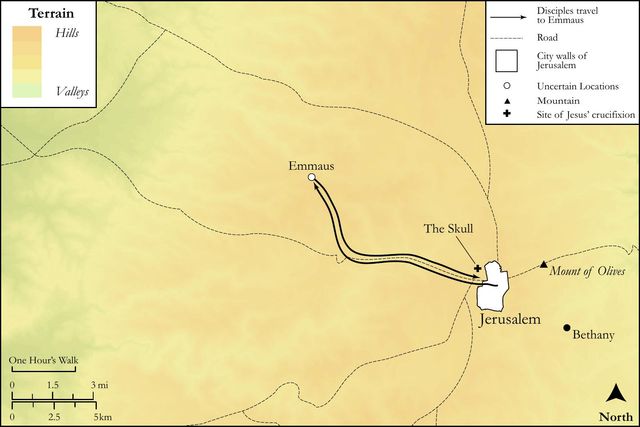
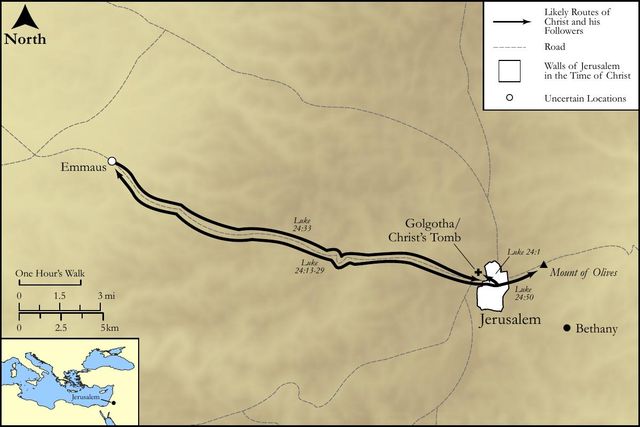
Study this verse
Public-domain commentary
Matthew Henry
From his Commentary on the Whole Bible. Henry wrote on whole passages, and this entry covers Luke 24:13–35. He set out his notes in a four-level outline, kept here as he numbered it.
This appearance of Christ to the two disciples going to Emmaus was mentioned, and but just mentioned, before (Mark xvi. 12); here it is largely related. It happened the same day that Christ rose, the first day of the new world that rose with him. One of these two disciples was Cleopas or Alpheus, said by the ancients to be the brother of Joseph, Christ's supposed father; who the other was is not certain. Some think it was Peter; it should seem indeed that Christ did appear particularly to Peter that day, which the eleven spoke of among themselves (v. 34), and Paul mentions, 1 Cor. xv. 5. But it could not be Peter that was one of the two, for he was one of the eleven to whom the two returned; and, besides, we know Peter so well as to think that if he had been one of the two he would have been the chief speaker, and not Cleopas. It was one of those that were associated with the eleven, mentioned v. 9. Now in this passage of story we may observe,
I.The walk and talk of these two disciples:
They went to a village called Emmaus, which is reckoned to be about two hours' walk from Jerusalem; it is here said to be about sixty furlongs, seven measured miles, v. 13. Whether they went thither upon business, or to see some friend, does not appear. I suspect that they were going homewards to Galilee, with an intention not to enquire more after this Jesus; that they were meditating a retreat, and stole away from their company without asking leave or taking leave; for the accounts brought them that morning of their Master's resurrection seemed to them as idle tales; and, if so, no wonder that they began to think of making the best of their way home. But as they travelled they talked together of all those things which had happened, v. 14. They had not courage to confer of these things, and consult what was to be done in the present juncture at Jerusalem, for fear of the Jews; but, when they were got out of the hearing of the Jews, they could talk it over with more freedom. They talked over these things, reasoning with themselves concerning the probabilities of Christ's resurrection; for, according as these appeared, they would either go forward or return back to Jerusalem. Note, It well becomes the disciples of Christ, when they are together, to talk of his death and resurrection; thus they may improve one another's knowledge, refresh one another's memory, and stir up one another's devout affections.
II.The good company they met with upon the road, when Jesus himself came, and joined himself to them (v.
15): They communed together, and reasoned, and perhaps were warm at the argument, one hoping that their Master was risen, and would set up his kingdom, the other despairing. Jesus himself drew near, as a stranger who, seeing them travel the same way that he went, told them that he should be glad of their company. We may observe it, for our encouragement to keep up Christian conference and edifying discourse among us, that where but two together are well employed in work of that kind Christ will come to them, and make a third. When they that fear the Lord speak one to another the Lord hearkens and hears, and is with them of a truth; so that two thus twisted in faith and love become a threefold cord, not easily broken, Eccl. iv. 12. They in their communings and reasonings together were searching for Christ, comparing notes concerning him, that they might come to more knowledge of him; and now Christ comes to them. Note, They who seek Christ shall find him: he will manifest himself to those that enquire after him, and give knowledge to those who use the helps for knowledge which they have. When the spouse enquired of the watchman concerning her beloved, it was but a little that she passed from them, but she found him. Cant. iii. 4. But, though they had Christ with them, they were not at first aware of it (v. 16): Their eyes were held, that they should not know him. It should seem, there were both an alteration of the object (for it is said in Mark that now he appeared in another form) and a restraint upon the organ (for here it is said that their eyes were held by a divine power); or, as some think, there was a confusion in the medium; the air was so disposed that they could not discern who it was. No matter how it was, but so it was they did not know him, Christ so ordering it that they might the more freely discourse with him and he with them, and that it might appear that his word, and the influence of it, did not depend upon his bodily presence, which the disciples had too much doted upon, and must be weaned from; but he could teach them, and warm their hearts, by others, who should have his spiritual presence with them, and should have his grace going along with them unseen.
III.The conference that was between Christ and them, when he knew them, and they knew not him.
Now Christ and his disciples, as is usual when friends meet incognito, or in a disguise, are here crossing questions.
1.Christ's first question to them is concerning their present sadness, which plainly appeared in their countenances: What manner of communications are those that you have one with another as you walk, and are sad? v. 17. It is a very kind and friendly enquiry. Observe,
(1.)They were sad; it appeared to a stranger that they were so.
[1.]They had lost their dear Master, and were, in their own apprehensions, quite disappointed in their expectations from him. They had given up the cause, and knew not what course to take to retrieve it. Note, Christ's disciples have reason to be sad when he withdraws from them, to fast when the Bridegroom is taken from them.
[2.]Though he was risen from the dead, yet either they did not know it or did not believe it, and so they were still in sorrow. Note, Christ's disciples are often sad and sorrowful even when they have reason to rejoice, but through the weakness of their faith they cannot take the comfort that is offered to them.
[3.]Being sad, they had communications one with another concerning Christ. Note, First, It becomes Christians to talk of Christ. Were our hearts as full of him, and of what he has done and suffered for us, as they should be, out of the abundance of the heart the mouth would speak, not only of God and his providence, but of Christ and his grace and love. Secondly, Good company and good converse are an excellent antidote against prevailing melancholy. When Christ's disciples were sad they did not each one get by himself, but continued as he sent them out, two and two, for two are better than one, especially in times of sorrow. Giving vent to the grief may perhaps give ease to the grieved; and by talking it over we may talk ourselves or our friends may talk us into a better frame. Joint mourners should be mutual comforters; comforts sometimes come best from such.
(2.)Christ came up to them, and enquired into the matter of their talk, and the cause of their grief: What manner of communications are these? Though Christ had now entered into his state of exaltation, yet he continued tender of his disciples, and concerned for their comfort. He speaks as one troubled to see their melancholy: Wherefore look ye so sadly to-day? Gen. xl. 7. Note, Our Lord Jesus takes notice of the sorrow and sadness of his disciples, and is afflicted in their afflictions. Christ has hereby taught us,
[1.]To be conversable. Christ here fell into discourse with two grave serious persons, though he was a stranger to them and they knew him not, and they readily embraced him. It does not become Christians to be morose and shy, but to take pleasure in good society.
[2.]We are hereby taught to be compassionate. When we see our friends in sorrow and sadness, we should, like Christ here, take cognizance of their grief, and give them the best counsel and comfort we can: Weep with them that weep.
2.In answer to this, they put a question to him concerning his strangeness. Art thou only a stranger in Jerusalem, and hast not known the things that are come to pass there in these days? Observe,
(1.)Cleopas gave him a civil answer. He does not rudely ask him. "As for what we are talking of, what is that to you?" and bid him go about his business. Note, We ought to be civil to those who are civil to us, and to conduct ourselves obligingly to all, both in word and deed. It was a dangerous time now with Christ's disciples; yet he was not jealous of this stranger, that he had any design upon them, to inform against them, or bring them into trouble. Charity is not forward to think evil, no, not of strangers.
(2.)He is full of Christ himself and of his death and sufferings, and wonders that every body else is not so too: "What! art thou such a stranger in Jerusalem as not to know what has been done to our Master there?" Note, Those are strangers indeed in Jerusalem that know not of the death and sufferings of Christ. What! are they daughters of Jerusalem, and yet so little acquainted with Christ as to ask, What is thy beloved more than another beloved?
(3.)He is very willing to inform this stranger concerning Christ, and to draw on further discourse with him upon this subject. He would not have any one that had the face of a man to be ignorant of Christ. Note, Those who have themselves the knowledge of Christ crucified should do what they can to spread that knowledge, and lead others into an acquaintance with him. And it is observable that these disciples, who were so forward to instruct the stranger, were instructed by him; for to him that has, and uses what he has, shall be given.
(4.)It appears, by what Cleopas says, that the death of Christ made a great noise in Jerusalem, so that it could not be imagined that any man should be such a stranger in the city as not to know of it; it was all the talk of the town, and discoursed of in all companies. Thus the matter of fact came to be universally known, which, after the pouring out of the Spirit, was to be explained.
3.Christ, by way of reply, asked concerning their knowledge (v. 19): He said unto them, What things? thus making himself yet more a stranger. Observe,
(1.)Jesus Christ made light of his own sufferings, in comparison with the joy set before him, which was the recompence of it. Now that he was entering upon his glory, see with what unconcernedness he looks back upon his sufferings: What things? He had reason to know what things; for to him they were bitter things, and heavy things, and yet he asks, What things? The sorrow was forgotten, for joy that the man-child of our salvation was born. He took pleasure in infirmities for our sakes, to teach us to do so for his sake.
(2.)Those whom Christ will teach he will first examine how far they have learned; they must tell him what things they know, and then he will tell them what was the meaning of these things. and lead them into the mystery of them.
4.They, hereupon, gave him a particular account concerning Christ, and the present posture of his affairs. Observe the story they tell, v. 19, &c.
(1.)Here is a summary of Christ's life and character. The things they are full of are concerning Jesus of Nazareth (so he was commonly called), who was a prophet, a teacher come from God. He preached a true and excellent doctrine, which had manifestly its rise from heaven, and its tendency towards heaven. He confirmed it by many glorious miracles, miracles of mercy, so that he was mighty in deed and word before God and all the people; that is, he was both a great favourite of heaven and a great blessing to this earth. He was, and appeared to be, greatly beloved of God, and much the darling of his people. He had great acceptance with God, and a great reputation in the country. Many are great before all the people, and are caressed by them, who are not so before God, as the scribes and Pharisees; but Christ was mighty both in his doctrine and in his doings, before God and all the people. Those were strangers in Jerusalem that did not know this.
(2.)Here is a modest narrative of his sufferings and death, v. 20. "Though he was so dear both to God and man, yet the chief priests and our rulers, in contempt of both, delivered him to the Roman power, to be condemned to death, and they have crucified him." It is strange that they did not aggravate the matter more, and lay a greater load upon those that had been guilty of crucifying Christ; but perhaps because they spoke to one that was a stranger they thought it prudent to avoid all reflections upon the chief priests and their rulers, how just soever.
(3.)Here is an intimation of their disappointment in him, as the reason of their sadness: "We trusted that it had been he who should have redeemed Israel, v. 21. We are of those who not only looked upon him to be a prophet, like Moses, but, like him, a redeemer too." He was depended upon, and great things expected from him, by them that looked for redemption, and in it for the consolation of Israel. Now, if hope deferred makes the heart sick, hope disappointed, especially such a hope, kills the heart. But see how they made that the ground of their despair which if they had understood it aright was the surest ground of their hope, and that was the dying of the Lord Jesus: We trusted (say they) that it had been he that should have redeemed Israel. And is it not he that doth redeem Israel? Nay, is he not by his death paying the price of their redemption? Was it not necessary, in order to his saving Israel from their sins, that he should suffer? Sop that now, since that most difficult part of his undertaking was got over, they had more reason than ever to trust that this was he that should deliver Israel; yet now they are ready to give up the cause.
(4.)Here is an account of their present amazement with reference to his resurrection. [1.] "This is the third day since he was crucified and died, and that was the day when it was expected, if ever, that he should rise again, and rise in glory and outward pomp, and show himself as publicly in honour as he had been shown three days before in disgrace; but we see no sign of it; nothing appears, as we expected, to the conviction and confusion of his prosecutors, and the consolation of his disciples, but all is silent." [2.] They own that there was a report among them that he was risen, but they seem to speak of it very slightly, and as what they gave no credit at all to (v. 22, 23): "Certain women also of our company made us astonished (and that was all), who were early at the sepulchre, and found the body gone, and they said that they had seen a vision of angels, who said that he was alive; but we are ready to think it was only their fancy, and no real thing, for angels would have been sent to the apostles, not to the women, and women are easily imposed upon." [3.] They acknowledge that some of the apostles had visited the sepulchre, and found it empty, v. 24. "But him they saw not, and therefore we have reason to fear that he is not risen, for, if he be, surely he would have shown himself to them; so that, upon the whole matter, we have no great reason to think that he is risen, and therefore have no expectations from him now; our hopes were all nailed to his cross, and buried in his grave."
(5.)Our Lord Jesus, though not known by face to them, makes himself known to them by his word.
[1.]He reproves them for their incogitancy, and the weakness of their faith in the scriptures of the Old Testament: O fools, and slow of heart to believe, v. 25. When Christ forbade us to say to our brother, Thou fool, it was intended to restrain us from giving unreasonable reproaches, not from giving just reproofs. Christ called them fools, not as it signifies wicked men, in which sense he forbade it to us, but as it signifies weak men. He might call them fools, for he knows our foolishness, the foolishness that is bound in our hearts. Those are fools that act against their own interest; so they did who would not admit the evidence given them that their Master was risen, but put away the comfort of it. That which is condemned in them as their foolishness is, First, Their slowness to believe. Believers are branded as fools by atheists, and infidels, and free-thinkers, and their most holy faith is censured as a fond credulity; but Christ tells us that those are fools who are slow of heart to believe, and are kept from it by prejudices never impartially examined. Secondly, Their slowness to believe the writings of the prophets. He does not so much blame them for their slowness to believe the testimony of the women and of the angels, but for that which was the cause thereof, their slowness to believe the prophets; for, if they had given the prophets of the Old Testament their due weight and consideration, they would have been as sure of Christ's rising from the dead that morning (being the third day after his death) as they were of the rising of the sun; for the series and succession of events as settled by prophecy are no less certain and inviolable than as settled by providence. Were we but more conversant with the scripture, and the divine counsels as far as they are made known in the scripture, we should not be subject to such perplexities as we often entangle ourselves in.
[2.]He shows them that the sufferings of Christ, which were such a stumbling-block to them, and made them unapt to believe his glory, were really the appointed way to his glory, and he could not go to it any other way (v. 26): "Ought not the Christ (the Messiah) to have suffered these things, and to enter into his glory? Was it not decreed, and was not that decree declared, that the promised Messiah must first suffer and then reign, that he must go by his cross to his crown?" Had they never read the fifty-third of Isaiah and the ninth of Daniel, where the prophets speak so very plainly of the sufferings of Christ and the glory that should follow? 1 Pet. i. 11. The cross of Christ was that to which they could not reconcile themselves; now here he shows them two things which take off the offence of the cross:—First, That the Messiah ought to suffer these things; and therefore his sufferings were not only no objection against his being the Messiah, but really a proof of it, as the afflictions of the saints are an evidence of their sonship; and they were so far from ruining their expectations that really they were the foundation of their hopes. He could not have been a Saviour, if he had not been a sufferer. Christ's undertaking our salvation was voluntary; but, having undertaken it, it was necessary that he should suffer and die. Secondly, That, when he had suffered these things, he should enter into his glory, which he did at his resurrection; that was his first step upward. Observe, It is called his glory, because he was duly entitled to it, and it was the glory he had before the world was; he ought to enter into it, for in that, as well as in his sufferings, the scripture must be fulfilled. He ought to suffer first, and then to enter into his glory; and thus the reproach of the cross is for ever rolled away, and we are directed to expect the crown of thorns and then that of glory.
[3.]He expounded to them the scriptures of the Old Testament, which spoke of the Messiah, and showed them how they were fulfilled in Jesus of Nazareth, and now can tell them more concerning him than they could before tell him (v. 27): Beginning at Moses, the first inspired writer of the Old Testament, he went in order through all the prophets, and expounded to them the things concerning himself, showing that the sufferings he had now gone through were so far from defeating the prophecies of the scripture concerning him that they were the accomplishment of them. He began at Moses, who recorded the first promise, in which it was plainly foretold that the Messiah should have his heel bruised, but that by it the serpent's head should be incurably broken. Note, First, There are things dispersed throughout all the scriptures concerning Christ, which it is of great advantage to have collected and put together. You cannot go far in any part of scripture but you meet with something that has reference to Christ, some prophecy, some promise, some prayer, some type or other; for he is the true treasure his in the field of the Old Testament. A golden thread of gospel grace runs through the whole web of the Old Testament. There is an eye of that white to be discerned in every place. Secondly, The things concerning Christ need to be expounded. The eunuch, though a scholar, would not pretend to understand them, except some man should guide him (Acts viii. 31); for they were delivered darkly, according to that dispensation: but now that the veil is taken away the New Testament expounds the Old. Thirdly, Jesus Christ is himself the best expositor of scripture, particularly the scriptures concerning himself; and even after his resurrection it was in this way that he led people into the knowledge of the mystery concerning himself; not by advancing new notions independent upon the scripture, but by showing how the scripture was fulfilled, and turning them over to the study of it. Even the Apocalypse itself is but a second part of the Old-Testament prophecies, and has continually an eye to them. If men believe not Moses and the prophets, they are incurable. Fourthly, In studying the scriptures, it is good to be methodical, and to take them in order; for the Old-Testament light shone gradually to the perfect day, and it is good to observe how at sundry times, and in divers manners (subsequent predictions improving and giving light to the preceding ones), God spoke to the fathers concerning his Son, by whom he has now spoken to us. Some begin their bible at the wrong end, who study the Revelation first; but Christ has here taught us to begin at Moses. Thus far the conference between them.
IV.Here is the discovery which Christ at length made of himself to them.
One would have given a great deal for a copy of the sermon Christ preached to them by the way, of that exposition of the bible which he gave them; but it is not thought fit that we should have it, we have the substance of it in other scriptures. The disciples are so charmed with it, that they think they are come too soon to their journey's end; but so it is: They drew nigh to the village whither they went (v. 28), where, it should seem, they determined to take up for that night. And now,
1.They courted his stay with them: He made as though he would have gone further; he did not say that he would, but he seemed to them to be going further, and did not readily turn into their friend's house, which it would not be decent for a stranger to do unless he were invited. He would have gone further if they had not courted his stay; so that here was nothing like dissimulation in the case. If a stranger be shy, every one knows the meaning of it; he will not thrust himself rudely upon your house or company; but, if you make it appear that you are freely desirous of him for your guest or companion, he knows not but he may accept your invitation, and this was all that Christ did when he made as though he would have gone further. Note, Those that would have Christ dwell with them must invite him, and be importunate with him; though he is often found of those that seek him not, yet those only that seek can be sure to find; and, if he seem to draw off from us, it is but to draw out our importunity; as here, they constrained him; both of them laid hold on him, with a kind and friendly violence, saying, Abide with us. Note, Those that have experienced the pleasure and profit of communion with Christ cannot but covet more of his company, and beg of him, not only to walk with them all day, but to abide with them at night. When the day is far spent, and it is towards evening, we begin to think of retiring for our repose, and then it is proper to have our eye to Christ, and to beg of him to abide with us, to manifest himself to us and to fill our minds with good thoughts of him and good affections to him. Christ yielded to their importunity: He went in, to tarry with them. Thus ready is Christ to give further instructions and comforts to those who improve what they have received. He has promised that if any man open the door, to bid him welcome, he will come in to him, Rev. iii. 20.
2.He manifested himself to them, v. 30, 31. We may suppose that he continued his discourse with them, which he began upon the road; for thou must talk of the things of God when thou sittest in the house as well as when thou walkest by the way. While supper was getting ready (which perhaps was soon done, the provision was so small and mean), it is probable that he entertained them with such communications as were good and to the use of edifying; and so likewise as they sat at meat his lips fed them. But still they little thought that it was Jesus himself that was all this while talking with them, till at length he was pleased to throw off his disguise, and then to withdraw.
(1.)They began to suspect it was he, when, as they sat down to meat, he undertook the office of the Master of the feast, which he performed so like himself, and like what he used to do among his disciples, that by it they discerned him: He took bread, and blessed it, and brake, and gave to them. This he did with his usual air both of authority and affection, with the same gestures and mien, with the same expressions perhaps in craving a blessing and in giving the bread to them. This was not a miraculous meal like that of the five loaves, nor a sacramental meal like that of the eucharist, but a common meal; yet Christ here did the same as he did in those, to teach us to keep up our communion with God through Christ in common providences as well as in special ordinances, and to crave a blessing and give thanks at every meal, and to see our daily bread provided for us and broken to us by the hand of Jesus Christ, the Master, not only of the great family, but of all our families. Wherever we sit down to eat, let us set Christ at the upper end of the table, take our meat as blessed to us by him, and eat and drink to his glory, and receive contentedly and thankfully what he is pleased to carve out to us, be the fare ever so coarse and mean. We may well receive it cheerfully, if we can by faith see it coming to us from Christ's hand, and with his blessing.
(2.)Presently their eyes were opened, and then they saw who it was, and knew him well enough. Whatever it was which had hitherto concealed him from them, it was now taken out of the way; the mists were scattered, the veil was taken off, and then they made no question but it was their Master. He might, for wise and holy ends, put on the shape of another, but no other could put on his; and therefore it must be he. See how Christ by his Spirit and grace makes himself known to the souls of his people.
[1.]He opens the scriptures to them, for they are they which testify of him to those who search them, and search for him in them.
[2.]He meets them at his table, in the ordinance of the Lord's supper, and commonly there makes further discoveries of himself to them, is known to them in the breaking of bread. But,
[3.]The work is completed by the opening of the eyes of their mind, and causing the scales to fall off from them, as from Paul's in his conversion. If he that gives the revelation do not give the understanding, we are in the dark still.
3.He immediately disappeared: He vanished out of their sight. Aphantos egeneto—He withdrew himself from them, slipped away of a sudden, and went out of sight. Or, he became not visible by them, was made inconspicuous by them. It should seem that though Christ's body, after his resurrection, was the very same body in which he suffered and died, as appeared by the marks in it, yet it was so far changed as to become either visible or not visible as he thought fit to make it, which was a step towards its being made a glorious body. As soon as he had given his disciples one glimpse of him he was gone presently. Such short and transient views have we of Christ in this world; we see him, but in a little while lose the sight of him again. When we come to heaven the vision of him will have no interruptions.
V.Here is the reflection which these disciples made upon this conference, and the report which they made of it to their brethren at Jerusalem.
1.The reflection they each of them made upon the influence which Christ's discourse had upon them (v. 32): They said one to another, Did not our hearts burn within us? "I am sure mine did," saith one; "And so did mine," saith the other, "I never was so affected with any discourse in all my life." Thus do they not so much compare notes as compare hearts, in the review of the sermon Christ had preached to them. They found the preaching powerful, even when they knew not the preacher. It made things very plain and clear to them; and, which was more, brought a divine heat with a divine light into their souls, such as put their hearts into a glow, and kindled a holy fire of pious and devout affections in them. Now this they take notice of, for the confirming of their belief, that it was indeed, as at last they saw, Jesus himself that had been talking with them all along. "What fools were we, that we were not sooner aware who it was! For none but he, no word but his, could make our hearts burn within us as they did; it must be he that has the key of the heart; it could be no other." See here,
(1.)What preaching is likely to do good—such as Christ's was, plain preaching, and that which is familiar and level to our capacity—he talked with us by the way; and scriptural preaching—he opened to us the scriptures, the scriptures relating to himself. Ministers should show people their religion in their bibles, and that they preach no other doctrine to them than what is there; they must show that they make that the fountain of their knowledge and the foundation of their faith. Note, The expounding of those scriptures which speak of Christ has a direct tendency to warm the hearts of his disciples, both to quicken and to comfort them.
(2.)What hearing is likely to do good—that which makes the heart burn; when we are much affected with the things of God, especially with the love of Christ in dying for us, and have our hearts thereby drawn out in love to him, and drawn up in holy desires and devotions, then our hearts burn within us; when our hearts are raised and elevated, and are as the sparks which fly upwards towards God, and when they are kindled and carried out with a holy zeal and indignation against sin, both in others and in ourselves, and we are in some measure refined and purified from it by the spirit of judgment and the spirit of burning, then we may say, "Through grace our hearts are thus inflamed."
2.The report they brought of this to their brethren at Jerusalem (v. 33): They rose up the same hour, so transported with joy at the discovery Christ had made of himself to them that they could not stay to make an end of their supper, but returned with all speed to Jerusalem, though it was towards evening. If they had had any thoughts of quitting their relation to Christ, this soon banished all such thoughts out of their mind, and there needed no more to send them back to his flock. It should seem that they intended at least to take up their quarters to-night at Emmaus; but now that they had seen Christ they could not rest till they had brought the good news to the disciples, both for the confirmation of their trembling faith and for the comfort of their sorrowful spirits, with the same comforts wherewith they were comforted of God. Note, It is the duty of those to whom Christ has manifested himself to let others know what he has done for their souls. When thou art converted, instructed, comforted, strengthen thy brethren. These disciples were full of this matter themselves, and must go to their brethren, to give vent to their joys, as well as to give them satisfaction that their Master was risen. Observe,
(1.)How they found them, just when they came in among them, discoursing on the same subject, and relating another proof of the resurrection of Christ. They found the eleven, and those that were their usual companions, gathered together late in the night, to pray together, it may be, and to consider what was to be done in this juncture; and they found them saying among themselves (legontas it is the saying of the eleven, not of the two, as is plain by the original), and when these two came in, they repeated to them with joy and triumph, The Lord is risen indeed, and hath appeared to Simon, v. 34. That Peter had a sight of him before the rest of the disciples had appears 1 Cor. xv. 5, where it is said, He was seen of Cephas, then of the twelve. The angel having ordered the women to tell Peter of it particularly (Mark xvi. 7), for his comfort, it is highly probable that our Lord Jesus did himself presently the same day appear to Peter, though we have no particular narrative of it, to confirm the word of his messengers. This he had related to his brethren; but, observe, Peter does not here proclaim it, and boast of it, himself (he thought this did not become a penitent), but the other disciples speak of it with exultation, The Lord is risen indeed, ontos—really; it is now past dispute, no room is left to doubt it, for he has appeared not only to the women, but to Simon.
(2.)How they seconded their evidence with an account of what they had seen (v. 35): They told what things were done in the way. The words that were spoken by Christ to them in the way, having a wonderful effect and influence upon them, are here called the things that were done in the way; for the words that Christ speaks are not an empty sound, but they are spirit and they are life, and wondrous things are done by them, done by the way, by the by as it were, where it is not expected. They told also how he was at length known to them in the breaking of bread; then, when he was carving out blessings to them, God opened their eyes to discern who it was. Note, It would be of great use for the discovery and confirmation of truth if the disciples of Christ would compare their observations and experiences, and communicate to each other what they know and have felt in themselves.
Historical interpretation
Eight Centuries of Reception
8 surviving comments on this verse. Each one is dated, so this reads as a timeline rather than a list.
Select a marker to jump to its quote. Markers stagger vertically where authors wrote within a few decades of each other.
(Anonm. in Cat. Gr.) They were in truth discoursing among themselves, no longer expecting to see Christ alive, but sorrowing as concerning their Saviour slain. Hence it follows, And one of them whose name was Cleophas, answering him said, Art thou only a stranger?
(ut sup.) They next assign the cause of their sadness, the betrayal and passion of Christ; and add in the voice of despair, But we hoped it had been he who should have redeemed Israel. We hoped, (he says,) not we hope; as if the death of the Lord were like to the deaths of other men.
The disciples also mention the report of the resurrection which was brought by the women; adding, Yea, and certain women also of our company made us astonished, &c. They say this indeed as if they did not believe it; wherefore they speak of themselves as frightened or astonished. For they did consider as established what was told them, or that there had been an angelic revelation, but derived from it reason for astonishment and alarm. The testimony of Peter also they did not regard as certain, since he did not say that he had seen our Lord, but conjectured His resurrection from the fact that His body was not lying in the sepulchre. Hence it follows, And certain of them that were with us went, &c.
Or to two of the disciples by themselves our Lord showed Himself in the evening, namely, Ammaon and Cleophas.
So then, what kind of consideration does the doubting of Moses demand of us?… Moses doubted when the wood came into contact with the rock. …The disciples doubted when they saw the Lord crucified. He came to them after his resurrection, as they were talking to each other about this matter in a sad conversation. He kept their eyes from recognizing him, not in order to remove himself from believers but to put them off while they were still doubters. He joined in their conversation as a third party and asked them what they were talking about. They were astonished that he should be the only person not to know what had happened—to the very man, in fact, who was asking about it. “Are you,” they said, “the only stranger in Jerusalem?” And they went over all that had happened to Jesus. Straightaway they proceeded to open up all the depth of their despair and, although unwittingly, they showed the doctor their wounds: “We had hoped that he was the one to redeem Israel.” The doubt arose because wood had come into contact with the rock. What Moses figuratively stood for was fulfilled.
Recognition, though, happened only when Jesus opened up the Scriptures for them, because they had given up hope and said, “But we had hoped that he was the one to redeem Israel.” O my dear disciples, you had hoped, now you don’t hope? Come here, robber, give the disciples a lesson. Why have you given up hope, just because you have seen him crucified, because you’ve looked at him hanging there, because you have thought him weak? He was like that for the robber too, hanging on the cross beside him. The robber was sharing in his punishment but he believed straightaway and acknowledged him, while you on the other hand have forgotten he is the author of life. Cry out, robber, from the cross! You, a criminal, win over the saints! What did they say? “We had hoped that he was the one to redeem Israel.” What did this man say? “Jesus, remember me, when you come in your kingdom.” So you had hoped, had you, that it was he who would redeem Israel? O my dear disciples, if he was the one that was going to redeem Israel, it means you have defected. But he has reinstated you; he didn’t abandon you. By becoming your companion on the way, he himself became for you the way.
(23. in Ev.) Rightly also He refrained from manifesting to them a form which they might recognise, doing that outwardly in the eyes of the body, which was done by themselves inwardly in the eyes of the mind. For they in themselves inwardly both loved and doubted. Therefore to them as they talked of Him He exhibited His presence, but as they doubted of Him He concealed the appearance which they knew. He indeed conversed with them, for it follows, And he said to them, What manner of communications, &c.
It is the same as Nicopolis, a remarkable town in Palestine, which after the taking of Judæa under the Emperor Marcus Aurelius Antonius, changed together with its condition its name also. But the stadium which, as the Greeks say, was invented by Hercules to measure the distances of roads, is the eighth part of a mile; therefore sixty stades are equal to seven miles and fifty paces. And this was the length of journey which they were walking, who were certain about our Lord's death and burial, but doubtful concerning His resurrection. For the resurrection which took place after the seventh day of the week, no one doubts is implied in the number eight. The disciples therefore as they walk and converse about the Lord had completed the sixth mile of their journey, for they were grieving that He who had lived without blame, had come at length even to death, which He underwent on the sixth day. They had completed also the seventh mile, for they doubted not that He rested in the grave. But of the eighth mile they had only accomplished half; for the glory of His already triumphant resurrection, they did not believe perfectly.
And as they spoke of Him, the Lord comes near and joins them, that He may both influence their minds with faith in His resurrection, and fulfil that which He had promised, Where two or three are gathered together in my name, there am I in the midst of them (Mat. 18:20); as it follows, And it came to pans while they communed together and reasoned, Jesus himself drew near and went with them.
Or he says this, because they thought Him a stranger, whose countenance they did not recognise. But in reality He was a stranger to them, from the infirmity of whose natures, now that He had obtained the glory of the resurrection, He was far removed, and to whose faith, as yet ignorant of His resurrection, He remained foreign. But again the Lord asks; for it follows, And he said unto them, What things? And their answer is given, Concerning Jesus of Nazareth, who was a Prophet. They confess Him to be a Prophet, but say nothing of the Son of God; either not yet perfectly believing, or fearful of falling into the hands of the persecuting Jews; either knowing not who He was, or concealing the truth which they believed. They add in praise of Him, mighty in deed and word.
Reason had they then for sorrow, because in some sort they blamed themselves for having hoped redemption in Him whom now they saw dead, and believed not that He would rise again, and most of all they bewailed Him put to death without a cause, whom they knew to be innocent.
Some say that Luke was one of these two, and for this reason concealed his name.
But the disciples above mentioned talked to one another of the things which had happened, not as believing them, but as bewildered at events so extraordinary.
For having now obtained a spiritual body, distance of place is no obstacle to His being present to whom He wished, nor did He any further govern His body by natural laws, but spiritually and supernaturally. Hence as Mark says, He appeared to them in a different form, in which they were not permitted to know Him; for it follows, And their eyes were holden that they should not know him; in order truly that they may reveal their entirely doubtful conceptions, and uncovering their wound may receive a cure; and that they might know that although the same body which suffered, rose again, yet it was no longer such as to be visible to all, but only to those by whom He willed it to be seen; and that they should not wonder why henceforth He walks not among the people, seeing that His conversation was not fit for mankind, but rather divine; which is also the character of the resurrection to come, in which we shall walk as the Angels and the sons of God.
As if he said, "Art thou a mere stranger, and one dwelling beyond the confines of Jerusalem, and therefore unacquainted with what has happened in the midst of it, that thou knowest not these things?
First comes deed, then word; for no word of teaching is approved unless first he who teaches shows himself to be a doer thereof. For acting goes before sight; for unless by thy works thou hast cleansed the glass of the understanding, the desired brightness does not appear. But still further it is added, Before God and all the people. For first of all we must please God, and then have regard as far as we can to honesty before men, that placing the honour of God first, we may live without offence to mankind.
For they expected that Christ would redeem Israel from the evils that were rising up among them and the Roman slavery. They trusted also that He was an earthly king, whom they thought would be able to escape the sentence of death passed upon Him.
And yet those men seem not to have been altogether without faith, by what follows, And besides all this, to day is the third day since these things were done. Whereby they seem to have a recollection of what the Lord had told them that He would rise again on the third day.
(non occ.) After the manifestation of Christ's resurrection made by the Angels to the women, the same resurrection is further manifested by an appearance of Christ Himself to His disciples; as it is said, And behold two of them.
Continue studying Luke 24:22 across the web’s major study libraries — every link below opens this exact verse, chapter, or book on the destination site.
Read & Compare
 BibleGatewayThis verse in more than 200 translations and 70 languages.
 Bible.comThe YouVersion reader — hundreds of translations, reading plans, and highlights.
 ESV.orgCrossway's official English Standard Version reader.
 NET BibleThe NET translation with 60,000+ translators' notes on every rendering decision.
 STEP BibleTyndale House's free study tool — original text, vocabulary, and scholarly resources.
 BibliaLogos Bible Software's free web reader.
 USCCBThe New American Bible (Revised Edition) with the U.S. bishops' study notes.
Commentaries
 BibleHub CommentariesDozens of classic commentaries on this verse, gathered on one page.
 StudyLightMore than 100 commentary sets — the largest collection on the web.
 BibleRefPlain-English commentary on what this verse means, verse by verse.
 Enduring WordDavid Guzik's free commentary on this chapter, widely used by Bible teachers.
 Bible Study ToolsVerse commentary alongside Greek and Hebrew study aids.
Original Language & Research
- BibleHub InterlinearThe verse word by word — original language, transliteration, and English.
- BibleHub LexiconEvery word's original-language definition and Strong's entry.
 Blue Letter BibleDeep-study tools — Strong's numbers, concordance, and word studies.
 CNTR CollationThe earliest Greek manuscripts of this verse, collated letter by letter.
Sermons, Hymns & Audio


TrulyRandomVerse is not affiliated with these sites and does not control their content.
Written with AI assistance. Always check it against Scripture.
This verse
The two add that some women of their company, who went to the tomb at dawn, had astonished them.
“certain women also of our company”
Women who belonged to the same company of disciples, so their word could not be brushed aside as a stranger’s.
“made us astonished,”
The report left them amazed and bewildered.
“which were early at the sepulchre;”
The women went at dawn, meaning to anoint the body.
Passage studyLuke 24:13–35
The Risen Lord on the Road to Emmaus
Summary
On the afternoon of the day Jesus rose, two of his followers walk away from Jerusalem toward a village called Emmaus. They are sad, and they are talking over the cross and the strange reports of an empty tomb. The risen Jesus comes up and walks with them, but their eyes are held so that they do not know him. He draws out their grief, calls them slow of heart to believe the prophets, and shows them from Moses and all the prophets that the Christ had to suffer these things and enter into his glory. At Emmaus they urge him to stay, and when he takes bread, blesses it, breaks it and gives it to them, their eyes are opened and they know him, and he vanishes. That same hour they go back to Jerusalem, where the apostles greet them with “The Lord is risen indeed,” and they tell how he was known to them in breaking of bread. Near the end of Luke 24, this account shows the risen Lord seeking out his downcast followers, opening the Scriptures about himself and making himself known.
Two Disciples Leave Jerusalem on Resurrection Day
Verse 13 opens with “behold”, idoú, an imperative meaning “lo, see”, which calls the reader to look at a new scene. “That same day” is the first day of the week. Early that morning the women had found the tomb empty and heard from angels that Jesus was alive, the apostles had taken their words for idle tales, and Peter had run to the tomb and gone away wondering (Luke 24:1–12). Into that confusion Luke sets two followers walking out of the city. “Went” is poreúomai, to travel, the verb that returns in verse 28 when Jesus makes as though he would go further.
Who were the two disciples?
One of them was Cleopas (Kleópas), named in verse 18, and the other is never named. Some have suggested that the second was Cleopas’s wife, Mary, but that is a guess, and Luke keeps our attention on what happened to them. “Two” is dýo, the plain number. They belonged to the wider company of Jesus’ followers and were apparently outside the eleven, since in verse 33 they come back and find the eleven gathered in Jerusalem. The risen Lord gave this long and patient meeting to two disciples whose names barely appear in the Gospels.
Where was Emmaus?
Luke calls Emmaus (Emmaoús, a name probably of Hebrew origin) a village, a kṓmē, which is a small settlement. He gives its distance from Jerusalem as threescore furlongs, sixty of the measure called a stádion, which comes to about seven miles or eleven kilometres. The exact site of the village is debated. The distance matters to the story, because a walk of some hours gives time for the long conversation that follows, and the two later make the same walk back as night falls.
What They Talked About on the Road
The two “talked together of all these things which had happened” (v14). The verb is homiléō, to be in company with someone and so to converse, and the English word “homily” comes from the same Greek family. “Together” is allḗlōn, “one another”, so each spoke and each listened. Verse 15 adds that they “reasoned”, syzētéō, to investigate jointly, to discuss and question. “Had happened” is symbaínō, to come about or take place. The arrest, the trial, the cross, the burial and the reports of the morning were facts the two could not deny, and they were trying hard to make sense of them.
Why were they so confused after all Jesus had foretold?
They had pictured the Messiah as a king who would set Israel free, a reading of promises such as the child who would sit on David’s throne (Isaiah 9:6–7), and a crucified Messiah broke that picture. Jesus had told his disciples plainly that he must suffer, be killed and be raised the third day (Matthew 16:21, Mark 8:31, Luke 18:31–33), but the shock of his death overwhelmed what they had heard. Paul says that the preaching of the cross is foolishness to them that perish, “but unto us which are saved it is the power of God” (1 Corinthians 1:18–25). The understanding they lacked was something the Lord himself would give. He had promised that the Spirit of truth would guide his disciples into all truth (John 16:12–13), and later that evening, Luke says, “opened he their understanding, that they might understand the scriptures” (Luke 24:45).
Jesus Himself Drew Near
“It came to pass” is gínomai, Luke’s ordinary way of moving the story on to its next event. While the two talked and reasoned, “Jesus himself drew near, and went with them” (v15). “Himself” puts the weight on the person: the one they were talking about came to them. engízō means to come near or approach, and it is the same verb as “drew nigh” in verse 28. “Went with” is symporeúomai, to journey together. He came alongside them on their road, at their pace, before they had asked anything of him, and he met them on an ordinary road in the middle of their sorrow.
This is the Lord who promised, “I will not leave you comfortless: I will come to you” (John 14:18), and who said that where two or three are gathered in his name, he is in the midst of them (Matthew 18:20). The psalmist knew this of God: “The LORD is nigh unto them that are of a broken heart” (Psalm 34:18). And it agrees with the promise that closes Matthew’s Gospel: “lo, I am with you alway, even unto the end of the world” (Matthew 28:20).
Their Eyes Were Holden
“But their eyes were holden that they should not know him” (v16). dé, “but”, turns from Jesus’ coming to the disciples’ blindness. “Holden” is kratéō, to use strength, to seize or retain, and its senses include plainly holding or keeping. Luke’s form of it is ekratounto. Their eyes were held back, kept from recognizing him. “Know” is epiginṓskō, to know upon some mark, to recognize, and the “not” is mḗ. The eyes, ophthalmós, were their ordinary eyes. They could see a man walking beside them, and they could not tell who he was.
Why did they not recognize Jesus?
Luke gives the reason in the verse itself, since their eyes were held “that they should not know him”: the hiding had a purpose, and the Lord was at work in it. When the time came, the same eyes “were opened, and they knew him” (v31), with the same two words, ophthalmós and epiginṓskō. Between those two verses lie the long talk on the road and the opening of the Scriptures. Their recognition waited until they had heard from Moses and the prophets why the Christ had to suffer, so that their faith would rest on God’s word as well as on what they saw. Their grief had its part too, because they were sure he was dead and were looking for nothing like a living Lord at their side.
Others met the risen Jesus without knowing him at first. Mary Magdalene took him for the gardener (John 20:11–16), and long before, Abraham welcomed visitors whose true identity came out only as they spoke with him (Genesis 18:1–15). The risen body of Jesus was real and his own, and he was recognized when he chose to be known.
Scripture speaks of other eyes that cannot see until God gives sight. Isaiah was sent to a people who would see and not perceive (Isaiah 6:9–10), Jesus spoke in parables to those who “seeing see not” (Matthew 13:10–17), and John applies Isaiah’s words to the unbelief Jesus met (John 12:40). Paul writes of a veil that lies on minds when the old covenant is read, a veil “done away in Christ” (2 Corinthians 3:14), and he says that the natural man receives not the things of the Spirit of God (1 Corinthians 2:14). These two on the road were believers whose sight was held for a short time and for their good. Paul describes the opening of eyes as God’s own work: God “hath shined in our hearts, to give the light of the knowledge of the glory of God in the face of Jesus Christ” (2 Corinthians 4:6), and he prays that “the eyes of your understanding” may be enlightened (Ephesians 1:18).
“What Manner of Communications Are These?”
Jesus speaks first (v17). He asks about their “communications”, lógos, something said or a topic of discussion, which they “have one to another”. The verb behind “have” is antibállō, to bandy, so these were words tossed back and forth between them. He also names what anyone could see as they walked (peripatéō, to walk about): they “are sad”. skythrōpós means gloomy, with a sad or sullen face. Their sorrow showed, and he asked about it. He already knew the answer, and his question gave them room to pour out what weighed on them before he answered them from Scripture.
Cleopas answers in surprise: “Art thou only a stranger in Jerusalem, and hast not known the things which are come to pass there in these days?” (v18). “Stranger” is paroikéō, to dwell near, to live somewhere as a foreigner, and mónos, “only”, sharpens the question: are you the one visitor who has heard nothing? Jerusalem was full of pilgrims after the Passover, and the crucifixion of so well-known a teacher was public news. “Known” is ginṓskō, the ordinary verb for knowing or having heard of something, and “come to pass” is gínomai again. The irony is plain to us as we read. The one man in Jerusalem who knew these events from the inside is asked whether he has heard of them.
What the Disciples Had Hoped
“What things?” (poîos, what sort of things) draws out their whole account (v19). They speak of “Jesus of Nazareth” (Nazōraîos), “a prophet mighty in deed and word before God and all the people.” A prophḗtēs is one who speaks for God. dynatós means strong, mighty, able. The deeds, érgon, are his works of healing and power, and the word, lógos, is his teaching, which astonished the crowds because he taught as one having authority (Matthew 7:28–29). Jesus pointed John’s messengers to these works (Luke 7:21–22), and he told his opponents to believe the works (John 10:37–38). Luke pairs the two again when he opens Acts with “all that Jesus began both to do and teach” (Acts 1:1), and Stephen says of Moses that he “was mighty in words and in deeds” (Acts 7:22). The crowds at the entry into Jerusalem had called him “Jesus the prophet of Nazareth of Galilee” (Matthew 21:11). “Before God and all the people” (enantíon, in the presence of) means that his ministry was done in public and stood approved by God. All of this is true, and they say it in the past tense, of a prophet whose work they believe has ended.
The chief priests and rulers delivered him
The chief priests (archiereús) and “our rulers” (árchōn, those first in rank) “delivered him to be condemned to death, and have crucified him” (v20). paradídōmi means to hand over, to surrender, and here it is the handing over of Jesus to the Roman governor, Pilate. Under Roman rule the Jewish council could not carry out a death sentence, so they gave him up to Rome. The council had feared that his following would bring the Romans down on the nation (John 11:47–48). “Condemned” is kríma, a decision, verdict or sentence, and “death” is thánatos. stauróō is to crucify, the Roman form of execution, public and shameful. The two call the leaders “our rulers”, the authorities of their own people.
Human guilt for the cross was real, and God’s plan stood behind it. Peter would preach that Jesus was “delivered by the determinate counsel and foreknowledge of God” and taken “by wicked hands” (Acts 2:23). Isaiah had foretold that the servant would be “wounded for our transgressions” (Isaiah 53:4–6), and Paul writes that Jesus “was delivered for our offences, and was raised again for our justification” (Romans 4:25). On the cross he blotted out the handwriting of ordinances that was against us and triumphed over principalities and powers (Colossians 2:14–15). The death they mourned was the death of “the Lamb of God, which taketh away the sin of the world” (John 1:29).
“We trusted that it had been he which should have redeemed Israel”
“We” in verse 21 is hēmeîs, a pronoun used only for emphasis. “Trusted” is elpízō, to hope, expect or trust, and “should have” is méllō, to be about to: they had believed he was the one about to redeem Israel. lytróō means to ransom or redeem. They hoped for Israel’s freedom, which in their minds meant freedom from Rome and the kingdom restored. Even after the resurrection the apostles asked, “Lord, wilt thou at this time restore again the kingdom to Israel?” (Acts 1:6). God was redeeming his people through the very death that had ended their hope, for his thoughts are higher than ours (Isaiah 55:8–9). “In whom we have redemption through his blood, the forgiveness of sins” (Ephesians 1:7). He has delivered us from the power of darkness into the kingdom of his dear Son (Colossians 1:13–14), he obtained eternal redemption by his own blood (Hebrews 9:11–14), and he redeemed people “out of every kindred, and tongue, and people, and nation” (Revelation 5:9).
“To day is the third day”
“And beside all this” joins allá with sýn, pâs and toútois: “with all these things” besides. “To day” is sḗmeron. “Is” stands for ágō, to lead, used here of time passing, and “the third day” is trítos with hēméra, the plain ordinal. “These things were done” is taûta, these things, with gínomai. They may have meant that hope was fading as the days went by. Without knowing it, they named the very day Jesus had spoken of when he said, “Destroy this temple, and in three days I will raise it up” (John 2:19–21), the day Paul would set at the heart of the gospel: “he rose again the third day according to the scriptures” (1 Corinthians 15:3–8).
The Women’s Report and the Empty Tomb
“Yea, and” in verse 22 is allá with kaí, adding something more. “Certain women also of our company” are the women Luke names earlier in the chapter, Mary Magdalene, Joanna, Mary the mother of James and others with them. “Women” is gynḗ, a woman or wife. They “made us astonished”: exístēmi means to put out of one’s wits, to astound. They had been “early at the sepulchre”: órthrios is at dawn, up at daybreak, and mnēmeîon is a tomb, a word whose first sense is a remembrance.
“When they found not his body” (v23): heurískō is to find, and the body is sōma. They came back saying they had “seen a vision of angels”. horáō is to see, optasía a vision or appearance, and ángelos a messenger. The angels “said that he was alive”: záō means to live, to be alive. The other Gospels also record the angels’ message at the tomb (Matthew 28:5–6, Mark 16:6), and Matthew adds that Jesus himself met the women as they ran to tell the disciples (Matthew 28:8–10).
Two things made the report hard for the apostles to accept. In that day the testimony of women was given less weight in legal matters. More than that, a Messiah raised from the dead before the general resurrection at the end lay outside anything they expected. The Sadducees denied the resurrection altogether (Matthew 22:23), while the Pharisees affirmed it. God chose these women to be first at the empty tomb and first to hear that he was alive, and Christ is “the firstfruits of them that slept” (1 Corinthians 15:20).
“Certain of them which were with us went to the sepulchre” (v24). Luke has told us that Peter ran there, and John’s Gospel says that Peter and another disciple ran together (John 20:1–10). They “found it even so as the women had said”: hoútō, so, and kathṓs, just as. The women’s word was confirmed. “But him they saw not” joins eídō, to see, with ou, not. The grave was empty and the body was gone, and the Lord himself had still not been seen by them. The empty tomb left them wondering, and it took the living Lord standing among them to turn their wonder into faith, as Luke goes on to tell (Luke 24:36–49).
“O Fools, and Slow of Heart”
Then Jesus answers (v25). “O” is ō, an exclamation. “Fools” is anóētos, a word formed with a negative prefix that means unintelligent or unwise, lacking understanding. The rest of the sentence shows that his rebuke concerns understanding and faith. “Slow” is bradýs, slow, or figuratively dull. “Heart” is kardía, the seat of thoughts and feelings, so their dullness lay in their inner selves. They were slow “to believe”, pisteúō, to believe and credit what is said, and slow to believe “all that the prophets have spoken”, where prophḗtēs is a prophet and laléō is the general verb to talk or utter words.
The word “all” carries the weight of the rebuke. The two had held on to what the prophets said of glory and passed over what they said of suffering. Peter would later preach that God had shown “by the mouth of all his prophets, that Christ should suffer” (Acts 3:18), and that “to him give all the prophets witness” (Acts 10:43). He also writes that the prophets searched what the Spirit of Christ in them meant “when it testified beforehand the sufferings of Christ, and the glory that should follow” (1 Peter 1:10–12). The rebuke is firm, and the one who gives it spends the rest of the road teaching them.
Why Ought Christ to Suffer?
Christ had to suffer because God had planned it and the prophets had foretold it, and the suffering was his way into glory. “Ought” is deî, it is necessary, one must, it is right. ouchí is a strengthened “not”, and together they frame a question that expects the answer yes: “Ought not Christ to have suffered these things, and to enter into his glory?” (v26). “Christ” is Christós, the anointed one, the Messiah. “Suffered” is páschō, to undergo something, usually something painful, and “these things” (taûta) points back to the passion the two had just described. “To enter” is eisérchomai, to go in, and “glory” is dóxa. The suffering and the glory belong together in one plan, as the cross led to the resurrection and to his exaltation.
Paul sets out the same order: Christ “became obedient unto death, even the death of the cross. Wherefore God also hath highly exalted him” (Philippians 2:8–9). Hebrews says that it became God, “in bringing many sons unto glory, to make the captain of their salvation perfect through sufferings” (Hebrews 2:10). God raised him and set him at his own right hand, far above all (Ephesians 1:20–23). Psalm 22 and Isaiah 53 had spoken of the Messiah’s suffering long before (Psalm 22, Isaiah 53).
The suffering was needed for our salvation. “God commendeth his love toward us, in that, while we were yet sinners, Christ died for us” (Romans 5:8–10). “Without shedding of blood is no remission” (Hebrews 9:22). God “hath made him to be sin for us, who knew no sin; that we might be made the righteousness of God in him” (2 Corinthians 5:21). Through his suffering he became a high priest who can be “touched with the feeling of our infirmities” (Hebrews 4:15), and those who suffer with him will “be also glorified together” (Romans 8:17).
Moses and All the Prophets
“Beginning at Moses and all the prophets, he expounded unto them in all the scriptures the things concerning himself” (v27). “Beginning” is árchomai, and “Moses” is Mōseús. Moses stands for the five books of the law, Genesis to Deuteronomy, and “all the prophets” for the rest, so that together they name the whole of the Scriptures. Later that evening Jesus names them in full as “the law of Moses, and in the prophets, and in the psalms” (Luke 24:44). “Expounded” is diermēneúō, to explain thoroughly, to interpret, and also to translate. “The scriptures” is graphḗ, which in the plural means the sacred writings as a whole. “Concerning” is perí, and “himself” is heautoû, the plain reflexive pronoun. Every part of the Scriptures, rightly understood, has something to say about him.
Luke does not list the passages Jesus used, and the rest of the New Testament points to many of them. There is the promise that the woman’s seed would bruise the serpent’s head (Genesis 3:15), and the prophet like Moses whom God would raise up (Deuteronomy 18:15), whom Peter declares to be Jesus (Acts 3:22–24). There are the sufferings of Psalm 22 and Isaiah 53, and the sacrifices and priesthood which Hebrews shows were fulfilled when Christ entered once into the holy place by his own blood. Jesus had told his hearers, “Search the scriptures... they are they which testify of me” (John 5:39), and “I am not come to destroy, but to fulfil” (Matthew 5:17). The God who spoke in the past by the prophets “hath in these last days spoken unto us by his Son” (Hebrews 1:1–3), by whom all things were created and in whom all things consist (Colossians 1:15–17).
“Abide with Us”
“They drew nigh unto the village, whither they went” (v28). engízō returns from verse 15, kṓmē is the village, and hoû is “whither”, the place where they were going. “He made as though he would have gone further”: prospoiéomai means to act as if about to do a thing, and “further” is porrhōtérō, farther on.
Did Jesus deceive them by walking on?
Jesus was giving the two the freedom to ask him in. A traveller of that day commonly showed that he meant to go on, which left the people of the house free to invite him, and a guest who took his welcome for granted would have been thought forward. He would have gone on had they let him go, and that is what made their invitation real. The Lord who says, “Behold, I stand at the door, and knock: if any man hear my voice, and open the door, I will come in to him” (Revelation 3:20), waited here to be welcomed.
“For it is toward evening”
“But they constrained him” (v29). parabiázomai means to compel by entreaty, so they pressed him with urgent pleading. “Abide with us”: ménō is to stay, and metá is “with”. “For it is toward evening”, hespéra, “and the day is far spent”. The verb behind “far spent” is klínō, to slant or slope, so the day had bent low toward its end. Hospitality to a traveller at nightfall was held a sacred duty in Israel, and sending someone on into the dark would have been a shameful breach of it. “And he went in to tarry with them”: “went in” is eisérchomai, and “tarry” is ménō again, the verb of their plea, so he stayed just as they had asked. Jesus’ own words “Abide in me, and I in you” (John 15:4) share the English word. The one who came as Emmanuel, “God with us” (Matthew 1:23), accepted a place at a table in a village house.
Known in the Breaking of Bread
“And it came to pass”, gínomai once more, “as he sat at meat with them” (v30). kataklínō means to recline, to take one’s place at table, as people did for a meal. Then the guest acts as the host. “He took (lambánō) bread (ártos), and blessed it (eulogéō), and brake (kláō), and gave (epidídōmi) to them.” eulogéō means to speak well of, to praise, to bless, here giving thanks to God over the bread. kláō is to break, used especially of bread, and epidídōmi is to hand over. At a Jewish meal the taking, blessing and breaking of bread belonged to the head of the house. These are the actions Jesus used when he fed the five thousand: “he blessed them, and brake, and gave to the disciples” (Luke 9:16). They are also what he did at the Last Supper, when “he took bread, and gave thanks, and brake it, and gave unto them, saying, This is my body which is given for you” (Luke 22:19–20).
“And their eyes were opened, and they knew him” (v31). dianoígō means to open thoroughly, and also to explain, and epiginṓskō is the recognizing that verse 16 held back. “And he vanished out of their sight”: Luke’s words are egeneto áphantos, where áphantos means unseen or invisible and gínomai means to become, so “he became unseen” to them. The moment they knew him, he was gone. His risen body was real and was the body they had known, and it was free of the limits of an ordinary body, as when he stood among the disciples behind shut doors and “then were the disciples glad, when they saw the Lord” (John 20:19–20). His going at once sent the two back to the others as witnesses, which is what he named all his disciples that evening: “ye are witnesses of these things” (Luke 24:48).
Was the meal at Emmaus the Lord’s Supper?
Luke describes an evening meal in a home, at which Jesus did with the bread what he had done at the Last Supper. Believers differ on how closely to tie it to the Lord’s Supper. Some hold that this was the Lord’s Supper itself, or that Luke tells it so that the church will see in its own breaking of bread the place where the risen Christ makes himself known, just as the first believers “continued stedfastly... in breaking of bread, and in prayers” (Acts 2:42) and Paul calls the bread we break “the communion of the body of Christ” (1 Corinthians 10:16). Others hold that it was an ordinary supper, and that the two knew him by actions they had seen many times, perhaps his way of blessing and breaking the bread. Believers also differ on how Christ is present when his people break bread at his table. On every reading, the bread in his hands showed them the Lord, and whenever the church eats this bread and drinks this cup it shows “the Lord’s death till he come” (1 Corinthians 11:26).
Hearts That Burned on the Road
“And they said one to another, Did not our heart burn within us, while he talked with us by the way, and while he opened to us the scriptures?” (v32). “One to another” is allḗlōn again, as on the road. “Heart” is kardía, and “burn” is kaíō, to set on fire or kindle. “Talked” is laléō, “the way” is hodós, the road, “opened” is dianoígō and “the scriptures” is graphḗ. The verb for opening their eyes at the table in verse 31 is the verb for opening the Scriptures here, so he opened the Scriptures on the road and their eyes at the table.
The burning was a glow within them, of conviction, warmth and hope kindled while he spoke. They felt it before they knew who he was, and only afterward did they look back and name it. The psalmist knew such a fire: “My heart was hot within me, while I was musing the fire burned” (Psalm 39:3). Jeremiah found God’s word “in mine heart as a burning fire shut up in my bones” (Jeremiah 20:9). “The word of God is quick, and powerful” (Hebrews 4:12), “all scripture is given by inspiration of God” (2 Timothy 3:16–17), and Jesus promised that the Holy Ghost would “teach you all things, and bring all things to your remembrance” (John 14:26). The Lord who opened the Scriptures to these two still opens them to his people by his Spirit.
Back to Jerusalem: “The Lord Is Risen Indeed”
“And they rose up the same hour, and returned to Jerusalem” (v33). anístēmi is to stand up or rise, and hōra is the hour, a twelfth part of the day or night. They had begged a stranger to stay because evening was near, and in that same hour they set out on the long road back. “Returned” is hypostréphō. They “found (heurískō) the eleven (héndeka) gathered together (synathroízō, to convene or gather), and them that were with them.” The eleven are the twelve apostles less Judas, and others were with them. The two had left Jerusalem in sorrow, and they came back with news to the city where the witness to Christ would begin and from which it would go “unto the uttermost part of the earth” (Acts 1:8).
Before the two could speak, the gathered company greeted them: “The Lord is risen indeed, and hath appeared to Simon” (v34). “Saying” is légō. “Lord” is kýrios, one supreme in authority, a master. “Is risen” is egeírō, to wake or rise, a verb used of Christ being raised by God. “Indeed” is óntōs, really, truly. “Hath appeared” is optánomai, to appear or be seen, and “Simon” is Símōn.
This is the ground of all our hope: “if Christ be not risen, then is our preaching vain” (1 Corinthians 15:14). Jesus was “declared to be the Son of God with power... by the resurrection from the dead” (Romans 1:4), and Peter preached that God raised him up, “having loosed the pains of death: because it was not possible that he should be holden of it” (Acts 2:24). The psalm had said, “thou wilt not leave my soul in hell; neither wilt thou suffer thine Holy One to see corruption” (Psalm 16:10), and Isaiah that after his soul was made an offering for sin, the servant would “prolong his days” (Isaiah 53:10–12). The one they crucified is “the Lord of glory” (1 Corinthians 2:8), who says, “I am he that liveth, and was dead; and, behold, I am alive for evermore” (Revelation 1:18).
Why is Simon named?
Simon Peter is named because the Lord had appeared to him on his own, and Peter had denied Jesus three times only days before (Luke 22:54–62). Luke tells us nothing of what passed between them. Paul puts this meeting first among the appearances he lists: “he was seen of Cephas, then of the twelve” (1 Corinthians 15:5). John later tells how Jesus restored Peter by the sea and gave him his charge, “Feed my sheep” (John 21:15–19). The appearance to Simon shows the risen Lord seeking out the disciple who had failed him most openly, and the word of that meeting strengthened the others’ faith.
“And they told what things were done in the way, and how he was known of them in breaking of bread” (v35). “Told” is exēgéomai, to set out aloud, to rehearse or unfold. “The way” is hodós once more, the road where their hearts burned. “Was known” is ginṓskō, and “breaking” is klásis, the act of breaking, with ártos, bread. Luke uses the phrase “breaking of bread” again for the life of the first church. As the two were telling it, Jesus himself stood among them all (Luke 24:36–49).
The Lord Who Comes Alongside His People
The Emmaus road shows the risen Christ seeking out two followers who were walking away in sorrow. He came to them before they called, asked what grieved them, and listened to the whole story of their disappointment. Then he gave them what they lacked, the Scriptures opened and himself known in them. “Blessed are they that mourn: for they shall be comforted” (Matthew 5:4), and these two were comforted by the Lord in person.
The Christ of this passage is the one Moses and the prophets spoke of, who had to suffer and has entered into his glory. His word is still “a lamp unto my feet, and a light unto my path” (Psalm 119:105), and the Spirit he promised still opens it. He makes himself known among his gathered people when bread is broken in his name. And the passage shows what knowing him does. Two tired travellers rose the same hour and walked back to Jerusalem in the dark, because the hope they had buried was alive, and they found the others already saying it: the Lord is risen indeed. That is the truth on which Paul builds his whole chapter on the resurrection (1 Corinthians 15), and on which our own hope stands.
Luke 24:13
“And, behold,”
Luke turns from the empty tomb and Peter’s visit to a new scene on the road.
“two of them went that same day”
“Them” points back to the disciples who heard the women’s report. “That same day” is the day of the resurrection.
“to a village called Emmaus,”
A small village whose site is debated. The two were apparently going home, since they later invite Jesus in.
“which was from Jerusalem about threescore furlongs.”
Sixty stádion, about seven miles, a walk of some hours.
Luke 24:14
“And they talked together”
The two talk with each other as companions, going over the events between them.
“of all these things which had happened.”
The arrest, trial, crucifixion and burial, and the morning’s reports from the tomb.
Luke 24:15
“while they communed together and reasoned,”
Two verbs, homiléō and syzētéō: they were talking and also questioning, trying to make sense of it.
“Jesus himself drew near,”
He comes to them on his own initiative, while they are talking about him.
“and went with them.”
He joins their journey and walks their road with them.
Luke 24:16
“But their eyes were holden”
Their eyes were held back from seeing who he was.
“that they should not know him.”
The holding had a purpose, and it lasted until verse 31, when the same eyes were opened.
Luke 24:17
“What manner of communications are these”
Jesus asks what they are discussing, though he knows, so that they will tell him.
“that ye have one to another,”
Words bandied back and forth between the two.
“as ye walk, and are sad?”
Their faces showed their grief, and he names it gently.
Luke 24:18
“whose name was Cleopas,”
The only one of the two whom Luke names.
“Art thou only a stranger in Jerusalem,”
Cleopas cannot imagine anyone in the city who had not heard. The question is full of irony, since he is asking the one person who knows these events best.
“in these days?”
The events are only days old.
Luke 24:19
“What things?”
Jesus draws them out further and lets them tell it in their own words.
“Jesus of Nazareth,”
The name by which he was publicly known, from the town where he grew up.
“a prophet mighty in deed and word”
His miracles and his teaching together.
“before God and all the people:”
His ministry was public and approved by God, seen by all.
Luke 24:20
“the chief priests and our rulers”
The leading priests and the council, the authorities of their own nation.
“delivered him to be condemned to death,”
They handed him over to the Roman governor for sentence.
“and have crucified him.”
The Roman death of shame, which to the two looked like the end of their hopes.
Luke 24:21
“But we trusted”
“We” is emphatic: we, his followers, had hoped.
“that it had been he which should have redeemed Israel:”
They had expected him to set Israel free, and his death had broken that hope.
“to day is the third day since these things were done.”
Unknowingly they name the day he had said he would rise.
Luke 24:22 This verse
“certain women also of our company”
Women who belonged to the same company of disciples, so their word could not be brushed aside as a stranger’s.
“made us astonished,”
The report left them amazed and bewildered.
“which were early at the sepulchre;”
The women went at dawn, meaning to anoint the body.
Luke 24:23
“when they found not his body,”
The women went expecting a body, and there was none.
“a vision of angels,”
The women described seeing angels, and Luke’s own account earlier in the chapter calls them two men in shining garments.
“which said that he was alive.”
The heart of the angels’ message.
Luke 24:24
“certain of them which were with us”
Luke names Peter in verse 12, and John’s Gospel adds another disciple.
“found it even so as the women had said:”
The empty tomb was confirmed by others.
“but him they saw not.”
The tomb was empty, and the Lord himself had still not been seen by them.
Luke 24:25
“O fools,”
A firm rebuke of their lack of understanding.
“and slow of heart to believe”
Their trouble lay in their hearts and their believing.
“all that the prophets have spoken:”
They had believed some of what the prophets said, and Jesus calls them to believe all of it.
Luke 24:26
“Ought not Christ”
Jesus speaks of himself by his title, the anointed one.
“to have suffered these things,”
“These things” are the very events the two had just described with such grief.
“and to enter into his glory?”
The suffering leads into the glory, and both were necessary.
Luke 24:27
“And beginning at Moses and all the prophets,”
He starts with the books of the law and goes on through the prophets.
“he expounded unto them in all the scriptures”
A thorough explanation of the Scriptures, in order, as they walked.
“the things concerning himself.”
The subject of the whole lesson was Jesus himself.
Luke 24:28
“And they drew nigh unto the village, whither they went:”
They reach Emmaus, the end of their journey.
“and he made as though he would have gone further.”
He acts as a traveller going on, leaving them free to invite him in.
Luke 24:29
“But they constrained him,”
They urged him with pressing entreaty.
“Abide with us:”
The plea to stay the night.
“for it is toward evening, and the day is far spent.”
The day was declining and night was coming on, a natural reason to offer a traveller lodging.
“And he went in to tarry with them.”
He accepts and stays, as they asked.
Luke 24:30
“as he sat at meat with them,”
They reclined together at the table.
“he took bread, and blessed it, and brake, and gave to them.”
The guest acts as host. These are the actions he used at the feeding of the five thousand and at the Last Supper.
Luke 24:31
“And their eyes were opened,”
What verse 16 held back is now given.
“and they knew him;”
They recognize the one who has walked with them all afternoon.
“and he vanished out of their sight.”
He became unseen to them at once.
Luke 24:32
“And they said one to another,”
They talk together again, as they did at the start, now with joy.
“Did not our heart burn within us,”
They look back and recognize what they had felt on the road.
“while he talked with us by the way, and while he opened to us the scriptures?”
The burning came as he spoke and explained the Scriptures, before they knew who he was.
Luke 24:33
“And they rose up the same hour,”
They left at once, in spite of the hour.
“and returned to Jerusalem,”
The road they had walked away on in sorrow, now walked back with news.
“and found the eleven gathered together, and them that were with them,”
The apostles and other disciples were together that evening.
Luke 24:34
“Saying, The Lord is risen indeed,”
The gathered disciples speak first, with the news they now hold as certain.
“and hath appeared to Simon.”
Peter had seen the risen Lord, an appearance Paul also records.
Luke 24:35
“And they told what things were done in the way,”
The two set out the whole story of the road and of the Scriptures opened.
“and how he was known of them in breaking of bread.”
The moment of recognition at the table, told to the others as the climax of their account.
Last revised