


Luke 13:22
- ΚαὶKaiAndG2532CONJConjunction
- διεπορεύετοdieporeuetoHe was going throughG1279V-INI-3SVerb Imperfect Middle Or Passive Deponent Indicative 3rd Singular
- κατὰkatabyG2596PREPPreposition
- πόλειςpoleistownsG4172N-APFNoun Accusative Plural Feminine
- καὶkaiandG2532CONJConjunction
- κώμαςkōmasvillagesG2968N-APFNoun Accusative Plural Feminine
- διδάσκωνdidaskōnteachingG1321V-PAP-NSMVerb Present Active Participle Nominative Singular Masculine
- καὶkaiandG2532CONJConjunction
- πορείανporeianprogressG4197N-ASFNoun Accusative Singular Feminine
- ποιούμενοςpoioumenosmakingG4160V-PMP-NSMVerb Present Middle Participle Nominative Singular Masculine
- εἰςeistowardG1519PREPPreposition
- ἹεροσόλυμαHi'erosolumaJerusalemG2414N-APN-LNoun Accusative Plural Neuter Location
English is a literal word-by-word gloss of the Greek, not the KJV's wording. Why?
This is the original text the KJV's translators worked from — each Greek word with its own literal English meaning in this verse, prepared by scholars at Tyndale House, Cambridge. The KJV translates whole sentences, not word by word, so its wording differs: one Greek word can become several English words, and the KJV may choose “charity” where the gloss reads “love”. Both are faithful — they answer different questions. For the KJV's own rendering, switch to the KJV text.
Details
See on the biblical-era map
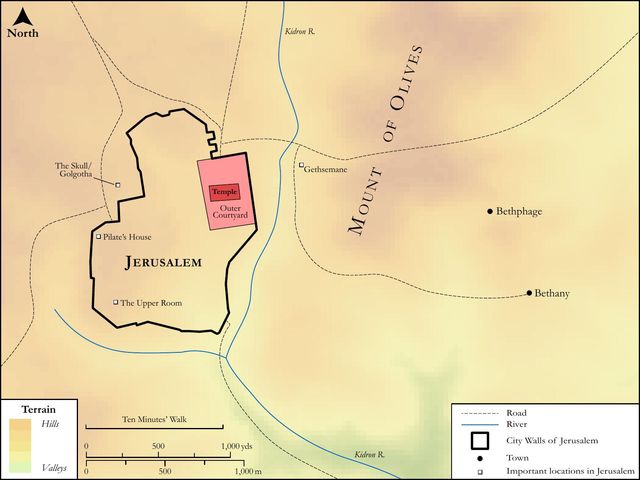
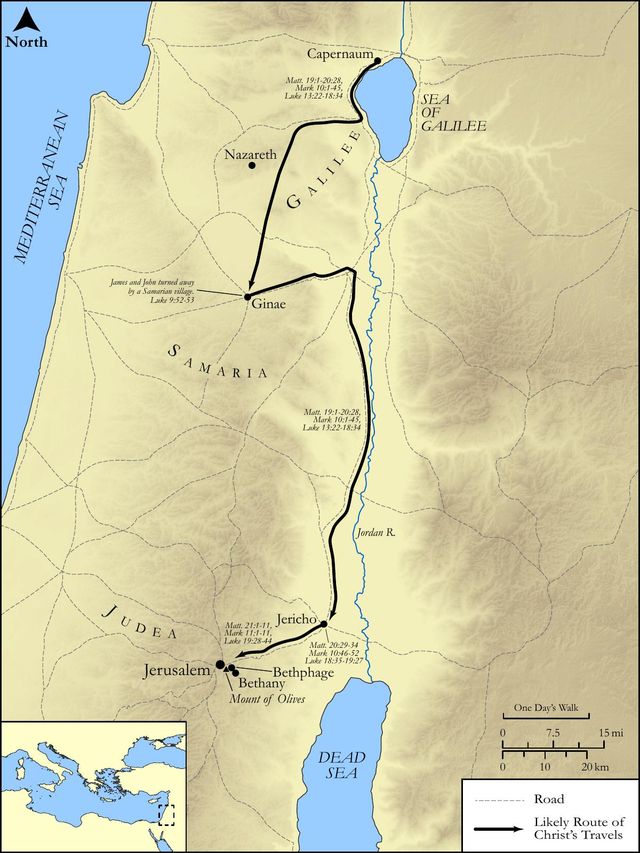
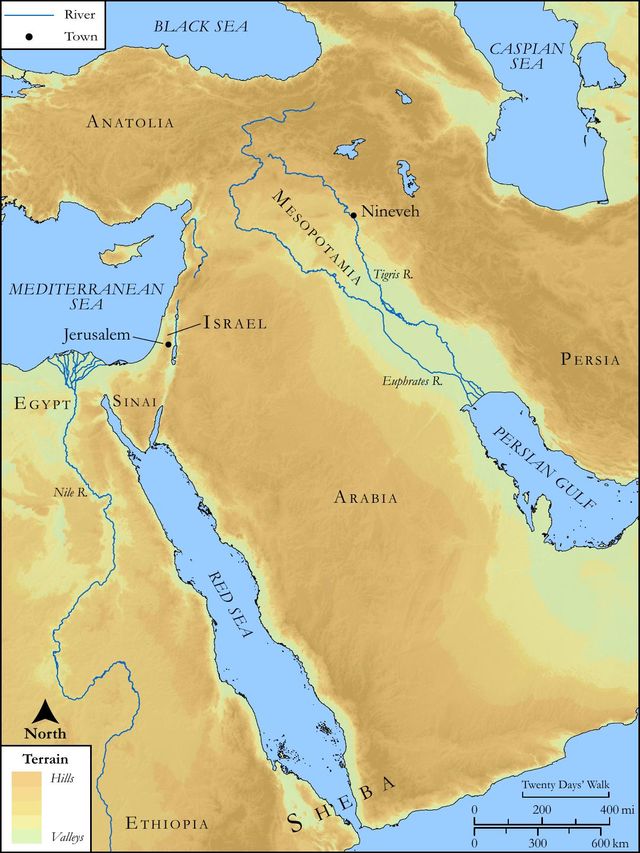
Study this verse
Public-domain commentary
Matthew Henry
From his Commentary on the Whole Bible. Henry comments on passages, not single verses — this entry covers Luke 13:18–22.
Here is, I. The gospel's progress foretold in two parables, which we had before, Mat 13:31-33. The kingdom of the Messiah is the kingdom of God, for it advances his glory; this kingdom was yet a mystery, and people were generally in the dark, and under mistakes, about it. Now, when we would describe a thing to those that are strangers to it, we choose to do it by similitudes. "Such a person you know not, but I will tell you whom he is like;" so Christ undertakes here to show what the kingdom of God is like (Luk 13:18): "Whereunto shall I liken the kingdom of God? Luk 13:20. It will be quite another thing from what you expect, and will operate, and gain its point, in quite another manner." 1. "You expect it will appear great, and will arrive at its perfection all of a sudden; but you are mistaken, it is like a grain of mustard-seed, a little thing, takes up but little room, makes but a little figure, and promises but little; yet, when sown in soil proper to receive it, it waxes a great tree," Luk 13:19. Many perhaps were prejudiced against the gospel, and loth to come in to the obedience of it, because its beginning was so small; they were ready to say of Christ, Can this man save us? And of his gospel, Is this likely ever to come to any thing? Now Christ would remove this prejudice, by assuring them that though its beginning was small its latter end should greatly increase; so that many should come, should come upon the wing, should fly like a cloud, to lodge in the branches of it with more safety and satisfaction than in the branches of Nebuchadnezzar's tree, Dan 4:21. 2. "You expect it will make its way by external means, by subduing nations and vanquishing armies, though it shall work like leaven, silently and insensibly, and without any force or violence, Luk 13:21. A little leaven leaveneth the whole lump; so the doctrine of Christ will strangely diffuse its relish into the world of mankind: in this it triumphs, that the savour of the knowledge of it is unaccountably made manifest in every place, beyond what one could have expected, Co2 2:14. But you must give it time, wait for the issue of the preaching of the gospel to the world, and you will find it does wonders, and alters the property of the souls of men. By degrees the whole will be leavened, even as many as are, like the meal to the leaven, prepared to receive the savour of it."
II.Christ's progress towards Jerusalem recorded:
He went through the cities and villages, teaching and journeying, Luk 13:22. Here we find Christ an itinerant, but an itinerant preacher, journeying towards Jerusalem, to the feast of dedication, which was in the winter, when travelling was uncomfortable, yet he would be about his Father's business; and therefore, whatever cities or villages he could make in his way, he gave them a sermon or two, not only in the cities, but in the country villages. Wherever Providence brings us, we should endeavour to be doing all the good we can.
Historical interpretation
Nine Centuries of Reception
8 surviving comments on this verse. Each one is dated, so this reads as a timeline rather than a list.
Select a marker to jump to its quote. Markers stagger vertically where authors wrote within a few decades of each other.
For the Fathers above mentioned, before the times of the Law, forsaking the sins of many gods to follow the Gospel way, received the knowledge of the most high God; to whom many of the Gentiles were conformed through a similar manner of life, but their children suffered estrangement from the Gospel rules; and herein it follows, And behold they are last which shall be first, and they are first which shall be last.
(in reg. ad int. 240.) For as in earthly life the departure from right is exceeding broad, so he who goes out of the path which leads to the kingdom of heaven, finds himself in a vast extent of error. (int. 241.). But the right way is narrow, the slightest turning aside being full of danger, whether to the right or to the left, as on a bridge, where he who slips on either side is thrown into the river.
(Hom. in Psalm 1, 15.) For the soul wavers to and fro, at one time choosing virtue when it considers eternity, at another preferring pleasures when it looks to the present. Here it beholds ease, or the delights of the flesh, there its subjection or captive bondage; here drunkenness, there sobriety; here wanton mirth, there overflowing of tears; here dancing, there praying; here the sound of the pipe, there weeping; here lust, there chastity.
(reg. brev. ad int. 282.) He perhaps speaks to those whom the Apostle describes in his own person, saying, If I speak with the tongues of men and of angels, and have all knowledge, and give all my goods to feed the poor, but have not charity, it profiteth me nothing. For whatever is done not from regard to the love of God, but to gain praise from men, obtains no praise from God.
(24, 40. in Matt.) What then is that which our Lord says elsewhere, My yoke is easy, and my burden is light? (Matt. 11:30.) There is indeed no contradiction, but the one was said because of the nature of temptations, the other with respect to the feeling of those who overcame them. For whatever is troublesome to our nature may be considered easy when we undertake it heartily. Besides also, though the way of salvation is narrow at its entrance, yet through it we come into a large space, but on the contrary the broad way leadeth to destruction.
(Mor. 11. c. 50.) Now when He was about to speak of the entrance of the narrow gate, He said first, strive, for unless the mind struggles manfully, the wave of the world is not overcome, by which the soul is ever thrown back again into the deep.
(Moral. 2. c. 5.) For God not to know is for Him to reject, as also a man who speaks the truth is said not to know how to lie, for he disdains to sin by telling a lie, not that if he wished to lie he knew not how, but that from love of truth he scorns to speak what is false. Therefore the light of truth knows not the darkness which it condemns. It follows, Then shall ye begin to say, We have eaten and drunk in thy presence, &c.
Urged thereto by their love of safety, yet shall not be able, frightened by the roughness of the road.
The master of the house is Christ, who since as very God He is every where, is already said to be within those whom though He is in heaven He gladdens with His visible presence, but is as it were without to those whom while contending in this pilgrimage, He helps in secret. But He will enter in when He shall bring the whole Church to the contemplation of Himself. He will shut the door when He shall take away from the reprobate all room for repentance. Who standing without will knock, that is, separated from the righteous will in vain implore that mercy which they have despised. Therefore it follows, And he will answer and say to you, I know you not whence ye are.
Or mystically, he eats and drinks in the Lord's presence who eagerly receives the food of the word. Hence it is added for explanation, Thou hast taught in our streets. For Scripture in its more obscure places is food, since by being expounded it is as it were broken and swallowed. In the clearer places it is drink, where it is taken down just as it is found. But at a feast the banquet does not delight him whom the piety of faith commends not. The knowledge of the Scriptures does not make him known to God, whom the iniquity of his works proves to be unworthy; as it follows, And he will say unto you, I know not whence ye are; depart from me.
But the twofold punishment of hell is here described, that is, the feeling cold and heat. For weeping is wont to be excited by heat, gnashing of teeth by cold. Or gnashing of teeth betrays the feeling of indignation, that he who repents too late, is too late angry with himself.
Many also at first burning with zeal, afterwards grow cold; many at first cold, on a sudden become warm; many despised in this world, will be glorified in the world to come; others renowned among men, will in the end be condemned.
However, you say that some are moved to inquire why in the Apocalypse, in the new interpretation, I have assigned Matthew to the lion and Mark to the man; they should have considered, whoever is moved by this, that I did not proclaim this as something new, but as something handed down in the ancient explanation of the fathers. For it did not appear to me from my own insight but I recalled that it had been explained in this way by the blessed Augustine, and I briefly mentioned also from where he affirmed this. It is not without reason that we present his very words, showing what he thought about the evangelists and their typified animals, by which our work may be saved from unjust criticism and this may be confirmed by the authority of such a great doctor.
For he did not visit the small places only, as they do who wish to deceive the simple, nor the cities only, as they who are fond of show, and seek their own glory; but as their common Lord and Father providing for all, He went about every where. Nor again did He visit the country towns only, avoiding Jerusalem, as if He feared the cavils of the lawyers, or death, which might follow therefrom; and hence he adds, And journeying towards Jerusalem. For where there were many sick, there the Physician chiefly showed Himself. It follows, Then said one unto him, Lord, are there few that be saved?
Or it is said to the Israelites, simply because Christ was born of them according to the flesh, and they ate and drank with Him, and heard Him preaching. But these things also apply to Christians. For we eat the body of Christ and drink His blood as often as we approach the mystic table, and He teaches in the streets of our souls, which are open to receive Him.
Observe also that they are objects of wrath in whose street the Lord teaches. If then we have heard Him teaching not in the streets, but in poor and lowly hearts, we shall not be regarded with wrath.
This also refers to the Israelites with whom He was speaking, who receive from this their severest blow, that the Gentiles have rest with the fathers, while they themselves are shut out. Hence He adds, When you shall see Abraham, Isaac, and Jacob, in the kingdom of God, &c.
But we as it seems are the first who have received from our very cradles the rudiments of Christian teaching, and perhaps shall be last in respect of the heathens who have believed at the end of life.
Having spoken in parables concerning the increase of the teaching of the Gospel, He every where endeavours to spread it by preaching. Hence it is said, And he went through the cities and villages.
This question seems to have reference to what had gone before. For in the parable which was given above, He had said, that the birds of the air rested on its branches, by which it might be supposed that there would be many who would obtain the rest of salvation. And because one had asked the question for all, the Lord does not answer him individually, as it follows, And he said unto them, Strive to enter in at the strait gate.
Or the teeth will gnash which here delighted in eating, the eyes will weep which here wandered with desire. By each He represents the real resurrection of the wicked.
Continue studying Luke 13:22 across the web’s major study libraries — every link below opens this exact verse, chapter, or book on the destination site.
Read & Compare
 BibleGatewayThis verse in more than 200 translations and 70 languages.
 Bible.comThe YouVersion reader — hundreds of translations, reading plans, and highlights.
 ESV.orgCrossway's official English Standard Version reader.
 NET BibleThe NET translation with 60,000+ translators' notes on every rendering decision.
 STEP BibleTyndale House's free study tool — original text, vocabulary, and scholarly resources.
 BibliaLogos Bible Software's free web reader.
 USCCBThe New American Bible (Revised Edition) with the U.S. bishops' study notes.
Commentaries
 BibleHub CommentariesDozens of classic commentaries on this verse, gathered on one page.
 StudyLightMore than 100 commentary sets — the largest collection on the web.
 BibleRefPlain-English commentary on what this verse means, verse by verse.
 Enduring WordDavid Guzik's free commentary on this chapter, widely used by Bible teachers.
 Bible Study ToolsVerse commentary alongside Greek and Hebrew study aids.
Original Language & Research
- BibleHub InterlinearThe verse word by word — original language, transliteration, and English.
- BibleHub LexiconEvery word's original-language definition and Strong's entry.
 Blue Letter BibleDeep-study tools — Strong's numbers, concordance, and word studies.
 CNTR CollationThe earliest Greek manuscripts of this verse, collated letter by letter.
Sermons, Hymns & Audio


TrulyRandomVerse is not affiliated with these sites and doesn’t control their content. They’re linked because they’re genuinely useful.
Summary
Luke 13:22 encapsulates a pivotal moment in Jesus' public ministry, portraying Him as actively engaged in teaching throughout the diverse communities of Galilee and Perea while simultaneously embarking on a deliberate and unwavering journey toward Jerusalem. This verse underscores the purposeful nature of His mission, highlighting both His commitment to proclaiming the Kingdom of God and His resolute progression toward the ultimate fulfillment of His redemptive work in the capital city.
Context
ShowHideLiterary Context
This verse is situated within what scholars often refer to as Luke's "Travel Narrative" (Luke 9:51-19:27), a significant and unique section of this Gospel that meticulously details Jesus' journey from Galilee to Jerusalem. This extended narrative is not merely a geographical account but a theological framework, emphasizing Jesus' resolute determination to fulfill His divine mission in Jerusalem. Preceding Luke 13:22, Jesus has been teaching on various aspects of discipleship, the nature of the Kingdom, and the urgency of repentance, often using parables and direct instruction. His movement through "cities and villages" in this context signifies a broad, inclusive, and continuous ministry of proclamation, reaching a wide array of people before His climactic arrival in the city where His atoning work would be accomplished. The narrative flow consistently points towards Jerusalem as the destination of destiny.
Historical & Cultural Context
Jesus' journey from Galilee to Jerusalem was a common pilgrimage route for Jews, especially during major festivals like Passover. While the most direct route passed through Samaria, many Jews, to avoid Samaritan territory, would travel east across the Jordan River into Perea and then south, crossing back into Judea near Jericho. This circuitous route through "cities and villages" (κώμας, kōmas, smaller settlements) and "cities" (πόλεις, poleis, larger towns) suggests Jesus was ministering to a diverse population, not limiting His outreach to the major centers or specific groups. Jerusalem itself was the religious, political, and cultural heart of Judaism, the seat of the Temple, and the expected place for the Messiah's arrival and, tragically, His rejection and crucifixion. The journey was physically demanding and often fraught with dangers, yet Jesus undertook it with resolute purpose, fully aware of what awaited Him there.
Key Themes
ShowHideLuke 13:22 contributes to several overarching themes in Luke's Gospel. Foremost is the Purposeful Journey and Divine Necessity of Jesus' mission. The phrase "journeying toward Jerusalem" is not a casual travel note but a profound theological statement, emphasizing Jesus' unwavering determination and His conscious movement toward the place where His atoning work would be accomplished. This resolve is powerfully introduced in Luke 9:51, where He "steadfastly set His face to go to Jerusalem." Another key theme is the Continuous and Inclusive Teaching Ministry of Jesus. Even while on this arduous and significant journey, Jesus remained committed to His primary ministry of teaching and proclaiming the Kingdom of God. His engagement with people in both "cities and villages" highlights the Broad Scope of His Ministry, demonstrating that His message was for all, not confined to one place or segment of society, but extending to various communities, both large and small, as God's sovereign plan unfolded.
Exposition and Analysis
ShowHideKey Word Analysis
ShowHideThis verb signifies "to travel through" or "to pass by." In Luke 13:22, it emphasizes Jesus' active and pervasive movement across the landscape, indicating that His ministry was not static but dynamic, reaching into various localities. It suggests a thoroughness in His itinerancy, touching many places along His path.
This term means "to teach" in a broad application, encompassing instruction, imparting knowledge, and guiding. Its use here highlights that Jesus' journey was not merely a physical relocation but was intrinsically linked to His primary vocation as a divine instructor. Even as He moved towards His destiny, His commitment to educating and discipling His followers and the crowds remained central.
As a primary preposition, eis indicates movement "to or into" a specific point, often implying purpose or result. In the context of "journeying toward Jerusalem," it is crucial for conveying the directedness and intentionality of Jesus' travel. It signifies not just a general direction but a determined movement with a clear destination and a profound purpose in mind.
Verse Breakdown
ShowHide"And he went through the cities and villages"
This clause describes the geographical scope and method of Jesus' ministry during this phase. It indicates His widespread engagement with the populace, not limiting Himself to major urban centers but also reaching into smaller, less prominent communities. This demonstrates the accessibility and comprehensive nature of His message, intended for all people regardless of their location.
"teaching"
This participle highlights the primary activity Jesus was engaged in throughout His travels. His journey was not a mere transit but a continuous act of proclamation and instruction. It underscores that His purpose was to impart the truths of the Kingdom of God, preparing hearts and minds for His ultimate work.
"and journeying toward Jerusalem"
This final phrase is highly significant, conveying the ultimate trajectory and divine purpose of Jesus' entire ministry. It signifies His resolute and unwavering progression toward the culmination of His redemptive mission. Jerusalem is not just a geographical destination but the divinely appointed place for His suffering, death, and resurrection, fulfilling ancient prophecies and securing salvation.
Literary Devices
ShowHideLuke 13:22 employs several literary devices to convey its profound meaning. The phrase "cities and villages" utilizes Merism, a rhetorical device where two contrasting or complementary parts represent a whole, emphasizing the comprehensive reach of Jesus' ministry—He taught everywhere, in all types of settlements. The entire verse functions as a form of Foreshadowing and Dramatic Irony. The reader, knowing the ultimate outcome of Jesus' journey to Jerusalem, understands the tragic yet redemptive significance of His purposeful movement, a knowledge not fully possessed by those He encountered along the way. Jerusalem itself serves as a powerful Symbol in this context, representing not merely a city but the nexus of divine prophecy, human rejection, and ultimate salvation. The verse also contributes to the Pacing of Luke's narrative, marking a deliberate and inexorable progression towards the climax of Jesus' earthly ministry, building anticipation for the events that will unfold in the capital.
Theological and Thematic Connections
ShowHideLuke 13:22 profoundly illustrates the divine sovereignty and intentionality behind Jesus' earthly ministry. His journey to Jerusalem was not a casual or spontaneous decision but a divinely appointed progression towards the fulfillment of God's redemptive plan. This unwavering commitment, even in the face of anticipated suffering, underscores Christ's perfect obedience to the Father's will. It highlights that the cross was not an accident but the very purpose for which He came, a journey undertaken with full knowledge and resolute determination. This commitment to His ultimate mission, even while actively engaged in teaching and healing, serves as a model for believers to pursue God's purposes with intentionality and perseverance, recognizing that true discipleship often involves a purposeful journey towards difficult, yet divinely ordained, ends.
Reflection and Application
ShowHideLuke 13:22 offers a profound model for our own lives of faith and discipleship. Jesus' journey was marked by both purposeful movement and continuous ministry. He did not wait until He reached His final destination to engage in His calling; rather, His journey itself was an opportunity for teaching and transformation. This challenges us to consider how we are living with intentionality, aligning our daily activities and long-term goals with God's will for our lives. Are we merely passing through life, or are we actively engaging in the mission God has given us, even amidst our own "journeys" and challenges? Furthermore, Jesus' unwavering resolve to go to Jerusalem, knowing the suffering that awaited Him, calls us to embrace God's purposes for us, even when they involve difficulty, sacrifice, or discomfort. Our faithfulness is not contingent on ease but on our commitment to His sovereign plan. We are called to be faithful witnesses, proclaiming the good news and living out our faith in every circumstance, just as Jesus taught relentlessly on His way to the cross.
Questions for Reflection
ShowHideFAQ
ShowHideWhy is Jerusalem so important in this verse?
ShowHideJerusalem is critically important in Luke 13:22 because it represents the divinely appointed culmination of Jesus' earthly ministry. It was the capital city, the center of Jewish worship with the Temple, and the place where prophets were often rejected and killed (Luke 13:33). For Jesus, journeying "toward Jerusalem" was not just a geographical movement but a theological trajectory towards His suffering, crucifixion, and resurrection, which were necessary for the salvation of humanity. It signifies His obedience to God's will and the fulfillment of Old Testament prophecies concerning the Messiah's atoning work.
Christ-Centered Fulfillment
ShowHideLuke 13:22, with its depiction of Jesus' resolute journey toward Jerusalem, finds its profound Christ-centered fulfillment in the ultimate purpose of His incarnation: to lay down His life as a ransom for many. This journey is not merely a geographical progression but a theological pilgrimage, leading directly to the cross and the empty tomb. Jesus, the perfect Lamb of God, was "journeying toward Jerusalem" to become the ultimate sacrifice, fulfilling the prophetic words of Isaiah 53:7 and echoing the declaration of John the Baptist, "Behold, the Lamb of God, who takes away the sin of the world!". His unwavering resolve, even in the face of the suffering He knew awaited Him, perfectly illustrates the "joy that was set before him" (Hebrews 12:2)—the joy of accomplishing salvation for His people. Thus, this verse points directly to Christ as the one whose entire life was oriented towards His redemptive mission, culminating in His death and resurrection in Jerusalem, thereby opening the way for all who believe to receive forgiveness of sins and eternal life (Luke 24:46-47).