


Judges 11:10
Bible text: King James Version (1769 Blayney text) · Public domain
Bible text: Berean Standard Bible · Public domain
Bible text: American Standard Version (1901) · Public domain
Bible text: World English Bible, Messianic edition · Public domain
Bible text: Geneva Bible (1599) · Public domain
Bible text: Young's Literal Translation · Public domain
- וַיֹּאמְרוּvai·yo·me·Ruand they saidH559Conj-w ¦ V-Qal-ConsecImperf-3mpVerb Qal Consecutive Imperfect 3rd Plural Masculineוַandיֹּאמְרוּthey said
- זִקְנֵיzik·nei[the] elders ofH2205Adj-mpcAdjective Plural Masculine Construct
- גִלְעָדgil·'AdGileadH1568N-properNoun Proper Location
- אֶל'eltoH413PrepPreposition
- יִפְתָּחyif·TachJephthahH3316N-proper-mNoun Proper Masculine
- יְהוָהYah·wehYahwehH3068N-properNoun Proper Title
- יִהְיֶהyih·Yehhe will beH1961V-Qal-Imperf-3msVerb Qal Imperfect 3rd Singular Masculine
- שֹׁמֵעַsho·Me·a'hearingH8085V-Qal-Prtcpl-msVerb Qal Participle Singular Masculine Absolute
- בֵּינוֹתֵינוּbei·no·Tei·nubetween usH996Adj-fpc ¦ 1cpAdjective Numerical Plural Feminine Constructבֵּינוֹתֵיbetweenנוּus
- אִם'imifH518PrtParticle Conditional
- לֹאlo'notH3808NegParticle Negative
- כִדְבָרְךָkhid·va·re·Khaaccording to your wordH1697Prep-k ¦ N-msc ¦ 2msNoun Singular Masculine Constructכִaccording toדְבָרְwordךָyour
- כֵּןkensoH3651AdvAdverb
- נַעֲשֶׂהna·'a·Sehwe will doH6213V-Qal-Imperf-1cpVerb Qal Imperfect 1st Plural common gender
English is a literal word-by-word gloss of the Hebrew, not the KJV's wording. Why?
This is the original text the KJV's translators worked from — each Hebrew word with its own literal English meaning in this verse, prepared by scholars at Tyndale House, Cambridge. The KJV translates whole sentences, not word by word, so its wording differs: one Hebrew word can become several English words, and the KJV may choose “the LORD” where the gloss reads “Yahweh”. Both are faithful — they answer different questions. For the KJV's own rendering, switch to the KJV text.
Details
See on the biblical-era maps
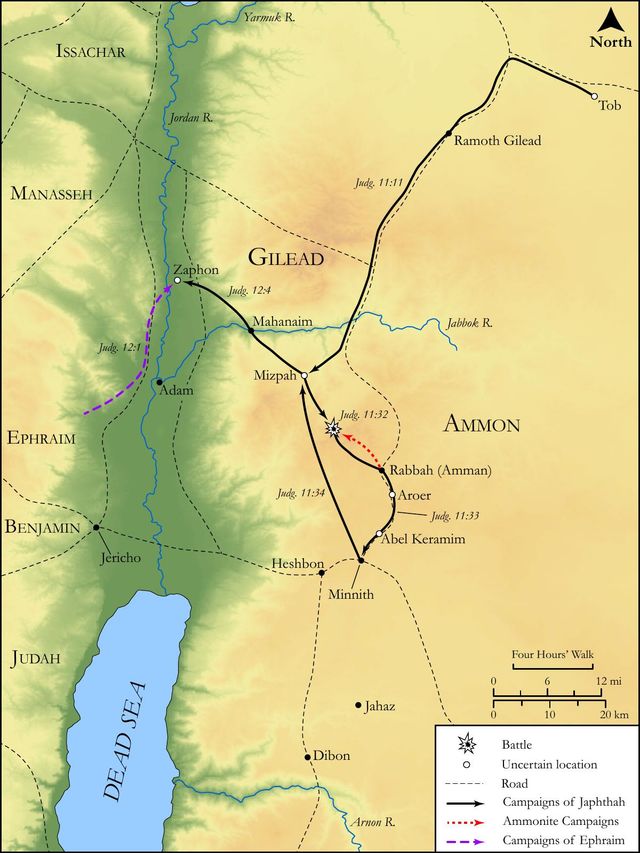
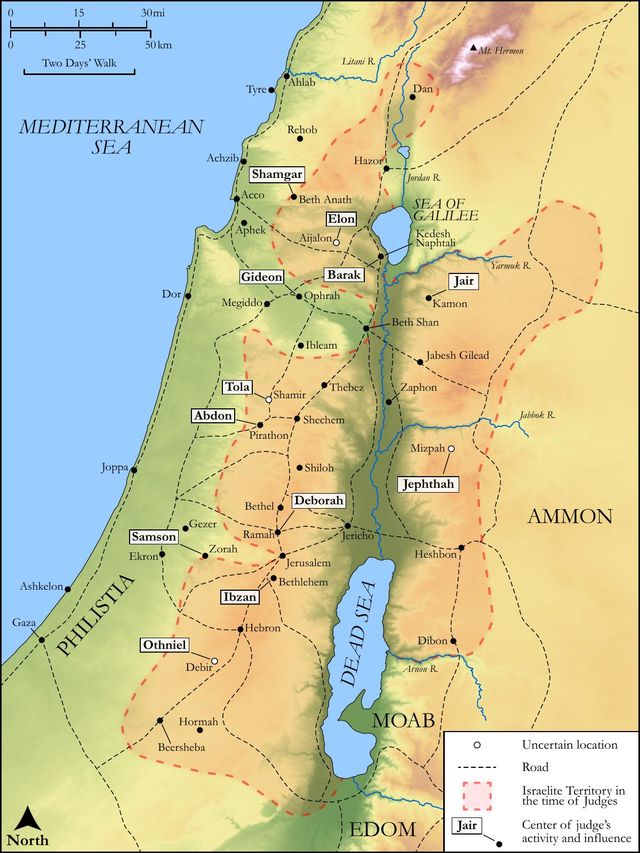
Study this verse
Public-domain commentary
Matthew Henry
From his Commentary on the Whole Bible. Henry comments on passages, not single verses — this entry covers Judges 11:4–11. His two-level outline is real structure in the source text, so it is rendered as structure.
Here is, I. The distress which the children of Israel were in upon the Ammonites' invasion of their country, Jdg 11:4. Probably this was the same invasion with that mentioned, Jdg 10:17, when the children of Ammon were gathered together and encamped in or against Gilead. And those words, in process of time, refer to what goes immediately before of the expulsion of Jephthah; many days after he had been thus thrust out in disgrace was he fetched back again with honour.
II.The court which the elders made to Jephthah hereupon to come and help them.
They did not write or send a messenger to him, but went themselves to fetch him, resolving to have no denial, and the exigence of the case was such as would admit no delay. Their errand to him was, Come, and be our captain, Jdg 11:6. They knew none among themselves that was able to undertake that great trust, but in effect confessed themselves unfit for it; they know him to be a bold man, and inured to the sword, and therefore he must be the man. See how God prepared men for the service he designs them for, and makes their troubles work for their advancement. If Jephthah had not been put to his shifts by his brethren's unkindness, he would not have had such occasion as this gave him to exercise and improve his martial genius, and so to signalize himself and become famous. Out of the eater comes forth meat. The children of Israel were assembled and encamped, Jdg 10:17. But an army without a general is like a body without a head; therefore Come, say they, and be our captain, that we may fight. See the necessity of government; though they were hearty enough in the cause, yet they owned they could not fight without a captain to command them. So necessary is it to all societies that there be a pars imperans and a pars subdita, some to rule and others to obey, that any community would humbly beg the favour of being commanded rather than that every man should be his own master. Blessed be God for government, for a good government.
III.The objections Jephthah makes against accepting their offer:
Did you not hate me, and expel me? Jdg 11:7. It should seem that his brethren were some of these elders, or these elders by suffering his brethren to abuse him, and not righting him as they ought to have done (for their business is to defend the poor and fatherless, Psa 82:3, Psa 82:4), had made themselves guilty of his expulsion, and he might justly charge them with it. Magistrates, that have power to protect those that are injured, if they neglect to redress their grievances are really guilty of inflicting them. "You hated me and expelled me, and therefore how can I believe that you are sincere in this proposal, and how can you expect that I should do you any service?" Not but that Jephthah was very willing to serve his country, but he thought fit to give them a hint of their former unkindness to him, that they might repent of their sin in using him so ill, and might for the future be the more sensible of their obligations. Thus Joseph humbled his brethren before he made himself known to them. The particular case between the Gileadites and Jephthah was a resemblance of the general state of the case between Israel and God at this time. They had thrust God out by their idolatries, yet in their distress begged his help; he told them how justly he might have rejected them, and yet graciously delivered them. So did Jephthah. Many slight God and good men till they come to be in distress, and then they are desirous of God's mercy and good men's prayers.
IV.Their urgency with him to accept the government they offer him, Jdg 11:8.
"Therefore because we formerly did thee that wrong, and to show thee that we repent of it and would gladly atone for it, we turn again to thee now, to put such an honour upon thee as shall balance that indignity." Let this instance be,
1.A caution to us not to despise or trample upon any because they are mean, nor to be injurious to any that we have advantage against, because, whatever we think of them now, the time may come when we may have need of them, and may be glad to be beholden to them. It is our wisdom to make no man our enemy, because we know not how soon our distresses may be such as that we may be highly concerned to make him our friend.
2.An encouragement to men of worth that are slighted or ill-treated. Let them bear it with meekness and cheerfulness, and leave it to God to make their light shine out of obscurity. Fuller's remark on this story, in his "Pisgah Sight," is this: "Virtue once in an age will work her own advancement, and, when such as hate it chance to need it, they will be forced to prefer it," and then the honour will appear the brighter.
V.The bargain he makes with them.
He had mentioned the injuries they had formerly done him, but, perceiving their repentance, his spirit was too great and generous to mention them any more. God had forgiven Israel the affronts they had put upon him (Jdg 10:16), and therefore Jephthah will forgive. Only he thinks it prudent to make his bargain wisely for the future, since he deals with men that he had reason to distrust. 1. He puts to them a fair question, Jdg 11:9. He speaks not with too much confidence of his success, knowing how justly God might suffer the Ammonites to prevail for the further punishment of Israel; but puts an if upon it. Nor does he speak with any confidence at all in himself; if he do succeed, it is the Lord that delivers them into his hand, intending hereby to remind his countrymen to look up to God, as arbitrator of the controversy and the giver of victory, for so he did. "Now if, by the blessing of God, I come home a conqueror, tell me plainly shall I be your head? If I deliver you, under God, shall I, under him, reform you?" The same question is put to those who desire salvation by Christ. "If he save you, will you be willing that he shall rule you? for on no other terms will he save you. If he make you happy, shall he make you holy? If he be your helper, shall he be your head?" 2. They immediately give him a positive answer (Jdg 11:10): "We will do according to thy words; command us in war, and thou shalt command us in peace." They do not take time to consider of it. The case was too plain to need a debate, and the necessity too pressing to admit a delay. They knew they had power to conclude a treaty for those whom they represented, and therefore bound it with an oath, The Lord be witness between us. They appeal to God's omniscience as the judge of their present sincerity, and to his justice as an avenger if afterwards they should prove false. The Lord be a hearer, so the word is. Whatever we speak, it concerns us to remember that God is a hearer, and to speak accordingly. Thus was the original contract ratified between Jephthah and the Gileadites, which all Israel, it should seem, agreed to afterwards, for it is said (Jdg 12:7), he judged Israel. He hereupon went with them (Jdg 11:11) to the place where they were all assembled (Jdg 10:17), and there by common consent they made him head and captain, and so ratified the bargain their representatives had made with him, that he should be not only captain now, but head for life. Jephthah, to obtain this little honour, was willing to expose his life for them (Jdg 12:3), and shall we be discouraged in our Christian warfare by any of the difficulties we may meet with in it, when Christ himself has promised a crown of life to him that overcometh?
VI.Jephthah's pious acknowledgment of God in this great affair (Jdg 11:11):
He uttered all his words before the Lord in Mizpeh, that is, upon his elevation, he immediately retired to his devotions, and in prayer spread the whole matter before God, both his choice to the office and his execution of the office, as one that had his eye ever towards the Lord, and would do nothing without him, that leaned not to his own understanding or courage, but depended on God and his favour. He utters before God all his thoughts and cares in this matter; for God gives us leave to be free with him. 1. "Lord, the people have made me their head; wilt thou confirm the choice, and own me as thy people's head under thee and for thee?" God justly complains of Israel (Hos 8:4), they have set up kings, but not by me. "Lord," said Jephthah, "I will be no head of their making without thee. I will not accept the government unless thou give me leave." Had Abimelech done this, he might have prospered. 2. "Lord, they have made me their captain, to go before them in this war with the Ammonites; shall I have thy presence? Wilt thou go before me? If not, carry me not up hence. Lord, satisfy me in the justice of the cause. Assure me of success in the enterprise." This is a rare example, to be imitated by all, particularly by great ones; in all our ways let us acknowledge God, seek his favour, ask counsel at his mouth, and take him along with us; so shall we make our way prosperous. Thus Jephthah opened the campaign with prayer. That was likely to end gloriously which began thus piously.
Continue studying Judges 11:10 across the web’s major study libraries — every link below opens this exact verse, chapter, or book on the destination site.
Read & Compare
 BibleGatewayThis verse in more than 200 translations and 70 languages.
 Bible.comThe YouVersion reader — hundreds of translations, reading plans, and highlights.
 ESV.orgCrossway's official English Standard Version reader.
 NET BibleThe NET translation with 60,000+ translators' notes on every rendering decision.
 STEP BibleTyndale House's free study tool — original text, vocabulary, and scholarly resources.
 BibliaLogos Bible Software's free web reader.
 USCCBThe New American Bible (Revised Edition) with the U.S. bishops' study notes.
Commentaries
 BibleHub CommentariesDozens of classic commentaries on this verse, gathered on one page.
 StudyLightMore than 100 commentary sets — the largest collection on the web.
 BibleRefPlain-English commentary on what this verse means, verse by verse.
 Enduring WordDavid Guzik's free commentary on this chapter, widely used by Bible teachers.
 Bible Study ToolsVerse commentary alongside Greek and Hebrew study aids.
Original Language & Research
- BibleHub InterlinearThe verse word by word — original language, transliteration, and English.
- BibleHub LexiconEvery word's original-language definition and Strong's entry.
 Blue Letter BibleDeep-study tools — Strong's numbers, concordance, and word studies.
 SefariaThe Hebrew text with Rashi and centuries of Jewish commentary.
Sermons, Hymns & Audio


TrulyRandomVerse is not affiliated with these sites and doesn’t control their content. They’re linked because they’re genuinely useful.
Summary
Judges 11:10 marks a critical turning point in the narrative of Jephthah, capturing the solemn moment when the elders of Gilead, in their desperate need for deliverance from Ammonite oppression, formally pledge their absolute allegiance to him. By invoking the LORD as their witness, they transform their promise into a sacred, binding oath, solidifying Jephthah's leadership and underscoring the extreme gravity of their situation and their profound commitment to his authority. This declaration, made by those who had previously rejected him, signifies a desperate yet decisive act of trust and submission.
Context
ShowHideLiterary Context
Judges 11:10 is situated at a pivotal juncture in the story of Jephthah, immediately following a tense negotiation between the elders of Gilead and Jephthah himself. The preceding verses (Judges 11:1-3) paint a picture of Jephthah as an outcast, the son of a prostitute, driven from his home by his half-brothers and forced to live among "worthless fellows" in the land of Tob. Despite this ignominious past, his reputation as a "mighty warrior" (Judges 11:1) precedes him. When the Ammonites pose a grave threat to Gilead (Judges 11:4), the elders, in their desperation, humble themselves to seek out this rejected leader (Judges 11:5). Jephthah initially confronts them with their past injustice (Judges 11:7), but their acknowledgment of wrongdoing and their unprecedented offer of supreme leadership (Judges 11:8-9) pave the way for this verse. Judges 11:10, therefore, serves as the elders' unequivocal, divinely-attested affirmation of their promise, a solemn oath designed to assuage Jephthah's skepticism and formally establish his authority before he embarks on the task of defending Israel.
Historical & Cultural Context
The period of the Judges (roughly 1200-1000 BC) was characterized by a fragmented Israel, lacking central leadership and frequently falling into cycles of disobedience, foreign oppression, and temporary deliverance by charismatic "judges." The Transjordanian region of Gilead, specifically, was often a frontier zone, vulnerable to incursions from neighboring peoples like the Ammonites, who were historical adversaries of Israel. In Israel, oaths invoking the LORD were not mere formalities; they were deeply serious and legally binding agreements. Such an oath transformed a human promise into a covenant made before the divine realm, carrying the weight of potential divine judgment if violated. The elders' willingness to humble themselves and make such a public, divinely witnessed pledge to Jephthah—an individual they had previously scorned and exiled—highlights the dire military threat they faced and the profound cultural significance of an oath as the ultimate means of establishing trust and legitimate authority in a chaotic and decentralized society.
Key Themes
ShowHideThis verse powerfully contributes to several overarching themes within the Book of Judges and the broader biblical narrative. Central among these is the theme of solemn oaths and covenants, emphasizing the profound gravity of promises made, particularly when God is invoked as a witness. This echoes the pervasive importance of covenant fidelity seen throughout the Old Testament, from the foundational Abrahamic covenant to the stipulations of the Mosaic Law, where vows and oaths are consistently treated with utmost seriousness (e.g., Deuteronomy 23:21-23). Another significant theme is divine oversight and justice, as the explicit invocation of "the LORD" (YHWH) signifies God's omnipresent awareness of human actions and His role as the ultimate guarantor of truth and justice. The desperate circumstances also highlight the theme of leadership in crisis, illustrating how dire necessity can compel a community to transcend prejudice and seek out the most capable individual, even a social outcast, to secure deliverance, much as Israel later sought a king in 1 Samuel 8.
Exposition and Analysis
ShowHideKey Word Analysis
ShowHideThis refers to the sacred, personal covenant name of God, YHWH, often translated as "LORD" in English Bibles. Its inclusion in the oath, "The LORD be witness," elevates the promise from a mere human agreement to a divinely sanctioned covenant. It signifies that God Himself is called upon to observe and enforce the terms, implying that any breach would be an offense directly against the Almighty, carrying severe spiritual consequences. The use of YHWH underscores the absolute seriousness and inviolability of the elders' pledge.
The Hebrew word shâmaʻ primarily means "to hear intelligently" or "to listen," often with the implication of attention or obedience. In the context of "The LORD be witness," it implies God's active hearing and attentive observation of the oath. It's not a passive acknowledgment but an appeal to God's omniscience and His role as the ultimate guarantor of truth and justice, who hears and therefore knows all. In ancient legal and social contexts, a witness was crucial for validating an agreement, and here, the supreme Hearer and Witness is invoked, making the oath utterly binding and public before heaven.
From the root meaning "to speak," dâbâr signifies "a word," but also carries broader implications of "a matter," "a thing," "an affair," or "a promise." In the phrase "according to thy words," it encompasses Jephthah's conditions for leadership and the terms of the agreement. The elders are pledging to fulfill not just his spoken utterances but the entire substance of his demands and the agreement reached, highlighting the comprehensive nature of their commitment.
Verse Breakdown
ShowHide"And the elders of Gilead said unto Jephthah"
This opening clause formally establishes the parties involved in this critical declaration. The "elders" represent the collective authority and voice of the community of Gilead, indicating that this is an official, communal commitment, not merely a private promise. Their direct address to Jephthah underscores their recognition of his leadership and their desperate need for him, signifying a profound shift in their attitude towards the man they had previously ostracized.
"The LORD be witness between us"
This is the solemn core of the oath. By invoking YHWH, the elders elevate their agreement to a sacred covenant, appealing to God's omnipresence and His role as the ultimate arbiter of truth and justice. This phrase serves to bind both parties—the elders to their promise and Jephthah to his acceptance of leadership—under divine scrutiny. It imbues the agreement with immense spiritual weight, making it unbreakable in the eyes of the community and, more importantly, in the eyes of God, who hears and observes all.
"if we do not so according to thy words"
This concluding clause functions as a self-imprecation, a common form of oath in Israel. While phrased conditionally, it is not an expression of doubt but a powerful affirmation of unwavering commitment. It implicitly invokes a curse or divine judgment upon the elders if they fail to fulfill their promise to Jephthah. They are essentially saying, "May we suffer divine retribution if we do not do exactly as we have promised you," thereby reinforcing the absolute seriousness and binding nature of their vow.
Literary Devices
ShowHideThe primary literary device at play in Judges 11:10 is the Oath Formula. The specific phrasing, "The LORD be witness... if we do not so," is a classic example of a self-imprecatory oath, where the speaker implicitly invokes a curse upon themselves if they fail to uphold their word. This device serves to underscore the extreme gravity and binding nature of the elders' promise to Jephthah, demonstrating their desperation and their commitment to honor him as their leader. Furthermore, there is a subtle but significant element of Foreshadowing within the broader narrative of Judges. The very act of making such a solemn, divinely witnessed oath subtly foreshadows the tragic irony of Jephthah's own subsequent vow to the LORD in Judges 11:30-31, which he, too, feels compelled to fulfill, with devastating consequences. This highlights the pervasive theme in Judges of the serious, often perilous, nature of vows and the profound implications of invoking God as a witness.
Theological and Thematic Connections
ShowHideJudges 11:10 powerfully illustrates the biblical understanding of oaths and covenants, portraying them not as mere human agreements but as solemn declarations made before God, carrying profound spiritual weight. The elders' invocation of YHWH as witness underscores God's omnipresence and His active role in overseeing human affairs, particularly those involving promises and commitments. This highlights a fundamental theological truth: God is a God of truth and faithfulness, and He expects His people to reflect His character in their words and deeds. The seriousness of this oath also speaks to the desperate state of Israel during the period of the Judges, where human failure often led to divine judgment and the need for extraordinary measures, including binding agreements, to restore order and secure deliverance.
Reflection and Application
ShowHideJudges 11:10 serves as a potent reminder of the profound gravity of our words and commitments, especially when made before God. The elders' desperate plea and solemn oath underscore the importance of integrity and faithfulness in our dealings, both with God and with one another. In a world where promises are often lightly given and easily broken, this verse calls us to a higher standard, challenging us to consider the weight of our vows, whether explicit or implicit. It reminds us that our God is a God of covenant faithfulness, and He expects His children to reflect that same integrity. Furthermore, the situation highlights how desperate circumstances can force us to confront past wrongs and seek reconciliation for the greater good, even with those we have previously wronged or who have wronged us. It encourages us to be people whose "yes" means yes and whose "no" means no, recognizing that God is always our ultimate witness, hearing every word and observing every action.
Questions for Reflection
ShowHideFAQ
ShowHideWhy was it necessary for the elders to make such a solemn oath to Jephthah?
ShowHideThe oath was necessary for several critical reasons, primarily stemming from Jephthah's past and the extreme urgency of the situation. First, Jephthah had been unjustly cast out by his own family and the community (as detailed in Judges 11:1-3). He had every reason to distrust the elders' sudden change of heart and their offer of leadership. The solemn oath, invoking the LORD as witness, was the strongest possible assurance they could offer that their offer was sincere, binding, and not a temporary convenience they would later revoke. Second, in Israel, such an oath was considered inviolable, carrying divine consequences if broken. It legally and spiritually bound the elders to their word, making Jephthah's acceptance of leadership a secure arrangement. It was a desperate measure to build trust and legitimacy for a leader they had previously scorned, underscoring the severity of their military threat from the Ammonites.
What does "The LORD be witness between us" imply about God's character?
ShowHideThis phrase implies several key aspects of God's character. Firstly, it highlights God's omnipresence and omniscience; He sees and hears all human interactions and agreements, even those made in secret. Nothing is hidden from Him. Secondly, it underscores God's character as the ultimate guarantor of truth and justice. By invoking Him as a witness, the elders acknowledge His role as the one who upholds righteousness and will hold individuals accountable for their vows. Thirdly, it speaks to God's faithfulness and covenant-keeping nature. Because God is faithful to His own covenants, He expects His people to be faithful to theirs, especially when His name is invoked. This phrase transforms a human promise into a sacred, divinely observed agreement, revealing God as actively engaged in the moral fabric of human society.
Christ-Centered Fulfillment
ShowHideWhile Judges 11:10 vividly portrays a human oath made in a desperate situation, it subtly points to the ultimate faithfulness of God and the perfection of His divine covenant, fully realized in Christ. The elders' profound need for a reliable, divine witness to their oath foreshadows the perfect and ultimate witness of God Himself in the person of Jesus Christ. Unlike human promises, which are prone to being broken, God's covenant promises are utterly reliable, secured not by an oath between fallible humans, but by the very character of God and the unchangeable nature of His word (as affirmed in Hebrews 6:13-18). Jesus Christ is the ultimate "Amen," the faithful and true witness (revealed in Revelation 3:14), embodying God's perfect integrity. He is the one who perfectly fulfilled every promise and prophecy, becoming the mediator of a new and better covenant (as described in Hebrews 8:6), established on superior promises. His sacrifice on the cross is the ultimate demonstration of God's unwavering commitment to His people, a divine vow sealed not by human words, but by His own precious blood, guaranteeing our salvation and eternal hope (as taught in Hebrews 9:15). In Christ, we find the absolute trustworthiness that the elders sought in their oath, a divine faithfulness that secures our redemption and offers a covenant relationship that will never be broken (powerfully expressed in 2 Corinthians 1:20).