


Jeremiah 6:22
Bible text: King James Version (1769 Blayney text) · Public domain
Bible text: Berean Standard Bible · Public domain
Bible text: American Standard Version (1901) · Public domain
Bible text: World English Bible, Messianic edition · Public domain
Bible text: Geneva Bible (1599) · Public domain
Bible text: Young's Literal Translation · Public domain
- כֹּהkohthusH3541AdvAdverb
- אָמַר'a·Marhe saysH559V-Qal-Perf-3msVerb Qal Perfect 3rd Singular Masculine
- יְהוָהYah·wehYahwehH3068N-properNoun Proper Title
- הִנֵּהhi·Nehthere!H2009PrtParticle Interjection
- עַם'ama peopleH5971N-msNoun Singular Masculine Absolute
- בָּאba'[is] about to comeH935V-Qal-Perf-3msVerb Qal Perfect 3rd Singular Masculine
- מֵאֶרֶץme·'E·retzfrom a land ofH776Prep-m ¦ N-fscNoun Singular Feminine Constructמֵfromאֶרֶץa land of
- צָפוֹןtza·Fon[the] northH6828N-fsNoun Singular Feminine Absolute
- וְגוֹיve·Goyand a nationH1471Conj-w ¦ N-msNoun Singular Masculine Absoluteוְandגוֹיa nation
- גָּדוֹלga·DolgreatH1419Adj-msAdjective Singular Masculine Absolute
- יֵעוֹרye·'orit will be rousedH5782V-Niphal-Imperf-3msVerb Niphal Imperfect 3rd Singular Masculine
- מִיַּרְכְּתֵיmi·yar·ke·teifrom [the] remotest parts ofH3411Prep-m ¦ N-fdcNoun Dual Feminine Constructמִfromיַּרְכְּתֵי[the] remotest parts of
- אָרֶץ'A·retz[the] earthH776N-fsNoun Singular Feminine Absolute
English is a literal word-by-word gloss of the Hebrew, not the KJV's wording. Why?
This is the original text the KJV's translators worked from — each Hebrew word with its own literal English meaning in this verse, prepared by scholars at Tyndale House, Cambridge. The KJV translates whole sentences, not word by word, so its wording differs: one Hebrew word can become several English words, and the KJV may choose “the LORD” where the gloss reads “Yahweh”. Both are faithful — they answer different questions. For the KJV's own rendering, switch to the KJV text.
Details
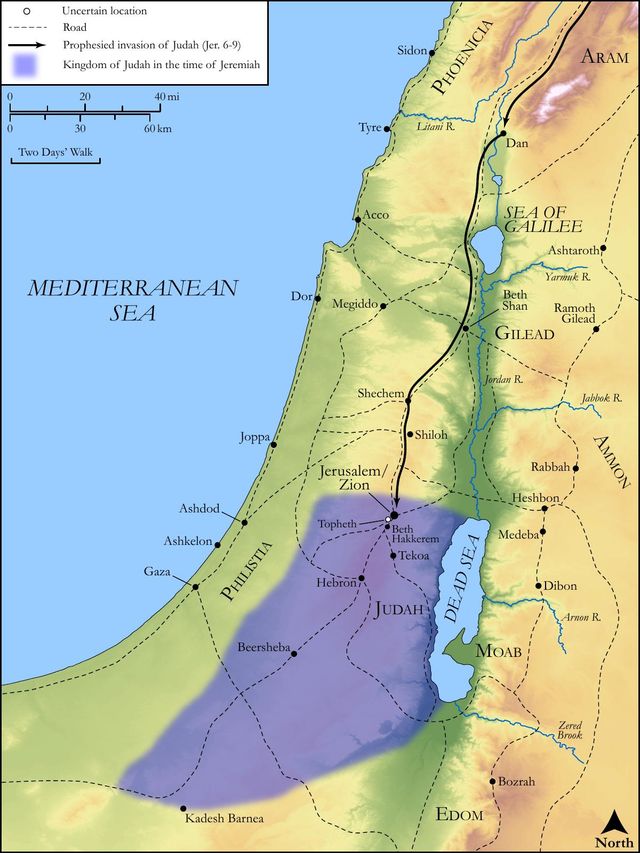
See on the biblical-era map
Study this verse
Public-domain commentary
Matthew Henry
From his Commentary on the Whole Bible. Henry comments on passages, not single verses — this entry covers Jeremiah 6:18–30. His three-level outline is real structure in the source text, so it is rendered as structure.
Here, I. God appeals to all the neighbours, nay, to the whole world, concerning the equity of his proceedings against Judah and Jerusalem (Jer 6:18, Jer 6:19): "Hear, you nations, and know particularly, O congregation of the mighty, the great men of the nations, that take cognizance of the affairs of states about you and make remarks upon them. Observe now what is doing among those of Judah and Jerusalem; you hear of the desolations brought upon them, the earth rings of it, trembles under it; you all wonder that I should bring evil upon this people, that are in covenant with me, that profess relation to me, that have worshipped me, and been highly favoured by me; you are ready to ask, Wherefore has the Lord done thus to this land? Deu 29:24. Know then," 1. "That it is the natural product of their devices. The evil brought upon them is the fruit of their thought. They thought to strengthen themselves by their alliance with foreigners, and by that very thing they weakened and diminished themselves, they betrayed and exposed themselves." 2. "That it is the just punishment of their disobedience and rebellion. God does but execute upon them the curse of the law for their violation of its commands. It is because they have not hearkened to my words nor to my law, nor regarded a word I have said to them, but rejected it all. They would never have been ruined thus by the judgments of God's hand if they had not refused to be ruled by the judgments of his mouth: therefore you cannot say that they have any wrong done them."
II.God rejects their plea, by which they insisted upon their external services as sufficient to atone for all their sins.
Alas! it is a frivolous plea (Jer 6:20): "To what purpose come there to me incense and sweet cane, to be burnt for a perfume on the golden altar, though it was the best of the kind, and far-fetched? What care I for your burnt-offerings and your sacrifices?" They not only cannot profit God (no sacrifice does, Psa 50:9), but they do not please him, for none does this but the sacrifice of the upright; that of the wicked is an abomination to him. Sacrifice and incense were appointed to excite their repentance, and to direct them to a Mediator, and assist their faith in him. Where this good use was made of them they were acceptable, God had respect to them and to those that offered them. But when they were offered with an opinion that thereby they made God their debtor, and purchased a license to go on in sin, they were so far from being pleasing to God that they were a provocation to him.
III.He foretels the desolation that was now coming upon them.
1.God designs their ruin because they hate to be reformed (Jer 6:21): I will lay stumbling-blocks before this people, occasions of falling not into sin, but into trouble. Those whom God has marked for destruction he perplexes and embarrasses in their counsels, and obstructs and retards all the methods they take for their own safety. The parties of the enemy, which they met with wherever they went, were stumbling-blocks to them; in ever corner they stumbled upon them and were dashed to pieces by them: The fathers and the sons together shall fall upon them; neither the fathers with their wisdom, nor the sons with their strength and courage, shall escape them, or get over them. The sons that sinned with their fathers fall with them. Even the neighbour and his friend shall perish and not be able to help either themselves or one another.
2.He will make use of the Chaldeans as instruments of it; for whatever work God has to do he will find out proper instruments for the doing of it. This is a people fetched from the north, from the sides of the earth. Babylon itself lay a great way off northward; and some of the countries that were subject to the king of Babylon, out of which his army was levied, lay much further. These must be employed in this service, Jer 6:22, Jer 6:23. For,
(1.)It is a people very numerous, a great nation, which will make their invasion the more formidable.
(2.)It is a warlike people. They lay hold on bow and spear, and at this time know how to use them, for they are used to them. They ride upon horses, and therefore they march the more swiftly, and in battle press the harder. No nation had yet brought into the field a better cavalry that the Chaldeans.
(3.)It is a barbarous people. They are cruel and have no mercy, being greedy of prey and flushed with victory. They take a pride in frightening all about them; their voice roars like the sea. And,
(4.)They have a particular design upon Judah and Jerusalem, in hopes greatly to enrich themselves with the spoil of that famous country. They are set in array against thee, O daughter of Zion! The sins of God's professing people make them an easy prey to those that are God's enemies as well as theirs.
IV.He describes the very great consternation which Judah and Jerusalem should be in upon the approach of this formidable enemy, Jer 6:24-26.
1.They own themselves in a fright, upon the first intelligence brought them of the approach of the enemy: "When we have but heard the fame thereof our hands wax feeble, and we have no heart to make any resistance; anguish has taken hold of us, and we are immediately in an extremity of pain, like that of a woman in travail." Note, Sense of guilt quite dispirits men, upon the approach of any threatening trouble. What can those hope to do for themselves who have made God their enemy?
2.They confine themselves by consent to their houses, not daring to show their heads abroad; for, though they could not but expect that the sword of the enemy would at last find them out there, yet they would rather die tamely and meanly there than run any venture, either by fight or flight, to help themselves. Thus they say one to another, "Go not forth into the field, no not to fetch in your provision thence, nor walk by the way; dare not to go to church or market, it is at your peril if you do, for the sword of the enemy, and the fear of it, are on every side; the highways are unoccupied, as in Jael's time," Jdg 5:6. Let this remind us, when we travel the roads in safety and there is none to make us afraid, to bless God for our share in the public tranquillity.
3.The prophet calls upon them sadly to lament the desolations that were coming upon them. He was himself the lamenting prophet, and called upon his people to join with him in his lamentations: "O daughter of my people, hear they God calling thee to weeping and mourning, and answer his call: do not only put on sackcloth for a day, but gird it on for thy constant wear; do not only put ashes on thy head, but wallow thyself in ashes; put thyself into close mourning, and use all the tokens of bitter lamentation, not forced and for show only, but with the greatest sincerity, as parents mourn for an only son, and think themselves comfortless because they are childless. Thus do thou lament for the spoiler that suddenly comes upon us. Though he has not come yet, he is coming, the decree has gone forth: let us therefore meet the execution of it with a suitable sadness." As saints may rejoice in hope of God's mercies, though they see them only in the promise, so sinners must mourn for fear of God's judgments, though they see them only in the threatenings.
V.He constitutes the prophet a judge over this people that now stand upon their trial:
as Jer 1:10, I have set thee over the nations; so here, I have set thee for a tower, or as a sentinel, or a watchman, upon a tower, among my people, as an inspector of their actions, that thou mayest know, and try their way, Jer 6:27. Not that God needed any to inform him concerning them; on the contrary, the prophet knew little of them in comparison but by the spirit of prophecy. But thus God appeals to the prophet himself, and his own observation concerning their character, that he might be fully satisfied in the equity of God's proceedings against them and with the more assurance give them warning of the judgments coming. God set him for a tower, conspicuous to all and attacked by many, but made him a fortress, a strong tower, gave him courage to stem the tide and bear the shock of their displeasure. Those that will be faithful reprovers have need to be firm as fortresses. Now in trying their way he will find two things: - 1. That they are wretchedly debauched (Jer 6:28): They are all grievous revolters, revolters of revolters (so the word is), the worst of revolters, as a servant of servants is the meanest servant. They have a revolting heart, have deeply revolted, and revolt more and more. They seemed to start fair, but they revolt and start back. They walk with slanders; they make nothing of belying and backbiting one another, nay, they make a perfect trade of it; it is their constant course, and they govern themselves by the slanders they hear, hating those that they hear ill-spoken of, though ever so unjustly. They are brass and iron, base metals, and there is nothing in them that is valuable. They were as silver and gold, but they have degenerated. Nay, as they are all revolters, so they are all corrupters, not only debauched themselves, but industrious to debauch others, to corrupt them as they themselves are corrupt; nay, to make them seven times more the children of hell than themselves. It is often so; sinners soon become tempters. 2. That they would never be reclaimed and reformed; it was in vain to think of reforming them, for various methods had been tried with them, and all to no purpose, Jer 6:29, Jer 6:30. He compares them to ore that was supposed to have some good metal in it, and was therefore put into the furnace by the refiner, who used all his art, and took abundance of pains, about it, but it proved all dross, nothing of any value could be extracted out of it. God by his prophets and by his providences had used the most proper means to refine this people and to purify them from their wickedness; but it was all in vain. By the continual preaching of the word, and in a series of afflictions, they had been kept in a constant fire, but all to no purpose. The bellows have been still kept so near the fire, to blow it, that they are burnt with the heat of it, or they are quite worn out with long use and thrown into the fire as good for nothing. The prophets have preached their throats sore with crying aloud against the sins of Israel, and yet they are not convinced and humbled. The lead, which was then used in refining silver, as quicksilver is now, is consumed of the fire, and has not done its work. The founder melts in vain; his labour is lost, for the wicked are not plucked away, no care is taken to separate between the precious and the vile, to purge out the old leaven, to cast out of communion those who, being corrupt themselves, are in danger of infecting others. Or, Their wickednesses are not removed (so some read it); they are still as bad as ever, and nothing will prevail to part between them and their sins. They will not be brought off from their idolatries and immoralities by all they have heard, and all they have felt, of the wrath of God against them; and therefore that doom is passed upon them (Jer 6:30): Reprobate silver shall they be called, useless and worthless; they glitter as if they had some silver in them, but there is nothing of real virtue or goodness to be found among them; and for this reason the Lord has rejected them. He will no more own them as his people, nor look for any good from them; he will take them away like dross (Psa 119:119), and prepare a consuming fire for those that would not be purified by a refining fire. By this it appears, (1.) That God has no pleasure in the death and ruin of sinners, for he tries all ways and methods with them to prevent their destruction and qualify them for salvation. Both his ordinances and his providences have a tendency this way, to part between them and their sins; and yet with many it is all lost labour. We have piped unto you, and you have not danced; we have mourned unto you, and you have not wept. Therefore, (2.) God will be justified in the death of sinners and all the blame will lie upon themselves. He did not reject them till he had used all proper means to reform them; did not cast them off so long as there was any hope of them, nor abandon them as dross till it appeared that they were reprobate silver.
Historical interpretation
Historical reception
1 surviving comment on this verse from the historical church.
(Verse 22, 23.) Thus says the Lord: Behold, a people comes from the land of the north, and a great nation will rise from the ends of the earth. They will take hold of the bow and shield (or javelin); they are cruel (or shameless) and will not show mercy. Their voice will sound like the sea, and they will ride on horses, prepared like a man for battle against you, daughter of Zion. This is specifically prophesied about the Babylonians, who will come against the people of Jerusalem, and the entire order of their armament is described, as well as the attack of the fighters, so that, shaken by the terrifying sound, they may repent and please the most merciful God. Finally, the opportunity to ask arises, as it were, against you, daughter of Zion. We can use this testimony during the time of persecution, when the rage of the devil is stirred up against us, and there is no mercy: and like the most violent waves of the sea, they overwhelm those who resist.
Continue studying Jeremiah 6:22 across the web’s major study libraries — every link below opens this exact verse, chapter, or book on the destination site.
Read & Compare
 BibleGatewayThis verse in more than 200 translations and 70 languages.
 Bible.comThe YouVersion reader — hundreds of translations, reading plans, and highlights.
 ESV.orgCrossway's official English Standard Version reader.
 NET BibleThe NET translation with 60,000+ translators' notes on every rendering decision.
 STEP BibleTyndale House's free study tool — original text, vocabulary, and scholarly resources.
 BibliaLogos Bible Software's free web reader.
 USCCBThe New American Bible (Revised Edition) with the U.S. bishops' study notes.
Commentaries
 BibleHub CommentariesDozens of classic commentaries on this verse, gathered on one page.
 StudyLightMore than 100 commentary sets — the largest collection on the web.
 BibleRefPlain-English commentary on what this verse means, verse by verse.
 Enduring WordDavid Guzik's free commentary on this chapter, widely used by Bible teachers.
 Bible Study ToolsVerse commentary alongside Greek and Hebrew study aids.
Original Language & Research
- BibleHub InterlinearThe verse word by word — original language, transliteration, and English.
- BibleHub LexiconEvery word's original-language definition and Strong's entry.
 Blue Letter BibleDeep-study tools — Strong's numbers, concordance, and word studies.
 SefariaThe Hebrew text with Rashi and centuries of Jewish commentary.
Sermons, Hymns & Audio


TrulyRandomVerse is not affiliated with these sites and doesn’t control their content. They’re linked because they’re genuinely useful.
Summary
Jeremiah 6:22 presents a stark prophetic declaration from the Lord, foretelling the imminent and devastating invasion of Judah by a powerful and distant nation from the north. This divine pronouncement serves as a severe warning, underscoring God's absolute sovereignty over all nations and His use of foreign powers as instruments of righteous judgment against His disobedient covenant people. The verse emphasizes the overwhelming nature and inevitability of the coming catastrophe, a direct consequence of Judah's persistent spiritual rebellion and moral decay.
Context
ShowHideLiterary Context
Jeremiah 6:22 is strategically placed within a broader prophetic indictment against Jerusalem and Judah, culminating in a vivid description of impending divine judgment. The preceding verses (Jeremiah 6:1-8) issue an urgent call for Jerusalem to prepare for siege, explicitly identifying the enemy as coming from the north. Jeremiah 6:9-15 meticulously details the pervasive spiritual sickness of the people, from their false prophets to their corrupt priests, highlighting their superficial religiosity and stubborn refusal to repent. In this context, verse 22 functions as a direct, authoritative divine pronouncement, specifying the nature and origin of the instrument of judgment. It bridges the general warnings of moral decay with the concrete reality of the coming invasion, intensifying the sense of dread and inevitability. The subsequent verses (Jeremiah 6:23-26) further amplify the ferocity and cruelty of this invading army, painting a grim picture of the suffering that awaits Judah. The entire chapter meticulously builds a compelling case for the necessity of God's severe judgment upon a people who have persistently spurned His grace and warnings.
Historical & Cultural Context
Jeremiah's prophetic ministry spanned a turbulent period in the late 7th and early 6th centuries BC, marked by significant geopolitical shifts. The once-dominant Assyrian Empire was in decline, giving rise to new regional powers, primarily Babylon (the Chaldeans) to the east and Egypt to the southwest. Judah, a small kingdom, found itself precariously positioned between these burgeoning empires, often attempting to navigate complex alliances. Despite Jeremiah's consistent warnings to serve the king of Babylon as God's chosen instrument of judgment, Judah frequently pursued alliances with Egypt, further provoking divine wrath. The "north country" (Hebrew: tsaphon) in Jeremiah's prophecies is a consistent and unmistakable reference to Babylon, whose armies would typically approach Judah from the north after traversing the fertile crescent, thereby avoiding the vast Arabian desert. Culturally, Judah had become deeply entrenched in syncretistic practices, blending the worship of Yahweh with Canaanite Baal worship, alongside widespread oppression, corruption, and a superficial adherence to covenant rituals without genuine heart transformation. This profound spiritual and moral apostasy directly precipitated the divine judgment articulated in this verse.
Key Themes
ShowHideJeremiah 6:22 powerfully contributes to several foundational themes woven throughout the book of Jeremiah. Firstly, it emphatically underscores Divine Judgment as the inevitable and just consequence of persistent sin and rebellion against God's covenant. Judah's pervasive idolatry, moral depravity, and oppression, explicitly detailed in passages like Jeremiah 7:9-10, necessitate a severe divine response. Secondly, the verse highlights God's Sovereignty Over Nations. It reveals that even powerful pagan empires like Babylon are not independent actors but are sovereignly raised up and directed by God to fulfill His divine purposes, serving as instruments of His will, as clearly stated in Jeremiah 25:9. The phrase "shall be raised" powerfully emphasizes this divine orchestration. Thirdly, the verse conveys a profound sense of Imminent Threat and Inevitability. The language of a people "cometh" and a nation "shall be raised" communicates an immediate and unstoppable danger, underscoring the urgency of Jeremiah's message and the utter futility of Judah's resistance without genuine repentance. This theme of an unavoidable invasion from the north is a recurring motif, also found in prophecies such as Jeremiah 4:6.
Exposition and Analysis
ShowHideKey Word Analysis
ShowHideThis primitive root signifies "to say," but its semantic range is remarkably broad, encompassing declaring, commanding, promising, and even internal thought. Here, it functions as a prophetic formula, introducing a direct divine utterance from the Lord. This emphasizes that the prophecy originates from YHWH Himself, not merely from Jeremiah's human observation or interpretation, thereby bestowing absolute authority, certainty, and inevitability upon the impending events.
Derived from a root meaning "to be great," this adjective denotes something large, significant, or powerful in any sense. When applied to the "nation" in this context, it describes their formidable size, overwhelming military might, and the sheer scale of their destructive capacity. It conveys that Judah would be utterly incapable of resisting such a colossal and potent invading force, highlighting the severity of the impending judgment.
This term specifically refers to a foreign nation or Gentile people, often used in contrast to Israel as God's chosen covenant people. In Jeremiah 6:22, it precisely identifies the invading force as a non-Israelite entity, underscoring that God is employing an external, pagan power to execute His judgment. This further emphasizes the depth of Judah's apostasy, as their covenant God must resort to an outside force to discipline His own rebellious people.
This primitive root means "to wake," "to stir up," or "to awaken," often implying a divine prompting or activation. Here, it powerfully signifies that the "great nation" is not acting independently or merely by its own ambition, but is being divinely activated, stirred up, and commissioned by the Lord Himself. This highlights God's active, sovereign role in orchestrating the invasion, demonstrating His ultimate control over historical events and human actors, even those unaware of His purposes.
Verse Breakdown
ShowHide"Thus saith the LORD"
This opening phrase functions as a solemn and authoritative prophetic formula, unequivocally establishing the divine origin and absolute authority of the message that follows. It signals that the subsequent declaration is not merely Jeremiah's human opinion or prediction, but a direct, infallible revelation from YHWH, the covenant God of Israel, thereby guaranteeing the certainty and truthfulness of the prophecy.
"Behold, a people cometh from the north country"
The interjection "Behold" (often translated "Look!" or "Indeed!") serves to draw immediate and urgent attention to the impending event, emphasizing its certainty and proximity. "A people" refers to the invading army, specifically identifying the Babylonians (Chaldeans). The "north country" is a consistent and unmistakable prophetic designation in Jeremiah for Babylon, indicating the strategic direction from which their formidable armies would advance into Judah. The use of "cometh" in the present tense (or a prophetic perfect) emphasizes the immediacy and inevitability of their arrival, portraying it as an already decided and rapidly approaching reality.
"and a great nation shall be raised from the sides of the earth"
This clause further describes the invading force, amplifying its formidable nature. "A great nation" highlights their immense power, vast numbers, and overwhelming military might, signifying an unstoppable threat. The phrase "shall be raised" underscores God's active and sovereign role in their mobilization; they are not coming by chance or solely by their own ambition, but are being divinely stirred up, commissioned, and empowered by the Lord Himself. "From the sides of the earth" conveys their distant origin and vast reach, portraying them as a global power whose influence extends to the very ends of the known world, making their advance seem utterly unstoppable and unavoidable, a truly universal force.
Literary Devices
ShowHideJeremiah 6:22 masterfully employs several potent literary devices to convey its urgent and dire message. Prophecy is the overarching device, as the verse declares a future event with absolute divine certainty. The immediate use of the prophetic formula "Thus saith the LORD" at the outset establishes the authoritative and undeniable voice of God. Imagery is vivid and evocative, particularly in the phrases "north country" and "sides of the earth," which conjure a sense of distant, overwhelming, and inescapable power. The "north country" functions as a specific Symbol for Babylon, a recurring and ominous motif throughout Jeremiah that consistently points to the divinely appointed instrument of judgment. The phrase "a great nation shall be raised" utilizes Divine Agency or Theopneusty, implying that God Himself is actively stirring up, mobilizing, and directing this foreign power, rather than it merely rising by its own accord. This underscores God's absolute Sovereignty over all nations and historical events, even those seemingly outside His direct control. The stark, declarative tone and the emphasis on inevitability also contribute to the pervasive sense of Doom and Urgency that characterizes this chapter, leaving the audience with a profound sense of impending catastrophe.
Theological and Thematic Connections
ShowHideJeremiah 6:22 powerfully articulates the profound theological principle that God is utterly sovereign over all nations and uses them as instruments of His divine justice. This impending judgment is not arbitrary punishment but a direct and inevitable consequence of Judah's persistent covenant unfaithfulness, widespread idolatry, and deep-seated oppression. The coming invasion from the north signifies God's righteous wrath against a people who have repeatedly rejected His warnings, spurned His grace, and refused to repent. It underscores that divine patience has limits, and unrepentant disobedience ultimately leads to severe and tangible consequences, even for His chosen people. While devastating, this judgment is ultimately intended to purify, humble, and bring about a remnant who will return to Him, demonstrating God's ultimate purpose in both judgment and redemptive restoration.
Reflection and Application
ShowHideJeremiah 6:22 serves as a timeless and sobering reminder of God's unwavering justice and His sovereign hand in orchestrating human history. For believers today, this verse calls us to profound introspection regarding our own faithfulness, obedience, and responsiveness to God's Word. While we may not face a literal invasion from a "north country," the underlying spiritual principle remains: persistent disobedience, spiritual apathy, and compromise with the values of the world can lead to severe spiritual consequences. These may manifest as a loss of peace, joy, and divine favor, a sense of spiritual desolation, or even a tangible decline in the vitality of our faith and communities. This verse challenges us to take God's warnings seriously, to cultivate a heart of genuine repentance, and to actively pursue righteousness, justice, and holiness in our personal lives and collective communities. It also encourages us to trust in God's overarching plan, knowing that even amidst difficult circumstances and global turmoil, He is working all things for His ultimate purposes, sovereignly guiding history towards the establishment of His eternal kingdom. We are called to live with a constant awareness of His sovereignty, responding to His call with humility, obedience, and unwavering faith.
Questions for Reflection
ShowHideFAQ
ShowHideWho is the "north country" referring to in Jeremiah's prophecy?
ShowHideIn the prophetic context of Jeremiah, the "north country" (Hebrew: tsaphon) unequivocally refers to the Neo-Babylonian Empire, also known as the Chaldeans. Babylon was the dominant geopolitical power during Jeremiah's ministry (late 7th to early 6th centuries BC), and its formidable armies would typically invade Judah from the north after traversing the fertile crescent. Jeremiah consistently identifies this powerful northern entity as the divinely appointed instrument God would use to bring judgment upon Judah for its persistent idolatry, covenant unfaithfulness, and deep-seated disobedience (e.g., Jeremiah 25:9).
Why would God use a pagan nation to punish His own people?
ShowHideGod's use of a pagan nation like Babylon to punish Judah demonstrates His absolute sovereignty over all nations and His unwavering commitment to justice. Despite His covenant relationship with Israel, God holds His people accountable for their persistent sin, idolatry, and rejection of His commands. When repeated warnings, prophetic calls to repentance, and even lesser forms of discipline were ignored, God, in His divine justice, employed a foreign power as a severe instrument of discipline. This act served not only as punishment for their rebellion but also as a profound wake-up call, intended to humble Judah and ultimately lead a faithful remnant back to Him. This theme of God using foreign powers as instruments of judgment is seen elsewhere in Scripture, such as God using Assyria against the northern kingdom of Israel in Isaiah 10:5-6.
Christ-Centered Fulfillment
ShowHideWhile Jeremiah 6:22 speaks of a specific historical judgment enacted through a literal invasion, its deeper theological currents find profound Christ-centered fulfillment. The terrifying prospect of a "great nation" raised by God from the "sides of the earth" to execute judgment foreshadows the ultimate, universal judgment that will be executed by Christ Himself. He is the one who comes from the very "sides of the earth" in His divine majesty and authority, not merely as an earthly king but as the sovereign Judge of all creation. Just as Babylon was God's instrument against a rebellious Judah, Christ is the ultimate executor of divine justice, not only against the unrepentant but also against all sin and evil that mars God's good creation. However, unlike the earthly invasion that brought only devastation and temporary exile, Christ's coming also ushers in an era of ultimate salvation and eternal restoration for those who believe. He is the one who bore the full weight of God's righteous wrath, becoming the "Lamb of God, who takes away the sin of the world!" (John 1:29). Through His atoning sacrifice on the cross, the judgment prophesied for human rebellion is absorbed and satisfied, offering a path to reconciliation with God and eternal life. Thus, the terrifying prospect of a "great nation" of judgment is ultimately transformed by the gospel into the glorious hope of a "great salvation" found exclusively in Christ, who will one day return not merely as an instrument of temporal judgment, but as the King of kings and Lord of lords to establish His eternal kingdom in perfect righteousness and peace (Revelation 19:11-16).