


Jeremiah 50:41
Bible text: King James Version (1769 Blayney text) · Public domain
Bible text: Berean Standard Bible · Public domain
Bible text: American Standard Version (1901) · Public domain
Bible text: World English Bible, Messianic edition · Public domain
Bible text: Geneva Bible (1599) · Public domain
Bible text: Young's Literal Translation · Public domain
- הִנֵּהhi·Nehthere!H2009PrtParticle Interjection
- עַם'ama peopleH5971N-msNoun Singular Masculine Absolute
- בָּאba'[is] about to comeH935V-Qal-Perf-3msVerb Qal Perfect 3rd Singular Masculine
- מִצָּפוֹןmi·tza·Fonfrom [the] northH6828Prep-m ¦ N-fsNoun Singular Feminine Absoluteמִfromצָּפוֹן[the] north
- וְגוֹיve·Goyand a nationH1471Conj-w ¦ N-msNoun Singular Masculine Absoluteוְandגוֹיa nation
- גָּדוֹלga·dOlgreatH1419Adj-msAdjective Singular Masculine Absolute
- וּמְלָכִיםu·me·la·Khimand kingsH4428Conj-w ¦ N-mpNoun Plural Masculine Absoluteוּandמְלָכִיםkings
- רַבִּיםra·BimmanyH7227Adj-mpAdjective Plural Masculine Absolute
- יֵעֹרוּye·'O·ruthey will be rousedH5782V-Niphal-Imperf-3mpVerb Niphal Imperfect 3rd Plural Masculine
- מִיַּרְכְּתֵיmi·yar·ke·teifrom [the] remotest parts ofH3411Prep-m ¦ N-fdcNoun Dual Feminine Constructמִfromיַּרְכְּתֵי[the] remotest parts of
- אָרֶץ'A·retz[the] earthH776N-fsNoun Singular Feminine Absolute
English is a literal word-by-word gloss of the Hebrew, not the KJV's wording. Why?
This is the original text the KJV's translators worked from — each Hebrew word with its own literal English meaning in this verse, prepared by scholars at Tyndale House, Cambridge. The KJV translates whole sentences, not word by word, so its wording differs: one Hebrew word can become several English words, and the KJV may choose “the LORD” where the gloss reads “Yahweh”. Both are faithful — they answer different questions. For the KJV's own rendering, switch to the KJV text.
Details
See on the biblical-era map
Study this verse
Public-domain commentary
Matthew Henry
From his Commentary on the Whole Bible. Henry comments on passages, not single verses — this entry covers Jeremiah 50:33–46. His four-level outline is real structure in the source text, so it is rendered as structure.
We have in these verses,
I.Israel's sufferings, and their deliverance out of those sufferings.
God takes notice of the bondage of his people in Babylon, as he did of their bondage in Egypt; he has surely seen it, and has heard their cry. Israel and Judah were oppressed together, Jer 50:33. Those that remained of the captives of the ten tribes, upon the uniting of the kingdoms of Assyria and Chaldea, seem to have come and mingled with t hose of the two tribes, and to have mingled tears with them, so that they were oppressed together. They were humble suppliants for their liberty, and that was all; they could not attempt any thing towards it, for all that took them captives held them fast, and were much too hard for them. But this is their comfort in distress, that, though they are weak, their Redeemer is strong (Jer 50:34), their Avenger (so the word signifies), he that has a right to them, and will claim his right and make good his claim. He is stronger than their enemies that hold them fast; he can overpower all the force that is against them, and put strength into his own people though they are very weak. The Lord of hosts is his name, and he will answer to his name, and make it to appear that he is what his people call him, and will be that to them for which they depend upon him. Note, It is the unspeakable comfort of the people of God that, though they have hosts against them, they have the Lord of hosts for them and he shall thoroughly plead their cause, pleading he shall plead it, plead it with jealousy, plead it effectually, plead it and carry it, that he may give rest to the land, and to his people's land, rest from all their enemies round about. This is applicable to all believers, who complain of the dominion of sin and corruption, and of their own weakness and manifold infirmities. Let them know that their Redeemer is strong; he is able to keep what they commit to him, and he will plead their cause. Sin shall not have dominion over them; he will make them free, and they shall be free indeed; he will give them rest, that rest which remains for the people of God.
II.Babylon's sin, and their punishment for that sin.
1.The sins they are here charged with are idolatry and persecution.
(1.)They oppressed the people of God; they held them fast, and would not let them go. They opened not the house of his prisoners, Isa 14:17. This was God's quarrel with them, as of old with Pharaoh; it cost him dear, and yet they would not take warning. The inhabitants of Babylon must be disquieted (Jer 50:34) because they have disquieted God's people, whose honour and comfort he is jealous for, and therefore will recompense tribulation to those that trouble them, as well as rest to those that are troubled, Th2 1:6, Th2 1:7.
(2.)They wronged God himself, and robbed him, giving that glory to others which is due to him alone; for (Jer 50:38) it is the land of graven images. All parts of the country abounded with idols, and they were mad upon them, were in love with them and doted on them, cared not what cost and pains they were at in the worship of them, were unwearied in paying their respects to them; and in all this they were wretchedly infatuated and acted like men out of their wits; they were carried on in their idolatry without reason or discretion, like men in a perfect fury. The word here used for idols properly signifies terrors - Enim, the name given to giants that were formidable, because they made the images of their gods to look frightful, to strike a terror upon fools and children. Their idols were scarecrows, yet they doted on them. Babylon was the mother of harlots (Rev 17:5), the source of idolatry. Note, It is the maddest thing in the world to make a god of any creature; and those who are proud against the Lord, the true God, are justly given up to strong delusions, to be mad upon idols that cannot profit. But this madness is wickedness, for which sinners will be certainly and severely reckoned with.
2.The judgments of God upon them for these sins are such as will quite lay them waste and ruin them.
(1.)All that should be their defence and support shall be cut off by the sword. The Chaldeans had long been God's sword, wherewith he had done execution upon the sinful nations round about: but now, they being as bad as any of them, or worse, a sword is brought upon them, even upon the inhabitants of Babylon (Jer 50:35), a sword of war; and, as it is in God's hand, sent and directed by him, it is a sword of justice. It shall be,
[1.]Upon their princes; they shall fall by it, and their dignity, wealth, and power, shall not secure them.
[2.]Upon their wise men, their philosophers, their statesmen, and privy-counsellors; their learning and policy shall neither secure them nor stand the public in any stead.
[3.]Upon their soothsayers and astrologers, here called the liars (Jer 50:36), for they cheated with their prognostications of peace and prosperity; the sword upon them shall make them dote, so that they shall talk like fools, and be as men that have lost all their wits. Note, God has a sword that can reach the soul and affect the mind, and bring men under spiritual plagues.
[4.]Upon their mighty men. A sword shall be upon their spirits; if they are not slain, yet they shall be dismayed, and shall be no longer mighty men; for what stead will their hands stand them in when their hearts fail them?
[5.]Upon their militia (Jer 50:37): The sword shall be upon their horses and chariots; the invaders shall make themselves masters of all their warlike stores, shall seize their horses and chariots for themselves, or destroy them. The troops of other nations that were in their service shall be quite disheartened: The mingled people shall become as weak and timorous as women.
[6.]Upon their exchequer: The sword shall be upon her treasures, which are the sinews of war, and they shall be robbed, and made use of by the enemy against them. See what universal destruction the sword makes when it comes with commission.
(2.)The country shall be made desolate (Jer 50:38): The waters shall be dried up, the water that secures the city. Cyrus drew the river Euphrates into so many channels as made it passable for his army, so that they got with ease to the walls of Babylon, which, if was thought, that river had rendered inaccessible. "The water likewise that made the country fruitful shall be dried up, so that it shall be turned into barrenness, and shall be no more inhabited by the children of men, but by the wild beasts of the desert," Jer 50:39. This was foretold concerning Babylon, Isa 13:19-22. It shall become like Sodom and Gomorrah, Jer 50:40. The same was foretold concerning Edom, Jer 49:18. As the Chaldeans had laid Edom waste, so they shall themselves be laid waste.
(3.)The king and kingdom shall be put into the utmost confusion and consternation by the enemies' invading them, Jer 50:41-43. All the expressions here used to denote the formidable power of the invaders, the terrors wherewith they should array themselves, and the great fright which both court and country should be put into thereby, we met with before (Jer 6:22-24) concerning the Chaldeans' invading the land of Judah. The battle which is there said to be against thee, O daughter of Zion! is here said to be against thee, O daughter of Babylon! to intimate that they should be paid in their own coin. God can find out such as shall be for terror and destruction to those that are for terror and destruction to others; and those who have dealt cruelly, and have shown no mercy, may expect to be cruelly dealt with, and to find no mercy. Only there is one difference between these passages; there it is said, We have heard the fame thereof and our hands wax feeble; here it is said, The king of Babylon has heard the report and his hands waxed feeble, which intimates that that proud and daring prince shall, in the day of his distress, be as weak and dispirited as the meanest Israelites were in the day of their distress.
(4.)That they shall be as much hurt as frightened, for the invader shall come up like a lion to tear and destroy (Jer 50:44) and shall make them and their habitation desolate (Jer 50:45), and the desolation shall be so astonishing that all the nations about shall be terrified by it, Jer 50:46. These three verses we had before (Jer 49:19-21) in the prophecy of the destruction of Edom, which was accomplished by the Chaldeans, and they are here repeated, mutatis mutandis - with a few necessary alterations, in the prophecy of the destruction of Babylon, which was to be accomplished upon the Chaldeans, to show that though the distributions of Providence may appear unequal for a time its retributions will be equal at last; when thou shalt make an end to spoil thou shalt be spoiled, Isa 33:1; Rev 13:10.
Continue studying Jeremiah 50:41 across the web’s major study libraries — every link below opens this exact verse, chapter, or book on the destination site.
Read & Compare
 BibleGatewayThis verse in more than 200 translations and 70 languages.
 Bible.comThe YouVersion reader — hundreds of translations, reading plans, and highlights.
 ESV.orgCrossway's official English Standard Version reader.
 NET BibleThe NET translation with 60,000+ translators' notes on every rendering decision.
 STEP BibleTyndale House's free study tool — original text, vocabulary, and scholarly resources.
 BibliaLogos Bible Software's free web reader.
 USCCBThe New American Bible (Revised Edition) with the U.S. bishops' study notes.
Commentaries
 BibleHub CommentariesDozens of classic commentaries on this verse, gathered on one page.
 StudyLightMore than 100 commentary sets — the largest collection on the web.
 BibleRefPlain-English commentary on what this verse means, verse by verse.
 Enduring WordDavid Guzik's free commentary on this chapter, widely used by Bible teachers.
 Bible Study ToolsVerse commentary alongside Greek and Hebrew study aids.
Original Language & Research
- BibleHub InterlinearThe verse word by word — original language, transliteration, and English.
- BibleHub LexiconEvery word's original-language definition and Strong's entry.
 Blue Letter BibleDeep-study tools — Strong's numbers, concordance, and word studies.
 SefariaThe Hebrew text with Rashi and centuries of Jewish commentary.
Sermons, Hymns & Audio


TrulyRandomVerse is not affiliated with these sites and doesn’t control their content. They’re linked because they’re genuinely useful.
Summary
Jeremiah 50:41 is a potent prophetic declaration foretelling the divinely orchestrated invasion and subsequent destruction of Babylon by a formidable coalition. It describes "a people," "a great nation," and "many kings" who will be "raised up from the coasts of the earth" to execute God's righteous judgment upon the arrogant empire that had previously served as His instrument of discipline against Judah. This verse profoundly underscores God's absolute sovereignty over nations and history, demonstrating His unwavering commitment to justice and the certain fulfillment of His prophetic word, ensuring that even the mightiest earthly powers are held accountable to His divine will.
Context
ShowHideLiterary Context
Jeremiah 50:41 is strategically placed within a comprehensive oracle against Babylon, encompassing chapters 50 and 51. These chapters constitute a distinct literary unit, a "burden" or "prophecy" specifically directed at the empire that had conquered Judah, destroyed Jerusalem, and exiled its people. While Jeremiah contains prophecies against various nations, the unparalleled scale and detailed nature of the Babylonian oracle highlight its immense theological and historical significance. This particular verse contributes to the vivid and terrifying portrayal of the invading force, detailing its origin and formidable nature, serving as a climactic description of the instruments of God's wrath. The verses immediately preceding (Jeremiah 50:39-40) describe the utter desolation and uninhabited state that will befall Babylon, setting the grim stage for the arrival of the destructive force precisely detailed in verse 41.
Historical & Cultural Context
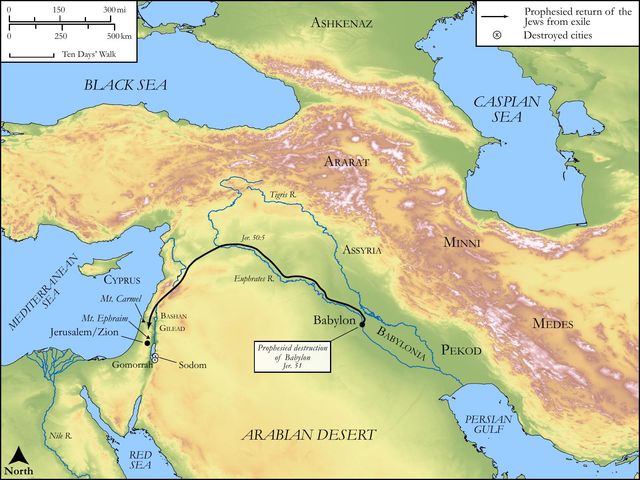
Historically, this prophecy finds its remarkable fulfillment in the rise of the Medo-Persian Empire, which, under the leadership of Cyrus the Great, conquered Babylon in 539 BC. The phrase "from the north" (H6828, tsâphôwn) was a recurring and ominous motif in Jeremiah's prophecies, consistently signifying the direction from which divine judgment would emerge, whether from Assyria, Babylon itself, or, in this context, the powers destined to overthrow Babylon. For Judah, the north represented a strategic and frequently utilized entry point for invading armies, making this geographical indicator a powerful symbol of impending doom. The "coasts of the earth" (H3411, yᵉrêkâh) implies a vast, geographically diverse coalition, accurately reflecting the expansive reach of the Medo-Persian Empire, which successfully consolidated numerous peoples, tribes, and kingdoms under its unified banner. This imagery would have powerfully evoked a sense of overwhelming and inescapable doom for Babylon, mirroring the terror and devastation it had inflicted upon others.
Key Themes
ShowHideThis verse powerfully illustrates several core themes prevalent throughout the book of Jeremiah and the broader Old Testament narrative. Firstly, it highlights Divine Sovereignty, demonstrating God's absolute and unchallengeable control over the rise and fall of nations. Even formidable empires like Babylon, which God had previously utilized for His own purposes as an instrument of discipline (as seen in Jeremiah 25:9), are ultimately subject to His supreme will and righteous judgment. Secondly, it underscores Prophetic Fulfillment, emphasizing the unwavering reliability and certainty of God's spoken word. Jeremiah's prophecies, including those specifically directed against Babylon, proved to be remarkably precise in their historical realization, thereby reinforcing the profound truth that what God declares will inevitably come to pass, as also powerfully demonstrated in Isaiah 44:28. Thirdly, the verse speaks profoundly to Divine Justice and Retribution. Babylon's pervasive pride, rampant idolatry, and brutal treatment of conquered peoples, including the people of Judah, would not go unpunished. God's inherent justice ensures that even the most powerful earthly kingdoms are held fully accountable for their actions and atrocities, a principle foreshadowed in passages like Psalm 9:16.
Exposition and Analysis
ShowHideKey Word Analysis
ShowHideThis term (H5971) refers to a congregated unit, a community, or a nation. In this prophetic context, it emphasizes the collective identity and unified nature of the invading force, suggesting a cohesive entity rather than merely disparate groups, even if composed of various tribes or nations under a single command. It underscores the organized and formidable character of the impending judgment.
This word (H6828) literally means "hidden" or "dark," but it is used exclusively in the Old Testament to denote the north as a geographical quarter, often associated with gloom, mystery, or the unknown. In prophetic literature, "the north" frequently serves as a metonym for the source of invasion and divine judgment for both Israel and its surrounding neighbors, as vividly illustrated in Jeremiah 1:14. Its specific mention here precisely identifies the strategic direction from which Babylon's destroyers would emerge, indicating a divinely appointed and inescapable point of origin.
This primitive root (H5782) means "to wake," "to stir up," or "to arouse." Here, in the passive voice ("shall be raised up"), it functions as a theological passive, signifying that these nations and kings are not acting solely on their own initiative or ambition but are being divinely activated, awakened, or mobilized for a specific, predetermined purpose. It powerfully implies God's direct agency and sovereign hand in assembling and directing these forces against Babylon, reinforcing His ultimate control over human affairs and military movements.
Verse Breakdown
ShowHide"Behold, a people shall come from the north"
This opening phrase serves as an emphatic interjection, "Behold," drawing immediate and urgent attention to the impending, certain event. It directly identifies the origin of the invading force as "the north," a direction consistently associated with divine judgment and military threat in Jeremiah's prophecies. The "people" signifies a unified, cohesive, and formidable group, indicating a significant military power rather than a mere raiding party.
"and a great nation"
This clause further amplifies the description of the invading force, adding to its formidable character. The term "great" (H1419, gâdôwl) denotes not only vast in number but also significant in power, influence, and military might. The use of "nation" (H1471, gôwy) alongside "people" suggests a broad, established political entity or empire, distinguishing it from a mere tribal confederation and emphasizing its organized strength.
"and many kings shall be raised up"
This phrase underscores the immense scale and diverse leadership of the attacking coalition. "Many kings" (H7227, rab and H4428, melek) indicates a multi-national alliance, a vast empire composed of numerous subordinate rulers, or a confederacy of independent monarchs. The passive construction "shall be raised up" is a crucial theological passive, subtly yet powerfully attributing the mobilization and coordination of these kings and nations to God's sovereign hand, highlighting His ultimate orchestration of historical events.
"from the coasts of the earth"
This final phrase emphasizes the immense geographical scope from which these diverse forces are gathered. "Coasts" (H3411, yᵉrêkâh) or "ends" of the earth signifies remote and distant regions, not merely immediate neighbors. This hyperbolic expression emphasizes the overwhelming, inescapable, and universally sourced nature of the judgment, suggesting that no corner of the world is beyond God's reach in raising up instruments for His divine purposes.
Literary Devices
ShowHideJeremiah 50:41 masterfully employs several potent literary devices to convey its message of impending and inescapable judgment. Hyperbole is powerfully evident in the description of "a great nation" and "many kings... from the coasts of the earth." This exaggeration serves to emphasize the overwhelming magnitude, diverse composition, and irresistible force of the invading coalition, far surpassing any single nation or typical military alliance. It highlights the certainty and totality of Babylon's impending downfall. Metonymy is present in the phrase "from the north," where the geographical direction stands in for the specific political and military power (the Medo-Persians) that would emerge from that region. This recurring motif in Jeremiah's prophecies creates a pervasive sense of dread, inevitability, and divine appointment. Furthermore, the phrase "shall be raised up" functions as a profound Divine Passive, subtly yet powerfully indicating God's active, sovereign agency behind the mobilization of these earthly powers. While human armies act based on their own ambitions, the ultimate orchestrator and instigator of their movements is the Lord, demonstrating His absolute control over history and nations.
Theological and Thematic Connections
ShowHideJeremiah 50:41 stands as a profound testament to God's absolute sovereignty over all earthly powers and His unwavering commitment to justice. It reveals that no nation, no matter how mighty, seemingly invincible, or strategically positioned, operates outside the purview of divine accountability. Babylon, which had been God's chosen instrument for disciplining Judah and other nations, now faces its own meticulous reckoning, illustrating the immutable biblical principle that God judges those who act with pride, cruelty, and defiance, even if they unknowingly fulfill His broader purposes. This passage offers profound assurance to believers that God remains enthroned, actively orchestrating historical events to achieve His righteous and redemptive ends, and that ultimately, all injustice will be meticulously addressed and rectified.
Reflection and Application
ShowHideIn a world perpetually marked by geopolitical instability, the cyclical rise and fall of empires, and the seemingly unchecked power of nations, Jeremiah 50:41 offers both profound reassurance and a sobering warning. It serves as a powerful reminder that behind the apparent chaos and intricate complexity of human history, a sovereign God is meticulously at work, orchestrating events according to His immutable divine purpose. This profound truth should instill in believers a deep and abiding sense of peace and trust, knowing with certainty that God's ultimate plans for justice, redemption, and the establishment of His kingdom will prevail, regardless of current global circumstances. Furthermore, this prophecy serves as a powerful and enduring reminder that all nations, their leaders, and their governing systems are ultimately and irrevocably accountable to the Lord of Hosts. Pride, pervasive injustice, and open rebellion against God's moral order will not go unpunished indefinitely. This calls us, as believers, to engage in fervent prayer for our leaders, to passionately seek justice and righteousness in our spheres of influence, and to live as faithful citizens of a heavenly kingdom that will ultimately supersede and endure beyond all transient earthly powers. It encourages us to place our ultimate hope and security not in fleeting human governments or the shifting sands of military might, but in the eternal, righteous, and unwavering reign of God.
Questions for Reflection
ShowHideFAQ
ShowHideWho are the "people from the north" mentioned in Jeremiah 50:41?
ShowHideThe "people from the north" primarily refer to the formidable Medo-Persian Empire. Historically, this prophecy was precisely fulfilled when Cyrus the Great, leading a combined and powerful force of Medes and Persians, successfully conquered the mighty city of Babylon in 539 BC. The geographical direction "from the north" was a consistent and significant motif in Jeremiah's prophecies, often signifying the strategic entry point for invading armies that God would sovereignly use as instruments of His divine judgment, as vividly illustrated in Jeremiah 1:14.
How does this prophecy relate to God's justice?
ShowHideThis prophecy serves as a powerful and undeniable demonstration of God's unwavering and perfect justice. Babylon had acted with extreme cruelty, unbridled pride, and widespread oppression, not only against Judah but also against numerous other nations, and had openly defied the Lord through its rampant idolatry and arrogance. Even though God had sovereignly used Babylon as an instrument to discipline His own people (as noted in Jeremiah 25:9), Babylon itself was by no means exempt from divine accountability. Jeremiah 50:41 powerfully underscores that God will ultimately judge all nations for their wickedness, injustice, and defiance, ensuring that no empire, no matter how powerful or seemingly invincible, escapes His righteous and inevitable retribution.
What is the significance of "many kings shall be raised up from the coasts of the earth"?
ShowHideThe phrase "many kings shall be raised up from the coasts of the earth" (H3411, yᵉrêkâh) profoundly emphasizes the vastness, diverse nature, and overwhelming scope of the coalition God would assemble against Babylon. "Coasts of the earth" or "ends of the earth" signifies distant and remote regions, highlighting that the invading force would not merely be neighboring adversaries but a widespread and formidable alliance drawn from far-flung territories. This imagery underscores the overwhelming and inescapable nature of the judgment, demonstrating that God's sovereign reach extends to the uttermost parts of the world to accomplish His divine purposes. It also powerfully reinforces the idea that these kings are "raised up" by divine initiative and orchestration, not merely by human ambition or geopolitical alignment, as seen in Psalm 75:6-7.
Christ-Centered Fulfillment
ShowHideWhile Jeremiah 50:41 directly prophesies the historical downfall of Babylon through a divinely appointed earthly power, its deeper theological resonance profoundly points to the ultimate sovereignty of God, a sovereignty fully embodied, perfectly exercised, and eternally established by Jesus Christ. The "raising up" of kings and nations to execute divine judgment foreshadows Christ's own supreme role as the King of kings and Lord of lords, who holds ultimate and absolute authority over all earthly powers and dominions. Just as God meticulously orchestrated the demise of Babylon through human instruments, so too will Christ, at His glorious second coming, bring all nations and kingdoms into complete submission, judging the wicked with perfect righteousness and establishing His eternal, unshakeable kingdom. The temporary and transient nature of earthly empires, even those momentarily used by God for His purposes, contrasts sharply with the everlasting dominion and unyielding reign of Christ (as powerfully described in Daniel 7:13-14). He is the one before whom every knee will ultimately bow and every tongue will confess His Lordship (as triumphantly declared in Philippians 2:9-11). The judgment against Babylon, executed by a vast coalition from "the coasts of the earth," prefigures the universal scope of Christ's reign over all things and final judgment, where He will gather all peoples to Himself, meticulously separating the righteous from the unrighteous (as vividly depicted in Matthew 25:31-34). Thus, Jeremiah 50:41, in its vivid portrayal of God's meticulous control over history and His unwavering commitment to justice, ultimately directs our gaze to the triumphant Christ, the true and eternal King, who will ultimately bring all things under His perfect, righteous, and everlasting rule.