


Jeremiah 50:10
Bible text: King James Version (1769 Blayney text) · Public domain
Bible text: Berean Standard Bible · Public domain
Bible text: American Standard Version (1901) · Public domain
Bible text: World English Bible, Messianic edition · Public domain
Bible text: Geneva Bible (1599) · Public domain
Bible text: Young's Literal Translation · Public domain
- וְהָיְתָהve·ha·ye·Tahand it will becomeH1961Conj-w ¦ V-Qal-ConsecPerf-3fsVerb Qal Consecutive Perfect 3rd Singular Feminineוְandהָיְתָהit will become
- כַשְׂדִּיםkhas·DimChaldeaH3778N-properNoun Proper Location
- לְשָׁלָלle·sha·Lal<into> plunderH7998Prep-l ¦ N-msNoun Singular Masculine Absoluteלְ<into>שָׁלָלplunder
- כָּלkolallH3605N-mscNoun Singular Masculine Construct
- שֹׁלְלֶיהָsho·le·Lei·ha[those who] plunder itH7997V-Qal-Prtcpl-mp ¦ 3fsVerb Qal Participle Plural Masculine Constructשֹׁלְלֶי[those who] plunderהָit
- יִשְׂבָּעוּyis·Ba·'uthey will be satisfiedH7646V-Qal-Imperf-3mpVerb Qal Imperfect 3rd Plural Masculine
- נְאֻםne·'um[the] utterance ofH5002N-mscNoun Singular Masculine Construct
- יְהוָהYah·wehYahwehH3068N-properNoun Proper Title
English is a literal word-by-word gloss of the Hebrew, not the KJV's wording. Why?
This is the original text the KJV's translators worked from — each Hebrew word with its own literal English meaning in this verse, prepared by scholars at Tyndale House, Cambridge. The KJV translates whole sentences, not word by word, so its wording differs: one Hebrew word can become several English words, and the KJV may choose “the LORD” where the gloss reads “Yahweh”. Both are faithful — they answer different questions. For the KJV's own rendering, switch to the KJV text.
Details
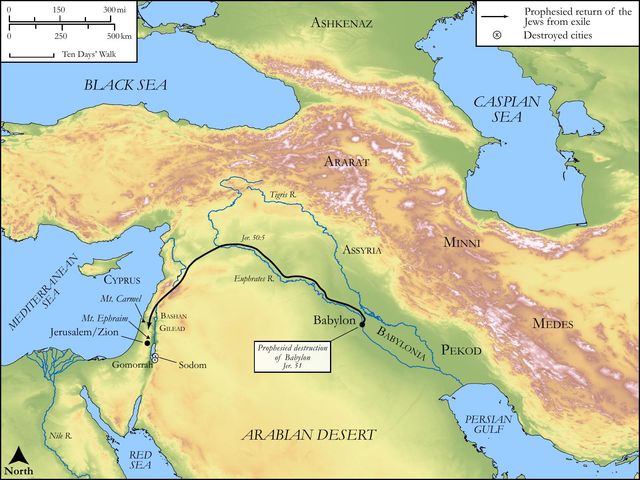
See on the biblical-era map
Study this verse
Public-domain commentary
Matthew Henry
From his Commentary on the Whole Bible. Henry comments on passages, not single verses — this entry covers Jeremiah 50:9–20. His two-level outline is real structure in the source text, so it is rendered as structure.
God is here by his prophet, as afterwards in his providence, proceeding in his controversy with Babylon. Observe,
I.The commission and charge given to the instruments that were to be employed in destroying Babylon.
The army that is to do it is called an assembly of great nations (Jer 50:9), the Medes and Persians, and all their allies and auxiliaries; it is called an assembly, because regularly formed by the divine will and counsel to do this execution. God will raise them up to do it, will incline them to and fir them for this service, and then he will cause them to come up, for all their motions are under his conduct and direction: he shall give the word of command, shall order them to put themselves in array against Babylon (Jer 50:14), and then they shall put themselves in array (Jer 50:9), for what God appoints to be done shall be done; and thence she shall be quickly taken; from their first sitting down before it they shall be still gaining ground against it till it be taken. God shall bid them shoot at her and spare no arrows (Jer 50:14), and then their arrows shall be as of a mighty expert man, that has both skill and strength, a good eye and a good hand (Jer 50:9); none shall return in vain. When God gives commission he will give success. Nay, they are bidden not only to shoot at her (Jer 50:14), but to shout against her (Jer 50:15) with a triumphant shout, as those that are already sure of victory. Those whom God directs to shoot may do so with shouting, for they are sure not to miss the mark.
II.The desolation and destruction itself that shall be brought upon Babylon. This is here set forth in a great variety of expressions.
1.The wealth of Babylon shall be a rich and easy prey to the conquerors (Jer 50:10): Chaldea shall be a spoil to all her destroyers, who shall enrich themselves by plundering her, and, which is strange, all that spoil her shall be satisfied; they shall have so much that even they themselves shall say that they have enough.
2.The country of Babylon shall be depopulated and lie uninhabited: It shall be wholly desolate (Jer 50:13) to such a degree that every one who goes by shall triumph in her fall, and, instead of condoling with them, shall hiss at all her plagues, Jer 50:13.
3.Their ancestors shall be ashamed of their cowardice, in fleeing from the first onset (Jer 50:12), or, Your mother, Babylon itself, the mother-city, shall be confounded, when she sees herself deserted by those that should have been her guards. Thus the former ages of Christians may justly be confounded and ashamed to see how unlike them the latter ages are, and how wretchedly they have degenerated; and no sin brings a surer and sorer ruin upon persons, or people, than apostasy.
4.The great admirers of Babylon shall see it rendered very despicable: the last of kingdoms, the very tail of the nations, shall it be, a wilderness, a dry land, a desert, Jer 50:12. The country that was populous shall be dispeopled, that was enriched with a fertile soil shall become barren.
5.The great city, the head of it, shall be quite ruined. Her foundations have fallen, and therefore her walls are thrown down; for how can the walls stand when divine vengeance is at the door and shakes the very foundations? It is the vengeance of the Lord, which nothing can contend with either in law or battle.
6.There shall not be left in Babylon so much as the poor of the land, for vine-dressers and husbandmen, as there was in Israel (Jer 50:16): The sower shall be cut off from Babylon, and he that handles the sickle; the country shall be so emptied of people that there shall be none to till the ground and gather in the fruits of it. Harvest shall come, and there shall be no reapers; seed-time shall come, but there shall be no sower; God will do his part, but there shall be no men to do theirs.
7.All their auxiliary forces, which they have hired into their service, shall ??desert them, as mercenary men often do upon the approach of danger (Jer 50:16): For fear of the oppressing sword they shall turn every one to his people. This was threatened before concerning Egypt, Jer 46:16.
III.The procuring provoking cause of this destruction.
It comes from God's displeasure; it is because of the wrath of the Lord that Babylon shall be wholly desolate (Jer 50:13), and his wrath is righteous, for (Jer 50:14) she hath sinned against the Lord, therefore spare no arrows. Note, It is sin that makes men a mark for the arrows of God's judgments. An abundance of idolatry and immorality was to be found in Babylon, yet those are not mentioned as the reason of God's displeasure against them, but the injuries they had done to the people of God, from a principle of enmity to them as his people. They have been the destroyers of God's heritage (Jer 50:11); herein indeed God made use of them for the necessary correction of his people, and yet it is laid to their charge as a heinous crime, because they designed nothing but their utter destruction.
1.What they did against Jerusalem they did with pleasure (Jer 50:11): You were glad, you rejoice. God does not afflict his people willingly, and therefore takes it very ill if the instruments he employs afflict them willingly. When Titus Vespasian destroyed Jerusalem he wept over it, but these Chaldeans triumphed over it.
2.The spoils of Jerusalem they made use of to feed their own luxury: "You have grown fat as the heifer at grass, and bellow as bulls; your having conquered Jerusalem has made you very wanton and proud, easy to yourselves and formidable to all about you, and therefore you must be a spoil." Those that have thus swallowed down riches must vomit them up again. Therefore they have given their hand (Jer 50:15); they have surrendered themselves to the conqueror, have tamely yielded so that now you may take vengeance on her, now you may make reprisals and do unto her as she hath done.
3.They aimed at nothing less than the utter ruin of God's Israel: Israel is a scattered sheep, as before (Jer 50:6), that is not only barked at and worried by dogs, but even lions, the most potent adversaries, have roared upon him and driven him away, Jer 50:17. One king of Assyria carried the ten tribes quite away and devoured them; another invaded Judah, and plundered and impoverished it, tore the fleece and flesh of this poor sheep; and now at last this Nebuchadnezzar, that is the terror and plague of all his neighbours, has taken advantage of the low condition to which he is reduced, and he has fallen upon him and broken his bones, has quite ruined him, and therefore the king of Babylon must be punished as the king of Assyria was, Jer 50:18. Note, Those who pursue and prosecute the sins of their predecessors must expect to be pursued and prosecuted by their plagues; if they do as they did, let them fare as they fared.
IV.The mercy promised to the Israel of God, which shall not only accompany, but accrue from, the destruction of Babylon.
1.God will return their captivity; they shall be released out of their bondage, and brought again to their own habitation as sheep that were scattered to their own fold Jer 50:19. They still retained a title to the land of Canaan; it is their habitation still. The discontinuance of their possession was not the destruction of their right. But now they shall recover the enjoyment of it again.
2.He will restore their prosperity; they shall not only live, but live comfortably, in their own land again; they shall feed upon Carmel and Bashan, the richest and most fruitful parts of the country. These sheep shall be gathered from the deserts to which they were dispersed, and put again into good pasture, which their soul shall be satisfied with though they shall come hungry to it, having been so long stinted, and straitened, and kept short, yet they shall find enough to satiate them and shall have hearts to be satiated with it. They enquired the way to Zion (Jer 50:5), where God was to be served and worshipped. This was what they chiefly aimed at in their return; but God will not only bring them thither, but bring them also to Carmel and Bashan, where they shall abundantly feed themselves. Note, Those that return to God and their duty shall find true satisfaction of soul in so doing; and those that seek first the kingdom of God and the righteousness thereof, that aim to make their habitation in Zion, the holy hill, shall have other things added to them, even all the comforts of Ephraim and Gilead, the fruitful hills.
3.God will pardon their iniquity; this is the root of all the rest (Jer 50:20): In those days the iniquity of Israel shall be sought for, and there shall be none. Not only the punishments of their iniquity shall be taken off, but the offence which it gave to God shall be forgotten, and he will be reconciled to them. Their sin shall be before him as if it had never been; it shall be blotted out as a cloud, crossed out as a debt, shall be cast behind his back; nay, it shall be cast into the depth of the sea, shall be no longer sealed up among God's treasures, nor in any danger of appearing again or rising up against them. This denotes how fully God forgives sin; he remembers it no more. Note, Deliverances out of trouble are then comforts indeed when they are the fruits of the forgiveness of sin, Isa 38:17. Judah and Israel were so fully forgiven when they were brought back out of Babylon that they are said to have received of the Lord's hand double for all their sins, Isa 40:2. This may include also a thorough reformation of their hearts and lives, as well as a full remission of their sins. If any seek for idols or any idolatrous customs among them, after their return, there shall be none, they shall not find them; their dross shall be purely purged away, and by that it shall appear that their guilt is so; for I will pardon those whom I reserve; I will be propitious to them (so the word is) and that must be through him who is the great propitiation. Note, Those whose sins God pardons he reserves for something very great; for whom he justifies them he glorifies.
Continue studying Jeremiah 50:10 across the web’s major study libraries — every link below opens this exact verse, chapter, or book on the destination site.
Read & Compare
 BibleGatewayThis verse in more than 200 translations and 70 languages.
 Bible.comThe YouVersion reader — hundreds of translations, reading plans, and highlights.
 ESV.orgCrossway's official English Standard Version reader.
 NET BibleThe NET translation with 60,000+ translators' notes on every rendering decision.
 STEP BibleTyndale House's free study tool — original text, vocabulary, and scholarly resources.
 BibliaLogos Bible Software's free web reader.
 USCCBThe New American Bible (Revised Edition) with the U.S. bishops' study notes.
Commentaries
 BibleHub CommentariesDozens of classic commentaries on this verse, gathered on one page.
 StudyLightMore than 100 commentary sets — the largest collection on the web.
 BibleRefPlain-English commentary on what this verse means, verse by verse.
 Enduring WordDavid Guzik's free commentary on this chapter, widely used by Bible teachers.
 Bible Study ToolsVerse commentary alongside Greek and Hebrew study aids.
Original Language & Research
- BibleHub InterlinearThe verse word by word — original language, transliteration, and English.
- BibleHub LexiconEvery word's original-language definition and Strong's entry.
 Blue Letter BibleDeep-study tools — Strong's numbers, concordance, and word studies.
 SefariaThe Hebrew text with Rashi and centuries of Jewish commentary.
Sermons, Hymns & Audio


TrulyRandomVerse is not affiliated with these sites and doesn’t control their content. They’re linked because they’re genuinely useful.
Summary
Jeremiah 50:10 delivers a powerful prophetic declaration concerning the impending judgment upon Babylon, here identified as "Chaldea." This verse foretells that the once-mighty empire, which had ruthlessly plundered Judah and other nations, would itself become a comprehensive spoil for its conquerors. The prophecy emphasizes the thoroughness of Babylon's desolation, asserting that those who despoil her will be completely satisfied, signifying a dramatic and divinely ordained reversal of fortunes, all declared with the authoritative word of the LORD.
Context
ShowHideLiterary Context
Jeremiah 50:10 is situated within an extensive prophetic oracle against Babylon, spanning Jeremiah chapters 50 and 51. This lengthy section is singularly dedicated to foretelling the downfall of Babylon, the dominant world power responsible for Jerusalem's destruction in 586 BC and the subsequent exile of the Jewish people. The verse directly contributes to the overarching theme of divine judgment against Babylon, following pronouncements of its humiliation and the call for nations to assemble against it. It precedes descriptions of Babylon's utter desolation and the eventual return of Israel and Judah, thereby serving as a crucial component in the narrative arc of divine retribution and the restoration of God's people. The immediate context in Jeremiah 50 details the specific means and extent of Babylon's destruction, making this verse a vivid portrayal of its ultimate fate.
Historical & Cultural Context
At the time of this prophecy, Babylon, often referred to as Chaldea, stood as the preeminent superpower among the nations, having reached its zenith under Nebuchadnezzar II. The Neo-Babylonian Empire had brutally subjugated numerous nations, including Judah, culminating in the destruction of Jerusalem and the Temple, an event extensively documented in historical accounts such as 2 Kings 25. Chaldea, the southern region of Mesopotamia from which the ruling dynasty originated, was the heartland of this vast empire, celebrated for its immense wealth, formidable military, and advanced civilization. The prophecy of its impending downfall would have appeared unfathomable and counter-intuitive to contemporary observers, given Babylon's seemingly invincible status. For the exiled Israelites, however, this message was a profound source of hope and reassurance, affirming that their oppressor would not escape divine justice and that God remained sovereign over all nations, even in their darkest hour of despair.
Key Themes
ShowHideThis verse powerfully articulates several foundational themes prevalent in the book of Jeremiah and broader prophetic literature. Firstly, it emphatically underscores the theme of Divine Justice and Retribution, illustrating God's righteous judgment against nations that act with arrogance, cruelty, and oppression, particularly towards His chosen people. Babylon, having sown seeds of violence and plunder, is prophesied to reap a just recompense, a principle of divine consequence echoed in the New Testament's teaching on sowing and reaping. Secondly, it highlights God's Sovereignty Over Nations, demonstrating unequivocally that no earthly power, regardless of its perceived might, operates beyond the ultimate authority and control of the LORD. The authoritative declaration "saith the LORD" serves as a divine seal, affirming that the rise and fall of empires are not random occurrences but are ultimately orchestrated by God, who "removes kings and sets up kings," as profoundly articulated in Daniel 2:21. Lastly, the verse offers Comfort and Hope for the Oppressed, assuring the exiled Israelites that their period of suffering under Babylonian dominion would indeed come to an end, and their oppressors would face their deserved fate, thereby providing a beacon of hope amidst profound despair, a hope also found in God's promises of future restoration in Jeremiah 29:10.
Exposition and Analysis
ShowHideKey Word Analysis
ShowHideThis term refers to the inhabitants of Chaldea, a region in southern Mesopotamia, and by implication, the Neo-Babylonian Empire itself. The Chaldeans were a Semitic people who established the ruling dynasty of Babylon, renowned for their military prowess and, culturally, for their advancements in astrology. In prophetic contexts, "Chaldea" often functions as a metonym for Babylon, representing the oppressive world power that brought Judah into exile, signifying the very core of the empire's identity and power.
Derived from the verb "to plunder," this noun denotes booty, plunder, or prey taken from a defeated enemy during warfare. Its usage here signifies that Chaldea, which had amassed vast wealth through its own conquests and plundering of other nations, would itself become the source of immense material wealth and possessions for its conquerors, undergoing a complete reversal of its historical role.
This primitive root means "to sate," "to fill to satisfaction," or "to have enough." It conveys the idea of being completely full, having an abundance, or being thoroughly content with what has been received. In the context of Jeremiah 50:10, it emphasizes the extraordinary thoroughness and abundance of the plunder that would be taken from Babylon, implying that the attackers would find more than enough to fully satiate their desires and greed.
Verse Breakdown
ShowHide"And Chaldea shall be a spoil"
This opening declaration pronounces the inevitable and humiliating fate of the once-mighty Babylonian Empire. Chaldea, the powerful and wealthy nation that had previously acted as the aggressor and plunderer of others, is here prophesied to become a mere object of plunder itself. This signifies a profound and dramatic reversal of its dominant position, highlighting its downfall from a state of formidable power to one of vulnerability, desolation, and utter defeat.
"all that spoil her shall be satisfied"
This clause amplifies the extent and completeness of Chaldea's impending desolation. It asserts that those who come to plunder Babylon will discover such an overwhelming abundance of wealth, resources, and possessions that they will be thoroughly and completely satisfied. This implies a comprehensive and exhaustive despoiling, leaving nothing of value behind, and underscoring the severity of the judgment against the empire.
"saith the LORD."
This concluding phrase serves as a powerful divine authentication and seal upon the entire prophecy. It emphasizes that this is not merely a human prediction or a speculative forecast, but an infallible and certain decree originating directly from the sovereign God of Israel. This divine oracle formula guarantees the prophecy's fulfillment, reinforcing God's ultimate authority and active involvement in the unfolding of historical events and the destiny of nations.
Literary Devices
ShowHideJeremiah 50:10 employs several potent literary devices to convey its message with force and clarity. Repetition is prominently featured through the use of the Hebrew root shâlal (to plunder) and its derivative shâlâl (spoil/booty), appearing as both a verb ("spoil her") and a noun ("a spoil"). This repetition powerfully underscores the comprehensive and inescapable nature of Babylon's impending plundering, highlighting the poetic justice that the empire, which once plundered others, will itself be thoroughly despoiled. The phrase "all that spoil her shall be satisfied" utilizes Hyperbole to convey the immense wealth and abundance of plunder available, suggesting an overwhelming quantity that would fully satiate the attackers' desires. Furthermore, the concluding phrase, "saith the LORD," functions as a definitive Divine Oracle Formula. This formula lends absolute authority, certainty, and divine origin to the prophecy, transforming the statement from a human prediction into an unalterable divine decree and reinforcing God's ultimate sovereignty over historical events and the fate of nations.
Theological and Thematic Connections
ShowHideJeremiah 50:10 stands as a profound theological statement on divine justice and the ultimate accountability of nations before God. It vividly reveals God's active and sovereign involvement in human history, orchestrating the rise and fall of empires according to His righteous purposes. The prophecy against Babylon serves as a powerful reminder that no earthly power, however mighty, wealthy, or seemingly invincible, is beyond the reach of God's righteous judgment. It underscores the immutable principle that those who sow injustice, arrogance, and oppression will ultimately reap destruction, demonstrating God's unwavering commitment to upholding righteousness and delivering His people from their oppressors. This verse, therefore, offers both a solemn warning to the proud and a comforting assurance to the afflicted, affirming that God sees all and will bring about His perfect justice in His appointed time.
Reflection and Application
ShowHideJeremiah 50:10 offers profound and enduring insights for contemporary believers, serving as a powerful reminder that God remains eternally sovereign over all earthly powers and that His perfect justice will ultimately prevail. In a world frequently marred by injustice, oppression, and the apparent triumph of the wicked, this verse serves as a steadfast anchor for our faith. It calls us to cultivate a deep trust in God's impeccable timing and His unwavering commitment to righteousness, even when His justice appears to be delayed or obscured. We are encouraged to persevere in fervent prayer for justice, knowing with certainty that the LORD intimately sees the suffering of His people and will, in His perfect wisdom, ultimately bring down those systems, ideologies, and individuals that operate in defiance of His divine will. Conversely, this passage serves as a solemn and potent warning against the insidious dangers of pride, arrogance, and the abuse of power. It reminds us that every nation, every leader, and indeed every individual will ultimately be held accountable before the sovereign God, and those who build their dominion on oppression and exploitation will inevitably face His righteous judgment. Our call, therefore, is to align ourselves wholeheartedly with God's justice, to champion the cause of the oppressed, and to live with profound humility, understanding that true and lasting satisfaction comes not from plundering others, but from living in faithful obedience and accordance with God's righteous and loving ways.
Questions for Reflection
ShowHideFAQ
ShowHideWhat is the significance of "Chaldea" in this verse, and why is it used instead of "Babylon"?
ShowHide"Chaldea" (Hebrew: Kasdîy) refers specifically to the region in southern Mesopotamia where the Chaldean people lived, who founded the Neo-Babylonian Empire. It is often used interchangeably with "Babylon" in prophetic texts, serving as a metonym for the entire empire. The use of "Chaldea" emphasizes the ethnic and geographical heartland of the empire, highlighting that the very core of their power and identity would be subjected to plunder. It underscores the comprehensive nature of the judgment, targeting not just the city but the people and their territory, as seen in other prophecies against Babylon throughout Jeremiah 50-51.
How does "all that spoil her shall be satisfied" relate to divine justice?
ShowHideThis phrase powerfully highlights the principle of lex talionis (law of retaliation) or "reaping what you sow" in a national context. Babylon had amassed immense wealth and power through ruthlessly plundering other nations, including Judah, as extensively detailed in historical accounts such as 2 Kings 24-25. The prophecy declares that Babylon's own fate will be a direct reversal of its actions: it will become the spoil, and its conquerors will be "satisfied" with the abundance of plunder. This demonstrates God's righteous and perfect justice, where the punishment precisely fits the crime, assuring that the oppressor will ultimately face the same fate they inflicted upon others, a theme of divine retribution found throughout biblical justice, such as in Psalm 137:8.
Christ-Centered Fulfillment
ShowHideWhile Jeremiah 50:10 directly prophesies the historical downfall of ancient Babylon, its profound theological trajectory finds ultimate Christ-centered fulfillment in the decisive defeat of all spiritual opposition and the glorious establishment of God's eternal kingdom. Ancient Babylon, in its historical context, represented a powerful, oppressive, and idolatrous world system that stood in direct defiance of God and His people. In the New Testament, particularly within the apocalyptic visions of Revelation 17 and Revelation 18, "Babylon the Great" emerges as a potent symbolic representation of all anti-God systems, human rebellion, and spiritual oppression that will ultimately be judged and utterly destroyed. Just as ancient Chaldea was historically plundered and its conquerors "satisfied" with the spoils, so too will the spiritual Babylon be completely despoiled and decisively defeated by the righteous judgment of God, executed through the triumphant work of Jesus Christ. The "satisfaction" of those who spoil her points to the complete and decisive victory of Christ over sin, death, and all evil powers. Through His atoning sacrifice on the cross and His glorious resurrection, Jesus disarmed the powers and authorities, triumphing over them decisively (Colossians 2:15). His promised return will usher in the final plundering and dismantling of all evil, leading to the full and eternal satisfaction of His redeemed people, who will inherit His glorious and everlasting kingdom, where true peace, justice, and righteousness reign forevermore (Revelation 21:1-4).