


Jeremiah 44:23
Bible text: King James Version (1769 Blayney text) · Public domain
Bible text: King James Version with Strong's numbers · Public domain
Bible text: Berean Standard Bible · Public domain
Bible text: American Standard Version (1901) · Public domain
Bible text: World English Bible, Messianic edition · Public domain
Bible text: Geneva Bible (1599) · Public domain
Bible text: Young's Literal Translation · Public domain
- מִפְּנֵיmi·pe·Nei<from> becauseH6440Prep-m ¦ N-mpcNoun Plural Masculine Constructמִ<from>פְּנֵיbecause
- אֲשֶׁר'a·SherthatH834RelParticle Relative
- קִטַּרְתֶּםki·tar·Temyou made smokeH6999V-Piel-Perf-2mpVerb Piel Perfect 2nd Plural Masculine
- וַאֲשֶׁרva·'a·Sherand thatH834Conj-w ¦ RelParticle Relativeוַandאֲשֶׁרthat
- חֲטָאתֶםcha·ta·Temyou had sinnedH2398V-Qal-Perf-2mpVerb Qal Perfect 2nd Plural Masculine
- לַיהוָהla·Yah·wehto YahwehH3068Prep-l ¦ N-properNoun Proper TitleלַtoיהוָהYahweh
- וְלֹאve·Lo'and notH3808Conj-w ¦ NegParticle Negativeוְandלֹאnot
- שְׁמַעְתֶּםshe·ma'·Temyou listenedH8085V-Qal-Perf-2mpVerb Qal Perfect 2nd Plural Masculine
- בְּקוֹלbe·Kolto [the] voice ofH6963Prep-b ¦ N-mscNoun Singular Masculine Constructבְּtoקוֹל[the] voice of
- יְהוָהYah·wehYahwehH3068N-properNoun Proper Title
- וּבְתֹרָתוֹu·ve·to·ra·Toand in his lawH8451Conj-w ¦ Prep-b ¦ N-fsc ¦ 3msNoun Singular Feminine Constructוּandבְinתֹרָתlawוֹhis
- וּבְחֻקֹּתָיוu·ve·chu·ko·Tavand in his decreesH2708Conj-w ¦ Prep-b ¦ N-fpc ¦ 3msNoun Plural Feminine Constructוּandבְinחֻקֹּתָיdecreesוhis
- וּבְעֵדְוֹתָיוu·ve·'e·de·vo·Tavand in his testimoniesH5715Conj-w ¦ Prep-b ¦ N-fpc ¦ 3msNoun Plural Feminine Constructוּandבְinעֵדְוֹתָיtestimoniesוhis
- לֹאlo'notH3808NegParticle Negative
- הֲלַכְתֶּםha·lakh·Temyou walkedH1980V-Qal-Perf-2mpVerb Qal Perfect 2nd Plural Masculine
- עַל'althere-H5921PrepPreposition
- כֵּןken-foreH3651AdvAdverb
- קָרָאתka·Ratit has happened toH7122V-Qal-Perf-3fsVerb Qal Perfect 3rd Singular Feminine
- אֶתְכֶם'et·Khem<obj.> youH853DirObjM ¦ 2mpParticle Object Indicatorאֶתְ<obj.>כֶםyou
- הָרָעָהha·ra·'Ahthe calamityH7451Art ¦ N-fsNoun Singular Feminine Absoluteהָtheרָעָהcalamity
- הַזֹּאתha·Zot<the> thisH2063Art ¦ PrtParticle Demonstrativeהַ<the>זֹּאתthis
- כַּיּוֹםkai·Yomas the dayH3117Prep-k ¦ N-msNoun Singular Masculine Absoluteכַּas theיּוֹםday
- הַזֶּהha·Zeh<the> thisH2088Art ¦ PrtParticle Demonstrativeהַ<the>זֶּהthis
English is a literal word-by-word gloss of the Hebrew, not the KJV's wording. Why?
This is the original text the KJV's translators worked from — each Hebrew word with its own literal English meaning in this verse, prepared by scholars at Tyndale House, Cambridge. The KJV translates whole sentences, not word by word, so its wording differs: one Hebrew word can become several English words, and the KJV may choose “the LORD” where the gloss reads “Yahweh”. Both are faithful — they answer different questions. For the KJV's own rendering, switch to the KJV text.
Details
See on the biblical-era map
Study this verse
Public-domain commentary
Matthew Henry
From his Commentary on the Whole Bible. Henry comments on passages, not single verses — this entry covers Jeremiah 44:20–30. His three-level outline is real structure in the source text, so it is rendered as structure.
Daring sinners may speak many a bold word and many a big word, but, after all, God will have the last word; for he will be justified when he speaks, and all flesh, even the proudest, shall be silent before him. Prophets may be run down, but God cannot; nay, here the prophet would not.
I.Jeremiah has something to say to them from himself, which he could say without a spirit of prophecy, and that was to rectify their mistake (a wilful mistake it was) concerning the calamities they had been under and the true intent and meaning of them. They said that these miseries came upon them because they had now left off burning incense to the queen of heaven. "No," says he, "it was because you had formerly done it, not because you had now left it off." When they gave him that answer, he immediately replied (Jer 44:20) that the incense which they and their fathers had burnt to other gods did indeed go unpunished a great while, for God was long-suffering towards them, and during the day of his patience it was perhaps, as they said, well with them, and they saw no evil; but at length they grew so provoking that the Lord could no longer bear (Jer 44:22), but began a controversy with them, whereupon some of them did a little reform; their sins left them, for so it might be said, rather than that they left their sins. But their old guilt being still upon the score, and their corrupt inclinations still the same, God remembered against them the idolatries of their fathers, their kings, and their princes, in the streets of Jerusalem, which they, instead of being ashamed of, gloried in as a justification of them in their idolatries; they all came into his mind (Jer 44:21), all the abominations which they had committed (Jer 44:22) and all their disobedience to the voice of the Lord (Jer 44:23), all were brought to account; and therefore, to punish them for these, is their land a desolation and a curse, as at this day (Jer 44:22); therefore, not for their late reformation, but for their old transgressions, has all this evil happened to them, as at this day, Jer 44:23. Note, The right understanding of the cause of our troubles, one would think, should go far towards the cure of our sins. Whatever evil comes upon us, it is because we have sinned against the Lord, and should therefore stand in awe and sin not.
II.Jeremiah has something to say to them, to the women particularly, from the Lord of hosts, the God of Israel, They have given their answer; now let them hear God's reply, Jer 44:24. Judah, that dwells in the land of Egypt, has God speaking to them, even there; that is their privilege. Let them observe what he says; that is their duty, Jer 44:26. Now God, in his reply, tells them plainly,
1.That, since they were fully determined to persist in their idolatry, he was fully determined to proceed in his controversy with them; if they would go on to provoke him, he would go on to punish them, and see which would get the better at last. God repeats what they had said (Jer 44:25): "You and your wives are agreed in this obstinacy; you have spoken with your mouths and fulfilled with your hands; you have said it, and you stand to it, have said it and go on to do accordingly, We will surely perform our vows that we have vowed, to burn incense to the queen of heaven," as if, though it were a sin, yet their having vowed to do it were sufficient to justify them in the doing of it; whereas no man can by his vow make that lawful to himself, much less duty, which God has already made sin. "Well" (says God), "you will accomplish, you will perform, your wicked vows: now hear what is my vow, what I have sworn by my great name;" and, if the Lord hath sworn, he will not repent, since they have sworn and will not repent. With the froward he will show himself froward, Psa 18:26.
(1.)He had sworn that what little remains of religion there were among them should be lost, Jer 44:26. Though they joined with the Egyptians in their idolatries, yet they continued upon many occasions to make mention of the name of Jehovah, particularly in their solemn oaths; they said, Jehovah liveth, he is the living God, so they owned him to be, though they worshipped dead idols; they swear, The Lord liveth (Jer 5:2), but I fear they retained this form of swearing more in honour of their nation than of their God. But God declares that his name shall no more be thus named by any man of Judah in all the land of Egypt; that is, there shall be no Jews remaining to use this dialect of their country, or, if there be, they shall have forgotten it and shall learn to swear, as the Egyptians do, by the life of Pharaoh, not of Jehovah. Note, Those are very miserable whom God has so far left to themselves that they have quite forgotten their religion and lost all the remains of their good education. Or this may intimate that God would take it as an affront to him and would resent it accordingly, if they did make mention of his name and profess any relation to him.
(2.)He hath sworn that what little remnant of people there was there should all be consumed (Jer 44:27): I will watch over them for evil; no opportunity shall be let slip to bring some judgment upon them, until there be an end of them and they be rooted out. Note, To those whom God finds impenitent sinners he will be found an implacable Judge. And, when it comes to this, they shall know (Jer 44:28) whose word shall stand, mind or theirs. They said that they should recover themselves when they returned to worship the queen of heaven; God said they should ruin themselves; and now the event will show which was in the right. The contest between God and sinners is whose word shall stand, whose will shall be done, and who shall get the better. Sinners say that they shall have peace though they go on; God says they shall have no peace. But when God judges he will overcome; God's word shall stand, and not the sinner's.
2.He tells them that a very few of them should escape the sword, and in process of time return into the land of Judah, a small number (Jer 44:28), next to none, in comparison with the great numbers that should return out of the land of the Chaldeans. This seems designed to upbraid those who boasted of their numbers that concurred in sin; there were none to speak of that did not join in idolatry: "Well," says God, "and there shall be as few that shall escape the sword and famine."
3.He gives them a sign that all these threatenings shall be accomplished in their season, that they shall be consumed here in Egypt and shall quite perish: Pharaoh-hophra, the present king of Egypt, shall be delivered into the hand of his enemies that seek his life - of his own rebellious subjects (so some) under Amasis, who usurped his throne - of Nebuchadnezzar king of Babylon (so others), who invaded his kingdom; the former is related by Herodotus, the latter by Josephus. It is likely that this Pharaoh had tempted the Jews to idolatry by promises of his favour; however, they depended upon him for his protection, and it would be more than a presage of their ruin, it would be a step towards it, if he were gone. They expected more from him than from Zedekiah king of Judah; he was a more potent and politic prince. "But," says God, "I will give him into the hand of his enemies, as I gave Zedekiah." Note, Those creature-comforts and confidences that we promise ourselves most from may fail us as soon as those that we promise ourselves least from, for they are all what God makes them, not what we fancy them.
The sacred history records not the accomplishment of this prophecy, but its silence is sufficient; we hear no more of these Jews in Egypt, and therefore conclude them, according to this prediction, lost there; for no word of God shall fall to the ground.
Continue studying Jeremiah 44:23 across the web’s major study libraries — every link below opens this exact verse, chapter, or book on the destination site.
Read & Compare
 BibleGatewayThis verse in more than 200 translations and 70 languages.
 Bible.comThe YouVersion reader — hundreds of translations, reading plans, and highlights.
 ESV.orgCrossway's official English Standard Version reader.
 NET BibleThe NET translation with 60,000+ translators' notes on every rendering decision.
 STEP BibleTyndale House's free study tool — original text, vocabulary, and scholarly resources.
 BibliaLogos Bible Software's free web reader.
 USCCBThe New American Bible (Revised Edition) with the U.S. bishops' study notes.
Commentaries
 BibleHub CommentariesDozens of classic commentaries on this verse, gathered on one page.
 StudyLightMore than 100 commentary sets — the largest collection on the web.
 BibleRefPlain-English commentary on what this verse means, verse by verse.
 Enduring WordDavid Guzik's free commentary on this chapter, widely used by Bible teachers.
 Bible Study ToolsVerse commentary alongside Greek and Hebrew study aids.
Original Language & Research
- BibleHub InterlinearThe verse word by word — original language, transliteration, and English.
- BibleHub LexiconEvery word's original-language definition and Strong's entry.
 Blue Letter BibleDeep-study tools — Strong's numbers, concordance, and word studies.
 SefariaThe Hebrew text with Rashi and centuries of Jewish commentary.
Sermons, Hymns & Audio


TrulyRandomVerse is not affiliated with these sites and doesn’t control their content. They’re linked because they’re genuinely useful.
Summary
Jeremiah 44:23 serves as a profound divine indictment against the Jewish remnant in Egypt, unequivocally declaring that their current calamitous circumstances are a direct and inevitable consequence of their persistent and comprehensive rebellion against the LORD. The verse attributes their suffering not to arbitrary misfortune, but to their deliberate acts of idolatry, specifically "burning incense" to other gods, and their wholesale failure to obey God's voice and walk according to His revealed law, statutes, and testimonies. It underscores the unwavering principle of divine justice, where profound disobedience yields predictable and severe outcomes, manifesting as the "evil" they currently experience.
Context
ShowHideLiterary Context
Jeremiah 44 stands as the prophet's final major recorded message, delivered to the Jewish people who had defiantly fled to Egypt following the devastating fall of Jerusalem in 586 BC and the subsequent assassination of Gedaliah, the Babylonian-appointed governor. This chapter immediately follows Jeremiah's fervent warnings against migrating to Egypt in Jeremiah 42 and Jeremiah 43, warnings which the people audaciously ignored. Verse 23 is a pivotal part of God's direct response to the people's shocking claim in Jeremiah 44:17-19 that their past prosperity was due to their worship of the "Queen of Heaven," and that their current suffering was a result of stopping that worship. Jeremiah 44:23 directly refutes this spiritual delusion, making it unequivocally clear that their "evil" (calamity) is precisely because of their idolatry and disobedience, not in spite of it, thereby sealing the divine verdict against their rebellion.
Historical & Cultural Context
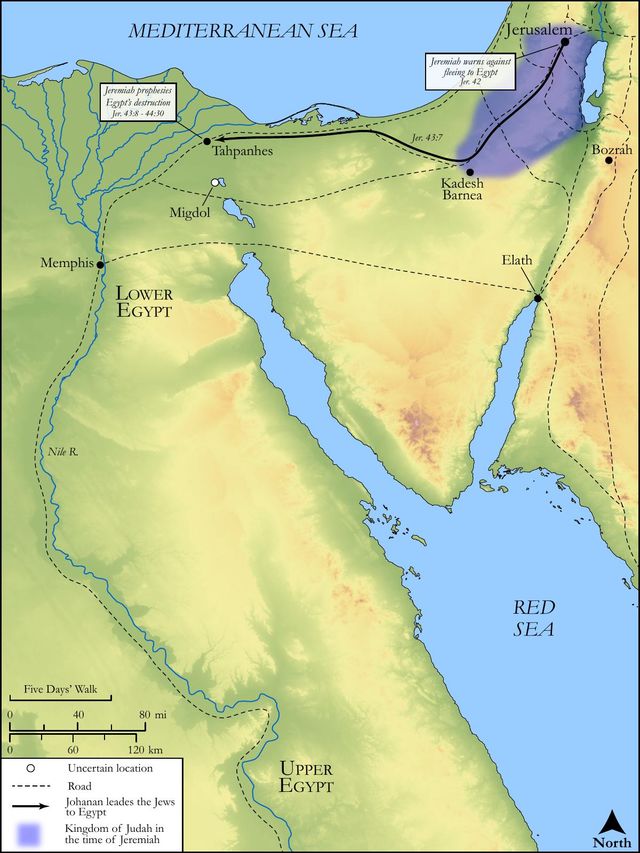
The historical setting is post-586 BC, with the Jewish remnant residing in various Egyptian cities like Migdol, Tahpanhes, and Memphis. Having witnessed the destruction of Jerusalem, the temple, and their nation—events explicitly prophesied as consequences of their idolatry and covenant breaking—one might expect repentance. However, this remnant, steeped in syncretistic practices, continued to engage in pagan worship, particularly the cult of the "Queen of Heaven," a fertility goddess. This practice was common among the nations and involved burning incense and pouring drink offerings. For the Israelites, such acts were a direct violation of the foundational covenant commands given at Sinai, particularly the prohibitions against idolatry found in Exodus 20:3-5. Their continued disobedience in Egypt, despite the clear evidence of God's judgment on Judah, highlights the profound spiritual blindness and hardened hearts of the people, demonstrating a tragic inability or unwillingness to learn from their recent history.
Key Themes
ShowHideJeremiah 44:23 powerfully articulates several core themes prevalent throughout the book of Jeremiah and the broader Old Testament narrative. Firstly, it emphasizes the inevitability of divine judgment for persistent disobedience. The "evil" that has befallen them is not random but a direct, just, and unavoidable consequence of their actions, echoing the covenant curses outlined in Deuteronomy 28:15-68. Secondly, idolatry is highlighted as a root sin, specifically "burning incense" to other gods, which represents a fundamental betrayal of their exclusive covenant relationship with the LORD. This act signifies a rejection of God's sovereignty and His unique claim on their worship, illustrating the spiritual adultery inherent in turning to false gods. Thirdly, the verse underscores the comprehensive nature of God's commands and the totality of their rebellion, referring to their failure to obey God's "law, statutes, and testimonies." This triad signifies the entirety of God's revealed will, indicating that their disobedience was not merely isolated incidents but a wholesale, deliberate rejection of God's authority and covenant requirements. Finally, the passage implicitly affirms God's faithfulness to His warnings, demonstrating that His word, whether of blessing or judgment, will always come to pass, reinforcing His unwavering character.
Exposition and Analysis
ShowHideKey Word Analysis
ShowHideThis primitive root (H6999) signifies "to smoke, i.e., turn into fragrance by fire (especially as an act of worship)." In the context of the Mosaic Law, burning incense was a sacred act, often performed by priests in the tabernacle or temple as an offering to the LORD. However, when directed towards pagan deities, as in Jeremiah 44:23, it represented a profound act of idolatry and spiritual adultery, a direct violation of God's command for exclusive worship. It was a tangible expression of transferring allegiance from Yahweh to false gods, a public declaration of spiritual infidelity.
This primitive root (H2398) primarily means "to miss" or "to miss the mark." Figuratively, it denotes falling short of a standard, deviating from a prescribed path, or failing in one's duty. In a theological sense, it describes any act, thought, or omission that falls short of God's perfect standard of righteousness and holiness. Here, it encompasses the broad spectrum of Israel's transgression against the LORD, beyond just idolatry, including their general rebellion, moral failings, and covenant breaking. It signifies a fundamental failure to align with God's character and will.
This primitive root (H8085) means "to hear intelligently," often implying attention, understanding, and crucially, compliance or obedience. It's not merely a passive reception of sound but an active hearkening that leads to action and submission. When used in the negative, as "have not obeyed," it signifies a deliberate refusal to listen to God's commands, warnings, and instructions, demonstrating a hardened heart and a defiant will against the divine authority. This lack of obedience is presented as the root cause of their comprehensive deviation from God's way.
Verse Breakdown
ShowHide"Because ye have burned incense, and because ye have sinned against the LORD"
This opening clause establishes the fundamental and primary reasons for the impending judgment. The specific act of "burning incense" highlights their egregious idolatry, a direct affront to God's covenant and His exclusive claim on their worship. This specific sin is immediately followed by the broader accusation of having "sinned against the LORD," encompassing all forms of transgression and rebellion that characterized their relationship with God. The emphatic repetition of "because" underscores the direct and undeniable causal link between their actions—both specific idolatry and general sin—and the catastrophic consequences they face.
"and have not obeyed the voice of the LORD, nor walked in his law, nor in his statutes, nor in his testimonies"
This segment elaborates on the comprehensive and pervasive nature of their disobedience. Their failure was not merely in isolated acts but a pervasive, wholesale rejection of God's revealed will. "Not obeyed the voice of the LORD" implies a deliberate refusal to heed His prophetic warnings, direct commands, and the very pronouncements of His character. The subsequent triad—"his law" (tôwrâh, God's comprehensive instruction and teaching), "his statutes" (chuqqâh, His prescribed ordinances, decrees, and fixed regulations), and "his testimonies" (ʻêdûwth, His covenant stipulations and declarations, often bearing witness to His character and will)—collectively represents the totality of God's covenant demands. Their failure to "walk" in these signifies a complete disregard for God's prescribed way of life, His moral framework, and the very path of righteousness.
"therefore this evil is happened unto you, as at this day"
This concluding clause delivers the definitive pronouncement of judgment and its present reality. The word "therefore" acts as a definitive consequence marker, directly linking their accumulated and pervasive disobedience to the "evil" (raʻ, meaning calamity, disaster, suffering, or misfortune) that has befallen them. The phrase "as at this day" emphasizes the immediate, undeniable, and ongoing reality of their suffering, serving as tangible and visible evidence of God's righteous judgment. It signifies that the calamity they are experiencing is not a past event or a future threat, but a present, observable reality directly attributable to their rebellion, a living testament to the consequences of their choices.
Literary Devices
ShowHideJeremiah 44:23 employs several potent literary devices to convey its message with clarity and force. The most prominent is Causal Conjunctions, specifically the repeated "Because" at the beginning of the verse, followed by "therefore." This structure creates a powerful and undeniable cause-and-effect relationship, leaving no ambiguity about the source of their suffering. It functions as a legal indictment, meticulously stating the charges and then pronouncing the verdict with divine authority. There is also a strong element of Anaphora and Parallelism in the repetition of "nor" ("nor walked in his law, nor in his statutes, nor in his testimonies"). This repetition emphasizes the comprehensive and pervasive nature of their disobedience, highlighting that their rebellion was not confined to one area but encompassed the entirety of God's covenant demands. The use of the Triadic Structure ("law, statutes, testimonies") further reinforces this sense of totality, representing the complete body of divine revelation and covenant requirements given to Israel. Finally, the verse is a quintessential example of Retribution Theology, a central theme in the Old Testament, where divine judgment is presented as a just and direct consequence of human sin and rebellion against God's revealed will, underscoring God's moral governance of the world.
Theological and Thematic Connections
ShowHideJeremiah 44:23 powerfully articulates the unwavering principle of divine justice and the direct, inevitable consequences of persistent sin and idolatry. It underscores God's absolute sovereignty and His faithfulness to His covenant, both in blessing for obedience and judgment for rebellion. The verse reveals that God's "law, statutes, and testimonies" are not arbitrary rules but the very framework for a flourishing life in covenant with Him. To disregard them, particularly through the egregious act of idolatry, is to invite calamity. This passage serves as a sobering reminder that spiritual infidelity has tangible, often devastating, repercussions, demonstrating that God takes sin seriously because it violates His holy character and undermines the very foundation of His relationship with His people. The "evil" they experienced was not random misfortune but the natural, divinely ordained outcome of their choices.
Reflection and Application
ShowHideJeremiah 44:23 offers a timeless and sobering lesson for believers today: actions have consequences, especially concerning our relationship with God. The "burning incense" of ancient Israel, representing idolatry and misplaced worship, finds its modern parallels in anything we elevate above God—be it career, material possessions, personal comfort, relationships, or even ideologies. If we consistently neglect God's "voice," disregard His "law," ignore His "statutes," and dismiss His "testimonies" (His Word), we, too, can expect to experience forms of "evil" in our lives, not as arbitrary punishment, but as the natural, often painful, outcome of living outside His divine order. This verse calls us to a radical self-examination, prompting us to honestly assess what we truly worship and to what extent we genuinely obey God's comprehensive will. True spiritual well-being and flourishing come not from pursuing our own desires or superstitious practices, but from wholehearted, diligent obedience to the living God, recognizing that His commands are for our good and His justice is always righteous.
Questions for Reflection
ShowHideFAQ
ShowHideWhat was the "evil" that happened to them "as at this day"?
ShowHideThe "evil" (Hebrew: raʻ, H7451) refers to the calamitous state and suffering that had already befallen the Jewish remnant and was continuing "as at this day." This included the devastating destruction of Jerusalem, the temple, and their homeland, which forced them into exile. Their current predicament as refugees in Egypt, facing further divine judgment and ultimate destruction there (as prophesied later in Jeremiah 44:26-28), was the direct manifestation of this "evil." It was a tangible, undeniable consequence of their persistent rebellion and idolatry against the LORD, demonstrating God's faithfulness to His covenant warnings and the certainty of His justice.
Why is "burning incense" specifically mentioned as a sin?
ShowHideBurning incense (Hebrew: qâṭar', H6999) was a deeply significant act of worship among the nations, often used to honor deities. For the Israelites, while legitimate incense offerings were prescribed for the LORD in the tabernacle and temple, offering incense to other gods was a direct and egregious violation of the first two commandments: "Thou shalt have no other gods before me" and "Thou shalt not make unto thee any graven image... Thou shalt not bow down thyself to them, nor serve them" (Exodus 20:3-5). Their specific act of "burning incense" to the "Queen of Heaven," as mentioned in Jeremiah 44:17-19, symbolized a complete spiritual betrayal and a transfer of their allegiance from the covenant-keeping God of Israel to pagan deities. It was a tangible and highly offensive expression of their idolatry and unfaithfulness, representing the heart of their covenant breach.
Christ-Centered Fulfillment
ShowHideJeremiah 44:23 powerfully illustrates the Old Covenant principle that sin brings judgment and disobedience leads to calamity. Israel's failure to "walk in his law, nor in his statutes, nor in his testimonies" resulted in the "evil" that befell them. This stark reality points forward to the ultimate solution found in Christ. Humanity, like Israel, has universally "sinned and fallen short of the glory of God" (Romans 3:23), incurring the just wages of sin, which is death (Romans 6:23). Jesus Christ, however, perfectly fulfilled the law where Israel failed; He "obeyed the voice of the LORD" in every respect, living a life of perfect righteousness, thereby reversing the disobedience of Adam and all humanity (Romans 5:19). More profoundly, He became the Lamb of God who bore the curse of the law for us, taking upon Himself the "evil" that our disobedience deserved (Galatians 3:13). Through His atoning sacrifice on the cross, the judgment for sin was satisfied, allowing for forgiveness and reconciliation with God. For those who believe in Him, the condemnation for disobedience is removed, and a new covenant is established, not based on our imperfect obedience, but on His perfect work, enabling us to "walk in newness of life" (Romans 6:4) by the power of the Holy Spirit. Thus, Jeremiah 44:23, while a testament to divine judgment, ultimately magnifies the boundless grace and redemptive power of Christ, who delivers us from the consequences of our sin and empowers us to live in true obedience and fellowship with God.