


Jeremiah 33:12
Bible text: King James Version (1769 Blayney text) · Public domain
Bible text: King James Version with Strong's numbers · Public domain
Bible text: Berean Standard Bible · Public domain
Bible text: American Standard Version (1901) · Public domain
Bible text: World English Bible, Messianic edition · Public domain
Bible text: Geneva Bible (1599) · Public domain
Bible text: Young's Literal Translation · Public domain
- כֹּהkohthusH3541AdvAdverb
- אָמַר'a·Marhe saysH559V-Qal-Perf-3msVerb Qal Perfect 3rd Singular Masculine
- יְהוָהYah·wehYahwehH3068N-properNoun Proper Title
- צְבָאוֹתtze·va·'Otof hostsH6635N-fpNoun Plural Feminine Absolute
- עוֹדodagainH5750Adj-msAdjective Numerical Singular Masculine Absolute
- יִהְיֶהyih·Yehit will beH1961V-Qal-Imperf-3msVerb Qal Imperfect 3rd Singular Masculine
- בַּמָּקוֹםba·ma·Komin the placeH4725Prep-b ¦ N-msNoun Singular Masculine Absoluteבַּin theמָּקוֹםplace
- הַזֶּהha·Zeh<the> thisH2088Art ¦ PrtParticle Demonstrativeהַ<the>זֶּהthis
- הֶחָרֵבhe·cha·Rev<the> desolateH2720Art ¦ Adj-msAdjective Singular Masculine Absoluteהֶ<the>חָרֵבdesolate
- מֵאֵיןme·'einfrom notH369Prep-m ¦ N-mscNoun Singular Masculine Constructמֵfromאֵיןnot
- אָדָם'a·Damhuman beingH120N-msNoun Singular Masculine Absolute
- וְעַדve·'adand untoH5704Conj-w ¦ PrepPrepositionוְandעַדunto
- בְּהֵמָהbe·he·Mahan animalH929N-fsNoun Singular Feminine Absolute
- וּבְכָלu·ve·Kholand in allH3605Conj-w ¦ Prep-b ¦ N-mscNoun Singular Masculine Constructוּandבְinכָלall
- עָרָיו'a·Ravits citiesH5892N-mpc ¦ 3msNoun Plural Masculine Constructעָרָיcitiesוits
- נְוֵהne·Vehpasture ofH5116N-mscNoun Singular Masculine Construct
- רֹעִיםro·'ImshepherdsH7462V-Qal-Prtcpl-mpVerb Qal Participle Plural Masculine Absolute
- מַרְבִּצִיםmar·bi·Tzim[who] make to lie downH7257V-Hiphil-Prtcpl-mpVerb Hiphil Participle Plural Masculine Absolute
- צֹאןTzonflock[s]H6629N-csNoun Singular common gender Absolute
English is a literal word-by-word gloss of the Hebrew, not the KJV's wording. Why?
This is the original text the KJV's translators worked from — each Hebrew word with its own literal English meaning in this verse, prepared by scholars at Tyndale House, Cambridge. The KJV translates whole sentences, not word by word, so its wording differs: one Hebrew word can become several English words, and the KJV may choose “the LORD” where the gloss reads “Yahweh”. Both are faithful — they answer different questions. For the KJV's own rendering, switch to the KJV text.
Details
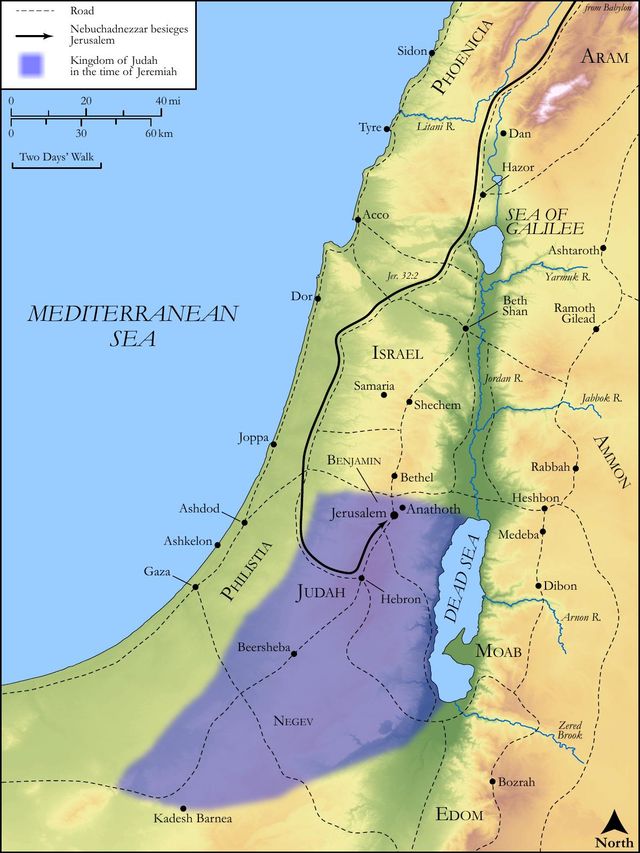
See on the biblical-era map
Study this verse
Public-domain commentary
Matthew Henry
From his Commentary on the Whole Bible. Henry comments on passages, not single verses — this entry covers Jeremiah 33:10–16. His two-level outline is real structure in the source text, so it is rendered as structure.
Here is a further prediction of the happy state of Judah and Jerusalem after their glorious return out of captivity, issuing gloriously at length in the kingdom of the Messiah.
I.It is promised that the people who were long in sorrow shall again be filled with joy.
Every one concluded now that the country would lie for ever desolate, that no beasts would be found in the land of Judah, no inhabitant in the streets of Jerusalem, and consequently there would be nothing but universal and perpetual melancholy (Jer 33:10); but, though weeping may endure for a time, joy will return. It was threatened (Jer 7:34 and Jer 16:9) that the voice of joy and gladness should cease there; but here it is promised that they shall revive again, that the voice of joy and gladness shall be heard there, because the captivity shall be returned; for then was their mouth filled with laughter, Psa 126:1, Psa 126:2.
1.There shall be common joy there, the voice of the bridegroom and the voice of the bride; marriages shall again be celebrated, as formerly, with songs, which in Babylon they had laid aside, for their harps were hung on the willow-trees.
2.There shall be religious joy there; temple-songs shall be revived, the Lord's songs, which they could not sing in a strange land. There shall be heard in their private houses, and in the cities of Judah, as well as in the temple, the voice of those that shall say, Praise the Lord of hosts. Note, Nothing is more the praise and honour of a people than to have God the glory of it, the glory both of the power and of the goodness by which it is effected; they shall prise him both as the Lord of hosts and as the God who is good and whose mercy endures for ever. This, though a song of old, yet, being sung upon this fresh occasion, will be a new song. We find this literally fulfilled at their return out of Babylon, Ezr 3:11. They sang together in praising the Lord, because he is good, for his mercy endures for ever. The public worship of God shall be diligently and constantly attended upon: They shall bring the sacrifice of praise to the house of the Lord. All the sacrifices were intended for the praise of God, but this seems to be meant of the spiritual sacrifices of humble adorations and joyful thanksgivings, the calves of our lips (Hos 14:2), which shall please the Lord better than an ox of bullock. The Jews say that in the days of the Messiah all sacrifices shall cease but the sacrifice of praise, and to those days this promise has a further reference.
II.It is promised that the country, which had lain long depopulated, shall be replenished and stocked again.
It was now desolate, without man and without beast; but, after their return, the pastures shall again be clothed with flocks, Psa 65:13. In all the cities of Judah and Benjamin there shall be a habitation of shepherds, Jer 33:12, Jer 33:13. This intimates,
1.The wealth of the country, after their return. It shall not be a habitation of beggars, who have nothing, but of shepherds and husbandmen, men of substance, with good stocks upon the ground they have returned to.
2.The peace of the country. It shall not be a habitation of soldiers, not shall there be tents and barracks set up to lodge them, but there shall be shepherds; tents; for they shall hear no more the alarms of war, nor shall there be any to make even the shepherds afraid. See Psa 144:13, Psa 144:14.
3.The industry of the country, and their return to their original plainness and simplicity, from which, in the corrupt ages, they had sadly degenerated. The seed of Jacob, in their beginning, gloried in this, that they were shepherds (Gen 47:3), and so they shall now be again, giving themselves wholly to that innocent employment, causing their flocks to lie down (Jer 33:12) and to pass under the hands of him that telleth them (Jer 33:13); for, though their flocks are numerous, they are not numberless, nor shall they omit to number them, that they may know if any be missing and may seek after it. Note, It is the prudence of those who have ever so much of the world to keep an account of what they have. Some think that they pass under the hand of him that telleth them that they may be tithed, Lev 27:32. Then we may take the comfort of what we have when God has had his dues out of it. Now because it seemed incredible that a people, reduced as now they were, should ever recover such a degree of peace and plenty as this, here is subjoined a general ratification of these promises (Jer 33:14): I will perform that good thing which I have promised. Though the promise may sometimes work slowly towards an accomplishment, it works surely. The days will come, though they are long in coming.
III.To crown all these blessings which God has in store for them, here is a promise of the Messiah, and of that everlasting righteousness which he should bring in (Jer 33:15, Jer 33:16), and probably this is that good thing, that great good thing, which in the latter days, days that were yet to come, God would perform, as he had promised to Judah and Israel, and to which their return out of captivity and their settlement again in their own land was preparatory. From the captivity to Christ is one of the famous periods, Mat 1:17. This promise of the Messiah we had before (Jer 23:5, Jer 23:6), and there it came in as a confirmation of the promise of the shepherds whom God would set over them, which would make one think that the promise here concerning the shepherds and their flocks, which introduces it, is to be understood figuratively. Christ is here prophesied of,
1.As a rightful King. He is a branch of righteousness, not a usurper, for he grows up unto David, descends from his loins, with whom the covenant of royalty was made, and is that seed with whom that covenant should be established, so that his title is unexceptionable.
2.As a righteous king, righteous in enacting laws, waging wars, and giving judgment, righteous in vindicating those that suffer wrong and punishing those that do wrong: He shall execute judgment and righteousness in the land. This may point at Zerubbabel, in the type, who governed with equity, not as Jehoiakim had done (Jer 22:17); but it has a further reference to him to whom all judgment is committed and who shall judge the world in righteousness.
3.As a king that shall protect his subjects from all injury. By him Judah shall be saved from wrath and the curse, and, being so saved, Jerusalem shall dwell safely, quiet from the fear of evil, and enjoying a holy security and serenity of mind, in a dependence upon the conduct of this prince of peace, this prince of their peace.
4.As a king that shall be praised by his subjects: "This is the name whereby they shall call him" (so the Chaldee reads it, the Syriac, and vulgar Latin); "this name of his they shall celebrate and triumph in, and by this name they shall call upon him." It may be read, more agreeably to the original, This is he who shall call her, The Lord our righteousness. As Moses's altar is called Jehovah-nissi (Exo 17:15), and Jerusalem Jehovah-shammah (Eze 48:35), intimating that they glory in Jehovah as present with them and their banner, so here the city is called The Lord our righteousness, because they glory in Jehovah as their righteousness. That which was before said to be the name of Christ (says Mr. Gataker) is here made the name of Jerusalem, the city of the Messiah, the church of Christ. He it is that imparts righteousness to her, for he is made of God to us righteousness, and she, by bearing that name, professes to have her whole righteousness, not from herself, but from him. In the Lord have I righteousness and strength, Isa 45:24. And we are made the righteousness of God in him. The inhabitants of Jerusalem shall have this name of the Messiah so much in their mouths that they shall themselves be called by it.
Continue studying Jeremiah 33:12 across the web’s major study libraries — every link below opens this exact verse, chapter, or book on the destination site.
Read & Compare
 BibleGatewayThis verse in more than 200 translations and 70 languages.
 Bible.comThe YouVersion reader — hundreds of translations, reading plans, and highlights.
 ESV.orgCrossway's official English Standard Version reader.
 NET BibleThe NET translation with 60,000+ translators' notes on every rendering decision.
 STEP BibleTyndale House's free study tool — original text, vocabulary, and scholarly resources.
 BibliaLogos Bible Software's free web reader.
 USCCBThe New American Bible (Revised Edition) with the U.S. bishops' study notes.
Commentaries
 BibleHub CommentariesDozens of classic commentaries on this verse, gathered on one page.
 StudyLightMore than 100 commentary sets — the largest collection on the web.
 BibleRefPlain-English commentary on what this verse means, verse by verse.
 Enduring WordDavid Guzik's free commentary on this chapter, widely used by Bible teachers.
 Bible Study ToolsVerse commentary alongside Greek and Hebrew study aids.
Original Language & Research
- BibleHub InterlinearThe verse word by word — original language, transliteration, and English.
- BibleHub LexiconEvery word's original-language definition and Strong's entry.
 Blue Letter BibleDeep-study tools — Strong's numbers, concordance, and word studies.
 SefariaThe Hebrew text with Rashi and centuries of Jewish commentary.
Sermons, Hymns & Audio


TrulyRandomVerse is not affiliated with these sites and doesn’t control their content. They’re linked because they’re genuinely useful.
Summary
Jeremiah 33:12 delivers a profound promise of divine restoration, declaring that the land of Judah, currently desolate and devoid of life due to judgment, will once again flourish. Through the authoritative word of the LORD of hosts, what was barren will become a peaceful habitation where shepherds tend their flocks, symbolizing a return to prosperity, security, and the tranquil order that God intends for His people. This verse stands as a beacon of hope, affirming God's power to reverse even the most dire circumstances and fulfill His covenant promises.
Context
ShowHideLiterary Context
This verse is situated within the "Book of Consolation" (Jeremiah 30-33), a section of Jeremiah's prophecy dedicated to promises of future restoration for Judah and Israel, despite their present suffering and impending exile. Chapters 30-31 detail the return of the exiles and the establishment of a New Covenant, while chapters 32-33 focus on the certainty of these promises, even as Jerusalem is under siege. Jeremiah 33:12 specifically reinforces the physical and agricultural renewal of the land, complementing earlier promises of spiritual healing (Jeremiah 33:6) and the re-establishment of a righteous Davidic king (Jeremiah 33:15-16). It serves as a tangible illustration of the comprehensive "good" that the Lord will bring upon His people, as mentioned in Jeremiah 33:14.
Historical & Cultural Context
Jeremiah prophesied during a tumultuous period leading up to and during the Babylonian exile. By the time this prophecy was given, Jerusalem was either under siege or had already fallen, and the land of Judah was being systematically depopulated and devastated. The description "desolate without man and without beast" vividly portrays the severity of God's judgment for Judah's persistent idolatry and covenant unfaithfulness. In Israel, the presence of thriving flocks and shepherds was a primary indicator of peace, prosperity, and a well-ordered society. The absence of these signified utter ruin and divine displeasure, making the promise of their return a powerful symbol of complete restoration.
Key Themes
ShowHideThe verse powerfully articulates several core themes. Firstly, Divine Sovereignty and the Certainty of God's Word is underscored by the authoritative declaration, "Thus saith the LORD of hosts." This title emphasizes God's absolute power and control over all creation, ensuring that His promises, no matter how impossible they seem, will be fulfilled. Secondly, the theme of Restoration and Reversal of Judgment is central. The transformation from a land "desolate without man and without beast" to a "habitation of shepherds causing their flocks to lie down" illustrates God's capacity to bring life out of death and abundance out of barrenness, reversing the consequences of sin and judgment. This echoes similar promises of renewal found in passages like Ezekiel 36:33-36. Finally, the imagery conveys a profound sense of Peace, Security, and Abundance. The picture of flocks resting peacefully under the care of shepherds is a timeless biblical metaphor for shalom—wholeness, well-being, and freedom from fear. This pastoral ideal is reminiscent of the Lord's care for His people as a shepherd, as beautifully depicted in Psalm 23.
Exposition and Analysis
ShowHideKey Word Analysis
ShowHideThis word (H2720) signifies a state of being parched or ruined, indicating a land that is dry and wasted. In Jeremiah 33:12, it vividly describes the physical condition of Judah's land and cities—a consequence of divine judgment and the ravages of war. It implies not just emptiness, but a destructive emptiness, a land rendered unusable and devoid of the life it once sustained. The promise of reversal is thus all the more striking against this backdrop of utter ruin.
This term (H5116) denotes a home, dwelling place, or pasture. It carries connotations of being "at home," implying satisfaction, comfort, and security. In contrast to "desolate," "nâveh" points to a place where life can thrive, where people and animals can dwell safely and peacefully. For flocks, it specifically refers to a fold or a pleasant pasture where they can rest, highlighting the return of order, productivity, and well-being.
This primitive root (H7257) describes the act of an animal crouching or reclining, typically in a state of rest or repose. For flocks, it signifies a state of peace, security, and contentment, where they are not threatened by predators or forced to wander in search of food. The image of flocks "causing their flocks to lie down" is the ultimate picture of a land restored to tranquility and abundance, where basic needs are met and safety is assured under the care of a shepherd.
Verse Breakdown
ShowHide"Thus saith the LORD of hosts"
This opening phrase is a classic prophetic formula, asserting the divine origin and absolute authority of the message. It emphasizes that the following promise is not a human wish or speculation but a certain declaration from God, who possesses unlimited power and is the sovereign commander of all creation ("hosts" referring to armies, heavenly bodies, or all created things). This divine endorsement guarantees the fulfillment of the prophecy.
"Again in this place, which is desolate without man and without beast, and in all the cities thereof"
This clause starkly describes the current reality of Judah. The phrase "this place" refers specifically to the land of Judah and its cities, including Jerusalem, which had been devastated by the Babylonian invasion. "Desolate without man and without beast" paints a picture of utter emptiness and ruin, signifying a complete reversal of the life and vibrancy that once characterized the land. The repetition of "without" underscores the thoroughness of the desolation, making the subsequent promise of restoration even more dramatic.
"shall be an habitation of shepherds causing [their] flocks to lie down"
This is the core of the promise, a vivid counter-image to the desolation. "An habitation of shepherds" signifies the return of human population and economic activity, particularly the vital pastoral life. The phrase "causing their flocks to lie down" evokes deep peace, security, and prosperity. Flocks lie down when they are well-fed, safe from danger, and content. This imagery points to a future where the land is fertile, the people are secure, and life thrives under divine blessing, reversing the judgment and ushering in an era of shalom.
Literary Devices
ShowHideJeremiah 33:12 masterfully employs several literary devices to convey its powerful message of hope. The most prominent is Contrast, setting the stark reality of "desolate without man and without beast" directly against the promised future of "an habitation of shepherds causing their flocks to lie down." This juxtaposition highlights the dramatic reversal God will bring about, emphasizing His power to transform utter ruin into flourishing life. Imagery is central, with the pastoral scene of shepherds and resting flocks serving as a rich symbol. This imagery evokes peace, security, abundance, and the tender care of a shepherd, which in biblical thought often represents God's relationship with His people. The phrase "Thus saith the LORD of hosts" functions as a Prophetic Formula, lending immense authority and certainty to the declaration. It underscores that the promise is not merely a comforting thought but an unshakeable decree from the sovereign God, assuring its inevitable fulfillment.
Theological and Thematic Connections
ShowHideJeremiah 33:12 powerfully articulates God's unwavering commitment to His covenant promises, even in the face of His people's profound unfaithfulness and the devastating consequences of their sin. It reveals a God who, though just in judgment, is ultimately merciful and faithful to His redemptive purposes. The restoration promised here is not merely a return to a past state but a demonstration of God's sovereign power to create new life and order out of chaos and desolation. It underscores the theological truth that God's ultimate plan for His people is one of flourishing and peace, a future secured by His own authoritative word. This verse also highlights the theme of divine care, portraying God as the ultimate Shepherd who will gather and protect His flock, providing them with security and rest.
Reflection and Application
ShowHideJeremiah 33:12 offers profound encouragement for believers facing periods of personal or communal desolation. Just as Judah experienced utter ruin, we too can encounter circumstances that feel barren, hopeless, or "without man and without beast"—whether it's a broken relationship, a lost dream, a spiritual wilderness, or societal decay. This verse serves as a powerful reminder that God's promises transcend our present realities. His word, spoken with the authority of the "LORD of hosts," has the power to transform any wasteland into a place of peace, security, and flourishing. It calls us to cultivate a radical hope, trusting that even when all seems lost, God is actively working to bring about His good and perfect will, restoring what was broken and bringing life where there was only emptiness. We are invited to rest in His faithfulness, knowing that He is our Good Shepherd who desires for us to "lie down" in peace, even amidst the storms of life.
Questions for Reflection
ShowHideFAQ
ShowHideWhat is the significance of the title "LORD of hosts" in this verse?
ShowHideThe title "LORD of hosts" (Hebrew: Yahweh Sabaoth) is highly significant. "Sabaoth" refers to armies, multitudes, or heavenly bodies, emphasizing God's supreme power, sovereignty, and His command over all creation—both earthly and celestial. In the context of Jeremiah 33:12, where God is promising to reverse utter desolation, this title reinforces the absolute certainty and authority of His word. It assures the hearers that the one making this seemingly impossible promise is the Almighty God, who has the power to bring about what He declares, even in the most desperate circumstances. This title underscores His capacity to intervene decisively and supernaturally, making His promises utterly reliable. For more on God's power, see Psalm 24:10.
How does Jeremiah 33:12 relate to the Babylonian exile?
ShowHideJeremiah 33:12 is inextricably linked to the Babylonian exile. At the time of this prophecy, Judah was facing or had already endured the devastating consequences of the Babylonian invasion, which led to the destruction of Jerusalem and the forced deportation of its inhabitants. The land was left "desolate without man and without beast" as a direct result of this judgment. Therefore, the promise in Jeremiah 33:12 is a direct counter-narrative to this historical reality. It assures the exiles and those left behind that the desolation is not God's final word. Instead, it is a promise of future physical restoration and repopulation of the land, signifying an end to the exile and a return to peace and prosperity under God's blessing. This promise is part of the broader "Book of Consolation" (Jeremiah 30-33), which looks beyond the immediate judgment to a glorious future for God's people.
Christ-Centered Fulfillment
ShowHideJeremiah 33:12 finds its ultimate and most profound fulfillment in Jesus Christ, who embodies the very essence of God's restorative promise. While the immediate context speaks to the physical return and renewal of the land of Israel, the spiritual reality foreshadowed points directly to the work of the Messiah. Jesus is the Good Shepherd who lays down His life for His sheep, leading them to true peace and security, causing them to "lie down" in spiritual green pastures, as foretold in Psalm 23. Through His atoning sacrifice and resurrection, Christ reverses the spiritual desolation brought about by sin, which had left humanity "without man and without beast" in terms of true fellowship with God. He brings spiritual life to those who were dead in trespasses and sins (Ephesians 2:1-5), transforming barren hearts into habitations for the Holy Spirit (1 Corinthians 6:19). The New Covenant, promised in Jeremiah 31:31-34, is inaugurated in Christ's blood, bringing about a spiritual restoration that transcends physical land. In Him, believers find true rest, security, and abundant life, anticipating the final and complete restoration of all things in the new heavens and new earth, where God's people will dwell in perfect shalom under the eternal reign of the Lamb of God.