


Jeremiah 32:33
Bible text: King James Version (1769 Blayney text) · Public domain
Bible text: King James Version with Strong's numbers · Public domain
Bible text: Berean Standard Bible · Public domain
Bible text: American Standard Version (1901) · Public domain
Bible text: World English Bible, Messianic edition · Public domain
Bible text: Geneva Bible (1599) · Public domain
Bible text: Young's Literal Translation · Public domain
- וַיִּפְנוּvai·yif·Nuand they turnedH6437Conj-w ¦ V-Qal-ConsecImperf-3mpVerb Qal Consecutive Imperfect 3rd Plural Masculineוַandיִּפְנוּthey turned
- אֵלַי'e·Laito meH413Prep ¦ 1csPreposition Definiteאֵלַtoיme
- עֹרֶף'O·refa backH6203N-msNoun Singular Masculine Absolute
- וְלֹאve·Lo'and notH3808Conj-w ¦ NegParticle Negativeוְandלֹאnot
- פָנִיםfa·Nima faceH6440N-mpNoun Plural Masculine Absolute
- וְלַמֵּדve·la·Medand I taughtH3925Conj-w ¦ V-Piel-InfVerb Piel Infinitive ConstructוְandלַמֵּדI taught
- אֹתָם'o·Tam<obj.> themH853DirObjM ¦ 3mpParticle Object Indicatorאֹתָ<obj.>םthem
- הַשְׁכֵּםhash·Kemrising earlyH7925V-Hiphil-InfAbsVerb Hiphil Infinitive Absolute
- וְלַמֵּדve·la·Medand teachingH3925Conj-w ¦ V-Piel-InfVerb Piel Infinitive Constructוְandלַמֵּדteaching
- וְאֵינָםve·'ei·Namand not theyH369Conj-w ¦ N-msc ¦ 3mpNoun Singular Masculine Constructוְandאֵינָnotםthey
- שֹׁמְעִיםsho·me·'Im[were] listeningH8085V-Qal-Prtcpl-mpVerb Qal Participle Plural Masculine Absolute
- לָקַחַתla·Ka·chatto acceptH3947Prep-l ¦ V-Qal-InfVerb Qal Infinitive Constructלָtoקַחַתaccept
- מוּסָרmu·SarcorrectionH4148N-msNoun Singular Masculine Absolute
English is a literal word-by-word gloss of the Hebrew, not the KJV's wording. Why?
This is the original text the KJV's translators worked from — each Hebrew word with its own literal English meaning in this verse, prepared by scholars at Tyndale House, Cambridge. The KJV translates whole sentences, not word by word, so its wording differs: one Hebrew word can become several English words, and the KJV may choose “the LORD” where the gloss reads “Yahweh”. Both are faithful — they answer different questions. For the KJV's own rendering, switch to the KJV text.
Details
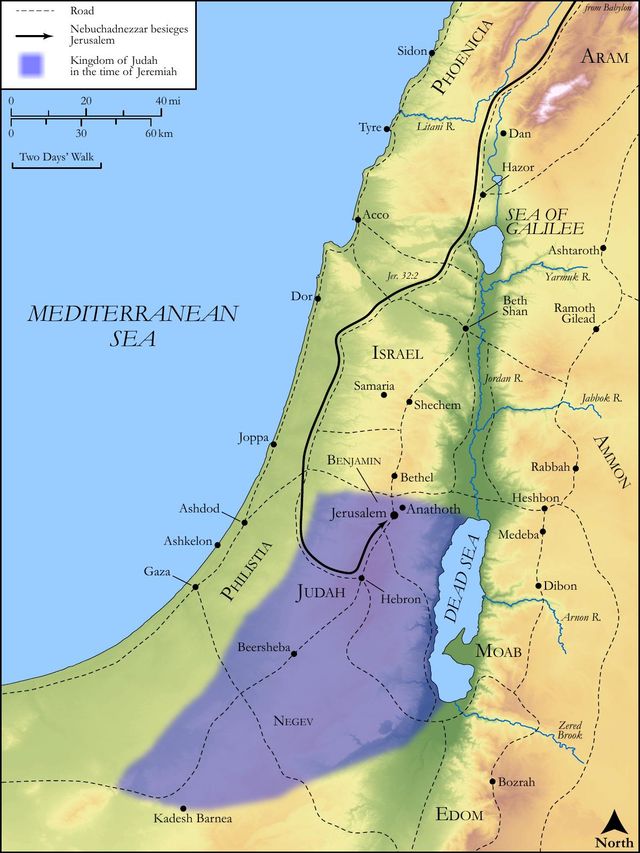
See on the biblical-era map
Study this verse
Public-domain commentary
Matthew Henry
From his Commentary on the Whole Bible. Henry comments on passages, not single verses — this entry covers Jeremiah 32:26–44. His four-level outline is real structure in the source text, so it is rendered as structure.
We have here God's answer to Jeremiah's prayer, designed to quiet his mind and make him easy; and it is a full discovery of the purposes of God's wrath against the present generation and the purposes of his grace concerning the future generations. Jeremiah knew not how to sing both of mercy and judgment, but God here teaches to sing unto him of both. When we know not how to reconcile one word of God with another we may yet be sure that both are true, both are pure, both shall be made good, and not one iota or tittle of either shall fall to the ground. When Jeremiah was ordered to buy the field in Anathoth he was willing to hope that God was about to revoke the sentence of his wrath and to order the Chaldeans to raise the siege. "No," says God, "the execution of the sentence shall go on; Jerusalem shall be laid in ruins." Note, Assurances of future mercy must not be interpreted as securities from present troubles. But, lest Jeremiah should think that his being ordered to buy this field intimated that all the mercy God had in store for his people, after their return, was only that they should have the possession of their own land again, he further informs him that that was but a type and figure of those spiritual blessings which should then be abundantly bestowed upon them, unspeakably more valuable than fields and vineyards; so that in this word of the Lord, which came to Jeremiah, we have first as dreadful threatenings and then as precious promises as perhaps any we have in the Old Testament; life and death, good and evil, are here set before us; let us consider and choose wisely.
I.The ruin of Judah and Jerusalem is here pronounced. The decree has gone forth, and shall not be recalled.
1.God here asserts his own sovereignty and power (Jer 32:27): Behold, I am Jehovah, a self-existent self-sufficient being; I am that I am; I am the God of all flesh, that is, of all mankind, here called flesh because weak and unable to contend with God (Psa 56:4), and because wicked and corrupt and unapt to comply with God. God is the Creator of all, and makes what use he pleases of all. He that is the God of Israel is the God of all flesh and of the spirits of all flesh, and, if Israel were cast off, could raise up a people to his name out of some other nation. If he be the God of all flesh, he may well ask, Is any thing too hard for me? What cannot he do from whom all the powers of men are derived, on whom they depend, and by whom all their actions are directed and governed? Whatever he designs to do, whether in wrath or in mercy, nothing can hinder him nor defeat his designs.
2.He abides by that he had often said of the destruction of Jerusalem by the king of Babylon (Jer 32:28): I will give this city into his hand, now that he is grasping at it, and he shall take it and make a prey of it, Jer 32:29. The Chaldeans shall come and set fire to it, shall burn it and all the houses in it, God's house not excepted, nor the king's neither.
3.He assigns the reason for these severe proceedings against the city that had been so much in his favour. It is sin, it is that and nothing else, that ruins it.
(1.)They were impudent and daring in sin. They offered incense to Baal, not in corners, as men ashamed or afraid of being discovered, but upon the tops of their houses (Jer 32:29), in defiance of God's justice.
(2.)They designed an affront to God herein. They did it to provoke me to anger, Jer 32:29. They have only provoked me to anger with the works of their hands, Jer 32:30. They could not promise themselves any pleasure, profit, or honour out of it, but did it on purpose to offend God. And again (Jer 32:32), All the evil which they have done was to provoke me to anger. They knew he was a jealous God in the matters of his worship, and there they resolved to try his jealousy and dare him to his face. "Jerusalem has been to me a provocation of my anger and fury," Jer 32:31. Their conduct in every thing was provoking.
(3.)They began betimes, and had continued all along provoking to God: "They have done evil before me from their youth, ever since they were first formed into a people (Jer 32:30), witness their murmurings and rebellions in the wilderness." And as for Jerusalem, though it was the holy city, it has been a provocation to the holy God from the day that they built it, even to this day, Jer 32:31. O what reason have we to lament the little honour God has from this world, and the great dishonour that is done him, when even in Judah, where he is known and his name is great, and in Salem where his tabernacle is, there was always that found that was a provocation to him!
(4.)All orders and degrees of men contributed to the common guilt, and therefore were justly involved in the common ruin. Not only the children of Israel, that had revolted from the temple, but the children of Judah too, that still adhered to it - not only the common people, the men of Judah and inhabitants of Jerusalem, but those that should have reproved and restrained sin in others were themselves ringleaders in it, their kings and princes, their priests and prophets.
(5.)God had again and again called them to repentance, but they turned a deaf ear to his calls, and rudely turned their back on him that called them, though he was their master, to whom they were bound in duty, and their benefactor, to whom they were bound in gratitude and interest, Jer 32:33. "I taught them better manners, with as much care as ever any tender parent taught a child, rising up early, in teaching them, studying to adapt the teaching to their capacities, taking them betimes, when they might have been most pliable, but all in vain; they turned not the face to me, would not so much as look upon me, nay, they turned the back upon me," an expression of the highest contempt. As he called them, like froward children, so they went from him, Hos 11:2. They have not hearkened to receive instruction; they regarded not a word that was said to them, though it was designed for their own good.
(6.)There was in their idolatries an impious contempt of God; for (Jer 32:34) they set their abominations (their idols, which they knew to be in the highest degree abominable to God) in the house which is called by my name, to defile it. They had their idols not only in their high places and groves, but even in God's temple.
(7.)They were guilty of the most unnatural cruelty to their own children; for they sacrificed them to Moloch, Jer 32:35. Thus because they liked not to retain God in their knowledge, but changed his glory into shame, they were justly given up to vile affections and stripped of natural ones, and their glory was turned into shame. And,
(8.)What was the consequence of all this?
[1.]They caused Judah to sin, Jer 32:35. The whole country was infected with the contagious idolatries and iniquities of Jerusalem.
[2.]They brought ruin upon themselves. It was as if they had done it on purpose that God should remove them from before his face (Jer 32:31); they would throw themselves out of his favour.
II.The restoration of Judah and Jerusalem is here promised, Jer 32:36, etc.
God will in judgment remember mercy, and there will a time come, a set time, to favour Zion. Observe,
1.The despair to which this people were now at length brought. When the judgment was threatened at a distance they had no fear; when it attacked them they had no hope. They said concerning the city (Jer 32:36), It shall be delivered into the hand of the king of Babylon, not by any cowardice or ill conduct of ours, but by the sword, famine, and pestilence. Concerning the country they said, with vexation (Jer 32:43), It is desolate, without man or beast; there is no relief, there is no remedy. It is given into the hand of the Chaldeans. Note, Deep security commonly ends in deep despair; whereas those that keep up a holy fear at all times have a good hope to support them in the worst of times.
2.The hope that God gives them of mercy which he had in store for them hereafter. Though their carcases must fall in captivity, yet their children after them shall again see this good land and the goodness of God in it.
(1.)They shall be brought up from their captivity and shall come and settle again in this land, Jer 32:37. They had been under God's anger and fury, and great wrath; but now they shall partake of his grace, and love, and great favour. He had dispersed them, and driven them into all countries. Those that fled dispersed themselves; those that fell into the enemies; hands were dispersed by them, in policy, to prevent combinations among them. God's hand was in both. But now God will find them out, and gather them out of all the countries whither they were driven, as he promised in the law (Deu 30:3, Deu 30:4) and the saints had prayed, Psa 106:47; Neh 1:9. He had banished them, but he will bring them again to this place, which they could not but have an affection for. For many years past, while they were in their own land, they were continually exposed, and terrified with the alarms of war; but now I will cause them to dwell safely. Being reformed, and having returned to God, neither their own consciences within nor their enemies without shall be a terror to them. He promises (Jer 32:41): I will plant them in this land assuredly; not only I will certainly do it, but they shall here enjoy a holy a security and repose, and they shall take root here, shall be planted in stability, and not again be unfixed and shaken.
(2.)God will renew his covenant with them, a covenant of grace, the blessings of which are spiritual, and such as will work good things in them, to qualify them for the great things God intended to do for them. It is called an everlasting covenant (Jer 32:40), not only because God will be for ever faithful to it, but because the consequences of it will be everlasting. For, doubtless, here the promises look further than to Israel according to the flesh, and are sure to all believers, to every Israelite indeed. Good Christians may apply them to themselves and plead them with God, may claim the benefit of them and take the comfort of them.
[1.]God will own them for his, and make over himself to them to be theirs (Jer 32:38): They shall be my people. He will make them his by working in them all the characters and dispositions of his people, and then he will protect, and guide, and govern them as his people. "And, to make them truly, completely, and eternally happy, I will be their God." They shall serve and worship God as theirs and cleave to him only, and he will approve himself theirs. All he is, all he has, shall be engaged and employed for their good.
[2.]God will give them a heart to fear him, Jer 32:39. That which he requires of those whom he takes into covenant with him as his people is that they fear him, that they reverence his majesty, dread his wrath, stand in awe of his authority, pay homage to him, and give him the glory due unto his name. Now what God requires of them he here promises to work in them, pursuant to his choice of them as his people. Note, As it is God's prerogative to fashion men's hearts, so it is his promise to his people to fashion theirs aright; and a heart to fear God is indeed a good heart, and well fashioned. It is repeated (Jer 32:40): I will put my fear in their hearts, that is, work in them gracious principles and dispositions, that shall influence and govern their whole conversation. Teachers may put good things into our heads, but it is God only that can put them into our hearts, that can work in us both to will and to do.
[3.]He will give them one heart and one way. In order to their walking in one way, he will give them one heart: as the heart is, so will the way be, and both shall be one; that is First, They shall be each of them one with themselves. One heart is the same with a new heart, Eze 11:19. The heart is then one when it is fully determined for God and entirely devoted to God. When the eye is single and God's glory alone aimed at, when our hearts are fixed, trusting in God, and we are uniform and universal in our obedience to him, then the heart is one and way one; and, unless the heart be thus steady, the goings will not be stedfast. From this promise we may take direction and encouragement to pray, with David (Psa 86:11), Unite my heart to fear thy name; for God says, I will give them one heart, that they may fear me. Secondly, They shall be all of them one with each other. All good Christians shall be incorporated into one body; Jews and Gentiles shall become one sheep-fold; and they shall all, as far as they are sanctified, have a disposition to love one another, the gospel they profess having in it the strongest inducements to mutual love, and the Spirit that dwells in them being the Spirit of love. Though they may have different apprehensions about minor things, they shall be all one in the great things of God, being renewed after the same image. Though they may have many paths, they have but one way, that of serious godliness.
[4.]He will effectually provide for their perseverance in grace and the perpetuating of the covenant between himself and them. They would have been happy when there were first planted in Canaan, like Adam in paradise, if they had not departed from God. And therefore, now that they are restored to their happiness, they shall be confirmed in it by the preventing of their departures from God, and this will complete their bliss. First, God will never leave nor forsake them: I will not turn away from them to do them good. Earthly princes are fickle, and their greatest favourites have fallen under their frowns; but God's mercy endures for ever. Whom he loves he loves to the end. God may seem to turn from this people (Isa 54:8), but even then he does not turn from doing and designing them good. Secondly, They shall never leave nor forsake him; that is the thing we are in danger of. We have no reason to distrust God's fidelity and constancy, but our own; and therefore it is here promised that God will give them a heart to fear him for ever, all days, to be in his fear every day and all the day long (Pro 23:17), and to continue so to the end of their days. He will put such a principle into their hearts that they shall not depart from him. Even those who have given up their names to God, if they be left to themselves, will depart from him; but the fear of God ruling in the heart, will prevent their departure. That, and nothing else, will do it. If we continue close and faithful to God, it is owing purely to his almighty grace and not to any strength or resolution of our own.
[5.]He will entail a blessing upon their seed, will give them grace to fear him, for the good of them and of their children after them. As their departures from God had been to the prejudice of their children, so their adherence to God should be to the advantage of their children. We cannot better consult the good of posterity than by setting up, and keeping up, the fear and worship of God in our families.
[6.]He will take a pleasure in their prosperity and will do every thing to advance it (Jer 32:41): I will rejoice over them to do them good. God will certainly do them good because he rejoices over them. They are dear to him; he makes his boast of them, and therefore will not only do them good, but will delight in doing them good. When he punishes them it is with reluctance. How shall I give thee up, Ephraim? But, when he restores them, it is with satisfaction; he rejoices in doing them good. We ought therefore to serve him with pleasure and to rejoice in all opportunities of serving him. He is himself a cheerful giver, and therefore loves a cheerful servant. I will plant them (says God) with my whole heart and with my whole soul. He will be intent upon it, and take delight in it; he will make it the business of his providence to settle them again in Canaan, and the various dispensations of providence shall concur to it. All things shall appear at last so to have been working for the good of the church that it will be said, The governor of the world is entirely taken up with the care of his church.
[7.]These promises shall as surely be performed as the foregoing threatenings were; and the accomplishment of those, notwithstanding the security of the people, might confirm their expectation of the performance of these, notwithstanding their present despair (Jer 32:42): As I have brought all this great evil upon them, pursuant to the threatenings, and for the glory of divine justice, so I will bring upon them all this good, pursuant to the promise, and for the glory of divine mercy. He that is faithful to his threatenings will much more be so to his promises; and he will comfort his people according to the time that he has afflicted them. The churches shall have rest after the days of adversity.
[8.]As an earnest of all this, houses and lands shall again fetch a good price in Judah and Jerusalem, and, though now they are a drug, there shall again be a sufficient number of purchasers (Jer 32:43, Jer 32:44): Fields shall be bought in this land, and people will covet to have lands here rather than any where else. Lands, wherever they lie, will go off, not only in the places about Jerusalem, but in the cities of Judah and of Israel, too, whether they lie on mountains, or in valleys, or in the south, in all parts of the country, men shall buy fields, and subscribe evidences. Trade shall revive, for they shall have money enough to buy land with. Husbandry shall revive, for those that have money shall covet to lay it out upon lands. Laws shall again have their due course, for they shall subscribe evidences and seal them. This is mentioned to reconcile Jeremiah to his new purchase. Though he had bought a piece of ground and could not go to see it, yet he must believe that this was the pledge of many a purchase, and those but faint resemblances of the purchased possessions in the heavenly Canaan, reserved for all those who have God's fear in their hearts and do not depart from him.
Historical interpretation
Two Centuries of Reception
2 surviving comments on this verse. Each one is dated, so this reads as a timeline rather than a list.
Select a marker to jump to its quote. Markers stagger vertically where authors wrote within a few decades of each other.
Of course nothing is “too hard for the Lord.” But if we choose to apply this principle so extravagantly and harshly in our capricious imaginations, we may then make out God to have done anything we please, on the ground that it was not impossible for him to do it. We must not suppose, however, because he is able to do all things, that he has done what he has not done. But we must inquire whether he has really done it. God could, if he had liked, have furnished humankind with wings to fly with, just as he gave wings to kites. We must not, however, run to the conclusion that he did this because he was able to do it. He might also have extinguished Praxeas and all other heretics at once; it does not follow, however, that he did, simply because he was able. For it was necessary that there should be both kites and heretics; it was necessary also that the Father should be crucified. In one sense there will be something difficult even for God—namely, that which he has not done—not because he could not but because he would not do it. For with God, to be willing is to be able and to be unwilling is to be unable; all that he has willed, however, he has both been able to accomplish and has displayed his ability.
(Verse 33.) When I was teaching them early in the morning, and instructing them, and they were unwilling to listen, in order to receive discipline. When the darkness of errors and all worship of idols had been driven away, my opinion being refuted, I desired daily to illuminate their hearts and teach what is right. And in order to preserve their free will, he adds and says: And they were unwilling to listen in order to receive discipline. It follows:
Continue studying Jeremiah 32:33 across the web’s major study libraries — every link below opens this exact verse, chapter, or book on the destination site.
Read & Compare
 BibleGatewayThis verse in more than 200 translations and 70 languages.
 Bible.comThe YouVersion reader — hundreds of translations, reading plans, and highlights.
 ESV.orgCrossway's official English Standard Version reader.
 NET BibleThe NET translation with 60,000+ translators' notes on every rendering decision.
 STEP BibleTyndale House's free study tool — original text, vocabulary, and scholarly resources.
 BibliaLogos Bible Software's free web reader.
 USCCBThe New American Bible (Revised Edition) with the U.S. bishops' study notes.
Commentaries
 BibleHub CommentariesDozens of classic commentaries on this verse, gathered on one page.
 StudyLightMore than 100 commentary sets — the largest collection on the web.
 BibleRefPlain-English commentary on what this verse means, verse by verse.
 Enduring WordDavid Guzik's free commentary on this chapter, widely used by Bible teachers.
 Bible Study ToolsVerse commentary alongside Greek and Hebrew study aids.
Original Language & Research
- BibleHub InterlinearThe verse word by word — original language, transliteration, and English.
- BibleHub LexiconEvery word's original-language definition and Strong's entry.
 Blue Letter BibleDeep-study tools — Strong's numbers, concordance, and word studies.
 SefariaThe Hebrew text with Rashi and centuries of Jewish commentary.
Sermons, Hymns & Audio


TrulyRandomVerse is not affiliated with these sites and doesn’t control their content. They’re linked because they’re genuinely useful.
Summary
Jeremiah 32:33 encapsulates God's poignant lament over the persistent rebellion and spiritual stubbornness of His covenant people, Judah. Despite God's tireless, diligent, and earnest efforts to instruct and guide them through His prophets and the Law, they deliberately turned away from Him, exhibiting profound disrespect and refusing to listen or obey. This verse vividly portrays the profound disconnect between God's unwavering faithfulness and Israel's consistent unfaithfulness, serving as a divine indictment that explains the impending judgment of exile while simultaneously setting the theological stage for the promise of future restoration found later in the chapter.
Context
ShowHideLiterary Context
Jeremiah 32 unfolds during the climactic and desperate final days of the Kingdom of Judah, with Jerusalem under an unrelenting siege by the Babylonian army. The prophet Jeremiah himself is confined within the court of the guard, a prisoner due to his unwavering prophecies of Jerusalem's destruction and the people's inevitable exile. Paradoxically, in the midst of this dire judgment, God commands Jeremiah to perform a symbolic act: to purchase a field in Anathoth Jeremiah 32:6-15. This seemingly absurd transaction, given the imminent conquest, serves as a powerful and tangible assurance of future restoration, signifying God's promise that houses, fields, and vineyards will indeed be bought again in the land Jeremiah 32:15. Verse 33, however, provides the crucial theological rationale for the present judgment, looking back at the long and tragic history of Judah's rebellion and explaining why such severe consequences are necessary before the promised restoration can occur. It functions as a divine indictment, justifying God's righteous actions in bringing about the exile.
Historical & Cultural Context
The historical backdrop for Jeremiah 32:33 is the tumultuous late 7th to early 6th century BCE, a period marked by immense geopolitical upheaval. The once-dominant Assyrian Empire had collapsed, and Babylon was rapidly ascending as the new regional superpower, posing an existential threat to Judah. Caught between these formidable powers, Judah frequently vacillated in its alliances, consistently turning away from God's covenant commands to pursue idolatry, trust in foreign nations, and engage in syncretistic practices. Culturally, the idiom "turning the back" was a profoundly significant gesture of disrespect, rejection, and contempt in Israel, signifying a complete severance of relationship or a deliberate act of defiance. In contrast, approaching a king or deity with one's "face" implied reverence, submission, and a desire for favor. God's "rising up early" (a recurring phrase in Jeremiah, such as in Jeremiah 7:13) is an anthropomorphic expression emphasizing His persistent, diligent, and earnest efforts to communicate with His people, akin to a responsible householder or parent who wakes early to attend to vital matters. Despite this tireless divine outreach, Judah's spiritual deafness and stubbornness led them to ignore prophetic warnings and covenant obligations, culminating in the devastating Babylonian invasion and exile.
Key Themes
ShowHideJeremiah 32:33 is rich with several foundational theological themes that resonate throughout the prophetic book. Foremost is the theme of Covenant Faithfulness vs. Unfaithfulness. God consistently upheld His covenant obligations, providing unwavering instruction and guidance, while Judah repeatedly broke their side of the covenant through pervasive idolatry and flagrant disobedience. This verse powerfully highlights God's Divine Patience and Persistence, demonstrated by His "rising up early and teaching," an evocative image of unwavering commitment despite constant rejection. Conversely, it starkly underscores humanity's Spiritual Stubbornness and Rebellion, vividly depicted by their act of turning the back and their refusal to "hearken to receive instruction." This volitional refusal to listen and obey is a recurring motif in Jeremiah, illustrating the deep-seated spiritual apathy that permeated Judah, leading inevitably to their judgment. Yet, even in this severe indictment, the broader context of the chapter points towards the overarching theme of God's Ultimate Plan for Restoration, where judgment serves as a painful but necessary prelude to a renewed relationship with a repentant people, as seen in the promise of a new and unbreakable covenant later in Jeremiah Jeremiah 31:31-34.
Exposition and Analysis
ShowHideKey Word Analysis
ShowHideA primitive root; properly, to turn; by implication, to face, i.e. appear, look, etc. In this context, it describes the Israelites' deliberate, volitional act of reorienting themselves away from God. It signifies a conscious choice to disregard His presence, His commands, and His very being, implying a shift in their spiritual and relational direction not towards Him, but emphatically away.
H6203 / H6440. ʻôreph refers to "the nape or back of the neck (as declining); hence, the back generally (whether literal or figurative)." pânîym refers to "the face (as the part that turns); used in a great variety of applications (literally and figuratively)." The powerful juxtaposition of "back" and "face" creates a vivid and culturally potent idiom. To turn one's back on someone is a gesture of profound disrespect, contempt, and outright rejection, indicating a complete disengagement and a refusal to acknowledge or interact. Conversely, turning one's face towards someone implies attention, favor, and a willingness to engage in relationship. The phrase thus graphically portrays Israel's deliberate and defiant rejection of God's presence, His overtures, and His covenant.
A primitive root; to hear intelligently (often with implication of attention, obedience, etc.; causatively, to tell, etc.). This crucial word encompasses far more than mere auditory perception; it implies listening with understanding, intent, and, most importantly, a willingness to obey. The Israelites' failure was not simply a lack of hearing God's words, but a volitional and stubborn refusal to internalize, assent to, and act upon God's instruction. This demonstrates a deep spiritual deafness that transcended physical hearing.
Verse Breakdown
ShowHide"And they have turned unto me the back, and not the face:"
This opening clause immediately establishes the core accusation and the profound spiritual state of Judah: their deliberate and disrespectful rejection of God. The imagery of turning the back, rather than the face, is a vivid Hebrew idiom for contempt, dismissal, and a complete refusal of relationship or engagement. It signifies a profound spiritual alienation, where God's people actively chose to disregard His presence, His covenant, and His loving overtures, opting instead for a posture of defiance and disinterest.
"though I taught them, rising up early and teaching [them],"
This clause powerfully highlights God's persistent, diligent, and earnest efforts to guide and instruct His people. The phrase "rising up early" (Hebrew: shâkam) conveys a sense of urgency, consistency, and dedication, much like a devoted parent or a diligent worker who begins their tasks at the break of day. It emphasizes that God's instruction was not sporadic, half-hearted, or infrequent, but a continuous, tireless endeavor, underscoring His unwavering commitment to His covenant people despite their repeated failures and His profound desire for their well-being.
"yet they have not hearkened to receive instruction."
This final clause reveals the tragic and lamentable outcome of God's persistent efforts: Israel's profound spiritual unresponsiveness and stubborn rebellion. "Hearkened" (Hebrew: shâmaʻ) implies not just hearing with the ears, but listening with intent to understand, internalize, and obey. Their failure was not due to a lack of divine teaching or clarity on God's part, but a deliberate, volitional refusal to listen, internalize, and act upon the wisdom, correction, and discipline (mûwçâr) offered by God. This spiritual deafness and unwillingness to receive divine instruction ultimately led them astray and brought about the severe consequences of judgment.
Literary Devices
ShowHideJeremiah 32:33 employs several potent literary devices to convey its message with striking clarity and emotional depth. The most striking is Idiom, specifically the phrase "turned unto me the back, and not the face." This is a powerful Hebrew expression that vividly portrays utter disrespect, rejection, and a deliberate severance of relationship, contrasting sharply with the expected posture of reverence and attentiveness towards God. Another prominent device is Anthropomorphism, seen in God's "rising up early." This attributes human-like diligence, earnestness, and tireless effort to God, making His persistent attempts to teach and communicate more relatable and emphasizing the profound depth of His divine care and commitment. The verse also utilizes Parallelism through contrast: God's diligent and continuous teaching is set in stark opposition to Israel's resolute refusal to hearken, highlighting the profound chasm between divine faithfulness and human unfaithfulness. Finally, there is an implied Metaphor of spiritual deafness or blindness, as the people are depicted as unable or unwilling to "receive instruction" despite God's clear and persistent communication, suggesting a deeper spiritual malady beyond mere auditory failure—a hardened heart.
Theological and Thematic Connections
ShowHideJeremiah 32:33 serves as a profound theological statement on the nature of God's covenant relationship with Israel and the tragic consequences of human rebellion. It underscores God's unwavering commitment to His people, even in the face of their persistent unfaithfulness, demonstrating His immense patience, diligent pursuit, and earnest desire for their obedience and flourishing. The verse highlights the core biblical principle that true wisdom, life, and blessing flow from hearkening to God's instruction, while deliberate and sustained disobedience inevitably leads to judgment. It reveals that God's judgment is never arbitrary but a just, sorrowful, and necessary response to a long history of deliberate rejection and spiritual apathy. Yet, even in this indictment, the broader context of Jeremiah's prophecy always points towards ultimate restoration, where judgment serves as a painful but redemptive prelude to a renewed relationship with a repentant people. This dynamic between divine fidelity and human infidelity is a recurring theme throughout salvation history, pointing to the ultimate necessity of a new heart and spirit for genuine, Spirit-empowered obedience.
Reflection and Application
ShowHideJeremiah 32:33 offers a timeless and piercing mirror for self-examination, urging us to consider our own posture towards God's Word and His guiding Spirit. Are we, like ancient Judah, prone to unconsciously or even deliberately "turning our backs" on divine instruction, preferring our own paths, wisdom, or comfort zones? This verse serves as a powerful reminder that God's efforts to communicate with us are tireless, earnest, and filled with profound love, whether through His inspired written Word, the quiet promptings of the Holy Spirit, or the wise counsel of godly community. Our spiritual health, growth, and ultimate trajectory are directly tied to our willingness to "hearken"—to listen with intent, receive correction, embrace discipline, and obey with a humble heart. The consequences of spiritual apathy, stubbornness, and a refusal to learn are profound, leading to separation from God's blessings, purpose, and the fullness of life He intends. May this verse stir within each of us a renewed and fervent desire to turn our faces towards God, eagerly embracing His instruction as the very source of life, wisdom, and true freedom, understanding that genuine faith is demonstrated not merely by hearing, but by actively doing.
Questions for Reflection
ShowHideFAQ
ShowHideWhat does "turned unto me the back, and not the face" mean in a spiritual sense?
ShowHideSpiritually, this idiom signifies a deliberate act of profound disrespect, rejection, and disengagement from God. To turn one's back on someone is to dismiss them, to show contempt, and to refuse to acknowledge their presence, authority, or overtures. In the context of Jeremiah 32:33, it means that despite God's continuous and earnest efforts to engage with His people through His prophets and the Law, they actively chose to disregard His covenant, His laws, and His prophetic warnings. Instead of seeking His presence and favor (which would be signified by turning their face towards Him), they chose idolatry, disobedience, and self-reliance, effectively cutting themselves off from a relationship with their Creator. This posture illustrates a profound spiritual rebellion, apathy, and a hardened heart, where the people refused to respond to God's loving initiatives and persistent calls to repentance.
Christ-Centered Fulfillment
ShowHideJeremiah 32:33, with its lament over Israel's persistent turning of their back on God and their refusal to "hearken to receive instruction," finds its profound Christ-centered fulfillment in the person and redemptive work of Jesus. Israel's consistent failure underscored the deep and inherent need for a new covenant and a new heart, as God Himself promised later through Jeremiah Jeremiah 31:31-34. Jesus Christ is the ultimate embodiment of perfect obedience and the complete fulfillment of God's instruction. Unlike Israel, who repeatedly turned their back, Jesus always turned His face towards the Father, declaring, "I always do what pleases him" John 8:29. He perfectly hearkened to every word from God, fulfilling the Law and the Prophets not by external adherence alone, but by an internal, Spirit-empowered, and loving obedience that culminated in His sacrificial death. Through His atoning sacrifice on the cross, Jesus takes away the sin that caused our rebellious backs to be turned to God, bearing the judgment we deserved. Through His glorious resurrection, He offers us a new heart and a new spirit, enabling us to turn our faces towards God in genuine repentance and living faith. The Holy Spirit, poured out through Christ, empowers believers to truly "hearken to receive instruction," transforming our stubborn hearts into ones that genuinely desire to walk in God's ways, thereby fulfilling the very desire of God expressed in Jeremiah's lament. This new covenant, inaugurated by Christ's precious blood, ensures that God's law is written not on tablets of stone, but on our hearts, leading to genuine obedience and an unbroken, intimate fellowship with Him Hebrews 8:10-12.