


Jeremiah 26:13
Bible text: King James Version (1769 Blayney text) · Public domain
Bible text: King James Version with Strong's numbers · Public domain
Bible text: Berean Standard Bible · Public domain
Bible text: American Standard Version (1901) · Public domain
Bible text: World English Bible, Messianic edition · Public domain
Bible text: Geneva Bible (1599) · Public domain
Bible text: Young's Literal Translation · Public domain
- וְעַתָּהve·'a·Tahand thereforeH6258Conj-w ¦ AdvAdverbוְandעַתָּהtherefore
- הֵיטִיבוּhei·Ti·vumake goodH3190V-Hiphil-Imp-2mpVerb Hiphil Imperative 2nd Plural Masculine
- דַרְכֵיכֶםdar·khei·Khemyour waysH1870N-mpc ¦ 2mpNoun Plural Masculine Constructדַרְכֵיwaysכֶםyour
- וּמַעַלְלֵיכֶםu·Ma·'a·lei·Khemand your deedsH4611Conj-w ¦ N-mpc ¦ 2mpNoun Plural Masculine Constructוּandמַעַלְלֵיdeedsכֶםyour
- וְשִׁמְעוּve·shim·'Uand listenH8085Conj-w ¦ V-Qal-Imp-2mpVerb Qal Imperative 2nd Plural Masculineוְandשִׁמְעוּlisten
- בְּקוֹלbe·Kolto [the] voice ofH6963Prep-b ¦ N-mscNoun Singular Masculine Constructבְּtoקוֹל[the] voice of
- יְהוָהYah·wehYahwehH3068N-properNoun Proper Title
- אֱלֹהֵיכֶם'e·lo·hei·Khemyour GodH430N-mpc ¦ 2mpNoun Plural Masculine ConstructאֱלֹהֵיGodכֶםyour
- וְיִנָּחֵםve·yi·na·Chemso he may repentH5162Conj-w ¦ V-Niphal-ConjImperf-3msVerb Niphal Conjunction+Imperfect 3rd Singular Masculineוְsoיִנָּחֵםhe may repent
- יְהוָהYah·wehYahwehH3068N-properNoun Proper Title
- אֶל'elconcerningH413PrepPreposition
- הָרָעָהha·ra·'Ahthe calamityH7451Art ¦ N-fsNoun Singular Feminine Absoluteהָtheרָעָהcalamity
- אֲשֶׁר'a·SherwhichH834RelParticle Relative
- דִּבֶּרdi·Berhe has spokenH1696V-Piel-Perf-3msVerb Piel Perfect 3rd Singular Masculine
- עֲלֵיכֶם'a·lei·Khemon youH5921Prep ¦ 2mpPreposition Definiteעֲלֵיonכֶםyou
English is a literal word-by-word gloss of the Hebrew, not the KJV's wording. Why?
This is the original text the KJV's translators worked from — each Hebrew word with its own literal English meaning in this verse, prepared by scholars at Tyndale House, Cambridge. The KJV translates whole sentences, not word by word, so its wording differs: one Hebrew word can become several English words, and the KJV may choose “the LORD” where the gloss reads “Yahweh”. Both are faithful — they answer different questions. For the KJV's own rendering, switch to the KJV text.
Details
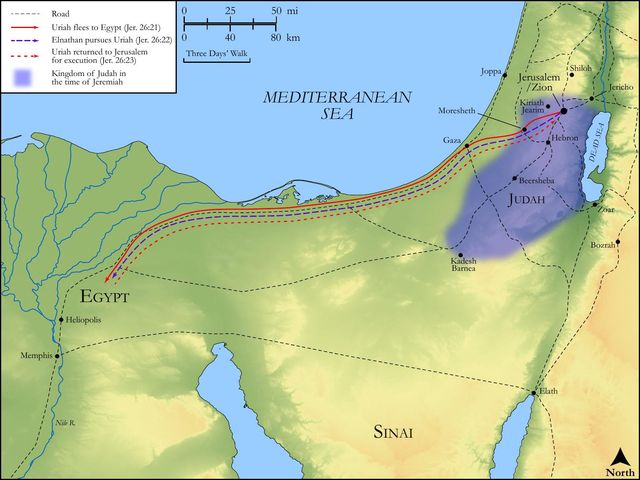
See on the biblical-era map
Study this verse
Public-domain commentary
Matthew Henry
From his Commentary on the Whole Bible. Henry comments on passages, not single verses — this entry covers Jeremiah 26:7–15. His two-level outline is real structure in the source text, so it is rendered as structure.
One would have hoped that such a sermon as that in the foregoing verses, so plain and practical, so rational and pathetic, and delivered in God's name, would work upon even this people, especially meeting them now at their devotions, and would prevail with them to repent and reform; but, instead of awakening their convictions, it did but exasperate their corruptions, as appears by this account of the effect of it.
I.Jeremiah is charged with it as a crime that he had preached such a sermon, and is apprehended for it as a criminal.
The priests, and false prophets, and people, heard him speak these words, Jer 26:7. They had patience, it seems, to hear him out, did not disturb him when he was preaching, nor give him any interruption till he had made an end of speaking all that the Lord commanded him to speak, Jer 26:8. So far they dealt more fairly with him than some of the persecutors of God's ministers have done; they let him say all he had to say, and yet perhaps with a bad design, in hopes to have something worse yet to lay to his charge; but, having no worse, this shall suffice to ground an indictment upon: He hath said, This house shall be like Shiloh, Jer 26:9. See how unfair they are in representing his words. He had said, in God's name, If you will not hearken to me, then will I make this house like Shiloh; but they leave out God's hand in the desolation (I will make it so) and their own hand in it in not hearkening to the voice of God, and charge it upon him that he blasphemed this holy place, the crime charged both on our Lord Jesus and on Stephen: He said, This house shall be like Shiloh. Well might he complain, as David does (Psa 56:5), Every day they wrest my words; and we must not think it strange if we, and what we say and do, be thus misrepresented. When the accusation was so weakly grounded, no marvel that the sentence passed upon it was unjust: Thou shalt surely die. What he had said agreed with what God had said when he took possession of the temple (Kg1 9:6-8), If you shall at all turn from following after me, then this house shall be abandoned; and yet he is condemned to die for saying it. It is not out of any concern for the honour of the temple that they appear thus warm, but because they are resolved not to part with their sins, in which they flatter themselves with a conceit that the temple of the Lord will protect them; therefore, right or wrong, Thou shalt surely die. This outcry of the priests and prophets raised the mob, and all the people were gathered together against Jeremiah in a popular tumult, ready to pull him to pieces, were gathered about him (so some read it); they flocked together, some crying one thing and some another. The people that were at first present were hot against him (v. 8), but their clamours drew more together, only to see what the matter was.
II.He is arraigned and indicted for it before the highest court of judicature they had. Here,
1.The princes of Judah were his judges, Jer 26:10. Those that filled the thrones of judgment, the thrones of the house of David, the elders of Israel, they, hearing of this tumult in the temple, came up from the king's house, where they usually sat near the court, to the house of the Lord, to enquire into this matter, and to see that nothing was done disorderly. They sat down in the entry of the new gate of the Lord's house, and held a court, as it were, by a special commission of Oyer and Terminer.
2.The priests and prophets were his prosecutors and accusers, and were violently set against him. They appealed to the princes, and to all the people, to the court and the jury, whether this man were not worthy to die, Jer 26:11. The corrupt priests and counterfeit prophets have always been the most bitter enemies of the prophets of the Lord; they had ends of their own to serve, which they thought such preaching as this would be an obstruction to. When Jeremiah prophesied in the house of the king concerning the fall of the royal family (Jer 22:1, etc.), the court, though very corrupt, bore it patiently, and we do not find that they persecuted him for it; but when he comes into the house of the Lord, and touches the copyhold of the priests, and contradicts the lies and flatteries of the false prophets, then he is adjudged worthy to die. For the prophets prophesied falsely, and the priests bore rule by their means, Jer 5:31. Observe, When Jeremiah is indicted before the princes the stress of his accusation is laid upon what he said concerning the city, because they thought the princes would be most concerned about that. But concerning the words spoken they appeal to the people, "You have heard what he hath said; let it be given in evidence."
III.Jeremiah makes his defence before the princes and the people.
He does not go about to deny the words, nor to diminish aught from them; what he has said he will stand to, though it cost him his life; he owns that he had prophesied against this house and this city, but,
1.He asserts that he did this by good authority, not maliciously nor seditiously, not out of any ill-will to his country nor any disaffection to the government in church or state, but, The Lord sent me to prophesy thus: so he begins his apology (Jer 26:12), and so he concludes it, for this is that which he resolves to abide by as sufficient to bear him out (Jer 26:15): Of a truth the Lord hath sent me unto you, to speak all these words. As long as ministers keep closely to the instructions they have from heaven they need not fear the opposition they may meet with from hell or earth. He pleads that he is but a messenger, and, if he faithfully deliver his message, he must bear no blame; but he is a messenger from the Lord, to whom they were accountable as well as he, and therefore might demand regard. If he speak but what God appointed him to speak, he is under the divine protection, and whatever affront they offer to the ambassador will be resented by the Prince that sent him.
2.He shows them that he did it with a good design, and that it was their fault if they did not make a good use of it. It was said, not by way of fatal sentence, but of fair warning; if they would take the warning, they might prevent the execution of the sentence, Jer 26:13. Shall I take it ill of a man that tells me of my danger, while I have an opportunity of avoiding it, and not rather return him thanks for it, as the greatest kindness he could do me? "I have indeed (says Jeremiah) prophesied against this city; but, if you will now amend your ways and your doings, the threatened ruin shall be prevented, which was the thing I aimed at in giving you the warning." Those are very unjust who complain of ministers for preaching hell and damnation, when it is only to keep them from that place of torment and to bring them to heaven and salvation.
3.He therefore warns them of their danger if they proceed against him (Jer 26:14): "As for me, the matter is not great what become of me; behold, I am in your hand; you know I am; I neither have any power, nor can make any interest, to oppose you, nor is it so much my concern to save my own life: do with me as seems meet unto you; if I be led to the slaughter, it shall be as a lamb." Note, It becomes God's ministers, that are warm in preaching, to be calm in suffering and to behave submissively to the powers that are over them, though they be persecuting powers. But, for themselves, he tells them that it is at their peril if they put him to death: You shall surely bring innocent blood upon yourselves, Jer 26:15. They might think that killing the prophet would help to defeat the prophecy, but they would prove wretchedly deceived; it would but add to their guilt and aggravate their ruin. Their own consciences could not but tell them that, if Jeremiah was (as certainly he was) sent of God to bring them this message, it was at their utmost peril if they treated him for it as a malefactor. Those that persecute God's ministers hurt not them so much as themselves.
Historical interpretation
Historical reception
1 surviving comment on this verse from the historical church.
(Verse 12 and following) And Jeremiah said to all the leaders and to all the people, saying: The Lord has sent me to prophesy to this house (or over this house) and to this city (or over this city) all the words that you have heard. Therefore, now make your ways and your pursuits good, and listen to the voice of the Lord your God, and the Lord will repent of the evil that He has spoken against you (or the Lord will cease from the evils that He has spoken against you). But behold, I am in your hands: do to me what is good and right in your eyes (or what is expedient for you). However, know and understand that if you kill me, you will bring innocent blood upon yourselves and upon this city and its inhabitants. Truly, the Lord has sent me to you to speak all these words in your ears. While the people were present, the princes sat in the gate of the city and accused Jeremiah the prophet to the priests and the prophets, and they conspired to bring about his death. Jeremiah spoke to the princes and to all the people, whom the faction of priests and false prophets had incited, wisely and humbly, yet steadfastly. Prudently, because he said that he had been sent by the Lord to speak against the temple and the city, and to give advice, that if they would listen to his advice and repent, the Lord would also change His decision. Yet humbly, in what he said: Behold, I am in your hands: do to me what is good and right in your eyes. Furthermore, firmly: The Lord has sent me to you in truth, to speak all these words in your ears. And he speaks in other statements: If you are angry because I have spoken against the temple and the city of the Lord, and you are concerned about the salvation of the city and the temple: why do you increase sins with sins, and make the city and its inhabitants guilty of my blood? Therefore, if and when we need humility due to the constraints of necessity, let us accept it in such a way that we do not abandon truth and steadfastness. For it is one thing to arrogantly insult the judge, which is a sign of foolishness; it is another thing to avoid impending danger in such a way that you do not subtract anything from the truth.
Continue studying Jeremiah 26:13 across the web’s major study libraries — every link below opens this exact verse, chapter, or book on the destination site.
Read & Compare
 BibleGatewayThis verse in more than 200 translations and 70 languages.
 Bible.comThe YouVersion reader — hundreds of translations, reading plans, and highlights.
 ESV.orgCrossway's official English Standard Version reader.
 NET BibleThe NET translation with 60,000+ translators' notes on every rendering decision.
 STEP BibleTyndale House's free study tool — original text, vocabulary, and scholarly resources.
 BibliaLogos Bible Software's free web reader.
 USCCBThe New American Bible (Revised Edition) with the U.S. bishops' study notes.
Commentaries
 BibleHub CommentariesDozens of classic commentaries on this verse, gathered on one page.
 StudyLightMore than 100 commentary sets — the largest collection on the web.
 BibleRefPlain-English commentary on what this verse means, verse by verse.
 Enduring WordDavid Guzik's free commentary on this chapter, widely used by Bible teachers.
 Bible Study ToolsVerse commentary alongside Greek and Hebrew study aids.
Original Language & Research
- BibleHub InterlinearThe verse word by word — original language, transliteration, and English.
- BibleHub LexiconEvery word's original-language definition and Strong's entry.
 Blue Letter BibleDeep-study tools — Strong's numbers, concordance, and word studies.
 SefariaThe Hebrew text with Rashi and centuries of Jewish commentary.
Sermons, Hymns & Audio


TrulyRandomVerse is not affiliated with these sites and doesn’t control their content. They’re linked because they’re genuinely useful.
Summary
Jeremiah 26:13 presents a pivotal message of divine grace and human responsibility, delivered by the prophet Jeremiah amidst a period of intense national crisis in Judah. It encapsulates God's unwavering willingness to avert impending judgment and calamity, provided His people genuinely turn from their wicked practices, amend their conduct, and obediently heed His voice. This verse underscores the conditional nature of divine judgment, presenting a profound opportunity for national repentance and restoration.
Context
ShowHideLiterary Context
This verse is a direct excerpt from Jeremiah's powerful and provocative Temple Sermon, delivered in the early years of King Jehoiakim's reign (c. 609-598 BC). Jeremiah had been commanded by the LORD to stand in the court of the LORD's house and speak all the words commanded, without omitting a word, warning that if the people did not listen and obey, the Temple would be destroyed like Shiloh, and Jerusalem would become a curse to all nations. This message, detailed in Jeremiah 26:1-6, enraged the priests, prophets, and all the people, who seized Jeremiah and declared he must die, as recounted in Jeremiah 26:7-8. Verse 13 serves as Jeremiah's defense, a reiteration of God's conditional promise, emphasizing that the threatened "evil" (calamity) was not an irreversible decree but a consequence that could be averted through genuine repentance and obedience. It functions as a passionate plea for the people to respond to God's gracious offer before it is too late.
Historical & Cultural Context
The historical backdrop is the late 7th century BC, a tumultuous time for the Kingdom of Judah. The Assyrian Empire, which had long dominated the region, was in decline, and new powers, particularly Babylon, were rising rapidly. Judah found itself caught between these geopolitical forces, often attempting to navigate through precarious political alliances rather than trusting in the LORD. Internally, the nation was plagued by widespread idolatry, oppression, and a superficial religiosity that failed to address the deep moral decay. The Temple, rather than being a place of genuine worship and repentance, had become a source of false security, with the people believing its mere presence would protect them from divine judgment, regardless of their actions, a dangerous complacency directly challenged by Jeremiah in Jeremiah 7:4. Jeremiah's message directly confronted this spiritual apathy, calling for a return to the covenant stipulations of the Mosaic Law. Culturally, the idea of a conditional covenant, where blessings followed obedience and curses followed disobedience, was foundational to Israelite understanding of their relationship with God, as vividly outlined in Deuteronomy 28.
Key Themes
ShowHideJeremiah 26:13 powerfully encapsulates several key themes prevalent throughout the book of Jeremiah. Foremost is the theme of Repentance and Obedience, highlighting God's persistent call for His people to turn from their sin and align their lives with His commands. This is not merely an outward behavioral adjustment but a deep, internal transformation of the heart, as God desires for His people to "return" to Him, as seen in Jeremiah 3:22. Another critical theme is God's Conditional Judgment and Mercy. While God is just and faithful to His pronounced word, He is also profoundly merciful and willing to relent from threatened judgment when His people respond with genuine contrition. This demonstrates that divine warnings are often remedial, intended to prompt a change of heart rather than immediate, irreversible destruction. This concept is further elaborated in passages like Jeremiah 18:7-10, where God explicitly states His prerogative to relent from both good and evil based on human response. Finally, the verse touches upon the Consequences of Disobedience, emphasizing that the "evil" (calamity) pronounced is a direct result of the nation's rebellion, yet still avoidable through a return to God.
Exposition and Analysis
ShowHideKey Word Analysis
ShowHideThis primitive root means "to be (causative) make well, literally (sound, beautiful) or figuratively (happy, successful, right)." In this context, it signifies a call to "make good" or "make right" one's ways and doings. It implies a thorough improvement or correction of behavior and moral conduct, moving from a state of spiritual sickness to one of health and alignment with God's will. It's not a superficial fix but a deep, transformative change, a comprehensive overhaul of one's moral and spiritual trajectory.
Derived from a root meaning "to tread," derek refers to a "road" or "path," but figuratively, it denotes a "course of life" or "mode of action." When paired with "doings" (maʻălâl), it encompasses both the general direction and habits of one's life and the specific acts performed. Here, it signifies the entire pattern of Judah's national and individual conduct, which had deviated significantly from God's righteous standards.
This primitive root properly means "to sigh," implying strong emotion. By implication, it means "to be sorry," "to pity," "to console," or (reflexively) "to rue." When applied to God, as in this verse, it means to "relent" or "change one's mind concerning a course of action" in response to human actions or prayers. It does not imply a change in God's immutable character or moral perfection, but rather a change in His declared intention or the execution of His judgment in light of a change in human behavior. God's ultimate purposes remain fixed, but His relational interaction with humanity allows for a redirection of His pronounced judgments when genuine repentance occurs.
Verse Breakdown
ShowHide"Therefore now amend your ways and your doings,"
This opening clause serves as an urgent imperative, a direct command from God through Jeremiah. The phrase "Therefore now" underscores the immediate necessity of action given the dire warnings and impending judgment. "Amend your ways and your doings" calls for a comprehensive moral and spiritual overhaul, addressing both the overall direction and habits of their lives ("ways") and their specific actions and practices ("doings"). It signifies a decisive turning away from sin and a turning towards righteousness, requiring a fundamental change in both character and conduct.
"and obey the voice of the LORD your God;"
This second command specifies the nature of the required amendment: it must be rooted in active listening and submissive adherence to God's revealed will. "The voice of the LORD" refers to His commandments, His prophetic word, and His covenant stipulations given through the Law and His prophets. True amendment of ways is inseparable from obedient hearing and doing what God requires, acknowledging His supreme authority and rightful claim as "your God," the covenant Lord of Israel.
"and the LORD will repent him of the evil that he hath pronounced against you."
This final clause presents the divine consequence and gracious promise contingent upon the people's repentance. "The LORD will repent him" means God will relent or turn from His previously declared intention to bring "evil" (Hebrew: raʻ, meaning calamity, disaster, or misfortune, not moral wickedness). This demonstrates God's profound mercy, His patience, and His desire for reconciliation over retribution. The "evil that he hath pronounced" refers to the specific judgments and destructions that Jeremiah had been prophesying, which were contingent upon the people's continued disobedience and served as a warning to prompt their return.
Literary Devices
ShowHideJeremiah 26:13 employs several powerful literary devices that amplify its urgent message. The most prominent is the Conditional Statement, clearly structured as an "if-then" proposition, even if the "if" is implied by the imperative "Therefore now amend..." and the "then" by "and the LORD will repent...". This highlights the direct causal link between human action (repentance and obedience) and divine response (relenting from judgment). Another significant device is Anthropomorphism, where God is described as "repenting" (Hebrew nâcham). While God's character is immutable, this human-like expression conveys His emotional response and willingness to alter His course of action in response to human repentance, demonstrating His relational nature and deep concern for His people's well-being. Furthermore, there is a degree of Parallelism in the phrase "your ways and your doings," which emphasizes the comprehensive nature of the required repentance, encompassing both the general trajectory of life and specific acts. The use of strong imperatives ("amend," "obey") also lends a sense of urgency and directness to the divine message, demanding an immediate and decisive response from the audience.
Theological and Thematic Connections
ShowHideJeremiah 26:13 profoundly illustrates the biblical principle of God's conditional judgment and His readiness to extend mercy in response to genuine repentance. It underscores that God's pronouncements of "evil" (calamity) are often warnings, not immutable decrees, designed to call His people back to Himself. This divine flexibility, rooted in His unchanging character of love and justice, offers a pathway to avert disaster through a humble turning from sin and a renewed commitment to obedience. It reveals a God who desires reconciliation over retribution, always leaving the door open for His people to return and experience His grace. This passage serves as a timeless testament to God's patience and His ultimate desire for the well-being of His creation, even in the face of their rebellion.
Reflection and Application
ShowHideJeremiah 26:13 offers a timeless and profoundly hopeful message for individuals and communities today. It reminds us that even when we stand under the shadow of consequences for our disobedience, God's heart remains open to our return. This verse challenges us to move beyond superficial religiosity or a sense of fatalism and to actively engage in the process of self-examination and spiritual transformation. It underscores that our actions, our choices, and our willingness to truly listen and obey God's voice have a direct impact on our experience of His blessing or judgment. The call to "amend your ways and your doings" is a call to radical honesty about our sin and a courageous commitment to align our lives with God's perfect will, trusting that His desire is always for our good, even when His warnings are severe. It encourages us to embrace repentance not as a burden, but as the pathway to peace, restoration, and the experience of God's relenting mercy, recognizing that true change begins with a humble heart and obedient spirit.
Questions for Reflection
ShowHideFAQ
ShowHideDoes God truly "repent" or change His mind, given that He is immutable?
ShowHideThe term "repent" (Hebrew: nâcham) when applied to God in Jeremiah 26:13 and similar passages does not imply a change in God's immutable character, moral perfection, or eternal purposes. Instead, it signifies a change in His declared intention or the execution of His judgment in response to a change in human behavior. God's ultimate plan of redemption and His righteous nature remain constant. However, His interaction with humanity is dynamic and relational. When people turn from their wickedness and genuinely repent, God, in His mercy, relents from the specific calamities or judgments He had previously warned them about. This demonstrates His responsiveness to human free will and His desire for reconciliation rather than destruction. It's a change in His posture towards humanity, not a change in His being. This concept is also seen in Exodus 32:14 when Moses intercedes for Israel, and in Jonah 3:10 concerning Nineveh.
Christ-Centered Fulfillment
ShowHideJeremiah 26:13, with its urgent call to "amend your ways and your doings, and obey the voice of the LORD your God" to avert "evil," finds its ultimate fulfillment and deepest meaning in Jesus Christ. While the Old Testament call to repentance often focused on a return to the Mosaic Law and the covenant, Jesus inaugurated a new covenant where true repentance is a turning to Him as the embodiment of God's voice and the pathway to life. He is the ultimate "voice of the LORD" whom we are called to obey, as He declares, "My sheep hear my voice" in John 10:27. The "evil" that God pronounced against humanity, which is the ultimate consequence of sin, is not merely averted but absorbed and overcome by Christ's atoning sacrifice on the cross. Through His death and resurrection, Jesus became the Lamb of God who takes away the sin of the world, enabling God to "repent" (relent) from the judgment due to us, not because we perfectly amend our ways in our own strength, but because we are united with Christ through faith. The New Testament call to repentance is therefore a call to believe in Jesus, whose perfect obedience and sacrifice fulfill the demands of the Law and provide the means for true amendment of life, empowered by the Holy Spirit, as Peter urged in Acts 2:38. In Christ, we find not just a temporary reprieve from judgment, but eternal reconciliation and transformation, truly making our "ways and doings" righteous in God's sight, for "He made Him who knew no sin to be sin for us, that we might become the righteousness of God in Him" (2 Corinthians 5:21).