


Isaiah 41:27
Bible text: King James Version (1769 Blayney text) · Public domain
Bible text: Berean Standard Bible · Public domain
Bible text: American Standard Version (1901) · Public domain
Bible text: World English Bible, Messianic edition · Public domain
Bible text: Geneva Bible (1599) · Public domain
Bible text: Young's Literal Translation · Public domain
- רִאשׁוֹןri·Shona first [one]H7223Adj-msAdjective Numerical Position Singular Masculine Absolute
- לְצִיּוֹןle·tzi·Yonto ZionH6726Prep-l ¦ N-properNoun Proper LocationלְtoצִיּוֹןZion
- הִנֵּהhi·Nehhere!H2009PrtParticle Interjection
- הִנָּםhi·Namhere [are] theyH2005Prt ¦ 3mpParticle Interjectionהִנָּhere [are]םthey
- וְלִירוּשָׁלִַםve·li·ru·sha·Limand to JerusalemH3389Conj-w ¦ Prep-l ¦ N-properNoun Proper LocationוְandלִtoירוּשָׁלִַםJerusalem
- מְבַשֵּׂרme·va·Sera bearer of newsH1319V-Piel-Prtcpl-msVerb Piel Participle Singular Masculine Absolute
- אֶתֵּן'e·TenI gaveH5414V-Qal-Imperf-1csVerb Qal Imperfect 1st Singular common gender
English is a literal word-by-word gloss of the Hebrew, not the KJV's wording. Why?
This is the original text the KJV's translators worked from — each Hebrew word with its own literal English meaning in this verse, prepared by scholars at Tyndale House, Cambridge. The KJV translates whole sentences, not word by word, so its wording differs: one Hebrew word can become several English words, and the KJV may choose “the LORD” where the gloss reads “Yahweh”. Both are faithful — they answer different questions. For the KJV's own rendering, switch to the KJV text.
Details
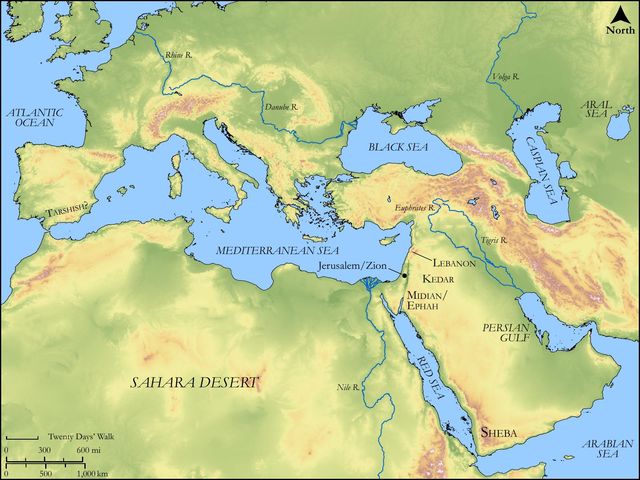
See on the biblical-era map
Study this verse
Public-domain commentary
Matthew Henry
From his Commentary on the Whole Bible. Henry comments on passages, not single verses — this entry covers Isaiah 41:21–29. His three-level outline is real structure in the source text, so it is rendered as structure.
The Lord, by the prophet, here repeats the challenge to idolaters to make out the pretentions of their idols: "Produce your cause (Isa 41:21) and make your best of it; bring forth the strongest reasons you have to prove that your idols are gods, and worthy of your adoration." Note, There needs no more to show the absurdity of sin than to produce the reasons that are given in defence of it, for they carry with them their own confutation.
I.The idols are here challenged to bring proofs of their knowledge and power.
Let us see what they can inform us of, and what they can do. Understanding and active power are the accomplishments of a man. Whoever pretends to be a god must have these in perfection; and have the idols made it to appear that they have? No;
1."They can tell us nothing that we did not know before, so ignorant are they. We challenge them to inform us," (1.) "What has been formerly: Let them show the former things, and raise them out of the oblivion in which they were buried" (God inspired Moses to write such a history of the creation as the gods of the heathen could never have dictated to any of their enthusiasts); or "let the defenders of idols tell us what mighty achievements they can boast of as performed by their gods in former times. What did they ever do that was worth taking notice of? Let them specify any thing, and it shall be considered, its due weight shall be given it, and it shall be compared with the latter end of it; and if, in the issue, it prove to be as great as it pretended to be, they shall have the credit of it." (2.) "We challenge them to tell us what shall happen, to declare to us things to come (Isa 41:22), and again (Isa 41:23), show the things that are to come hereafter. Give this evidence of your omniscience, that nothing can be hidden from you, and of your sovereignty and dominion. Make it to appear that you have the doing of all, by letting us know beforehand what you deign to do. Do this kindness to the world; let them know what is to come, that they may provide accordingly. Do this, and we will own that you are gods above us, and gods to us, and worthy of our adoration." No creature can foretel things to come, otherwise than by divine information, with any certainty.
2."They can do nothing that we cannot do ourselves, so impotent are they." He challenges them to do either good or evil, good to their friends or evil to their enemies: "Let them do, if they can, any thing extraordinary, that people will admire and be affected with. Let them either bless or curse, with power. Let us see them either inflict such plagues such as God brought on Egypt or bestow such blessings as God bestowed on Israel. Let them do some great thing, and we shall be amazed when we see it, and frightened into a veneration of them, as many have been into a veneration of the true God." That which is charged upon these idols, and let them disprove it if they can, is that they are of nothing, Isa 41:24. Their claims have no foundation at all, nor is there any ground or reason in the least for men's paying them the respect they do; there is nothing in them worthy our regard. "They are less than nothing, worse than nothing;" so some read it. "The work they do is of nought, and so is the ado that is made about them. There is no pretence or colour for it; it is all a jest; it is all a sham put upon the world; and therefore he that chooses you, and so give you your deity, and" (as some read it) "that delights in you, is an abomination;" so some take it. A servant is at liberty to choose his master, but a man is not at liberty to choose his God. He that chooses any other than the true God chooses an abomination; his choosing it makes it so.
II.God here produces proofs that he is the true God, and that there is none besides him. Let him produce his strong reasons.
1.He has an irresistible power. This he will shortly make to appear in the raising up of Cyrus and making him a type of Christ (Isa 41:25): He will raise him up from the north and from the rising of the sun. Cyrus by his father was a Mede, by his mother a Persian; and his army consisted of Medes, whose country lay north, and Persians, whose country lay east, from Babylon. God will raise him up to great power, and he shall come against Babylon with ends of his own to serve. But,
(1.)He shall proclaim God's name; so it may be read. He shall publish the honour of the God of Israel; so he did remarkably when, in his proclamation for the release of the Jews out of their captivity, he acknowledged that the Lord God of Israel was the Lord God of heaven, and the God: and he might be said to call on his name when he encouraged the building of his temple, and very probably did himself call upon him and pray to him, Ezr 1:2, Ezr 1:3.
(2.)All opposition shall fall before him: He shall come upon the princes of Babylon, and all others that stood in his way, as mortar, and trample upon them as the potter treads clay, to serve his own purposes with it. Christ, as man, was raised up from the north, for Nazareth lay in the northern parts of Canaan; as the angel of the covenant, he ascends from the east. He maintained the honour of heaven (he shall call upon my name), and broke the powers of hell, came upon the prince of darkness as mortar and trod him down.
2.He has an infallible foresight. He would not only do this, but he did now, by his prophet, foretel it. Now the false gods not only could not do it, but they could not foresee it.
(1.)He challenges them to produce any of their pretended deities, or their diviners, that had given notice of this, or could (Isa 41:26): "Who has declared from the beginning any thing of this kind, or has told it before-time? Tell us if there be any that you know of, for we know not any; if there be any, we will say, He is righteous, he is true, his cause is just, his claims are proved, and he is in the right in demanding to be worshipped." This agrees with Isa 41:22, Isa 41:23.
(2.)He challenges to himself the sole honour of doing it and foretelling it (Isa 41:27): I am the first (so it may be read) that will say to Zion, Behold, behold them, that will let the people of Israel know their deliverers are at hand (for there were those who understood by books, God's books, the approach of the time, Dan 9:2), and I am he that will give to Jerusalem one that brings good tidings, these good tidings of their enlargement. This is applicable to the work of redemption, in which the Lord showed himself much more than in the release of the Jews out of Babylon: he it was that contrived our salvation, and he brought it about, and he has given to us the glad tidings of reconciliation.
III.Judgment is here given upon this trial.
1.None of all the idols had foretold, or could foresee, this work of wonder. Other nations besides the Jews were released out of captivity in Babylon by Cyrus, or at least were greatly concerned in the revolution of the monarchy and there transferring of it to the Persians; and yet none of them had any intelligence given them of it beforehand, by any of their gods or prophets: "There is none that shows (Isa 41:26), none that declares, none that gives the least intimation of it; there is none of the nations that hears your words, that can pretend to have heard from their gods such words as you, O Israelites! have heard from your God, by your prophets," Psa 147:20. None of all the gods of the nations have shown their worshippers the way of salvation, which God will show by the Messiah. The good tidings which the Lord will send in the gospel is a mystery hidden from ages and generations, Rom 16:25, Rom 16:26.
2.None of those who pleaded for them could produce any instance of their knowledge or power that had in it any colour of proof that they were gods. All their advocates were struck dumb with this challenge (Isa 41:28): "I beheld, and there was no man that could give evidence for them, even among those that were their most zealous admirers; and there was no counsellor, none that could offer any thing for the support of their cause. Even among the idols themselves there was none fit to give counsel in the most trivial matters, and yet there were those that asked counsel of them in the most important and difficult affairs. When I asked them what they had to say for themselves they stood mute; the case was so plain against them that there was none who could answer a word." Judgment must therefore be given against the defendant upon Nihil dicit - He is mute. He has nothing to say for himself. He was speechless, Mat 22:12.
3.Sentence is therefore given according to the charge exhibited against them (Isa 41:24): "Behold, they are all vanity (Isa 41:29); they are a lie and a cheat; they are not in themselves what they pretend to be, nor will their worshippers find that in them which they promise themselves. Their works are nothing, of no force, of no worth; their enemies need fear no hurt from them; their worshippers can hope for no good from them. Their molten images, and indeed all their images, are wind and confusion, vanity and vexation; those that worship them will be deceived in them, and will reflect upon their own folly with the greatest bitterness. Therefore, dearly beloved, flee from idolatry," Co1 10:14.
Historical interpretation
Historical reception
4 surviving comments on this verse. Each one is dated, so this reads as a timeline rather than a list.
Select a marker to jump to its quote. Markers stagger vertically where authors wrote within a few decades of each other.
I want you to know, God is saying, I have intended from the beginning of everything to give authority to my church over all things, and the authority of my kingdom I shall give to my Zion. And I shall stir up my Jerusalem, preparing it as the road on which are all those who labor in it towards the thrice-blessed goal—to the God over all and his heavenly kingdom.
(Verse 25 onwards) He stirred up from the north, and he will come from the rising sun: he will call my name, and he will bring magistrates like clay: and like a potter treading the earth. Who announced it from the beginning, so that we may say: You are just. There is neither announcer, nor predictor, nor listener to your words. The first to Zion will say: Behold, they are here, and I will give Jerusalem a messenger. And I saw, and there was none among them that could counsel, and when I asked, no one could answer a word. Behold, all are unjust, and their works are vain; their idols are wind and emptiness. LXX: But I have raised up one from the north, and he shall come from the rising of the sun; they shall call upon my name. Let the princes come and be like the potter's vessel, and let the potter tread down the clay. For who can declare to you the things that are from the beginning, that we may know them that shall be in the future? And we shall say that they are true: there is none that announces, nor that hears your words. I will give the beginning to Zion: and I will console Jerusalem in the way: for there is no one from the nations, and from their idols there was no one who announced. And if I ask them where they are, they will not respond to me: for they are your makers, and they deceive you in vain. Yet he speaks against the idols, and those who did not want to abandon them after the coming of Christ. He says that he himself, having arisen from the North, has raised up the people of the nations. For from the North shall evil be kindled against all inhabitants of the earth. And to Jeremiah it is said: What do you see, Jeremiah? And he answered: I see a burning pot, and its face is towards the North. They are stirred up from the North, that they may believe in him who came from the East. As we read above: Who has stirred up the just one from the East, or justice? Also in another place: Behold a man, the East is his name. Those who call them (Others have called them) by my name, so that, forsaking idols, they may worship one God. For he himself speaks in the Gospel: I came in my Father's name, and you did not receive me; another will come in his own name, and you will receive him (John 5:43). He will trample down the princes and rulers and all the pride of the world, and they will be subjected to him like clay in the hand of the potter, so that he may make one vessel for honor and another for dishonor (Romans 9). These things, which I say I have done according to the prophetic tradition, as if they were already past, or, according to Symmachus, I promise they will be in the future, no demon or idol can predict. Therefore, all oracles have remained silent, because there is no one to announce, no one to hear, while the dull hearts of the Gentiles were first understood in their own terror, and they left behind false prophecies. And the Lord will speak first to Zion, that is, to His Church, and He will say to her: See, your children are here, whom I have given to you through my faith. But it signifies the Apostles, who preached the Gospel throughout the whole world. Zion and Jerusalem differ in name; but as one city, so is one Church. Therefore, let all the nations that follow the error of idols be questioned by us, so that they may respond where they come from. And this will be the answer of all, that they all follow vanity and winds, and adore the works of their own hands. Whatever we have said about idols and nations, let us attribute it to the doctrines of wickedness; and to their leaders, heresiarchs, who, when the Church announces peace in Christ and shows them the way of truth, themselves follow error and are compared to wind and whirlwind. The Hebrews, rising from the North, and coming from the rising of the sun, interpret it as Assyria and Persia, who will come to Jerusalem, and trample all its princes; and let him know that none of the idols they worship will come to pass, except the Lord alone, who has avenged them for their sins.
"I will give a leader to Zion, and I will console Jerusalem as I go." … Again the multitude of those going astray is promised the revealing of the Savior, through whom each one under heaven has been saved and is summoned to the recognition of the truth. So that we could have a guide who would be able and skilled to lead us along the path of salvation, the only-begotten Son of God became a human being. And though he was King by nature in that he is considered to be God and from God the Father and ruler of all things with all creation under his feet, he is said to be elected king among us.
It is in a perfectly appropriate way that he both shows the stupid nature of the idols and accuses of impiety those who have fashioned them. For if the idols are inanimate, their makers are full of stupidity and impiety.
Continue studying Isaiah 41:27 across the web’s major study libraries — every link below opens this exact verse, chapter, or book on the destination site.
Read & Compare
 BibleGatewayThis verse in more than 200 translations and 70 languages.
 Bible.comThe YouVersion reader — hundreds of translations, reading plans, and highlights.
 ESV.orgCrossway's official English Standard Version reader.
 NET BibleThe NET translation with 60,000+ translators' notes on every rendering decision.
 STEP BibleTyndale House's free study tool — original text, vocabulary, and scholarly resources.
 BibliaLogos Bible Software's free web reader.
 USCCBThe New American Bible (Revised Edition) with the U.S. bishops' study notes.
Commentaries
 BibleHub CommentariesDozens of classic commentaries on this verse, gathered on one page.
 StudyLightMore than 100 commentary sets — the largest collection on the web.
 BibleRefPlain-English commentary on what this verse means, verse by verse.
 Enduring WordDavid Guzik's free commentary on this chapter, widely used by Bible teachers.
 Bible Study ToolsVerse commentary alongside Greek and Hebrew study aids.
Original Language & Research
- BibleHub InterlinearThe verse word by word — original language, transliteration, and English.
- BibleHub LexiconEvery word's original-language definition and Strong's entry.
 Blue Letter BibleDeep-study tools — Strong's numbers, concordance, and word studies.
 SefariaThe Hebrew text with Rashi and centuries of Jewish commentary.
Sermons, Hymns & Audio


TrulyRandomVerse is not affiliated with these sites and doesn’t control their content. They’re linked because they’re genuinely useful.
Summary
Isaiah 41:27 serves as a powerful declaration of God's unparalleled sovereignty and His unique foreknowledge, asserting His singular ability to announce future events and His unwavering commitment to His chosen people, Zion and Jerusalem. This verse underscores the divine initiative in proclaiming a message of profound hope and deliverance, starkly contrasting God's active involvement and prophetic power with the impotence of the idols worshipped by the nations. It anticipates the arrival of a divinely appointed messenger bearing glad tidings, highlighting God's faithfulness to His covenant promises even in times of distress and exile, and ultimately pointing to the comprehensive restoration He alone can bring.
Context
ShowHideLiterary Context
Isaiah 41:27 is strategically positioned within the "Book of Comfort" (Isaiah 40-55), a section primarily addressed to the Jewish exiles in Babylon, offering profound hope and assurance of their impending return and restoration. Specifically, chapter 41 unfolds as a dramatic divine courtroom scene where the Lord challenges the nations and their impotent idols to prove their deity by accurately foretelling future events. God repeatedly asserts His unique identity as "the first and the last" (Isaiah 41:4) and the only one capable of declaring "the former things" and "the things to come" (Isaiah 41:22). Verse 27 functions as the triumphant conclusion to this divine challenge, demonstrating that it is God Himself who initiates the good news for His people, not the silent, lifeless idols. It directly follows God's rhetorical questions to the idols, emphasizing their utter inability to produce a true prophet or deliver any meaningful word (Isaiah 41:26). This verse thus serves as a powerful counter-declaration, affirming Yahweh's active and redemptive presence.
Historical & Cultural Context
The historical backdrop for this prophetic message is the Babylonian exile, a period of immense national trauma, despair, and spiritual crisis for the people of Judah. Stripped of their land, the sacred Temple, and their monarchy, they faced the profound temptation to doubt God's power and faithfulness, perhaps even turning to the seemingly powerful gods of their captors. The surrounding nations, including the dominant Babylonian empire, worshipped a vast pantheon of gods, often relying on various forms of divination, omens, and astrologers to discern the future. Isaiah's message directly confronts this polytheistic worldview, asserting the absolute supremacy, unique foreknowledge, and sovereign control of Yahweh, the one true God of Israel, over all history and all nations. The references to "Zion" and "Jerusalem" evoke the spiritual and political heart of the Israelite identity, now in ruins, emphasizing that God's promise of restoration and good news is directed to the very core of their national and religious being, assuring them that their identity and future are secure in His hands.
Key Themes
ShowHideThis verse powerfully encapsulates several key themes prevalent throughout the book of Isaiah, particularly in the "Book of Comfort." Firstly, it underscores Divine Initiative and Sovereignty, highlighting that God is the ultimate source of all revelation and redemptive action. He is not merely reactive but actively declares His plans and brings them to pass, demonstrating His unparalleled control over history and prophecy. This theme of God being "the first and the last" is a recurring motif in Isaiah, emphasizing His eternal nature and unique authority (Isaiah 41:4, Isaiah 44:6). Secondly, it offers profound Hope and Assurance for Jerusalem, promising a future of good news despite the current or impending distress of exile. This assurance serves as a powerful antidote to despair, reminding the exiles that God has not abandoned His covenant people and that their restoration is certain. Finally, the verse introduces the pivotal theme of The Messenger of Good Tidings. The promise "I will give to Jerusalem one that bringeth good tidings" points to a divinely appointed herald, foreshadowing not only immediate historical deliverers but ultimately pointing to the glorious proclamation of the Gospel, as beautifully echoed in Isaiah 52:7 and ultimately fulfilled in the person and work of Jesus Christ, the ultimate bringer of the greatest good news (Luke 2:10).
Exposition and Analysis
ShowHideKey Word Analysis
ShowHideThis word (H7223) denotes precedence in place, time, or rank. In the context of Isaiah 41, it profoundly emphasizes God's unique position as the one who exists before all things and who declares events before they happen. He is the originator, the one who initiates the prophetic word and brings it to pass, asserting His unparalleled foreknowledge and sovereign control over history, in stark contrast to the impotence of idols.
This interjection (H2009) is a particle of exclamation, drawing immediate and urgent attention to what follows. Its repetition in the verse ("Behold, behold them") intensifies the emphasis, creating a sense of certainty and imminence. It serves as a divine command for the audience to "Look!" or "Pay attention!" to the undeniable reality and imminent fulfillment of God's declaration, signaling a crucial moment of divine revelation and action.
This primitive root (H1319) fundamentally means "to be fresh" or "full," and by extension, "to announce glad news." It is the very root from which the Hebrew word for "good news" or "gospel" (besorah) is derived. Here, it refers to a messenger who delivers joyous, hopeful, and often salvific news, typically of victory, peace, or restoration. The active participle form emphasizes the specific, divinely appointed role of the one designated to bear this message of comfort and deliverance to God's people.
Verse Breakdown
ShowHide"The first [shall say] to Zion"
This clause establishes God, referred to as "The first" (Yahweh Himself), as the supreme initiator and speaker. In direct contrast to the silent and impotent idols challenged throughout the chapter, God is the one who speaks and declares the future. His declaration is specifically directed "to Zion," a poetic and prophetic name for Jerusalem, symbolizing God's deep and enduring commitment to His chosen city and people, even in their desolate state. It signifies that the divine word of comfort and promise originates directly from God and is intended for His covenant community.
"Behold, behold them"
The repeated interjection "Behold!" serves as a powerful call to attention, emphasizing the certainty and imminent manifestation of what is to come. "Them" likely refers to the "good tidings" themselves, or the specific events that constitute the fulfillment of the divine promise that God is about to send. This emphatic repetition urges the exiles to look forward with anticipation to God's active intervention and the undeniable realization of His word, assuring them that what is promised will indeed come to pass.
"and I will give to Jerusalem one that bringeth good tidings"
This is the core promise of the verse, a direct and unconditional divine commitment. God explicitly states His intention to "give" or send a messenger to "Jerusalem" (another name for Zion, reinforcing the target of the message). This "one that bringeth good tidings" is a herald of restoration, peace, and deliverance, a divinely appointed agent to convey God's message of hope. This promise is a direct fulfillment of God's unique ability, asserted throughout the chapter, to declare and bring about the future, contrasting sharply with the utter inability of pagan deities to do so. It is a divine assurance that hope is on the way, initiated and guaranteed by God Himself.
Literary Devices
ShowHideIsaiah 41:27 employs several potent literary devices to convey its message with maximum impact. The most prominent is Divine Pronouncement, where God Himself speaks directly, asserting His absolute authority and unparalleled foreknowledge. This creates an undeniable sense of certainty and power, establishing the divine origin and reliability of the message. The Repetition of "Behold, behold" (Hebrew: hinnêh) serves as an emphatic interjection, a powerful rhetorical device designed to draw immediate and intense attention to the coming event or messenger, underscoring its significance and certainty. Furthermore, the verse uses Personification by addressing "Zion" and "Jerusalem" as entities capable of receiving a message, imbuing these geographical locations with the identity of God's covenant people and emphasizing God's personal engagement with them. Finally, the entire passage functions as a Prophecy, a divinely inspired declaration of future events, specifically the sending of a messenger with good news, which finds both immediate historical and ultimate eschatological fulfillment.
Theological and Thematic Connections
ShowHideIsaiah 41:27 profoundly reinforces the Old Testament understanding of God as the sovereign Lord of history, whose word is not merely descriptive but performative—it brings about what it declares. This verse is a powerful testament to God's unique attribute of foreknowledge, distinguishing Him absolutely from all false gods and idols who are deaf, dumb, and impotent. It underscores that salvation, hope, and true revelation originate solely from divine initiative, not human effort, pagan divination, or the machinations of earthly powers. The "good tidings" promised here are not merely political or military victories but encompass the comprehensive restoration of God's people, foreshadowing the ultimate good news of spiritual salvation. This divine commitment to sending a messenger with good news prefigures the entire prophetic tradition and culminates in the ultimate proclamation of the Gospel, demonstrating God's consistent plan to communicate His redemptive purposes to humanity.
Reflection and Application
ShowHideIsaiah 41:27 offers profound comfort and a compelling call to faith for believers in every generation. It reminds us that even in the darkest valleys of life—whether personal despair, societal upheaval, or global uncertainty—God remains enthroned as the sovereign Lord, who declares the end from the beginning. His promises are not contingent on human circumstances or the perceived power of earthly forces, but are rooted in His unchanging character and omnipotent power. We are called to trust in His divine initiative, knowing that He is actively working out His purposes, even when we cannot fully perceive or understand them. Furthermore, as recipients of the ultimate "good tidings" in Jesus Christ, we are commissioned to participate in God's ongoing mission, becoming those who "bring good tidings" to a world desperately in need of hope, peace, and reconciliation with God. Our lives, words, and actions should reflect the transformative power of the Gospel, echoing God's own declaration of good news to Zion.
Questions for Reflection
ShowHideFAQ
ShowHideWho is "the first" mentioned in Isaiah 41:27?
ShowHide"The first" refers unequivocally to Yahweh, the God of Israel. Throughout Isaiah 41, God repeatedly asserts His unique identity as "the first and the last" (Isaiah 41:4, Isaiah 44:6). This title emphasizes His eternal existence, His unparalleled sovereignty over history, and His exclusive ability to foretell and bring to pass future events, thereby distinguishing Him absolutely from the powerless idols of the nations.
Who is "one that bringeth good tidings" to Jerusalem?
ShowHideThis phrase carries multiple layers of fulfillment. Historically, it could refer to prophets like Isaiah himself, or future messengers who would announce the end of the Babylonian exile and the joyous return to Jerusalem. Ultimately, however, in light of the New Testament, it points to the ultimate bringer of good news: Jesus Christ, and the proclamation of the Gospel. The "good tidings" (Hebrew: besorah) are the news of salvation, peace, and restoration that culminates in the person and work of Christ (Luke 2:10).
What is the significance of God addressing "Zion" and "Jerusalem" directly in this verse?
ShowHide"Zion" and "Jerusalem" are synonymous terms in this context, representing God's chosen city and, by extension, His covenant people, Israel. Addressing them directly underscores God's unwavering faithfulness to His covenant promises despite their sin and impending exile. It signifies that the good news is specifically for His beloved people, offering them hope, restoration, and a future, reaffirming their central and enduring place in His redemptive plan for all of humanity.
Christ-Centered Fulfillment
ShowHideIsaiah 41:27 finds its profoundest Christ-centered fulfillment in the person and mission of Jesus Christ. He is the ultimate "one that bringeth good tidings," the very embodiment of the "good news" (Gospel) that God promised to Zion. While the immediate historical context speaks of a messenger bringing news of deliverance from exile, the Spirit-inspired trajectory of prophecy points far beyond mere physical return to the spiritual and eternal salvation offered through Christ. Jesus Himself declared His mission to "preach good news to the poor" (Luke 4:18), directly echoing the language and spirit of Isaiah. He is not merely a messenger but the message itself—the Lamb of God who takes away the sin of the world, the Prince of Peace, and the resurrection and the life. The emphatic "behold, behold them" of Isaiah 41:27 finds its ultimate echo in the angelic announcement of Christ's birth, "Behold, I bring you good tidings of great joy, which shall be to all people" (Luke 2:10). Thus, God's ancient promise to send a herald of good news culminates in the advent of His Son, who not only declares the good news of the Kingdom but inaugurates it through His life, atoning death, and glorious resurrection, fulfilling God's sovereign plan to bring salvation to Zion and to all who believe, both Jew and Gentile (Romans 1:16).