


Hosea 13:3
Bible text: King James Version (1769 Blayney text) · Public domain
Bible text: King James Version with Strong's numbers · Public domain
Bible text: Berean Standard Bible · Public domain
Bible text: American Standard Version (1901) · Public domain
Bible text: World English Bible, Messianic edition · Public domain
Bible text: Geneva Bible (1599) · Public domain
Bible text: Young's Literal Translation · Public domain
- לָכֵןla·Khen<to> thereforeH3651Prep-l ¦ AdvAdverbלָ<to>כֵןtherefore
- יִהְיוּyih·Yuthey will becomeH1961V-Qal-Imperf-3mpVerb Qal Imperfect 3rd Plural Masculine
- כַּעֲנַןka·'a·nanlike a cloud ofH6051Prep-k ¦ N-mscNoun Singular Masculine Constructכַּlikeעֲנַןa cloud of
- בֹּקֶרBo·ker[the] morningH1242N-msNoun Singular Masculine Absolute
- וְכַטַּלve·kha·Taland like <the> dewH2919Conj-w ¦ Prep-k ¦ N-msNoun Singular Masculine Absoluteוְandכַlike <the>טַּלdew
- מַשְׁכִּיםmash·Kimrising earlyH7925V-Hiphil-Prtcpl-msVerb Hiphil Participle Singular Masculine Absolute
- הֹלֵךְho·LekhgoingH1980V-Qal-Prtcpl-msVerb Qal Participle Singular Masculine Absolute
- כְּמֹץke·Motzlike chaffH4671Prep-k ¦ N-msNoun Singular Masculine Absoluteכְּlikeמֹץchaff
- יְסֹעֵרye·so·'Er[which] it is storm-drivenH5590V-Piel-Imperf-3msVerb Piel Imperfect 3rd Singular Masculine
- מִגֹּרֶןmi·Go·renfrom a threshing floorH1637Prep-m ¦ N-fsNoun Singular Feminine Absoluteמִfromגֹּרֶןa threshing floor
- וּכְעָשָׁןu·khe·'a·Shanand like smokeH6227Conj-w ¦ Prep-k ¦ N-msNoun Singular Masculine Absoluteוּandכְlikeעָשָׁןsmoke
- מֵאֲרֻבָּהme·'a·ru·Bahfrom a windowH699Prep-m ¦ N-fsNoun Singular Feminine Absoluteמֵfromאֲרֻבָּהa window
English is a literal word-by-word gloss of the Hebrew, not the KJV's wording. Why?
This is the original text the KJV's translators worked from — each Hebrew word with its own literal English meaning in this verse, prepared by scholars at Tyndale House, Cambridge. The KJV translates whole sentences, not word by word, so its wording differs: one Hebrew word can become several English words, and the KJV may choose “the LORD” where the gloss reads “Yahweh”. Both are faithful — they answer different questions. For the KJV's own rendering, switch to the KJV text.
Details
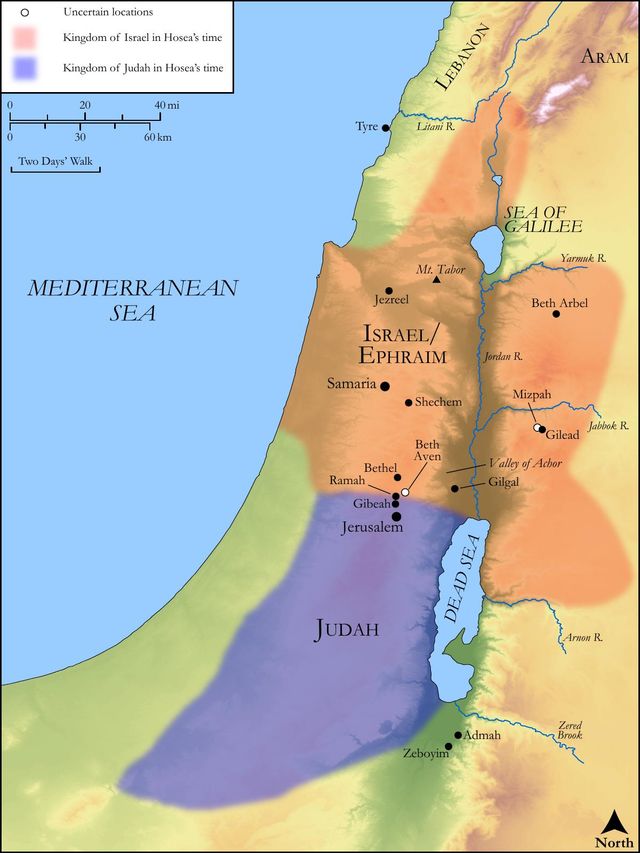
See on the biblical-era map
Study this verse
Public-domain commentary
Matthew Henry
From his Commentary on the Whole Bible. Henry comments on passages, not single verses — this entry covers Hosea 13:1–4. His two-level outline is real structure in the source text, so it is rendered as structure.
Idolatry was the sin that did most easily beset the Jewish nation till after the captivity; the ten tribes from the first were guilty of it, but especially after the days of Ahab; and this is the sin which, in these verses, they are charged with. Observe,
I.The provision that God made to prevent their falling into idolatry.
This we have, Hos 13:4. God did what was fit to be done to keep them close to himself; what could have been done more?
1.He made known himself to them as the Lord their God, and took them to be his people in a peculiar manner. Both by his word and by his works all along from the land of Egypt he declared, I am the Lord thy God; he told them so from heaven at Mount Sinai, that he was the Lord and their God, who brought them out of the land of Egypt. This he continued both to declare and to prove to them by his prophets and by his providences.
2.He gave them a law forbidding them to worship any other: "Thou shalt know no God but me; not only shalt not own and worship any other, but shalt not acquaint thyself with any other, nor make the rites and usages of the Gentiles familiar to thee." Note, It is a happy ignorance not to know that which we ought not to meddle with. We find those commended who have not known the depths of Satan.
3.He gave them a good reason for it: There is no saviour besides me. Whatever we take for our God we expect to have for our saviour, to make us happy here and hereafter; as, where we have protection, we owe allegiance, so where we have salvation, and hope for it, we owe adoration.
II.The honour that Ephraim had, while he kept himself clear from idolatry (Hos 13:1):
While Ephraim spoke trembling, or with trembling (that is, as Dr. Pocock understands it, while he behaved himself towards God as his father Jacob did, with weeping and supplications, and spoke not proudly and insolently against God and his prophets, while he kept up a holy fear of God, and worshipped him in that fear) so long he exalted himself in Israel, that is, he was very considerable among the tribes and made a figure. Jeroboam, who was of that tribe, exalted himself and his family. When he spoke there was trembling, that is, all about him stood in awe of him; so some understand it. Note, Those that humble themselves, especially that humble themselves before God, shall be exalted. When people speak with modesty and jealousy of themselves, with a diffidence of their own judgment and a deference to others, they exalt themselves, they gain a reputation. But as for Ephraim he soon lost himself: When he offended in Baal he died, that is, he lost his reputation, his honour soon dwindled and sunk, and was laid in the dust. Baal is here put for all idolatry; when Ephraim forsook God, and took to worship images, the state received its death's wound and was never good for any thing afterwards. Note, Deserting God is the death of any person or persons.
III.The lamentable growth of idolatry among them (Hos 13:2):
Now they sin more and more. When once he began to offend in Baal the ice was broken, and he grew worse and worse, coveted more idols, doted more upon those he had, and grew more ridiculous in the worship of them. Note, The way of idolatry, as of other sins, is down-hill, and men cannot easily stop themselves. It is the sad case of all those who have forsaken God that they sin yet more and more. Let us trace them in their apostasy.
1.They made themselves molten images, proud to have gods that they could cast into what mould they pleased; probably these were the calves in miniature like the silver shrines for Diana; the zealots for the calf-worship carried about with them, it may be, images of the gods they worshipped, made on purpose for themselves.
2.They made them of their silver, and then doubted not of their property in them, when they purchased them with their own money or made them of their own plate melted down for that purpose. See what cost they put themselves to in the service of their idols, which they honoured with the best they had, and therefore made their molten images of silver.
3.They made them according to their own understanding, according to their own fancy. They consulted with themselves what shape they should make their idol in, and made it accordingly, a god according to the best of their judgment. Or according to their own likeness, in the form of a man. And, when they made their idols men like themselves in shape, they made themselves stocks and stones like them in reality; for those that make them are like unto them, and so is every one that trusts in them.
4.It was all the work of the craftsmen. Their images did not pretend, like that of Diana, to have come down from Jupiter (Act 19:35); no, perhaps the workmen stamped their names upon them, such an idol was such a man's work. See Hos 8:6; Isa 44:9, etc.
5.Though they were thus the work of their hands, yet they were the beloved of their souls; for they say of them, Let the men that sacrifice kiss the calves. Either the priests called upon the people thus to pay their homage, or the people, who were not allowed to come so near themselves, called upon the men that sacrificed, the priests that attended for them, to kiss the calves in their name and stead, because they could not reach to do it, so very fond were they of paying their utmost respects to such an idol as they were taught to have a veneration for. Though they were calves, yet, if they were gods, the worshippers, by themselves or their proxies, thus made their honours to them. They kissed the calves, in token of the adoration of them, affection for them, and allegiance to them, as theirs. Thus we are directed to kiss the Son, to take him for our Lord and our God.
IV.Threatenings of wrath for their idolatry.
The Lord, whose name is Jealous, is a jealous God, and will not give his glory to another; and therefore all those that worship images shall be confounded, especially if Ephraim do it, Psa 97:7. Because they are so fond of kissing their calves, therefore God will give them sensible convictions of their folly, Hos 13:3. They promise themselves a great del of safety and satisfaction in the worship of their idols, and that their prosperity will thereby be established; but God tells them that they shall be disappointed, and driven away in their wickedness. This is illustrated by four similitudes: - They shall be,
1.As the morning cloud, which promises showers of rain to the parched ground.
2.As the early dew, which seems to be an earnest of such showers. But both pass away, and the day proves as dry and hot as ever; so fleet and transitory their profession of piety was (Hos 6:4), and so had they disappointed God's expectation from them, and therefore it is just that so their prosperity should be, and so their expectations from their idols should be disappointed, and so will all theirs be that make an idol of this world.
3.They are as the chaff, light and worthless; and they shall be driven as the chaff is driven with the whirlwind out of the floor, Psa 1:4; Psa 25:5; Job 21:18. Nay,
4.They are as the smoke, noisome and offensive (see Isa 65:5), and they shall be driven away as the smoke out of the chimneys, that is soon dissipated and disappears, Psa 68:2. Note, No solid lasting comfort is to be expected any where but in God.
Historical interpretation
Historical reception
2 surviving comments on this verse. Each one is dated, so this reads as a timeline rather than a list.
Select a marker to jump to its quote. Markers stagger vertically where authors wrote within a few decades of each other.
Such, brethren, is our life, we whose existence is so transitory. Such is the game we play upon earth. We do not exist, and then we are born, and being born we are soon dissolved. We are a fleeting dream, an apparition without substance, the flight of a bird that passes, a ship that leaves no trace upon the sea. We are dust, a vapor, the morning dew, a flower growing but a moment and withering in a moment. “Man’s days are as grass: as the flower of the field, so shall he flourish.” How beautifully has holy David meditated on our weakness: “Declare unto me the fewness of my days.” ON HIS BROTHER ST.
Therefore they will be like morning clouds, and like morning dew that passes away, like dust swept up by a whirlwind, and like smoke from a chimney.” (Vulgate "passing by"). And similarly in the Septuagint: “changing only the final image, ‘and like the vapor from locusts’ or ‘from tears,’ since we find it rendered as either ‘locusts’ or ‘tears’ in most manuscripts. For, he says, they sacrificed to calves as though slaughtering men; therefore they will be like morning clouds, and like the morning dew that passes, like dust swept up by a whirlwind, and like smoke from a chimney.” "All things seem to exist for a time and then quickly pass away, in keeping with the saying, 'He caused his king of Samaria to pass like foam on the surface of water,' and again, 'The king of Israel passes away like a morning shadow.' Everyone knows that clouds, dew, dust from the ground, and smoke from the hearth, all quickly vanish, in accordance with the scripture that says, 'As smoke is driven away, so let them be driven away.'" (Psalm 68:2) However, why have the LXX rendered "fumario" as "locustas," which Theodotion translates as καπνοδόχην (the editions read καπνοδόχον)? Among the Hebrews, locust and fumarium are written with the same letters, Aleph, Res, Beth, He. If it is read as Arbe, it means "locust"; if Orobba ((Al. "arobba")), it means "fumarium": for which Aquila interprets καταράκτην and Symmachus interprets "foramen." Cataractam, however, properly signifies the hole made in the wall through which smoke comes out. But if anyone is contentious and unwilling to receive the truth of Hebrew (Scripture), let him seek after the sense of locusts; let him hear Ephraim compared to "vapour" or "air" and "wind," which is so fine and thin that it cannot be perceived coming forth from the mouth of the locust. And if he objects to this, then why did Ephraim liken himself to anything that is even smaller, such as a flea, which has all of its members, a head, eyes, feet, belly, and all the rest, which, although we do not see with our eyes, we still understand through our senses; for we feel the bites of its mouth, even though we do not see its mouth and teeth. It must be answered that the glory of the dying is compared to the vapor of the locust or the thinnest air because the locust is harmful and so hostile to humans that it causes famine and devastates cultivated crops, to the extent that it even strips trees and vines of their bark, which we read more fully in the Prophet Joel (Joel I and II). And this locust is compared to the morning cloud, dew, and heretic dust, about which it is also said in the Catholic Epistle: "These are clouds without water" (Judae XII). For they have the appearance of prophets, and of apostolic clouds, to which the truth of God has come: but they do not have water, that is, the grace of the Holy Spirit, with the Lord saying in the Gospel: "He who believes in me, (as the Scripture says) rivers of living water will flow out of his belly. But this," he said, "refers to the spirit which " "those who believe in him would receive" (John 7:38-39). But as for tears, which have some resemblance in the Greek language to locusts, δακρύων καὶ ἀκρίδων, it is a clear mistake, with some thinking they mean "tears" in place of "locusts".
Continue studying Hosea 13:3 across the web’s major study libraries — every link below opens this exact verse, chapter, or book on the destination site.
Read & Compare
 BibleGatewayThis verse in more than 200 translations and 70 languages.
 Bible.comThe YouVersion reader — hundreds of translations, reading plans, and highlights.
 ESV.orgCrossway's official English Standard Version reader.
 NET BibleThe NET translation with 60,000+ translators' notes on every rendering decision.
 STEP BibleTyndale House's free study tool — original text, vocabulary, and scholarly resources.
 BibliaLogos Bible Software's free web reader.
 USCCBThe New American Bible (Revised Edition) with the U.S. bishops' study notes.
Commentaries
 BibleHub CommentariesDozens of classic commentaries on this verse, gathered on one page.
 StudyLightMore than 100 commentary sets — the largest collection on the web.
 BibleRefPlain-English commentary on what this verse means, verse by verse.
 Enduring WordDavid Guzik's free commentary on this chapter, widely used by Bible teachers.
 Bible Study ToolsVerse commentary alongside Greek and Hebrew study aids.
Original Language & Research
- BibleHub InterlinearThe verse word by word — original language, transliteration, and English.
- BibleHub LexiconEvery word's original-language definition and Strong's entry.
 Blue Letter BibleDeep-study tools — Strong's numbers, concordance, and word studies.
 SefariaThe Hebrew text with Rashi and centuries of Jewish commentary.
Sermons, Hymns & Audio


TrulyRandomVerse is not affiliated with these sites and doesn’t control their content. They’re linked because they’re genuinely useful.
Summary
Hosea 13:3 delivers a stark prophetic declaration of God's impending judgment upon unfaithful Israel, vividly portraying their swift and complete demise through a series of powerful, transient natural metaphors. The verse underscores the ephemeral nature of any strength, security, or prosperity not firmly rooted in God's covenant, emphasizing that their rebellion will lead to their utter dissipation, leaving no lasting trace.
Context
ShowHideLiterary Context
Hosea 13 stands as a climactic chapter in the prophet's message of judgment against the Northern Kingdom of Israel (Ephraim), following a protracted narrative of God's steadfast love and Israel's persistent idolatry and apostasy. The "Therefore" at the beginning of Hosea 13:3 directly links this pronouncement of judgment to Israel's prior sins, particularly their ingratitude and pride, as highlighted in Hosea 13:1-2. Having recounted God's past care and Israel's subsequent rebellion, the prophet now details the inevitable consequences, setting the stage for the ultimate call to repentance and restoration in Hosea 14. This verse serves as a chilling summary of the nation's spiritual and physical dissolution.
Historical & Cultural Context
The prophecy of Hosea is primarily directed at the Northern Kingdom of Israel during the tumultuous 8th century BC, a period marked by political instability, assassinations of kings, and a profound spiritual decline. Ephraim, as the dominant tribe, had embraced the idolatrous worship of Baal and the golden calves established by Jeroboam I (1 Kings 12:28-30). Culturally, the imagery employed in Hosea 13:3 would have been immediately understandable to an agrarian society. Morning clouds and early dew quickly vanish under the intense Middle Eastern sun. Threshing floors were common sights, where grain was separated from worthless chaff by the wind. Chimneys, though perhaps simple apertures, would release smoke that rapidly dispersed. These common phenomena served as powerful, relatable metaphors for the swift and complete disappearance of Israel's national identity, power, and population in the face of the impending Assyrian invasion and exile.
Key Themes
ShowHideThis verse powerfully contributes to several overarching themes in Hosea and the broader prophetic literature. It underscores the transience of human strength and worldly security when divorced from divine faithfulness, illustrating how quickly material prosperity and national stability can dissipate, much like the fleeting goodness of Ephraim. It serves as a stark warning of divine judgment and the inevitable consequences of apostasy, demonstrating God's righteous response to persistent rebellion and idolatry. The imagery vividly portrays the futility of idolatry, showing that reliance on false gods or human alliances ultimately leads to utter destruction and dispersion, rather than the promised stability. Finally, the verse speaks to the theme of loss and dispersion, where the nation's identity is not merely diminished but violently scattered and annihilated, akin to the wicked being driven away like chaff.
Exposition and Analysis
ShowHideKey Word Analysis
ShowHideFrom a root meaning "to cover," this word refers to a cloud as covering the sky, specifically a nimbus or thunder-cloud. In Hosea 13:3, it emphasizes the temporary, insubstantial nature of Israel's existence, easily dispersed and leaving no trace, much like a cloud vanishes from the sky.
A primitive root meaning "to walk," but with a wide range of applications, including "to go," "to depart," or "to pass away." Here, it highlights the swift and complete disappearance of the dew, reinforcing the theme of transience and the inability of Israel to endure in their unfaithful state.
This term refers to the worthless husks separated from the grain during threshing, which are then winnowed or driven away by the wind. In this context, it powerfully symbolizes the wicked or those without substance, indicating that Israel, due to its spiritual emptiness, will be violently removed and scattered, utterly devoid of value or stability.
Verse Breakdown
ShowHide"Therefore they shall be as the morning cloud,"
This opening clause immediately establishes the consequence of Israel's unfaithfulness, linking it to the preceding verses. The "morning cloud" is a common phenomenon in the ancient Near East, appearing briefly at dawn but quickly dissipating with the rising sun. It symbolizes the swift, complete, and insubstantial nature of Israel's existence and prosperity, which will vanish without a trace.
"and as the early dew that passeth away,"
This second simile reinforces the theme of transience. Early dew, while refreshing, is even more ephemeral than the morning cloud, evaporating quickly as the day warms. This imagery emphasizes the utter lack of permanence in Israel's strength and blessing, which will disappear just as rapidly and completely.
"as the chaff [that] is driven with the whirlwind out of the floor,"
This shifts the imagery to the threshing floor, a place of separation and judgment. Chaff is the worthless byproduct of grain, easily carried away by the wind. The "whirlwind" indicates a violent, irresistible force, signifying God's powerful judgment that will utterly scatter and remove Israel, leaving nothing of value behind. This speaks to their national dispersion and the loss of their identity.
"and as the smoke out of the chimney."
The final simile continues the theme of complete disappearance. Smoke, rising from a chimney, is insubstantial and quickly disperses into the air, leaving no lasting form or presence. This image underscores the finality and thoroughness of Israel's destruction and scattering, suggesting that their memory and presence will be utterly consumed and vanish.
Literary Devices
ShowHideHosea 13:3 is rich in Simile, employing four distinct comparisons introduced by "as" to vividly illustrate the ephemeral nature of Israel's existence and the swiftness of God's judgment. Each comparison—morning cloud, early dew, driven chaff, and chimney smoke—serves as a powerful Symbolism for transience, worthlessness, and complete disappearance. The cumulative effect of these images creates intense Imagery, appealing to the reader's visual and sensory understanding of rapid dissolution. The repetitive structure of the similes also creates a form of Parallelism, reinforcing the central message through a series of analogous expressions. This rhetorical strategy emphasizes the comprehensive and inescapable nature of the impending judgment, leaving no doubt as to the fate of an unfaithful nation.
Theological and Thematic Connections
ShowHideHosea 13:3 profoundly illustrates the theological principle that anything built on a foundation other than God's truth and covenant faithfulness is inherently temporary and destined to fail. It serves as a stark reminder of divine sovereignty and the immutable consequences of rebellion against a holy God. Israel's fleeting nature, depicted through these natural elements, stands in sharp contrast to the enduring, eternal nature of Yahweh. Their pursuit of idolatry and reliance on human strength led them to build on sand, rather than the rock of God's steadfast love and promises. This passage underscores that true security and lasting prosperity are found only in a faithful relationship with the unchanging Creator, who alone grants substance and permanence.
Reflection and Application
ShowHideHosea 13:3 challenges us to profoundly examine the foundations upon which we build our lives, our hopes, and our sense of security. In a world that often prioritizes fleeting achievements, material wealth, or human approval, this verse serves as a sobering prophetic warning: anything not rooted in God's eternal truth and unwavering faithfulness is ultimately as insubstantial and transient as the morning cloud or the driven chaff. It calls us away from spiritual complacency and any form of idolatry—whether overt worship of false gods or subtle reliance on self-sufficiency—that can cause our spiritual vitality and earthly stability to vanish. True and lasting stability, meaning, and security are found only in an abiding, obedient relationship with the unchanging God, whose kingdom is eternal and whose promises never fade.
Questions for Reflection
ShowHideFAQ
ShowHideWhy does God use such harsh and destructive imagery to describe Israel's fate?
ShowHideThe imagery in Hosea 13:3 is intentionally stark to convey the absolute certainty and thoroughness of God's judgment against Israel's persistent unfaithfulness and idolatry. It reflects the severity of their sin, which was a breach of their covenant relationship with God. The metaphors of vanishing elements (cloud, dew, smoke) and violent dispersion (chaff by whirlwind) are not merely descriptive; they are punitive. They underscore the futility of relying on anything other than God and serve as a powerful warning that rebellion against the Creator leads to utter dissolution and loss of identity. This imagery also highlights God's justice, demonstrating that He is not indifferent to sin but will act decisively to uphold His holiness and covenant.
What is the significance of "chaff" as a symbol in the Bible?
ShowHideIn biblical literature, "chaff" (Hebrew môts') is a potent symbol primarily representing the wicked, the worthless, the insubstantial, and those destined for judgment. It is the light, useless part of the grain that is separated from the valuable kernel during threshing and then easily blown away by the wind. This imagery is used throughout Scripture to contrast the righteous, who are like firmly rooted trees (Psalm 1:3), with the wicked, who lack substance and will be scattered and destroyed by divine judgment (Psalm 1:4; Isaiah 17:13). John the Baptist also employs this imagery when speaking of the coming Messiah, who will "gather his wheat into the garner; but he will burn up the chaff with unquenchable fire" (Matthew 3:12).
Christ-Centered Fulfillment
ShowHideWhile Hosea 13:3 paints a grim picture of Israel's fleeting existence due to their unfaithfulness, it implicitly points to the ultimate permanence and stability found in Christ. Israel's failure to maintain their covenant relationship led to their dispersal, but in Jesus, God establishes a new and eternal covenant, one not dependent on human faithfulness but on His own perfect sacrifice. Where Israel was like the vanishing cloud and dew, Christ is the unchanging Son, the radiance of God's glory, whose kingdom is eternal and whose word will never pass away (Matthew 24:35). He is the solid rock upon which we can build our lives, providing an unshakeable foundation that contrasts sharply with the "chaff" of human effort and idolatry. Through His death and resurrection, Jesus absorbed the judgment symbolized by the whirlwind and smoke, offering a way for humanity to escape the ultimate dissolution of sin and death, and instead, to find eternal life and security in Him (John 3:16). He is the true and enduring reality, fulfilling the longing for permanence that Israel, in its fleetingness, could never attain.