


Genesis 24:45
Bible text: King James Version (1769 Blayney text) · Public domain
Bible text: King James Version with Strong's numbers · Public domain
Bible text: Berean Standard Bible · Public domain
Bible text: American Standard Version (1901) · Public domain
Bible text: World English Bible, Messianic edition · Public domain
Bible text: Geneva Bible (1599) · Public domain
Bible text: Young's Literal Translation · Public domain
- אֲנִי'a·NiIH589Pro-1csPronoun Personal 1st Singular common gender
- טֶרֶםTe·remnot yetH2962Adj-csAdjective Numerical Singular common gender Absolute
- אֲכַלֶּה'a·kha·LehI had finishedH3615V-Piel-Imperf-1csVerb Piel Imperfect 1st Singular common gender
- לְדַבֵּרle·da·Berto speakH1696Prep-l ¦ V-Piel-InfVerb Piel Infinitive Constructלְtoדַבֵּרspeak
- אֶל'eltoH413PrepPreposition
- לִבִּיli·Bimy heartH3820N-msc ¦ 1csNoun Singular Masculine Constructלִבִּheartיmy
- וְהִנֵּהve·hi·Nehand there!H2009Conj-w ¦ PrtParticle Interjectionוְandהִנֵּהthere!
- רִבְקָהriv·KahRebekahH7259N-proper-fNoun Proper Feminine
- יֹצֵאתyo·tzeT[was] coming outH3318V-Qal-Prtcpl-fsVerb Qal Participle Singular Feminine Construct
- וְכַדָּהּve·kha·Dahand her jarH3537Conj-w ¦ N-fsc ¦ 3fsNoun Singular Feminine Constructוְandכַדָּjarהּher
- עַל'al[was] onH5921PrepPreposition
- שִׁכְמָהּshikh·Mahher shoulderH7926N-msc ¦ 3fsNoun Singular Masculine Constructשִׁכְמָshoulderהּher
- וַתֵּרֶדva·Te·redand she went downH3381Conj-w ¦ V-Qal-ConsecImperf-3fsVerb Qal Consecutive Imperfect 3rd Singular Feminineוַandתֵּרֶדshe went down
- הָעַיְנָהha·'Ay·nahthe spring towardsH5869Art ¦ N-fs ¦ SfxNoun Singular Feminine Absoluteהָtheעַיְנָspringהtowards
- וַתִּשְׁאָבva·tish·'Avand she drew waterH7579Conj-w ¦ V-Qal-ConsecImperf-3fsVerb Qal Consecutive Imperfect 3rd Singular Feminineוַandתִּשְׁאָבshe drew water
- וָאֹמַרva·'o·Marand I saidH559Conj-w ¦ V-Qal-ConsecImperf-1csVerb Qal Consecutive Imperfect 1st Singular common genderוָandאֹמַרI said
- אֵלֶיהָ'e·Lei·hato herH413Prep ¦ 3fsPreposition Definiteאֵלֶיtoהָher
- הַשְׁקִינִיhash·Ki·nigive a drink meH8248V-Hiphil-Imp-2fs ¦ 1csVerb Hiphil Imperative 2nd Singular Feminineהַשְׁקִיgive a drinkנִיme
- נָאNa'pleaseH4994PrtParticle Interjection
English is a literal word-by-word gloss of the Hebrew, not the KJV's wording. Why?
This is the original text the KJV's translators worked from — each Hebrew word with its own literal English meaning in this verse, prepared by scholars at Tyndale House, Cambridge. The KJV translates whole sentences, not word by word, so its wording differs: one Hebrew word can become several English words, and the KJV may choose “the LORD” where the gloss reads “Yahweh”. Both are faithful — they answer different questions. For the KJV's own rendering, switch to the KJV text.
Details
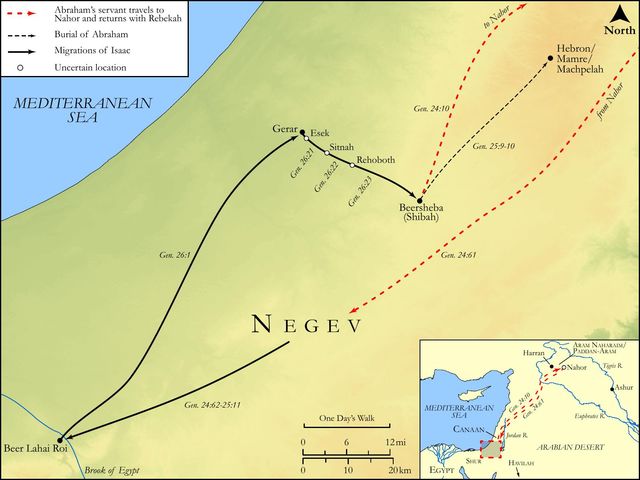
See on the biblical-era maps


Study this verse
Public-domain commentary
Matthew Henry
From his Commentary on the Whole Bible. Henry comments on passages, not single verses — this entry covers Genesis 24:29–53. His four-level outline is real structure in the source text, so it is rendered as structure.
We have here the making up of the marriage between Isaac and Rebekah. It is related very largely and particularly, even to the minute circumstances, which, we should think, might have been spared, while other things of great moment and mystery (as the story of Melchizedek) are related in few words. Thus God conceals that which is curious from the wise and prudent, reveals to babes that which is common and level to their capacity (Mat 11:25), and rules and saves the world by the foolishness of preaching, Co1 1:21. Thus also we are directed to take notice of God's providence in the little common occurrences of human life, and in them also to exercise our own prudence and other graces; for the scripture was not intended for the use of philosophers and statesmen only, but to make us all wise and virtuous in the conduct of ourselves and families. Here is,
I.The very kind reception given to Abraham's servant by Rebekah's relations.
Her brother Laban went to invite and conduct him in, but not till he saw the ear-rings and the bracelets upon his sister's hands, Gen 24:30. "O," thinks Laban, "here is a man that there is something to be got by, a man that is rich and generous; we will be sure to bid him welcome!" We know so much of Laban's character, by the following story, as to think that he would not have been so free of his entertainment if he had not hoped to be well paid for it, as he was, Gen 24:53. Note, A man's gift maketh room for him (Pro 18:16), which way soever it turneth, it prospereth, Pro 17:8.
1.The invitation was kind: Come in, thou blessed of the Lord, Gen 24:31. They saw he was rich, and therefore pronounced him blessed of the Lord; or, perhaps, because they heard from Rebekah (Gen 24:28) or the gracious words which proceeded out of his mouth, they concluded him a good man, and therefore blessed of the Lord. Note, Those that are blessed of God should be welcome to us. It is good owning those whom God owns.
2.The entertainment was kind, Gen 24:32, Gen 24:33. Both the house and stable were well furnished, and Abraham's servant was invited to the free use of both. Particular care was taken of the camels; for a good man regardeth the life of his beast, Pro 12:10. If the ox knows his owner to serve him, the owner should know his ox to provide for him that which is fitting for him.
II.The full account which he gave them of his errand, and the court he made to them for their consent respecting Rebekah. Observe,
1.How intent he was upon his business; though he had come off a journey, and come to a good house, he would not eat, till he had told his errand, Gen 24:33. Note, The doing of our work, and the fulfilling of our trusts, either for God or man, should be preferred by us before our necessary food: it was our Saviour's meat and drink, Joh 4:34.
2.How ingenious he was in the management of it; he approved himself, in this matter, both a prudent man and a man of integrity, faithful to his master by whom he was trusted, and just to those with whom he now treated.
(1.)He gives a short account of the state of his master's family, Joh 4:34-36. He was welcome before, but we may suppose him doubly welcome when he said, I am Abraham's servant. Abraham's name, no doubt, was well known among them and respected, and we might suppose them not altogether ignorant of his state, for Abraham knew theirs, Gen 22:20-24. Two things he suggests, to recommend his proposal: - [1.] That his master Abraham, through the blessing of God, had a very good estate; and, [2.] That he had settled it all upon Isaac, for whom he was now a suitor.
(2.)He tells them the charge his master had given him, to fetch a wife for his son from among his kindred, with the reason of it, Gen 24:37, Gen 24:38. Thus he insinuates a pleasing hint, that, though Abraham had removed to a country at so great a distance, yet he still retained the remembrance of his relations that he had left behind, and a respect for them. The highest degrees of divine affection must not divest us of natural affection. He likewise obviates an objection, That, if Isaac were deserving, he needed not send so far off for a wife: why did he not marry nearer home? "For a good reason," says he; "my master's son must not match with a Canaanite." He further recommends his proposal,
[1.]From the faith his master had that it would succeed, Gen 24:40. Abraham took encouragement from the testimony of his conscience that he walked before God in a regular course of holy living, and thence inferred that God would prosper him; probably he refers to that covenant which God had made with him (Gen 17:1), I am God, all-sufficient, walk before me. Therefore, says he the God before whom I walk will send his angel. Note, While we make conscience of our part of the covenant, we may take the comfort of God's part of it; and we should learn to apply general promises of particular cases, as there is occasion.
[2.]From the care he himself had taken to preserve their liberty of giving or refusing their consent, as they should see cause, without incurring the guilt of perjury (Gen 24:39-41), which showed him, in general, to be a cautious man, and particularly careful that their consent might not be forced, but be either free or not at all.
(3.)He relates to them the wonderful concurrence of providences, to countenance and further the proposal, plainly showing the finger of God in it.
[1.]He tells them how he had prayed for direction by a sign, Gen 24:42-44. Note, It is good dealing with those who be prayer take God along with them in their dealings.
[2.]How God had answered his prayer in the very letter of it. Though he did but speak in his heart (Gen 24:45), which perhaps he mentions, lest it should be suspected that Rebekah had overheard his prayer and designedly humoured it. "No," says he, "I spoke it in my heart, so that none heard it but God, to whom thought are word, and from him the answer came," Gen 24:46, Gen 24:47.
[3.]How he had immediately acknowledged God's goodness to him therein, leading him, as he here expresses it, in the right way. Note, God's way is always the right way (Psa 107:7), and those are well led whom he leads.
(4.)He fairly refers the matter to their consideration, and waits their decision (Gen 24:49): "If you will deal kindly and truly with my master, well and good: if you will be sincerely kind, you will accept the proposal, and I have what I came for; if not, do not hold me in suspense." Note, Those who deal fairly have reason to expect fair dealing.
(5.)They freely and cheerfully close with the proposal upon a very good principle (Gen 24:50): "The thing proceedeth from the Lord, Providence smiles upon it, and we have nothing to say against it." They do not object distance of place, Abraham's forsaking them, or his having no land in possession, but person estate only: they do not question the truth of what this man said; but,
[1.]They trust much to his integrity. It were well if honesty did so universally prevail among men that it might be as much an act of prudence as it is of good nature to take a man's word.
[2.]They trust more to God's providence, and therefore by silence give consent, because it appears to be directed and disposed by Infinite Wisdom. Note, A marriage is then likely to be comfortable when it appears to proceed from the Lord.
(6.)Abraham's servant makes a thankful acknowledgment of the good success he had met with,
[1.]To God: He worshipped the Lord, Gen 24:52. Observe, First, As his good success went on, he went on to bless God. Those that pray without ceasing should in every thing give thanks, and own God in every step of mercy. Secondly, God sent his angel before him, and so gave him success, Gen 24:7, Gen 24:40. But when he has the desired success, he worships God, not the angel. Whatever benefit we have by the ministration of angels, all the glory must be given to the Lord of the angels, Rev 22:9.
[2.]He pays his respects to the family also, and particularly to the bride, Gen 24:53. He presented her, and her mother, and brother, with many precious things, both to give a real proof of his master's riches and generosity and in gratitude for their civility to him, and further to ingratiate himself with them.
Continue studying Genesis 24:45 across the web’s major study libraries — every link below opens this exact verse, chapter, or book on the destination site.
Read & Compare
 BibleGatewayThis verse in more than 200 translations and 70 languages.
 Bible.comThe YouVersion reader — hundreds of translations, reading plans, and highlights.
 ESV.orgCrossway's official English Standard Version reader.
 NET BibleThe NET translation with 60,000+ translators' notes on every rendering decision.
 STEP BibleTyndale House's free study tool — original text, vocabulary, and scholarly resources.
 BibliaLogos Bible Software's free web reader.
 USCCBThe New American Bible (Revised Edition) with the U.S. bishops' study notes.
Commentaries
 BibleHub CommentariesDozens of classic commentaries on this verse, gathered on one page.
 StudyLightMore than 100 commentary sets — the largest collection on the web.
 BibleRefPlain-English commentary on what this verse means, verse by verse.
 Enduring WordDavid Guzik's free commentary on this chapter, widely used by Bible teachers.
 Bible Study ToolsVerse commentary alongside Greek and Hebrew study aids.
Original Language & Research
- BibleHub InterlinearThe verse word by word — original language, transliteration, and English.
- BibleHub LexiconEvery word's original-language definition and Strong's entry.
 Blue Letter BibleDeep-study tools — Strong's numbers, concordance, and word studies.
 SefariaThe Hebrew text with Rashi and centuries of Jewish commentary.
Sermons, Hymns & Audio


TrulyRandomVerse is not affiliated with these sites and doesn’t control their content. They’re linked because they’re genuinely useful.
Summary
Rebekah's arrival at the well vividly portrays the immediate and precise fulfillment of Abraham's servant's prayer for a divine sign to identify Isaac's destined wife. Even before the servant had concluded his heartfelt supplication, Rebekah appeared at the well, pitcher on her shoulder, initiating the actions that would confirm her as the woman chosen by God, thereby demonstrating God's direct and meticulous providence in the unfolding of His covenant plan.
Context
ShowHideLiterary Context
This verse is a pivotal moment within the extended narrative of Abraham's servant's mission to find a wife for Isaac, detailed in Genesis 24. Following Abraham's solemn charge to his servant (vv. Genesis 24:1-9), the servant journeys to Mesopotamia. Upon arriving at Nahor's city, he pauses at a well outside the city, where he offers a specific and earnest prayer for divine guidance (vv. Genesis 24:10-14). Genesis 24:45 immediately follows this prayer, serving as the dramatic climax where God's answer is revealed with astonishing speed and precision, setting the stage for the subsequent interactions (vv. Genesis 24:46-61) that confirm Rebekah's identity and willingness to return with the servant. The narrative's careful pacing emphasizes the miraculous nature of God's intervention.
Historical & Cultural Context
In Canaan and in Nahor's land, wells were crucial communal gathering places, especially for women who drew water for their households and livestock. These locations often served as social hubs and significant sites for encounters, including betrothals. The act of drawing water, particularly for a stranger and his animals, was a laborious task and a profound demonstration of hospitality—a highly valued virtue in the culture. Marriage arrangements were typically negotiated by families, often involving a bride-price and careful consideration of lineage. Abraham's insistence that Isaac not marry a Canaanite woman (vv. Genesis 24:3-4) reflects the importance of maintaining ethnic and religious purity within the covenant line, making the servant's mission to Abraham's kin in Mesopotamia culturally appropriate and theologically significant.
Key Themes
ShowHideGenesis 24:45 contributes significantly to several overarching themes within Genesis and the broader biblical narrative. Foremost is the theme of Divine Providence and Guidance, showcasing God's active and meticulous involvement in the lives of His covenant people, even in seemingly ordinary circumstances like finding a spouse. It powerfully illustrates the Efficacy of Prayer, demonstrating God's attentiveness and immediate response to faithful supplication, particularly when aligned with His will (Psalm 37:4). The entire chapter, including this verse, underscores God's unwavering Faithfulness to His Covenant Promises made to Abraham, ensuring the continuation of the promised lineage through Isaac (Genesis 12:2-3). Finally, Rebekah's character, implicitly highlighted by her actions, introduces the theme of Hospitality and Virtue as essential qualities for those chosen by God for significant roles in His redemptive plan.
Exposition and Analysis
ShowHideKey Word Analysis
ShowHideThis primitive root means "to arrange," but is used figuratively for "to speak." Here, it emphasizes the servant's internal articulation of his prayer, indicating a thoughtful, deliberate communication with God that was not necessarily vocalized aloud. The immediacy of God's response to a prayer "spoken in mine heart" highlights the depth of divine attentiveness to the innermost thoughts and desires of His faithful servants.
This word, a form of H3824, refers to the "heart" and is used very widely in a figurative sense for the feelings, the will, and even the intellect. In this context, "in mine heart" signifies the servant's deep, sincere, and internal prayer, originating from his core being, not merely a superficial utterance. It underscores the profound spiritual engagement and earnestness of his supplication before God.
From an unused root meaning "to deepen," this word properly refers to a "pail" but generally denotes an earthenware "jar for domestic purposes." Rebekah's carrying her pitcher on her shoulder signifies her purpose in coming to the well—to draw water for her household. This detail is crucial as it sets the stage for her subsequent actions of drawing water for the servant and his camels, directly fulfilling the specific sign requested in the servant's prayer.
Verse Breakdown
ShowHide"And before I had done speaking in mine heart"
This clause powerfully conveys the astonishing immediacy of God's response. The servant's prayer was not even fully articulated or completed in his thoughts before the divine answer began to unfold, emphasizing God's profound attentiveness and readiness to act on behalf of those who trust Him.
"behold, Rebekah came forth with her pitcher on her shoulder"
The interjection "behold" (Hebrew: hinneh) draws immediate attention to the miraculous timing. Rebekah's appearance, equipped for the task of drawing water, is not a coincidence but a divinely orchestrated event, perfectly aligning with the servant's specific request for a woman who would come to the well.
"and she went down unto the well, and drew [water]:"
These actions are precisely what would be expected of someone coming to a well for water. Her immediate and purposeful descent to the water source confirms her readiness to engage in the very act of drawing water, which was central to the servant's requested sign. This sets the stage for her subsequent generous offer.
"and I said unto her, Let me drink, I pray thee."
The servant's initiative in asking for a drink is the first direct interaction, a crucial step in testing the sign he had prayed for. This polite request provides Rebekah the opportunity to demonstrate the hospitality and generosity that would confirm her as the chosen woman for Isaac.
Literary Devices
ShowHideThe narrative in Genesis 24:45 masterfully employs several literary devices to heighten its impact. The most prominent is Divine Intervention, presented with striking Immediacy. The phrase "before I had done speaking in mine heart" underscores God's instantaneous and precise response, making it clear that Rebekah's arrival is no mere coincidence but a direct answer from the Almighty. This swiftness creates a sense of awe and highlights God's active hand in human affairs. The use of "behold" (Hebrew: hinneh) functions as a Narrative Marker or Exclamatory Particle, drawing the reader's attention to the sudden and significant appearance of Rebekah, emphasizing the miraculous nature of the event. Furthermore, the well itself serves as a powerful Symbolism; in an arid land, it represents life, sustenance, and a gathering place, making it a fitting location for a divinely orchestrated meeting that would lead to the continuation of God's covenant lineage. The entire scene is imbued with a sense of Providential Irony, where the servant's deep, internal prayer is met with an immediate, external, and perfectly aligned response, showcasing God's sovereignty over even the minutiae of life.
Theological and Thematic Connections
ShowHideGenesis 24:45 stands as a powerful testament to God's profound and meticulous providence, demonstrating His active involvement in the lives of His people and His unwavering commitment to His covenant promises. The instantaneous fulfillment of the servant's specific prayer underscores the efficacy of earnest, faith-filled supplication, illustrating that God not only hears but also responds with divine precision and perfect timing. This passage reassures believers that God is intimately concerned with the details of their lives, orchestrating circumstances to bring about His purposes, especially when those purposes align with His overarching redemptive plan. It highlights the principle that when we seek God's will with sincere hearts, He often acts in ways that leave no doubt about His sovereign hand.
Reflection and Application
ShowHideGenesis 24:45 offers profound encouragement and practical guidance for believers navigating life's significant decisions. It challenges us to cultivate a deep dependence on God, approaching Him with specific, heartfelt prayers, particularly when seeking His will in matters of great importance, such as career, relationships, or ministry. The servant's experience reminds us that God's timing is impeccable, and He is capable of orchestrating circumstances in ways that surpass our understanding, often revealing His hand in astonishing and unmistakable fashion. This passage encourages us to remain watchful and discerning, recognizing God's providential leading in seemingly ordinary events, and to be ready to act in faith when His direction becomes clear. Furthermore, it subtly highlights the virtues of diligence and hospitality, demonstrating how God can use the character and actions of individuals to fulfill His divine purposes, inviting us to embody such virtues in our own lives as we seek to be instruments of His will.
Questions for Reflection
ShowHideFAQ
ShowHideWhy did the servant pray for such a specific sign?
ShowHideThe servant prayed for a highly specific sign, as detailed in Genesis 24:12-14, because he recognized the immense importance of his mission: finding a wife for Isaac who was not only from Abraham's kin but also divinely chosen. This specificity was not about testing God, but rather about seeking clear, unmistakable confirmation of God's will. It demonstrated his profound dependence on divine guidance for such a crucial task, ensuring that the chosen woman possessed not only the right lineage but also a virtuous, hospitable character suitable for the matriarch of God's chosen line, thereby safeguarding the covenant promises.
Does God always answer prayers immediately, as in this verse?
ShowHideWhile Genesis 24:45 provides a remarkable example of an immediate answer to prayer, it does not establish a universal rule that all prayers will be answered instantly. God's timing is sovereign and perfect, and He answers according to His wise will and for His ultimate glory, which may involve a period of waiting, a different answer than expected, or a delayed response. This passage primarily serves to highlight God's power, attentiveness, and faithfulness, reassuring us that He hears our prayers and is intimately involved in our lives, even if His answers are not always immediate or precisely what we anticipate. The key is to trust in His perfect plan and timing, as exemplified throughout the biblical narrative.
Christ-Centered Fulfillment
ShowHideThe divine orchestration evident in Genesis 24:45, where God providentially guides Abraham's servant to find a bride for Isaac, serves as a profound and beautiful foreshadowing of Christ's relationship with His Church. Just as a bride was meticulously sought and prepared for Isaac to continue the covenant lineage through which the Messiah would eventually come, so too does God, through the work of the Holy Spirit—often referred to as the "Helper" or "Advocate" (John 14:26)—prepare and gather a bride for His Son, Jesus Christ. This narrative of God's faithfulness in securing the earthly lineage ultimately points to Christ, the true Bridegroom, who, through His atoning sacrifice (Ephesians 5:25-27), establishes an eternal covenant with His Church. The Holy Spirit, like Abraham's servant, goes forth to call and prepare those who will be united with Christ, ensuring the continuation of God's redemptive plan in a far grander, spiritual, and eternal sense, culminating in the marriage supper of the Lamb (Revelation 19:7-9).