


Acts 10:30
Bible text: King James Version (1769 Blayney text) · Public domain
Bible text: King James Version with Strong's numbers · Public domain
Bible text: Berean Standard Bible · Public domain
Bible text: American Standard Version (1901) · Public domain
Bible text: World English Bible, Messianic edition · Public domain
Bible text: Geneva Bible (1599) · Public domain
Bible text: Young's Literal Translation · Public domain
- ΚαὶKaiAndG2532CONJConjunction
- ὁho<the>G3588T-NSMDefinite article Nominative Singular Masculine
- ΚορνήλιοςKornēliosCorneliusG2883N-NSM-PNoun Nominative Singular Masculine Individual
- ἔφη·ephēwas sayingG5346V-IAI-3SVerb Imperfect Active Indicative 3rd Singular
- ἀπὸapoAgoG575PREPPreposition
- τετάρτηςtetartēsfourG5067A-GSFAdjective Genitive Singular Feminine
- ἡμέραςhēmerasdaysG2250N-GSFNoun Genitive Singular Feminine
- μέχριmechriuntilG3360PREPPreposition
- ταύτηςtautēsthisG3778D-GSFDemonstrative pronoun Genitive Singular Feminine
- τῆςtēstheG3588T-GSFDefinite article Genitive Singular Feminine
- ὥραςhōrashourG5610N-GSFNoun Genitive Singular Feminine
- ἤμηνēmēnI wasG1510V-IMI-1SVerb Imperfect Middle Indicative 1st Singular
- νηστεύωνnēsteuōnfastingG3522V-PAP-NSMVerb Present Active Participle Nominative Singular Masculine
- καὶkaiandG2532CONJConjunction
- τὴνtēnat theG3588T-ASFDefinite article Accusative Singular Feminine
- ἐνάτηνenatēnninthG1766A-ASFAdjective Accusative Singular Feminine
- ὥρανhōranhourG5610N-ASFNoun Accusative Singular Feminine
- προσευχόμενοςproseuchomenosprayingG4336V-PNP-NSMVerb Present Middle Or Passive Deponent Participle Nominative Singular Masculine
- ἐνeninG1722PREPPreposition
- τῷtōtheG3588T-DSMDefinite article Dative Singular Masculine
- οἴκῳoikōhouseG3624N-DSMNoun Dative Singular Masculine
- μουmouof mineG3165P-1GSPersonal pronoun Genitive 1st Singular
- καὶkaiandG2532CONJConjunction
- ἰδοὺidoubeholdG2400INJInterjection
- ἀνὴρanēra manG435N-NSMNoun Nominative Singular Masculine
- ἔστηestēstoodG2476V-2AAI-3SVerb 2nd Aorist Active Indicative 3rd Singular
- ἐνώπιόνenōpionbeforeG1799PREPPreposition
- μουmoumeG3165P-1GSPersonal pronoun Genitive 1st Singular
- ἐνeninG1722PREPPreposition
- ἐσθῆτιesthētiapparelG2066N-DSFNoun Dative Singular Feminine
- λαμπρᾷlamprabrightG2986A-DSFAdjective Dative Singular Feminine
English is a literal word-by-word gloss of the Greek, not the KJV's wording. Why?
This is the original text the KJV's translators worked from — each Greek word with its own literal English meaning in this verse, prepared by scholars at Tyndale House, Cambridge. The KJV translates whole sentences, not word by word, so its wording differs: one Greek word can become several English words, and the KJV may choose “charity” where the gloss reads “love”. Both are faithful — they answer different questions. For the KJV's own rendering, switch to the KJV text.
Details
See on the biblical-era maps

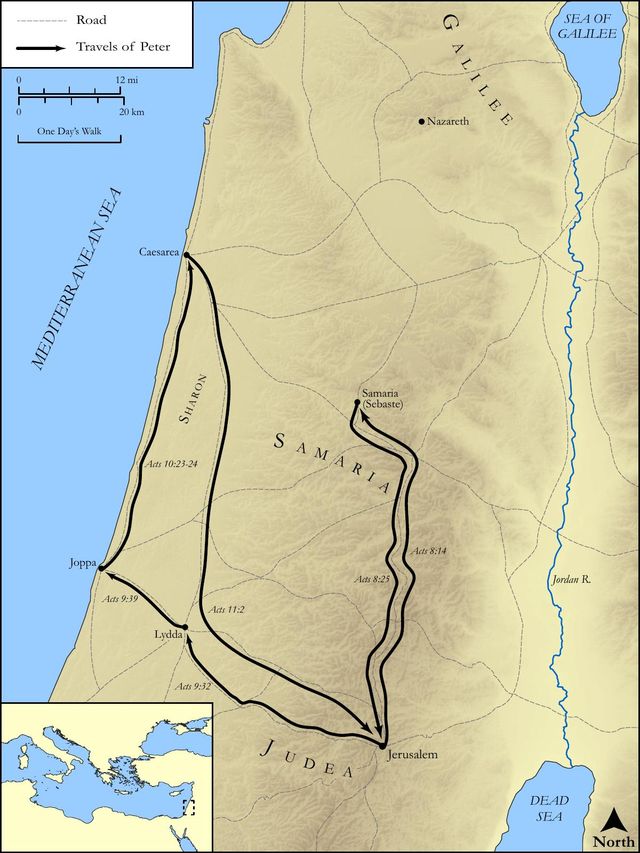
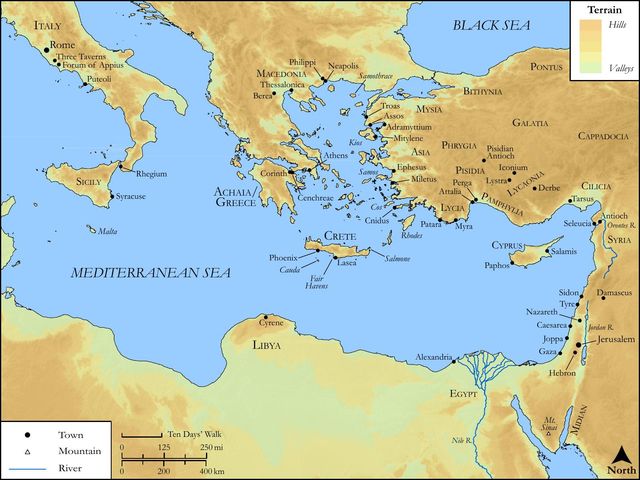
Study this verse
Public-domain commentary
Matthew Henry
From his Commentary on the Whole Bible. Henry comments on passages, not single verses — this entry covers Acts 10:19–33. His four-level outline is real structure in the source text, so it is rendered as structure.
We have here the meeting between Peter the apostle, and Cornelius the centurion. Though Paul was designed to be the apostle of the Gentiles, and to gather in the harvest among them, and Peter to be the apostle of the circumcision, yet it is ordered that Peter shall break the ice, and reap the first-fruits of the Gentiles, that the believing Jews, who retained too much of the old leaven of ill-will to the Gentiles, might be the better reconciled to their admission into the church, when they were first brought in by their own apostle, which Peter urges against those that would have imposed circumcision upon the Gentile converts (Act 15:7), You know that God made choice among us that the Gentiles by my mouth should hear the word of the gospel. Now here,
I.Peter is directed by the Spirit to go along with Cornelius's messengers (Act 10:19, Act 10:20), and this is the exposition of the vision; now the riddle is unriddled: While Peter thought on the vision; he was musing upon it, and then it was opened to him. Note, Those that would be taught the things of God must think on those things; those that would understand the scriptures must meditate in them day and night. He was at a loss about it, and then had it explained, which encourages us, when we know not what to do, to have our eyes up unto God for direction. Observe,
1.Whence he had the direction. The Spirit said to him what he should do. It was not spoken to him by an angel, but spoken in him by the Spirit, secretly whispering it in his ear as it were, as God spoke to Samuel (Sa1 9:15), or impressing it powerfully upon his mind, so that he knew it to be a divine afflatus or inspiration, according to the promise, Joh 16:13.
2.What the direction was.
(1.)He is told, before any of the servants could come up to tell him, that three men below want to speak with him (Act 10:19), and he must arise from his musings, leave off thinking of the vision, and go down to them, Act 10:20. Those that are searching into the meaning of the words of God, and the visions of the Almighty, should not be always poring, no, nor always praying, but should sometimes look abroad, look about them, and they may meet with that which will be of use to them in their enquiries; for the scripture is in the fulfilling every day.
(2.)He is ordered to go along with the messengers to Cornelius, though he was a Gentile, doubting nothing. He must not only go, but go cheerfully, without reluctance or hesitation, or any scruple concerning the lawfulness of it; not doubting whether he might go, no, nor whether he ought to go; for it was his duty "Go with them, for I have sent them: and I will bear thee out in going along with them, however thou mayest be censured for it." Note, When we see our call clear to any service, we should not suffer ourselves to be perplexed with doubts and scruples concerning it arising from former prejudices or pre-possessions, or a fear of men's censure. Let every man be fully persuaded in his own mind, and prove his own work.
II.He receives both them and their message:
He went down to them, Act 10:21. So far was he from going out of the way, or refusing to be spoken with, as one that was shy of them, or making them tarry, as one that took state upon him, that he went to them himself, told them he was the person they were enquiring for. And 1. He favourably receives their message; with abundance of openness and condescension he asks what their business is, what they have to say to him: What is the cause wherefore you are come? and they tell him their errand (Act 10:22): "Cornelius, an officer of the Roman army, a very honest gentleman, and one who has more religion than most of his neighbours, who fears God above many (Neh 7:2), who, though he is not a Jew himself, has carried it so well that he is of good report among all the people of the Jews - they will all give him a good word, for a conscientious, sober, charitable man, so that it will be no discredit to thee to be seen in his company - he was warned from God," echrēmatisthē - "he had an oracle from God, sent to him by an angel" (and the lively oracles of the law of Moses were given by the disposition of angels), "by which he was ordered to send for thee to his house (where he is expecting thee, and ready to bid thee welcome), and to hear words of thee: they know not what words, but they are such as he may hear from thee, and not from any one else so well." Faith comes by hearing. When Peter repeats this, he tells us more fully, they are words whereby thou and all thy house shall be saved, Act 11:14. "Come to him, for an angel bade him send for thee: come to him, for he is ready to hear and receive the saving words thou hast to bring to him." 2. He kindly entertained the messengers (Act 10:23): He called them in, and lodged them. He did not bid them go and refresh and repose themselves in an inn at their own charge, but was himself at the charge of entertaining them in his own quarters. What was getting ready for him (Act 10:10) they should be welcome to share in; he little thought what company he should have when he bespoke his dinner, but God foresaw it. Note, It becomes Christians and ministers to be hospitable, and ready, according as their ability is, and there is occasion for it, to entertain strangers. Peter lodged them, though they were Gentiles, to show how readily he complied with the design of the vision in eating with Gentiles; for he immediately took them to eat with him. Though they were two of them servants, and the other a common soldier, yet Peter thought it not below him to take them into his house. Probably he did it that he might have some talk with them about Cornelius and his family; for the apostles, though they had instructions from the Spirit, yet made use of other information, as they had occasion for it.
III.He went with them to Cornelius, whom he found ready to receive and entertain him.
1.Peter, when he went with them, was accompanied by certain brethren from Joppa, where he now was, Act 10:23. Six of them went along with him, as we find, Act 11:12. Either Peter desired their company, that they might be witnesses of his proceeding cautiously with reference to the Gentiles, and of the good ground on which he went, and therefore he invited them (Act 11:12), or they offered their service to attend him, and desired they might have the honour and happiness of being his fellow travellers. This was one way in which the primitive Christians very much showed their respect to their ministers: they accompanied them in their journeys, to keep them in countenance, to be their guard, and, as there was occasion, to minister to them; with a further prospect not only of doing them service, but of being edified by their converse. It is a pity that those who have skill and will to do good to others by their discourse should want an opportunity for it by travelling alone.
2.Cornelius, when he was ready to receive him, had got some friends together of Cesarea. It seems, it was above a day's journey, nearly two, from Joppa to Cesarea; for it was the day after they set out that they entered into Cesarea (Act 10:24), and the afternoon of that day, Act 10:30. It is probable that they travelled on foot; the apostles generally did so. Now when they came into the house of Cornelius Peter found,
(1.)That he was expected, and this was an encouragement to him. Cornelius waited for them, and such a guest was worth waiting for; nor can I blame him if he waited with some impatience, longing to know what that mighty thing was which an angel bade him expect to hear from Peter.
(2.)That he was expected by many, and this was a further encouragement to him. As Peter brought some with him to partake of the spiritual gift he had now to dispense, so Cornelius had called together, not only his own family, but kinsmen and near friends, to partake with him of the heavenly instructions he expected from Peter, which would give Peter a larger opportunity of doing good. Note, We should not covet to eat our spiritual morsels alone, Job 31:17. It ought to be both given and taken as a piece of kindness and respect to our kindred and friends to invite them to join with us in religious exercises, to go with us to hear a sermon. What Cornelius ought to do he thought his kinsmen and friends ought to do too; and therefore let them come and hear it at the first hand, that it may be no surprise to them to see him change upon it.
IV.Here is the first interview between Peter and Cornelius, in which we have,
1.The profound and indeed undue respect and honour which Cornelius paid to Peter (Act 10:25): He met him as he was coming in, and instead of taking him in his arms, and embracing him as a friend, which would have been very acceptable to Peter, he fell down at his feet, and worshipped him; some think, as a prince and a great man, according to the usage of the eastern countries; others think, as an incarnate deity, or as if he took him to be the Messiah himself. His worshipping a man was indeed culpable; but, considering his present ignorance, it was excusable, nay, and it was an evidence of something in him that was very commendable - and that was a great veneration for divine and heavenly things: no wonder if, till he was better informed, he took him to be the Messiah, and therefore worshipped him, whom he was ordered to send for by an angel from heaven. But the worshipping of his pretended successor, who is not only a man, but a sinful man, the man of sin himself, is altogether inexcusable, and such an absurdity as would be incredible if we were not told before that all the world would worship the beast, Rev 13:4.
2.Peter's modest and indeed just and pious refusal of this honour that was done him (Act 10:26): He took him up into his arms, with his own hands (though time was when he little thought he should ever either receive so much respect from or show so much affection to an uncircumcised Gentile), saying, "Stand up, I myself also am a man, and therefore not to be worshipped thus." The good angels of the churches, like the good angels of heaven, cannot bear to have the least of that honour shown to them which is due to God only. See thou do it not, saith the angel to John (Rev 19:10; Rev 22:9), and in like manner the apostle to Cornelius. How careful was Paul that no man should think of him above what he saw in him! Co2 12:6. Christ's faithful servants could better bear to be vilified than to be deified. Peter did not entertain a surmise that his great respect for him, though excessive, might contribute to the success of his preaching, and therefore if he will be deceived let him be deceived; no, let him know that Peter is a man, that the treasure is in earthen vessels, that he may value the treasure for its own sake.
V.The account which Peter and Cornelius give to each other, and to the company, of the hand of Heaven in bringing them together:
As he talked with him - sunomilōn autō, he went in, Act 10:27. Peter went in, talking familiarly with Cornelius, endeavouring, by the freedom of his converse with him, to take off something of that dread which he seemed to have of him; and, when he came in, he found many that were come together, more than he expected, which added solemnity, as well as opportunity of doing good, to this service. Now,
1.Peter declares the direction God gave to him to come to those Gentiles, Act 10:28, Act 10:29. They knew it had never been allowed by the Jews, but always looked upon as an unlawful thing, athemiton - an abomination, for a man that is a Jew, a native Jew as I am, to keep company or come unto one of another nation, a stranger, an uncircumcised Gentile. It was not made so by the law of God, but by the decree of their wise men, which they looked upon to be no less binding. They did not forbid them to converse or traffic with Gentiles in the street or shop, or upon the exchange, but to eat with them. Even in Joseph's time, the Egyptians and Hebrews could not eat together, Gen 43:32. The three children would not defile themselves with the king's meat, Dan 1:8. They might not come into the house of a Gentile, for they looked upon it to be ceremonially polluted. Thus scornfully did the Jews look upon the Gentiles, who were not behindhand with them in contempt, as appears by many passages in the Latin poets. "But now," saith Peter, "God hath shown me, by a vision, that I should not call any man common or unclean, nor refuse to converse with any man for the sake of his country." Peter, who had taught his new converts to save themselves from the untoward generation of wicked men (Act 2:40), is now himself taught to join himself with the towardly generation of devout Gentiles. Ceremonial characters were abolished, that more regard might be had to moral ones. Peter thought it necessary to let them know how he came to change his mind in this matter, and that it was by a divine revelation, lest he should be upbraided with it as having used lightness. God having thus taken down the partition-wall,
(1.)He assures them of his readiness to do them all the good offices he could; that, when he kept at a distance, it was not out of any personal disgust to them, but only because he wanted leave from heaven, and, having now received permission, he was at their service: "Therefore came I unto you without gainsaying, as soon as I was sent for, ready to preach the same gospel to you that I have preached to the Jews." The disciples of Christ could not but have some notion of the preaching of the gospel to the Gentiles, but they imagined it must be only to those Gentiles that were first proselyted to the Jewish religion, which mistake Peter acknowledges was not rectified.
(2.)He enquires wherein he might be serviceable to them: "I ask, therefore, for what intent you have sent for me? What do you expect from me, or what business have you with me?" Note, Those that desire the help of God's ministers ought to look well to it that they propose right ends to themselves in it, and do it with a good intention.
2.Cornelius declares the directions God gave to him to send for Peter, and that it was purely in obedience to those directions that he had sent for him. Then we are right in our aims, in sending for and attending on a gospel-ministry, when we did it with a regard to the divine appointment instituting that ordinance and requiring us to make use of it. Now,
(1.)Cornelius gives an account of the angel's appearing to him, and ordering him to send for Peter; not as glorying in it, but as that which warranted his expectation of a message from heaven by Peter.
[1.]He tells how this vision found him employed (Act 10:30): Four days ago I was fasting until this hour, this hour of the day that it is now when Peter came, about the middle of the afternoon. By this it appears that religious fasting, in order to the greater seriousness and solemnity of praying, was used by devout people who were not Jews; the king of Nineveh proclaimed a fast, Jon 3:5. Some give these words another sense: From four days ago I have been fasting until this hour; as if he had eaten no meat, or at least no meal, from that time to this. But it comes in as an introduction to the story of the vision; and therefore the former must be the meaning. He was at the ninth hour praying in his house, not in the synagogue, but at home. I will that men pray wherever they dwell. His praying in his house intimates that it was not a secret prayer in his closet, but in a more public room of his house, with his family about him; and perhaps after prayer he retired, and had this vision. Observe, At the ninth hour of the day, three of the clock in the afternoon, most people were travelling or trading, working in the fields, visiting their friends, taking their pleasure, or taking a nap after dinner; yet then Cornelius was at his devotions, which shows how much he made religion his business; and then it was that he had this message from heaven. Those that would hear comfortably from God must be much in speaking to him.
[2.]He describes the messenger that brought him this message from heaven: There stood a man before me in bright clothing, as Christ's was when he was transfigured, and that of the two angels who appeared at Christ's resurrection (Luk 24:4), and at his ascension (Act 1:10), showing their relation to the world of light.
[3.]He repeats the message that was sent to him (Act 10:31, Act 10:32), just as we had it, Act 10:4-6. Only here it is said, thy prayer is heard. We are not told what his prayer was; but if this message was an answer to it, and it should seem it was, we may suppose that finding the deficiency of natural light, and that it left him at a loss how to obtain the pardon of his sin and the favour of God, he prayed that God would make some further discoveries of himself and of the way of salvation to him. "Well," saith the angel, "send for Peter, and he shall give thee such a discovery."
(2.)He declares his own and his friends' readiness to receive the message Peter had to deliver (Act 10:33): Immediately therefore I sent to thee, as I was directed, and thou hast well done that thou hast come to us, though we are Gentiles. Note, Faithful ministers do well to come to people that are willing and desirous to receive instruction from them; to come when they are sent for; it is as good a deed as they can do. Well, Peter is come to do his part; but will they do theirs? Yes. "Thou art here prepared to speak, and we are here prepared to hear," Sa1 3:9, Sa1 3:10. Observe,
[1.]Their religious attendance upon the word: "We are all here present before God; we are here in a religious manner, are here as worshippers" (they thus compose themselves into a serious solemn frame of spirit): "therefore, because thou art come to us by such a warrant, on such an errand, because we have such a price in our hand as we never had before and perhaps may never have again, we are ready now at this time of worship, here in this place of worship" (though it was in a private house): "we are present, paresmen - we are at the business, and are ready to come at a call." If we would have God's special presence at an ordinance, we must be there with a special presence, an ordinance presence: Here I am. "We are all present, all that were invited; we, and all that belong to us; we, and all that is within us." The whole of the man must be present; not the body here, and the heart, with the fool's eyes, in the ends of the earth. But that which makes it indeed a religious attendance is, We are present before God. In holy ordinances we present ourselves unto the Lord, and we must be as before him, as those that see his eye upon us.
[2.]The intention of this attendance: "We are present to hear all things that are commanded thee of God, and given thee in charge to be delivered to us." Observe, First, Peter was there to preach all things that were commanded him of God; for, as he had an ample commission to preach the gospel, so he had full instructions what to preach. Secondly, They were ready to hear, not whatever he pleased to say, but what he was commanded of God to say. The truths of Christ were not communicated to the apostles to be published or stifled as they thought fit, but entrusted with them to be published to the world. "We are ready to hear all, to come at the beginning of the service and stay to the end, and be attentive all the while, else how can we hear all? We are desirous to hear all that thou art commissioned to preach, though it be ever so displeasing to flesh and blood, and ever so contrary to our former notions or present secular interests. We are ready to hear all, and therefore let nothing be kept back that is profitable for us."
Historical interpretation
Three Centuries of Reception
3 surviving comments on this verse. Each one is dated, so this reads as a timeline rather than a list.
Select a marker to jump to its quote. Markers stagger vertically where authors wrote within a few decades of each other.
What then does Cornelius? He does not say, Why, did not the soldiers tell thee? but observe again, how humbly he speaks. For he says, "From the fourth day I was fasting until this hour; and at the ninth hour I prayed in my house, and, behold, a man stood before me in bright clothing, and said, Cornelius, thy prayer is heard, and thine alms are come up for a memorial before God." It seems to me, that this man had also fixed for himself set times of a life under stricter rule, and on certain days. For this is why he says, "From the fourth day." See how great a thing prayer is! When he advanced in piety, then the Angel appears to him.
He does not say, an Angel, so unassuming is he: "and said, Cornelius, thy prayer is heard, and thine alms are had in remembrance in the sight of God."
And Cornelius said: Four days ago to this hour, I was praying in my house at the ninth hour. In Greek, it is written more fully and clearly: Four days ago to this hour, I was fasting and praying from the sixth hour until the ninth. Where it is clearly shown that four days before he spoke with Peter, he remained fasting until the ninth hour; and to make the fast acceptable to God, he prayed devoutly from the sixth hour until the ninth; hence he deserved to obtain what he sought with great persistence in fasting and prayer.
From the fourth day until this hour, I was praying in my house at the ninth hour, and behold, a man stood before me, and so on. In Greek and in some Latin manuscripts it is written thus: From the fourth day until this hour I was fasting, and praying from the sixth hour to the ninth, and behold, a man, and so on. It was very appropriate that he who extended his prayer for three hours from the sixth to the ninth should be heard. At which time the Lord himself, whom he beseeched, prayed with outstretched hands on the cross for the salvation of the whole world.
Continue studying Acts 10:30 across the web’s major study libraries — every link below opens this exact verse, chapter, or book on the destination site.
Read & Compare
 BibleGatewayThis verse in more than 200 translations and 70 languages.
 Bible.comThe YouVersion reader — hundreds of translations, reading plans, and highlights.
 ESV.orgCrossway's official English Standard Version reader.
 NET BibleThe NET translation with 60,000+ translators' notes on every rendering decision.
 STEP BibleTyndale House's free study tool — original text, vocabulary, and scholarly resources.
 BibliaLogos Bible Software's free web reader.
 USCCBThe New American Bible (Revised Edition) with the U.S. bishops' study notes.
Commentaries
 BibleHub CommentariesDozens of classic commentaries on this verse, gathered on one page.
 StudyLightMore than 100 commentary sets — the largest collection on the web.
 BibleRefPlain-English commentary on what this verse means, verse by verse.
 Enduring WordDavid Guzik's free commentary on this chapter, widely used by Bible teachers.
 Bible Study ToolsVerse commentary alongside Greek and Hebrew study aids.
Original Language & Research
- BibleHub InterlinearThe verse word by word — original language, transliteration, and English.
- BibleHub LexiconEvery word's original-language definition and Strong's entry.
 Blue Letter BibleDeep-study tools — Strong's numbers, concordance, and word studies.
 CNTR CollationThe earliest Greek manuscripts of this verse, collated letter by letter.
Sermons, Hymns & Audio


TrulyRandomVerse is not affiliated with these sites and doesn’t control their content. They’re linked because they’re genuinely useful.
Summary
Acts 10:30 captures Cornelius's personal testimony to Peter, recounting the precise divine encounter that prompted him to send for the apostle. This verse details the spiritual discipline of Cornelius, a devout Gentile, and the miraculous appearance of an angelic messenger, setting the stage for a groundbreaking moment in the early church's understanding of God's universal plan for salvation.
Context
ShowHideLiterary Context
Acts 10 is a pivotal narrative in the Book of Acts, marking a significant transition in the early Christian church's mission from primarily Jewish to universally inclusive. Prior to this verse, Peter has received his transformative vision of unclean animals (Acts 10:9-16), which challenges his deeply ingrained Jewish dietary and social customs. Simultaneously, Cornelius, a Roman centurion and Gentile God-fearer, receives a vision instructing him to send for Peter. Verse 30 is Cornelius's direct account to Peter and the gathered company, explaining the divine command that led to their meeting. It immediately precedes Peter's sermon and the unprecedented outpouring of the Holy Spirit upon Gentiles (Acts 10:44-48), underscoring God's orchestration of events to dismantle ethnic barriers within the nascent church.
Historical & Cultural Context
Cornelius was a Roman centurion stationed in Caesarea, a significant Roman administrative and military center. Although a Gentile, he is described as "a devout man who feared God with all his household, gave alms generously to the people, and prayed to God continually" (Acts 10:2). This indicates he was a "God-fearer," a Gentile who adhered to certain Jewish moral and religious practices without fully converting to Judaism (e.g., circumcision). Jewish custom generally prohibited close association or dining with Gentiles (Acts 10:28), making Peter's willingness to enter Cornelius's house a radical act, directly prompted by divine revelation. The "ninth hour" (approximately 3:00 PM) was a traditional Jewish hour for prayer, observed by devout Jews and God-fearers alike, highlighting Cornelius's spiritual discipline and openness to God.
Key Themes
ShowHideThis verse significantly contributes to several major theological and narrative themes in Acts. It highlights Divine Initiative, demonstrating that God actively seeks out and reveals His will to those who are open to Him, regardless of their background, as evidenced by both Cornelius's vision and Peter's (Acts 10:9-16). It underscores the Power of Prayer and Devotion, showing how Cornelius's consistent spiritual practices, including fasting and prayer, were directly honored by God's intervention. Most critically, it serves as a foundational moment for the theme of Gentile Inclusion in God's redemptive plan, illustrating that salvation is not exclusive to the Jews but extends to all who believe. This narrative prepares the way for the Holy Spirit's outpouring on the Gentiles (Acts 10:44-48), fulfilling Old Testament prophecies of God being a "light to the Gentiles" (Isaiah 49:6).
Exposition and Analysis
ShowHideKey Word Analysis
ShowHideTo abstain from food, specifically in a religious context. Cornelius's statement that he "was fasting" indicates a period of spiritual discipline and earnest seeking of God, often associated with heightened prayer and spiritual sensitivity, demonstrating his devout character.
Ordinal number referring to the ninth hour, which corresponds to approximately 3:00 PM. This was a customary Jewish hour for prayer, signifying Cornelius's adherence to a structured, devout spiritual life, even as a Gentile, and highlighting the specific moment of divine intervention.
Radiant, limpid, magnificent, or sumptuous in appearance. Used here to describe the clothing of the man (angel) who appeared to Cornelius, denoting a celestial, glorious, or divine presence, a common biblical descriptor for angelic or divine messengers.
Verse Breakdown
ShowHide"And Cornelius said, Four days ago I was fasting until this hour;"
Cornelius begins his testimony to Peter, establishing the timeframe of his divine encounter. His mention of fasting indicates a state of spiritual earnestness and preparation, suggesting he was already deeply engaged in seeking God when the vision occurred. The phrase "until this hour" could imply he had been fasting for a significant period leading up to the vision, or that the vision itself occurred at the culmination of a fasting period, emphasizing his spiritual readiness.
"and at the ninth hour I prayed in my house,"
This clause specifies the exact time and place of the vision. The "ninth hour" (3:00 PM) was a recognized Jewish hour of prayer, underscoring Cornelius's devout spiritual routine and consistent communion with God. The location, "in my house," highlights the personal and private nature of his devotion, yet it was a devotion God publicly honored through a miraculous visitation.
"and, behold, a man stood before me in bright clothing,"
This introduces the miraculous and divine element of the encounter. The interjection "behold" (Greek idoú) draws immediate attention to the sudden and impactful appearance. The "man" is understood to be an angel, whose "bright clothing" signifies his divine origin, glory, and purity, a common biblical motif for heavenly messengers (Luke 24:4).
Literary Devices
ShowHideThe narrative in Acts 10:30 employs several literary devices to convey its profound message. The use of Foreshadowing is prominent, as Cornelius's vision and his subsequent actions directly set the stage for Peter's groundbreaking ministry to the Gentiles, which dramatically alters the trajectory of the early church. The description of the "man... in bright clothing" utilizes Imagery, painting a vivid and evocative picture of a celestial messenger, a common biblical motif that signifies divine communication and authority. The interjection "behold" (Greek idoú) functions as an Exclamatory Device, drawing the listener's immediate attention to the sudden, miraculous, and divinely orchestrated appearance, emphasizing the supernatural nature of the event. The entire account of Cornelius and Peter in Acts 10 serves as a Paradigm Shift within the biblical narrative, illustrating God's active dismantling of ethnic and religious barriers to salvation.
Theological and Thematic Connections
ShowHideCornelius's testimony in Acts 10:30 powerfully illustrates God's responsiveness to sincere devotion, even from those outside the traditional covenant. It underscores the truth that God is not a respecter of persons, but in every nation, whoever fears Him and works righteousness is accepted by Him. This encounter marks a pivotal moment in redemptive history, revealing God's universal salvific purpose and His active initiation in bringing the Gospel to the Gentiles, thereby expanding the boundaries of His people beyond ethnic Israel. It demonstrates that God sees and honors genuine spiritual hunger, preparing hearts for the revelation of Christ and demonstrating His desire to draw all people to Himself.
Reflection and Application
ShowHideCornelius's account in Acts 10:30 offers profound insights for contemporary believers. His consistent spiritual disciplines—fasting and prayer at designated times—demonstrate a deep, active pursuit of God that God honored with a direct, personal revelation. This challenges us to examine the earnestness and consistency of our own spiritual lives. Are we cultivating an environment where God can speak to us, through prayer, Scripture, and intentional seeking? Furthermore, Cornelius's immediate obedience to the angelic instruction, even before fully understanding its implications, serves as a powerful model of faith. It reminds us that God often works through unexpected means and people, and our willingness to step outside our comfort zones, prejudices, or preconceived notions is crucial for participating in His broader redemptive work. His story encourages us to trust that God sees our sincere efforts and will meet us where we are, guiding us into deeper truth and service, and expanding our understanding of His boundless love for all humanity.
Questions for Reflection
ShowHideFAQ
ShowHideWhy is the "ninth hour" significant in this verse?
ShowHideThe "ninth hour" (approximately 3:00 PM) was one of the traditional Jewish hours of prayer, alongside the third (9:00 AM) and sixth (12:00 PM) hours. That Cornelius, a Gentile, observed this practice underscores his deep spiritual devotion and discipline, indicating he was a "God-fearer" who had adopted certain Jewish customs. His prayer at this specific time highlights his earnest seeking of God, which God honored with a divine visitation. This detail emphasizes God's responsiveness to sincere prayer, regardless of the individual's ethnic background, as seen in Acts 10:2.
Who was the "man in bright clothing" who appeared to Cornelius?
ShowHideThe "man in bright clothing" is universally understood to be an angel, a heavenly messenger sent directly from God. The description of "bright clothing" (Greek lamprós esthḗs) is a common biblical motif used to depict angelic or divine appearances, signifying their celestial origin, glory, and purity. Similar descriptions are found elsewhere in Scripture, such as the angels at Jesus' tomb in Luke 24:4. This angelic appearance served to deliver God's direct instruction to Cornelius, prompting him to send for Peter, thereby initiating the pivotal encounter that would open the door for Gentile inclusion in the early church.
Christ-Centered Fulfillment
ShowHideActs 10:30, as an integral part of the broader narrative of Cornelius, profoundly illustrates the Christ-centered fulfillment of God's redemptive plan for all humanity. Cornelius, a devout Gentile, was earnestly seeking God, and God responded, not by bringing him into the old covenant, but by directing him to Peter, who would proclaim the good news of Jesus Christ. The "man in bright clothing" was an angelic messenger, but his message pointed not to himself, but to the one through whom salvation would come—Jesus. The ultimate purpose of Cornelius's vision and Peter's subsequent visit was to reveal that "everyone who believes in [Jesus] receives forgiveness of sins through His name" (Acts 10:43). This event shatters the previous ethnic barriers to God's covenant, demonstrating that Christ's atoning work on the cross (Colossians 1:19-20) has created "one new humanity" (Ephesians 2:15) in Him. This fulfillment extends the Abrahamic promise that "all peoples on earth will be blessed through you" (Genesis 12:3), showing that Christ is the means by which this blessing is extended to Gentiles, allowing them to be fully incorporated into the body of Christ, the Church, without first becoming Jewish proselytes (Galatians 3:28).