


Genesis 15:9
Bible text: King James Version (1769 Blayney text) · Public domain
Bible text: King James Version with Strong's numbers · Public domain
Bible text: Berean Standard Bible · Public domain
Bible text: American Standard Version (1901) · Public domain
Bible text: World English Bible, Messianic edition · Public domain
Bible text: Geneva Bible (1599) · Public domain
Bible text: Young's Literal Translation · Public domain
- וַיֹּאמֶרvai·Yo·merand he saidH559Conj-w ¦ V-Qal-ConsecImperf-3msVerb Qal Consecutive Imperfect 3rd Singular Masculineוַandיֹּאמֶרhe said
- אֵלָיו'e·Lavto himH413Prep ¦ 3msPreposition Definiteאֵלָיtoוhim
- קְחָהke·Chahbring !H3947V-Qal-Imp-2ms ¦ SfxVerb Qal Imperative 2nd Singular Masculineקְחָbringה!
- לִיlito <the> mePrep-l ¦ 1csSuffix Personal 1st Singular common genderלִto <the>יme
- עֶגְלָה'eg·Laha heiferH5697N-fsNoun Singular Feminine Absolute
- מְשֻׁלֶּשֶׁתme·shu·Le·shetthree years oldH8027V-Pual-PassPrtcpl-fsVerb Pual Participle Passive Singular Feminine Construct
- וְעֵזve·'Ezand a goatH5795Conj-w ¦ N-fsNoun Singular Feminine Absoluteוְandעֵזa goat
- מְשֻׁלֶּשֶׁתme·shu·Le·shetthree years oldH8027V-Pual-PassPrtcpl-fsVerb Pual Participle Passive Singular Feminine Construct
- וְאַיִלve·'A·yiland a ramH352Conj-w ¦ N-msNoun Singular Masculine Absoluteוְandאַיִלa ram
- מְשֻׁלָּשׁme·shu·Lashthree years oldH8027V-Pual-PassPrtcpl-msVerb Pual Participle Passive Singular Masculine Absolute
- וְתֹרve·Torand a turtle-doveH8449Conj-w ¦ N-csNoun Singular common gender Absoluteוְandתֹרa turtle-dove
- וְגוֹזָלve·go·Zaland a young pigeonH1469Conj-w ¦ N-msNoun Singular Masculine Absoluteוְandגוֹזָלa young pigeon
English is a literal word-by-word gloss of the Hebrew, not the KJV's wording. Why?
This is the original text the KJV's translators worked from — each Hebrew word with its own literal English meaning in this verse, prepared by scholars at Tyndale House, Cambridge. The KJV translates whole sentences, not word by word, so its wording differs: one Hebrew word can become several English words, and the KJV may choose “the LORD” where the gloss reads “Yahweh”. Both are faithful — they answer different questions. For the KJV's own rendering, switch to the KJV text.
Details
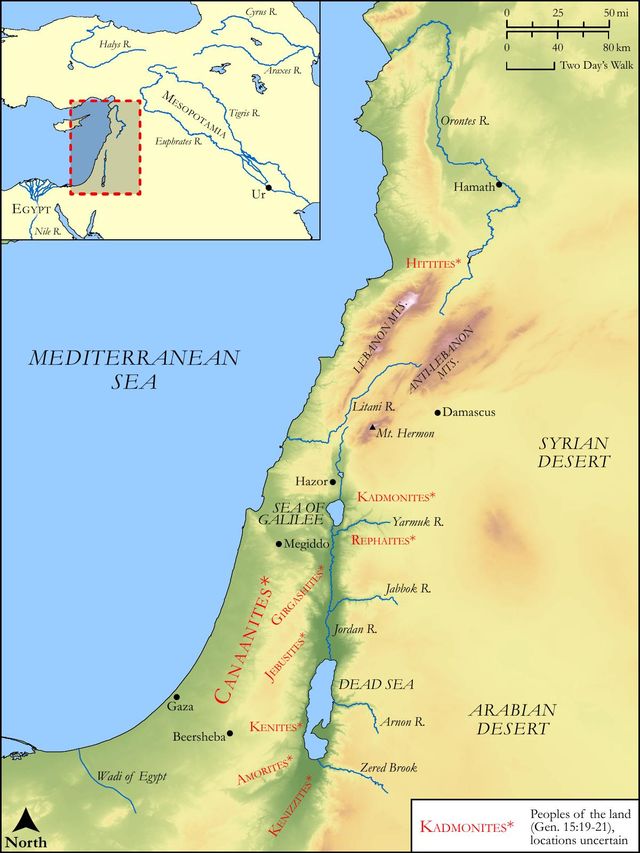
See on the biblical-era maps


Study this verse
Public-domain commentary
Matthew Henry
From his Commentary on the Whole Bible. Henry comments on passages, not single verses — this entry covers Genesis 15:7–11. His three-level outline is real structure in the source text, so it is rendered as structure.
We have here the assurance given to Abram of the land of Canaan for an inheritance.
I.God declares his purpose concerning it, Gen 15:7.
Observe here, Abram made no complaint in this matter, as he had done for the want of a child. Note, Those that are sure of an interest in the promised seed will see no reason to doubt of a title to the promised land. If Christ is ours, heaven is ours. Observe again, When he believed the former promise (Gen 15:6) then God explained and ratified this to him. Note, To him that has (improves what he has) more shall be given. Three things God here reminds Abram of, for his encouragement concerning the promise of this good land: -
1.What God is in himself: I am the Lord Jehovah; and therefore, (1.) "I may give it to thee, for I am sovereign Lord of all, and have a right to dispose of the whole earth." (2.) "I can give it to thee, whatever opposition may be made, though by the sons of Anak." God never promises more than he is able to perform, as men often do. (3.) "I will make good my promise to thee." Jehovah is not a man that he should lie.
2.What he had done for Abram. He had brought him out of Ur of the Chaldees, out of the fire of the Chaldees, so some, that is, either from their idolatries (for the Chaldeans worshipped the fire), or from their persecutions. The Jewish writers have a tradition that Abram was cast into a fiery furnace for refusing to worship idols, and was miraculously delivered. It is rather a place of that name. Thence God brought him by an effectual call, brought him with a gracious violence, snatched him as a brand out of the burning. This was,
(1.)A special mercy: "I brought thee, and left others, thousands, to perish there." God called him alone, Isa 51:2.
(2.)A spiritual mercy, a mercy to his soul, a deliverance from sin and its fatal consequences. If God save our souls, we shall want nothing that is good for us.
(3.)A fresh mercy, lately bestowed, and therefore should be the more affecting, as that in the preface to the commandments, I am the Lord that brought thee out of Egypt lately.
(4.)A foundation mercy, the beginning of mercy, peculiar mercy to Abram, and therefore a pledge and earnest of further mercy, Isa 66:9. Observe how God speaks of it as that which he gloried in: I am the Lord that brought thee out. He glories in it as an act both of power and grace; compare Isa 29:22, where he glories in it, long afterwards. Thus saith the Lord who redeemed Abraham, redeemed him from sin.
3.What he intended to do yet further for him: "I brought thee hither, on purpose to give thee this land to inherit it, not only to possess it, but to possess it as an inheritance, which is the sweetest and surest title." Note,
(1.)The providence of God has secret but gracious designs in all its various dispensations towards good people; we cannot conceive the projects of Providence, till the event shows them in all their mercy and glory.
(2.)The great thing God designs in all his dealings with his people is to bring them safely to heaven. They are chosen to salvation (Th2 2:13), called to the kingdom (Th1 2:12), begotten to the inheritance (Pe1 1:3, Pe1 1:4), and by all made meet for it, Col 1:12, Col 1:13; Co2 4:17.
II.Abram desires a sign:
Whereby shall I know that I shall inherit it? Gen 15:8. This did not proceed from distrust of God's power or promise, as that of Zacharias; but he desired this,
1.For the strengthening and confirming of his own faith; he believed (Gen 15:6), but here he prays, Lord, help me against my unbelief. Now he believed, but he desired a sign to be treasured up against an hour of temptation, not knowing how his faith might, by some event or other, be shocked and tried. Note, We all need, and should desire, helps from heaven for the confirming of our faith, and should improve sacraments, which are instituted signs, for that purpose. See Jdg 6:36-40; Kg2 20:8-10; Isa 7:11, Isa 7:12.
2.For the ratifying of the promise to his posterity, that they also might be brought to believe it. Note, Those that are satisfied themselves should desire that others also may be satisfied of the truth of God's promises. John sent his disciples to Christ, not so much for his own satisfaction as for theirs, Mat 11:2, Mat 11:3. Canaan was a type of heaven. Note, It is a very desirable thing to know that we shall inherit the heavenly Canaan, that is, to be confirmed in our belief of the truth of that happiness, and to have the evidences of our title to it more and more cleared up to us.
III.God directs Abram to make preparations for a sacrifice, intending by that to give him a sign, and Abram makes preparation accordingly (Gen 15:9-11): Take me a heifer, etc. Perhaps Abram expected some extraordinary sign from heaven; but God gives him a sign upon a sacrifice. Note, Those that would receive the assurances of God's favour, and would have their faith confirmed, must attend instituted ordinances, and expect to meet with God in them. Observe,
1.God appointed that each of the beasts used for this service should be three years old, because then they were at their full growth and strength: God must be served with the best we have, for he is the best.
2.We do not read that God gave Abram particular directions how to manage these beasts and fowls, knowing that he was so well versed in the law and custom of sacrifices that he needed not any particular directions; or perhaps instructions were given him, which he carefully observed, thought they are not recorded: at least it was intimated to him that they must be prepared for the solemnity of ratifying a covenant; and he well knew the manner of preparing them.
3.Abram took as God appointed him, though as yet he knew not how these things should become a sign to him. This was not the first instance of Abram's implicit obedience. He divided the beasts in the midst, according to the ceremony used in confirming covenants, Jer 34:18, Jer 34:19, where it is said, They cut the calf in twain, and passed between the parts.
4.Abram, having prepared according to God's appointment, now set himself to wait for the sign God might give him by these, like the prophet upon his watch-tower, Hab 2:1. While God's appearing to own his sacrifice was deferred, Abram continued waiting, and his expectations were raised by the delay; when the fowls came down upon the carcasses to prey upon them, as common and neglected things, Abram drove them away (Gen 15:11), believing that the vision would, at the end, speak, and not lie. Note, A very watchful eye must be kept upon our spiritual sacrifices, that nothing be suffered to prey upon them and render them unfit for God's acceptance. When vain thoughts, like these fowls, come down upon our sacrifices, we must drive them away, and not suffer them to lodge within us, but attend on God without distraction.
Historical interpretation
Three Centuries of Reception
3 surviving comments on this verse. Each one is dated, so this reads as a timeline rather than a list.
Select a marker to jump to its quote. Markers stagger vertically where authors wrote within a few decades of each other.
Here also, in fine, a symbol was given, consisting of these animals: a heifer, a she-goat, a ram and two birds, a turtledove and pigeon, that he might know that the things which he had not doubted should come to pass were to happen in accordance with this symbol. The heifer may be a sign that the people should be put under the law, the she-goat that the same people were to become sinful, the ram that they should reign. Perhaps these animals are said to be of three years old for this reason: that there are three remarkable divisions of time, from Adam to Noah, and from him to Abraham, and from him to David. David, on the rejection of Saul, was first established by the will of the Lord in the kingdom of the Israelite nation. In this third division, which extends from Abraham to David, people grew up as if passing through the third age of life. Or perhaps it may be that they had some other more suitable meaning. Still I have no doubt whatever that spiritual things were prefigured by them as well as by the turtledove and pigeon.
Therefore the heifer, the she-goat and the ram of three years, as also the turtledove and the pigeon, presented a type of all nations. They were described as of three years, because all the nations were to believe in the mystery of the Trinity. Now the entire Catholic church has not only spiritual members but carnal ones also, for although some say they believe in the Trinity, they are nevertheless carnal because they neglect to avoid sins and vices. Since there are spiritual souls with the carnal ones, for this reason the turtledove and pigeon were added. In the latter, spiritual people can be meant, but in those other three animals carnal people are understood.
The Lord replied: "Take for me a three-year-old heifer, a three-year-old goat, and a three-year-old ram, also a turtledove and a pigeon." He took all these and divided them in half, and placed each half opposite the other, but he did not divide the birds. For the heifer may signify the people under the yoke of the law; the goat the same people who would be sinful, the ram the same people who would also reign. Therefore, these animals are called three because in the third age of the world that people matured and entered the land of promise. The first age is from Adam to Noah, the second from Noah to Abraham himself, the third from Abraham to David; in which the people were saved from Egyptian servitude and transferred to the land of promise. Or if these signify something else more fitting, I would by no means doubt that the spiritual are prefigured in the addition of the turtledove and the pigeon; and thus it is said: "But he did not divide the birds," because the carnal are divided among themselves, but the spiritual by no means, whether they remove themselves from the busy dealings of men like the turtledove, or dwell among them like the pigeon; yet both birds are simple and harmless, signifying that in the very Israelite people, to whom that land was to be given, there would be undivided peoples of promise and heirs of the kingdom remaining in eternal happiness.
Continue studying Genesis 15:9 across the web’s major study libraries — every link below opens this exact verse, chapter, or book on the destination site.
Read & Compare
 BibleGatewayThis verse in more than 200 translations and 70 languages.
 Bible.comThe YouVersion reader — hundreds of translations, reading plans, and highlights.
 ESV.orgCrossway's official English Standard Version reader.
 NET BibleThe NET translation with 60,000+ translators' notes on every rendering decision.
 STEP BibleTyndale House's free study tool — original text, vocabulary, and scholarly resources.
 BibliaLogos Bible Software's free web reader.
 USCCBThe New American Bible (Revised Edition) with the U.S. bishops' study notes.
Commentaries
 BibleHub CommentariesDozens of classic commentaries on this verse, gathered on one page.
 StudyLightMore than 100 commentary sets — the largest collection on the web.
 BibleRefPlain-English commentary on what this verse means, verse by verse.
 Enduring WordDavid Guzik's free commentary on this chapter, widely used by Bible teachers.
 Bible Study ToolsVerse commentary alongside Greek and Hebrew study aids.
Original Language & Research
- BibleHub InterlinearThe verse word by word — original language, transliteration, and English.
- BibleHub LexiconEvery word's original-language definition and Strong's entry.
 Blue Letter BibleDeep-study tools — Strong's numbers, concordance, and word studies.
 SefariaThe Hebrew text with Rashi and centuries of Jewish commentary.
Sermons, Hymns & Audio


TrulyRandomVerse is not affiliated with these sites and doesn’t control their content. They’re linked because they’re genuinely useful.
Summary
Genesis 15:9 records God's specific instructions to Abram concerning the animals required for a solemn covenant ceremony. This divine directive details the procurement of a three-year-old heifer, a three-year-old she-goat, a three-year-old ram, a turtledove, and a young pigeon, all intended for a ritual that would formally ratify the extraordinary promises God had made to Abram regarding his numerous descendants and the inheritance of the land.
Context
ShowHideLiterary Context
This verse is a pivotal moment within Genesis chapter 15, which serves as the foundational account of the Abrahamic Covenant. Immediately prior, Abram has expressed his concern about being childless, prompting God to reiterate and expand upon His promise of an innumerable offspring, likening them to the stars in the sky (Genesis 15:5). Crucially, Abram's belief in this divine assurance is explicitly stated to be "counted to him as righteousness" (Genesis 15:6). Following this declaration of faith and righteousness, God initiates the formal covenant-making process by giving Abram these precise instructions for gathering the animals. The subsequent verses detail the cutting of these animals and God's dramatic appearance as a smoking firepot and flaming torch, passing between the pieces, thereby ratifying the covenant in a culturally significant "covenant of cutting" ritual (Genesis 15:17-18).
Historical & Cultural Context
The ritual described in Genesis 15:9-17, often referred to as a "covenant of cutting" (berith karat), has its witness in Scripture itself, where the princes of Judah and Jerusalem later passed between the parts of the calf cut in twain. In such ceremonies, parties entering into a solemn agreement would typically cut animals in half and walk between the divided pieces. This act symbolized the dire consequences—a self-malediction—that would befall either party if they broke the covenant, essentially saying, "May I become like these animals if I fail to uphold my end of the agreement." The specificity of the animals (heifer, she-goat, ram, turtledove, young pigeon) points to common sacrificial animals used in the region, and their age ("three years old") likely indicated prime maturity, signifying a complete and valuable offering. The inclusion of both large animals and birds also reflects a comprehensive range of sacrificial types, later echoed in Mosaic Law's provisions for various economic statuses.
Key Themes
ShowHideGenesis 15:9 contributes significantly to several overarching themes within the book of Genesis and the broader biblical narrative. The most prominent theme is Covenant and Promise, as this verse initiates the formal establishment of the Abrahamic Covenant, which becomes the bedrock of God's redemptive plan for Israel and, ultimately, for all nations. It underscores God's Divine Initiative and Faithfulness, demonstrating that God takes the lead in confirming His word, not waiting for Abram to initiate, thereby showcasing His unwavering commitment to His promises. Furthermore, the selection of specific animals and the subsequent ritual foreshadow the central biblical theme of Sacrifice and Atonement, pointing to the necessity of blood-shedding for the ratification of covenants and the forgiveness of sins, a theme that finds its ultimate fulfillment in Christ. The concept of Righteousness by Faith, established in Genesis 15:6, is also reinforced, as God's response to Abram's faith is to provide a tangible sign of His commitment.
Exposition and Analysis
ShowHideGenesis 15:9 marks the divine initiation of a profound covenant ritual, often referred to as a "covenant of cutting" (Hebrew: berith karat), a practice to which Scripture bears witness again when the princes of Judah passed between the parts of the calf. God's command to Abram is precise and laden with significance.
Key Word Analysis
ShowHideA primitive root meaning "to say" or "to speak," used with great latitude. In this context, it signifies a divine utterance, a direct command from God to Abram, highlighting the authoritative and intentional nature of the instructions. It is not a suggestion but a clear directive that initiates the covenant ceremony.
A primitive root meaning "to take" in a wide variety of applications, including to accept, fetch, or receive. Here, it is an imperative verb, emphasizing Abram's immediate and active role in procuring the specific animals. It conveys the necessity of his participation in preparing for the sacred ritual.
A primitive root, perhaps originally meaning "to intensify" or "to treble," and used as a denominative from the word for "three." It signifies being triplicate or in the third stage. In this verse, applied to the heifer, she-goat, and ram, it denotes their prime maturity, indicating that they are robust, healthy, and valuable offerings. This age likely symbolizes completeness, strength, or a period of readiness for the sacred purpose.
Verse Breakdown
ShowHide"And he said unto him,"
This opening phrase establishes the divine speaker (God) and the recipient (Abram), emphasizing that the following instructions are a direct, personal, and authoritative command from the Almighty. It sets a tone of solemnity and importance for what is about to be revealed.
"Take me an heifer of three years old,"
God commands Abram to procure a female bovine in its prime. The "three years old" specification ensures the animal is mature, healthy, and of significant value, making it a worthy offering for a covenant of such magnitude. This animal would be one of the larger, more substantial sacrifices.
"and a she goat of three years old,"
Similar to the heifer, a female goat of prime age is required. Goats were common sacrificial animals, as the law of Moses later shows, and their inclusion alongside cattle indicates a comprehensive selection for the ritual. The age again emphasizes maturity and value.
"and a ram of three years old,"
A male sheep, also in its prime, completes the trio of larger, mature animals. Rams were frequently used in offerings, symbolizing strength and leadership. The repetition of "three years old" for these three animals underscores their prime condition and the meticulousness of God's instructions.
"and a turtledove,"
The inclusion of a turtledove, a smaller, pure bird, introduces a different category of sacrificial animal. These birds were accessible to those of lesser means and would later be prescribed in the Mosaic Law as acceptable offerings for certain situations, demonstrating God's provision for all.
"and a young pigeon."
Completing the list, a young pigeon, similar to the turtledove, further emphasizes the comprehensive nature of the required offerings. Its inclusion ensures that both larger, more costly animals and smaller, more accessible birds are represented, signifying the all-encompassing nature of the covenant and God's meticulous attention to detail in its establishment.
Literary Devices
ShowHideThe verse employs several significant literary devices. Divine Command is paramount, as God directly issues precise instructions to Abram, underscoring His sovereignty and the non-negotiable nature of the covenant ritual. The Repetition of "of three years old" for the heifer, she-goat, and ram serves to emphasize the specific maturity and prime condition required for these animals, highlighting the value and completeness of the offering. This repetition also creates a rhythmic, solemn tone. The detailed list of animals itself functions as Symbolism, as each animal type would later be recognized within the Mosaic Law as suitable for sacrifice, thereby Foreshadowing the future sacrificial system and the necessity of blood atonement in God's redemptive plan. The very act of taking these animals initiates a Ritualistic Preparation, setting the stage for the profound "covenant of cutting" that follows, imbuing the scene with a sense of sacred purpose and impending divine action.
Theological and Thematic Connections
ShowHideGenesis 15:9 is not merely a list of animals; it is a profound theological statement about the nature of God's covenant with humanity and the means by which it is established. This divine instruction underscores God's absolute sovereignty and His meticulousness in initiating and ratifying His promises. The specific requirements for the animals—their type, age, and number—speak to the seriousness and sanctity of the covenant, demonstrating that God's agreements are not made lightly but with precise, divinely ordained terms. This scene prefigures the necessity of sacrifice and blood-shedding in covenant-making, a theme that runs throughout the biblical narrative and points to the ultimate sacrifice required for the New Covenant. It also highlights God's unwavering faithfulness, as He takes the initiative to confirm His word to Abram in a tangible, culturally understandable way, thereby solidifying the promise made to a man who had simply believed.
Reflection and Application
ShowHideGenesis 15:9 offers profound insights for believers today, reminding us that God's promises are not abstract but are often confirmed through tangible, divinely ordained actions. Abram's immediate obedience to these detailed instructions, even when the full scope of the ritual was unclear, exemplifies the nature of true faith—a faith that trusts God's word and acts upon it. This passage encourages us to take God's covenants and promises seriously, recognizing His unwavering commitment to His word. Just as God initiated and confirmed His promise to Abram with such specificity, we are called to respond with diligent obedience and unwavering trust, knowing that His faithfulness endures through all generations. It prompts us to consider how God might be calling us to tangible acts of faith in response to His promises in our lives, even when the full picture is not yet revealed. Our obedience, like Abram's, becomes a testament to our belief in God's character and His unfailing word.
Questions for Reflection
ShowHideFAQ
ShowHideWhy did God specify "three years old" for the larger animals?
ShowHideThe age "three years old" for the heifer, she-goat, and ram likely signifies that these animals were in their prime, mature, and thus represented a complete and valuable offering. Animals of this age were considered robust and healthy, ensuring they were unblemished and fit for a sacred covenant. This age may also carry symbolic meaning, possibly representing completeness, stability, or even a foreshadowing of the three days between Christ's death and resurrection, or the third day of resurrection itself. It underscores the high value and perfection required for the covenant sacrifice.
What is the significance of including both large animals and birds in the offering?
ShowHideThe inclusion of both large animals (heifer, she-goat, ram) and birds (turtledove, young pigeon) reflects a comprehensive representation of sacrificial animals. Later, in the Mosaic Law, birds were permitted as offerings for those who could not afford larger animals (Leviticus 5:7), demonstrating God's provision for all socio-economic levels to participate in atonement and covenant rituals. Here, it may signify that the covenant's scope is all-encompassing, or simply that various types of common sacrificial animals were required for the ritual to fully represent the breadth of the impending covenant and the ultimate sacrifice it prefigured.
Christ-Centered Fulfillment
ShowHideThe covenant ritual initiated in Genesis 15:9, involving the cutting of animals and the shedding of blood, powerfully foreshadows the ultimate covenant sealed by the blood of Jesus Christ. The animals offered here prefigure the perfect, unblemished sacrifice of Christ, whose death established the New Covenant, providing forgiveness of sins and eternal life. Just as the covenant with Abram was confirmed through a solemn, bloody ritual, the new and better covenant is secured by Christ's singular, all-sufficient sacrifice on the cross (Hebrews 9:22). This ancient act points forward to the Lamb of God who takes away the sin of the world, fulfilling the deepest meaning of covenant and redemption. Through His shed blood, Christ became the mediator of a new covenant, making possible a relationship with God based not on animal sacrifices but on His perfect and final offering, which cleanses us from all sin and grants us eternal inheritance (Hebrews 9:15).