


Ezekiel 16:53
Bible text: King James Version (1769 Blayney text) · Public domain
Bible text: King James Version with Strong's numbers · Public domain
Bible text: Berean Standard Bible · Public domain
Bible text: American Standard Version (1901) · Public domain
Bible text: World English Bible, Messianic edition · Public domain
Bible text: Geneva Bible (1599) · Public domain
Bible text: Young's Literal Translation · Public domain
- וְשַׁבְתִּיve·shav·Tiand I will turn backH7725Conj-w ¦ V-Qal-ConsecPerf-1csVerb Qal Consecutive Perfect 1st Singular common genderוְandשַׁבְתִּיI will turn back
- אֶת'et<obj.>H853DirObjMParticle Object Indicator
- שְׁבִיתְהֶןshe·Vi·te·Hentheir captivityH7622N-fsc ¦ 3fpNoun Singular Feminine Constructשְׁבִיתְcaptivityהֶןtheir
- אֶת'et<obj.>H853DirObjMParticle Object Indicator
- שְׁבוּתshe·vit[the] captivity ofH7622N-fscNoun Singular Feminine Construct
- סְדֹםse·DomSodomH5467N-properNoun Proper Location
- וּבְנוֹתֶיהָu·ve·no·Tei·haand her daughtersH1323Conj-w ¦ N-fpc ¦ 3fsNoun Plural Feminine Constructוּandבְנוֹתֶיdaughtersהָher
- וְאֶתve·'Etand <obj.>H853Conj-w ¦ DirObjMParticle Object Indicatorוְandאֶת<obj.>
- שְׁבוּתshe·vit[the] captivity ofH7622N-fscNoun Singular Feminine Construct
- שֹׁמְרוֹןsho·me·RonSamariaH8111N-properNoun Proper Location
- וּבְנוֹתֶיהָu·ve·no·Tei·haand her daughtersH1323Conj-w ¦ N-fpc ¦ 3fsNoun Plural Feminine Constructוּandבְנוֹתֶיdaughtersהָher
- וּשְׁבוּתu·she·vitand [the] captivity ofH7622Conj-w ¦ N-fscNoun Singular Feminine Constructוּandשְׁבוּת[the] captivity of
- שְׁבִיתַיִךְshe·vi·Ta·yikhyour captivitiesH7622N-mpc ¦ 2fsNoun Plural Masculine Constructשְׁבִיתַיִcaptivitiesךְyour
- בְּתוֹכָהְנָהbe·to·Kha·he·nahin midst of themH8432Prep-b ¦ N-msc ¦ 3fpNoun Singular Masculine Constructבְּinתוֹכָmidst ofהְנָהthem
English is a literal word-by-word gloss of the Hebrew, not the KJV's wording. Why?
This is the original text the KJV's translators worked from — each Hebrew word with its own literal English meaning in this verse, prepared by scholars at Tyndale House, Cambridge. The KJV translates whole sentences, not word by word, so its wording differs: one Hebrew word can become several English words, and the KJV may choose “the LORD” where the gloss reads “Yahweh”. Both are faithful — they answer different questions. For the KJV's own rendering, switch to the KJV text.
Details
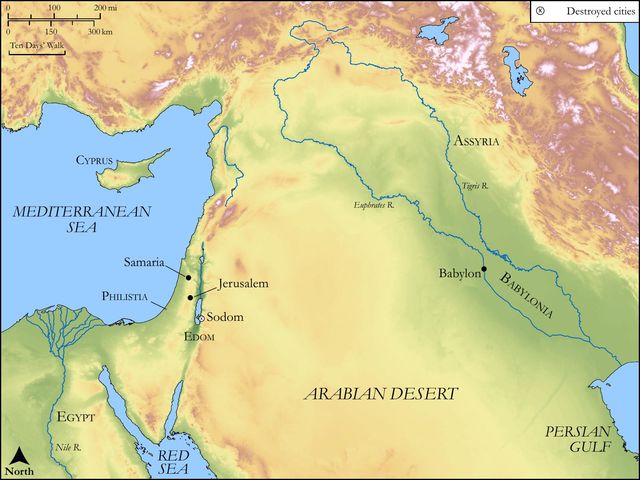
See on the biblical-era map
Study this verse
Public-domain commentary
Matthew Henry
From his Commentary on the Whole Bible. Henry comments on passages, not single verses — this entry covers Ezekiel 16:44–59. His three-level outline is real structure in the source text, so it is rendered as structure.
The prophet here further shows Jerusalem her abominations, by comparing her with those places that had gone before her, and showing that she was worse than any of them, and therefore should, like them, be utterly and irreparably ruined. We are all apt to judge of ourselves by comparison, and to imagine that we are sufficiently good if we are but as good as such and such, who are thought passable; or that we are not dangerously bad if we are no worse than such and such, who, though bad, are not of the worst. Now God by the prophet shows Jerusalem,
I.That she was as bad as her mother, that is, as the accursed devoted Canaanites that were the possessors of this land before her.
Those that use proverbs, as most people do, shall apply that proverb to Jerusalem, As is the mother, so is her daughter, Eze 16:44. She is her mother's own child. The Jews are as like the Canaanites in temper and inclination as if they had been their own children. The character of the mother was that she loathed her husband and her children, she had all the marks of an adulteress; and that is the character of the daughter: she forsakes the guide of her youth, and is barbarous to the children of her own bowels. When God brought Israel into Canaan he particularly warned them not to do according to the abominations of the men of that land, who went before them (for which it had spued them out, Lev 18:27, Lev 18:28), the monuments of whose idolatry, with the remains of the idolaters themselves, would be a continual temptation to them; but they learned their way, and trod in their steps, and were as well affected to the idols of Canaan as ever they were (Psa 106:38), and thus, in respect of imitation, it might truly be said that their mother was a Hittite and their father an Amorite (Eze 16:45), for they resembled them more than Abraham and Sarah.
II.That she was worse than her sisters Sodom and Samaria, that were adulteresses too, that loathed their husbands and their children, that were weary of the gods of their fathers, and were for introducing new gods, a-la-mode - quite in style, that came newly up, and new fashions in religion, and were given to change. On this comparison between Jerusalem and her sisters the prophet here enlarges, that he might either shame them into repentance or justify God in their ruin. Observe,
1.Who Jerusalem's sisters were, Eze 16:45. Samaria and Sodom. Samaria is called the elder sister, or rather the greater, because it was a much larger city and kingdom, richer and more considerable, and more nearly allied to Israel. If Jerusalem look northward, this is partly on her left hand. This city of Samaria, and the towns and villages, that were as daughters to that mother-city, these had been lately destroyed for their spiritual whoredom. Sodom, and the adjacent towns and villages that were her daughters, dwelt at Jerusalem's right hand, and was her less sister, less than Jerusalem, less than Samaria, and these were of old destroyed for their corporeal whoredom, Jde 1:7.
2.Wherein Jerusalem's sins resembled her sisters', particularly Sodom's (v. 49): This was the iniquity of Sodom (it is implied, and this is thy iniquity too), pride, fulness of bread, and abundance of idleness. Their going after strange flesh, which was Sodom's most flagrant wickedness, is not mentioned, because notoriously known, but those sins which did not look so black, but opened the door and led the way to these more enormous crimes, and began to fill that measure of her sins, which was filled up at length by their unnatural filthiness. Now these initiating sins were,
(1.)Pride, in which the heart lifts up itself above and against both God and man. Pride was the first sin that turned angels into devils, and the garden of the Lord into a hell upon earth. It was the pride of the Sodomites that they despised righteous Lot, and would not bear to be reproved by him; and this ripened them for ruin.
(2.)Gluttony, here called fulness of bread. It was God's great mercy that they had plenty, but their great sin that they abused it, glutted themselves with it, ate to excess and drank to excess, and made that the gratification of their lusts which was given them to be the support of their lives.
(3.)Idleness, abundance of idleness, a dread of labour and a love of ease. Their country was fruitful, and the abundance they had they came easily by, which was a temptation to them to indulge themselves in sloth, which disposed them to all that abominable filthiness which kindled their flames. Note, Idleness is an inlet to much sin. The men of Sodom, who were idle, were wicked, and sinners before the Lord exceedingly, Gen 13:13. The standing waters gather filth and the sitting bird is the fowler's mark. When David arose from off his bed at evening he saw Bathsheba. Quaeritur, Aegisthus quare sit factus adulter? In promptu causa est; desidiosus erat - What made Aegisthus an adulterer? Indolence.
(4.)Oppression: Neither did she strengthen the hands of the poor and needy; probably it is implied that she weakened their hands and broke their arms; however, it was bad enough that, when she had so much wealth, and consequently power and interest and leisure, she did nothing for the relief of the poor, in providing for whose wants those that themselves are full of bread may employ their time well; they need not be so abundantly idle as too often they are. These were the sins of the Sodomites, and these were Jerusalem's sins. Their pride, the cause of their sins, is mentioned again (Eze 16:50): They were haughty, with the horrid effects of their sins, their abominations which they committed before God. Men arrive gradually at the height of impiety and wickedness. Nemo repente fit turpissimus - No man reaches the height of vice at once. But, where pride has got the ascendant in a man, he is in the high road to all abominations.
3.How much the sins of Jerusalem exceeded those of Sodom and Samaria; they were more heinous in the sight of God, either in themselves or by reason of several aggravations: "Thou hast not only walked after their ways, and trod in their steps, but hast quite outdone them in wickedness, Eze 16:47. Thou thoughtest it a very little thing to do as they did; didst laugh at them as sneaking sinners and silly ones; thou wouldst be more cunning, more daring, in wickedness, wouldst triumph more boldly over thy convictions, and bid more open defiance to God and religion: 'if a man will break, let him break for something.' Thus thou wast corrupted more than they in all thy ways." Jerusalem was more polite, and therefore sinned with more wit, more art and ingenuity, than Sodom and Samaria could. Jerusalem had more wealth and power, and its government was more absolute and arbitrary, and therefore had the more opportunity of oppressing the poor, and shedding malignant influences around her, than Sodom and Samaria had. Jerusalem had the temple, and the ark, and the priesthood, and kings of the house of David; and therefore the wickedness of that holy city, that was so dignified, so near, so dear to God, was more provoking to him than the wickedness of Sodom and Samaria, that had not Jerusalem's privileges and means of grace. Sodom has not done as thou hast done, Eze 16:48. This agrees with what Christ says. Mat 11:24, It shall be more tolerable for the land of Sodom in the day of judgment than for thee. The kingdom of the ten tribes had been very wicked; and yet Samaria has not committed half thy sins (Eze 16:51), has not worshipped half so many idols, nor slain half so many prophets. It was bad enough that those of Jerusalem were guilty of Sodom's sins, Sodomy itself not excepted, Kg1 14:24; Kg2 23:7. And though the Dead Sea, the standing monument of Sodom's sin and ruin, bordered upon their country (Num 34:12), and that sulphureous lake was always under their nose (God having taken away Sodom and her daughters in such way and manner as he saw good, as he says here, Eze 16:50, so as that one thing should effectually make their overthrow an example to those that afterwards should live ungodly, Pe2 2:6), yet they did not take warning, but multiplied their abominations more than they; and,
(1.)By this they justified Sodom and Samaria, Eze 16:51. They pretended, in their haughtiness and superciliousness, to judge them, and in the days of old, when they retained their integrity, they did judge them, Eze 16:52. But now they justify them comparatively: Sodom and Samaria are more righteous than thou, that is, less wicked. It will look like some extenuation of their sins that, bad as they were, Jerusalem was worse, though it was God's own city. Not that it will serve for a plea to justify Sodom, but it condemns Jerusalem, against which Sodom and Samaria will rise up in judgment.
(2.)For this they ought themselves to be greatly ashamed: "Thou who hast judged thy sisters, and cried out shame on them, now bear thy own shame, for thy sins which thou hast committed, which, though of the same kind with theirs, yet, being committed by thee, are more abominable than theirs," Eze 16:52. This may be taken either as foretelling their ruin (Thou shalt bear thy shame) or as inviting them to repentance: "Be thou confounded and bear thy shame; take the shame to thyself that is due to thee." It may be hoped that sinners will forsake their sins when they begin to be heartily ashamed of them. And therefore they shall go into captivity, and there they shall lie, that they may be confounded in all that they have done, because they had been a comfort and encouragement to Sodom and Samaria, Eze 16:54. Note, There is nothing in sin which we have more reason to be ashamed of than this, that by our sin we have encouraged others in sin, and comforted them in that for which they must be grieved or they are undone. Another reason why they must now be ashamed is because in the day of their prosperity they had looked with so much disdain upon their neighbours: Thy sister Sodom was not mentioned by thee in the day of they pride, Eze 16:56. They thought Sodom not worthy to be named the same day with Jerusalem, little dreaming that Jerusalem would at length lie under a worse and more scandalous character than Sodom herself. Those that are high may perhaps come to stand upon a level with those they contemn. Or "Sodom was not mentioned, that is, the warning designed to be given to thee by Sodom's ruin was not regarded." If the Jews had but talked more frequently and seriously to one another, and to their children, concerning the wrath of God revealed from heaven against Sodom's ungodliness and unrighteousness, it might have kept them in awe, and prevented their treading in their steps; but they kept the thought of it at a distance, would not bear the mention of it, and (as the ancients say) put Isaiah to death for putting them in mind of it, when he called them rulers of Sodom and people of Gomorrah, Isa 1:10. Note, Those are but preparing judgments for themselves that will not take notice of God's judgments upon others.
4.What desolations God had brought and was bringing upon Jerusalem for these wickednesses, wherein they had exceeded Sodom and Samaria.
(1.)She has already long ago been disgraced, and has fallen into contempt, among her neighbours (Eze 16:57): Before her wickedness was discovered, before she came to be so grossly and openly flagitious, she bore the just punishment of her secret and more concealed lewdness, when she fell under the reproach of the daughters of Syria, of the Philistines, who were said to despise her and be ashamed of her (Eze 16:27), and under the reproach of all that were round about her, which seems to refer to the descent made upon Judah by the Syrians in the days of Ahaz, and soon after another by the Philistines, Ch2 28:5, Ch2 28:18. Note, Those that disgrace themselves by yielding to their lusts will justly be brought into disgrace by being made to yield to their enemies; and it is observable that before God brought potent enemies upon them, for their destruction, he brought enemies upon them that were less formidable, for their reproach. If less judgments would do the work, God would not send greater. In this thou hast borne thy lewdness, Eze 16:58. Those that will not cast off their sins by repentance and reformation shall be made to bear their sins to their confusion.
(2.)She is now in captivity, or hastening into captivity, and therein is reckoned with, not only for her lewdness (Eze 16:58), but for her perfidiousness and covenant-breaking (Eze 16:59): "I will deal with thee as thou hast done; I will forsake thee as thou hast forsaken me, and cast thee off as thou hast cast me off, for thou hast despised the oath, in breaking the covenant." This seems to be meant of the covenant God made with their fathers at Mount Sinai, whereby he took them and theirs to be a peculiar people to himself. They flattered themselves with a conceit that because God had hitherto continued his favour to them, notwithstanding their provocations, he would do so still. "No," says God, "you have broken covenant with me, have despised both the promises of the covenant and the obligations of it, and therefore I will deal with thee as thou hast done." Note, Those that will not adhere to God as their God have no reason to expect that he should continue to own them as his people.
(3.)The captivity of the wicked Jews, and their ruin, shall be as irrevocable as that of Sodom and Samaria. In this sense, as a threatening, most interpreters take Eze 16:53, Eze 16:55. "When I shall bring again the captivity of Sodom and Samaria, and when they shall return to their former estate, then I will bring again the captivity of thy captives in the midst of them, and as it were for their sakes, and under their shadow and protection, because they are more righteous than thou, and then thou shalt return to thy former estate," But Sodom and Samaria were never brought back, nor ever returned to their former estate, and therefore let not Jerusalem expect it, that is, those who now remained there, whom God would deliver to be removed into all the kingdoms of the earth for their hurt, Jer 24:9, Jer 24:10. Sooner shall the Sodomites arise out of the salt sea, and the Samaritans return out of the land of Assyria, than they enjoy their peace and prosperity again; for, to their shame be it spoken, it is a comfort to those of the ten tribes, who are dispersed and in captivity, to see those of the two tribes who had been as bad as they, or worse, in like manner dispersed and in captivity; and therefore they shall live and die, shall stand and fall, together. The bad ones of both shall perish together; the good ones of both shall return together. Note, Those who do as the worst of sinners do must expect to fare as they fare. Let my enemy be as the wicked.
Historical interpretation
Two Centuries of Reception
2 surviving comments on this verse. Each one is dated, so this reads as a timeline rather than a list.
Select a marker to jump to its quote. Markers stagger vertically where authors wrote within a few decades of each other.
Anger is something other than God himself, so that it is never part of him, nor does he share in it in any way.
(Verse 53, 54.) And I will restore their fortunes, the fortunes of Sodom and her daughters, and the fortunes of Samaria and her daughters. And I will restore your own fortune among them, so that you may bear your shame and be confounded in everything you have done, consoling them. LXX: And I will restore their fortunes like the fortunes of Sodom and her daughters, I will restore the fortune of Samaria and her daughters, and I will restore your own fortune among them, so that you may bear your punishment and have shame for everything you have done, in order to provoke me to anger. Jerusalem made great progress, that after the confusion and ignominy that was brought upon it by the judgment of God, it willingly accepted and carried, saying: I will bear the wrath of the Lord, for I have sinned against Him, let restoration be promised to it in its former state. But yet, because by the comparison of its crimes, Sodom and Samaria were justified, of which one is on the right and the other on the left; first, the conversion or captivity of Sodom is restored, as Aquila interpreted; secondly, the captivity of Samaria, as Aquila and Symmachus also translated; and lastly, Jerusalem, which was oppressed by greater iniquity, will be restored, and it had shown that its sinful sisters were just in comparison to itself. For of whom is it doubted that among three sinners, rather sinners, a gentile, a heretic, and a churchman, he is more deserving of greater punishments, who is deserving of greater dignity? For the powerful, as we have said, endure torments powerfully (Wisdom 6:7). But he who is least deserving is deserving of mercy. And the servant who knows the will of his master, and does not do it, will be beaten with many (Luke 12:47). Therefore Peter also says: It is time for judgment to begin with God's house (1 Peter 4:17). And in this same place, the prophet commands those who have axes: 'From my saints begin' (Above, IX, 6) , that Jerusalem, having been converted and restored to its former state before its sisters, may bear its own shame, and be confounded, and blush over those things which it has sinned, and in all things may console its sisters, while it endures more weighty things (Jerem. VI) . Or certainly, it is confounded and blushes for this reason, because it has provoked God to anger. From this it is clear that the anger of God is not natural, but rather that the God who is most kind and gentle is provoked to anger by our vices, as the Apostle says: “Do you despise the riches of his goodness and forbearance and patience? Do you not realize that God’s kindness is meant to lead you to repentance?” (Rom. II, 4, 5). You, however, with your hard and impenitent heart, are storing up wrath for yourself, which is not according to the nature of God. And in another place it is written: You have sent forth your wrath, which consumed them like stubble (Exodus 15:7). For what is joined and united in one body cannot be sent, but that which is outside the body. For example, a spear, weapon, arrow, sword. We also read in the Gospel (Matthew 10:15) that it will be more tolerable for the land of Sodom on the day of judgment than for the one who does not receive the apostles.
Continue studying Ezekiel 16:53 across the web’s major study libraries — every link below opens this exact verse, chapter, or book on the destination site.
Read & Compare
 BibleGatewayThis verse in more than 200 translations and 70 languages.
 Bible.comThe YouVersion reader — hundreds of translations, reading plans, and highlights.
 ESV.orgCrossway's official English Standard Version reader.
 NET BibleThe NET translation with 60,000+ translators' notes on every rendering decision.
 STEP BibleTyndale House's free study tool — original text, vocabulary, and scholarly resources.
 BibliaLogos Bible Software's free web reader.
 USCCBThe New American Bible (Revised Edition) with the U.S. bishops' study notes.
Commentaries
 BibleHub CommentariesDozens of classic commentaries on this verse, gathered on one page.
 StudyLightMore than 100 commentary sets — the largest collection on the web.
 BibleRefPlain-English commentary on what this verse means, verse by verse.
 Enduring WordDavid Guzik's free commentary on this chapter, widely used by Bible teachers.
 Bible Study ToolsVerse commentary alongside Greek and Hebrew study aids.
Original Language & Research
- BibleHub InterlinearThe verse word by word — original language, transliteration, and English.
- BibleHub LexiconEvery word's original-language definition and Strong's entry.
 Blue Letter BibleDeep-study tools — Strong's numbers, concordance, and word studies.
 SefariaThe Hebrew text with Rashi and centuries of Jewish commentary.
Sermons, Hymns & Audio


TrulyRandomVerse is not affiliated with these sites and doesn’t control their content. They’re linked because they’re genuinely useful.
Summary
Ezekiel 16:53 delivers a shocking divine decree to Jerusalem, prophesying that God will restore the fortunes of Sodom and Samaria—cities long condemned as epitomes of wickedness—either before or concurrently with the restoration of Jerusalem's own captives. This pronouncement functions as a profound humiliation for Jerusalem, underscoring the egregious nature of her spiritual adultery and pride, which had rendered her sins even more detestable than those of her despised "sisters." It powerfully illustrates God's sovereign capacity to reverse destinies and His paradoxical justice, where even the most debased may experience a form of restoration, ultimately serving to humble the arrogant and reveal the unfathomable depths of divine grace and covenant faithfulness.
Context
ShowHideLiterary Context
Ezekiel 16 unfolds as an elaborate and deeply symbolic allegory, portraying Jerusalem as an unfaithful wife whom God graciously rescued from utter destitution, nurturing her from an abandoned infant into a glorious bride adorned with covenant blessings, as vividly depicted in Ezekiel 16:3-7. Despite this lavish favor, Jerusalem engaged in spiritual prostitution with foreign nations and idols, committing egregious spiritual adultery. The verses immediately preceding Ezekiel 16:53—specifically Ezekiel 16:44-52—intensify the indictment, unequivocally declaring Jerusalem's sins to be far more heinous than those of Sodom, infamous for its moral depravity (as recounted in Genesis 19), and Samaria, the capital of the idolatrous northern kingdom of Israel. Verse 53 introduces a startling reversal, suggesting that even these notorious "sisters" will experience a form of restoration, a declaration designed to further shame Jerusalem and prepare the way for God's ultimate, unconditional covenant renewal promised in Ezekiel 16:60-63.
Historical & Cultural Context
At the time Ezekiel delivered this prophecy, during the Babylonian exile, Jerusalem had already suffered conquest, and its populace had been deported. The collective memory of Sodom's cataclysmic destruction for its profound wickedness, detailed in Genesis 18-19, and Samaria's devastating fall to Assyria due to rampant idolatry, chronicled in 2 Kings 17, would have served as potent and enduring symbols of divine judgment. For the exiled Jerusalemites, the very notion of being compared to, let alone placed in a position of lesser standing than, these utterly despised cities, represented the ultimate affront and humiliation. The concept of "captivity" (Hebrew: shᵉbûwth) in this context extends beyond mere physical exile to encompass a state of utter ruin, desolation, and divine judgment. The prophetic idiom "bringing again their captivity" (Hebrew: shûwb shᵉbûwth) is a well-established phrase signifying a complete reversal of fortunes, a restoration from ruin to prosperity, often imbued with profound spiritual implications. This idiom is commonly employed for Judah's eventual restoration in other prophetic books, rendering its application to Sodom and Samaria particularly jarring and impactful, highlighting the severity of Jerusalem's spiritual condition.
Key Themes
ShowHideThis verse significantly contributes to several overarching themes pervasive in Ezekiel 16 and throughout the broader book of Ezekiel. Firstly, it powerfully underscores Divine Sovereignty and Unpredictability, demonstrating God's absolute freedom and capacity to act in ways that defy human expectation, logic, and even perceived justice, extending restoration to the seemingly irredeemable. Secondly, it amplifies the theme of Profound Humiliation and Judgment directed at Jerusalem, a judgment meticulously designed to shatter her entrenched pride and provoke genuine repentance. By being placed in a position inferior to Sodom and Samaria, Jerusalem's deep spiritual depravity and covenant unfaithfulness are starkly exposed. Thirdly, and subtly, it introduces the theme of God's Ultimate Grace and Unconditional Covenant Faithfulness, foreshadowing the unconditional restoration and renewal promised later in the chapter. Even within the context of severe judgment, God's overarching plan encompasses redemption, a redemption that extends far beyond human merit. The shocking nature of this proposed restoration for Sodom and Samaria points to the expansive and often surprising nature of God's redemptive purposes, even if their "restoration" is primarily rhetorical, serving as a powerful catalyst for Jerusalem's humbling.
Exposition and Analysis
ShowHideKey Word Analysis
ShowHideA primitive root meaning "to turn back (hence, away) transitively or intransitively, literally or figuratively." When combined with "captivity" (shᵉbûwth), it forms a powerful idiom signifying a complete reversal of fortune, a restoration, or a return to a former, often prosperous, state. It emphatically implies God's active, sovereign intervention to transform a dire situation of judgment into one of renewed favor.
Derived from the verb shâbâh (to take captive); this noun refers concretely to exile or prisoners, and figuratively to a former state of prosperity. In this context, it denotes the state of utter ruin, desolation, and divine judgment that Sodom, Samaria, and Judah had experienced. God's promise is to actively reverse this state, bringing about a profound change.
From an unused root meaning "to scorch"; it refers to a burnt, volcanic, or bituminous district. This is the infamous city near the Dead Sea, utterly destroyed by God for its extreme wickedness and moral depravity. Its mention here evokes the ultimate symbol of irreversible divine judgment, making the very idea of its "captivity" being "brought again" profoundly shocking and paradoxical.
Verse Breakdown
ShowHide"When I shall bring again their captivity, the captivity of Sodom and her daughters"
This clause declares God's astonishing intention to reverse the dire fortunes of Sodom. The phrase "her daughters" refers to the surrounding towns and villages associated with Sodom, indicating a comprehensive reversal or restoration encompassing the entire region and its people. This statement is particularly jarring given Sodom's historical destruction and its enduring symbolic status as a byword for utter depravity and irreversible divine judgment.
"and the captivity of Samaria and her daughters"
In parallel fashion, God proclaims His intent to restore Samaria and its associated towns. Samaria, as the capital of the northern kingdom of Israel, was notorious for its deep-seated idolatry, apostasy, and syncretism, which ultimately led to its conquest and exile by Assyria. Its promised restoration, mirroring that of Sodom, powerfully underscores God's sovereign power to reverse even the most severe and seemingly definitive judgments.
"then [will I bring again] the captivity of thy captives in the midst of them"
This concluding clause reveals the profound purpose and implication of the preceding declarations. Jerusalem ("thy") will indeed have her own fortunes restored, but this restoration will occur either after or concurrently with that of Sodom and Samaria. The phrase "in the midst of them" emphasizes the deep humiliation intended for Jerusalem: she will not be restored in a position of unique privilege or superiority, but rather as one among those very cities she despised as far more wicked. This divinely ordained sequence dramatically underscores the depth of Jerusalem's spiritual fall and God's deliberate intent to humble her pride by placing her on par with, or even below, these notoriously condemned cities.
Literary Devices
ShowHideEzekiel 16:53 masterfully employs several potent literary devices to convey its challenging message. The entire chapter functions as an extended Allegory, where Jerusalem is vividly personified as an unfaithful wife, and Sodom and Samaria are presented as her "sisters." Within this framework, this specific verse utilizes profound Irony and Paradox by proposing the restoration of Sodom and Samaria. These cities were universally understood as archetypes of irreversible divine judgment, making the notion of their "captivity" being "brought again" utterly counter-intuitive and shocking. This astonishing pronouncement serves as a form of Hyperbole or extreme comparison, meticulously crafted to underscore the unparalleled severity of Jerusalem's sin. By stating that Jerusalem's restoration is contingent upon or concurrent with that of Sodom and Samaria, God delivers a profound Humiliation, forcing Jerusalem to confront the stark reality that her depravity had exceeded even that of the most infamous sinners. The use of "daughters" to refer to the surrounding towns and villages is a form of Metonymy, extending the identity and fate of the main city to its associated settlements.
Theological and Thematic Connections
ShowHideEzekiel 16:53 stands as a profound theological statement concerning God's absolute sovereign power to enact restoration, even in the most unexpected and, from a human perspective, seemingly undeserving circumstances. It radically challenges conventional human assumptions about justice, merit, and mercy, powerfully demonstrating that God's boundless grace can extend even to those considered utterly lost or irredeemable. This is primarily intended to humble the proud and to reveal the unfathomable depth of His covenant faithfulness. While the "restoration" of Sodom and Samaria is most commonly understood rhetorically—serving to emphasize Jerusalem's greater guilt and profound humiliation—it simultaneously points to the expansive and unmerited nature of God's redemptive capacity. This passage underscores that true restoration, both individually and corporately, often begins with a profound humbling and a genuine recognition of one's sin, thereby preparing the heart to receive God's unmerited favor.
Reflection and Application
ShowHideEzekiel 16:53 offers a deeply challenging yet ultimately hopeful message for contemporary believers. It confronts our often-subtle pride and self-righteousness, serving as a stark reminder that no one is beyond the profound need for God's unmerited grace. Indeed, our own spiritual complacency, judgmental attitudes, or perceived moral superiority can, in God's eyes, be more offensive than the overt sins of those we might readily condemn. The startling concept that God would even consider restoring Sodom and Samaria before or alongside Jerusalem compels us to radically re-evaluate our perceptions of who "deserves" grace and who is "undeserving." It calls us to a deeper, more authentic humility, prompting us to recognize that any restoration, blessing, or spiritual progress we experience is purely by God's unmerited favor, never by our own merit or inherent goodness. This verse profoundly encourages us to trust implicitly in God's sovereign and often surprising ways, knowing with certainty that His ultimate plan is always geared towards redemption and the magnificent display of His glory, even if it entails humbling His own people to bring them to a place of true dependence, brokenness, and covenant fidelity.
Questions for Reflection
ShowHideFAQ
ShowHideDoes Ezekiel 16:53 mean that Sodom and Samaria were literally restored to their former glory?
ShowHideThe interpretation of the "restoration" of Sodom and Samaria in Ezekiel 16:53 is complex and has been a subject of scholarly debate. While a few interpretations, particularly within certain Jewish traditions and some Christian eschatological views, suggest a literal, future restoration, the predominant understanding among biblical scholars is that the statement functions primarily as a powerful rhetorical device. It is a hyperbolic pronouncement designed to profoundly humble Jerusalem. By suggesting that even the most notoriously condemned cities—archetypes of irreversible divine judgment—might experience a reversal of fortune, God emphasizes the extreme depth of Jerusalem's sin. Her iniquity was so great that she deserved even less favor or consideration than Sodom or Samaria. This highlights that if God could even conceive of restoring them, then Jerusalem's eventual restoration, when it came, would be an act of pure, unmerited grace, entirely independent of her own worthiness. Thus, the primary thrust in Ezekiel's immediate prophetic context is the shaming, humbling, and ultimate preparation of Jerusalem for a future, grace-based covenant renewal.
Christ-Centered Fulfillment
ShowHideWhile Ezekiel 16:53 primarily serves as a powerful rhetorical device to humble the proud and unfaithful Jerusalem, its underlying themes of unexpected restoration, God's boundless grace, and the radical reversal of human expectations find profound and ultimate fulfillment in the person and work of Jesus Christ. The astonishing idea that God could "bring again the captivity" of cities like Sodom and Samaria, which stood as ultimate symbols of human depravity and divine judgment, powerfully foreshadows the universal reach and transformative power of the Gospel. In Christ, God offers restoration and new life not merely to the "righteous" or the "less sinful," but to all who are, by nature, "dead in trespasses and sins" (Ephesians 2:1). Jesus's divine mission was precisely "to seek and to save the lost" (Luke 19:10), demonstrating God's unwavering willingness to extend mercy and salvation to those whom society, and often even religious people, might deem utterly irredeemable. The ultimate "bringing again of captivity" is powerfully manifested in Christ's decisive victory over the spiritual bondage of sin and the dominion of death, offering spiritual liberation and new life to all who place their faith in Him, regardless of their past depravity or perceived unworthiness (Colossians 1:13-14). Through His sacrificial atonement, the proud are humbled, and the outcast are brought near, thereby fulfilling the paradoxical and expansive nature of God's redemptive plan so powerfully hinted at in Ezekiel's challenging prophecy.