


Exodus 37:8
Bible text: King James Version (1769 Blayney text) · Public domain
Bible text: King James Version with Strong's numbers · Public domain
Bible text: Berean Standard Bible · Public domain
Bible text: American Standard Version (1901) · Public domain
Bible text: World English Bible, Messianic edition · Public domain
Bible text: Geneva Bible (1599) · Public domain
Bible text: Young's Literal Translation · Public domain
- כְּרוּבke·ruva cherubH3742N-msNoun Singular Masculine Absolute
- אֶחָד'e·ChadoneH259Adj-fsAdjective Numerical Singular Feminine Absolute
- מִקָּצָהmi·ka·Tzah[was] from an endH7098Prep-m ¦ N-fsNoun Singular Feminine Absoluteמִ[was] fromקָּצָהan end
- מִזֶּהmi·Zehfrom thisH2088Prep-m ¦ PrtParticle Demonstrativeמִfromזֶּהthis
- וּכְרוּבu·khe·ruvand a cherubH3742Conj-w ¦ N-msNoun Singular Masculine Absoluteוּandכְרוּבa cherub
- אֶחָד'e·ChadoneH259Adj-fsAdjective Numerical Singular Feminine Absolute
- מִקָּצָהmi·ka·Tzah[was] from an endH7098Prep-m ¦ N-fsNoun Singular Feminine Absoluteמִ[was] fromקָּצָהan end
- מִזֶּהmi·Zehfrom thisH2088Prep-m ¦ PrtParticle Demonstrativeמִfromזֶּהthis
- מִןminfromH4480PrepPreposition
- הַכַּפֹּרֶתha·ka·Po·retthe atonement coverH3727Art ¦ N-fsNoun Singular Feminine Absoluteהַtheכַּפֹּרֶתatonement cover
- עָשָׂה'a·Sahhe madeH6213V-Qal-Perf-3msVerb Qal Perfect 3rd Singular Masculine
- אֶת'et<obj.>H853DirObjMParticle Object Indicator
- הַכְּרֻבִיםha·ke·ru·Vimthe cherubimH3742Art ¦ N-mpNoun Plural Masculine Absoluteהַtheכְּרֻבִיםcherubim
- מִשְּׁנֵיmi·she·Neifrom [the] twoH8147Prep-m ¦ Adj-cdcAdjective Numerical Dual common gender Constructמִfromשְּׁנֵי[the] two
- קְצוֹתָיוkitz·vo·tovits endsH7098N-fpc ¦ 3msNoun Plural Feminine Constructקְצוֹתָיendsוits
English is a literal word-by-word gloss of the Hebrew, not the KJV's wording. Why?
This is the original text the KJV's translators worked from — each Hebrew word with its own literal English meaning in this verse, prepared by scholars at Tyndale House, Cambridge. The KJV translates whole sentences, not word by word, so its wording differs: one Hebrew word can become several English words, and the KJV may choose “the LORD” where the gloss reads “Yahweh”. Both are faithful — they answer different questions. For the KJV's own rendering, switch to the KJV text.
Details
See on the biblical-era maps

Study this verse
Public-domain commentary
Matthew Henry
From his Commentary on the Whole Bible. Henry comments on passages, not single verses — this entry covers Exodus 37:1–9. His two-level outline is real structure in the source text, so it is rendered as structure.
I.It may be thought strange that Moses, when he had recorded so fully the instructions given him upon the mount for the making of all these things, should here record as particularly the making of them, when it might have sufficed only to have said, in a few words, that each of these things was made exactly according to the directions before recited. We are sure that Moses, when he wrote by divine inspiration, used no vain repetitions; there are no idle words in scripture. Why then are so many chapters taken up with this narrative, which we are tempted to think needless and tedious? But we must consider,
1.That Moses wrote primarily for the people of Israel, to whom it would be of great use to read and hear often of these divine and sacred treasures with which they were entrusted. These several ornaments wherewith the tabernacle was furnished they were not admitted to see, but the priests only, and therefore it was requisite that they should be thus largely described particularly to them. That which they ought to read again (lest they should fail of doing it) is written again and again: thus many of the same passages of the history of Christ are in the New Testament related by two or three, and some by four of the evangelists, for the same reason. The great things of God's law and gospel we need to have inculcated upon us again and again. To write the same (says St. Paul) to me is not grievous, but for you it is safe, Phi 3:1.
2.Moses would thus show the great care which he and his workmen took to make every thing exactly according to the pattern shown him in the mount. Having before given us the original, he here givers us the copy, that we may compare them, and observe how exactly they agree. Thus he appeals to every reader concerning his fidelity to him that appointed him, in all his house, and in all the particulars of it, Heb 3:5. And thus he teaches us to have respect to all God's commandments, even to every iota and tittle of them.
3.It is intimated hereby that God takes delight in the sincere obedience of his people, and keeps an exact account of it, which shall be produced to their honour in the resurrection of the just. None can be so punctual in their duty, but God will be as punctual in his notices of it. He is not unrighteous to forget the work and labour of love, in any instance of it, Heb 6:10.
4.The spiritual riches and beauties of the gospel tabernacle are hereby recommended to our frequent and serious consideration. Go walk about this Zion, view it and review it: the more you contemplate the glories of the church, the more you will admire them and be in love with them. The charter of its privileges, and the account of its constitution, will very well bear a second reading.
II.In these verses we have an account of the making of the ark, with its glorious and most significant appurtenances, the mercy-seat and the cherubim. Consider these three together, and they represent the glory of a holy god, the sincerity of a holy heart, and the communion that is between them, in and by a Mediator.
1.It is the glory of a holy god that he dwells between the cherubim; that is, is continually attended and adored by the blessed angels, whose swiftness was signified by their faces being one towards another.
2.It is the character of an upright heart that, like the ark of the testimony, it has the law of God hid and kept in it.
3.By Jesus Christ, the great propitiation, there is reconciliation made, and a communion settled, between us and God: he interposes between us and God's displeasure; and not only so, but through him we become entitled to God's favour. If he write his law in our heart, he will be to us a God and we shall be to him a people. From the mercy-seat he will teach us, there he will accept us, and show himself merciful to our unrighteousness; and under the shadow of his wings we shall be safe and easy.
Continue studying Exodus 37:8 across the web’s major study libraries — every link below opens this exact verse, chapter, or book on the destination site.
Read & Compare
 BibleGatewayThis verse in more than 200 translations and 70 languages.
 Bible.comThe YouVersion reader — hundreds of translations, reading plans, and highlights.
 ESV.orgCrossway's official English Standard Version reader.
 NET BibleThe NET translation with 60,000+ translators' notes on every rendering decision.
 STEP BibleTyndale House's free study tool — original text, vocabulary, and scholarly resources.
 BibliaLogos Bible Software's free web reader.
 USCCBThe New American Bible (Revised Edition) with the U.S. bishops' study notes.
Commentaries
 BibleHub CommentariesDozens of classic commentaries on this verse, gathered on one page.
 StudyLightMore than 100 commentary sets — the largest collection on the web.
 BibleRefPlain-English commentary on what this verse means, verse by verse.
 Enduring WordDavid Guzik's free commentary on this chapter, widely used by Bible teachers.
 Bible Study ToolsVerse commentary alongside Greek and Hebrew study aids.
Original Language & Research
- BibleHub InterlinearThe verse word by word — original language, transliteration, and English.
- BibleHub LexiconEvery word's original-language definition and Strong's entry.
 Blue Letter BibleDeep-study tools — Strong's numbers, concordance, and word studies.
 SefariaThe Hebrew text with Rashi and centuries of Jewish commentary.
Sermons, Hymns & Audio


TrulyRandomVerse is not affiliated with these sites and doesn’t control their content. They’re linked because they’re genuinely useful.
Summary
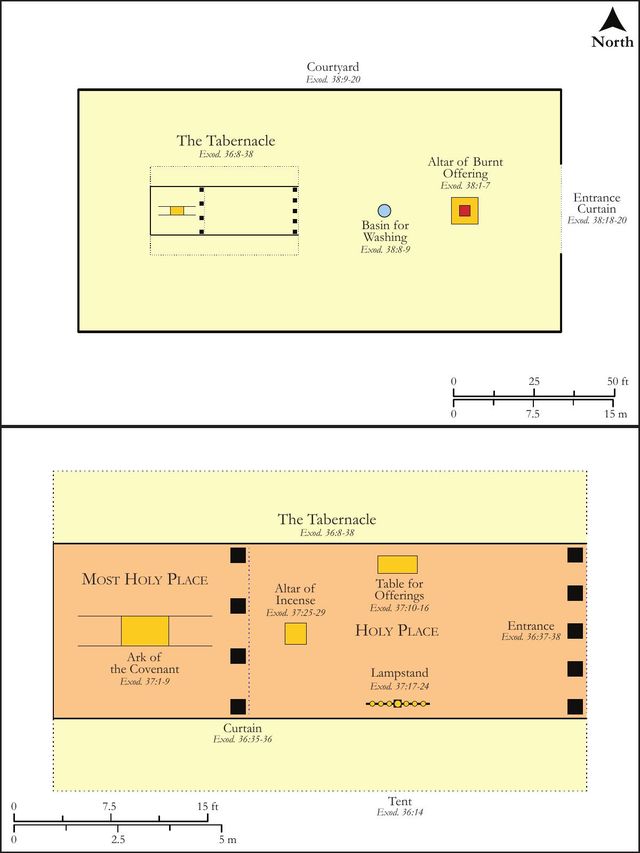
Exodus 37:8 precisely details the construction of the cherubim on the mercy seat, emphasizing their singular origin "out of" the same piece of gold as the mercy seat itself and their symmetrical placement at each end. This meticulous description within the Tabernacle's construction narrative highlights the divine precision, unified design, and inherent holiness of the most sacred object in Israel's wilderness sanctuary, underscoring the inseparable connection between God's majestic presence and His provision for atonement.
Context
ShowHideLiterary Context
Exodus 37 is part of the extensive section (Exodus 35-40) that meticulously recounts the actual construction of the Tabernacle and its furnishings, fulfilling the divine instructions given to Moses on Mount Sinai in Exodus 25-31. Specifically, verses 6-9 of Exodus 37 focus on the creation of the mercy seat (kapporeth) and its accompanying cherubim, immediately following the construction of the Ark of the Covenant itself (Exodus 37:1-5). This reiteration of the divine blueprint, now as completed work, underscores the Israelites' obedient response to God's detailed commands and the precise fulfillment of His will. The mercy seat served as the lid for the Ark, which housed the tablets of the covenant, thereby signifying the intimate connection between God's law, His presence, and His provision for grace. The cherubim, integral to this design, were not mere ornamentation but held profound theological significance, symbolizing the guarded holiness of God's throne and the means of access to His presence.
Historical & Cultural Context
The construction of the Tabernacle occurred during Israel's formative period in the wilderness, immediately following their miraculous liberation from Egyptian bondage. God's command to build this portable sanctuary was a direct response to His covenant promise to dwell among His people, establishing a tangible center for worship and a visible representation of His presence. This divine dwelling distinguished Israel from surrounding pagan nations, whose worship often involved crude idols and local shrines. The intricate details, such as the cherubim being fashioned "out of" the mercy seat from pure gold, reflected the divine standard of holiness, perfection, and immense value attributed to God's dwelling place. This level of craftsmanship stood in stark contrast to the often-idolatrous practices of other cultures. The entire Tabernacle structure, particularly the Ark of the Covenant and the mercy seat, was designed to facilitate atonement and communion between a holy God and His sinful people, culminating in the annual Day of Atonement, when the high priest would sprinkle blood upon the mercy seat.
Key Themes
ShowHideExodus 37:8 contributes significantly to several overarching themes within Exodus and the Pentateuch. The theme of Divine Presence is central, as the Tabernacle was God's chosen dwelling place among His people, making Him accessible yet also emphasizing His transcendent holiness. The meticulous detail of the construction, especially the unified nature of the mercy seat and cherubim, reinforces the theme of Divine Precision and Perfection in God's commands and design; every element is purposeful and perfectly integrated. Furthermore, the verse highlights the theme of Atonement and Reconciliation, as the mercy seat was the focal point for the covering of sin, allowing a holy God to dwell among an unholy people. The cherubim, often associated with guarding sacred spaces (e.g., Genesis 3:24), here symbolize the guarded nature of God's holiness, yet paradoxically, their presence on the mercy seat points to the divinely ordained means of access. The theme of Obedience to Divine Command is also evident throughout Exodus 35-40, as the Israelites faithfully execute the blueprint given in Exodus 25.
Exposition and Analysis
ShowHideKey Word Analysis
ShowHideThis term refers to a cherub or an imaginary figure, often depicted as celestial, angelic beings who serve as guardians of sacred spaces and symbols of God's glory and presence. Their first appearance in Scripture is guarding the Garden of Eden after the Fall, preventing access to the tree of life. On the mercy seat, their presence signifies the holiness and guarded nature of God's throne, yet also, paradoxically, the means of access through atonement. Their posture, facing inward towards the mercy seat with wings outstretched, suggests both reverence and a protective stance over the divine presence.
This word, meaning "a lid" and specifically referring to the cover of the sacred Ark, is derived from the verb kaphar, meaning "to cover," "to atone," or "to make propitiation." The kappôreth was the solid gold lid of the Ark of the Covenant, and its name inherently defines its primary function: the place where atonement for sins was made. It was here, on the Day of Atonement, that the high priest would sprinkle the blood of the sin offering, symbolically covering the sins of Israel and enabling God's presence to remain among His people without consuming them in their sin. It is the focal point of God's condescension to meet with humanity.
This primitive root means "to do or make, in the broadest sense and widest application." In the context of Exodus 37:8, when it says "out of the mercy seat made he the cherubims," it signifies a specific method of creation: the cherubim were not separately crafted and then affixed, but rather were formed by hammering and working the same piece of pure gold from which the mercy seat was made. This mikshah (hammered work) technique emphasizes a unified, indivisible whole, reflecting the seamless integration of God's holiness and His provision for atonement.
Verse Breakdown
ShowHide"One cherub on the end on this side, and another cherub on the [other] end on that side"
This clause precisely describes the symmetrical and balanced placement of the two cherubim. They were positioned at opposite ends of the mercy seat, facing each other with their wings spread out and upward, overshadowing the mercy seat. This deliberate arrangement underscores the divine order and precision inherent in God's instructions, ensuring the sanctity and balance of the most holy space. Their facing inward towards the mercy seat also highlights their focus on the place of atonement and God's presence, indicating their role as guardians of the divine encounter.
"out of the mercy seat made he the cherubims on the two ends thereof"
This pivotal part of the verse specifies the method of construction, reiterating the instruction from Exodus 25:19. The cherubim were not crafted as distinct pieces and then attached, but rather were formed by hammering and working the same solid block of pure gold from which the mercy seat itself was made. This mikshah (מִקְשָׁה) or "hammered work" technique signifies a unified, indivisible whole. It profoundly emphasizes that the cherubim, as guardians of God's holiness, are intrinsically linked to the mercy seat, the very place where His holiness is appeased through atonement. Their unity speaks to the singular, perfect nature of God's plan for reconciliation and His presence among His people.
Literary Devices
ShowHideExodus 37:8 employs several literary devices to convey its profound theological meaning. Symbolism is paramount, with the cherubim symbolizing divine guardianship, the awe-inspiring holiness of God, and the sacredness of His presence. The mercy seat itself is a powerful symbol of divine grace, propitiation, and the locus where God condescends to meet with humanity. The detailed description of their unified construction through mikshah (hammered work) serves as a form of Emphasis, underscoring the inseparability of God's holiness (represented by the cherubim) and His provision for atonement (the mercy seat). This unity also suggests Divine Precision and Perfection in God's design, where every component is meticulously crafted and integrated into a harmonious whole, leaving no room for human improvisation. The verse also implicitly uses Metonymy, where "mercy seat" stands for the entire process and reality of atonement and God's accessible presence, representing the means by which a holy God can dwell among a sinful people.
Theological and Thematic Connections
ShowHideExodus 37:8, in its meticulous description of the mercy seat and its cherubim, powerfully conveys the dual nature of God's character: His absolute holiness and His gracious desire to dwell among His people. The cherubim, often associated with guarding God's sacred spaces and glory, signify the barrier that human sin creates between humanity and a holy God. Yet, their placement on the mercy seat, the very place of atonement, highlights God's sovereign provision for overcoming that barrier. This unified construction underscores that access to God's presence is not arbitrary but is strictly on His terms, through the prescribed means of propitiation. It foreshadows a greater reality where God's justice and His mercy perfectly converge in a singular, divinely orchestrated act of redemption, revealing that His holiness is not a hindrance to relationship but the very foundation upon which true reconciliation is built.
Reflection and Application
ShowHideThe meticulous detail in Exodus 37:8, describing the cherubim hammered "out of" the mercy seat, invites us to ponder the profound unity and intentionality of God's plan for our salvation. It reminds us that God's holiness is not a distant, unapproachable attribute, but one that is intimately connected with His provision for mercy. Just as the cherubim and the mercy seat were one piece, so too are God's justice and His love perfectly integrated in His redemptive work. This passage challenges us to consider the immense cost and careful design behind our access to God. It calls us to approach Him with reverence, understanding that our ability to draw near is not due to our merit but solely to His gracious provision through atonement. It also encourages us to trust in the completeness and perfection of God's plan, knowing that every detail, from the ancient Tabernacle to the cross, was divinely orchestrated for our reconciliation. This unity of holiness and mercy should inspire both awe and confidence in our relationship with God.
Questions for Reflection
ShowHideFAQ
ShowHideWhat is the significance of the cherubim being made "out of" the mercy seat?
ShowHideThe phrase "out of" (Hebrew: min) signifies that the cherubim were not separate pieces attached to the mercy seat but were hammered and formed from the very same solid block of pure gold. This construction method, known as mikshah, emphasizes the seamless unity and integrity of the entire structure. It highlights that the guardians of God's holiness (the cherubim) and the place of atonement (the mercy seat) are intrinsically one, reflecting the singular, perfect, and indivisible nature of God's plan for reconciliation and His presence among His people. It shows that God's holiness and His mercy are not at odds but are perfectly integrated in His divine design for humanity's redemption.
What was the primary function of the mercy seat?
ShowHideThe primary function of the mercy seat (kapporet) was to serve as the place of atonement for the sins of Israel. It was the golden lid of the Ark of the Covenant, located in the Most Holy Place of the Tabernacle. Once a year, on the Day of Atonement, the high priest would enter the Most Holy Place and sprinkle the blood of the sin offering upon the mercy seat. This act symbolically covered the sins of the people, making propitiation and allowing a holy God to dwell among His sinful people without consuming them. It was the focal point where God promised to meet with Moses and speak to him, as seen in Exodus 25:22, signifying the place of divine encounter and reconciliation.
Christ-Centered Fulfillment
ShowHideExodus 37:8, with its intricate depiction of the cherubim and the mercy seat, serves as a profound Old Testament type pointing directly to the person and work of Jesus Christ. The mercy seat, the kapporet, literally "the covering," finds its ultimate fulfillment in Christ, who is our true "propitiation" (as described in Romans 3:25 and 1 John 2:2). Just as the mercy seat was the place where blood was applied to cover sins, Jesus, through His once-for-all sacrifice on the cross, shed His own blood, providing a perfect and permanent covering for the sins of the world. The cherubim, guarding God's holiness, symbolize the barrier that sin created between humanity and God; yet, through Christ, that barrier has been definitively removed. He is the ultimate High Priest, who entered the true heavenly sanctuary, not with the blood of animals, but with His own precious blood, securing eternal redemption (as beautifully explained in Hebrews 9:11-14). In Christ, the holiness of God and the mercy of God perfectly converge, allowing us to boldly approach the "throne of grace" (Hebrews 4:16) with confidence, for He Himself is the living embodiment of God dwelling among His people (John 1:14). He is the ultimate fulfillment of God's desire to be present with humanity, providing the perfect means of atonement and access to the Father.