


Exodus 33:3
Bible text: King James Version (1769 Blayney text) · Public domain
Bible text: King James Version with Strong's numbers · Public domain
Bible text: Berean Standard Bible · Public domain
Bible text: American Standard Version (1901) · Public domain
Bible text: World English Bible, Messianic edition · Public domain
Bible text: Geneva Bible (1599) · Public domain
Bible text: Young's Literal Translation · Public domain
- אֶל'eltoH413PrepPreposition
- אֶרֶץ'E·retza landH776N-fsNoun Singular Feminine Absolute
- זָבַתza·Vatflowing ofH2100V-Qal-Prtcpl-fsVerb Qal Participle Singular Feminine Construct
- חָלָבcha·LavmilkH2461N-msNoun Singular Masculine Absolute
- וּדְבָשׁu·de·Vashand honeyH1706Conj-w ¦ N-msNoun Singular Masculine Absoluteוּandדְבָשׁhoney
- כִּיkiforH3588PrtParticle Conditional
- לֹאlo'notH3808NegParticle Negative
- אֶעֱלֶה'e·'e·LehI will go upH5927V-Qal-Imperf-1csVerb Qal Imperfect 1st Singular common gender
- בְּקִרְבְּךָbe·kir·be·Chain your midstH7130Prep-b ¦ N-msc ¦ 2msNoun Singular Masculine Constructבְּinקִרְבְּmidstךָyour
- כִּיkiforH3588PrtParticle Conditional
- עַם'am[are] a peopleH5971N-msNoun Singular Masculine Absolute
- קְשֵׁהke·shehstiff ofH7186Adj-mscAdjective Singular Masculine Construct
- עֹרֶף'o·refneckH6203N-msNoun Singular Masculine Absolute
- אַתָּה'A·tahyouH859Pro-2msPronoun Personal 2nd Singular Masculine
- פֶּןpenlestH6435PrtParticle Conditional
- אֲכֶלְךָ'a·khel·KhaI should make an end of youH3615V-Piel-Imperf-1cs ¦ 2msVerb Piel Imperfect 1st Singular common genderאֲכֶלְI should make an end ofךָyou
- בַּדָּרֶךְba·Da·rekhon the journeyH1870Prep-b ¦ N-csNoun Singular common gender Absoluteבַּon theדָּרֶךְjourney
English is a literal word-by-word gloss of the Hebrew, not the KJV's wording. Why?
This is the original text the KJV's translators worked from — each Hebrew word with its own literal English meaning in this verse, prepared by scholars at Tyndale House, Cambridge. The KJV translates whole sentences, not word by word, so its wording differs: one Hebrew word can become several English words, and the KJV may choose “the LORD” where the gloss reads “Yahweh”. Both are faithful — they answer different questions. For the KJV's own rendering, switch to the KJV text.
Details
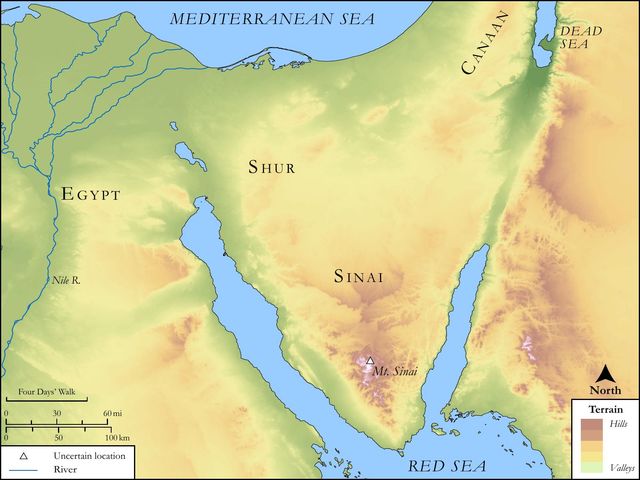
See on the biblical-era maps

Study this verse
Public-domain commentary
Matthew Henry
From his Commentary on the Whole Bible. Henry comments on passages, not single verses — this entry covers Exodus 33:1–6. His two-level outline is real structure in the source text, so it is rendered as structure.
Here is, I. The message which God sent by Moses to the children of Israel, signifying the continuance of the displeasure against them, and the bad terms they yet stood upon with God. This he must let them know for their further mortification. 1. He applies to them a mortifying name, by giving them their just character - a stiff-necked people, Exo 33:3, Exo 33:5. "Go," says God to Moses, "go and tell them that they are so." He that knows them better than they know themselves says so of them. God would have brought them under the yoke of his law, and into the bond of his covenant, but their necks were too stiff to bow to them. God would have cured them of their corrupt and crooked dispositions, and have set them straight; but they were wilful and obstinate, and hated to be reformed, and would not have God to reign over them. Note, God judges of men by the temper of their minds. We know what man does; God knows what he is: we know what proceeds from man; God knows what is in man, and nothing is more displeasing to him than stiff-neckedness, as nothing in children is more offensive to their parents and teachers than stubbornness. 2. He tells them what they deserved, that he should come into the midst of them in a moment, and consume them, Exo 33:5. Had he dealt with them according to their sins, he had taken them away with a swift destruction. Note, Those whom God pardons must be made to know what their sin deserved, and how miserable they would have been if they had been unpardoned, that God's mercy may be the more magnified. 3. He bids them depart and go up hence to the land of Canaan, Exo 33:1. This mount Sinai, where they now were, was the place appointed for the setting up of God's tabernacle and solemn worship among them; this was not yet done, so that in bidding them depart hence God intimates that it should not be done - "Let them go forward as they are;" and so it was very expressive of God's displeasure. 4. He turns them over to Moses, as the people whom he had brought up out of the land of Egypt, and leaves it to him to lead them to Canaan. 5. Though he promises to make good his covenant with Abraham, in giving them Canaan, yet he denies them the extraordinary tokens of his presence, such as they had hitherto been blessed with, and leaves them under the common conduct of Moses their prince, and the common convoy of a guardian angel: "I will send an angel before thee, for thy protector, otherwise the evil angels would soon destroy thee; but I will not go up in the midst of thee, lest I consume thee" (Exo 33:2, Exo 33:3); not as if an angel would be more patient and compassionate than God, but their affronts given to an angel would not be so provoking as those given to the shechinah, or divine Majesty itself. Note, The greater the privileges we enjoy the greater is our danger if we do not improve them and live up to them. 6. He speaks as one that was at a loss what course to take with them. Justice said, "Cut them off, and consume them." Mercy said, "How shall I give thee up, Ephraim?" Hos 11:8. Well, says God, put off thy ornaments, that I may know what to do with thee; that is, "Put thyself into the posture of a penitent, that the dispute may be determined in thy favour, and mercy may rejoice against judgment," Exo 33:5. Note, Calls to repentance are plain indications of mercy designed. If the Lord were pleased to kill us, justice knows what to do with a stiff-necked people: but God has no pleasure in the death of those that die; let them return and repent, and then mercy, which otherwise is at a loss, knows what to do.
II.The people's melancholy reception of this message; it was evil tidings to them to hear that they should not have God's special presence with them, and therefore,
1.They mourned (Exo 33:4), mourned for their sin which had provoked God to withdraw from them, and mourned for this as the sorest punishment of their sin. When 3000 of them were at one time laid dead upon the spot by the Levites' sword, we do not find that they mourned for this (hoping that it would help to expiate the guilt); but when God denied them his favourable presence then they mourned and were in bitterness. Note, Of all the bitter fruits and consequences of sin, that which true penitents most lament, and dread most, is God's departure from them. God had promised that, notwithstanding their sin, he would give them the land flowing with milk and honey. but they could have small joy of that if they had not God's presence with them. Canaan itself would be no pleasant land without that; therefore, if they want that, they mourn.
2.In token of great shame and humiliation, those that were undressed did not put on their ornaments (Exo 33:4), and those that were dressed stripped themselves of their ornaments, by the mount; or, as some read it, at a distance from the mount (Exo 33:6), standing afar off like the publican, Luk 18:13. God bade them lay aside their ornaments (Exo 33:5), and they did so, both to show, in general, their deep mourning, and, in particular, to take a holy revenge upon themselves for giving their ear-rings to make the golden calf of. Those that would part with their ornaments for the maintenance of their sin could do no less than lay aside their ornaments in token of their sorrow and shame for it. When the Lord God calls to weeping and mourning we must comply with the call, and not only fast from pleasant bread (Dan 10:3), but lay aside our ornaments; even those that are decent enough at other times are unseasonably worn on days of humiliation or in times of public calamity, Isa 3:18.
Continue studying Exodus 33:3 across the web’s major study libraries — every link below opens this exact verse, chapter, or book on the destination site.
Read & Compare
 BibleGatewayThis verse in more than 200 translations and 70 languages.
 Bible.comThe YouVersion reader — hundreds of translations, reading plans, and highlights.
 ESV.orgCrossway's official English Standard Version reader.
 NET BibleThe NET translation with 60,000+ translators' notes on every rendering decision.
 STEP BibleTyndale House's free study tool — original text, vocabulary, and scholarly resources.
 BibliaLogos Bible Software's free web reader.
 USCCBThe New American Bible (Revised Edition) with the U.S. bishops' study notes.
Commentaries
 BibleHub CommentariesDozens of classic commentaries on this verse, gathered on one page.
 StudyLightMore than 100 commentary sets — the largest collection on the web.
 BibleRefPlain-English commentary on what this verse means, verse by verse.
 Enduring WordDavid Guzik's free commentary on this chapter, widely used by Bible teachers.
 Bible Study ToolsVerse commentary alongside Greek and Hebrew study aids.
Original Language & Research
- BibleHub InterlinearThe verse word by word — original language, transliteration, and English.
- BibleHub LexiconEvery word's original-language definition and Strong's entry.
 Blue Letter BibleDeep-study tools — Strong's numbers, concordance, and word studies.
 SefariaThe Hebrew text with Rashi and centuries of Jewish commentary.
Sermons, Hymns & Audio


TrulyRandomVerse is not affiliated with these sites and doesn’t control their content. They’re linked because they’re genuinely useful.
Summary
Exodus 33:3 encapsulates a profound moment of divine judgment and mercy following Israel's egregious sin with the golden calf. God declares His intention to lead His people to the promised "land flowing with milk and honey" through an angel, but explicitly states He will not personally accompany them "in the midst" of their journey. This withdrawal of His immediate, intimate presence is a direct consequence of their persistent rebellion and idolatry, for Israel is deemed a "stiffnecked people," and God's holy nature necessitates this distance to prevent their utter consumption by His righteous wrath.
Context
ShowHideLiterary Context
This verse is situated immediately after God's initial declaration of His intent to destroy Israel and start anew with Moses (Exodus 32:10), and Moses' fervent intercession that averted this complete annihilation. Following the devastating golden calf incident, where the people quickly abandoned the covenant made at Mount Sinai by worshipping an idol (Exodus 32:4), God's anger burns fiercely. In Exodus 33:1-2, God commands Moses to lead the people to the promised land, reiterating His commitment to drive out the inhabitants, but crucially, He states He will send an angel ahead of them. Verse 3 then provides the chilling reason for God's personal withdrawal: His holiness cannot tolerate the persistent sinfulness of a "stiffnecked people" without consuming them. This sets the stage for Moses' desperate plea for God's presence in the subsequent verses (Exodus 33:12-16), highlighting the critical importance of God's personal accompaniment for Israel's identity and journey.
Historical & Cultural Context
The historical backdrop is the immediate aftermath of the giving of the Law at Sinai, a pivotal moment in Israel's covenant relationship with Yahweh. The golden calf incident (Exodus 32) represented a catastrophic breach of the first two commandments and a profound act of apostasy. For a nomadic people, the direct, tangible presence of their deity was paramount for guidance, protection, and identity. God's declaration in Exodus 33:3 to send an angel instead of going Himself would have been a terrifying prospect, signifying a partial withdrawal of divine favor and a profound consequence for their rebellion. The "land flowing with milk and honey" was a well-established symbol of abundance and divine blessing in Scripture, a promise first made to Abraham (Genesis 15:18) and reiterated to Moses at the burning bush (Exodus 3:8). God's commitment to the land remained, but the means of their arrival and the nature of His presence among them were now severely impacted by their sin, underscoring the gravity of covenant infidelity in a culture where divine-human relationships were often understood in terms of reciprocal obligations.
Key Themes
ShowHideThis verse contributes significantly to several key themes within Exodus and the Pentateuch. Firstly, the Holiness of God is paramount; His absolute purity necessitates separation from unrepentant sin, even among His chosen people. Secondly, it highlights the Seriousness of Sin and Covenant Infidelity, demonstrating that even divine promises can be impacted by human rebellion, particularly idolatry, which is a direct affront to God's exclusive claim on Israel's worship. Thirdly, the enduring mention of the land flowing with milk and honey underscores God's Faithfulness to His Promises, even as He adjusts the mode of their fulfillment due to human failure. Finally, it introduces the critical theme of Divine Presence and Absence, setting the stage for Moses' desperate intercession for God's continued personal accompaniment, recognizing that Israel's identity and success are inextricably linked to Yahweh's immediate presence.
Exposition and Analysis
ShowHideKey Word Analysis
ShowHideThis vivid idiom literally translates to "hard of neck" (from H7186 qâsheh, meaning 'severe' or 'hard,' and H6203 ʻôreph, referring to 'the nape or back of the neck'). It describes an ox that stubbornly refuses to submit to the yoke, resisting the farmer's direction. In a spiritual context, it powerfully conveys Israel's persistent obstinacy, their unwillingness to bow their will to God's commands, and their deep-seated resistance to divine authority and instruction. It signifies a people characterized by stubborn rebellion and an inability or unwillingness to repent fully.
This phrase combines H2461 (châlâb), meaning 'milk (as the richness of kine),' and H1706 (dᵉbash), meaning 'honey (from its stickiness).' It is a recurring biblical motif (e.g., Exodus 3:8) symbolizing the extraordinary fertility, richness, and abundance of the Promised Land. It evokes images of lush pastures for livestock (milk) and wild bees producing honey, representing a land of natural bounty and prosperity, a stark contrast to the barren wilderness they currently inhabited. It underscores the enduring nature of God's promise, even amidst judgment.
This verb (H3615, kâlâh) carries the sense of bringing to an end, destroying, or utterly finishing. In this context, it speaks to the destructive power of God's holiness when confronted with unrepentant sin. God's presence, which is life-giving to the obedient, becomes a consuming fire to the rebellious, highlighting the absolute purity and righteous judgment inherent in His character. His withdrawal is, paradoxically, an act of mercy to prevent their complete annihilation.
Verse Breakdown
ShowHide"Unto a land flowing with milk and honey:"
This clause reiterates the ultimate destination and the enduring nature of God's covenant promise to bring Israel into a land of extraordinary abundance and blessing, despite their recent rebellion. The promise itself remains steadfast.
"for I will not go up in the midst of thee;"
This is the core declaration of God's withdrawal. "In the midst of thee" signifies His personal, intimate, and guiding presence. This is a severe consequence, indicating that while the goal (the land) remains, the means of achieving it will be different, lacking the immediate, protective, and empowering presence of Yahweh Himself.
"for thou [art] a stiffnecked people:"
This provides the direct justification for God's decision. Israel's inherent and demonstrated stubbornness, their unyielding resistance to His will, and their quick turn to idolatry are the root cause of this divine separation. It's a character assessment of their spiritual disposition.
"lest I consume thee in the way."
This final clause reveals the merciful yet terrifying reason behind God's decision. His holiness is so absolute that His direct presence among an unrepentant and rebellious people would inevitably lead to their destruction. His withdrawal, therefore, is an act of preservation, preventing His righteous judgment from utterly annihilating them during the journey.
Literary Devices
ShowHideExodus 33:3 employs several powerful literary devices. Metaphor is prominently featured in the phrase "stiffnecked people," drawing a vivid image from an ox resisting its yoke to describe Israel's stubborn spiritual rebellion against God's authority. This Metaphor effectively communicates the depth of their disobedience. The phrase "a land flowing with milk and honey" functions as Symbolism, representing not just physical abundance but also the fulfillment of divine promise and blessing. The entire verse also exhibits a form of Divine Irony or Paradox: God's withdrawal, seemingly a punishment, is simultaneously an act of mercy, as His presence, due to their sin, would lead to their destruction. This highlights the tension between God's holiness and His covenant love. Furthermore, the verse contains an implicit Conditional Statement – if God were to go with them, then He would consume them – underscoring the severity of their sin and the necessity of His chosen course of action.
Theological and Thematic Connections
ShowHideExodus 33:3 profoundly underscores the themes of divine holiness, the seriousness of sin, and the enduring nature of God's promises despite human failure. God's decision to withdraw His direct presence reveals His absolute purity, which cannot tolerate unholiness in close proximity without judgment. Israel's "stiffneckedness" exemplifies humanity's persistent rebellion against divine authority, a characteristic seen throughout biblical history. Yet, even in judgment, God's faithfulness to His covenant is evident; the promise of the land remains, though the path to it is now altered. This passage sets a crucial precedent for understanding the necessity of a mediator and the profound implications of God's presence among His people.
Reflection and Application
ShowHideExodus 33:3 serves as a potent reminder that while God is merciful and faithful to His promises, His holiness demands reverence and obedience. Our persistent rebellion, our "stiffneckedness" in refusing to yield to God's will, can indeed hinder the fullness of His presence and blessing in our lives. This passage challenges us to examine our own hearts: are we quick to repent when we fall short, or do we stubbornly resist God's gentle leading? Do we truly understand the gravity of sin in the light of God's absolute purity? The consequence for Israel—the withdrawal of God's immediate presence—should prompt us to cultivate humility, foster a spirit of genuine repentance, and prioritize seeking God's will above our own desires. It highlights that God's presence is not a given, but a precious gift that requires a responsive and obedient heart.
Questions for Reflection
ShowHideFAQ
ShowHideWhy did God choose not to go "in the midst" of the Israelites?
ShowHideGod chose not to go "in the midst" of the Israelites primarily because of their profound and persistent sinfulness, specifically their idolatry with the golden calf (Exodus 32). His holy nature cannot tolerate unrepentant sin in close proximity without bringing judgment. As He states in Exodus 33:3, He feared that His direct presence among such a "stiffnecked people" would lead to their utter consumption or destruction along the way. This decision was, paradoxically, an act of mercy to preserve them from His righteous wrath.
What does "stiffnecked people" mean in this context?
ShowHideThe term "stiffnecked people" (Hebrew: qesheh-oreph) is a powerful metaphor describing a stubborn, rebellious, and unyielding disposition. It likens the people to an ox that refuses to bend its neck to the yoke, resisting the farmer's guidance. Spiritually, it signifies Israel's persistent unwillingness to obey God's commands, their resistance to His authority, and their tendency to quickly turn away from Him, as evidenced by their rapid descent into idolatry after the covenant at Mount Sinai. This characteristic is frequently highlighted throughout their wilderness journey, such as in Exodus 32:9.
Christ-Centered Fulfillment
ShowHideExodus 33:3, with its stark portrayal of God's holiness confronting human sin, powerfully foreshadows the necessity of Christ. The dilemma presented—God's desire to bless His people with the land versus His inability to dwell among their sinfulness without consuming them—finds its ultimate resolution in Jesus Christ. Moses, as the mediator who intercedes for Israel and seeks God's renewed presence, serves as a type of Christ. However, unlike Moses, who could only temporarily bridge the gap, Jesus permanently reconciles humanity to a holy God. Through His atoning sacrifice on the cross, Christ, the Lamb of God who takes away the sin of the world, bore the consuming wrath of God, allowing God's holy presence to dwell among us without destroying us. The New Testament reveals that in Christ, God's presence is not withdrawn but fully realized in the person of Jesus, who tabernacled among us, and through the indwelling Holy Spirit, who makes believers His temple (1 Corinthians 6:19). Thus, the "lest I consume thee" of the Old Covenant is transformed into the "I will dwell in them and walk among them" (2 Corinthians 6:16) of the New, all made possible by the perfect mediation and sacrifice of our Lord Jesus Christ.