


Exodus 12:49
Bible text: King James Version (1769 Blayney text) · Public domain
Bible text: Berean Standard Bible · Public domain
Bible text: American Standard Version (1901) · Public domain
Bible text: World English Bible, Messianic edition · Public domain
Bible text: Geneva Bible (1599) · Public domain
Bible text: Young's Literal Translation · Public domain
- תּוֹרָהto·RahlawH8451N-fsNoun Singular Feminine Absolute
- אַחַת'a·ChatoneH259Adj-fsAdjective Numerical Singular Feminine Absolute
- יִהְיֶהyih·Yehit will be[long]H1961V-Qal-Imperf-3msVerb Qal Imperfect 3rd Singular Masculine
- לָאֶזְרָחla·'ez·Rachto the native-bornH249Prep-l ¦ N-msNoun Singular Masculine Absoluteלָto theאֶזְרָחnative-born
- וְלַגֵּרve·la·Gerand to the sojournerH1616Conj-w ¦ Prep-l ¦ N-msNoun Singular Masculine Absoluteוְandלַto theגֵּרsojourner
- הַגָּרha·Garwho sojournsH1481Art ¦ V-Qal-Prtcpl-msVerb Qal Participle Singular Masculine Absoluteהַwhoגָּרsojourns
- בְּתוֹכְכֶםbe·tokh·Khemin midst of youH8432Prep-b ¦ N-msc ¦ 2mpNoun Singular Masculine Constructבְּinתוֹכְmidst ofכֶםyou
English is a literal word-by-word gloss of the Hebrew, not the KJV's wording. Why?
This is the original text the KJV's translators worked from — each Hebrew word with its own literal English meaning in this verse, prepared by scholars at Tyndale House, Cambridge. The KJV translates whole sentences, not word by word, so its wording differs: one Hebrew word can become several English words, and the KJV may choose “the LORD” where the gloss reads “Yahweh”. Both are faithful — they answer different questions. For the KJV's own rendering, switch to the KJV text.
Details
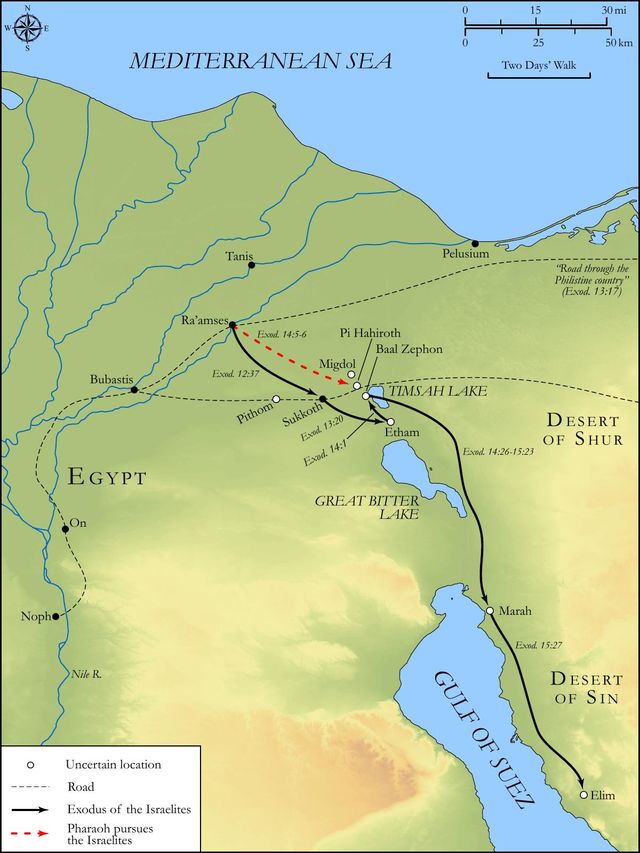
See on the biblical-era maps


Study this verse
Public-domain commentary
Matthew Henry
From his Commentary on the Whole Bible. Henry comments on passages, not single verses — this entry covers Exodus 12:43–51. His two-level outline is real structure in the source text, so it is rendered as structure.
Some further precepts are here given concerning the passover, as it should be observed in times to come.
I.All the congregation of Israel must keep it, Exo 12:47.
All that share in God's mercies should join in thankful praises for them. Though it was observed in families apart, yet it is looked upon as the act of the whole congregation; for the smaller communities constituted the greater. The New Testament passover, the Lord's supper, ought not to be neglected by any who are capable of celebrating it. He is unworthy the name of an Israelite that can contentedly neglect the commemoration of so great a deliverance.
1.No stranger that was uncircumcised might be admitted to eat of it, Exo 12:43, Exo 12:45, Exo 12:48. None might sit at the table but those that came in by the door; nor may any now approach to the improving ordinance of the Lord's supper who have not first submitted to the initiating ordinance of baptism. We must be born again by the word ere we can be nourished by it. Nor shall any partake of the benefit of Christ's sacrifice, or feast upon it, who are not first circumcised in heart, Col 2:11.
2.Any stranger that was circumcised might be welcome to eat of the passover, even servants, Exo 12:44. If, by circumcision, they would make themselves debtors to the law in its burdens, they were welcome to share in the joy of its solemn feasts, and not otherwise. Only it is intimated (Exo 12:48) that those who were masters of families must not only be circumcised themselves, but have all their males circumcised too. If in sincerity, and with that zeal which the thing required and deserves, we give up ourselves to God, we shall, with ourselves, give up all we have to him, and do our utmost that all ours may be his too. Here is an early indication of favour to the poor Gentiles, that the stranger, if circumcised, stands upon the same level with the home-born Israelite. One law for both, Exo 12:49. This was a mortification to the Jews, and taught them that it was their dedication to God, not their descent from Abraham, that entitled them to their privileges. A sincere proselyte was as welcome to the passover as a native Israelite, Isa 56:6, Isa 56:7.
II.In one house shall it be eaten (Exo 12:46), for good-fellowship sake, that they might rejoice together, and edify one another in the eating of it. None of it must be carried to another place, nor left to another time; for God would not have them so taken up with care about their departure as to be indisposed to take the comfort of it, but to leave Egypt, and enter upon a wilderness, with cheerfulness, and, in token of that, to eat a good hearty meal. The papists' carrying their consecrated host from house to house is not only superstitious in itself, but contrary to this typical law of the passover, which directed that no part of the lamb should be carried abroad.
The chapter concludes with a repetition of the whole matter, that the children of Israel did as they were bidden, and God did for them as he promised (Exo 12:50, Exo 12:51); for he will certainly be the author of salvation to those that obey him.
Continue studying Exodus 12:49 across the web’s major study libraries — every link below opens this exact verse, chapter, or book on the destination site.
Read & Compare
 BibleGatewayThis verse in more than 200 translations and 70 languages.
 Bible.comThe YouVersion reader — hundreds of translations, reading plans, and highlights.
 ESV.orgCrossway's official English Standard Version reader.
 NET BibleThe NET translation with 60,000+ translators' notes on every rendering decision.
 STEP BibleTyndale House's free study tool — original text, vocabulary, and scholarly resources.
 BibliaLogos Bible Software's free web reader.
 USCCBThe New American Bible (Revised Edition) with the U.S. bishops' study notes.
Commentaries
 BibleHub CommentariesDozens of classic commentaries on this verse, gathered on one page.
 StudyLightMore than 100 commentary sets — the largest collection on the web.
 BibleRefPlain-English commentary on what this verse means, verse by verse.
 Enduring WordDavid Guzik's free commentary on this chapter, widely used by Bible teachers.
 Bible Study ToolsVerse commentary alongside Greek and Hebrew study aids.
Original Language & Research
- BibleHub InterlinearThe verse word by word — original language, transliteration, and English.
- BibleHub LexiconEvery word's original-language definition and Strong's entry.
 Blue Letter BibleDeep-study tools — Strong's numbers, concordance, and word studies.
 SefariaThe Hebrew text with Rashi and centuries of Jewish commentary.
Sermons, Hymns & Audio


TrulyRandomVerse is not affiliated with these sites and doesn’t control their content. They’re linked because they’re genuinely useful.
Summary
Exodus 12:49 articulates a pivotal principle within Israel's nascent covenant community: the divine law, particularly concerning the sacred observance of Passover, applies equally and without distinction to both native-born Israelites and resident aliens who have committed to dwelling among them. This declaration profoundly underscores God's impartial justice, His desire for a unified people defined by shared obedience to His revealed will, and the universal reach of His covenant, which transcends mere ethnic or national origin.
Context
ShowHideLiterary Context
This verse serves as the concluding and summarizing statement of the detailed instructions for the initial Passover observance in Exodus 12. It immediately follows a section (Exodus 12:43-48) that meticulously outlines who is permitted to partake in the Passover meal, specifically mandating circumcision for any male, whether native or foreign, who wishes to participate. By placing this principle of "one law" at the culmination of the Passover regulations, the text emphasizes that the covenant's privileges and responsibilities are not solely a matter of birthright but extend to all who genuinely align themselves with God's statutes and covenant requirements. It solidifies the idea that participation in the most foundational act of Israel's redemption is open to a broader community than just those born into the twelve tribes.
Historical & Cultural Context
In Israel, resident aliens, often referred to as gerim (as in this verse), were typically a vulnerable class, dependent on the hospitality and protection of the host society. Their rights and status were often precarious and inferior to those of native citizens. Israel itself had just emerged from centuries as "strangers" and slaves in Egypt, a poignant memory that God frequently commanded them to recall when dealing with foreigners (Leviticus 19:34). Unlike many of the nations round about, God's law for Israel gave one law to the homeborn and to the stranger that sojourneth among you. While the ger had to demonstrate a commitment to residing within the community and often assimilate culturally and religiously (symbolized here by circumcision for Passover participation), once they did, they were granted equal standing under the covenant law, not merely tolerated. This demonstrated the unique character of the LORD and His purpose for a people united by His divine will, not solely by bloodline.
Key Themes
ShowHideExodus 12:49 contributes significantly to several overarching themes within the book of Exodus and the Pentateuch. Firstly, it highlights God's impartial justice and righteousness, demonstrating that His standards are universal for all who enter into a covenant relationship with Him. Secondly, it introduces the theme of universal reach within God's chosen people, indicating that the covenant community, while initially ethnic, was designed with a broader scope, allowing non-Israelites to join through obedience. This foreshadows a more expansive, global vision for God's people. Thirdly, it underscores the paramount importance of covenant adherence and obedience as the basis for belonging and participation in God's blessings, rather than mere physical descent. The Passover narrative itself is foundational to Israel's identity, and by extending its core regulations to the stranger, God establishes a principle that would echo throughout Israel's legal and prophetic traditions, emphasizing compassion and equity for the lowly (Deuteronomy 10:18-19).
Exposition and Analysis
ShowHideKey Word Analysis
ShowHideThis phrase combines two significant Hebrew terms. ʼechâd (H259), meaning "one" or "united," emphasizes the singularity and indivisibility of the law. There is no dual standard. tôwrâh (H8451), often translated "law," refers more broadly to God's instruction, teaching, or divine revelation. It encompasses the entire body of God's revealed will, not just a set of rules. Together, "one law" powerfully conveys that God's divine instruction is singular, authoritative, and applies uniformly to all within His covenant community, establishing a non-discriminatory standard.
(H249) This term denotes someone "native" or "indigenous" to the land or born within the Israelite community. It signifies those who belong by birthright, heritage, and naturalized citizenship within the nation of Israel. It represents the default member of the covenant community.
This phrase translates the Hebrew gêr (H1616), which specifically refers to a "resident alien" or "foreigner" who has chosen to settle and dwell among the Israelites. A gêr is not merely a transient visitor but someone who has taken up permanent or semi-permanent residence. The accompanying verb gûwr (H1481), "to sojourn," reinforces this status, indicating a deliberate act of dwelling or abiding as a guest within the community. For the gêr to participate in the Passover, this implied a commitment to integrate into the Israelite way of life and embrace its laws, including the crucial act of circumcision for males.
Verse Breakdown
ShowHide"One law shall be to him that is homeborn,"
This initial clause establishes the foundational standard for the native Israelite. The torah is presented as their inherent guide and obligation, defining their identity and responsibilities within the covenant. It signifies that the divine instruction is binding upon those who belong by birth.
"and unto the stranger that sojourneth among you."
This extends the exact same standard to the gêr, the resident alien. The crucial phrase "among you" highlights that this equality applies to those who have chosen to integrate into the Israelite community and live under its jurisdiction. For the specific context of Passover, this meant that if a gêr wished to participate in this foundational covenant meal, they had to fulfill the same requirements as a native Israelite, including circumcision (Exodus 12:48). This was not about ethnic assimilation for its own sake, but about covenant adherence, providing a pathway for non-Israelites to fully participate in the blessings and responsibilities of God's people.
Literary Devices
ShowHideThe verse employs a clear parallelism by juxtaposing two distinct groups—the "homeborn" and the "stranger that sojourneth"—and applying the identical standard of "one law" to both. This direct comparison highlights the universal reach of God's command, emphasizing that covenant obligations and privileges transcend ethnic origin. The repetition and emphatic placement of "one law" at the beginning of the statement serve as a powerful emphasis, underscoring the non-negotiable unity and impartiality of the divine standard. This simple yet profound structure reinforces the theological weight of the declaration.
Theological and Thematic Connections
ShowHideExodus 12:49 reveals profound theological truths about God's character and the nature of His covenant community. It demonstrates God's impartial justice, showing that His standards are universal for all who enter into a relationship with Him, regardless of their ethnic or social origin. This principle underscores that belonging in God's covenant community is ultimately based on obedience and commitment to His revealed will, not on birthright alone. It provides a foundational glimpse into God's broader vision for His people, transcending national boundaries and foreshadowing a future where all peoples can draw near to Him. This verse concretely applies the principle of welcoming the stranger to the most sacred of Israelite rituals, the Passover, demonstrating that the covenant was open to all who would embrace its terms.
Reflection and Application
ShowHideThe principle of "one law" for both native and stranger in Exodus 12:49 holds immense and enduring relevance for believers today, challenging us to reflect God's impartial love and justice in our own communities and interactions. This verse calls us to cultivate an universal reach, recognizing that the new covenant community, the Church, transcends all human-made distinctions. Just as God welcomed the ger into the covenant community upon their commitment and obedience, so too are believers called to welcome all who, by faith in Christ, seek to follow Him, regardless of their background, ethnicity, social status, or past. This means receiving one another as Christ has received us, and fostering a genuine fellowship in which every believer shares the same privileges under the same Word. Furthermore, this passage reminds us of God's own love for the stranger, whom He provides for and protects. In our own day, it calls believers to deal justly and kindly with the stranger, as the Law required: "One law shall be to him that is homeborn, and unto the stranger that sojourneth among you." We are to remember our own spiritual status as "strangers and foreigners" who have been brought near by God's grace, compelling us to extend that same grace and equity to others. Ultimately, the verse emphasizes that participation in God's blessings and covenant relationship is contingent upon humble obedience to His commands, a universal truth that unites all believers in a common Lord and a shared commitment to His teachings, fostering a profound unity that transcends all earthly distinctions.
Questions for Reflection
ShowHideFAQ
ShowHideDoes this verse mean anyone could join Israel and participate in their sacred rites without distinction?
ShowHideNot without distinction, but without discrimination once certain conditions were met. The verse explicitly states "one law," meaning the same rules applied to both native and ger (resident alien). For Passover, this included circumcision for males (Exodus 12:48), signifying their commitment to the covenant. This was a pathway for non-Israelites to fully integrate and participate, not a blanket invitation without any commitment to God's covenant and its stipulations.
Why is this verse specifically placed at the end of the Passover instructions?
ShowHideIts placement is highly significant and intentional. The Passover was the foundational event marking Israel's identity as God's redeemed people and the beginning of their national existence. By concluding the instructions with this statement, God immediately broadens the scope of His covenant community beyond mere ethnicity. It signals that while Israel was chosen, God's redemptive plan was never exclusively tribal; it always had an inclusive dimension, allowing non-Israelites to join and equally partake in the blessings and responsibilities of His people through obedience and covenant commitment. It sets a precedent for the inclusion of Gentiles in God's redemptive purposes.
What is the difference between a "stranger" and a "sojourner" in the biblical context?
ShowHideIn the KJV, "stranger that sojourneth" translates the single Hebrew word ger (גֵּר). The word ger specifically refers to a resident alien—someone who has left their homeland and taken up permanent or semi-permanent residence in a foreign land, often implying a degree of assimilation and commitment to the laws and customs of their new home. This is distinct from a nokri (נָכְרִי), a temporary visitor or a complete foreigner with no intention of settling, or a toshav (תּוֹשָׁב), a temporary resident. The ger was afforded specific protections and rights under Israelite law, as seen in this verse, underscoring their unique status as integrated members of the community, albeit not native-born.
Christ-Centered Fulfillment
ShowHideExodus 12:49, with its radical declaration of "one law" for native and stranger, finds its ultimate and most profound fulfillment in the person and redemptive work of Jesus Christ. The Old Testament's partial inclusion of the ger prefigures God's grander, universal plan to create a new, unified people from all nations through Christ. In His life, death, and resurrection, Jesus fundamentally dismantles the dividing wall between Jew and Gentile, native and stranger. The Old Covenant, while open to the stranger who joined himself to it, still maintained distinctions and ceremonial requirements (e.g., circumcision for Passover participation). In Christ, these ethnic and ceremonial distinctions become irrelevant for salvation and belonging. As Ephesians 2:14-16 powerfully declares, "For he himself is our peace, who has made us both one and has broken down in his flesh the dividing wall of hostility... that he might create in himself one new humanity in place of the two, thus making peace." The "one law" in Christ is the law of faith and love, where salvation is no longer contingent on ethnic lineage or adherence to the Mosaic ceremonial law, but on faith in Jesus Christ, open to "whoever believes" (John 3:16). This creates a spiritual family where, as Galatians 3:28 boldly states, "There is neither Jew nor Gentile, neither slave nor free, nor is there male and female, for you are all one in Christ Jesus." The Church, comprised of believers from every tribe, tongue, people, and nation (Revelation 7:9), is the fulfillment of God's vision for a unified people. It is the spiritual Israel, where all who confess Christ as Lord are equally members of God's household, with equal access to His grace, His Spirit, and His blessings, regardless of their earthly origin. The "stranger" is no longer a guest but a full co-heir with the "homeborn" in the glorious promises of God through Christ.