


Daniel 10:16
- וְהִנֵּהve·hi·Nehand there!H2009Conj-w ¦ PrtParticle Interjectionוְandהִנֵּהthere!
- כִּדְמוּתkid·Mutlike [the] likeness ofH1823Prep-k ¦ N-fscNoun Singular Feminine Constructכִּlikeדְמוּת[the] likeness of
- בְּנֵיbe·Nei[the] sons ofH1121N-mpcNoun Plural Masculine Construct
- אָדָם'a·DamhumankindH120N-msNoun Singular Masculine Absolute
- נֹגֵעַno·Ge·a'[was] touchingH5060V-Qal-Prtcpl-msVerb Qal Participle Singular Masculine Absolute
- עַל'al<on>H5921PrepPreposition
- שְׂפָתָיse·fa·Taimy lipsH8193N-fdc ¦ 1csNoun Dual Feminine Constructשְׂפָתָlipsיmy
- וָאֶפְתַּחva·'ef·tachand I openedH6605Conj-w ¦ V-Qal-ConsecImperf-1csVerb Qal Consecutive Imperfect 1st Singular common genderוָandאֶפְתַּחI opened
- פִּיPimy mouthH6310N-msc ¦ 1csNoun Singular Masculine Constructפִּmouthיmy
- וָאֲדַבְּרָהva·'a·da·be·Rahand I spoke !H1696Conj-w ¦ V-Piel-ConsecImperf-1cs ¦ SfxVerb Piel Consecutive Imperfect 1st Singular common genderוָandאֲדַבְּרָI spokeה!
- וָאֹמְרָהva·'o·me·Rahand I said !H559Conj-w ¦ V-Qal-ConsecImperf-1cs ¦ SfxVerb Qal Consecutive Imperfect 1st Singular common genderוָandאֹמְרָI saidה!
- אֶל'eltoH413PrepPreposition
- הָעֹמֵדha·'o·Medthe [one] standingH5975Art ¦ V-Qal-Prtcpl-msVerb Qal Participle Singular Masculine Absoluteהָtheעֹמֵד[one] standing
- לְנֶגְדִּיle·neg·Dito before meH5048Prep-l ¦ Adj-msc ¦ 1csAdjective Numerical Singular Masculine Constructלְtoנֶגְדִּbeforeיme
- אֲדֹנִי'a·do·Nimy O lordH113N-msc ¦ 1csNoun Singular Masculine ConstructאֲדֹנִO lordיmy
- בַּמַּרְאָהba·mar·'Ahon the visionH4759Prep-b ¦ N-fsNoun Singular Feminine Absoluteבַּon theמַּרְאָהvision
- נֶהֶפְכוּne·hef·Khuthey have turnedH2015V-Niphal-Perf-3cpVerb Niphal Perfect 3rd Plural common gender
- צִירַיtzi·Raimy pangsH6735N-mpc ¦ 1csNoun Plural Masculine Constructצִירַpangsיmy
- עָלַי'a·Laion meH5921Prep ¦ 1csPrepositionעָלַonיme
- וְלֹאve·Lo'and notH3808Conj-w ¦ NegParticle Negativeוְandלֹאnot
- עָצַרְתִּי'a·Tzar·tiI have retainedH6113V-Qal-Perf-1csVerb Qal Perfect 1st Singular common gender
- כֹּחַKo·achstrengthH3581N-msNoun Singular Masculine Absolute
English is a literal word-by-word gloss of the Hebrew, not the KJV's wording. Why?
This is the original text the KJV's translators worked from — each Hebrew word with its own literal English meaning in this verse, prepared by scholars at Tyndale House, Cambridge. The KJV translates whole sentences, not word by word, so its wording differs: one Hebrew word can become several English words, and the KJV may choose “the LORD” where the gloss reads “Yahweh”. Both are faithful — they answer different questions. For the KJV's own rendering, switch to the KJV text.
Details
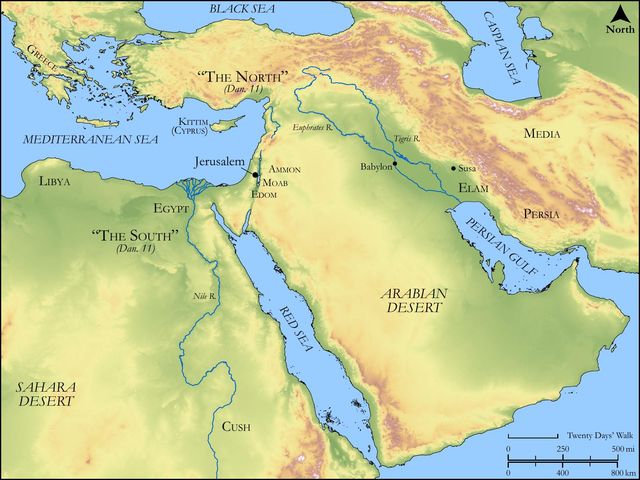
See on the biblical-era map
Study this verse
Public-domain commentary
Matthew Henry
From his Commentary on the Whole Bible. Henry comments on passages, not single verses — this entry covers Daniel 10:10–21. His four-level outline is real structure in the source text, so it is rendered as structure.
Much ado here is to bring Daniel to be able to bear what Christ has to say to him. Still we have him in a fright, hardly and very slowly recovering himself; but he is still answered and supported with good words and comfortable words. Let us see how Daniel is by degrees brought to himself, and gather up the several passages that are to the same purport.
I.Daniel is in a great consternation and finds it very difficult to get clear of it.
The hand that touched him set him at first upon his knees and the palms of his hands, Dan 10:10. Note, Strength and comfort commonly come by degrees to those that have been long cast down and disquieted; they are first helped up a little, and then more. After two days he will revive us, and then the third day he will raise us up. And we must not despise the day of small things, but be thankful for the beginnings of mercy. Afterwards he is helped up, but he stands trembling (Dan 10:11), for fear lest he fall again. Note, Before God gives strength and power unto his people he makes them sensible of their own weakness. I trembled in myself, that I might rest in the day of trouble, Hab 3:16. But when, afterwards, Daniel recovered so much strength in his limbs that he could stand steadily, yet he tells us (Dan 10:15) that he set his face towards the ground and became dumb; he was as a man astonished, who knew not what to say, struck dumb with admiration and fear, and was loth to enter into discourse with one so far above him; he kept silence, yea, even from good, till he had recollected himself a little. Well, at length he recovered, not only the use of his feet, but the use of his tongue; and, when he opened his mouth (Dan 10:16), that which he had to say was to excuse his having been so long silent, for really he durst not speak, he could not speak: "O my lord" (so, in great humility, this prophet calls the angel, though the angels, in great humility, called themselves fellow-servants to the prophets, Rev 22:9), "by the vision my sorrows are turned upon me; they break in upon me with violence; the sense of my sinful sorrowful state turns upon me when I see thy purity and brightness." Note, Man, who has lost his integrity, has reason to blush, and be ashamed of himself, when he sees or considers the glory of the blessed angels that keep their integrity. "My sorrows are turned upon me, and I have retained no strength to resist them or bear up a head against them." And again (Dan 10:17), like one half dead with the fright, he complains, "As for me, straightway there remained no strength in me to receive these displays of the divine glory and these discoveries of the divine will; nay, there is no breath left in me." Such a deliquium did he suffer that he could not draw one breath after another, but panted and languished, and was in a manner breathless. See how well it is for us that the treasure of divine revelation is put into earthen vessels, that God speaks to us by men like ourselves and not by angels. Whatever we may wish, in a peevish dislike of the method God takes in dealing with us, it is certain that if we were tried we should all be of Israel's mind at Mt. Sinai, when they said to Moses, Speak thou to us, and we will hear, but let not God speak to us lest we die, Exo 20:19. If Daniel could not bear it, how could we? Now this he insists upon as an excuse for his irreverent silence, which otherwise would have been blame-worthy: How can the servant of this my lord talk with this my lord? Dan 10:17. Note, Whenever we enter into communion with God it becomes us to have a due sense of the vast distance and disproportion that there are between us and the holy angels, and of the infinite distance, and no proportion at all, between us and the holy God, and to acknowledge that we cannot order our speech by reason of darkness. How shall we that are dust and ashes speak to the Lord of glory?
II.The blessed angel that was employed by Christ to converse with him gave him all the encouragement and comfort that could be.
It should seem, it was not he whose glory he saw in vision (Dan 10:5, Dan 10:6) that here touched him, and talked with him; that was Christ, but this seems to have been the angel Gabriel, whom Christ had once before ordered to instruct Daniel, Dan 8:16. That glorious appearance (as that of the God of glory to Abraham, Act 7:2) was to give authority and to gain attention to what the angel should say. Christ himself comforted John when he in a like case fell at his feet as dead (Rev 1:17); but here he did it by the angel, whom Daniel saw in a glory much inferior to that of the vision in the verses before; for he was like the similitude of the sons of men (Dan 10:16), one like the appearance of a man, Dan 10:18. When he only appeared, as he had done before (Dan 9:21), we do not find that Daniel was put into any disorder by it, as he was by this vision; and therefore he is here employed a third time with Daniel.
1.He lent him his hand to help him, touched him, and set him upon his hands and knees (Dan 10:10), else he would still have lain grovelling, touched his lips (Dan 10:16), else he would have been still dumb; again he touched him (Dan 10:18), and put strength into him, else he would still have been staggering and trembling. Note, The hand of God's power going along with the word of his grace is alone effectual to redress all our grievances, and to rectify whatever is amiss in us. One touch from heaven brings us to our knees, sets us on our feet, opens our lips, and strengthens us; for it is God that works on us, and works in us, both to will and to do that which is good.
2.He assured him of the great favour that God had for him: Thou art a man greatly beloved (Dan 10:11); and again (Dan 10:19), O man greatly beloved! Note, Nothing is more likely, nothing more effectual, to revive the drooping spirits of the saints than to be assured of God's love to them. Those are greatly beloved indeed whom God loves; and it is comfort enough to know it.
3.He silenced his fears, and encouraged his hopes, with good words and comfortable words. He said unto him, Fear not, Daniel (Dan 10:12); and again (Dan 10:19), O man greatly beloved! fear not; peace be unto thee; be strong, yea, be strong. Never did any tender mother quiet her child, when any thing had grieved or frightened it, with more compassion and affection than the angel here quieted Daniel. Those that are beloved of God have no reason to be afraid of any evil; peace is to them; God himself speaks peace to them; and they ought, upon the warrant of that, to speak peace to themselves; and that peace, that joy of the Lord, will be their strength. Will God plead against us with his great power? will he take advantage against us of our being overcome by his terror? No, but he will put strength into us, Job 23:6. So he did into Daniel here, when, by reason of the lustre of the vision, no strength of his own remained in him; and he acknowledges it (Dan 10:19): When he had spoken to me I was strengthened. Note, God by his word puts life, and strength, and spirit into his people; for if he says, Be strong, power goes along with the word. And, now that Daniel has experienced the efficacy of God's strengthening word and grace, he is ready for any thing: "Now, Let my lord speak, and I can hear it, I can bear it, and am ready to do according to it, for thou hast strengthened me." Note, To those that (like Daniel here) have no might God increases strength, Isa 40:29. And we cannot keep up our communion with God but by strength derived from him; but, when he is pleased to put strength into us, we must make a good use of it, and say, Speak, Lord, for thy servant hears. Let God enable us to comply with his will, and them, whatever it is, we will stand complete in it. Da quod jubes, et jube quod vis - Give what thou commandest, and then command what thou wilt.
4.He assured him that his fastings and prayers had come up for a memorial before God, as the angel told Cornelius (Act 10:4): Fear not, Daniel, Dan 10:12. It is natural to fallen man to be afraid of an extraordinary messenger from heaven, as dreading to hear evil tidings thence; but Daniel need not fear, for he has by his three weeks' humiliation and supplication sent extraordinary messengers to heaven, which he may expect to return with an olive-branch of peace: "From the first day that thou didst set thy heart to understand the word of God, which is to be the rule of thy prayers, and to chasten thyself before thy God, that thou mightest put an edge upon thy prayers, thy words were heard," as, before, at the beginning of thy supplication, Dan 9:23. Note, As the entrance of God's word is enlightening to the upright, so the entrance of their prayers is pleasing to God, Psa 119:130. From the first day that we begin to look towards God in a way of duty he is ready to meet us in a way of mercy. Thus ready is God to hear prayer. I said, I will confess, and thou forgavest.
5.He informed him that he was sent to him on purpose to bring him a prediction of the future state of the church, as a token of God's accepting his prayers for the church: "Knowest thou wherefore I come unto thee? If thou knewest on what errand I come, thou wouldst not be put into such a consternation by it." Note, If we rightly understood the meaning of God's dealings with us, and the methods of his providence and grace concerning us, we should be better reconciled to them. "I have come for thy words (Dan 10:12), to bring thee a gracious answer to thy prayers." Thus, when God's praying people call to him, he says, Here I am (Isa 58:9); what would you have with me? See the power of prayer, what glorious things it has, in its time, fetched from heaven, what strange discoveries! On what errand did this angel come to Daniel? He tells him (Dan 10:14): I have come to make thee understand what shall befal thy people in the latter days. Daniel was a curious inquisitive man, that had all his days been searching into secret things, and it would be a great gratification to him to be let into the knowledge of things to come. Daniel had always been concerned for the church; its interests lay much upon his heart, and it would be a particular satisfaction to him to know what its state should be, and he would know the better what to pray for as long as he lived. He was now lamenting the difficulties which his people met with in the present day; but, that he might not be offended in those, the angel must tell him what greater difficulties are yet before them; and, if they be wearied now that they only run with the footmen, how will they contend with horses? Note, It would abate our resentment of present troubles to consider that we know not but much greater are before us, which we are concerned to provide for. Daniel must be made to know what shall befal his people in the latter days of the church, after the cessation of prophecy, and when the time drew nigh for the Messiah to appear, for yet the vision is for many days; the principal things that this vision was intended to give the church the foresight of would come to pass in the days of Antiochus, nearly 300 years after this. Now that which the angel is entrusted to communicate to Daniel, and which Daniel is encouraged to expect from him, is not any curious speculations, moral prognostications, nor rational prospects of his own, though he is an angel, but what he has received from the Lord. It was the revelation of Jesus Christ that the angel gave to St. John to be delivered to the churches, Rev 1:1. So here (Dan 10:21): I will show thee what is written in the scriptures of truth, that is, what is fixed in the determinate counsel and foreknowledge of God. The decree of God is a thing written, it is a scripture which remains and cannot be altered. What I have written I have written. As there are scriptures for the revealed will of God, the letters-patent, which are published to the world, so there are scriptures for the secret will of God, the close rolls, which are sealed among his treasures, the book of his decrees. Both are scriptures of truth; nothing shall be added to nor taken from either of them. The secret things belong not to us, only now and then some few paragraphs have been copied out from the book of God's counsels, and delivered to the prophets for the use of the church, as here to Daniel; but they are the things revealed, even the words of this law, which belong to us and to our children; and we are concerned to study what is written in these scriptures of truth, for they are things which belong to our everlasting peace.
6.He gave him a general account of the adversaries of the church's cause, from whom it might be expected that troubles would arise, and of its patrons, under whose protection it might be assured of safety and victory at last.
(1.)The kings of the earth are and will be its adversaries; for they set themselves against the Lord, and against his Anointed, Psa 2:2. The angel told Daniel that he was to have come to him with a gracious answer to his prayers, but that the prince of the kingdom of Persia withstood him one and twenty days, just the three weeks that Daniel had been fasting and praying. Cambyses king of Persia had been very busy to embarrass the affairs of the Jews, and to do them all the mischief he could, and the angel had been all that time employed to counter-work him; so that he had been constrained to defer his visit to Daniel till now, for angels can be but in one place at a time. Or, as Dr. Lightfoot says, This new king of Persia, by hindering the temple, had hindered those good tidings which otherwise he should have brought him. The kings and kingdoms of the world were indeed sometimes helpful to the church, but more often they were injurious to it. "When I have gone forth from the kings of Persia, when their monarchy is brought down for their unkindness to the Jews, then the prince of Grecia shall come," Dan 10:20. The Grecian monarchy, though favourable to the Jews at first, as the Persian was, will yet come to be vexatious to them. Such is the state of the church-militant; when it has got clear of one enemy it has another to encounter: and such a hydra's head is that of the old serpent; when one storm has blown over it is not long before another rises.
(2.)The God of heaven is, and will be, its protector, and, under him, the angels of heaven are its patrons and guardians.
[1.]Here is the angel Gabriel busy in the service of the church, making his part good in defence of it twenty-one days, against the prince of Persia, and remaining there with the kings of Persia, as consul, or liege-ambassador, to take care of the affairs of the Jews in that court, and to do them service, Dan 10:13. And, though much was done against them by the kings of Persia (God permitting it), it is probably that much more mischief would have been done them, and they would have been quite ruined (witness Haman's plot) if God had not prevented it by the ministration of angels. Gabriel resolves, when he has despatched this errand to Daniel, that he will return to fight with the prince of Persia, will continue to oppose him, and will at length humble and bring down that proud monarchy (v. 20), though he knows that another as mischievous, even that of Grecia, will rise instead of it.
[2.]Here is Michael our prince, the great protector of the church, and the patron of its just but injured cause: The first of the chief princes, Dan 10:13. Some understand it of a created angel, but an archangel of the highest order, Th1 4:16; Jde 1:9. Others think that Michael the archangel is no other than Christ himself, the angel of the covenant, and the Lord of the angels, he whom Daniel saw in vision, Dan 10:5. He came to help me (Dan 10:13); and there is none but he that holds with me in these things, Dan 10:21. Christ is the church's prince; angels are not, Heb 2:5. He presides in the affairs of the church and effectually provides for its good. He is said to hold with the angels, for it is he that makes them serviceable to the heirs of salvation; and, if he were not on the church's side, its case were bad. But, says David, and so says the church, The Lord takes my part with those that help me, Psa 118:7. The Lord is with those that uphold my soul, Psa 54:4.
Historical interpretation
Two Centuries of Reception
4 surviving comments on this verse. Each one is dated, so this reads as a timeline rather than a list.
Select a marker to jump to its quote. Markers stagger vertically where authors wrote within a few decades of each other.
"My inwards are turned" (A. V., "my sorrows are turned upon me"). For it was meet that, at the appearing of the Lord, what was above should be turned beneath, in order that also what was beneath might come above.-I require time, he says, to recover myself, and to be able to endure the words and to make reply to what is said.-But while I was in this position, he continues, I was strengthened beyond my hope. For one unseen touched me, and straightway my weakness was removed, and I was restored to my former strength. For whenever all the strength of our life and its glory pass from us, then are we strengthened by Christ, who stretches forth His hand and raises the living from among the dead, and as it were from Hades itself, to the resurrection of life.
“Like the Son of man.” He foresees the incarnation of the Only Begotten and calls him the Son of man, the one who was to be born of holy Mary and made human. “And my insides churned.” Since life is compared with a wheel, the one who lives among the saints, that is, the soul being directed in this life, ought to leave behind the evils here below and ought to bring up good things, that is, good deeds, from the earthly realm to the sublime and heavenly.
Let those Anomoeans listen who, out of curiosity, are investigating into the essence of the Lord of angels. Daniel, to whom the eyes of the lions showed reverence, Daniel, who had a more than human power in his human body, could not endure the presence of his fellow servant but lay on the ground before the angel and could not breathe. For he said, “My bowels were turned within me at what I saw, and no breath was left in me.” But these Anomoeans, who are so far removed from the virtue of that just man, profess to know with all exactness the highest and first of essences, the very essence of God, who has created myriads of these angels. And yet Daniel did not have the strength to look on a single one of them.
Verse 16. "O my lord, at the sight of thee my joints are loosed..." Theodotion interprets it this way, in accordance with what we read in the One Hundred and Second Psalm: "Bless the Lord, O my soul, and all that is within me, bless His holy name." (Psalm 103:1) For our inward nature must direct its gaze without, before we deserve to behold a vision of God; and when we actually have beheld a vision of God, then our inward nature is converted within us and we become wholly of the number of those concerning whom it is written in another Psalm: "All the glory of the daughter of kings is within, in golden borders" (Psalm 45:13).
Continue studying Daniel 10:16 across the web’s major study libraries — every link below opens this exact verse, chapter, or book on the destination site.
Read & Compare
 BibleGatewayThis verse in more than 200 translations and 70 languages.
 Bible.comThe YouVersion reader — hundreds of translations, reading plans, and highlights.
 ESV.orgCrossway's official English Standard Version reader.
 NET BibleThe NET translation with 60,000+ translators' notes on every rendering decision.
 STEP BibleTyndale House's free study tool — original text, vocabulary, and scholarly resources.
 BibliaLogos Bible Software's free web reader.
 USCCBThe New American Bible (Revised Edition) with the U.S. bishops' study notes.
Commentaries
 BibleHub CommentariesDozens of classic commentaries on this verse, gathered on one page.
 StudyLightMore than 100 commentary sets — the largest collection on the web.
 BibleRefPlain-English commentary on what this verse means, verse by verse.
 Enduring WordDavid Guzik's free commentary on this chapter, widely used by Bible teachers.
 Bible Study ToolsVerse commentary alongside Greek and Hebrew study aids.
Original Language & Research
- BibleHub InterlinearThe verse word by word — original language, transliteration, and English.
- BibleHub LexiconEvery word's original-language definition and Strong's entry.
 Blue Letter BibleDeep-study tools — Strong's numbers, concordance, and word studies.
 SefariaThe Hebrew text with Rashi and centuries of Jewish commentary.
Sermons, Hymns & Audio


TrulyRandomVerse is not affiliated with these sites and doesn’t control their content. They’re linked because they’re genuinely useful.
Summary
Daniel 10:16 vividly portrays a pivotal moment in the prophet Daniel's profound spiritual encounter, where a heavenly messenger, appearing in human form, restores his ability to speak. This verse captures Daniel's overwhelming physical and emotional debilitation following a divine vision, alongside the crucial divine intervention that enables him to articulate his distress and dependence, highlighting God's compassionate provision for His servants in their weakness.
Context
ShowHideLiterary Context
This verse is situated within Daniel's final and most extensive vision, spanning chapters 10-12. Chapter 10 serves as an introduction, setting the scene for the detailed prophetic revelations that follow concerning the future of Persia, Greece, and the end times. Daniel had been in a state of mourning and fasting for three weeks, seeking understanding of a great conflict (Daniel 10:2-3). The chapter opens with Daniel encountering a glorious, awe-inspiring angelic being, whose appearance caused his companions to flee and left Daniel himself prostrate, trembling, and utterly devoid of strength, breath, and speech (Daniel 10:4-9). Prior to this verse, the angelic messenger had already touched Daniel once, causing him to rise to his hands and knees, and then a second time, strengthening him to stand, albeit still in a state of profound weakness and silence (Daniel 10:10-11). Daniel 10:16 marks the third and specific touch that enables Daniel to regain his voice, allowing him to express the overwhelming impact of the vision upon him.
Historical & Cultural Context
The vision occurs in the third year of Cyrus, king of Persia (circa 536 BC), placing Daniel well into the period of the Babylonian exile and the early Persian Empire. Daniel, now an old man, was deeply concerned about the future of his people, Israel, and the prophecies concerning their return and restoration. The "great conflict" mentioned in Daniel 10:1 likely refers to the ongoing spiritual warfare influencing earthly kingdoms, a theme that permeates the latter half of the book. In ancient Near Eastern cultures, divine encounters were often depicted as physically overwhelming, sometimes even fatal, for mortals. Prophets and seers were understood to be intermediaries between the divine and human realms, and their physical reactions to such encounters underscored the immense power and holiness of God. Daniel's prostration, loss of strength, and inability to speak are consistent with such cultural understandings of profound spiritual experiences, emphasizing the chasm between the human and the divine.
Key Themes
ShowHideDaniel 10:16 significantly contributes to several key themes within the book of Daniel. Firstly, it underscores the theme of Divine Intervention and Empowerment. Despite Daniel's profound physical and spiritual debilitation, God actively intervenes through His angelic messenger to restore Daniel's capacity to function and receive further revelation. This highlights God's commitment to equipping His servants for their appointed tasks, even when they are at their weakest. Secondly, the verse emphasizes The Physical and Emotional Toll of Spiritual Encounters. Daniel's confession, "by the vision my sorrows are turned upon me, and I have retained no strength," vividly illustrates the overwhelming nature of encountering the divine. This theme recurs throughout Daniel, as seen in his sickness after a vision in Daniel 8:27 and his prostration in Daniel 10:8. Thirdly, the passage highlights Humility and Dependence on God. Daniel's address to the figure as "O my lord" and his honest admission of his complete physical and emotional exhaustion demonstrate his deep humility and utter reliance on heavenly provision for strength and continued understanding.
Exposition and Analysis
ShowHideKey Word Analysis
ShowHideMeaning "resemblance; concretely, model, shape; adverbially, like." This word emphasizes that the angelic being appeared in a form that resembled a human, rather than being fully human. It denotes a likeness or similarity, suggesting a recognizable but not identical form to a "son of man."
A primitive root meaning "properly, to touch, i.e. lay the hand upon (for any purpose); by implication, to reach; violently, to strike." In this context, the touch is not violent but purposeful and restorative. It signifies direct, physical contact that effects a change, specifically enabling Daniel to regain his speech.
Meaning "a hinge (as pressed in turning); also a throe (as a phys. or mental pressure); also a herald or erranddoer." Here, "sorrows" refers to the intense physical and mental anguish or distress, akin to birth pangs or a crushing burden, that Daniel experienced as a direct result of the overwhelming vision.
Meaning "vigor, literally (force, in a good or a bad sense) or figuratively (capacity, means, produce)." Daniel's declaration that he "retained no strength" signifies a complete depletion of physical vitality, mental fortitude, and the capacity to function, highlighting his utter helplessness.
Verse Breakdown
ShowHide"And, behold, [one] like the similitude of the sons of men touched my lips:"
This clause describes the specific intervention that initiates Daniel's restoration. The heavenly messenger, previously described as glorious, now appears in a form resembling a human. The act of "touching the lips" is a direct, targeted action, indicating that the immediate purpose of this touch is to enable Daniel to speak. This touch is a divine act of empowerment, addressing Daniel's specific inability to communicate.
"then I opened my mouth, and spake, and said unto him that stood before me,"
This phrase indicates the immediate and direct effect of the angelic touch. Daniel's mouth, previously sealed by his overwhelming experience, is now opened, and he regains the faculty of speech. The sequence "opened my mouth, and spake, and said" emphasizes the restoration of his communicative ability, allowing him to articulate his condition to the divine messenger who remained standing before him.
"O my lord, by the vision my sorrows are turned upon me,"
Daniel's first words are an address of reverence ("O my lord") to the angelic figure, acknowledging his authority and power. He then immediately expresses the profound and debilitating impact of the vision. The vision itself, not external circumstances, is identified as the direct cause of his "sorrows," which are described as having "turned upon" him, implying an overwhelming, oppressive burden of distress and anguish.
"and I have retained no strength."
This final statement reiterates Daniel's complete physical and mental exhaustion. The phrase "retained no strength" signifies a total depletion of his vital energy and capacity to endure. It underscores the severity of his physical and emotional breakdown, emphasizing his utter helplessness and dependence on divine aid.
Literary Devices
ShowHideDaniel 10:16 employs several potent Literary Devices to convey Daniel's profound experience and the divine response. The phrase "one like the similitude of the sons of men" is a form of Simile, using "like" to draw a comparison between the angelic being and a human form, making the divine encounter more relatable while maintaining the otherness of the heavenly messenger. Daniel's declaration, "by the vision my sorrows are turned upon me, and I have retained no strength," utilizes Hyperbole to emphasize the overwhelming nature of his distress; while he may not literally have zero strength, the expression conveys a state of extreme debilitation. The "touch" on Daniel's lips functions as a powerful Symbolism of divine empowerment and restoration, directly addressing his inability to speak and signifying a spiritual and physical renewal of function. Furthermore, Daniel's raw admission of his "sorrows" and lack of "strength" evokes Pathos, drawing the reader into the prophet's vulnerable and desperate state, fostering empathy for the human response to divine revelation.
Theological and Thematic Connections
ShowHideDaniel 10:16 profoundly illustrates the principle that God often empowers His servants precisely when they are at their weakest, demonstrating that divine strength is made perfect in human frailty. Daniel's overwhelming experience and subsequent restoration highlight the immense power of God's presence and the necessity of divine enablement for mortals to engage with the spiritual realm. This passage underscores that true spiritual encounters can be physically and emotionally taxing, yet God, in His mercy, provides the necessary grace and strength to endure and fulfill His purposes. It teaches us that our limitations are not barriers to God's work but often the very conditions through which His power is most clearly manifested.
Reflection and Application
ShowHideDaniel 10:16 offers a deeply resonant message for contemporary believers navigating moments of overwhelming challenge or spiritual exhaustion. Daniel, a man of profound faith and prayer, was still brought to his knees, speechless and strengthless, by a divine encounter. This reminds us that even the most devout among us are not immune to feeling utterly depleted by life's pressures, spiritual battles, or the sheer weight of God's truth. In such moments, like Daniel, our honest admission of weakness and dependence becomes the very conduit for divine intervention. God often provides the specific touch—whether through His Spirit, His Word, or through the encouragement of others—that enables us to speak, to stand, and to move forward. This passage encourages us to lean into our vulnerability, trusting that when we have "retained no strength," God's empowering grace is most ready to meet us, not to condemn our weakness, but to perfect His strength within us for His glory and our perseverance.
Questions for Reflection
ShowHideFAQ
ShowHideWho was "one like the similitude of the sons of men" who touched Daniel's lips?
ShowHideThis figure is an angelic being, a heavenly messenger sent by God, who appeared to Daniel in a human-like form. While the text does not explicitly name him, he is clearly a powerful divine emissary, distinct from the glorious figure described earlier in Daniel 10:5-6. This human-like appearance facilitates interaction with Daniel and is a recurring motif in Daniel's visions, preparing the way for the "Son of Man" figure in Daniel 7:13. His role here is to strengthen and enable Daniel to receive further revelation.
Christ-Centered Fulfillment
ShowHideDaniel 10:16, though set in the Old Testament, finds profound Christ-centered fulfillment in several ways. The "one like the similitude of the sons of men" who touches Daniel's lips foreshadows the ultimate "Son of Man," Jesus Christ. While the angelic messenger is a created being, his human-like appearance and empowering touch anticipate Christ's incarnation, where God Himself took on human flesh to dwell among us and redeem us (John 1:14). Daniel's overwhelming weakness and inability to speak reflect humanity's spiritual paralysis and inability to approach a holy God or articulate its deepest needs without divine intervention. Christ, as the incarnate Word, is the ultimate divine touch that opens the lips of humanity, enabling us to speak to God in prayer and to declare His praises (Hebrews 10:19-22). Moreover, just as the angelic touch restored Daniel's strength and voice, Christ's Holy Spirit empowers believers, giving strength in weakness (2 Corinthians 12:9-10) and enabling them to speak the truth of God's Word with boldness (Acts 4:31). Daniel's experience prefigures the complete restoration and empowerment that humanity receives through the finished work of Jesus Christ.