


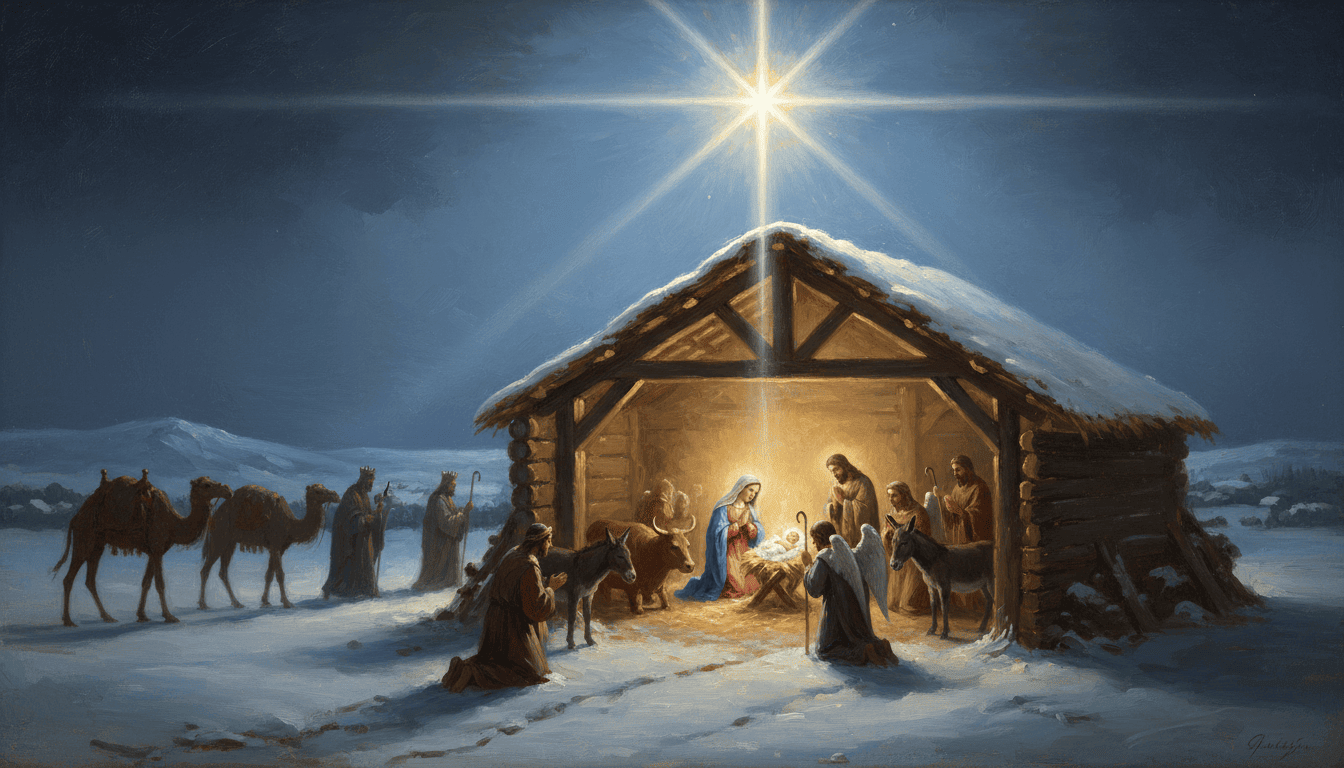
ChristmasThe Birth of Jesus
Introduction
The birth of Jesus Christ is the most pivotal moment in human history. What happened in a humble Bethlehem stable over two thousand years ago was more than the arrival of a remarkable teacher or prophet — it was the incarnation of God himself. The eternal Word became flesh and dwelt among us, fulfilling centuries of prophecy and inaugurating the age of grace. Christmas celebrates this divine mystery—that the infinite God would condescend to enter his creation as a vulnerable infant, born to a virgin in the most humble of circumstances.
Prophecies Fulfilled in Bethlehem
The birth of Jesus was no accident of history, but the precise fulfillment of God's ancient promises. Seven hundred years before Christ, the prophet Micah declared that the ruler of Israel would come from Bethlehem, a town seemingly too small to matter. Yet God delights in using the insignificant to accomplish the magnificent.
But thou, Bethlehem Ephratah, though thou be little among the thousands of Judah, yet out of thee shall he come forth unto me that is to be ruler in Israel; whose goings forth have been from of old, from everlasting.
Micah 5:2
KJV
Isaiah prophesied the virgin birth, declaring that a young woman would conceive and bear a son called Immanuel—"God with us." This supernatural conception would become the sign that God himself had entered human history in the most intimate way possible.
Therefore the Lord himself shall give you a sign; Behold, a virgin shall conceive, and bear a son, and shall call his name Immanuel.
Isaiah 7:14
KJV
The Gospel of Matthew takes pains to show how Jesus's birth fulfilled these ancient prophecies. Joseph, confronted with Mary's unexpected pregnancy, receives divine confirmation through an angel that this child is the long-awaited Messiah. The name "Jesus" itself—meaning "he will save his people from their sins"—encapsulates the entire purpose of the incarnation.
Now the birth of Jesus Christ was on this wise: When as his mother Mary was espoused to Joseph, before they came together, she was found with child of the Holy Ghost. Then Joseph her husband, being a just man, and not willing to make her a publick example, was minded to put her away privily. But while he thought on these things, behold, the angel of the Lord appeared unto him in a dream, saying, Joseph, thou son of David, fear not to take unto thee Mary thy wife: for that which is conceived in her is of the Holy Ghost. And she shall bring forth a son, and thou shalt call his name JESUS: for he shall save his people from their sins. Now all this was done, that it might be fulfilled which was spoken of the Lord by the prophet, saying, Behold, a virgin shall be with child, and shall bring forth a son, and they shall call his name Emmanuel, which being interpreted is, God with us.
Matthew 1:18-23
KJV
The Nativity: Heaven Touches Earth
Luke's Gospel provides the most detailed account of Jesus's birth. The setting could hardly be more humble: a young couple, far from home due to a Roman census, finding shelter in a stable because there was no room in the inn. Mary, heavy with child, gives birth to the Son of God surrounded by animals, laying him in a feeding trough because there was no cradle available.
And it came to pass in those days, that there went out a decree from Caesar Augustus, that all the world should be taxed. (And this taxing was first made when Cyrenius was governor of Syria.) And all went to be taxed, every one into his own city. And Joseph also went up from Galilee, out of the city of Nazareth, into Judaea, unto the city of David, which is called Bethlehem; (because he was of the house and lineage of David:) To be taxed with Mary his espoused wife, being great with child. And so it was, that, while they were there, the days were accomplished that she should be delivered. And she brought forth her firstborn son, and wrapped him in swaddling clothes, and laid him in a manger; because there was no room for them in the inn.
Luke 2:1-7
KJV
The contrast between heaven's King and earth's poverty is stark and intentional. The One through whom all things were created, who holds the universe together by the word of his power, enters his creation in utter vulnerability. This humility characterizes Christ's entire earthly ministry and models for us the way of true greatness in God's kingdom.
The shepherds—among the lowest in social status—become the first evangelists of the gospel. An angel appears to them in the fields, announcing good news of great joy: a Savior, Christ the Lord, has been born. Suddenly, the night sky erupts with a heavenly choir praising God. These humble workers rush to Bethlehem and find everything exactly as the angel described.
And there were in the same country shepherds abiding in the field, keeping watch over their flock by night. And, lo, the angel of the Lord came upon them, and the glory of the Lord shone round about them: and they were sore afraid. And the angel said unto them, Fear not: for, behold, I bring you good tidings of great joy, which shall be to all people. For unto you is born this day in the city of David a Saviour, which is Christ the Lord. And this shall be a sign unto you; Ye shall find the babe wrapped in swaddling clothes, lying in a manger. And suddenly there was with the angel a multitude of the heavenly host praising God, and saying, Glory to God in the highest, and on earth peace, good will toward men. And it came to pass, as the angels were gone away from them into heaven, the shepherds said one to another, Let us now go even unto Bethlehem, and see this thing which is come to pass, which the Lord hath made known unto us. And they came with haste, and found Mary, and Joseph, and the babe lying in a manger. And when they had seen it, they made known abroad the saying which was told them concerning this child. And all they that heard it wondered at those things which were told them by the shepherds. But Mary kept all these things, and pondered them in her heart. And the shepherds returned, glorifying and praising God for all the things that they had heard and seen, as it was told unto them.
Luke 2:8-20
KJV
The Incarnation: God Becomes Man
John's Gospel provides the theological framework for understanding Christmas. The Word—the divine Logos—who existed from eternity with God and was himself God, became flesh. This is the doctrine of the incarnation: Jesus is fully God and fully man, two natures united in one person. He did not cease to be God when he became man, nor was his humanity diminished by his deity.
In the beginning was the Word, and the Word was with God, and the Word was God. The same was in the beginning with God. All things were made by him; and without him was not any thing made that was made. In him was life; and the life was the light of men. And the light shineth in darkness; and the darkness comprehended it not.
John 1:1-5
KJV
And the Word was made flesh, and dwelt among us, (and we beheld his glory, the glory as of the only begotten of the Father,) full of grace and truth.
John 1:14
KJV
The incarnation was necessary for our redemption. Only a human could represent humanity before God, but only God could provide a sacrifice sufficient to atone for sin. In Jesus, these requirements meet perfectly. He is the bridge between God and humanity, the mediator of a new covenant, the High Priest who offered himself as the perfect sacrifice.
Paul emphasizes the voluntary nature of Christ's humiliation. Though he existed in the form of God and possessed equality with God as his right, Jesus did not cling to his divine privileges. Instead, he emptied himself, taking the form of a servant and being born in human likeness. This self-emptying (kenosis) reached its climax in his death on a cross.
Let this mind be in you, which was also in Christ Jesus: Who, being in the form of God, thought it not robbery to be equal with God: But made himself of no reputation, and took upon him the form of a servant, and was made in the likeness of men: And being found in fashion as a man, he humbled himself, and became obedient unto death, even the death of the cross. Wherefore God also hath highly exalted him, and given him a name which is above every name: That at the name of Jesus every knee should bow, of things in heaven, and things in earth, and things under the earth; And that every tongue should confess that Jesus Christ is Lord, to the glory of God the Father.
The Magi: Gentiles Seek the King
Matthew records the visit of the Magi—wise men from the East who followed a star to find the newborn King of the Jews. Their journey represents the inclusion of Gentiles in God's plan of salvation. These foreigners recognized what many of God's own people missed: that the long-awaited Messiah had arrived.
Now when Jesus was born in Bethlehem of Judaea in the days of Herod the king, behold, there came wise men from the east to Jerusalem, Saying, Where is he that is born King of the Jews? for we have seen his star in the east, and are come to worship him.
Matthew 2:1-2
KJV
The Magi's gifts were both practical and prophetic. Gold acknowledged Jesus's kingship, frankincense his divinity, and myrrh foreshadowed his death. They worshiped this child, offering their treasures to One who, though he possessed all things, had been born in poverty. Their worship contrasts sharply with Herod's murderous jealousy and the chief priests' indifference.
When they had heard the king, they departed; and, lo, the star, which they saw in the east, went before them, till it came and stood over where the young child was. When they saw the star, they rejoiced with exceeding great joy. And when they were come into the house, they saw the young child with Mary his mother, and fell down, and worshipped him: and when they had opened their treasures, they presented unto him gifts; gold, and frankincense, and myrrh. And being warned of God in a dream that they should not return to Herod, they departed into their own country another way.
Matthew 2:9-12
KJV
The Meaning of Christmas for Believers
Christmas is fundamentally about God's love for fallen humanity. The Father sent his Son into the world not to condemn it, but to save it. This mission of redemption required the incarnation—God had to become one of us to rescue us. The manger in Bethlehem points directly to the cross on Calvary; Jesus was born to die so that we might live.
The angels' announcement to the shepherds remains the heart of the Christmas message: "Fear not: for, behold, I bring you good tidings of great joy, which shall be to all people. For unto you is born this day in the city of David a Saviour, which is Christ the Lord." This is good news because humanity desperately needed a Savior. We were lost in sin, alienated from God, under the sentence of death. But God, rich in mercy, sent his Son to seek and save the lost.
Paul connects Christ's birth to our adoption as God's children. When the fullness of time came, God sent his Son, born of a woman, born under the law, to redeem those under the law so that we might receive adoption as sons and daughters. Because of Christmas, believers can cry "Abba, Father" and know that we are heirs of God and co-heirs with Christ.
But when the fulness of the time was come, God sent forth his Son, made of a woman, made under the law, To redeem them that were under the law, that we might receive the adoption of sons. And because ye are sons, God hath sent forth the Spirit of his Son into your hearts, crying, Abba, Father. Wherefore thou art no more a servant, but a son; and if a son, then an heir of God through Christ.
Galatians 4:4-7
KJV
Conclusion: Immanuel, God With Us
The true wonder of Christmas lies in its central declaration: God is with us. In Jesus, the eternal God entered time and space, experienced human life in all its joys and sorrows, and ultimately offered himself as a sacrifice for our sins. The babe of Bethlehem is the Lord of glory, the Creator dwelling among his creatures, the Holy One bearing our unholiness to the cross. Christmas celebrates the beginning of God's rescue mission, the dawn of redemption, the arrival of grace and truth in human form. As we remember Christ's birth, we worship the One who loved us enough to become one of us, and we await his return in glory when he will complete the salvation he began in that Bethlehem stable.