


Acts 21:16
Bible text: King James Version (1769 Blayney text) · Public domain
Bible text: King James Version with Strong's numbers · Public domain
Bible text: Berean Standard Bible · Public domain
Bible text: American Standard Version (1901) · Public domain
Bible text: World English Bible, Messianic edition · Public domain
Bible text: Geneva Bible (1599) · Public domain
Bible text: Young's Literal Translation · Public domain
- συνῆλθονsunēlthonWentG4905V-2AAI-3PVerb 2nd Aorist Active Indicative 3rd Plural
- δὲdethenG1161CONJConjunction
- καὶkaialso [some]G2532CONJConjunction
- τῶνtōnof theG3588T-GPMDefinite article Genitive Plural Masculine
- μαθητῶνmathētōndisciplesG3101N-GPMNoun Genitive Plural Masculine
- ἀπὸapofromG575PREPPreposition
- ΚαισαρείαςKaisareiasCaesareaG2542N-GSF-LNoun Genitive Singular Feminine Location
- σὺνsunwithG4862PREPPreposition
- ἡμῖνhēminusG3165P-1DPPersonal pronoun Dative 1st Plural
- ἄγοντεςagontesbringing [one]G71V-PAP-NPMVerb Present Active Participle Nominative Plural Masculine
- παρ᾽par᾽withG3844PREPPreposition
- ᾧhōwhomG3739R-DSMRelative pronoun Dative Singular Masculine
- ξενισθῶμενxenisthōmenwe may lodgeG3579V-APS-1PVerb Aorist Passive Subjunctive 1st Plural
- ΜνάσωνίMnasōniMnasonG3416N-DSM-PNoun Dative Singular Masculine Individual
- τινιtinia certainG5100X-DSMIndefinite pronoun Dative Singular Masculine
- ΚυπρίῳKupriōCypriotG2953N-DSM-LGNoun Dative Singular Masculine Location Gentilic
- ἀρχαίῳarchaiōan earlyG744A-DSMAdjective Dative Singular Masculine
- μαθητῇmathētēadiscipleG3101N-DSMNoun Dative Singular Masculine
English is a literal word-by-word gloss of the Greek, not the KJV's wording. Why?
This is the original text the KJV's translators worked from — each Greek word with its own literal English meaning in this verse, prepared by scholars at Tyndale House, Cambridge. The KJV translates whole sentences, not word by word, so its wording differs: one Greek word can become several English words, and the KJV may choose “charity” where the gloss reads “love”. Both are faithful — they answer different questions. For the KJV's own rendering, switch to the KJV text.
Details
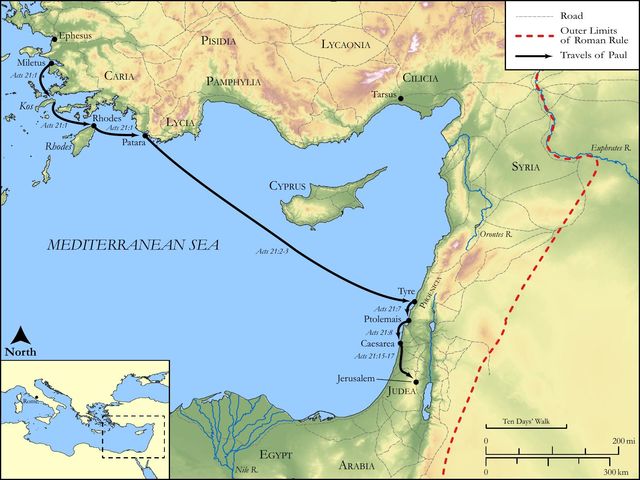
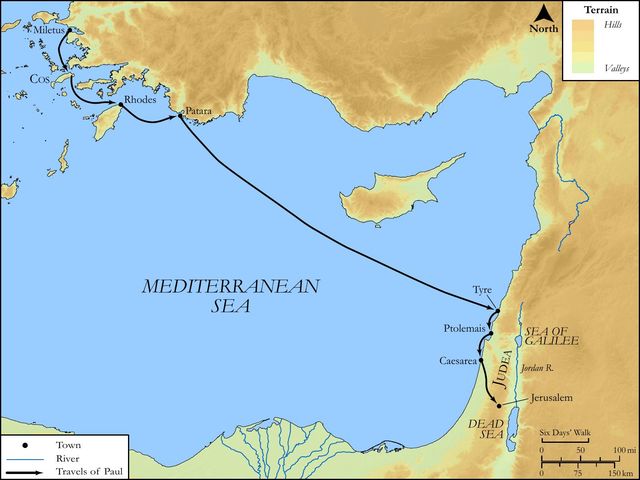
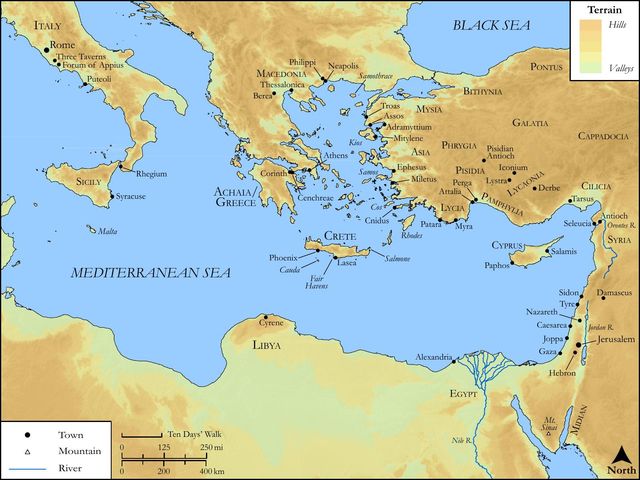
See on the biblical-era maps
Study this verse
Public-domain commentary
Matthew Henry
From his Commentary on the Whole Bible. Henry comments on passages, not single verses — this entry covers Acts 21:15–26. His four-level outline is real structure in the source text, so it is rendered as structure.
In these verses we have,
I.Paul's journey to Jerusalem from Caesarea, and the company that went along with him.
1.They took up their carriages, their bag and baggage, and as it should seem, like poor travellers or soldiers, were their own porters; so little had they of change of raiment. Omnia mea mecum porto - My property is all about me. Some think they had with them the money that was collected in the churches of Macedonia and Achaia for the poor saints at Jerusalem. If they could have persuaded Paul to go some other way, they would gladly have gone along with him; but if, notwithstanding their dissuasive, he will go to Jerusalem, they do no say, "Let him go by himself then;" but as Thomas, in a like case, when Christ would go into danger at Jerusalem, Let us go and die with him, Joh 11:16. Their resolution to cleave to Paul was like that of Ittai to cleave to David (Sa2 15:21): In what place my Lord the king shall be, whether in death or life, there also will thy servant be. Thus Paul's boldness emboldened them.
2.Certain of the disciples of Caesarea went along with them. Whether they designed to go however, and took this opportunity of going with so much good company, or whether they went on purpose to see if they could do Paul any service and if possible prevent his trouble, or at least minister to him in it, does not appear. The less while that Paul is likely to enjoy his liberty the more industrious they are to improve every opportunity of conversation with him. Elisha kept close to Elijah when he knew the time was at hand that he should be taken up.
3.They brought with them an honest old gentleman that had a house of his own at Jerusalem, in which he would gladly entertain Paul and his company, one Mnason of Cyprus (Act 21:16), with whom we should lodge. Such a great concourse of people there was to the feast that it was a hard matter to get lodgings; the public houses would be taken up by those of the better sort, and it was looked upon as a scandalous thing for those that had private houses to let their rooms out at those times, but they must freely accommodate strangers with them. Every one then would choose his friends to be his guests, and Mnason took Paul and his company to be his lodgers; though he had heard what trouble Paul was likely to come into, which might bring those that entertained him into trouble too, yet he shall be welcome to him, whatever comes of it. This Mnason is called an old disciple - a disciple from the beginning; some think, one of the seventy disciples of Christ, or one of the first converts after the pouring out of the Spirit, or one of the first that was converted by the preaching of the gospel in Cyprus, Act 13:4. However it was, it seems he had been long a Christian, and was now in years. Note, It is an honourable thing to be an old disciple of Jesus Christ, to have been enabled by the grace of God to continue long in a course of duty, stedfast in the faith, and growing more and more prudent and experienced to a good old age. And with these old disciples one would choose to lodge; for the multitude of their years will teach wisdom.
II.Paul's welcome at Jerusalem.
1.Many of the brethren there received him gladly, Act 21:17. As soon as they had notice that he was come to town, they went to his lodgings at Manson's house, and congratulated him on his safe arrival, and told him they were glad to see him, and invited him to their houses, accounting it an honour to be known to one that was such an eminent servant of Christ. Streso observes that the word here used concerning the welcome they gave to the apostles, asmenōs apodechein̂ is used concerning the welcome of the apostles' doctrine, Act 2:41. They gladly received his word. We think if we had Paul among us we should gladly receive him; but it is a question whether we should or no it, having his doctrine, we do not gladly receive that.
2.They paid a visit to James and the elders of the church, at a church-meeting (Act 21:18): "The day following, Paul went unto James, and took us with him, that were his companions, to introduce us into acquaintance with the church at Jerusalem." It should seem that James was now the only apostle that was resident at Jerusalem; the rest had dispersed themselves to preach the gospel in other places. But still they forecasted to have an apostle at Jerusalem, perhaps sometimes one and sometimes another, because there was a great resort thither from all parts. James was now upon the spot, and all the elders or presbyters that were the ordinary pastors of the church, both to preach and govern, were present. Paul saluted them all, paid his respects to them, enquired concerning their welfare, and gave them the right hand of fellowship. He saluted them, that is, he wished them all health and happiness, and prayed to God to bless them. The proper signification of salutation is, wishing salvation to you: salve, or salus tibi sit; like peace be unto you. And such mutual salutations, or good wishes, very well become Christians, in token of their love to each other and joint regard to God.
III.The account they had from him of his ministry among the Gentiles, and their satisfaction in it.
1. He gave them a narrative of the success of the gospel in those countries where he had been employed, knowing it would be very acceptable to them to hear of the enlarging of Christ's kingdom: He declared particularly what things God had wrought among the Gentiles by his ministry, v. 19. Observe how modestly he speaks, not what things he had wrought (he was but the instrument), but what God had wrought by his ministry. It was not I, but the grace of God which was with me. He planted and watered, but God gave the increase. He declared it particularly, that the grace of God might appear the more illustrious in the circumstances of his success. Thus David will tell others what God has done for his soul (Psa 66:16), as Paul here what God has done by his hand, and both that their friends may help them to be thankful. 2. Hence they took occasion to give praise to God (v. 20): When they heart it, they glorified the Lord. Paul ascribed it all to God, and to God they gave the praise of it. They did not break out into high encomiums of Paul, but left it to his Master to say to him, Well done, good and faithful servant; but they gave glory to the grace of God, which was extended to the Gentiles. Note, The conversion of sinners ought to be the matter of our joy and praise as it is of the angels'. God had honoured Paul more than any of them, in making his usefulness more extensive, yet they did not envy him, nor were they jealous of his growing reputation, but, on the contrary, glorified the Lord. And they could not do more to encourage Paul to go on cheerfully in his work than to glorify God for his success in it; for, if God be praised, Paul is pleased.
IV.The request of James and the elders of the church at Jerusalem to Paul, or their advice rather, that he would gratify the believing Jews by showing some compliance with the ceremonial law, and appearing publicly in the temple to offer sacrifice, which was not a thing in itself sinful; for the ceremonial law, though it was by no means to be imposed upon the Gentile converts (as the false teachers would have it, and thereby endeavoured to subvert the gospel), yet it was not become unlawful as yet to those that had been bred up in the observance of it, but were far from expecting justification by it. It was dead, but not buried; dead, but not yet deadly. And, being not sinful, they thought it was a piece of prudence in Paul to conform thus far. Observe the counsel they give to Paul herein, not as having authority over him, but an affection for him.
1.They desired him to take notice of the great numbers there were of the Jewish converts: Thou seest, brother, how many thousands of the Jews there are who believe. They called him brother, for they looked upon him as a joint-commissioner with them in gospel-work. Though they were of the circumcision and he the apostle of the Gentiles, though they were conformists and he a nonconformist, yet they were brethren, and owned the relation. Thou hast been in some of our assemblies, and seest how numerous they are: how many myriads of Jews believe. The word signifies, not thousands, but ten thousands. Even among the Jews, who were most prejudiced against the gospel, yet there were great multitudes that received it; for the grace of God can break down the strongest holds of Satan. The number of the names at first was but one hundred and twenty, yet now many thousands. Let none therefore despise the day of small things; for, though the beginning be small, God can make the latter end greatly to increase. Hereby it appeared that God had not quite cast away his people the Jews, for among them there was a remnant, an election, that obtained (see Rom 11:1, Rom 11:5, Rom 11:7): many thousands that believed. And this account which they could give to Paul of the success of the gospel among the Jews was, no doubt, as grateful to Paul as the account which he gave them of the conversion of the Gentiles was to them; for his heart's desire and prayer to God for the Jews was that they might be saved.
2.They informed him of a prevailing infirmity these believing Jews laboured under, of which they could not yet be cured: They are all zealous of the law. They believe in Christ as the true Messiah, they rest upon his righteousness and submit to his government; but they know the law of Moses was of God, they have found spiritual benefit in their attendance on the institutions of it, and therefore they can by no means think of parting with it, no, nor of growing cold to it. And perhaps they urged Christ's being made under the law, and observing it (which was designed to be our deliverance from the law), as a reason for their continuance under it. This was a great weakness and mistake, to be so fond of the shadows when the substance was come, to keep their necks under a yoke of bondage when Christ had come to make them free. But see,
(1.)The power of education and long usage, and especially of a ceremonial law.
(2.)The charitable allowance that must be made in consideration of these. These Jews that believed were not therefore disowned and rejected as no Christians because they were for the law, nay, were zealous for it, while it was only in their own practice, and they did not impose it upon others. Their being zealous of the law was capable of a good construction, which charity would put upon it; and it was capable of a good excuse, considering what they were brought up in, and among whom they lived.
3.They gave him to understand that these Jews, who were so zealous of the law, were ill-affected to him, Act 21:21. Paul himself, though as faithful a servant as any Christ ever had, yet could not get the good word of all that belonged to Christ's family: "They are informed of thee (and form their opinion of thee accordingly) that thou not only dost not teach the Gentiles to observe the law, as some would have had thee (we have prevailed with them to drop that), but dost teach all the Jews who are dispersed among the Gentiles to forsake Moses, not to circumcise their children nor to walk after the customs of our nation, which were of divine appointment, so far as they might be observed even among the Gentiles, at a distance from the temple, - not to observe the fasts and feasts of the church, not to wear their phylacteries, nor abstain from unclean meats." Now,
(1.)It was true that Paul preached the abrogation of the law of Moses, taught them that it was impossible to be justified by it, and therefore we are not bound up any longer to the observance of it. But,
(2.)It was false that he taught them to forsake Moses; for the religion he preached tended not to destroy the law, but to fulfil it. He preached Christ (the end of the law for righteousness), and repentance and faith, in the exercise of which we are to make great use of the law. The Jews among the Gentiles whom Paul taught were so far from forsaking Moses that they never understood him better, nor ever embraced him so heartily as now when they were taught to make use of him as a schoolmaster to bring them to Christ. But even the believing Jews, having got this notion of Paul, that he was an enemy to Moses, and perhaps giving too much regard to the unbelieving Jews too, were much exasperated against him. Their ministers, the elders here present, loved and honoured him, and approved of what he did, and called him brother, but the people could hardly be induced to entertain a favourable thought of him; for it is certain the least judicious are the most censorious, the weak-headed are the hot-headed. They could not distinguish upon Paul's doctrine as they ought to have done, and therefore condemned it in the gross, through ignorance.
4.They therefore desired Paul that he would by some public act, now that he had come to Jerusalem, make it to appear that the charge against him was false, and that he did not teach people to forsake Moses and to break the customs of the Jewish church, for he himself retained the use of them.
(1.)They conclude that something of this kind must be done: "What is it therefore? What must be done? The multitude will hear that thou art come to town." This is an inconvenience that attends men of fame, that their coming and going are taken notice of more than other people's, and will be talked of, by some for good-will and by others for ill-will. "When they hear thou art come, they must needs come together, they will expect that we call them together, to advise with them whether we should admit thee to preach among us as a brother or no; or, they will come together of themselves expecting to hear thee." Now something must be done to satisfy them that Paul does not teach the people to forsake Moses, and they think it necessary,
[1.]For Paul's sake, that his reputation should be cleared, and that so good a man may not lie under any blemish, nor so useful a man labour under any disadvantage which may obstruct his usefulness.
[2.]For the people's sake, that they may not continue prejudiced against so good a man, nor lose the benefit of his ministry by those prejudices.
[3.]For their own sake, that since they knew it was their duty to own Paul their doing it might not be turned to their reproach among those that were under their charge.
(2.)They produce a fair opportunity which Paul might take to clear himself: "Do this that we say unto thee, take our advice in this case. We have four men, Jews who believe, of our own churches, and they have a vow on them, a vow of Nazariteship for a certain time; their time has now expired (Act 21:23), and they are to offer their offering according to the law, when they shave the head of their separation, a he-lamb for a burnt-offering, a ewe-lamb for a sin-offering, and a ram for a peace-offering, with other offerings pertinent to them, Num 6:13-20. Many used to do this together, when their vow expired about the same time, either for the greater expedition or for the greater solemnity. Now Paul having so far of late complied with the law as to take upon him the vow of a Nazarite, and to signify the expiration of it by shaving his head at Cenchrea (Act 18:18), according to the custom of those who lived at a distance from the temple, they desire him but to go a little further, and to join with these four in offering the sacrifices of a Nazarite: 'Purify thyself with them according to the law; and be willing not only to take that trouble, but to be at charges with them, in buying sacrifices for this solemn occasion, and to join with them in the sacrifice." This, they think, will effectually stop the mouth of calumny, and every one will be convinced that the report was false, that Paul was not the man he was represented to be, did not teach the Jews to forsake Moses, but that he himself, being originally a Jew, walked orderly, and kept the law; and then all would be well.
5.They enter a protestation that this shall be no infringement at all of the decree lately made in favour of the Gentile converts, nor do they intend by this in the least to derogate from the liberty allowed them (Act 21:25): "As touching the Gentiles who believe, we have written and concluded, and resolve to abide by it, that they observe no such things; we would not have them to be bound up by the ceremonial law by any means, but only that they keep themselves from things offered to idols, and from blood, and from things strangled, and from fornication; but let not them be tied to the Jewish sacrifices or purifications, nor any of their rites and ceremonies." They knew how jealous Paul was for the preservation of the liberty of the converted Gentiles, and therefore expressly covenant to abide by that. Thus far is their proposal.
V.Here is Paul's compliance with it.
He was willing to gratify them in this matter. Though he would not be persuaded not to go to Jerusalem, yet, when he was there, he was persuaded to do as they there did, Act 21:26. Then Paul took the men, as they advised, and the very next day, purifying himself with them, and not with multitude nor tumult, as he himself pleads (Act 24:18), he entered into the temple, as other devout Jews that came upon such errands did, to signify the accomplishment of the days of purification to the priests; desiring the priest would appoint a time when the offering should be offered for every one of them, one for each. Ainsworth, on Num 6:18, quotes out of Maimonides a passage which gives some light to this: If a man say, Upon me behalf the oblations of a Nazarite, or, Upon me be half the shaving of a Nazarite, them he brings half the offerings by what Nazarite he will, and that Nazarite pays his offering out of that which is his. So Paul did here; he contributed what he vowed to the offerings of these Nazarites, and some think bound himself to the law of Nazariteship, and to an attendance at the temple with fastings and prayers for seven days, not designing that the offering should be offered till them, which was what he signified to the priest. Now it has been questioned whether James and the elders did well to give Paul this advice, and whether he did well to take it.
1.Some have blamed this occasional conformity of Paul's, as indulging the Jews too much in their adherence to the ceremonial law, and a discouragement of those who stood fast in the liberty wherewith Christ had made them free. Was it not enough for James and the elders of Jerusalem to connive at this mistake in the Jewish converts themselves, but must they wheedle Paul to countenance them in it? Had it not been better, when they had told Paul how zealous the believing Jews were for the law, if they had desired, whom God had endued with such excellent gifts, to take pains with their people to convince them of their error, and to show them that they were made free from the law by their marriage to Christ? Rom 7:4. To urge him to encourage them in it by his example seems to have more in it of fleshly wisdom than of the grace of God. Surely Paul knew what he had to do better than they could teach him. But,
2.Others think the advice was prudent and good, and Paul's following it was justifiable enough, as the case stood. It was Paul's avowed principle, To the Jews became I as a Jew, that I might gain the Jews, Co1 9:20. He had circumcised Timothy, to please the Jews; though he would not constantly observe the ceremonial law, yet, to gain an opportunity of doing good, and to show how far he could comply, he would occasionally go to the temple and join in the sacrifices there. Those that are weak in the faith are to be borne with, when those that undermine the faith must be opposed. It is true, this compliance of Paul's sped ill to him, for this very thing by which he hoped to pacify the Jews did but provoke them, and bring him into trouble; yet this is not a sufficient ground to go upon in condemning it: Paul might do well, and yet suffer for it. But perhaps the wise God overruled both their advice and Paul's compliance with it to serve a better purpose than was intended; for we have reason to think that when the believing Jews, who had endeavoured by their zeal for the law to recommend themselves to the good opinion of those who believed not, saw how barbarously they used Paul (who endeavoured to oblige them), they were by this more alienated from the ceremonial law than they could have been by the most argumentative or affecting discourses. They saw it was in vain to think of pleasing men that would be pleased with nothing else but the rooting out of Christianity. Integrity and uprightness will be more likely to preserve us than sneaking compliances. And when we consider what a great trouble it must needs be to James and the presbyters, in the reflection upon it, that they had by their advice brought Paul into trouble, it should be a warning to us not to press men to oblige us by doing any thing contrary to their own mind.
Historical interpretation
Historical reception
1 surviving comment on this verse from the historical church.
"And after these days," it says, "having taken up our baggage" - i.e. having received the supplies necessary for the journey - "we went up to Jerusalem. And there went with us also certain of the disciples from Caesarea, bringing us to one with whom we should lodge, one Mnason, an ancient disciple of Cyprus." "Bringing us," it says, "to him with whom we should lodge" - not to the church: for on the former occasion, when they went up concerning the decrees, they lodged with the Church, but now with a certain "ancient disciple." The expression shows that the preaching had been going on a long time: whence it seems to me that this writer in the Acts epitomizes the events of many years, relating only the matters of chief importance. So unwilling were they to burthen the Church, when there was another to lodge them; and so little did they stand upon their dignity.
Continue studying Acts 21:16 across the web’s major study libraries — every link below opens this exact verse, chapter, or book on the destination site.
Read & Compare
 BibleGatewayThis verse in more than 200 translations and 70 languages.
 Bible.comThe YouVersion reader — hundreds of translations, reading plans, and highlights.
 ESV.orgCrossway's official English Standard Version reader.
 NET BibleThe NET translation with 60,000+ translators' notes on every rendering decision.
 STEP BibleTyndale House's free study tool — original text, vocabulary, and scholarly resources.
 BibliaLogos Bible Software's free web reader.
 USCCBThe New American Bible (Revised Edition) with the U.S. bishops' study notes.
Commentaries
 BibleHub CommentariesDozens of classic commentaries on this verse, gathered on one page.
 StudyLightMore than 100 commentary sets — the largest collection on the web.
 BibleRefPlain-English commentary on what this verse means, verse by verse.
 Enduring WordDavid Guzik's free commentary on this chapter, widely used by Bible teachers.
 Bible Study ToolsVerse commentary alongside Greek and Hebrew study aids.
Original Language & Research
- BibleHub InterlinearThe verse word by word — original language, transliteration, and English.
- BibleHub LexiconEvery word's original-language definition and Strong's entry.
 Blue Letter BibleDeep-study tools — Strong's numbers, concordance, and word studies.
 CNTR CollationThe earliest Greek manuscripts of this verse, collated letter by letter.
Sermons, Hymns & Audio


TrulyRandomVerse is not affiliated with these sites and doesn’t control their content. They’re linked because they’re genuinely useful.
Summary
Acts 21:16 provides a specific logistical detail within the narrative of Paul's final journey to Jerusalem, illustrating the practical outworking of Christian fellowship and hospitality. As Paul and his companions depart from Caesarea, they are joined by local disciples who facilitate lodging with Mnason of Cyprus, identified as an "old disciple," highlighting the importance of mature believers and communal support in the early church's ministry and travel.
Context
ShowHideLiterary Context
This verse is situated within the concluding chapters of Acts, which chronicle Paul's determined journey to Jerusalem despite numerous prophetic warnings of suffering and imprisonment (e.g., Acts 20:22-23 and Acts 21:10-14). Having spent time in Caesarea with Philip the evangelist (Acts 21:8), Paul is now making the final leg of his journey. The mention of specific individuals and logistical arrangements, like the lodging with Mnason, grounds the narrative in historical reality, emphasizing the communal nature of Paul's mission and the practical support systems within the nascent church. It shows that even in the face of danger, the church functioned as a supportive family.
Historical & Cultural Context
Travel in that day, especially for missionaries like Paul, relied heavily on hospitality. There were no established inns as we know them; travelers depended on the generosity of hosts, often fellow believers. This practice was deeply embedded in Israel and among the Gentiles, but it took on particular significance within the early Christian community as a demonstration of love, solidarity, and practical support for those spreading the Gospel. Cyprus, Mnason's origin, was an early center of Christian activity, notably visited by Paul and Barnabas on their first missionary journey (Acts 13:4-12). The designation "old disciple" (ἀρχαῖος μαθητής) suggests someone who had been a believer for a significant period, possibly since the very early days of the church, perhaps even a convert from Pentecost or soon thereafter, making his home a respected and reliable haven.
Key Themes
ShowHideActs 21:16 contributes to several overarching themes in the book of Acts. Firstly, it underscores the theme of Christian Fellowship and Mutual Support, demonstrating how believers from different regions collaborated to aid Paul in his mission, even amidst foreboding circumstances. This communal spirit is a hallmark of the early church, where believers shared resources and burdens (Acts 2:44-45). Secondly, the verse highlights the vital role of Hospitality as a practical expression of love and a necessary component of missionary work, echoing broader biblical commands to welcome strangers (Hebrews 13:2). Thirdly, the introduction of Mnason as an "old disciple" subtly emphasizes the Value of Mature Believers within the community, whose steadfast faith and experience provided stability and resources for the younger or traveling members of the church. This respect for spiritual seniority is evident throughout the New Testament, as seen in the qualifications for elders (Titus 1:5-9).
Exposition and Analysis
ShowHideKey Word Analysis
ShowHideFrom the verb "to learn," this term signifies a learner or pupil. In the New Testament, it refers to followers of Jesus Christ, emphasizing their commitment to His teachings and their ongoing process of spiritual growth. Here, it applies both to the "certain of the disciples of Caesarea" and specifically to Mnason, identifying them as members of the Christian community.
This adjective means "original" or "primeval." When coupled with "disciple," as it is for Mnason, it doesn't merely denote advanced age but strongly implies someone who has been a believer from the very beginning of the Christian movement, or at least for a very long time. This suggests a deep spiritual maturity and a long-standing commitment to Christ, making him a respected figure within the early church.
Derived from the word for "stranger" or "guest," this verb means "to be a host" or, passively, "to be a guest." In this context, it clearly indicates that Mnason was to provide accommodation for Paul and his company, underscoring the crucial practice of hospitality in supporting traveling ministers and fostering Christian community.
Verse Breakdown
ShowHide"There went with us also certain of the disciples of Caesarea"
This clause reveals that Paul and his immediate traveling companions were joined by local believers from Caesarea. This demonstrates the active involvement and solidarity of the Caesarean church with Paul, providing not just moral support but practical assistance by accompanying them on the journey.
"and brought with them one Mnason of Cyprus"
The Caesarean disciples played a crucial role in facilitating the connection with Mnason. They "brought" him along, suggesting they either arranged for him to travel with them from Caesarea, or they led Paul's group directly to his home upon arrival in Jerusalem or a nearby village. Mnason's origin from Cyprus connects him to a significant early Christian center.
"an old disciple"
This is the key descriptor for Mnason. It highlights his long tenure in the faith, implying spiritual wisdom, experience, and perhaps even direct connection to the earliest days of the church. This status likely made his home a trusted and suitable place for the apostle and his company to stay.
"with whom we should lodge"
This final phrase explicitly states the purpose of Mnason's inclusion in the narrative: to provide lodging. It underscores the practical necessity of hospitality for itinerating missionaries and the communal provision within the early church for its members.
Literary Devices
ShowHideLuke, as the author of Acts, masterfully employs Narrative Detail throughout his work, and Acts 21:16 is a prime example. While seemingly a minor logistical note, it serves to ground the grand narrative of Paul's mission in the tangible realities of travel, community, and personal relationships. This meticulous detail enhances the historical verisimilitude of the account. Furthermore, the verse utilizes Character Introduction to present Mnason, whose brief appearance is nonetheless significant due to his defining epithet, "an old disciple." This descriptive phrase functions as a form of Epithet or Appellation, immediately conveying Mnason's spiritual maturity and long-standing faith, which implicitly explains why his home was chosen as a place of lodging. The very act of providing lodging, though a simple action, carries Symbolism of Christian fellowship, mutual support, and the practical outworking of love within the body of Christ, especially as Paul heads into a perilous situation.
Theological and Thematic Connections
ShowHideActs 21:16, though brief, offers profound theological insights into the nature of the early church. It vividly portrays the interconnectedness and mutual support that characterized the nascent Christian community. In a world without modern amenities for travelers, hospitality was not merely a social custom but a vital expression of Christian love and a practical necessity for the spread of the Gospel. The willingness of the Caesarean disciples to accompany Paul and to arrange lodging with Mnason exemplifies the self-sacrificial spirit and communal solidarity that bound believers together. Mnason's designation as an "old disciple" further highlights the value placed on spiritual maturity and the wisdom that comes from a long walk with Christ, suggesting that seasoned believers were foundational pillars providing stability and resources for the church's mission.
Reflection and Application
ShowHideActs 21:16, a seemingly minor detail in Paul's journey, offers rich lessons for contemporary believers. It reminds us that the Christian life is not meant to be lived in isolation but in vibrant community, marked by genuine care and practical support for one another. The willingness of the Caesarean disciples to accompany Paul, even into potential danger, and their proactive arrangement of lodging with Mnason, challenges us to consider how we can actively participate in supporting those who serve the Lord, especially those in demanding ministries. Furthermore, Mnason's example as an "old disciple" underscores the invaluable role of mature believers within the church. Their wisdom, steadfastness, and willingness to open their homes and lives provide stability, guidance, and a safe haven for others. This verse calls us to cultivate a spirit of hospitality, recognizing that opening our homes and resources to others is a tangible way to express Christ's love and strengthen the bonds of fellowship within the body of Christ. It encourages us to seek out and honor the wisdom of those who have walked with the Lord for many years, and to be willing to be a "Mnason" for others, providing practical support and a welcoming presence.
Questions for Reflection
ShowHideFAQ
ShowHideWho was Mnason, and why is he mentioned in Acts 21:16?
ShowHideMnason was a Christian from Cyprus who is described as an "old disciple." He is mentioned because he provided lodging for Paul and his companions during their final leg of the journey to Jerusalem. His designation as an "old disciple" suggests he was a long-time believer, possibly one of the earliest converts, making his home a trusted and suitable place for the apostle to stay. His inclusion highlights the vital role of hospitality and mutual support within the early Christian community.
What is the significance of "an old disciple" in this verse?
ShowHideThe Greek phrase for "old disciple" (ἀρχαῖος μαθητής, archaîos mathētḗs) implies more than just advanced age. It suggests that Mnason was a believer from the very early days of Christianity, perhaps even a contemporary of the apostles or a convert from the initial outpouring of the Holy Spirit at Pentecost. This status would have given him significant spiritual maturity, wisdom, and respect within the church, making his home a natural and honorable place for Paul to lodge. It underscores the value placed on seasoned faith and long-standing commitment within the early church.
Why was hospitality so important for early Christians like Paul?
ShowHideHospitality was crucial for early Christians, especially for traveling missionaries like Paul, because there were no widespread commercial lodging options like modern hotels. Believers relied on the generosity of fellow Christians for food, shelter, and safe passage. This practice was not just a practical necessity but also a profound expression of Christian love, solidarity, and obedience to biblical commands to welcome strangers (Hebrews 13:2). It strengthened communal bonds and facilitated the spread of the Gospel by providing essential support for those carrying the message.
Christ-Centered Fulfillment
ShowHideActs 21:16, with its focus on hospitality and communal support for Paul, beautifully reflects the Christ-centered nature of the early church. While the verse describes a practical logistical detail, it embodies the very spirit of Christ, who Himself was often dependent on the hospitality of others during His earthly ministry, finding rest in homes like that of Mary and Martha (Luke 10:38-42). Jesus taught His disciples to rely on such provision when sent out (Luke 10:5-7). More profoundly, the act of welcoming and providing for fellow believers, especially those serving the Gospel, is an act of service to Christ Himself, as He taught in His parable of the sheep and the goats: "whatever you did for one of the least of these brothers and sisters of mine, you did for me" (Matthew 25:40). Mnason, the "old disciple," embodies the mature faith that flows from a deep relationship with Christ, demonstrating the love and selflessness that Christ modeled and commanded His followers to exhibit (John 13:34-35). The communal support shown to Paul by the disciples of Caesarea and Mnason is a tangible expression of the church functioning as the body of Christ, each part supplying what is needed for the health and mission of the whole (Ephesians 4:15-16). Ultimately, all hospitality and provision within the Christian community point to Christ, the ultimate Host and Provider, who invites us into His eternal dwelling and provides for our every need (John 14:2-3).