


2 Samuel 21:13
Bible text: King James Version (1769 Blayney text) · Public domain
Bible text: Berean Standard Bible · Public domain
Bible text: American Standard Version (1901) · Public domain
Bible text: World English Bible, Messianic edition · Public domain
Bible text: Geneva Bible (1599) · Public domain
Bible text: Young's Literal Translation · Public domain
- וַיַּעַלvai·Ya·'aland he brought upH5927Conj-w ¦ V-Hiphil-ConsecImperf-3msVerb Hiphil Consecutive Imperfect 3rd Singular Masculineוַandיַּעַלhe brought up
- מִשָּׁםmi·Shamfrom thereH8033Prep-m ¦ AdvAdverbמִfromשָּׁםthere
- אֶת'et<obj.>H853DirObjMParticle Object Indicator
- עַצְמוֹתatz·Mot[the] bones ofH6106N-fpcNoun Plural Feminine Construct
- שָׁאוּלsha·'UlSaulH7586N-proper-mNoun Proper Masculine
- וְאֶתve·'Etand <obj.>H853Conj-w ¦ DirObjMParticle Object Indicatorוְandאֶת<obj.>
- עַצְמוֹתatz·Mot[the] bones ofH6106N-fpcNoun Plural Feminine Construct
- יְהוֹנָתָןye·ho·na·TanJonathanH3083N-proper-mNoun Proper Masculine
- בְּנוֹbe·Nohis sonH1121N-msc ¦ 3msNoun Singular Masculine Constructבְּנsonוֹhis
- וַיַּאַסְפוּvai·Ya·'as·Fuand they gatheredH622Conj-w ¦ V-Qal-ConsecImperf-3mpVerb Qal Consecutive Imperfect 3rd Plural Masculineוַandיַּאַסְפוּthey gathered
- אֶת'et<obj.>H853DirObjMParticle Object Indicator
- עַצְמוֹתatz·Mot[the] bones ofH6106N-fpcNoun Plural Feminine Construct
- הַמּוּקָעִיםha·mu·ka·'Imthe impaled [men]H3363Art ¦ V-Hophal-PassPrtcpl-mpVerb Hophal Participle Passive Plural Masculine Absoluteהַtheמּוּקָעִיםimpaled [men]
English is a literal word-by-word gloss of the Hebrew, not the KJV's wording. Why?
This is the original text the KJV's translators worked from — each Hebrew word with its own literal English meaning in this verse, prepared by scholars at Tyndale House, Cambridge. The KJV translates whole sentences, not word by word, so its wording differs: one Hebrew word can become several English words, and the KJV may choose “the LORD” where the gloss reads “Yahweh”. Both are faithful — they answer different questions. For the KJV's own rendering, switch to the KJV text.
Details
See on the biblical-era maps
Study this verse
Public-domain commentary
Matthew Henry
From his Commentary on the Whole Bible. Henry comments on passages, not single verses — this entry covers 2 Samuel 21:10–14. His two-level outline is real structure in the source text, so it is rendered as structure.
Here we have, I. Saul's sons not only hanged, but hanged in chains, their dead bodies left hanging, and exposed, till the judgment ceased, which their death was to turn away, by the sending of rain upon the land. They died as sacrifices, and thus they were, in a manner, offered up, not consumed all at once by fire, but gradually by the air. They died as anathemas, and by this ignominious usage they were represented as execrable, because iniquity was laid upon them. When our blessed Saviour was made sin for us he was made a curse for us. But how shall we reconcile this with the law which expressly required that those who were hanged should be buried on the same day? Deu 21:23. One of the Jewish rabbin wishes this passage of story expunged, that the name of God might be sanctified, which, he thinks, is dishonoured by his acceptance of that which was a violation of his law: but this was an extraordinary case, and did not fall within that law; nay, the very reason for that law is a reason for this exception. he that is thus left hanged is accursed; therefore ordinary malefactors must not be so abused; but therefore these must, because they were sacrificed, not to the justice of the nation, but for the crime of the nation (no less a crime than the violation of the public faith) and for the deliverance of the nation from no less a judgment than a general famine. Being thus made as the off-scouring of all things, they were made a spectacle to the world (Co1 4:9, Co1 4:13), God appointing, or at least allowing it.
II.Their dead bodies watched by Rizpah, the mother of two of them, Sa2 21:10.
It was a great affliction to her, now in her old age, to see her two sons, who, we may suppose, had been a comfort to her, and were likely to be the support of her declining years, cut off in this dreadful manner. None know what sorrows they are reserved for. She may not see them decently interred, but they shall be decently attended. She attempts not to violate the sentence passed upon them, that they should hang there till God sent rain; she neither steals nor forces away their dead bodies, though the divine law might have been cited to bear her out; but she patiently submits, pitches a tent of sackcloth near the gibbets, where, with her servants and friends, she protects the dead bodies from birds and beasts of prey. Thus,
1.She indulged her grief, as mourners are too apt to do, to no good purpose. When sorrow, in such cases, is in danger of growing excessive, we should rather study how to divert and pacify it than how to humour and gratify it. Why should we thus harden ourselves in sorrow?
2.She testified her love. Thus she let the world know that her sons died, not for any sin of their own, not as stubborn and rebellious sons, whose eye had despised to obey their mother; if that had been the case, she would have suffered the ravens of the valley to pick it out and the young eagles to eat it, Pro 30:17. But they died for their father's sin and therefore her mind could not be alienated from them by their hard fate. Though there is not remedy, but they must die, yet they shall die pitied and lamented.
III.The solemn interment of their dead bodies, with the bones of Saul and Jonathan, in the burying-place of their family.
David was so far from being displeased at what Rizpah had done that he was himself stirred up by it to do honour to the house of Saul, and to these branches of it among the rest; thus it appeared that it was not out of any personal disgust to the family that he delivered them up, and that he had not desired the woeful day, but that he was obliged to do it for the public good.
1.He now bethought himself of removing the bodies of Saul and Jonathan from the place where the men of Jabesh-Gilead had decently, but privately and obscurely, interred them, under a tree, Sa1 31:12, Sa1 31:13. Though the shield of Saul was vilely cast away, as if he had not been anointed with oil, yet let not royal dust be lost in the graves of the common people. Humanity obliges us to respect human bodies, especially of the great and good, in consideration both of what they have been and what they are to be.
2.With them he buried the bodies of those that were hanged; for, when God's anger was turned away, they were no longer to be looked upon as a curse, Sa2 21:13, Sa2 21:14. When water dropped upon them out of heaven (Sa2 21:10), that is, when God sent rain to water the earth (which perhaps was not many days after they were hung up), then they were taken down, for then it appeared that God was entreated for the land. When justice is done on earth vengeance from heaven ceases. Through Christ, who was hanged on a tree and so made a curse for us, to expiate our guilt (though he was himself guiltless), God is pacified, and is entreated for us: and it is said (Act 13:29) that when they had fulfilled all that was written of him, in token of the completeness of the sacrifice and of God's acceptance of it, they took him down from the tree and laid him in a sepulchre.
Continue studying 2 Samuel 21:13 across the web’s major study libraries — every link below opens this exact verse, chapter, or book on the destination site.
Read & Compare
 BibleGatewayThis verse in more than 200 translations and 70 languages.
 Bible.comThe YouVersion reader — hundreds of translations, reading plans, and highlights.
 ESV.orgCrossway's official English Standard Version reader.
 NET BibleThe NET translation with 60,000+ translators' notes on every rendering decision.
 STEP BibleTyndale House's free study tool — original text, vocabulary, and scholarly resources.
 BibliaLogos Bible Software's free web reader.
 USCCBThe New American Bible (Revised Edition) with the U.S. bishops' study notes.
Commentaries
 BibleHub CommentariesDozens of classic commentaries on this verse, gathered on one page.
 StudyLightMore than 100 commentary sets — the largest collection on the web.
 BibleRefPlain-English commentary on what this verse means, verse by verse.
 Enduring WordDavid Guzik's free commentary on this chapter, widely used by Bible teachers.
 Bible Study ToolsVerse commentary alongside Greek and Hebrew study aids.
Original Language & Research
- BibleHub InterlinearThe verse word by word — original language, transliteration, and English.
- BibleHub LexiconEvery word's original-language definition and Strong's entry.
 Blue Letter BibleDeep-study tools — Strong's numbers, concordance, and word studies.
 SefariaThe Hebrew text with Rashi and centuries of Jewish commentary.
Sermons, Hymns & Audio


TrulyRandomVerse is not affiliated with these sites and doesn’t control their content. They’re linked because they’re genuinely useful.
Summary
2 Samuel 21:13 describes King David's pivotal act of gathering and reburying the bones of King Saul and his son Jonathan, along with the bones of Saul's seven descendants who had been executed to atone for Saul's violation of the Gibeonite covenant. This solemn and meticulous act of proper burial, performed with profound reverence and dignity, served as the culminating step in appeasing God's wrath, which had manifested as a three-year famine, and symbolized the restoration of honor to the deceased, leading to the spiritual healing and reconciliation of the land.
Context
ShowHideLiterary Context
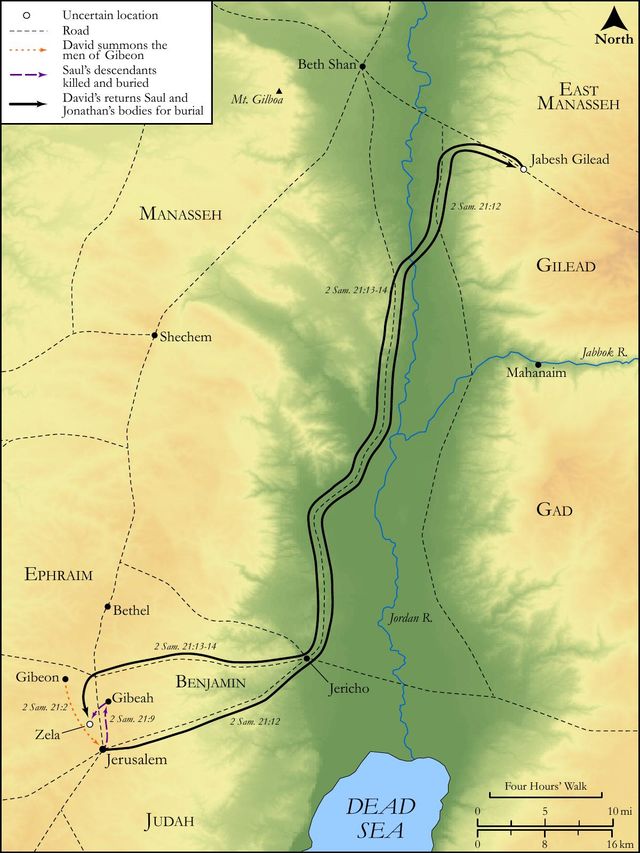
This verse is situated within a critical narrative in 2 Samuel 21, which opens with a severe three-year famine plaguing Israel. David's inquiry of the Lord reveals the famine to be a direct consequence of King Saul's past sin against the Gibeonites, a people with whom Joshua had made a solemn covenant centuries earlier, as recorded in Joshua 9:15. To atone for this breach, the Gibeonites demand the execution of seven of Saul's male descendants, which David grants, notably sparing Mephibosheth, Jonathan's son, due to his own covenant with Jonathan. After these seven are executed, their bodies are left exposed as a public display of judgment. Saul's concubine, Rizpah, performs a remarkable vigil, guarding their bodies from scavengers for months, as detailed in 2 Samuel 21:10. Deeply moved by Rizpah's profound devotion and recognizing the necessity of proper closure and honor for the dead, David initiates the sacred act of gathering the bones mentioned in this verse, bringing them to a proper burial site, which is explicitly stated in 2 Samuel 21:14.
Historical & Cultural Context
In ancient Israel, the proper burial of the dead was of paramount importance, signifying respect, honor, and the dignity of the deceased. Conversely, leaving bodies unburied or exposed was considered a profound disgrace, a sign of divine curse, or extreme judgment, as explicitly outlined in Deuteronomy 21:22-23. The act of "gathering the bones" (ossilegium) for reburial, even years after death, was a practice that demonstrated deep reverence and a desire to restore honor to the deceased and their lineage. This cultural norm underscores the gravity of David's actions: he was not merely disposing of remains but performing a sacred rite that brought spiritual and communal healing. Furthermore, the narrative highlights the sanctity of covenants in ancient Israelite society; a breach, even by a previous king, could have generational consequences and incur divine wrath, necessitating a public and thorough act of atonement to restore communal harmony and divine favor.
Key Themes
ShowHideThis verse is central to several profound themes. Firstly, it underscores Restoration and Atonement, as the proper burial of the dead, particularly those who had suffered a dishonorable death or remained unburied, was a crucial step in appeasing divine wrath and restoring peace to the land. The immediate cessation of the famine following this act, as noted in 2 Samuel 21:14, clearly links the burial to the completion of atonement for Saul's sin. Secondly, it powerfully illustrates Honor and Dignity in Death. Despite the circumstances of their deaths—Saul and Jonathan in battle, the seven descendants by execution—David ensures that all receive a dignified burial. This act transcends personal animosity or the shame of judgment, affirming the inherent value of human life even in death. Finally, David's actions here reflect his Righteous Leadership. He not only facilitated the necessary retribution to uphold divine justice and honor the ancient covenant but also demonstrated profound compassion and reverence by ensuring proper burial for all involved, including his former adversary and his family. This showcases David's nuanced approach to kingship, balancing justice with mercy and spiritual integrity, leading to the healing of the land as promised in 2 Samuel 21:14.
Exposition and Analysis
ShowHideKey Word Analysis
ShowHideThe Hebrew word עֶצֶם (H6106, ʻetsem) literally means "bone" or "skeleton," but it often carries a deeper symbolic weight, representing the very essence or core of a person, or the entire person themselves, as seen in the declaration "bone of my bones" in Genesis 2:23. In the context of burial, "bones" signify the physical remains that, when properly interred, allow the deceased to "rest in peace" and receive honor. The exposure of bones was a profound disgrace and a sign of utter destruction or divine curse, making their proper collection and burial an act of restoration and re-dignification, signifying the integrity of the individual even in death.
The verb עָלָה (H5927, ʻâlâh) means "to ascend," "to bring up," or "to mount." Here, it implies a deliberate and significant journey to retrieve the remains of Saul and Jonathan from Jabesh-Gilead, where they had been honorably buried after their deaths on Mount Gilboa (1 Samuel 31:11-13). This act of "bringing up" signifies David's personal initiative and the elevation of their status, ensuring they would be laid to rest with their family in the ancestral tomb, thereby completing a cycle of honor and reconciliation.
The verb אָסַף (H622, ʼâçaph) means "to gather," "to collect," or "to assemble for any purpose." This term emphasizes the active and intentional collection of the scattered or exposed bones of the seven executed descendants. It highlights the meticulous and reverent nature of the act, ensuring that no remains were left dishonored. This "gathering" was a communal effort, signifying the community's participation in the act of atonement and restoration, removing the disgrace and bringing closure.
Verse Breakdown
ShowHide"And he brought up from thence the bones of Saul and the bones of Jonathan his son;"
This clause highlights King David's personal initiative and leadership in this sacred task. "Thence" refers to Jabesh-Gilead, where the valiant men had previously buried Saul and Jonathan after their deaths in battle (1 Samuel 31:11-13). David's decision to retrieve their bones, even though they had already received a burial, demonstrates his commitment to providing them with a final, unified resting place in their ancestral land, alongside the other members of Saul's family, thus bringing comprehensive closure to the entire affair. This act also underscores David's continued respect for Saul as the Lord's anointed and for his covenant with Jonathan.
"and they gathered the bones of them that were hanged."
This second clause describes the collection of the bones of the seven executed descendants of Saul, whose bodies had been left exposed as a public display of judgment and atonement. The use of "they gathered" suggests a broader, perhaps communal, effort in this part of the task, under David's direction. This act of gathering the remains of those who died a shameful death was crucial for restoring their dignity and completing the ritual of atonement. It ensured that even those who bore the consequences of a past sin would ultimately receive a proper and respectful burial, essential for the healing of the land and the cessation of the famine.
Literary Devices
ShowHideThe verse employs several significant literary devices that enrich its meaning and impact. Symbolism is paramount, with the "bones" representing not merely physical remains but the deceased's dignity, honor, and the very essence of their person. The act of gathering and burying them symbolizes the restoration of honor, the completion of atonement, and the return of peace to the land after a period of divine judgment. The famine itself serves as a powerful symbol of God's displeasure and the brokenness of the covenant. There is a strong sense of Resolution in this verse, as the gathering of the bones marks the final, physical act required to appease God and bring an end to the famine, signaling a turning point in the narrative from divine judgment to divine favor. Furthermore, the verse subtly uses Juxtaposition by mentioning the bones of Saul and Jonathan (who died honorably in battle and were already buried) alongside "the bones of them that were hanged" (who died a shameful, executed death and were exposed). This juxtaposition highlights David's comprehensive compassion and his commitment to bringing dignity and proper burial to all involved in this complex situation, regardless of their past or manner of death.
Theological and Thematic Connections
ShowHideThis passage profoundly illustrates the seriousness with which God views covenants and the far-reaching consequences of their violation. Saul's sin, though generations past, brought a severe famine upon the land, demonstrating the principle of corporate responsibility and the enduring nature of divine justice. David's actions, guided by divine revelation, underscore the necessity of atonement for sin and the importance of ritual purity and proper burial in the ancient Israelite worldview as a means of appeasing God's wrath and restoring communal well-being. It highlights God's demand for justice but also His readiness to bring healing and restoration when proper steps of repentance and atonement are taken. The care for the deceased, even those under divine judgment, reflects a deep theological understanding of human dignity, created in God's image, which extends even beyond physical life.
Reflection and Application
ShowHideThe narrative of 2 Samuel 21:13 serves as a powerful reminder that the consequences of sin, particularly the breaking of sacred covenants, can extend across generations and impact an entire community. It challenges us to consider the long-term ripple effects of our actions and the importance of addressing past wrongs, even if they predate us, for the sake of communal healing and spiritual well-being. David's leadership provides a model of seeking divine wisdom, acting justly, and demonstrating compassion even in difficult circumstances. His meticulous care for the dignity of the dead, regardless of their status or the manner of their demise, calls us to reflect on the inherent value of every human life, created in the image of God, and to treat all individuals with respect, both in life and in death. This passage encourages us to pursue reconciliation, seek closure, and ensure that justice is tempered with mercy, allowing for true restoration and peace in our relationships and communities, ultimately fostering an environment where God's blessing can return.
Questions for Reflection
ShowHideFAQ
ShowHideWhy was it so important to bury the bones of Saul and Jonathan, and the executed descendants, together?
ShowHideThe act of burying all the bones together was crucial for several reasons. For Saul and Jonathan, it was about providing a final, unified, and honorable resting place in their ancestral family tomb in Zela, Benjamin, as explicitly stated in 2 Samuel 21:14. They had initially been buried by the men of Jabesh-Gilead, but David wanted to ensure they were laid to rest with their kin, bringing complete closure to their story. For the seven executed descendants, whose bodies had been left exposed as part of the atonement for Saul's sin, proper burial was essential to restore their dignity and complete the ritual of appeasing God's wrath. In ancient Israel, leaving a body unburied was a profound disgrace and a sign of divine curse (Deuteronomy 21:22-23). By burying them all together, David ensured that the entire family received proper honor in death, signifying comprehensive closure to the famine and the generational sin, and bringing healing to the land.
What was the significance of Rizpah's vigil mentioned earlier in the chapter?
ShowHideRizpah's vigil, detailed in 2 Samuel 21:10, was an extraordinary act of maternal devotion and public lament. For approximately five months, from the beginning of barley harvest until the first rains, she guarded the exposed bodies of her two sons and Saul's five grandsons from scavengers and birds of prey. This vigil was not just an expression of profound grief but a powerful, silent plea for justice and dignity for the deceased. By preventing further desecration of the bodies, Rizpah highlighted the profound dishonor of their unburied state and implicitly appealed to King David to provide a proper burial. Her courageous and public act deeply moved David, prompting him to take the necessary steps to gather all the bones and provide them with a dignified burial, thereby bringing the entire tragic episode to a reverent close and demonstrating a king's compassion in the face of suffering.
Christ-Centered Fulfillment
ShowHideThe narrative of 2 Samuel 21:13, with its focus on atonement, the lifting of a curse, and the restoration of dignity through the burial of the dead, powerfully foreshadows the ultimate work of Jesus Christ. Just as the famine was a consequence of Saul's sin, humanity's spiritual famine and death are the direct result of sin, which brings a curse upon all, as articulated in Galatians 3:10. The Gibeonites' demand for retribution and David's act of gathering the bones served as a temporal atonement to lift a specific curse and restore physical well-being to Israel. However, the true and eternal atonement for the sin of the world is found in Christ. He became a curse for us, "having become a curse for us—for it is written, 'Cursed is everyone who hangs on a tree,'" as proclaimed in Galatians 3:13. Through His crucifixion, Jesus bore the full weight of God's judgment against sin, thereby canceling the record of debt that stood against us, as described in Colossians 2:14. Unlike the exposed bodies of Saul's descendants, Jesus' body, though crucified, was not left to be dishonored; it was honorably taken down and laid in a tomb by Joseph of Arimathea and Nicodemus, a scene beautifully recounted in John 19:38-42. His resurrection on the third day is the ultimate act of restoration, conquering death and ending the curse of sin forever. The "gathering of bones" in 2 Samuel 21:13 points to a physical restoration and peace; Christ's death and resurrection bring about spiritual reconciliation with God, as promised in Romans 5:10, and the promise of eternal life, a far greater and more comprehensive fulfillment of atonement and dignity for all who believe.