


2 Kings 15:26
Bible text: King James Version (1769 Blayney text) · Public domain
Bible text: Berean Standard Bible · Public domain
Bible text: American Standard Version (1901) · Public domain
Bible text: World English Bible, Messianic edition · Public domain
Bible text: Geneva Bible (1599) · Public domain
Bible text: Young's Literal Translation · Public domain
- וְיֶתֶרve·Ye·terand [the] rest ofH3499Conj-w ¦ N-mscNoun Singular Masculine Constructוְandיֶתֶר[the] rest of
- דִּבְרֵיdiv·Rei[the] matters ofH1697N-mpcNoun Plural Masculine Construct
- פְקַחְיָהfe·kach·YahPekahiahH6494N-proper-mNoun Proper Masculine
- וְכָלve·kholand allH3605Conj-w ¦ N-msNoun Singular Masculine Absoluteוְandכָלall
- אֲשֶׁר'a·SherthatH834RelParticle Relative
- עָשָׂה'a·Sahhe didH6213V-Qal-Perf-3msVerb Qal Perfect 3rd Singular Masculine
- הִנָּםhi·Namthere theyH2009Prt ¦ 3mpParticle Interjectionהִנָּthereםthey
- כְּתוּבִיםke·tu·Vim[are] writtenH3789V-Qal-PassPrtcpl-mpVerb Qal Participle Passive Plural Masculine Absolute
- עַל'alonH5921PrepPreposition
- סֵפֶרSe·fer[the] scroll ofH5612N-mscNoun Singular Masculine Construct
- דִּבְרֵיdiv·Rei[the] matters ofH1697N-mpcNoun Title Plural Masculine Construct
- הַיָּמִיםhai·ya·Mimthe daysH3117Art ¦ N-mpNoun Plural Masculine Absoluteהַtheיָּמִיםdays
- לְמַלְכֵיle·mal·Kheiof [the] kings ofH4428Prep-l ¦ N-mpcNoun Plural Masculine Constructלְofמַלְכֵי[the] kings of
- יִשְׂרָאֵלYis·ra·'ElIsraelH3478N-properNoun Proper Location
English is a literal word-by-word gloss of the Hebrew, not the KJV's wording. Why?
This is the original text the KJV's translators worked from — each Hebrew word with its own literal English meaning in this verse, prepared by scholars at Tyndale House, Cambridge. The KJV translates whole sentences, not word by word, so its wording differs: one Hebrew word can become several English words, and the KJV may choose “the LORD” where the gloss reads “Yahweh”. Both are faithful — they answer different questions. For the KJV's own rendering, switch to the KJV text.
Details
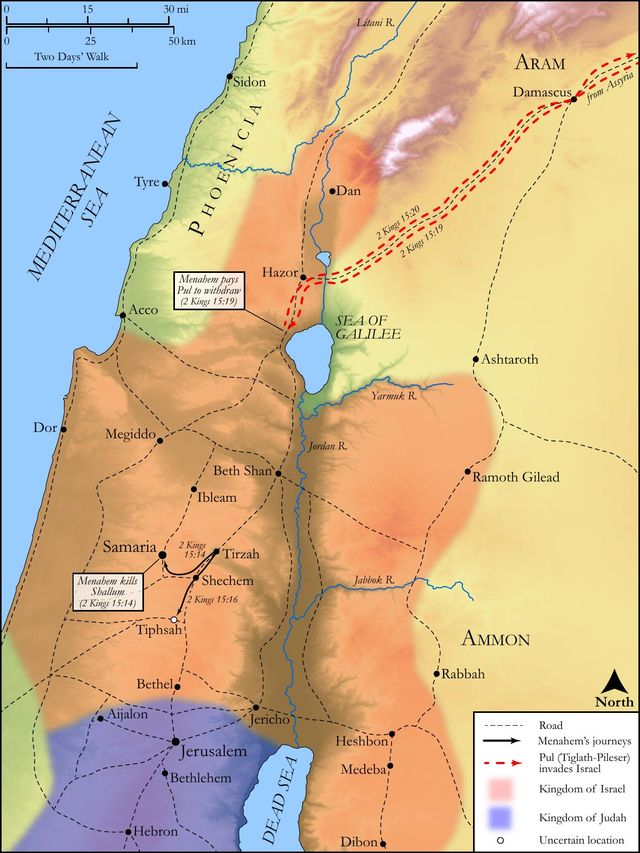
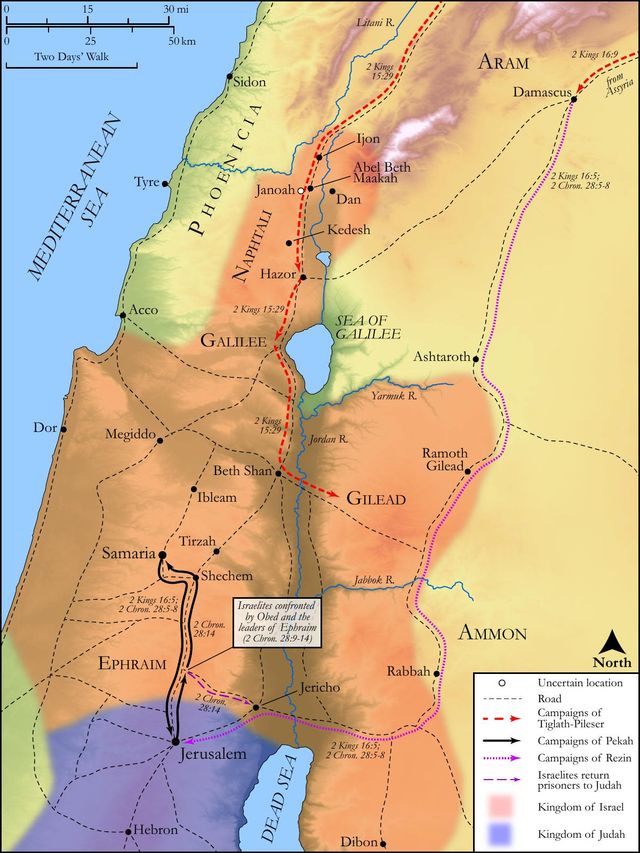
See on the biblical-era maps
Study this verse
Public-domain commentary
Matthew Henry
From his Commentary on the Whole Bible. Henry comments on passages, not single verses — this entry covers 2 Kings 15:8–31. His three-level outline is real structure in the source text, so it is rendered as structure.
The best days of the kingdom of Israel were while the government was in Jehu's family. In his reign, and the next three reigns, though there were many abominable corruptions and miserable grievances in Israel, yet the crown went in succession, the kings died in their beds, and some care was taken of public affairs; but, now that those days are at an end, the history which we have in these verses of about thirty-three years represents the affairs of that kingdom in the utmost confusion imaginable. Woe to those that were with child (Kg2 15:16) and to those that gave suck in those days, for then must needs be great tribulations, when, for the transgression of the land, many were the princes thereof.
I.Let us observe something, in general, concerning these unhappy revolutions and the calamities which must needs attend them - these bad times, as they may truly be called.
1.God had tried the people of Israel both with judgments and mercies, explained and enforced by his servants the prophets, and yet they continued impenitent and unreformed, and therefore God justly brought these miseries upon them, as Moses had warned them. If you will yet walk contrary to me, I will punish you yet seven times more, Lev 26:21, etc.
2.God made good his promise to Jehu, that his sons to the fourth generation after him should sit upon the throne of Israel, which was a greater favour than was shown to any of the royal families either before or after his. God had said it should be so (Kg2 10:30) and we are told in this chapter (Kg2 15:12) that so it came to pass. See how punctual God is to his promises. These calamities God long designed for Israel, and they deserved them, yet they were not inflicted till that word had taken effect to the full. Thus God rewarded Jehu for his zeal in destroying the worship of Baal and the house of Ahab; and yet, when the measure of the sins of the house of Jehu was full, God avenged upon it the blood then shed, called the blood of Jezreel, Hos 1:4.
3.All these kings did that which was evil in the sight of the Lord, for they walked in the sins of Jeroboam the son of Nebat. Though at variance with one another, yet in this they agreed, to keep up idolatry, and the people loved to have it so; though they were emptied from vessel to vessel, that taste remained in them, and that scent was not changed. It was sad indeed when their government was so often altered, yet never for the better - that among all those contending interests none of them should think it as much their interest to destroy the calves as others had done to support them.
4.Each of these (except one) conspired against his predecessor, and slew him - Shallum, Menahem, Pekah, and Hoshea, all traitors and murderers, and yet all kings awhile, one of them ten, another twenty, and another nine years; for God may suffer wickedness to prosper and to carry away the wealth and honours awhile, but, sooner or later, blood shall have blood, and he that dealt treacherously shalt be dealt treacherously with. One wicked man is often made a scourge to another, and every wicked man, at length, a ruin to himself.
5.The ambition of the great men made the nation miserable. Here is Tiphsah, a city of Israel, barbarously destroyed, with all the coasts thereof, by one of these pretenders (Kg2 15:16), and no doubt it was through blood that each of them waded to the throne, nor could any of these kings perish alone. No land can have greater pests, nor Israel worse troubles, than such men as care not how much the welfare and repose of their country are sacrificed to their revenge and affectation of dominion.
6.While the nation was thus shattered by divisions at home the kings of Assyria, first one (Kg2 15:19) and then another (Kg2 15:29), came against it and did what they pleased. Nothing does more towards the making of a nation an easy prey to a common enemy than intestine broils and contests for the sovereignty. Happy the land where that is settled.
7.This was the condition of Israel just before they were quite ruined and carried away captive, for that was in the ninth year of Hoshea, the last of these usurpers. If they had, in these days of confusion and perplexity, humbled themselves before God and sought his face, that final destruction might have been prevented; but when God judgeth he will overcome. These factions, the fruit of an evil spirit sent among them, hastened that captivity, for a kingdom thus divided against itself will soon come to desolation.
II.Let us take a short view of the particular reigns.
1.Zachariah, the son of Jeroboam, began to reign in the thirty-eighth year of Azariah, or Uzziah, king of Judah, Kg2 15:8. Some of the most critical chronologers reckon that between Jeroboam and his son Zachariah the throne was vacant twenty-two years, others eleven years, through the disturbances and dissensions that were in the kingdom; and then it was not strange that Zachariah was deposed before he was well seated on the throne: he reigned but six months, and then Shallum slew him before the people, perhaps as Caesar was slain in the senate, or he put him to death publicly as a criminal, with the approbation of the people, to whom he had, some way or other, made himself odious; so ended the line of Jehu.
2.But had Shallum peace, who slew his master? No, he had not (Kg2 15:13), one month of days measured his reign and then he was cut off; perhaps to this the prophet, who then lived, refers (Hos 5:7), Now shall a month devour them with their portions. That dominion seldom lasts long which is founded in blood and falsehood. Menahem, either provoked by his crime or animated by his example, soon served him as he had served his master - slew him and reigned in his stead, Kg2 15:14. Probably he was general in the army, which then lay encamped at Tirzah, and, hearing of Shallum's treason and usurpation, hastened to punish it, as Omri did that of Zimri in a like case, Kg1 16:17.
3.Menahem held the kingdom ten years, Kg2 15:17. But, whereas we have heard that the kings of the house of Israel were merciful kings (Kg1 20:31), this Menahem (the scandal of his country) was so prodigiously cruel to those of his own nation who hesitated a little at submitting to him that he not only ruined a city, and the coasts thereof, but, forgetting that he himself was born of a woman, ripped up all the women with child, Kg2 15:16. We may well wonder that ever it should enter into the heart of any man to be so barbarous, and to be so perfectly lost to humanity itself. By these cruel methods he hoped to strengthen himself and to frighten all others into his interests; but it seems he did not gain his point, for when the king of Assyria came against him,
(1.)So little confidence had he in his people that he durst not meet him as an enemy, but was obliged, at a vast expense, to purchase a peace with him.
(2.)Such need had he of help to confirm the kingdom in his hand that he made it part of his bargain with him (a bargain which, no doubt, the king of Assyria knew how to make a good hand of another time) that he should assist him against his own subjects that were disaffected to him. The money wherewith he purchased his friendship was a vast sum, no less than 1000 talents of silver (Kg2 15:19), which Menahem exacted, it is probable, by military execution, of all the mighty men of wealth, very considerately sparing the poor, and laying the burden (as was fit) on those that were best able to bear it; being raised, it was given to the king of Assyria, as pay for his army, fifty shekels of silver for each man in it. Thus he got clear of the king of Assyria for this time; he staid not to quarter in the land (Kg2 15:20), but his army now got so rich a booty with so little trouble that it encouraged them to come again, not long after, when they laid all waste. Thus was he the betrayer of his country that should have been the protector of it.
4.Pekahiah, the son of Menahem, succeeded his father, but reigned only two years, and then was treacherously slain by Pekah, falling under the load both of his own and of his father's wickedness. It is repeated concerning him as before that he departed not from the sins of Jeroboam. Still this is mentioned, to show that God was righteous in bringing that destruction upon them which came not long after, because they hated to be reformed, Kg2 15:24. Pekah, it seems, had some persons of figure in his interest, two of whom are here named (Kg2 15:25), and with their help he compassed his design.
5.Pekah, though he got the kingdom by treason, kept it twenty years (Kg2 15:27), so long it was before his violent dealing returned upon his own head, but it returned at last. This Pekah, son of Remaliah,
(1.)Made himself more considerable abroad than any of these usurpers, for he was, even in the latter end of his time (in the reign of Ahaz, which began in his seventeenth year), a great terror to the kingdom of Judah, as we find, Isa 7:1, etc.
(2.)He lost a great part of his kingdom to the king of Assyria. Several cities are here named (Kg2 15:29) which were taken from him, all the land of Gilead on the other side Jordan, and Galilee in the north containing the tribes of Naphtali and Zebulon, were seized, and the inhabitants carried captive into Assyria. By this judgment God punished him for his attempt upon Judah and Jerusalem. It was then foretold that within two or three years after he made that attempt, before a child, then born, should be able to cry My father and my mother, the riches of Samaria should be taken away before the king of Assyria (Isa 8:4), and here we have the accomplishment of that prediction.
(3.)Soon after this he forfeited his life to the resentments of his countrymen, who, it is probable, were disgusted at him for leaving them exposed to a foreign enemy, while he was invading Judah, of which Hoshea took advantage and, to gain his crown, seized his life, slew him, and reigned in his stead. Surely he was fond of a crown indeed who, at this time, would run such a hazard as a traitor did; for the crown of Israel, now that it had lost the choicest of its flowers and jewels, was lined more than ever with thorns, had of late been fatal to all the heads that had worn it, was forfeited to divine justice, and now ready to be laid in the dust - a crown which a wise man would not have taken up in the street, yet Hoshea not only ventured upon it but ventured for it, and it cost him dear.
Continue studying 2 Kings 15:26 across the web’s major study libraries — every link below opens this exact verse, chapter, or book on the destination site.
Read & Compare
 BibleGatewayThis verse in more than 200 translations and 70 languages.
 Bible.comThe YouVersion reader — hundreds of translations, reading plans, and highlights.
 ESV.orgCrossway's official English Standard Version reader.
 NET BibleThe NET translation with 60,000+ translators' notes on every rendering decision.
 STEP BibleTyndale House's free study tool — original text, vocabulary, and scholarly resources.
 BibliaLogos Bible Software's free web reader.
 USCCBThe New American Bible (Revised Edition) with the U.S. bishops' study notes.
Commentaries
 BibleHub CommentariesDozens of classic commentaries on this verse, gathered on one page.
 StudyLightMore than 100 commentary sets — the largest collection on the web.
 BibleRefPlain-English commentary on what this verse means, verse by verse.
 Enduring WordDavid Guzik's free commentary on this chapter, widely used by Bible teachers.
 Bible Study ToolsVerse commentary alongside Greek and Hebrew study aids.
Original Language & Research
- BibleHub InterlinearThe verse word by word — original language, transliteration, and English.
- BibleHub LexiconEvery word's original-language definition and Strong's entry.
 Blue Letter BibleDeep-study tools — Strong's numbers, concordance, and word studies.
 SefariaThe Hebrew text with Rashi and centuries of Jewish commentary.
Sermons, Hymns & Audio


TrulyRandomVerse is not affiliated with these sites and doesn’t control their content. They’re linked because they’re genuinely useful.
Summary
This verse functions as the standard concluding formula for the brief and tumultuous reign of Pekahiah, the seventeenth king of Israel (the Northern Kingdom). It indicates that the comprehensive details of his two-year rule, including all his actions and administrative affairs, were officially recorded in an external, non-biblical historical document known as "the book of the chronicles of the kings of Israel." This formula highlights the selective nature of the biblical narrative, which prioritizes theological and spiritual lessons over exhaustive historical accounts, while simultaneously affirming the historical grounding and verifiability of the events described within the sacred text.
Context
ShowHideLiterary Context
2 Kings 15:26 serves as the concluding statement for Pekahiah's reign, immediately following the account of his assassination by Pekah, one of his own captains, who subsequently seized the throne. This formulaic closing, "And the rest of the acts of [King's Name], and all that he did, behold, they [are] written in the book of the chronicles of the kings of Israel/Judah," is a pervasive literary device throughout the books of Kings. Its consistent repetition marks the end of a king's narrative segment, signals a transition to the next ruler, and directs the reader to a more comprehensive, external historical record for additional details. This recurring pattern establishes a predictable narrative rhythm and underscores the biblical author's deliberate focus on the spiritual and covenantal implications of each king's rule, rather than providing an exhaustive historical biography. The brevity of Pekahiah's narrative, mirroring his short reign, emphasizes the instability of the Northern Kingdom's monarchy, a stark contrast to the more stable (though still flawed) Davidic line in Judah.
Historical & Cultural Context
Pekahiah's brief and violent reign (c. 742-740 BC) occurred during a period of profound political instability, moral decay, and rapid succession of kings in the Northern Kingdom of Israel. Following the relatively prosperous but spiritually compromised reign of Jeroboam II, Israel experienced a series of coups and assassinations, reflecting the nation's deep-seated idolatry and consistent departure from the Mosaic covenant. The powerful Assyrian Empire was an increasingly dominant and menacing force among the nations, frequently demanding tribute and intervening in the affairs of smaller states like Israel, further contributing to regional instability. The "book of the chronicles of the kings of Israel" refers to official state annals or royal records meticulously maintained by the Israelite monarchy. Such chronicles were a common practice in the kingdoms of that day, serving to document the reigns, military campaigns, administrative activities, and significant events of their rulers. These state records were distinct from the later theological histories compiled in the biblical books of 1 Chronicles and 2 Chronicles.
Key Themes
ShowHideThough a formulaic statement, this verse contributes to several significant themes within the book of Kings. Firstly, it highlights the formulaic nature of biblical historiography, emphasizing that the sacred text is not a comprehensive secular history but a theologically driven narrative, selectively presenting events to convey divine truth. Secondly, it subtly points to divine sovereignty amidst human chaos; despite the rampant political turmoil, assassinations, and rapid succession of kings in Israel, the biblical record consistently frames these events within God's overarching plan and judgment, often as a direct consequence of national sin and disobedience to the Mosaic covenant. Pekahiah's two-year reign, ending in violent overthrow, powerfully illustrates the fleeting nature of earthly power and the precariousness of human authority without divine blessing. This serves as a potent reminder of the impermanence of worldly glory, a theme echoed in wisdom literature such as Psalm 146:3-4. Finally, the reference to external records subtly underscores the historicity of the biblical narrative, grounding its theological claims in verifiable (though now lost) historical accounts.
Exposition and Analysis
ShowHideKey Word Analysis
ShowHideMeaning "an overhanging, i.e. (by implication) an excess, superiority, remainder." In this context, "the rest" refers to the remaining, unrecorded details or the full scope of Pekahiah's actions and reign that are not explicitly detailed in the biblical narrative. It implies that the biblical account is a condensed summary, not an exhaustive historical record, and that more information existed elsewhere.
Meaning "a word; by implication, a matter (as spoken of) or thing." Here, it refers to the "deeds," "affairs," or "events" of a king's reign. In the phrase "the rest of the acts," it encompasses all the unrecorded details of his administration, military campaigns, building projects, and general conduct that the biblical author chose not to include. It emphasizes the comprehensive nature of the external records compared to the selective biblical account.
A primitive root meaning "to grave, by implication, to write (describe, inscribe, prescribe, subscribe)." This word confirms that the "acts" were formally documented and preserved in a written format. The use of the passive voice ("are written") highlights the established fact of their recording and their existence as a verifiable historical source, lending credibility to the biblical author's selective narrative.
Verse Breakdown
ShowHide"And the rest of the acts of Pekahiah, and all that he did"
This opening clause serves as a comprehensive summary reference to the entirety of Pekahiah's brief two-year reign. It acknowledges that the biblical text provides only a condensed account, implying that numerous other actions, decisions, and events occurred during his time as king that are not detailed within the sacred narrative. The phrase "all that he did" further emphasizes the totality of his activities, both public and private, known and unknown to the immediate biblical reader.
"behold, they [are] written"
This declarative statement powerfully asserts the existence and accessibility of these additional records. The interjection "behold" (Hebrew, hinnēh) functions as an attention-grabber, drawing the reader's focus to the certainty and verifiability of the information. It serves as a historical validation, assuring the audience that the biblical account is not fabricated but is grounded in and supported by external, official documentation, even if those specific sources are no longer extant.
"in the book of the chronicles of the kings of Israel"
This final clause precisely specifies the location of these supplementary records. It refers to a specific, official state archive maintained by the Northern Kingdom of Israel. This "book of the chronicles" was a contemporaneous historical record, distinct from the later biblical books of Chronicles, and served as the primary source for many of the historical facts presented in 1 and 2 Kings. Its mention underscores the historicity of the biblical narrative while simultaneously highlighting the biblical author's theological agenda, as they chose to extract only those details relevant to God's covenant and purposes.
Literary Devices
ShowHideThe primary literary device at play in 2 Kings 15:26 is the Formulaic Closing or Colophon. This highly repetitive phrase, consistently found at the conclusion of nearly every king's reign in 1 and 2 Kings, serves as a crucial structural marker. It provides narrative closure for one king's story, signals the transition to the next ruler, and functions as an Allusion to an external, non-extant historical source. This allusion implies that the biblical account is not exhaustive but is a selective, theologically driven narrative, drawing upon broader historical records. This Selectivity is itself a profound literary and theological choice, emphasizing that the biblical author's primary goal is not to provide a comprehensive political history, but to convey spiritual truths about God's interaction with His people, particularly concerning their obedience or disobedience to the covenant. The consistent repetition of this formula also creates a sense of Rhythm and predictability within the historical narrative, subtly reinforcing the idea of a divinely ordered, though often chaotic, succession of rulers, all operating under God's ultimate oversight.
Theological and Thematic Connections
ShowHideThe formulaic statement in 2 Kings 15:26, though seemingly mundane, carries significant theological weight. It affirms the historicity of the biblical narrative by pointing to external, verifiable records, thereby grounding its spiritual lessons in real-world events. Yet, by consistently referring to these "chronicles" rather than reproducing them in full, the biblical author subtly communicates that God's Word is not merely a historical ledger but a divinely inspired interpretation of history, focusing on the moral and spiritual implications of human actions and divine judgment. This highlights the transient nature of human power and the ultimate accountability of all rulers before God. While earthly kings rise and fall, and their detailed histories fade into obscurity, God's sovereign plan unfolds consistently, and His Word endures as the ultimate interpretive framework for all history.
Reflection and Application
ShowHide2 Kings 15:26, despite its brevity and formulaic nature, offers profound insights for contemporary readers. It serves as a powerful reminder that every life, and especially every period of leadership, leaves a record, whether in human annals or, more importantly, in the divine ledger. The biblical author's deliberate selectivity in detailing Pekahiah's reign, focusing only on its brevity and violent end, underscores that what truly matters in God's eyes is not the quantity of "acts" or the length of one's tenure, but their quality and alignment with His covenant and purposes. This calls us to consider the enduring legacy of our own lives and actions, recognizing that true significance is found not in worldly power, fleeting accomplishments, or the accolades of others, but in faithfulness to God and obedience to His will. It also reinforces the timeless truth that while human kingdoms are inherently unstable and their records perishable, God's kingdom is eternal, and His Word, which interprets and transcends all human history, remains forever as our ultimate guide and source of truth.
Questions for Reflection
ShowHideFAQ
ShowHideWhat was the "book of the chronicles of the kings of Israel" mentioned in this verse?
ShowHideThe "book of the chronicles of the kings of Israel" was an official, non-biblical state archive or royal annals maintained by the Northern Kingdom of Israel. It contained detailed historical records of the reigns of its kings, including administrative decisions, military campaigns, building projects, and other significant events. These chronicles were distinct from the biblical books of 1 Chronicles and 2 Chronicles, which were later theological histories written from a different, divinely inspired perspective, primarily focusing on the Davidic line and the Southern Kingdom of Judah. The repeated mention of these external records in the books of Kings serves to affirm the historical grounding and verifiability of the biblical narrative, indicating that the biblical authors drew upon existing historical sources.
Why does the Bible frequently refer to external books like this instead of providing all the details itself?
ShowHideThe biblical authors frequently refer to these external chronicles (e.g., 1 Kings 14:19 for Jeroboam, 2 Kings 1:18 for Ahaziah) for several key reasons. Firstly, it provides a crucial historical validation, assuring the reader that the events recounted are rooted in verifiable historical accounts and are not merely fictional narratives. Secondly, and perhaps more importantly, it highlights the biblical text's selective nature and its unique purpose. The goal of the books of Kings is not to provide an exhaustive secular history but to offer a theological history, interpreting events through the lens of God's covenant with Israel. The authors chose to include only those details relevant to God's interaction with His people, their obedience or disobedience to His commands, and the resulting divine consequences, leaving other political or administrative details to the official state records. This divine selectivity underscores the spiritual and moral lessons God intends to convey to His people across generations.
Christ-Centered Fulfillment
ShowHideThe recurring formula of 2 Kings 15:26, marking the end of yet another transient, often unrighteous, king's reign in Israel, powerfully foreshadows the ultimate and eternal reign of Jesus Christ. The "book of the chronicles of the kings of Israel" recorded the fleeting "acts" of human rulers whose power was precarious and whose reigns often ended in violence and instability, reflecting the brokenness of a world under the curse of sin. These earthly chronicles, now lost to history, stand in stark contrast to the eternal "chronicles" of God's redemptive plan, culminating in the person and work of Jesus. While Pekahiah's reign was brief and his legacy one of continued decline, Jesus, the true King of Kings and Lord of Lords, establishes a kingdom that is not of this world and will never end (John 18:36). His "acts" were not merely recorded in human annals but were the very acts of God incarnate—healing the sick, casting out demons, and ultimately offering Himself as the perfect, once-for-all sacrifice for sin (Hebrews 9:26). The instability and moral decay of Israel's monarchy, so evident in Pekahiah's time, underscore humanity's desperate need for a perfect, righteous ruler whose reign brings true peace and justice, a need perfectly met in the Messiah. Jesus is the fulfillment of all the promises to David, the King whose kingdom is everlasting and whose "chronicles" are written not in perishable scrolls, but in the hearts of those He redeems and in the eternal counsels of God (Luke 1:32-33).