


2 Corinthians 8:7
Bible text: King James Version (1769 Blayney text) · Public domain
Bible text: King James Version with Strong's numbers · Public domain
Bible text: Berean Standard Bible · Public domain
Bible text: American Standard Version (1901) · Public domain
Bible text: World English Bible, Messianic edition · Public domain
Bible text: Geneva Bible (1599) · Public domain
Bible text: Young's Literal Translation · Public domain
- ἀλλ᾽all᾽ButG235CONJConjunction
- ὥσπερhōspereven asG5618CONJConjunction
- ἐνeninG1722PREPPreposition
- παντὶpantievery [way]G3956A-DSNAdjective Dative Singular Neuter
- περισσεύετεperisseueteyou aboundG4052V-PAI-2PVerb Present Active Indicative 2nd Plural
- πίστειpisteiin faithG4102N-DSFNoun Dative Singular Feminine
- καὶkaiandG2532CONJConjunction
- λόγῳlogōin speechG3056N-DSMNoun Dative Singular Masculine
- καὶkaiandG2532CONJConjunction
- γνώσειgnōseiin knowledgeG1108N-DSFNoun Dative Singular Feminine
- καὶkaiandG2532CONJConjunction
- πάσῃpasēin allG3956A-DSFAdjective Dative Singular Feminine
- σπουδῇspoudēaearnestnessG4710N-DSFNoun Dative Singular Feminine
- καὶkaiandG2532CONJConjunction
- τῇtēain theG3588T-DSFDefinite article Dative Singular Feminine
- ἐξexfromG1537PREPPreposition
- ἡμῶνhēmōnof usG3165P-1GPPersonal pronoun Genitive 1st Plural
- ἐνeninG1722PREPPreposition
- ὑμῖνhuminyouG4771P-2DPPersonal pronoun Dative 2nd Plural
- ἀγάπῃagapēloveG26N-DSFNoun Dative Singular Feminine
- ἵναinathatG2443CONJConjunction
- καὶkaialsoG2532CONJConjunction
- ἐνeninG1722PREPPreposition
- ταύτῃtautēthisG3778D-DSFDemonstrative pronoun Dative Singular Feminine
- τῇtēa<the>G3588T-DSFDefinite article Dative Singular Feminine
- χάριτιcharitigraceG5485N-DSFNoun Dative Singular Feminine
- περισσεύητεperisseuēteyou may aboundG4052V-PAS-2PVerb Present Active Subjunctive 2nd Plural
English is a literal word-by-word gloss of the Greek, not the KJV's wording. Why?
This is the original text the KJV's translators worked from — each Greek word with its own literal English meaning in this verse, prepared by scholars at Tyndale House, Cambridge. The KJV translates whole sentences, not word by word, so its wording differs: one Greek word can become several English words, and the KJV may choose “charity” where the gloss reads “love”. Both are faithful — they answer different questions. For the KJV's own rendering, switch to the KJV text.
Details
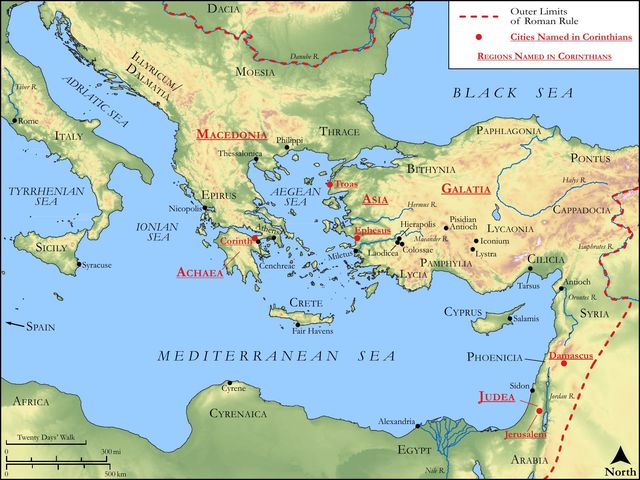
See on the biblical-era maps

Study this verse
Public-domain commentary
Matthew Henry
From his Commentary on the Whole Bible. Henry comments on passages, not single verses — this entry covers 2 Corinthians 8:7–15. His two-level outline is real structure in the source text, so it is rendered as structure.
In these verses the apostle uses several cogent arguments to stir up the Corinthians to this good work of charity.
I.He urges upon them the consideration of their eminence in other gifts and graces, and would have them excel in this of charity also, Co2 8:7. Great address and much holy art are here used by the apostle. When he would persuade the Corinthians to this good thing, he commends them for other good things that were found in them. Most people love to be complimented, especially when we ask a gift of them for ourselves or others; and it is a justice we owe to those in whom God's grace shines to give them their due commendation. Observe here, What it was that the Corinthians abounded in. Faith is mentioned first, for that is the root; and, as without faith it is impossible to please God (Heb 11:6), so those who abound in faith will abound in other graces and good works also; and this will work and show itself by love. To their faith was added utterance, which is an excellent gift, and redounds much to the glory of God and the good of the church. Many have faith who want utterance. But these Corinthians excelled most churches in spiritual gifts, and particularly in utterance; and yet this was not in them, as in too many, both the effect and evidence of ignorance; for with their utterance there appeared knowledge, abundance of knowledge. They had a treasury of things new and old, and in their utterance they brought out of this treasury. They abounded also in all diligence. Those who have great knowledge and ready utterance are not always the most diligent Christians. Great talkers are not always the best doers; but these Corinthians were diligent to do, as well as know and talk, well. And further, they had abundant love to their minister; and were not like too many, who, having gifts of their own, are but too apt to slight their ministers, and neglect them. Now to all these good things the apostle desires them to add this grace also, to abound in charity to the poor; that, where so much good was found, there should be found yet more good. Before the apostle proceeds to another argument he takes care to prevent any misapprehensions of his design to impose on them, or to bind heavy burdens upon them by his authority; and tells them (Co2 8:8) he does not speak by commandment, or in a way of authority. I give my advice, Co2 8:10. He took occasion from the forwardness of others to propose what would be expedient for them, and would prove the sincerity of their love, or be the genuine effect and evidence thereof. Note, A great difference should be made between plain and positive duty, and the improvement of a present opportunity of doing or getting good. Many a thing which is good for us to do, yet can not be said to be, by express and indispensable commandment, our duty at this or that time.
II.Another argument is taken from the consideration of the grace of our Lord Jesus Christ.
The best arguments for Christian duties are those that are taken from the love of Christ, that constraineth us. The example of the churches of Macedonia was such as the Corinthians should imitate; but the example of our Lord Jesus Christ should have much greater influence. And you know, saith the apostle, the grace of our Lord Jesus Christ (Co2 8:9), that though he was rich, as being God, equal in power and glory with the Father, rich in all the glory and blessedness of the upper world, yet for your sakes he became poor; not only did become man for us, but he became poor also. He was born in poor circumstances, lived a poor life, and died in poverty; and this was for our sakes, that we thereby might be made rich, rich in the love and favour of God, rich in the blessings and promises of the new covenant, rich in the hopes of eternal life, being heirs of the kingdom. This is a good reason why we should be charitable to the poor out of what we have, because we ourselves live upon the charity of the Lord Jesus Christ.
III.Another argument is taken from their good purposes, and their forwardness to begin this good work. As to this he tells them,
1.It was expedient for them to perform what they purposed, and finish what they had begun, Co2 8:10, Co2 8:11. What else did their good purposes and good beginnings signify? Good purposes, indeed, are good things; they are like buds and blossoms, pleasant to behold, and give hopes of good fruit; but they are lost, and signify nothing, without performances. So good beginnings are amiable; but we shall lose the benefit unless there be perseverance, and we bring forth fruit to perfection. Seeing therefore the Corinthians had shown a readiness to will, he would have them be careful also in the performance, according to their ability. For,
2.This would be acceptable to God. This willing mind is accepted (Co2 8:12), when accompanied with sincere endeavours. When men purpose that which is good, and endeavour, according to their ability, to perform also, God will accept of what they have, or can do, and not reject them for what they have not, and what is not in their power to do: and this is true as to other things besides the work of charity. But let us note here that this scripture will by no means justify those who think good meanings are enough, or that good purposes, and the profession of a willing mind, are sufficient to save them. It is accepted, indeed, where there is a performance as far as we are able, and when Providence hinders the performance, as in David's case concerning building a house for the Lord, 2 Sa. 7.
IV.Another argument is taken from the discrimination which the divine Providence makes in the distribution of the things of this world, and the mutability of human affairs, Co2 8:13-15. The force of the arguing seems to be this: - Providence gives to some more of the good things of this world, and to some less, and that with this design, that those who have a greater abundance may supply those who are in want, that there may be room for charity. And further, considering the mutability of human affairs, and how soon there may be an alteration, so that those who now have an abundance may stand in need of being supplied themselves in their wants, this should induce them to be charitable while they are able. It is the will of God that, by our mutually supplying one another, there should be some sort of equality; not an absolute equality indeed, or such a levelling as would destroy property, for in such a case there could be no exercise of charity. But as in works of charity there should be an equitable proportion observed, that the burden should not lie too heavy on some, while others are wholly eased, so all should think themselves concerned to supply those who are in want. This is illustrated by the instance of gathering and distributing manna in the wilderness, concerning which (as we may read, Ex. 16) it was the duty of every family, and all in the family, to gather what they could, which, when it was gathered, was put into some common receptacle for each family, whence the master of the family distributed to every one as he had occasion, to some more than they were able, through age and infirmity, to gather up; to others less than they gathered, because they did not need so much: and thus he that had gathered much (more than he had occasion for) had nothing over, when a communication was made to him that had gathered little, who by this method had no lack. Note, Such is the condition of men in this world that we mutually depend on one another, and should help one another. Those who have ever so much of this world have no more than food and raiment; and those who have but a little of this world seldom want these; nor, indeed, should those who have abundance suffer others to want, but be ready to afford supply.
Historical interpretation
Historical reception
2 surviving comments on this verse. Each one is dated, so this reads as a timeline rather than a list.
Select a marker to jump to its quote. Markers stagger vertically where authors wrote within a few decades of each other.
Paul is exhorting the Corinthians to take pride in these things in the sight of the other churches, for if they are keen to minister to the saints it is proof that they have mended their ways. Commentary on Paul’s Epistles.
See again his exhortation accompanied with commendations, greater commendations. And he said not, 'that ye give,' but "that ye abound; in faith," namely, of the gifts, and "in utterance," the word of wisdom, and "knowledge," namely, of the doctrines, and "in all earnestness," to the attaining of all other virtue.
"And in your love," that, namely of which I have before spoken, of which I have also made proof.
"That ye may abound in this grace also." Seest thou that for this reason it was that he began by those praises, that advancing forward he might draw them on to the same diligence in these things also.
Continue studying 2 Corinthians 8:7 across the web’s major study libraries — every link below opens this exact verse, chapter, or book on the destination site.
Read & Compare
 BibleGatewayThis verse in more than 200 translations and 70 languages.
 Bible.comThe YouVersion reader — hundreds of translations, reading plans, and highlights.
 ESV.orgCrossway's official English Standard Version reader.
 NET BibleThe NET translation with 60,000+ translators' notes on every rendering decision.
 STEP BibleTyndale House's free study tool — original text, vocabulary, and scholarly resources.
 BibliaLogos Bible Software's free web reader.
 USCCBThe New American Bible (Revised Edition) with the U.S. bishops' study notes.
Commentaries
 BibleHub CommentariesDozens of classic commentaries on this verse, gathered on one page.
 StudyLightMore than 100 commentary sets — the largest collection on the web.
 BibleRefPlain-English commentary on what this verse means, verse by verse.
 Enduring WordDavid Guzik's free commentary on this chapter, widely used by Bible teachers.
 Bible Study ToolsVerse commentary alongside Greek and Hebrew study aids.
Original Language & Research
- BibleHub InterlinearThe verse word by word — original language, transliteration, and English.
- BibleHub LexiconEvery word's original-language definition and Strong's entry.
 Blue Letter BibleDeep-study tools — Strong's numbers, concordance, and word studies.
 CNTR CollationThe earliest Greek manuscripts of this verse, collated letter by letter.
Sermons, Hymns & Audio


TrulyRandomVerse is not affiliated with these sites and doesn’t control their content. They’re linked because they’re genuinely useful.
Summary
In 2 Corinthians 8:7, the Apostle Paul commends the Corinthian believers for their existing spiritual strengths and virtues, including their faith, eloquence, knowledge, diligence, and love for him and his ministry. Building on this foundation of excellence, Paul exhorts them to extend their spiritual abundance to the practical realm of generous giving, urging them to "abound in this grace also." This verse serves as a pivotal call to holistic Christian maturity, emphasizing that spiritual giftedness and theological understanding should naturally manifest in tangible acts of sacrificial love and liberality, particularly in support of the impoverished saints in Jerusalem.
Context
ShowHideLiterary Context
This verse is strategically placed within Paul's extensive appeal to the Corinthian church concerning the collection for the poor saints in Jerusalem, spanning chapters 8 and 9 of his second epistle. Paul initiates this discussion by highlighting the extraordinary generosity of the Macedonian churches, who, despite their own severe poverty, gave beyond their means, demonstrating a profound overflow of joy and grace (2 Corinthians 8:1-5). He presents their example not as a legalistic demand but as an invitation to participate in a divine work of grace. Paul then introduces Titus, whom he has sent to Corinth to help facilitate this collection, underscoring the importance of their participation (2 Corinthians 8:6). Verse 7, therefore, acts as a direct exhortation, leveraging their acknowledged spiritual strengths as a springboard for growth in the specific area of financial giving, framing it as another manifestation of God's grace.
Historical & Cultural Context
The collection for the Jerusalem saints was a significant undertaking for Paul, symbolizing the unity between the Gentile and Jewish believers and providing practical relief to a community suffering from famine and poverty (Romans 15:25-27). The Corinthian church, situated in a wealthy Roman provincial capital, was known for its intellectualism, spiritual gifts, and sometimes, its internal divisions and moral issues (1 Corinthians 1:10-12 and 1 Corinthians 1:5). Paul's challenge to them was not merely about raising funds, but about cultivating a spirit of generous love that would transcend their intellectual and spiritual pride, demonstrating their genuine commitment to Christ and their fellow believers. The act of giving was a tangible expression of their unity in the Body of Christ, bridging geographical and cultural divides.
Key Themes
ShowHideThe overarching theme in this passage, and particularly in 2 Corinthians 8, is the Grace of Giving. Paul consistently presents giving not as a burdensome obligation but as a divine enablement and a spiritual privilege, a manifestation of God's unmerited favor at work in believers. He emphasizes that true generosity flows from a heart transformed by grace, mirroring the ultimate grace of Christ's self-emptying act (2 Corinthians 8:9). Another key theme is Holistic Christian Maturity. Paul acknowledges the Corinthians' existing excellence in various spiritual virtues—faith, utterance, knowledge, diligence, and love—which he had also touched upon in his first letter (1 Corinthians 1:5-7). By urging them to "abound in this grace also," he underscores that spiritual growth must be comprehensive, encompassing both internal spiritual endowments and external, practical expressions of love, particularly through sacrificial giving. This highlights the importance of Balancing Spiritual Gifts with Practical Love, ensuring that their spiritual gifts are not ends in themselves but instruments for demonstrating tangible love and service to others.
Exposition and Analysis
ShowHideKey Word Analysis
ShowHideMeaning "to superabound (in quantity or quality), be in excess, be superfluous; also (transitively) to cause to superabound or excel." Paul uses this word twice in the verse, first acknowledging their existing abundance in other virtues and then urging them to similarly "superabound" or "excel" in the grace of giving. It implies not merely having enough, but having an overflowing measure, indicative of spiritual vitality and generosity.
Meaning "knowing (the act), i.e. (by implication) knowledge." This refers to their spiritual understanding and insight into divine truths. Paul recognizes their intellectual and theological acumen, setting up the contrast that this intellectual abundance should be matched by practical, tangible expressions of love.
Meaning "graciousness (as gratifying), of manner or act (abstract or concrete; literal, figurative or spiritual; especially the divine influence upon the heart, and its reflection in the life; including gratitude)." In this context, "grace" refers to the spiritual enablement and divine favor that empowers believers to give generously. It transforms giving from a mere obligation into a joyful, Spirit-empowered act that reflects God's own character.
Verse Breakdown
ShowHide"Therefore, as ye abound in every thing, in faith, and utterance, and knowledge"
Paul begins with "Therefore" (G235, allá), indicating a logical progression from the preceding discussion about the Macedonian churches' exemplary generosity. He then acknowledges the Corinthians' existing spiritual strengths, using "abound" (G4052, perisseúō) to describe their overflowing measure in "every thing" (G3956, pâs), specifically listing "faith" (G4102, pístis - their trust in God), "utterance" (G3056, lógos - their ability to speak God's truth, perhaps referring to prophecy or teaching), and "knowledge" (G1108, gnōsis - their spiritual understanding). This commendation sets a positive tone, affirming their spiritual giftedness before challenging them further.
"and in all diligence, and in your love to us"
Continuing the list of their commendable qualities, Paul adds "all diligence" (G3956, pâs G4710, spoudḗ - their earnestness, zeal, and carefulness in spiritual matters) and "in your love to us" (G5216, hymōn G26, agápē G1722, en G2254, hēmîn - their affection and benevolent regard for Paul and his fellow workers). This comprehensive list underscores the breadth of their spiritual endowments, establishing a high standard of excellence that Paul expects them to apply consistently.
"see that ye abound in this grace also."
This is the core exhortation. The phrase "see that" (G2443, hína) introduces a purpose or result clause, urging them to ensure they also excel in "this grace" (G5026, taútēi G5485, cháris). The "grace" here specifically refers to the grace of giving, implying that just as their other virtues are manifestations of God's grace, so too should their generosity be. Paul calls them to an overflowing, excellent participation in the collection, making their giving commensurate with their other spiritual abundances.
Literary Devices
ShowHidePaul employs several effective literary devices in this verse. Anaphora is evident in the repeated use of "in" (G1722, en) before each listed virtue ("in faith, and utterance, and knowledge, and in all diligence, and in your love to us"), creating a rhythmic emphasis on the breadth of their spiritual abundance. This repetition highlights the comprehensive nature of their existing excellence. The verse also utilizes Juxtaposition by placing their acknowledged strengths (faith, utterance, knowledge, diligence, love) directly alongside the area where they need to grow (the grace of giving). This contrast serves to motivate them, suggesting that their existing spiritual wealth should naturally extend to practical generosity. Furthermore, Paul uses Metaphor by referring to giving as a "grace" (G5485, cháris). This elevates the act of giving beyond a mere financial transaction to a divinely empowered spiritual expression, likening it to other spiritual gifts and virtues. This framing transforms the perception of giving from a burden to a privilege and a manifestation of God's work within them.
Theological and Thematic Connections
ShowHide2 Corinthians 8:7 profoundly connects the spiritual and the practical, asserting that true Christian maturity is not compartmentalized but holistic. It teaches that the abundance of God's grace, manifested in spiritual gifts and virtues, should naturally overflow into tangible acts of love, particularly generous giving. This perspective elevates giving from a mere obligation to a spiritual discipline and a reflection of God's own character, who gives abundantly and sacrificially. It underscores that our spiritual endowments are given not for personal accumulation but for the edification of the body of Christ and the blessing of others, especially those in need.
Reflection and Application
ShowHide2 Corinthians 8:7 serves as a powerful mirror for contemporary believers and churches, prompting us to examine the consistency of our spiritual lives. If we claim to abound in faith, knowledge, and love, does that abundance translate into tangible, sacrificial generosity? This verse challenges us to view giving not as an optional add-on to our spiritual walk, but as an integral expression of our Christian identity and a vital sign of spiritual maturity. It encourages us to cultivate a heart that delights in giving, recognizing it as a divine enablement and an opportunity to partner with God in His work. Our diligence in spiritual disciplines should be matched by our earnestness in practical love, ensuring that our intellectual understanding and spiritual experiences are grounded in compassionate action. Ultimately, this verse calls us to a holistic discipleship where every aspect of our lives, including our finances, is yielded to Christ and used for His glory and the good of others.
Questions for Reflection
ShowHideFAQ
ShowHideWhat does Paul mean by "grace" in the context of giving?
ShowHideIn 2 Corinthians 8:7, when Paul speaks of "this grace also" (G5485, cháris), he is elevating the act of giving beyond a mere financial transaction or human effort. "Grace" fundamentally refers to God's unmerited favor and divine influence. Here, it encompasses the spiritual enablement and divine favor that empowers believers to give generously. It means that giving is not something we do purely out of our own strength or obligation, but it is a capacity and a desire that God Himself works within us. It is a gift from God that allows us to participate in His generous nature, reflecting His own self-giving love. Paul emphasizes that God is "able to make all grace abound toward you" (2 Corinthians 9:8), implying that our ability to give generously is itself a testament to His work in our lives.
Christ-Centered Fulfillment
ShowHide2 Corinthians 8:7 finds its ultimate fulfillment and motivation in the person and work of Jesus Christ. Paul's exhortation for the Corinthians to "abound in this grace also" directly echoes the supreme example of Christ's unparalleled generosity. As Paul articulates in the very next verse, "For ye know the grace of our Lord Jesus Christ, that, though he was rich, yet for your sakes he became poor, that ye through his poverty might be rich" (2 Corinthians 8:9). Jesus, being eternally rich in divine glory and majesty, willingly emptied Himself, taking on the form of a servant, and ultimately suffered the poverty of the cross, all to bestow upon humanity the immeasurable riches of salvation and eternal life (Philippians 2:5-8). Therefore, the call to abound in the grace of giving is not a legalistic demand but an invitation to participate in the very character of God revealed in Christ. Our generosity, whether in material resources, time, or talent, becomes a tangible reflection of the self-emptying love of the One who gave His all for us, enabling us to live out the new covenant reality where we are "rich in every way, to be generous in every way" (2 Corinthians 9:11).