


1 Samuel 20:9
Bible text: King James Version (1769 Blayney text) · Public domain
Bible text: Berean Standard Bible · Public domain
Bible text: American Standard Version (1901) · Public domain
Bible text: World English Bible, Messianic edition · Public domain
Bible text: Geneva Bible (1599) · Public domain
Bible text: Young's Literal Translation · Public domain
- וַיֹּאמֶרvai·Yo·merand he saidH559Conj-w ¦ V-Qal-ConsecImperf-3msVerb Qal Consecutive Imperfect 3rd Singular Masculineוַandיֹּאמֶרhe said
- יְהוֹנָתָןye·ho·na·TanJonathanH3083N-proper-mNoun Proper Masculine
- חָלִילָהcha·Li·lahfar be itH2486PrtParticle Interjection
- לָּךְLakhto <the> youPrep-l ¦ 2msSuffix Personal 2nd Singular Masculineלָּto <the>ךְyou
- כִּיkithatH3588PrtParticle Conditional
- אִם'imifH518PrtParticle Conditional
- יָדֹעַya·Do·a'ever <to know>H3045V-Qal-InfAbsVerb Qal Infinitive Absolute
- אֵדַע'e·Da'I will knowH3045V-Qal-Imperf-1csVerb Qal Imperfect 1st Singular common gender
- כִּיkithatH3588PrtParticle Conditional
- כָלְתָהkhal·Tahit has been determinedH3615V-Qal-Perf-3fsVerb Qal Perfect 3rd Singular Feminine
- הָרָעָהha·ra·'Ah<the> harmH7451Art ¦ N-fsNoun Singular Feminine Absoluteהָ<the>רָעָהharm
- מֵעִםme·'Imfrom withH5973Prep-m ¦ PrepPrepositionמֵfromעִםwith
- אָבִי'a·Vimy fatherH1N-msc ¦ 1csNoun Singular Masculine Constructאָבִfatherיmy
- לָבוֹאla·Vo'to comeH935Prep-l ¦ V-Qal-InfVerb Qal Infinitive Constructלָtoבוֹאcome
- עָלֶיךָ'a·Lei·khaon youH5921Prep ¦ 2msPreposition Definiteעָלֶיonךָyou
- וְלֹאve·Lo'and notH3808Conj-w ¦ NegParticle Negativeוְandלֹאnot
- אֹתָהּ'o·Tah<obj.> itH853DirObjM ¦ 3fsParticle Object Indicatorאֹתָ<obj.>הּit
- אַגִּיד'a·Gidwill I tellH5046V-Hiphil-Imperf-1csVerb Hiphil Imperfect 1st Singular common gender
- לָךְLakhto <the> you[?]Prep-l ¦ 2msSuffix Personal 2nd Singular Masculineלָto <the>ךְyou[?]
English is a literal word-by-word gloss of the Hebrew, not the KJV's wording. Why?
This is the original text the KJV's translators worked from — each Hebrew word with its own literal English meaning in this verse, prepared by scholars at Tyndale House, Cambridge. The KJV translates whole sentences, not word by word, so its wording differs: one Hebrew word can become several English words, and the KJV may choose “the LORD” where the gloss reads “Yahweh”. Both are faithful — they answer different questions. For the KJV's own rendering, switch to the KJV text.
Details
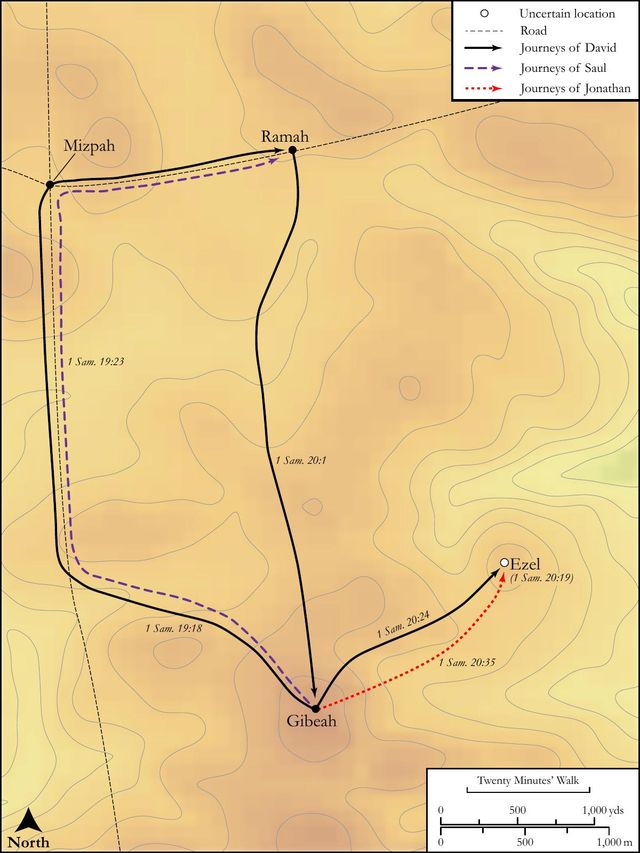
See on the biblical-era map
Study this verse
Public-domain commentary
Matthew Henry
From his Commentary on the Whole Bible. Henry comments on passages, not single verses — this entry covers 1 Samuel 20:9–23. His two-level outline is real structure in the source text, so it is rendered as structure.
Here, I. Jonathan protests his fidelity to David in his distress. Notwithstanding the strong confidence David had in Jonathan, yet, because he might have some reason to fear that his father's influence, and his own interest, should make him warp, or grow cool towards him, Jonathan thought it requisite solemnly to renew the professions of his friendship to him (Sa1 20:9): "Far be it from thee to think that I suspect thee of any crime for which I should either slay thee myself or deliver thee to my father; no, if thou hast any jealousy of that, Come let us go into the field (Sa1 20:11), and talk it over more fully." He did not challenge him to the field to fight him for an affront, but to fix him in his friendship. He faithfully promised him that he would let him know how, upon trial, he found his father affected towards him, and would make the matter neither better nor worse than it was. "If there be good towards thee, I will show it thee, that thou mayest be easy (Sa1 20:12), if evil, I will send thee away, that thou mayest be safe" (Sa1 20:13); and thus he would help to deliver him from the evil if it were real and from the fear of evil if it were but imaginary. For the confirmation of his promise he appeals to God, 1. As a witness (Sa1 20:12): "O Lord God of Israel, thou knowest I mean sincerely, and think as I speak." The strength of his passion made the manner of his speaking concise and abrupt. 2. As a judge: "The Lord do so and much more to Jonathan (Sa1 20:13), if I speak deceitfully, or break my word with my friend." He expressed himself thus solemnly that David might be abundantly assured of his sincerity. And thus God has confirmed his promises to us, that we might have strong consolation, Heb 6:17, Heb 6:18. Jonathan adds to his protestations his hearty prayers: "The Lord be with thee, to protect and prosper thee, as he has been formerly with my father, though now he has withdrawn." Thus he imitates his belief that David would be in his father's place, and his good wishes that he might prosper in it better than his father now did.
II.He provides for the entail of the covenant of friendship with David upon his posterity, Sa1 20:14-16.
He engages David to be a friend to his family when he was gone (Sa1 20:15): Thou shalt promise that thou wilt not cut off thy kindness from my house for ever. This he spoke from a natural affection he had to his children, whom he desired it might go well with after his decease, and for whose future welfare he desired to improve his present interest. It also intimates his firm belief of David's advancement, and that it would be in the power of his hand to do a kindness or unkindness to his seed; for, in process of time, the Lord would cut off his enemies, Saul himself was not expected; then "Do not thou cut off thy kindness from my house, nor revenge my father's wrongs upon my children." The house of David must likewise be bound to the house of Jonathan from generation to generation; he made a covenant (Sa1 20:16) with the house of David. Note, True friends cannot but covet to transmit to theirs after them their mutual affections. Thy own friend, and thy father's friend, forsake not. This kindness,
1.He calls the kindness of the Lord, because it is such kindness as God shows to those he takes into covenant with himself; for he is a God to them and to their seed; they are beloved for the fathers' sakes.
2.He secures it by an imprecation (Sa1 20:16): The Lord require it at the hand of David's seed (for of David himself he had no suspicion) if they prove so far David's enemies as to deal wrongfully with the posterity of Jonathan, David's friend. He feared lest David, or some of his, should hereafter be tempted, for the clearing and confirming of their title to the throne, to do by his seed as Abimelech had done by the sons of Gideon (Jdg 9:5), and this he would effectually prevent; but the reason given (Sa1 20:17) why Jonathan was so earnest to have the friendship entailed is purely generous, and has nothing of self in it; it was because he loved him as he loved his own soul, and therefore desired that he and his might be beloved by him. David, though now in disgrace at court and in distress, was as amiable in the eyes of Jonathan as ever he had been, and he loved him never the less for his father's hating him, so pure were the principles on which his friendship was built. Having himself sworn to David, he caused David to swear to him, and (as we read it) to swear again, which David consented to (for he that bears an honest mind does not startle at assurances), to swear by his love to him, which he looked upon as a sacred thing. Jonathan's heart was so much upon it that, when they parted this time, he concluded with a solemn appeal to God: The Lord be between me and thee for ever (Sa1 20:23), that is, "God himself be judge between us and our families for ever, if on either side this league of friendship be violated." It was in remembrance of this covenant that David was kind to Mephibosheth, Sa2 9:7; Sa2 21:7. It will be a kindness to ourselves and ours to secure an interest in those whom God favours and to make his friends ours.
III.He settles the method of intelligence, and by what signs and tokens he would give him notice how his father stood affected towards him.
David would be missed the first day, or at least the second day, of the new moon, and would be enquired after, Sa1 20:18. On the third day, by which time he would have returned from Bethlehem, he must be at such a place (Sa1 20:19), and Jonathan would come towards that place with his bow and arrows to shoot for diversion (Sa1 20:20), would send his lad to fetch his arrows, and, if they were shot short of the lad, David must take it for a signal of safety, and not be afraid to show his head (Sa1 20:21); but, if he shot beyond the lad, it was a signal of danger, and he must shift for his safety, Sa1 20:22. This expedient he fixed lest he should not have the opportunity, which yet it proved he had, of talking with David, and making the report by word of mouth.
Continue studying 1 Samuel 20:9 across the web’s major study libraries — every link below opens this exact verse, chapter, or book on the destination site.
Read & Compare
 BibleGatewayThis verse in more than 200 translations and 70 languages.
 Bible.comThe YouVersion reader — hundreds of translations, reading plans, and highlights.
 ESV.orgCrossway's official English Standard Version reader.
 NET BibleThe NET translation with 60,000+ translators' notes on every rendering decision.
 STEP BibleTyndale House's free study tool — original text, vocabulary, and scholarly resources.
 BibliaLogos Bible Software's free web reader.
 USCCBThe New American Bible (Revised Edition) with the U.S. bishops' study notes.
Commentaries
 BibleHub CommentariesDozens of classic commentaries on this verse, gathered on one page.
 StudyLightMore than 100 commentary sets — the largest collection on the web.
 BibleRefPlain-English commentary on what this verse means, verse by verse.
 Enduring WordDavid Guzik's free commentary on this chapter, widely used by Bible teachers.
 Bible Study ToolsVerse commentary alongside Greek and Hebrew study aids.
Original Language & Research
- BibleHub InterlinearThe verse word by word — original language, transliteration, and English.
- BibleHub LexiconEvery word's original-language definition and Strong's entry.
 Blue Letter BibleDeep-study tools — Strong's numbers, concordance, and word studies.
 SefariaThe Hebrew text with Rashi and centuries of Jewish commentary.
Sermons, Hymns & Audio


TrulyRandomVerse is not affiliated with these sites and doesn’t control their content. They’re linked because they’re genuinely useful.
Summary
1 Samuel 20:9 captures a pivotal moment of profound loyalty and trust between Jonathan and David. Following David's desperate plea for clarity regarding King Saul's murderous intentions, Jonathan, Saul's son, vehemently rejects the notion that he would ever conceal his father's evil designs. This declaration reaffirms their sacred covenant, pledging absolute transparency and protection, and prioritizing David's safety above all else, even his own dynastic prospects.
Context
ShowHideLiterary Context
This verse is strategically placed at a critical juncture in the unfolding drama of Saul's reign and David's ascent. David, having fled Saul's increasingly erratic and hostile presence, seeks out Jonathan, his covenant friend, to ascertain the true extent of Saul's murderous intent. David's profound distress and sense of imminent danger are palpable in his preceding declaration, "there is but a step between me and death" 1 Samuel 20:3. Jonathan's emphatic response in verse 9 directly addresses David's underlying fear of betrayal or concealment, serving as a powerful reassurance of his unwavering commitment. This interaction lays the groundwork for the elaborate plan Jonathan devises in the subsequent verses to definitively determine Saul's disposition towards David, highlighting the deep bond and strategic collaboration between the two men.
Historical & Cultural Context
The setting is the nascent Israelite monarchy, a period characterized by shifting power dynamics, tribal allegiances, and the sacred nature of covenants. In Israel, loyalty to one's father and reigning monarch was a foundational societal expectation. Jonathan's steadfast commitment to David, who was perceived as a rival to his own rightful claim to the throne, is therefore exceptionally remarkable and counter-cultural. The covenant between David and Jonathan, first established in [1_samuel/18-3 "1 Samuel 18:3 - The Covenant of Friendship"], was a solemn and binding oath, carrying significant social, spiritual, and even legal weight. Jonathan's actions in this verse transcend conventional loyalties, demonstrating a prioritization of this sacred bond over familial and political expediency, underscoring the unique and divinely ordained nature of their friendship.
Key Themes
ShowHideThis verse powerfully illuminates several enduring theological and narrative themes. Foremost is Unwavering Loyalty and Friendship, as Jonathan's declaration transcends familial ties and personal ambition, demonstrating a profound commitment to David's well-being and, implicitly, to God's plan for David's future as king. His words embody Trust and Assurance, providing David with a much-needed anchor in a sea of peril, built upon a foundation of open communication and mutual respect. Furthermore, Jonathan's actions are a crucial human instrument in the unfolding of Divine Providence. Though not explicitly stated within this verse, Jonathan's protection of David directly facilitates God's sovereign plan for David to become the next king of Israel, showcasing how God often works through human relationships and choices to achieve His purposes, a theme prevalent throughout the broader narrative of [1_samuel/1 "The Book of 1 Samuel"].
Exposition and Analysis
ShowHideKey Word Analysis
ShowHideThis is a powerful Hebrew interjection, literally meaning "a profaned thing" or "unthinkable." It conveys a vehement denial, expressing shock and utter repugnance at the very idea that Jonathan would betray David or withhold vital information. Jonathan is not merely disagreeing; he is passionately rejecting the notion as an abomination, emphasizing the depth and sacredness of their bond.
This primitive root means "to know," encompassing a wide variety of senses including to ascertain by seeing, to comprehend, to discern, and to be acquainted with. In the context of "knew certainly," it implies a thorough, reliable, and intimate understanding of the situation. Jonathan is not offering a casual assurance but pledging to gain precise, undeniable knowledge of Saul's intentions, demonstrating his commitment to an active and informed vigilance.
While often translated simply as "evil," raʻ in this context refers specifically to harm, misfortune, calamity, or destructive intent. It encompasses Saul's malicious designs and the concrete, life-threatening plot he is devising against David. Jonathan is not speaking of abstract wickedness but of a tangible, impending danger that his father intends to inflict upon David.
Verse Breakdown
ShowHide"And Jonathan said, Far be it from thee"
Jonathan's immediate, emphatic, and almost horrified response underscores the depth of his emotional connection to David and his absolute rejection of any suggestion of disloyalty or complicity in Saul's schemes. This phrase serves as a powerful verbal embrace, reassuring David of his unwavering support and integrity, and establishing the moral foundation of their interaction.
"for if I knew certainly that evil were determined by my father to come upon thee"
This clause reveals Jonathan's commitment to active and informed vigilance on David's behalf. He is not offering passive comfort but pledging to actively seek out, discern, and confirm Saul's true intentions. The phrase "knew certainly" (a Hebrew infinitive absolute construction, "knowing I would know") implies a thorough and reliable investigation, demonstrating his dedication to uncovering the precise nature of the threat David faces.
"then would not I tell it thee?"
This rhetorical question functions as a powerful, undeniable affirmation. The implied answer is a resounding "Yes, I would certainly tell you!" It reinforces Jonathan's promise of complete transparency and immediate communication. His loyalty dictates that he would never allow David to walk into danger unknowingly, emphasizing his role as a protector, faithful friend, and a crucial conduit of life-saving information.
Literary Devices
ShowHideThe passage employs several potent literary devices that amplify its emotional and thematic weight. The most prominent is the Rhetorical Question in Jonathan's concluding phrase, "then would not I tell it thee?" This is not a genuine inquiry but a powerful affirmation, leaving no doubt about his absolute commitment to transparency and protection for David. There is also a strong element of Dramatic Irony, as the reader is already acutely aware of Saul's escalating madness and murderous intent, which Jonathan is only now seeking to confirm. This irony heightens the tension and underscores the precariousness of David's situation, highlighting Jonathan's crucial role as David's sole reliable informant within the royal court. Furthermore, the entire interaction is steeped in Symbolism, with Jonathan representing the ideal of selfless friendship and covenant loyalty, contrasting sharply with Saul's embodiment of jealous paranoia and tyrannical power. Jonathan's pledge to protect David, the anointed king, also serves as a subtle Foreshadowing of the divine protection that will ultimately preserve David for his destined throne, despite the numerous threats against his life.
Theological and Thematic Connections
ShowHideJonathan's extraordinary loyalty to David, expressed so powerfully in this verse, resonates with profound theological themes of covenant faithfulness and divine sovereignty. His actions are not merely a testament to exemplary human friendship but reflect a deeper spiritual alignment with God's purposes. Jonathan, despite being the rightful heir to the throne, willingly steps aside and actively protects the one whom God has chosen, demonstrating a remarkable humility and submission to the divine will. This self-sacrificing love and commitment to another's well-being, even at great personal cost and against familial expectation, mirrors the character of God's unwavering covenant loyalty to His people and foreshadows the ultimate act of divine love in Christ.
Reflection and Application
ShowHideJonathan's resolute pledge in 1 Samuel 20:9 offers a timeless paradigm for true friendship and integrity, challenging us to examine the quality of our own relationships. In a world often characterized by self-interest, conditional connections, and the pursuit of personal advantage, Jonathan's unwavering loyalty reminds us of the profound value of covenantal bonds—those relationships built on trust, transparency, and a willingness to prioritize the well-being of another, even when it demands personal sacrifice or challenges existing allegiances. This verse calls us to cultivate friendships marked by radical honesty, where we are committed to speaking truth, offering protection, and standing by those we love, especially in times of vulnerability and peril. It challenges us to consider whether our own relationships are characterized by such selflessness and courage, to be people who would never conceal "evil" or danger from those we are called to protect, but rather actively seek their good and safety, embodying the very spirit of Jonathan's "Far be it from thee."
Questions for Reflection
ShowHideFAQ
ShowHideWhat was the nature of the "evil" Jonathan was referring to?
ShowHideThe "evil" Jonathan refers to (Hebrew raʻ) was the malicious intent and murderous plot that King Saul, his father, was actively harboring against David. Saul had become consumed by jealousy and paranoia, viewing David as a direct threat to his throne and dynastic succession. This "evil" was not merely abstract wickedness but a concrete, life-threatening danger—Saul's determined plan to kill David, as evidenced by previous attempts on David's life and his increasingly erratic and violent behavior. Jonathan's solemn pledge was to inform David of any specific plan or move Saul might make to harm him, ensuring David was not caught unawares and could take necessary precautions. This commitment highlights the mortal danger David was in and Jonathan's crucial role in his survival.
Christ-Centered Fulfillment
ShowHideJonathan's self-sacrificing loyalty and protective stance toward David, the Lord's anointed king, powerfully prefigure the ultimate covenant faithfulness of Jesus Christ. Just as Jonathan pledged to warn and protect David from the "evil" determined by an earthly king, so Christ, our faithful friend and High Priest, continually intercedes for and protects His people from spiritual "evil" and the insidious machinations of the adversary. Jonathan, the rightful heir to Israel's throne, willingly set aside his own claim to ensure David's safety and ascent, echoing Christ's ultimate act of humility and self-emptying, where He "made himself nothing, taking the form of a servant" (Philippians 2:7). Our Lord Jesus not only warns us of danger but actively delivers us from it, laying down His life for His friends (John 15:13) and securing our eternal safety through His perfect sacrifice. He is the ultimate "good shepherd" who "lays down his life for the sheep" (John 10:11), fulfilling the protective and covenantal love that Jonathan so beautifully demonstrated for David, who was himself a type of the coming King of kings.