


1 Corinthians 7:29
Bible text: King James Version (1769 Blayney text) · Public domain
Bible text: King James Version with Strong's numbers · Public domain
Bible text: Berean Standard Bible · Public domain
Bible text: American Standard Version (1901) · Public domain
Bible text: World English Bible, Messianic edition · Public domain
Bible text: Geneva Bible (1599) · Public domain
Bible text: Young's Literal Translation · Public domain
- ΤοῦτοToutoThisG3778D-ASNDemonstrative pronoun Accusative Singular Neuter
- δέdenowG1161CONJConjunction
- φημιphēmiI sayG5346V-PAI-1SVerb Present Active Indicative 1st Singular
- ἀδελφοίadelphoibrothersG80N-VPMNoun Vocative Plural Masculine
- ὁhoTheG3588T-NSMDefinite article Nominative Singular Masculine
- καιρὸςkairosseasonG2540N-NSMNoun Nominative Singular Masculine
- συνεσταλμένοςsunestalmenosshortenedG4958V-RPP-NSMVerb Perfect Passive Participle Nominative Singular Masculine
- τὸto<the>G3588T-ASNDefinite article Accusative Singular Neuter
- λοιπόνloiponFrom now onG3063A-ASNAdjective Accusative Singular Neuter
- ἐστίνestinisG1510V-PAI-3SVerb Present Active Indicative 3rd Singular
- ἵναinathatG2443CONJConjunction
- καὶkaibothG2532CONJConjunction
- οἱhoithoseG3588T-NPMDefinite article Nominative Plural Masculine
- ἔχοντεςechonteshavingG2192V-PAP-NPMVerb Present Active Participle Nominative Plural Masculine
- γυναῖκαςgunaikaswivesG1135N-APFNoun Accusative Plural Feminine
- ὡςhōsasG5613PRTParticle or Disjunctive
- μὴmēnoneG3361PRT-NNegative Particle Negative
- ἔχοντεςechonteshavingG2192V-PAP-NPMVerb Present Active Participle Nominative Plural Masculine
- ὦσινōsinmay beG1510V-PAS-3PVerb Present Active Subjunctive 3rd Plural
English is a literal word-by-word gloss of the Greek, not the KJV's wording. Why?
This is the original text the KJV's translators worked from — each Greek word with its own literal English meaning in this verse, prepared by scholars at Tyndale House, Cambridge. The KJV translates whole sentences, not word by word, so its wording differs: one Greek word can become several English words, and the KJV may choose “charity” where the gloss reads “love”. Both are faithful — they answer different questions. For the KJV's own rendering, switch to the KJV text.
Details
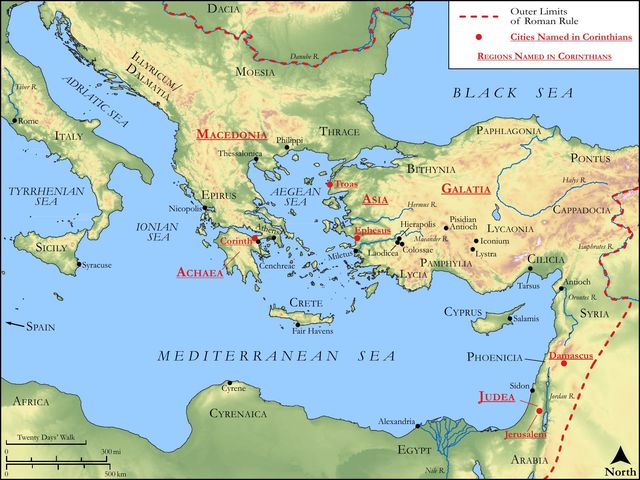
See on the biblical-era maps

Study this verse
Public-domain commentary
Matthew Henry
From his Commentary on the Whole Bible. Henry comments on passages, not single verses — this entry covers 1 Corinthians 7:25–35. His two-level outline is real structure in the source text, so it is rendered as structure.
The apostle here resumes his discourse, and gives directions to virgins how to act, concerning which we may take notice,
I.Of the manner wherein he introduces them:
"Now concerning virgins I have no commandment of the Lord, Co1 7:25. I have no express and universal law delivered by the Lord himself concerning celibacy; but I give my judgment, as one who hath obtained mercy of the Lord to be faithful," namely, in the apostleship. He acted faithfully, and therefore his direction was to be regarded as a rule of Christ: for he gave judgment as one who was a faithful apostle of Christ. Though Christ had before delivered no universal law about that matter, he now gives direction by an inspired apostle, one who had obtained mercy of the Lord to be faithful. Note, Faithfulness in the ministry is owing to the grace and mercy of Christ. It is what Paul was ready to acknowledge upon all occasions: I laboured more abundantly than they all; yet not I, but the grace of God which was with me, Co1 15:10. And it is a great mercy which those obtain from God who prove faithful in the ministry of his word, either ordinary or extraordinary.
II.The determination he gives, which, considering the present distress, was that a state of celibacy was preferable:
It is good for a man so to be, that is, to be single. I suppose, says the apostle, or it is my opinion. It is worded with modesty, but delivered, notwithstanding, with apostolic authority. It is not the mere opinion of a private man, but the very determination of the Spirit of God in an apostle, though it be thus spoken. And it was thus delivered to give it the more weight. Those that were prejudiced against the apostle might have rejected this advice had it been given with a mere authoritative air. Note, Ministers do not lose their authority by prudent condescensions. They must become all things to all men, that they may do them the more good. This is good, says he, for the present distress. Christians, at the first planting of their religion, were grievously persecuted. Their enemies were very bitter against them, and treated them very cruelly. They were continually liable to be tossed and hurried by persecution. This being the then state of things, he did not think it so advisable for Christians that were single to change conditions. The married state would bring more care and cumber along with it (Co1 15:33, Co1 15:34), and would therefore make persecution more terrible, and render them less able to bear it. Note, Christians, in regulating their conduct, should not barely consider what is lawful in itself, but what may be expedient for them.
III.Notwithstanding he thus determines, he is very careful to satisfy them that he does not condemn marriage in the gross, nor declare it unlawful. And therefore, though he says, "If thou art loosed from a wife (in a single state, whether bachelor or widower, virgin or widow) do not seek a wife, do not hastily change conditions;" yet he adds, "If thou art bound to a wife, do not seek to be loosed. It is thy duty to continue in the married relation, and do the duties of it." And though such, if they were called to suffer persecution, would find peculiar difficulties in it; yet, to avoid these difficulties, they must not cast off nor break through the bonds of duty. Duty must be done, and God trusted with events. But to neglect duty is the way to put ourselves out of the divine protection. He adds therefore, I thou marry thou hast not sinned; or if a virgin marry she hath not sinned: but such shall have trouble in the flesh. Marrying is not in itself a sin, but marrying at that time was likely to bring inconvenience upon them, and add to the calamities of the times; and therefore he thought it advisable and expedient that such as could contain should refrain from it; but adds that he would not lay celibacy on them as a yoke, nor, by seeming to urge it too far, draw them into any snare; and therefore says, But I spare you. Note, How opposite in this are the papist casuists to the apostle Paul! They forbid many to marry, and entangle them with vows of celibacy, whether they can bear the yoke or no.
IV.He takes this occasion to give general rules to all Christians to carry themselves with a holy indifferency towards the world, and every thing in it.
1.As to relations: Those that had wives must be as though they had none; that is, they must not set their hearts too much on the comforts of the relation; they must be as though they had none. They know not how soon they shall have none. This advice must be carried into every other relation. Those that have children should be as though they had none. Those that are their comfort now may prove their greatest cross. And soon may the flower of all comforts be cut down.
2.As to afflictions: Those that weep must be as though they wept not; that is, we must not be dejected too much with any of our afflictions, nor indulge ourselves in the sorrow of the world, but keep up a holy joy in God in the midst of all our troubles, so that even in sorrow the heart may be joyful, and the end of our grief may be gladness. Weeping may endure for a night, but joy will come in the morning. If we can but get to heaven at last, all tears shall be wiped from our eyes; and the prospect of it now should make us moderate our sorrows and refrain our tears.
3.As to worldly enjoyments: Those that rejoice should be as though they rejoiced not; that is, they should not take too great a complacency in any of their comforts. They must be moderate in their mirth, and sit loose to the enjoyments they most value. Here is not their rest, nor are these things their portion; and therefore their hearts should not be set on them, nor should they place their solace or satisfaction in them.
4.As to worldly traffic and employment: Those that buy must be as though they possessed not. Those that prosper in trade, increase in wealth, and purchase estates, should hold these possessions as though they held them not. It is but setting their hearts on that which is not (Pro 23:5) to do otherwise. Buying and possessing should not too much engage our minds. They hinder many people altogether from minding the better part. Purchasing land and trying oxen kept the guests invited from the wedding-supper, Luk 14:18, Luk 14:19. And, when they do not altogether hinder men from minding their chief business, they do very much divert them from a close pursuit. Those are most likely to run so as to obtain the prize who ease their minds of all foreign cares and cumbrances.
5.As to all worldly concerns: Those that use this world as not abusing it, Co1 7:31. The world may be used, but must not be abused. It is abused when it is not used to those purposes for which it is given, to honour God and do good to men - when, instead of being oil to the wheels of our obedience, it is made fuel to lust - when, instead of being a servant, it is made our master, our idol, and has that room in our affections which should be reserved for God. And there is great danger of abusing it in all these respects, if our hearts are too much set upon it. We must keep the world as much as may be out of our hearts, that we may not abuse it when we have it in our hands.
V.He enforces these advices with two reasons:
- 1. The time is short, Co1 7:29. We have but little time to continue in this world; but a short season for possessing and enjoying worldly things; kairos sunestalmenos. It is contracted, reduced to a narrow compass. It will soon be gone. It is just ready to be wrapped up in eternity. Therefore do not set your hearts on worldly enjoyments. Do not be overwhelmed with worldly cares and troubles. Possess what you must shortly leave without suffering yourselves to be possessed by it. Why should your hearts be much set on what you must quickly resign? 2. The fashion of this world passeth away (Co1 7:31), schēma - the habit, figure, appearance, of the world, passeth away. It is daily changing countenance. It is in a continual flux. It is not so much a world as the appearance of one. All is show, nothing solid in it; and it is transient show too, and will quickly be gone. How proper and powerful an argument is this to enforce the former advice! How irrational is it to be affected with the images, the fading and transient images, of a dream! Surely man walketh in a vain show (Psa 39:6), in an image, amidst the faint and vanishing appearances of things. And should he be deeply affected, or grievously afflicted, with such a scene?
VI.He presses his general advice by warning them against the embarrassment of worldly cares:
But I would have you without carefulness, Co1 7:32. Indeed to be careless is a fault; a wise concern about worldly interests is a duty; but to be careful, full of care, to have an anxious and perplexing care about them, is a sin. All that care which disquiets the mind, and distracts it in the worship of God, is evil; for God must be attended upon without distraction, Co1 7:35. The whole mind should be engaged when God is worshipped. The work ceases while it diverts to any thing else, or is hurried and drawn hither and thither by foreign affairs and concerns. Those who are engaged in divine worship should attend to this very thing, should make it their whole business. But how is this possible when the mind is swallowed up of the cares of this life? Note, It is the wisdom of a Christian so to order his outward affairs, and choose such a condition in life, as to be without distracting cares, that he may attend upon the Lord with a mind at leisure and disengaged. This is the general maxim by which the apostle would have Christians govern themselves. In the application of it Christian prudence must direct. That condition of life is best for every man which is best for his soul, and keeps him most clear of the cares and snares of the world. By this maxim the apostle solves the case put to him by the Corinthians, whether it were advisable to marry? To this he says, That, by reason of the present distress, and it may be in general, at that time, when Christians were married to infidels, and perhaps under a necessity of being so, if married at all: I say, in these circumstances, to continue unmarried would be the way to free themselves from any cares and incumbrances, and allow them more vacation for the service of God. Ordinarily, the less care we have about the world the more freedom we have for the service of God. Now the married state at that time (if not at all times) did bring most worldly care along with it. He that is married careth for the things of the world, that he may please his wife, Co1 7:33. And she that is married careth for the things of the world, how she may please her husband. But the unmarried man and woman mind the things of the Lord, that they may please the Lord, and be holy both in body and spirit, Co1 7:32, Co1 7:34. Not but the married person may be holy both in body and spirit too. Celibacy is not in itself a state of greater purity and sanctity than marriage; but the unmarried would be able to make religion more their business at that juncture, because they would have less distraction from worldly cares. Marriage is that condition of life that brings care along with it, though sometimes it brings more than at others. It is the constant care of those in that relation to please each other; though this is more difficult to do at some reasons, and in some cases, than in others. At that season, therefore, the apostle advises that those who were single should abstain from marriage, if they were under no necessity to change conditions. And, where the same reason is plain at other times, the rule is as fit to be observed. And the very same rule must determine persons for marriage where there is the same reason, that is, if in the unmarried state persons are likely to be more distracted in the service of God than if they were married, which is a case supposable in many respects. This is the general rule, which every one's discretion must apply to his own particular case; and by it should he endeavour to determine, whether it be for marriage or against. That condition of life should be chosen by the Christian in which it is most likely he will have the best helps, and the fewest hindrances, in the service of God and the affairs of his own salvation.
Historical interpretation
Four Centuries of Reception
15 surviving comments on this verse. Each one is dated, so this reads as a timeline rather than a list.
Select a marker to jump to its quote. Markers stagger vertically where authors wrote within a few decades of each other.
Explaining this more clearly, he adds "It remains that they that have wives be as though they had none, and they that buy as though they possessed not.".
Thus also the apostle says, "that he who marries should be as though he married not"
Now, when Marcion wholly prohibits all carnal intercourse to the faithful (for we will say nothing about his catechumens), and when he prescribes repudiation of all engagements before marriage, whose teaching does he follow, that of Moses or of Christ? Even Christ, however, when He here commands "the wife not to depart from her husband, or if she depart, to remain unmarried or be reconciled to her husband," both permitted divorce, which indeed He never absolutely prohibited, and confirmed (the sanctity) of marriage, by first forbidding its dissolution; and, if separation had taken place, by wishing the nuptial bond to be resumed by reconciliation. But what reasons does (the apostle) allege for continence? Because "the time is short." I had almost thought it was because in Christ there was another god! And yet He from whom emanates this shortness of the time, will also send what suits the said brevity.
Since, then, the Creator promised the gift of His Spirit in the latter days; and since Christ has in these last days appeared as the dispenser of spiritual gifts (as the apostle says, "When the fulness of the time was come, God sent forth His Son; " and again, "This I say, brethren, that the time is short" ), it evidently follows in connection with this prediction of the last days, that this gift of the Spirit belongs to Him who is the Christ of the predicters.
why, after the apostles, could not the same Spirit, supervening for the purpose of conducting disciplehood into "all truth" through the gradations of the times (according to what the preacher says, "A time to everything" ), impose by this time a final bridle upon the flesh, no longer obliquely calling us away from marriage, but openly; since now more (than ever) "the time is become wound up," -about 160 years having elapsed since then? Would you not spontaneously ponder (thus) in your own mind: "This discipline is old, shown beforehand, even at that early date, in the Lord's flesh and will, (and) successively thereafter in both the counsels and the examples of His apostles? Of old we were destined to this sanctity.
It follows that it is evil to have contact with her; for nothing is contrary to good except evil. And accordingly (he says), "It remains, that both they who have wives so be as if they have not," that it may be the more binding on them who have not to abstain from having them.
Why so? Because he had laid down the premiss, saying, "The time is wound up." If, then he shows plainly that even wives themselves are so to be had as if they be not had, on account of the straits of the times, what would be his sentiments about these vain appliances of theirs? Why, are there not many, withal, who so do, and seal themselves up to eunuchhood for the sake of the kingdom of God, spontaneously relinquishing a pleasure so honourable, and (as we know) permitted? Are there not some who prohibit to themselves (the use of) the very "creature of God," abstaining from wine and animal food, the enjoyments of which border upon no peril or solicitude; but they sacrifice to God the humility of their soul even in the chastened use of food? Sufficiently, therefore, have you, too, used your riches and your delicacies; sufficiently have you cut down the fruits of your dowries, before (receiving) the knowledge of saving disciplines.
It remaineth that they who have wives act as if they had them not.
That he who has attained to trust, having put off the former man, ought to regard only celestial and spiritual things, and to give no heed to the world which he has already renounced. In Isaiah: "Seek ye the Lord; and when ye have found Him, call upon Him. But when He hath come near unto you, let the wicked forsake his ways, and the unrighteous man his thoughts: and let him be turned unto the Lord, and he shall obtain mercy, because He will plentifully pardon your sins." Of this same thing in Solomon: "I have seen all the works which are done under the sun; and, lo, all are vanity." Of this same thing in Exodus: "But thus shall ye eat it; your loins girt, and your shoes on your feet, and your staves in your hands: and ye shall eat it in haste, for it is the Lord's passover." Of this same thing in the Gospel according to Matthew: "Take no thought, saying, What shall we eat? or, What shall we drink? or, Wherewith shall we be clothed? for these things the nations seek after. But your Father knoweth that ye have need of all these things. Seek first the kingdom of God, and His righteousness; and all these things shall be added unto you." Likewise in the same place: "Think not for the morrow, for the morrow shall take thought for itself. Sufficient unto the day is its own evil." Likewise in the same place: "No one looking back, and putting his hands to the plough, is fit for the kingdom of God." Also in the same place: "Behold the fowls of the heaven: for they sow not, nor reap, nor gather into barns; and your heavenly Father feedeth them. Are not ye of more value than they? " Concerning this same thing, according to Luke: "Let your loins be girded, and your lamps burning; and ye like unto men that wait for their lord, when he cometh from the wedding; that, when he cometh and knocketh, they may open to him. Blessed are those servants, whom their lord, when he cometh, shall find watching." Of this same thing in Matthew: "The foxes have holes, and the birds of the heaven have nests; but the Son of man hath not where He may lay His head." Also in the same place: "Whoso forsaketh not all that he hath, cannot be my disciple." Of this same thing in the first to the Corinthians: "Ye are not your own, for ye are bought with a great price. Glorify and bear God in your body." Also in the same place: "The time is limited. It remaineth, therefore, that both they who have wives be as though they have them not, and they who lament as they that lament not, and they that rejoice as they that rejoice not, and they who buy as they that buy not, and they who possess as they who possess not, and they who use this world as they that use it not; for the fashion of this world passeth away."
But yet if it shall please you who find chastity hard to bear, rather to turn to marriage; I consider it to be profitable for you to restrain yourselves in the gratification of the flesh, not making your marriage an occasion for abusing your own vessels to uncleanness. "Then he adds.
But those who are goaded on by their lusts, although they do not commit fornication, yet who, even in the things which are permitted with a lawful wife, through the heat of unsubdued concupiscence are excessive in embraces, how shall they celebrate the feast? how shall they rejoice, who have not adorned their tabernacle, that is their flesh, with the boughs of the Agnos, nor have listened to that which has been said; that "they that have wives be as though they had none? "
Concerning virginity we have received no commandment; but we leave it to the power of those that are willing, as a vow: exhorting them so far in this matter that they do not promise anything rashly; since Solomon says, "It is better not to vow, than to vow and not pay." [Ecclesiastes 5:5] Let such a virgin, therefore, be holy in body and soul, as the temple of God, [1 Corinthians 7:34] as the house of Christ, as the habitation of the Holy Spirit. For she that vows ought to do such works as are suitable to her vow; and to show that her vow is real, and made on account of leisure for piety, not to cast a reproach on marriage. Let her not be a wanderer abroad, nor one that rambles about unseasonably; not double-minded, but grave, continent, sober, pure, avoiding the conversation of many, and especially of those that are of ill reputation.
Paul means by this that the end of the world is coming soon. Given this fact, believers should not worry about having children and instead should dedicate themselves to the service of God. For there will be many unprecedented pressures on them, and many will fall into the devil’s trap. No one among us who has a proper fear of the pressures which the Savior predicted will want to be caught like that.
Let us expect, therefore, hour by hour, the kingdom of God in love and righteousness, since we know not the day of the appearing of God. For the Lord Himself, being asked by one when His kingdom would come, replied, "When two shall be one, that which is without as that which is within, and the male with the female, neither male nor female." Now, two are one when we speak the truth one to another, and there is unfeignedly one soul in two bodies. And "that which is without as" that which is within means this: He calls the soul "that which is within," and the body "that which is without." As, then, your body is visible to sight, so also let your soul be manifest by good works. And "the male, with the female, neither male nor female," this He says, that brother seeing sister may have no thought concerning her as female, and that she may have no thought concerning him as male. "If you do these things," says He, "the kingdom of my Father shall come." [1 Corinthians 7:29]
If married people are supposed to live as if they were single, how is it possible not to prefer virginity?
Those who practice physical sterility should observe fruitfulness in souls, and those who cannot have earthly children should try to beget spiritual ones. All our deeds are children. If we perform good works every day, we shall not lack spiritual offspring.
For this reason the Apostle Paul says: "The time is short: it remains that those who have wives be as though not having them, those who weep as though not weeping, and those who rejoice as though not rejoicing, and those who buy as though not possessing, and those who use this world as though not using it; for the form of this world is passing away." For he has a wife, but as though not having one, who knows how to pay the debts of the flesh in such a way that he is not compelled through her to cling to the world with his whole mind. For when the same excellent preacher says again: "He who has a wife thinks about the things of this world, how he may please his wife," that man has a wife as though not having one who strives to please his spouse in such a way that he nevertheless does not displease his Creator. He also weeps, but as though not weeping, who is so afflicted by temporal losses that he nevertheless always consoles his soul with thoughts of eternal gains. But he rejoices, yet as though not rejoicing, who is so gladdened by temporal goods that he nevertheless always considers the everlasting torments; and in that by which he lifts up his mind with joy, he immediately presses it down with the weight of prudent fear. Moreover, he buys, but as though not possessing, who both prepares earthly things for use, and yet with careful thought foresees that he will soon leave these behind. He also uses the world, but as though not using it, who both outwardly applies all necessary things to the service of his life, and yet does not allow these same things to dominate his mind, so that they serve as subjects externally, and never break the intention of a soul striving toward higher things. Whoever therefore are such, for them indeed all earthly things are present not for desire but for use, because they make use of necessary things indeed, but desire to have nothing with sin. From these very possessions they daily acquire rewards, and they rejoice more in good work than in good possession.
Continue studying 1 Corinthians 7:29 across the web’s major study libraries — every link below opens this exact verse, chapter, or book on the destination site.
Read & Compare
 BibleGatewayThis verse in more than 200 translations and 70 languages.
 Bible.comThe YouVersion reader — hundreds of translations, reading plans, and highlights.
 ESV.orgCrossway's official English Standard Version reader.
 NET BibleThe NET translation with 60,000+ translators' notes on every rendering decision.
 STEP BibleTyndale House's free study tool — original text, vocabulary, and scholarly resources.
 BibliaLogos Bible Software's free web reader.
 USCCBThe New American Bible (Revised Edition) with the U.S. bishops' study notes.
Commentaries
 BibleHub CommentariesDozens of classic commentaries on this verse, gathered on one page.
 StudyLightMore than 100 commentary sets — the largest collection on the web.
 BibleRefPlain-English commentary on what this verse means, verse by verse.
 Enduring WordDavid Guzik's free commentary on this chapter, widely used by Bible teachers.
 Bible Study ToolsVerse commentary alongside Greek and Hebrew study aids.
Original Language & Research
- BibleHub InterlinearThe verse word by word — original language, transliteration, and English.
- BibleHub LexiconEvery word's original-language definition and Strong's entry.
 Blue Letter BibleDeep-study tools — Strong's numbers, concordance, and word studies.
 CNTR CollationThe earliest Greek manuscripts of this verse, collated letter by letter.
Sermons, Hymns & Audio


TrulyRandomVerse is not affiliated with these sites and doesn’t control their content. They’re linked because they’re genuinely useful.
Summary
In the Apostle Paul delivers a profound and urgent exhortation to the Corinthian believers, asserting that the present age is rapidly drawing to its close. This foundational premise leads to a radical call for spiritual detachment from earthly concerns, specifically advising those who are married to live as if they were not, thereby emphasizing an internal posture of non-ultimate reliance on worldly relationships and possessions in light of the imminent eschatological reality and the supreme priority of devotion to God.
Context
ShowHideLiterary Context
This verse is a pivotal statement within Paul's extensive discourse in 1 Corinthians 7, where he addresses various questions ("Now concerning...") posed by the Corinthian church regarding marriage, singleness, and sexual ethics. Paul has already provided practical advice on marital duties (1 Corinthians 7:1-7), counsel for the unmarried and widows (1 Corinthians 7:8-9), and guidance for mixed-faith marriages (1 Corinthians 7:10-16). His overarching theme is that believers should remain in the state in which they were called, whether married or single, circumcised or uncircumcised, slave or free (1 Corinthians 7:17-24). Verse 29 then introduces a powerful eschatological rationale that undergirds all his preceding and subsequent advice, particularly the call for undivided devotion in 1 Corinthians 7:32-35. It shifts the focus from specific relational dynamics to the overarching spiritual posture required of all believers in light of the transient nature of this world.
Historical & Cultural Context
Corinth was a thriving, cosmopolitan port city, notorious for its wealth, diverse population, and moral laxity, particularly sexual immorality (hence the term "Corinthianize" meaning to live dissolutely). The church in Corinth, composed of both Jews and Gentiles, faced significant challenges in navigating their new Christian identity within this pagan environment. They were influenced by various philosophical currents, including Stoicism (emphasizing apathy towards external things) and Epicureanism (seeking pleasure), as well as ascetic tendencies that sometimes led to an overemphasis on spiritual purity through abstinence from marriage or food. Paul's letter addresses these cultural pressures and internal divisions, providing a robust theological framework for living a distinctly Christian life. The early Christian community also lived with a strong sense of eschatological expectation, believing in the imminent return of Christ and the dawning of a new age, which profoundly shaped their worldview and ethical considerations.
Key Themes
ShowHideThe primary themes converging in 1 Corinthians 7:29 are Eschatological Urgency and Spiritual Detachment. The phrase "the time is short" (Greek: ho kairos synestalmenos estin) underscores the brevity and temporary nature of the present age, urging believers to live with an eternal perspective. This is not merely about the brevity of individual life, but the compressed nature of the entire historical epoch before Christ's return and the consummation of His kingdom. Flowing from this urgency is the theme of Spiritual Detachment, expressed in the radical instruction "that both they that have wives be as though they had none." This does not advocate for neglecting marital duties or abandoning one's spouse, but rather calls for an internal posture of holding all earthly relationships, possessions, and pursuits loosely. It is a call to avoid becoming entirely absorbed or defined by these good gifts, ensuring they do not become ultimate preoccupations that distract from one's primary devotion to God. This detachment ultimately serves the broader theme of Undivided Devotion and Prioritization of God's Kingdom, aligning with Jesus' teaching to seek first the kingdom of God and His righteousness.
Exposition and Analysis
ShowHideKey Word Analysis
ShowHideThis word refers not to chronological time (chronos), but to a specific, appointed, or opportune time. In this context, kairós signifies a decisive moment, a critical period, or the opportune season, often with eschatological overtones. Paul is indicating that the present season of history is not merely passing, but has reached a critical, contracted phase, implying the nearing culmination of God's redemptive plan. This understanding imbues the verse with a profound sense of urgency, signaling that the window for worldly pursuits as ultimate ends is rapidly closing.
Derived from syn (together) and stellō (to send, to set), systéllō literally means "to draw together," "to contract," or "to roll up." It was used, for example, of rolling up a sail or winding up a corpse for burial. Here, it vividly portrays the present age as being compressed, condensed, or nearing its end, like a scroll being rolled up. This powerful imagery reinforces the idea that the time remaining for the present order of things is severely limited, emphasizing a sense of finality and imminent transition.
This versatile verb means "to hold," "to possess," "to have," or "to be in a certain condition." In the phrase "they that have wives," échō denotes the state of being married. The subsequent instruction, "be as though they had none," uses the same verb, highlighting the contrast between the external reality of possession (having a wife) and the internal spiritual posture of non-possession or detachment. It emphasizes that while one may physically "have" something, their inner disposition should be one of holding it loosely, without ultimate dependence or distraction.
Verse Breakdown
ShowHide"But this I say, brethren,"
Paul begins with a characteristic phrase that signals a significant, authoritative pronouncement, often introducing a new point or a strong emphasis. The address "brethren" maintains a pastoral and familial tone, inviting the Corinthian believers to receive his counsel as from a spiritual father.
"the time is short:"
This is the foundational theological premise of Paul's exhortation. As analyzed above, "the time" (kairós) refers to the decisive, opportune period, and "is short" (systéllō) means it is contracted or drawing to a close. This statement encapsulates the early Christian eschatological worldview: the present age is temporary, finite, and quickly approaching its culmination with Christ's return and the establishment of His eternal kingdom. This urgency shapes all subsequent ethical considerations.
"it remaineth, that both they that have wives be as though they had none;"
This clause presents the radical implication of the "shortness of time." The phrase "it remaineth" (loipón) indicates "for the rest" or "henceforth," signaling what follows from the preceding truth. The instruction "that both they that have wives be as though they had none" is a striking call for spiritual detachment. It is not a literal command to abandon one's spouse or neglect marital duties (which Paul explicitly affirms elsewhere in this chapter, e.g., 1 Corinthians 7:3-5). Instead, it's a call to an internal posture: to hold even the most intimate and cherished earthly relationships with a loose grip, ensuring that they do not become the ultimate source of identity, security, or distraction from one's primary devotion to God and His kingdom.
Literary Devices
ShowHidePaul's communication in 1 Corinthians 7:29 employs several powerful literary devices. The phrase "the time is short" functions as a Metaphor, portraying the present age not as a linear progression but as a compressed or rolled-up scroll, conveying a sense of imminence and finality. This vivid imagery underscores the urgency of Paul's message. The subsequent instruction, "that both they that have wives be as though they had none," is a striking example of Paradox or Hyperbole. On the surface, it seems contradictory to Paul's earlier affirmations of marriage, but it serves to emphasize a profound spiritual truth: the need for radical internal detachment from earthly realities, even good ones. It is not a literal command to abandon one's spouse, but an exaggerated statement designed to shock the reader into a new perspective on priorities. Furthermore, Paul's opening "But this I say, brethren," demonstrates Apostolic Authority combined with a pastoral tone, setting the stage for a weighty and impactful pronouncement.
Theological and Thematic Connections
ShowHide1 Corinthians 7:29 stands as a foundational text for understanding Christian eschatological ethics – how believers should live in the "already but not yet" tension of God's kingdom. It powerfully articulates the transient nature of the present world order and calls for a radical reorientation of priorities in light of eternity. This verse challenges believers to cultivate a spiritual detachment from all earthly things, not out of asceticism or neglect, but out of a profound recognition that only God and His kingdom are eternal. It underscores the biblical theme that our ultimate allegiance and deepest affections must be reserved for Christ, influencing how we engage with every aspect of life, including marriage, possessions, and worldly pursuits. The "shortness of time" serves as a perpetual reminder that our true citizenship is in heaven, and our lives on earth are a stewardship to be lived with eternal purpose.
Reflection and Application
ShowHide1 Corinthians 7:29 serves as a timeless call to live with an eternal perspective, reminding us that our earthly lives, with all their joys and challenges, are temporary. This awareness should not lead to fatalism or irresponsible neglect of our duties, but rather to a profound re-evaluation of our priorities. It challenges us to hold all things – our relationships, possessions, careers, and even our very lives – with an open hand, recognizing that they are gifts to be stewarded for God's glory, not idols to be clung to. Cultivating this spiritual detachment means that while we fully engage in our responsibilities and enjoy the good gifts God provides, our hearts remain ultimately fixed on Him. It prompts us to ask: Are my deepest affections and ultimate security found in Christ alone, or have I allowed earthly comforts and relationships, however good, to subtly usurp His rightful place? Living with the "time is short" mindset compels us to maximize every opportunity for kingdom work, evangelism, and spiritual growth, knowing that the most valuable investments are those that yield eternal returns.
Questions for Reflection
ShowHideFAQ
ShowHideDoes "the time is short" mean Paul expected Jesus to return in his lifetime?
ShowHideWhile many early Christians, including Paul, lived with a strong sense of the imminence of Christ's return, the phrase "the time is short" (Greek: ho kairos synestalmenos estin) does not necessarily imply a precise, immediate expectation within Paul's lifetime. Kairos refers to an appointed or decisive time, and systéllō means "contracted" or "rolled up." This conveys a sense of the present age being compressed or nearing its end, emphasizing its transient nature and the urgency of living for God's kingdom. It speaks to the "already and not yet" tension of Christian eschatology: Christ has inaugurated the new age, and the old age is passing away, regardless of when the final consummation occurs. The attitude of urgency and eternal perspective remains timeless for all believers, as life itself is brief and the return of Christ is always a present possibility.
Does "as though they had none" mean Christians should neglect their spouses or families?
ShowHideAbsolutely not. Paul's instruction "that both they that have wives be as though they had none" is a call for spiritual detachment, not physical or emotional neglect. Throughout 1 Corinthians 7 itself, Paul explicitly affirms the importance of marital duties and mutual respect (e.g., 1 Corinthians 7:3-5). The phrase is a hyperbole, designed to emphasize an internal posture: that one's ultimate identity, security, and devotion must be in Christ alone, not in any earthly relationship, however good. It means not allowing even the most cherished relationships to become idols or to distract from one's primary allegiance to God and the advancement of His kingdom. Believers are called to love their spouses and families deeply, but to hold them loosely in light of eternity, ready to prioritize God above all.
Christ-Centered Fulfillment
ShowHide1 Corinthians 7:29, with its urgent declaration that "the time is short," finds its ultimate fulfillment and deepest meaning in the person and work of Jesus Christ. His first coming inaugurated the "shortening" of the old age and ushered in the new creation, marking the decisive kairos in human history. Jesus Himself lived a life of radical detachment from worldly comforts and pursuits, having nowhere to lay His head, and consistently prioritizing His Father's will and the kingdom of God above all else. His teachings, such as the call to seek first the kingdom of God, perfectly embody the spirit of this verse. Through His death and resurrection, Christ has decisively defeated sin and death, guaranteeing the ultimate triumph of God's eternal kingdom. Therefore, for the believer, living "as though they had none" is not merely an ascetic discipline, but a Christ-like posture, reflecting His own self-emptying and singular focus on His redemptive mission. We are called to live in light of His accomplished work and His promised return, allowing the reality of His Lordship and the brevity of this passing world to shape every relationship and pursuit, echoing Paul's own commitment to consider everything a loss compared to the surpassing worth of knowing Christ Jesus and to press on toward the goal for the prize of the upward call of God in Christ Jesus.