


Zechariah 10:4
Bible text: King James Version (1769 Blayney text) · Public domain
Bible text: Berean Standard Bible · Public domain
Bible text: American Standard Version (1901) · Public domain
Bible text: World English Bible, Messianic edition · Public domain
Bible text: Geneva Bible (1599) · Public domain
Bible text: Young's Literal Translation · Public domain
- מִמֶּנּוּmi·Me·nufrom itH4480Prep ¦ 3msPrepositionמִמֶּfromנּוּit
- פִנָּהfi·Naha cornerH6438N-fsNoun Singular Feminine Absolute
- מִמֶּנּוּmi·Me·nufrom itH4480Prep ¦ 3msPrepositionמִמֶּfromנּוּit
- יָתֵדya·Teda pegH3489N-fsNoun Singular Feminine Absolute
- מִמֶּנּוּmi·Me·nufrom itH4480Prep ¦ 3msPrepositionמִמֶּfromנּוּit
- קֶשֶׁתKe·sheta bow ofH7198N-fscNoun Singular Feminine Construct
- מִלְחָמָהmil·cha·MahwarH4421N-fsNoun Singular Feminine Absolute
- מִמֶּנּוּmi·Me·nufrom itH4480Prep ¦ 3msPrepositionמִמֶּfromנּוּit
- יֵצֵאye·Tze'he will come forthH3318V-Qal-Imperf-3msVerb Qal Imperfect 3rd Singular Masculine
- כָלkholeveryH3605N-msNoun Singular Masculine Absolute
- נוֹגֵשׂno·GesrulerH5065V-Qal-Prtcpl-msVerb Qal Participle Singular Masculine Absolute
- יַחְדָּוyach·DavtogetherH3162AdvAdverb
English is a literal word-by-word gloss of the Hebrew, not the KJV's wording. Why?
This is the original text the KJV's translators worked from — each Hebrew word with its own literal English meaning in this verse, prepared by scholars at Tyndale House, Cambridge. The KJV translates whole sentences, not word by word, so its wording differs: one Hebrew word can become several English words, and the KJV may choose “the LORD” where the gloss reads “Yahweh”. Both are faithful — they answer different questions. For the KJV's own rendering, switch to the KJV text.
Details
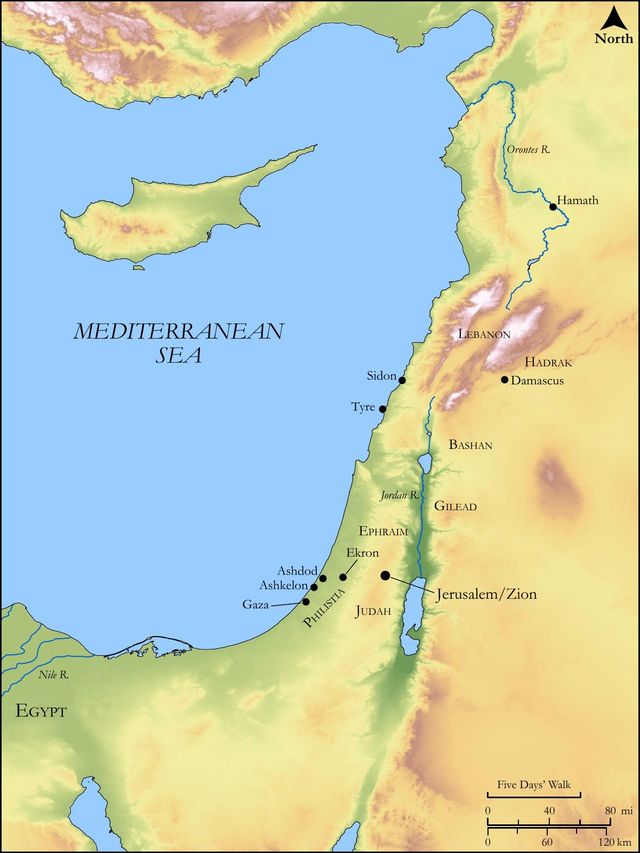
See on the biblical-era map
Study this verse
Public-domain commentary
Matthew Henry
From his Commentary on the Whole Bible. Henry comments on passages, not single verses — this entry covers Zechariah 10:1–4. His two-level outline is real structure in the source text, so it is rendered as structure.
Gracious things and glorious ones, very glorious and very gracious, were promised to this poor afflicted people in the foregoing chapter; now here God intimates to them that he will for these things be enquired of by them, and that he expects they should acknowledge him in all their ways and in all his ways towards them - and not idols that were rivals with him for their respects.
I.The prophet directs them to apply to God by prayer for rain in the season thereof.
He had promised, in the close of the foregoing chapter, that there should be great plenty of corn and wine, whereas for several years, by reason of unseasonable weather, there had been great scarcity of both; but the earth will not yield its fruits unless the heavens water it, and therefore they must look up to God for the dew of heaven, in order to the fatness and fruitfulness of the earth (Zac 10:1): "Ask you of the Lord rain. Do not pray to the clouds, nor to the stars, for rain, but to the Lord; for he it is that hears the heavens, when they hear the earth," Hos 2:21. Seasonable rain is a great mercy, which we must ask of God, rain in the time of the latter rain, when there is most need of it. The former rain fell at the seed-time, in autumn, the latter fell in the spring, between March and May, which brought the corn to an ear and filled it. If either of these rains failed, it was very bad with that land; for from the end of May to September they never had any rain at all. Jerome, who lived in Judea, says that he never saw any rain there in June or July. They are directed to ask for it in the time when it used to come. Note, We must, in our prayers, dutifully attend the course of Providence; we must ask for mercies in their proper time, and not expect that God should go out of his usual way and method for us. But, since sometimes God denied rain in the usual time as a token of his displeasure, they must pray for it then as a token of his favour, and they shall not pray in vain. Ask and it shall be given you. So the Lord shall make bright clouds (which, though they are without rain themselves, are yet presages of rain) - lightnings (so the margin reads it), for he maketh lightnings for the rain. He will give them showers of rain in great abundance, and so give to every one grass in the field; for God is universally good, and makes his rain to fall upon the just and the unjust.
II.He shows them the folly of making their addresses to idols as their fathers had done (Zac 10:2):
The idols have spoken vanity; the teraphim, which they courted and consulted in their distress, were so far from being able to command rain for them that they could not so much as tell them when they should have rain. They pretended to promise them rain at such a time, but it did not come. The diviners, who were the prophets of those idols, have seen a lie (their visions were all a cheat and a sham); and they have told false dreams, such as the event did not answer, which proved that they were not from God. Thus they comforted in vain those that consulted the lying oracles; all the vanities of the heathen put together could not give rain, Jer 14:22. Yet this was not the worst of it; they not only got nothing by the false gods, but they lost the favour of the true God, for therefore they went their way into captivity as a flock driven into the fold, and they were troubled with one vexation after another, as scattered sheep are, because there was no shepherd, no prince to rule them, no priest to intercede for them, none to take care of them and keep them together. Those that wandered after strange gods were made to wander, into strange nations.
III.He shows them the hand of God in all the events that concerned them, both those that made against them and those that made for them, Zac 10:3. Let them consider,
1.When every thing went cross it was God that walked contrary to them (Zac 10:3): "My anger was kindled against the shepherds that should have fed the flock, but neglected it, and starved it. I was displeased at the wicked magistrates and ministers, the idol-shepherds." The captivity in Babylon was a token of God's anger against them; in it likewise he punished the goats, those of the flock that were filthy and mischievous; they were set on the left hand, to go away into punishment. Though the body of the nation suffered in the captivity, yet it was only the goats and the shepherds that God was angry with, and that he punished; the same affliction to others came from the love of God, and was but a fatherly chastisement, which to them came from his wrath, and was a judicial punishment.
2.When things began to change for the better it was God that gave them the happy turn. "He has now visited his flock with favour, to enquire after them, and provides what he finds proper for them, and he has made them as his goodly horse in the battle, has beautified them, taken care of them, managed and made use of them, as a man does the horse he rides on, has made them valuable in themselves and formidable to those about them, as his goodly horse." It is God that makes us what we are, and it is with us as he appoints.
IV.He shows them that every creature is to them what God makes it to be (Zac 10:4): Out of him came forth the corner, out of him the nails.
1.All the power that was engaged against them was from God. Out of him came all the combined force of their enemies; every oppressor together (and the oppressors of Israel were not a few) did but what his hand and his counsel determined before to be done; nor could they have had such power against them unless it had been given them from above.
2.All the power likewise that was engaged for them was derived from him and depended on him. Out of him came forth the corner-stone of the building, the power of magistrates, which keeps the several parts of the state together. Princes are often called the corners of the people, as Sa1 14:38, marg. Out of him came forth the nail that fixed the state, the nail in the sure place (Isa 22:23), the nail in his holy place, Ezr 9:8. Out of him came forth the battle-bow, the military power, and out of him every oppressor, or exactor, that had the civil power in his hand; and therefore to God, the fountain of power, we must always have an eye, and see every man's judgment proceeding from him.
Historical interpretation
Historical reception
1 surviving comment on this verse from the historical church.
(Verse 3 and following) My anger is kindled against the shepherds, and I will punish the goats; for the Lord of hosts will visit his flock, the house of Judah, and make them like his majestic horse in battle. From him comes the cornerstone, from him the tent peg, from him the bow of battle; from him every oppressor comes forth together, and they shall be like mighty warriors trampling the mud of the streets in battle. They will fight, for the Lord is with them. (Septuagint: My anger is kindled against the shepherds, and I will punish the lambs; and the Lord God Almighty will visit his flock, the house of Judah, and make them like his majestic horse in battle. From him he looked upon, and from him he set, and from him the bow in wrath will come forth; from him every one who brings forth together, and they shall be like warriors trampling the mud of the streets in battle, and they shall be prepared, for the Lord is with them.) And in this place there are two explanations of the Jews. For some believe that everything will be accomplished in the coming of Christ: others believe that it has already been accomplished under the Maccabees. And this is the explanation of what the Lord promises: The Lord is angry with the shepherds, rulers, and priests, and with the goats, and he visited the people, according to what is written: My people have become lost sheep, the shepherds have driven them away (Jer. L, 6), so that the disciples would be punished for the fault of their masters: not by the injustice of the judge, who renders the sins of the fathers onto the children; but because, when they sinned, the people applauded them together: and at that time, the Lord visited his goats, or the fattest lambs, and made them, according to the Septuagint, dry with drought. But afterwards the Almighty Lord visited his flock, the house of Judah: for he raised up Judas Maccabaeus, and others with him, against the leaders of Antioch, and he set them up like horses of his glory in battle, that is, those who were born of his lineage: for they oppressed the Macedonians for a long time. And what follows: From him comes the cornerstone, from him comes the peg, from him comes the bow of battle, from him comes every tax collector together, which metaphorically they understand, interpreting the cornerstone as royal power, because it encompasses the very walls. And from it, he says, comes the staff, that is, the priesthood. Read Isaiah, in which Eliakim is depicted in the temple of God as a staff (Isa. XXII). From it comes the bow of battle, the strong for war: from it also comes every exactor, which in Hebrew is written as Noges (), and Aquila interprets it as εἰσπράσσων: so that not only the strong and good, but also others unworthy of their own kind. For Judas Maccabeus and all who were leaders of his people from his lineage were angles; for they held the people in royal power, and they were the staffs themselves, and as bows of battle, because they were the strongest men, not only to arrange the army and battle line, but also to be the first to leap into battle. We can gather from this that: From him will come every exactor together (for whom the seventy were transferred): From him will come everyone who brings out together, and this means: There will be no dignity in the army that is not determined by his judgment. And there will be mighty men, trampling the Macedonians like mud on the roads in battle: they will indeed be mighty, and they will fight, because the Lord is with them. Our people refer these things to the time of persecution, because frequently even the people are handed over to the adversaries for the fault of the priests: and yet the Almighty Lord visits afterwards his flock, the house of Judah, who confesses God both in words and in heart: and he makes them like a horse of his glory in war, of which the saints say: Mount your horses, and your riding is salvation (Hab. 3:8). He himself will be both the bow and the fury of the Lord, of which it is said: I will make my arrows drunk with blood (Deut. XXXII, 42) . And again: My arrows will consume them. Concerning this bow and these arrows, we read in the seventh Psalm (Vers. 13, 14) : He stretched out his bow and prepared it; and in it he prepared vessels of death, he made his arrows burn like fire. And they will trample on their adversaries, crowned in martyrdom, and they will say: The Lord is my light and my salvation, whom shall I fear? The Lord is the protector of my life, from whom shall I fear? When those who do me harm draw near to devour my flesh, my enemies who trouble me shall stumble and fall. Even if armies camp against me, my heart shall not fear. Even if battle arises against me, in this I will trust. (Psalm 27:1-3) When will this saying be fulfilled: one of you will chase a thousand, and two will put ten thousand to flight? (Deuteronomy 32)
Continue studying Zechariah 10:4 across the web’s major study libraries — every link below opens this exact verse, chapter, or book on the destination site.
Read & Compare
 BibleGatewayThis verse in more than 200 translations and 70 languages.
 Bible.comThe YouVersion reader — hundreds of translations, reading plans, and highlights.
 ESV.orgCrossway's official English Standard Version reader.
 NET BibleThe NET translation with 60,000+ translators' notes on every rendering decision.
 STEP BibleTyndale House's free study tool — original text, vocabulary, and scholarly resources.
 BibliaLogos Bible Software's free web reader.
 USCCBThe New American Bible (Revised Edition) with the U.S. bishops' study notes.
Commentaries
 BibleHub CommentariesDozens of classic commentaries on this verse, gathered on one page.
 StudyLightMore than 100 commentary sets — the largest collection on the web.
 BibleRefPlain-English commentary on what this verse means, verse by verse.
 Enduring WordDavid Guzik's free commentary on this chapter, widely used by Bible teachers.
 Bible Study ToolsVerse commentary alongside Greek and Hebrew study aids.
Original Language & Research
- BibleHub InterlinearThe verse word by word — original language, transliteration, and English.
- BibleHub LexiconEvery word's original-language definition and Strong's entry.
 Blue Letter BibleDeep-study tools — Strong's numbers, concordance, and word studies.
 SefariaThe Hebrew text with Rashi and centuries of Jewish commentary.
Sermons, Hymns & Audio


TrulyRandomVerse is not affiliated with these sites and doesn’t control their content. They’re linked because they’re genuinely useful.
Summary
Zechariah 10:4 is a powerful prophetic declaration affirming that God will raise up from His people, Judah, all the necessary components for their restoration, stability, defense, and righteous governance. Far from relying on external powers or false leadership, the Lord Himself will empower and equip His chosen remnant with foundational leaders (cornerstone), steadfast support (nail), military might (battle bow), and the capacity to overcome all forms of oppression, uniting these strengths for His purposes.
Context
ShowHideLiterary Context
Zechariah 10:4 is situated within the latter half of the book (chapters 9-14), which shifts from visions of judgment and restoration to a more direct prophetic oracle concerning the future of Judah and Jerusalem. Specifically, it follows Zechariah 10:1-3, where the prophet urges the people to seek rain (blessing) from the Lord, not from idols, and condemns the false shepherds (leaders) who have misled the flock. God declares His intention to visit His flock, the house of Judah, and make them "as His goodly horse in the battle" (Zechariah 10:3). This sets the immediate stage for verse 4, which elaborates on how God will empower Judah, detailing the specific types of leadership and strength that will emerge from within them, rather than from external sources or corrupt existing structures. The passage emphasizes divine agency in raising up genuine, effective leadership for His people's deliverance and triumph.
Historical & Cultural Context
Zechariah prophesied after the Babylonian exile, during the period of the Second Temple's reconstruction (c. 520-518 BC). The returned exiles faced significant challenges, including internal disunity, external opposition from surrounding peoples, and a general sense of vulnerability and discouragement. They longed for the restoration of their former glory and sovereignty. In this context, the imagery of "corner," "nail," "battle bow," and "oppressor" would resonate deeply. A "corner" (cornerstone) was crucial for building stability; a "nail" (tent peg) was essential for securing shelter and possessions; a "battle bow" was a primary weapon for defense and conquest. The "oppressor" (or taskmaster) represented the foreign powers and internal corruption that had long afflicted Israel. The prophecy, therefore, speaks directly to their immediate needs for strong, God-ordained leadership and the means to secure their future against adversaries, assuring them that these vital elements would arise from within their own ranks through divine empowerment.
Key Themes
ShowHideThis verse powerfully contributes to several overarching themes in Zechariah and the broader prophetic literature. A primary theme is Divine Sovereignty and Empowerment, as God Himself is the ultimate source of the strength and leadership that emerges from Judah. It underscores the theme of Restoration and Deliverance, promising that God will not abandon His people but will equip them to overcome their adversaries and establish a secure future, echoing the promises found in Zechariah 9:9-10. The verse also highlights Righteous Leadership, contrasting the divinely appointed leaders with the "false shepherds" condemned earlier in Zechariah 10:2-3. Finally, it speaks to the theme of Messianic Anticipation, as the imagery of the "cornerstone" and the righteous ruler points forward to the ultimate leader and deliverer, the Messiah, who would perfectly embody these qualities, a theme further developed in Zechariah 9:9.
Exposition and Analysis
ShowHideKey Word Analysis
ShowHideThis primitive root signifies "to go out" or "to bring forth" in a wide variety of applications. In Zechariah 10:4, its active voice emphasizes divine agency: God is the one who causes these essential elements to "come forth" or "emerge" from Judah. It highlights that the leadership, stability, and military strength are not self-generated but divinely appointed and empowered.
From a root meaning "angle," this feminine noun refers to a corner, specifically a cornerstone or a pinnacle. Figuratively, it denotes a chieftain, a leader, or a chief support. In architectural terms, the cornerstone is foundational and crucial for the stability and alignment of the entire structure. Its use here points to a principal, foundational leader or group of leaders who provide stability and direction for the community.
This word refers to a peg, particularly a tent peg or a large nail used for securing things. It symbolizes reliability, stability, and a fixed, dependable point of support. Just as a tent peg secures a dwelling, this "nail" represents a person or institution that provides steadfastness and holds the community together, preventing collapse or disarray.
A primitive root meaning "to drive" (an animal, a workman, a debtor, an army). By implication, it means to tax, harass, or tyrannize. While often translated negatively as "oppressor" or "taskmaster," it can also simply mean an "exactor" or "ruler." In this context, given the preceding "battle bow," the KJV's translation "oppressor" likely refers to the defeat of those who impose hardship. However, some interpretations suggest that Judah will produce every type of ruler, including those who exact tribute or govern, thus signifying complete self-governance and authority over all aspects of their society. The context of battle and deliverance leans toward the former, implying victory over those who oppress.
Verse Breakdown
ShowHide"Out of him came forth the corner"
"Him" refers to Judah, as established in Zechariah 10:3. This clause declares that from within Judah itself, God will raise up the "cornerstone"—a foundational leader or a series of leaders who will provide stability, direction, and the essential support upon which the restored nation will be built. This is a promise of divinely appointed, internal leadership.
"out of him the nail"
Continuing the theme of internal empowerment, this phrase signifies that from Judah will also emerge the "nail" or "peg." This represents a reliable, steadfast source of support and authority, someone or something that provides security and holds the community together, preventing its unraveling. It speaks to the establishment of enduring and trustworthy structures or individuals.
"out of him the battle bow"
This clause indicates that Judah will also be the source of military strength and the means of defense and victory. The "battle bow" symbolizes the instruments of warfare and the capacity to engage and overcome enemies. This is a promise of divine equipping for physical and spiritual triumph against adversaries, empowering Judah to defend itself and execute God's judgment.
"out of him every oppressor together"
This final phrase, building on the preceding elements, means that from Judah will come those who confront and overcome all forms of oppression. The term "oppressor" (Hebrew nâgas) can refer to a taskmaster or exactor. In conjunction with "battle bow," it strongly implies that Judah will be empowered to defeat those who tyrannize or impose hardship, signifying complete liberation and the establishment of self-rule where righteous authority prevails over all forms of subjugation.
Literary Devices
ShowHideZechariah 10:4 employs rich Symbolism to convey its message of divine empowerment and restoration. The "corner" (cornerstone) symbolizes foundational leadership, stability, and importance, often with messianic undertones. The "nail" or "peg" represents reliability, security, and steadfast support, crucial for holding things together. The "battle bow" is a clear symbol of military might, defense, and the ability to achieve victory over enemies. The phrase "every oppressor together" uses Synecdoche, where "oppressor" stands for all forms of tyranny and opposition, implying a comprehensive victory. The repeated phrase "Out of him" (Hebrew mimmennu) functions as an Anaphora, emphasizing that Judah itself, by divine design, will be the source from which these vital elements of restoration and strength emerge, highlighting God's direct agency in raising up His people.
Theological and Thematic Connections
ShowHideZechariah 10:4 profoundly underscores God's commitment to His covenant people, demonstrating His active role in raising up the necessary leadership and resources from within them for their deliverance and flourishing. It reveals a God who does not abandon His flock but personally intervenes to provide stability, strength, and victory. This divine empowerment ensures that the restoration is not merely external but deeply rooted in God's work through His chosen instruments, setting a pattern for how God equips His people for His purposes throughout history, ensuring that true authority and strength originate from Him.
Reflection and Application
ShowHideZechariah 10:4 offers profound encouragement and practical guidance for believers today. It reminds us that true strength, stability, and effective leadership for God's purposes do not primarily come from external sources, human ingenuity, or worldly power structures, but are divinely raised up and empowered from within His people. Just as God equipped Judah with its "corner," "nail," and "battle bow," He continues to equip His church and individual believers with spiritual gifts, wisdom, and courage to serve as foundational pillars of truth, steadfast sources of support, and instruments of spiritual warfare against the forces of oppression in our world. We are called to recognize and affirm God's hand in raising up leaders, to be those who provide stability and support in our communities, and to actively engage in the spiritual battles of our time, trusting that God provides the necessary tools and authority for His kingdom to advance. Our hope for overcoming challenges and seeing God's purposes fulfilled rests not in our own abilities, but in His faithful provision and empowerment from within His people.
Questions for Reflection
ShowHideFAQ
ShowHideDoes Zechariah 10:4 refer to the Messiah?
ShowHideWhile Zechariah 10:4 primarily refers to leaders and instruments of deliverance raised up from Judah in the immediate post-exilic context, the imagery, particularly "the corner" (cornerstone), has strong messianic overtones. The concept of a divinely appointed, foundational leader who brings stability and victory ultimately finds its perfect fulfillment in Jesus Christ. Passages like Psalm 118:22 and Isaiah 28:16 explicitly use "cornerstone" to refer to the Messiah. Therefore, while not directly naming Him, Zechariah 10:4 points to the kind of leadership that culminates in Christ.
What does "every oppressor together" mean in this context?
ShowHideThe phrase "every oppressor together" (Hebrew kol noges yachad) can be interpreted in a few ways, but given the context of "battle bow" and the broader theme of deliverance, the most common understanding is that from Judah will come those who will conquer or overcome all forms of oppressors or taskmasters. This signifies complete liberation from tyranny and the establishment of righteous self-governance. It implies that Judah will be empowered to defeat all adversaries who seek to subjugate them, whether foreign powers or internal corruption, thus bringing an end to their oppression.
Christ-Centered Fulfillment
ShowHideZechariah 10:4 finds its ultimate and most profound fulfillment in Jesus Christ. He is the preeminent "corner"—the Chief Cornerstone upon whom the entire spiritual temple, the Church, is built, as declared in Ephesians 2:20 and 1 Peter 2:6. He is the "nail" or "peg" in a sure place, the one who provides ultimate stability and reliability, holding all things together by His power (Colossians 1:17). Furthermore, Christ is the victorious "battle bow," the mighty warrior who has triumphed over all spiritual adversaries, disarming principalities and powers through His cross (Colossians 2:15). He came forth from Judah, a descendant of David, to liberate humanity from the ultimate "oppressor"—sin and death—and from the tyranny of Satan (Hebrews 2:14-15). Thus, Zechariah 10:4 is a prophetic glimpse into the comprehensive, divinely empowered leadership and deliverance that would one day be fully realized in the person and work of Jesus Christ, the true King and Shepherd of His people.