


Numbers 22:39
Bible text: King James Version (1769 Blayney text) · Public domain
Bible text: Berean Standard Bible · Public domain
Bible text: American Standard Version (1901) · Public domain
Bible text: World English Bible, Messianic edition · Public domain
Bible text: Geneva Bible (1599) · Public domain
Bible text: Young's Literal Translation · Public domain
- וַיֵּלֶךְvai·Ye·lekhand he wentH1980Conj-w ¦ V-Qal-ConsecImperf-3msVerb Qal Consecutive Imperfect 3rd Singular Masculineוַandיֵּלֶךְhe went
- בִּלְעָםbil·'AmBalaamH1109N-proper-mNoun Proper Masculine
- עִם'imwithH5973PrepPreposition
- בָּלָקba·LakBalakH1111N-proper-mNoun Proper Masculine
- וַיָּבֹאוּvai·ya·Vo·'uand they cameH935Conj-w ¦ V-Qal-ConsecImperf-3mpVerb Qal Consecutive Imperfect 3rd Plural Masculineוַandיָּבֹאוּthey came
- קִרְיַתkir·YatKiriath-H7155N-properNoun Proper Location
- חֻצוֹתchu·TzothuzothH7155N-properNoun Proper Location
English is a literal word-by-word gloss of the Hebrew, not the KJV's wording. Why?
This is the original text the KJV's translators worked from — each Hebrew word with its own literal English meaning in this verse, prepared by scholars at Tyndale House, Cambridge. The KJV translates whole sentences, not word by word, so its wording differs: one Hebrew word can become several English words, and the KJV may choose “the LORD” where the gloss reads “Yahweh”. Both are faithful — they answer different questions. For the KJV's own rendering, switch to the KJV text.
Details
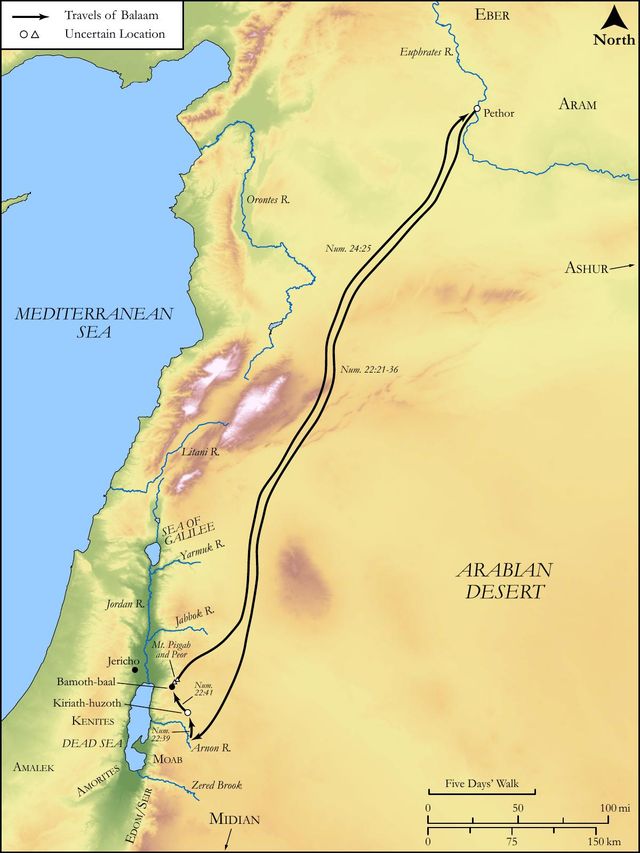
See on the biblical-era map
Study this verse
Public-domain commentary
Matthew Henry
From his Commentary on the Whole Bible. Henry comments on passages, not single verses — this entry covers Numbers 22:36–41.
We have here the meeting between Balak and Balaam, confederate enemies to God's Israel; but here they seem to differ in their expectations of the success. 1. Balak speaks of it with confidence, not doubting but to gain his point now that Balaam had come. In expectation of this, he went out to meet him, even to the utmost border of his country (Num 22:36), partly to gratify his own impatient desire to see one he had such great expectations from, and partly to do honour to Balaam, and so to engage him with his utmost power to serve him. See what respect heathen princes paid to those that had but the name and face of prophets, and pretended to have any interest in heaven; and how welcome one was that came with his mouth full of curses. What a shame is it then that the ambassadors of Christ are so little respected by most, so much despised by some, and that those are so coldly entertained who bring tidings of peace and a blessing! Balak has now nothing to complain of but that Balaam did not come sooner, Num 22:37. And he thinks that he should have considered the importunity Balak had used, Did I not earnestly send to thee? (and the importunity of people inferior to kings has prevailed with many against their inclinations), and that he should also have considered Balak's intentions concerning him: Am not I able to promote thee to honour? Balak, as king, was in his own kingdom the fountain of honour, and Balaam should have his choice of all the preferments that were in his gift; he therefore thinks himself affronted by Balaam's delays, which looked as if he thought the honours he prepared not worthy his acceptance. Note, Promotion to honour is a very tempting bait to many people; and it were well if we would be drawn into the service of God by the honour he sets before us. Why do we delay to come unto him? Is not he able to promote us to honour? 2. Balaam speaks doubtfully of the issue, and bids Balak not depend to much upon him (Num 22:38): "Have I now any power at all to say any thing? I have come, but what the nearer am I? Gladly would I curse Israel; but I must not, I cannot, God will not suffer me." He seems to speak with vexation at the hook in his nose and the bridle in his jaws, such as Sennacherib was tied up with, Isa 37:29. 3. They address themselves with all speed to the business. Balaam is nobly entertained over night, a sacrifice of thanksgiving is offered to the gods of Moab, for the safe arrival of this welcome guest, and his is treated with a feast upon the sacrifice, Num 22:40. And the next morning, that no time might be lost, Balak takes Balaam in his chariot to the high places of his kingdom, not only because their holiness (such as it was), he thought, might give some advantage to his divinations, but their height might give him a convenient prospect of the camp of Israel, which was to be the butt or mark at which he must shoot his envenomed arrows. And now Balaam is really as solicitous to please Balak as ever he had pretended to be to please God. See what need we have to pray every day, Our Father in heaven, lead us not into temptation.
Continue studying Numbers 22:39 across the web’s major study libraries — every link below opens this exact verse, chapter, or book on the destination site.
Read & Compare
 BibleGatewayThis verse in more than 200 translations and 70 languages.
 Bible.comThe YouVersion reader — hundreds of translations, reading plans, and highlights.
 ESV.orgCrossway's official English Standard Version reader.
 NET BibleThe NET translation with 60,000+ translators' notes on every rendering decision.
 STEP BibleTyndale House's free study tool — original text, vocabulary, and scholarly resources.
 BibliaLogos Bible Software's free web reader.
 USCCBThe New American Bible (Revised Edition) with the U.S. bishops' study notes.
Commentaries
 BibleHub CommentariesDozens of classic commentaries on this verse, gathered on one page.
 StudyLightMore than 100 commentary sets — the largest collection on the web.
 BibleRefPlain-English commentary on what this verse means, verse by verse.
 Enduring WordDavid Guzik's free commentary on this chapter, widely used by Bible teachers.
 Bible Study ToolsVerse commentary alongside Greek and Hebrew study aids.
Original Language & Research
- BibleHub InterlinearThe verse word by word — original language, transliteration, and English.
- BibleHub LexiconEvery word's original-language definition and Strong's entry.
 Blue Letter BibleDeep-study tools — Strong's numbers, concordance, and word studies.
 SefariaThe Hebrew text with Rashi and centuries of Jewish commentary.
Sermons, Hymns & Audio


TrulyRandomVerse is not affiliated with these sites and doesn’t control their content. They’re linked because they’re genuinely useful.
Summary
Numbers 22:39 marks the pivotal arrival of Balaam, the renowned diviner of Mesopotamia, and Balak, the fearful king of Moab, at Kirjathhuzoth. This seemingly simple geographical detail signifies the culmination of a divinely orchestrated journey, positioning Balaam precisely where Balak intended him to curse Israel. Yet, this moment sets the stage for God's dramatic demonstration of absolute sovereignty, as He would supernaturally transform every intended malediction into a blessing, powerfully affirming His unassailable purposes for His chosen people and the futility of human opposition.
Context
ShowHideLiterary Context
This verse immediately follows the dramatic and revelatory encounter between Balaam and the Angel of the Lord, mediated by Balaam's donkey. Despite God's initial prohibition against accompanying Balak's envoys, clearly stated in Numbers 22:12, Balak's persistent entreaties and increased rewards led God to permit Balaam to go, but with the strict caveat that he was to speak only what God commanded, as reiterated in Numbers 22:20 and Numbers 22:35. The journey itself was fraught with divine intervention, culminating in the Angel of the Lord confronting Balaam directly, revealing the donkey's supernatural sight and reiterating the divine mandate. Thus, the arrival at Kirjathhuzoth is not merely a geographical marker but the divinely orchestrated culmination of a journey, setting the stage for the prophetic pronouncements that will dominate the subsequent chapters of Numbers 23 and Numbers 24.
Historical & Cultural Context
Among the nations, it was a common and deeply ingrained practice for kings and peoples to employ diviners, seers, or prophets to gain an advantage in warfare or to secure prosperity. This often involved invoking curses upon enemies or blessings upon their own armies, believing that such spiritual pronouncements held tangible power. Balak, as the king of Moab, was profoundly fearful of the numerous Israelites encamped on his border, having witnessed their decisive victories over the Amorites, recounted in Numbers 21:21-35. His desperate decision to hire Balaam, a renowned diviner from Pethor on the Euphrates, reflects this pervasive cultural practice and his attempt to counter Israel's perceived threat through potent spiritual means. Kirjathhuzoth, meaning "city of streets" or "city of villages," likely implies a prominent or accessible location, suitable for a public declaration of curses, which would have been the expected ritual. This setting underscores Balak's intention for a public, potent spiritual assault on Israel.
Key Themes
ShowHideThe narrative of Balaam and Balak, culminating in this arrival, powerfully underscores several key themes central to the book of Numbers and broader biblical theology. Firstly, Divine Sovereignty and Control is paramount; despite Balak's human machinations and Balaam's initial mercenary inclinations, God remains in absolute control of the prophetic word, turning intended curses into blessings. This highlights that no human will or power can thwart God's sovereign purposes for His chosen people, as seen throughout the wilderness journey. Secondly, the Conflict of Motives within Balaam is evident: he is drawn by the allure of Balak's rewards, a "love of money" that is explicitly condemned in the New Testament (e.g., 2 Peter 2:15 and Jude 1:11), yet he is supernaturally constrained to speak only God's truth. This tension between personal gain and divine obedience serves as a profound cautionary tale. Lastly, the arrival at Kirjathhuzoth signifies Preparation for Prophecy, marking the transition from Balaam's journey and internal struggle to the public delivery of God's word, which would profoundly bless Israel and reveal future messianic hope, including the prophecy of a "star" and "scepter" from Jacob in Numbers 24:17.
Exposition and Analysis
ShowHideKey Word Analysis
ShowHideProbably from בַּל and עַם; meaning "not (of the) people," i.e., foreigner; Bilam, a prophet of Mesopotamia. Balaam is presented as a non-Israelite diviner from Pethor, whose reputation for powerful blessings and curses was widespread among the nations. His character is complex: he acknowledges the Lord and seeks His will, yet he is also driven by greed and ultimately advises Balak on how to tempt Israel into idolatry and immorality (Numbers 31:16). His journey and oracles are a profound testament to God's ability to use even compromised individuals to accomplish His divine purposes, demonstrating His ultimate control over all human words and actions.
From בָּלַק; meaning "waster"; Balak, a Moabitish king. Balak, the son of Zippor, is portrayed as the fearful and hostile king of Moab, representing the nations surrounding Israel who sought to thwart their progress. His desperate attempt to use spiritual means (hiring Balaam) to counter the perceived threat of the advancing Israelites highlights the futility of opposing God's plan. His persistent efforts to induce Balaam to curse Israel, and his subsequent frustration, underscore the unassailable nature of God's covenant promises to His people.
From קִרְיָה and the feminine plural of חוּץ; meaning "city of streets" or "city of villages." This name suggests a prominent, open, or public location, rather than a secluded one. Its significance lies in its function as the designated place from which Balaam was expected to perform his divinations and pronounce the curses. This emphasizes the public and official nature of the impending confrontation, as Balak intended a grand, ritualistic cursing. However, the narrative will reveal the profound irony, as this public stage becomes the platform for God's public blessing of Israel.
Verse Breakdown
ShowHide"And Balaam went with Balak"
This clause signifies the successful completion of Balak's mission to bring Balaam to Moab, marking the culmination of intense negotiations and the dramatic encounter with the Angel of the Lord. Despite the divine warnings and Balaam's initial reluctance, he has now fully committed to accompanying the king, setting the stage for the direct confrontation between Balak's will and God's sovereign plan. This phrase underscores the human agency involved, yet it is enveloped within the larger framework of divine permission and control.
"and they came unto Kirjathhuzoth"
This specifies the destination, a "city of streets," implying a public and visible location. Their arrival at this particular place is crucial as it is from here that Balaam will begin to utter his oracles. The choice of location underscores Balak's intention for a public, ritualistic cursing of Israel, believing that the physical proximity and the diviner's pronouncements would be effective. However, the narrative will soon reveal the profound irony of Balak's plans, as this very public stage will become the platform for God's public and undeniable blessing of Israel.
Literary Devices
ShowHideNumbers 22:39, though concise, effectively employs several literary devices to convey its profound significance. Setting is paramount, as the arrival at Kirjathhuzoth provides the physical backdrop for the dramatic prophetic pronouncements that are about to unfold. The name itself, "city of streets," subtly suggests a public arena, enhancing the sense of anticipation and the grand scale of Balak's intentions. There is a strong element of Foreshadowing, as this arrival directly precedes Balaam's oracles, building narrative tension and signaling the imminent climax of this section of Numbers. The reader, aware of Balaam's divine constraint from the preceding narrative, perceives a deep Irony between Balak's expectations of a devastating curse and the divinely mandated blessings that will actually be delivered. The simple declarative statement of their arrival belies the profound theological and narrative significance of this moment, serving as a crucial Transition point from Balaam's journey and internal struggle to the public delivery of God's sovereign word.
Theological and Thematic Connections
ShowHideNumbers 22:39, though brief, serves as a powerful theological pivot, demonstrating God's absolute sovereignty over human plans and even over the words of a diviner. It underscores the profound truth that no weapon formed against God's chosen people can ultimately prosper if God is for them. Balak's desperate attempt to manipulate spiritual forces for political gain is utterly subverted by divine will, revealing that God's purposes for Israel are unassailable and His promises inviolable. This narrative prefigures the ultimate triumph of God's kingdom and His protective hand over His covenant people throughout history, reminding believers that divine promises are inviolable and God's control extends to every circumstance, even those seemingly orchestrated by adversaries. It assures us that even when evil intentions are at play, God can turn them for good.
Reflection and Application
ShowHideThe arrival of Balaam and Balak at Kirjathhuzoth is a profound reminder that even when human intentions are set against God's will, His ultimate plan cannot be thwarted. We often face situations where adversaries, or even our own misguided desires, seem to be setting us up for failure or harm. This verse powerfully illustrates that God is sovereign over all circumstances, even the seemingly mundane details of travel and location. It encourages us to trust implicitly in God's protective hand over our lives and His church, knowing that He can turn intended curses into blessings and use even the schemes of the wicked to achieve His righteous ends. Like Balaam, we may be tempted by worldly gain, public pressure, or personal ambition to compromise our integrity or deviate from God's revealed will. However, true wisdom, lasting peace, and genuine blessing are found not in pursuing personal advantage, but in humbly submitting to God's direction, speaking only what He commands, and resting in His unwavering faithfulness to His promises. This narrative calls us to a deeper reliance on God's omnipotence and a greater commitment to obedience, regardless of external pressures.
Questions for Reflection
ShowHideFAQ
ShowHideWhat is the significance of Kirjathhuzoth in this narrative?
ShowHideKirjathhuzoth, meaning "city of streets" or "city of villages," is significant primarily as the designated location from which Balak intended Balaam to pronounce curses upon Israel. Its name suggests a public or accessible place, implying that Balak desired a grand, public, and ritualistic cursing. However, its true significance lies in the irony of its purpose: what was intended as a platform for curses became the stage for God's divinely mandated blessings, demonstrating His absolute control over Balaam's words and His unwavering protection of Israel. It serves as a physical marker for the transition from the journey and anticipation to the actual prophetic pronouncements, highlighting God's ability to subvert human plans for His own glorious purposes.
Why did Balaam go with Balak despite God's initial command not to?
ShowHideGod's initial command to Balaam was unequivocally "You shall not go with them; you shall not curse the people, for they are blessed" (Numbers 22:12). However, Balak persisted, sending more distinguished and numerous officials with greater promises of reward. Balaam, though he claimed to only speak God's word, was clearly tempted by the allure of wealth and honor, a "love of money" that is later condemned in the New Testament (2 Peter 2:15). When Balaam pressed God again, God permitted him to go, but with the strict caveat that he must "do only what I tell you" (Numbers 22:20). This permission was not an endorsement of Balaam's greed but a demonstration of God's ability to use even a compromised individual to fulfill His purposes, turning Balaam's journey into a profound lesson in divine sovereignty and the futility of human opposition to God's will.
Christ-Centered Fulfillment
ShowHideThe narrative of Balaam, culminating in his arrival at Kirjathhuzoth, finds profound Christ-centered fulfillment in the ultimate authority and redemptive work of Jesus Christ. Just as God supernaturally controlled Balaam's tongue, turning every intended curse into a blessing for Israel, so too does Christ possess all authority in heaven and on earth (Matthew 28:18). He is the true and faithful prophet, not constrained by human greed or external pressure, but speaking the very words of God, for He has come to do the Father's will (John 12:49-50). The unwavering protection God afforded Israel from Balaam's curses foreshadows the ultimate security and blessing found in Christ for His church, the new Israel. Through His atoning sacrifice on the cross, Christ bore the ultimate curse of sin, becoming a curse for us, thereby ensuring that no curse can stand against those who are in Him (Galatians 3:13). He is the Lamb of God who takes away the sin of the world (John 1:29), transforming the curse of death into the blessing of eternal life and victory over all spiritual opposition. Thus, Balaam's inability to curse God's people points forward to Christ's definitive triumph, securing an eternal and unassailable blessing for all who believe.