


Nahum 3:15
Bible text: King James Version (1769 Blayney text) · Public domain
Bible text: King James Version with Strong's numbers · Public domain
Bible text: Berean Standard Bible · Public domain
Bible text: American Standard Version (1901) · Public domain
Bible text: World English Bible, Messianic edition · Public domain
Bible text: Geneva Bible (1599) · Public domain
Bible text: Young's Literal Translation · Public domain
- שָׁםShamthereH8033AdvAdverb
- תֹּאכְלֵךְto·khe·Lekhit will consume youH398V-Qal-Imperf-3fs ¦ 2fsVerb Qal Imperfect 3rd Singular Feminineתֹּאכְלֵit will consumeךְyou
- אֵשׁ'EshfireH784N-csNoun Singular common gender Absolute
- תַּכְרִיתֵךְtakh·ri·Tekhit will cut off youH3772V-Hiphil-Imperf-3fs ¦ 2fsVerb Hiphil Imperfect 3rd Singular Feminineתַּכְרִיתֵit will cut offךְyou
- חֶרֶבChe·rev[the] swordH2719N-fsNoun Singular Feminine Absolute
- תֹּאכְלֵךְto·khe·Lekhit will consume youH398V-Qal-Imperf-3fs ¦ 2fsVerb Qal Imperfect 3rd Singular Feminineתֹּאכְלֵit will consumeךְyou
- כַּיָּלֶקkai·Ya·leklike the locustH3218Prep-k ¦ N-msNoun Singular Masculine Absoluteכַּlike theיָּלֶקlocust
- הִתְכַּבֵּדhit·ka·Bedmake yourself numerousH3513V-Hithpael-Imp-2msVerb Hithpael Imperative 2nd Singular Masculine
- כַּיֶּלֶקkai·Ye·leklike the locustH3218Prep-k ¦ N-msNoun Singular Masculine Absoluteכַּlike theיֶּלֶקlocust
- הִתְכַּבְּדִיhit·ka·be·Dimake yourself numerousH3513V-Hithpael-Imp-2fsVerb Hithpael Imperative 2nd Singular Feminine
- כָּאַרְבֶּהka·'ar·Behlike the locustH697Prep-k ¦ N-msNoun Singular Masculine Absoluteכָּlike theאַרְבֶּהlocust
English is a literal word-by-word gloss of the Hebrew, not the KJV's wording. Why?
This is the original text the KJV's translators worked from — each Hebrew word with its own literal English meaning in this verse, prepared by scholars at Tyndale House, Cambridge. The KJV translates whole sentences, not word by word, so its wording differs: one Hebrew word can become several English words, and the KJV may choose “the LORD” where the gloss reads “Yahweh”. Both are faithful — they answer different questions. For the KJV's own rendering, switch to the KJV text.
Details
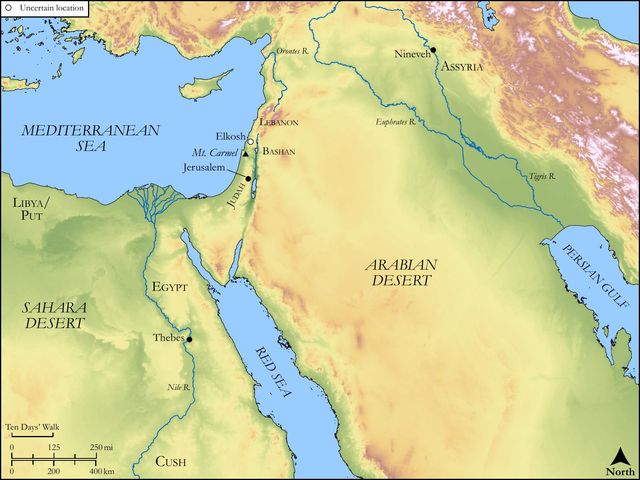
See on the biblical-era map
Study this verse
Public-domain commentary
Matthew Henry
From his Commentary on the Whole Bible. Henry comments on passages, not single verses — this entry covers Nahum 3:8–19. His three-level outline is real structure in the source text, so it is rendered as structure.
Nineveh has been told that God is against her, and then none can be for her, to stand her in any stead; yet she sets God himself at defiance, and his power and justice, and says, I shall have peace. Threatened folks live long; therefore here the prophet largely shows how vain her confidences would prove and insufficient to ward off the judgment of God. To convince them of this,
I.He shows them that other places, which had been as strong and as secure as they, could not keep their ground against the judgments of God.
Nineveh shall fall unpitied and uncomforted (for miserable comforters will those prove who speak peace to those on whom God will fasten trouble), and she shall not be able to help herself: Art thou better than populous No? Nah 3:8. He takes them off from their vain confidences by quoting precedents. The city mentioned is No, a great city in the land of Egypt (Jer 46:25), No-Ammon, so some read it both there and here. We read of it, Eze 30:14-16. Some think it was Diospolis, others Alexandria. As God said to Jerusalem, Go, see what I did to Shiloh (Jer 7:12), so to Nineveh that great city, Go, see what I did to populous No. Note, It will help to keep us in a holy fear of the judgments of God to consider that we are not better than those that have fallen under those judgments before us. We deserve them as much, and are as little able to grapple with them. This also should help to reconcile us to afflictions. Are we better than such and such, who were in like manner exercised? Nay, were not they better than we, and less likely to be afflicted? Now, concerning No, observe,
1.How firm her standing seemed to be, Nah 3:8. She was fortified both by nature and art, was situate among the rivers. Nile, in several branches, not only watered her fields, but guarded her wall. Her rampart was the sea, the lake of Mareotis, an Egyptian sea, like the sea of Tiberias. Her wall was from the sea; it was fenced with a wall which was thought to make the place impregnable. It was also supported by its interests and alliances abroad, Nah 3:9. Ethiopia, or Arabia, was her strength, either by the wealth brought to her in a way of trade or by the auxiliary forces furnished for military service. The whole country of Egypt also contributed to the strength of this populous city; so that it was infinite, and there was no end of it (so it might be rendered); She set no bounds to her ambition and knew no end of her wealth and strength; people flocked to her endlessly, and she thought there never would be any end of it; but it is God's prerogative to be infinite. Put and Lubim were thy helpers, two neighbouring countries of Africa, Mauritania and Libya, that is, Libya Cyrenica, a country that Egypt had much dependence upon. No, thus helped, seemed to sit as a queen, and was not likely to see any sorrow. But,
2.See how fatal her fall proved to be (v, 10): Yet was she carried away, and her strength failed her; even she that was so strong, so secure, yet went into captivity. This refers to some destruction of that city which was then well-known, and probably fresh in memory, though not recorded in history; for the destruction of it by Nebuchadnezzar (if we should understand this prophetically) could not be made an example to Nineveh; for the reducing of Nineveh was one of the first of his victories and that of Egypt one of the last. The strength and grandeur of that great city could not be its protection from military execution.
(1.)Not from that which was most barbarous; for her young children had no compassion shown them, but were dashed in pieces at the top of all the streets by the merciless conquerors.
(2.)Not from that which was most inglorious and disgraceful: They cast lots for her honourable men that were made prisoners of war, who should have them for their slaves. So many had they of them that they knew not what to do with them, but they made sport with throwing dice for them; all her great men, that used to be adorned on state-days with chains of gold, were now bound in chains of iron; they were pinioned or handcuffed (so the word properly signifies), not only as slaves, but as condemned malefactors. What a mortification was this to populous No, to have her honourable men and great men, that were her pride and confidence, thus abused! Now hence he infers against Nineveh (Nah 3:11), "Thou also shalt be intoxicated, infatuated; thou also shalt reel and stagger, as drunk with the cup of the Lord's fury, that shall be put into thy hand" (see Jer 25:17, Jer 25:27); "Thou shalt fall and rise no more. The cup shall go round, and come to thy turn, O Nineveh! to drink off at last, and shall be to thee as the waters of jealousy."
II.He shows them that all those things which they reposed a confidence in should fail them.
1.Did the men of Nineveh trust to their own magnanimity and bravery? Their hearts should sink and fail them. They shall be hid, shall abscond for shame, being in disgrace, abscond for fear, being in distress and danger, and not able to face the enemies, because of whose strength and terror, having no strength of their own, they shall seek strength, shall come sneaking to their neighbours to beg their assistance in a time of need. Thus God can cut off the spirit of princes, and take away their heart.
2.Did they depend upon their barrier, the garrisons and strongholds they had, which were regularly fortified and bravely manned? Those shall prove but paper-walls, and like the first-ripe figs, which, if you give the tree but a little shake, will fall into the mouth of the eater that gapes for them; so easily will all their strongholds be made to surrender to the advancing enemy, upon the first summons, Nah 3:12. Note, Strongholds, even the strongest, are no fence against the judgments of God, when they come with commission. The rich man's wealth is his strong city, and a high wall, but only in his own conceit, Pro 18:10. They are supposed to make their strongholds as strong as possible, and are challenged to do their utmost to make them tenable, and serviceable to them against the invader (Nah 3:14): Draw thee water for the siege; lay in great quantities of water, that that which is so necessary to the support of human life may not be wanting; it is put here for all manner of provision, with which Nineveh is ironically told to furnish herself, in expectation of a siege. "Take ever so much care that thou mayest not be starved out, and forced by famine to surrender, yet that shall not avail. Fortify the strongholds, by adding out-works to them, or putting men and arms into them," as with us by planting cannon upon them. "Go into clay, and tread the mortar, and make strong the brick-kiln; take all the pains thou canst in erecting new fortifications; but it shall be all in vain, for (Nah 3:15) there shall even the fire devour thee if it be taken by storm." It is by fire and sword that in time of war the great devastations are made.
3.Did they put confidence in the multitude of their inhabitants? Were they, from their number and valour, reckoned their strongest walls and fortifications? Alas! these shall stand them in no stead; they shall but sink the sooner under the weight of their own numbers (Nah 3:13): Thy people in the midst of thee are women; they have no wisdom, no courage; they shall be fickle, feeble, and faint-hearted, as women commonly are in such times of danger and distress; they shall be at their wits' end, adding to their griefs and fears by the power of their own imagination, and utterly unable to do any thing for themselves; the valiant men shall become cowards. O ver Phrygiae, neque enim Phryges - Phrygian dames, not Phrygian men. Though they make themselves many (Nah 3:15), as the canker-worm and as the locust, that come in vast swarms, though thou hast multiplied thy merchants above the stars of heaven, though thy exchange be thronged with wealthy traders, who, having so much money to stand up in defence of and so much to lay out in the means of their defence, should, one would think, give the enemy a warm reception, yet their hearts shall fail them too; though they be numerous as caterpillars, yet the fire and sword shall eat them up easily and irresistibly as the canker-worm, Nah 3:15. They are as numerous as those wasting insects, but their enemies shall be mischievous like them. He adds (Nah 3:16), The canker-worm spoils, or spreads herself, and flies away. Both the merchants and the enemies were compared to canker-worms. The enemies shall spoil Nineveh, and carry away the spoil, without opposition, or any hope of recovering it. Or the rich merchants, who have come from abroad to settle in Nineveh, and have raised vast estates there, out of which it was hoped they would contribute largely for the defence of the city, when they see the country invaded and the city likely to be besieged, will send away their effects, and remove to some other place, will spread their wings and fly away where they may be safe, and Nineveh shall be never the better for them. Note, It is rare to find even those that have shared with us in our joys willing to share with us in our griefs too. The canker-worms will continue upon the field while there is any thing to be had, but they are gone when all is gone. Those that men have got by they do not care to lose by. Nineveh's merchants bid her farewell in her distress. Riches themselves are as the canker-worms, which on a sudden fly away as the eagle towards heaven, Pro 23:5.
4.Did they put a confidence in the strength of their gates and bars? What fence will those be against the force of the judgments of God? Nah 3:13. The gates of thy land shall be set wide open unto thy enemies, the gates of thy rivers (Nah 2:6), the flood-gates, or the passes and avenues, by which the enemy would make his entrance into the country, or the gates of the cities; these, though ever so strong and well-guarded, shall not answer their end: The fire shall devour thy bars, the bars of thy gates, and then they shall fly open.
5.Did they put a confidence in their king and princes? They should do them no service (Nah 3:17): Thy crowned heads are as the locusts; those that had pomp and power, as crowned heads, were enfeebled, and had no power to make resistance, when the enemy came in like a flood. "Thy captains, that should lead thy forces into the field, are great indeed, and look great, but they are as the great grasshoppers, the maximum quod sic - the largest specimens of that species; still they are but grasshoppers, worthless things, that can do no service. They encamp in the hedges, in the cold day, the cold weather, but, when the sun arises, they flee away, and are gone, nobody knows whither. So these mercenary soldiers that lay slumbering about Nineveh, when any trouble arises, flee away, and shift for their own safety. The hireling flees, because he is a hireling." The king of Assyria is told, and it is a shame he needs to be told it (who might observe it himself), that his shepherds slumber; they have no life or spirit to appear for the flock, and are very remiss in the discharge of the duty of their place and the trust reposed in them: Thy nobles shall dwell in the dust, and be buried in silence.
6.Did they hope that they should yet recover themselves and rally again? In this also they should be disappointed; for, when the shepherds are smitten, the sheep are scattered; the people are dispersed upon the mountains and no man gathers them, nor will they ever come together of themselves, but will wander endlessly, as scattered sheep do. The judgment they are under is as a wound, and it is incurable; there is no relief for it, "no healing of thy bruise, no possibility that the wound, which is so grievous and painful to thee, should be so much as skinned over; thy case is desperate (Nah 3:19) and thy neighbours, instead of lending a hand to help thee, shall clap their hands over thee, and triumph in thy fall; and the reason is, because thou hast been one way or other injurious to them all: Upon whom has not thy wickedness passed continually? Thou hast been always doing mischief to those about thee; there is none of them but what thou hast abused and insulted; and therefore they shall be so far from pitying thee that they shall be glad to see thee reckoned with." Note, Those that have been abusive to their neighbours will, one time or another, find it come home to them; they are but preparing enemies to themselves against their day comes to fall: and those that dare not lay hands on them themselves will clap their hands over them, and upbraid them with their former wickedness, for which they are now well enough served and paid in their own coin. The troublers shall be troubled will be the burden of many, as it is here the burden of Nineveh.
Historical interpretation
Historical reception
1 surviving comment on this verse from the historical church.
(Verse 13 onwards) Behold, your people, women in your midst: the gates of your land will be opened wide to your enemies: fire will devour your bars. Draw water for the siege: build your fortifications, go into the mud, and trample: force the brick. There the fire will consume you; you will perish by the sword, you will be devoured like the chigoe: gather therefore like the chigoe: multiply like the locust. You have made more deals than there are stars in the sky: the chigoe has spread out and flown away. Your guards are like locusts, and your little ones are like the grasshoppers of locusts, which settle in the hedges in the cold weather. The sun rises, and they have flown away, and the place where they were will not be known. LXX: Behold, your people are like women in you, opening the gates of your land to your enemies: fire devours your bars. Draw water for the siege, strengthen your fortifications: go into the mud and trample in the straw, strengthen it upon the brick. There the fire will devour you, the sword will scatter you; it will devour you like a locust. Multiply yourselves like the locust, multiply your trades like the stars of heaven. Yet even now, in Nineveh, it is said: 'Your strong men are like the ripe figs, which when shaken fall into the mouth of the eater. Your people have become effeminate and unable to resist.' Your gates will be opened wide, and the city will be exposed to the enemy. The strongest bars that secured the gates will be consumed by fire. So, gather water and make sure there is no shortage of drink for the besieged garrison: make bricks, so that you can build up the interrupted walls, for the siege is close at hand. And when you have done all these things, just as the earth is devoured by drought, so shall you be devoured by the sword. But even when you have multiplied like the drought and gathered together like locusts, and gathered together your riches like the stars of the sky, like locusts and drought, and the small offspring of locusts, which are called attelabi (Al. adtelebi), flying away when the sun grows hot, they are not found: thus you will disperse and flee. For it is the nature of locusts that they become sluggish in the cold and fly in the heat. Furthermore, the attelabus, which the eagle interprets as a more significant devourer, is a small locust between the locust and the cankerworm, crawling with small wings rather than flying, and always leaping up: and for this reason, wherever it arises, it consumes everything to dust, because until its wings grow, it cannot fly away. I have explained these things more clearly, following the Hebrew text, in order to make it easier for the reader to understand. But I will speak according to the beginning of the Translation, following the Septuagint, first briefly, that is, as in an epitome, and then more fully, discussing each point separately: Your people, O Nineveh, that is, the secular men who are properly called the people of the city of Assyria, are so weakened by passions and enfeebled by vices that they are compared to the weakness of women; for they possess nothing strong or manly in their souls. Therefore, their enemies, prevailing against them, have opened all their senses and entered through the gates of their bodies. And notably, the senses of the body are called the gates of the Assyrian land. Moreover, even those who have enslaved themselves to vices have the opportunity to know God, like very strong bolts, with which they block and seal the gates of the senses. But they will also be consumed by the fire, which is carried by burning arrows, which is why it is said to Nineveh: Draw water for yourself, and cleanse yourself with the word and reason, and use the opportunities to understand God and to exercise the virtues that are inherent in you, for the sake of battle. But you, with your loose hands, that is, with the works of pleasure, have lost whatever strength you had: therefore turn back and repent, and again obtain your defences. And because you have once entered into mud, and are shut up in a body (which is compacted together like earth and straw and water, so also with flesh, blood, veins, nerves, and bones), endure the injuries and necessities of the body: and suffer to be trodden down by enemies, and endure all things that are worthy of repentance in order to accomplish the flesh. For once, assuming clay and chaff, and involved in the empty matters of this world, you must willingly endure injury and yet not completely despair of salvation: be confident, and subject your body, that is, your clay, to the assumed word as if you were bringing water into servitude, and submit yourself to it, so that you may rule over your clay; otherwise, unless you do this, the living flame will consume you afterwards, either as punishment through Gehenna, or by the burning darts of the enemy raised up: and not only will you be laid waste by fire, but the sword will also devour you like a green locust on the earth. And if you were not to endure this, you would fall heavily upon the brick, and, weighed down by your own burden, losing all elevation, you would be dragged down to the ground, just as a beetle suddenly falls to the ground when it can no longer fly. Therefore, you should have virtues so countless, just like a beetle, so that you are not dragged down to the ground by your own weight, just like a beetle. All of these things which you have suffered, since you have multiplied riches for yourself and engaged in various doctrines, thinking that they shine more brightly than the stars and gleam more than the stars of the sky. These things, as I have said, have been briefly spoken by us to comprehend the meaning: now returning to the beginning of the chapter, let us explain each one as best we can. Who would not say that beautiful Nineveh, a soul naturally beautiful, delving into the delights and pleasures of this age, has come to feminine delicacies and, having lost its manhood, has languished into a woman? For if a righteous soul, coming into perfect manhood and preserving the strictness of its condition, adhering to God, becomes one spirit with Him: why should not, on the contrary, a soul that loves the world, become one with the world and, reduced to softness, lose the strength of manliness? I think for this reason in Exodus, Pharaoh commanded that every male who is born to the Hebrews be thrown into the river, and every female be kept alive. For the Egyptian king, who says elsewhere: The rivers are mine, and I made them, could not command anything other than this, that whatever is Hebrew, and their descendants who pass through this age, perhaps even their males, be thrown into the water and carried away through their currents into the sea. And, on the other hand, whatever appears feminine, soft, and beautiful in this world, is vivified, grows, and generates. At the same time, consider that the Egyptian emperor cannot kill the Hebrew men, nor those who have already left infancy, but those whose age is still tender, and whose body is soft, and whose progress is beginning: he knows that women cannot be nurtured unless the males have been killed. Therefore, he wants to suffocate in the depths of his river whatever is by chance strong and masculine among the Hebrews, so that those things which are feminine may grow more freely on their own. But what follows: Your enemies will open the gates of your land openly, you will be able to understand, taking testimony from Jeremiah, in which it is written: Death has come up through our windows (Jer. IX, 21). And what is asserted to be demonstrated by Jeremiah through windows, you will relate to these very gates. For knowing that divine speech has twofold meaning, to distinguish evil meanings, it says in Proverbs: You will find divine understanding. But here you should not take 'sense' to mean 'mind and intellect,' which in Greek is called νοῦς, but rather 'sensation,' from which the five senses are named: sight, smell, taste, touch, and hearing. Therefore, the gates of Nineveh are to be understood as bodily senses, while the gates of Jerusalem are heavenly, representing all divine and supernatural senses. The people of Nineveh open these gates through sight and hearing, as well as through all the other senses, by seeking to pursue bodily pleasures, which close the gates of God for humans, blocking their ears so they do not hear the judgment of blood, shutting their eyes so they do not see wickedness, closing their nostrils so they do not inhale the first scent of temptation into the softening of their souls, closing their mouths to gluttony and restraining their hands from soft touch, so that their belly, inflamed with desire, does not force their burning soul into embraces with women. But those who are the people of God open their senses, that is, the gates of the heavenly Jerusalem, so that the word of God may enter them. An example of evil gates is: You have exalted me from the gates of death. And an example of good gates is: That I may declare all your praises in the gates of the daughter of Zion (Ps. IX, 15). When you see someone who loves pleasures more than they love God, and is given to luxury, immediately say about them: He has opened the gates of his land to his enemies, for they do not open the gates to their soul's friends, but to their enemies they open the gates of the land of Nineveh. But if these who are considered the leaders of the people also do the same, you will not hesitate to say about them: The rulers of my people have been driven out of their luxurious houses. But if you see them indulging in pleasures and being hindered by excessive luxury, having no compassion for the poor, and not being concerned for the people of God, you will apply to them what follows: Those who sleep on ivory beds and revel in their pleasures, those who eat young goats from the flocks and calves from the herds, those who drink wine to excess and are anointed with the finest oils; but they do not care about the downfall of Joseph (Amos 6:4). Furthermore, what is said: Your stakes are devoured by fire, is as follows: If there was any natural good in your soul, which could protect and defend against enemies who were attempting to break through the gates of your senses, like stakes, it was consumed by the fire of Babylon. And also, draw for yourself the water of fortification, it is said from the speech of God, that it may surround itself with the strongest wall of the teachings and reasoning of Scriptures, so that the enemy may not be able to invade its innermost parts. Get, he says, your defenses. Whatever good you have by nature and the beginning of the best creator in you, oh unfortunate soul of Nineveh, hold on to for your defense, and do not allow the outflow from the ruling authority of the heart. But what is added after this: Walk (or cut) into the mud, and trample in the streets: perhaps someone else might think that it speaks of the soul, which, being fixed in the mud of the body and the husks of this world, of course empty and fleeting, is completely trampled by demons. But it seems to me that this is said to her: Endure temptations, injuries, to which you are subject: the punishments you suffer are deserved; for if you tread upon the empty and fragile affairs of this world, you know that you sustain them for your remedy, if indeed you attain the mark and subjugate the flesh to the rule of the soul. Finally, it follows: There the fire shall consume you. If you are not on the mark, and do not have dominion over the flesh, but remain on the side, and love chaff, and live alongside the flesh in the fashion of the flesh, not only will the burning arrows of the enemy consume you; but his sword will also kill you, and whatever appeared green in you like locusts, and what was naturally producing good, will be consumed by the greedy tooth: and like a eating moth without flight: and burdened by its own weight: so too you, burdened by the weight of sins, are drawn down to the earth. Therefore, in order to avoid such things and endure such great things, you should multiply like a weevil, and have as many virtues as it has numbers. For you have multiplied your businesses and gathered riches by fair means and foul means, as if you desired to possess heavenly things, which are destined to perish. You should equal the multitude of your sins with the multitude of virtues. I had come close to understanding it according to the Hebrew text, up to the point where it says: The sun rose and they flew away, and the place where they were is not known. And I said what seemed to me in the context of the very discourse. Now because the LXX seem to have their own meaning, having set aside their testimony, I will follow the order of the explanation that has been begun.
LXX: The Bruchus attacked and flew away; it leapt out like your mixed-breed Attelabus, like a locust that rises above the hedge on a frosty day; the sun rose and it leapt out, and did not recognize its place. Woe to them. It seems to me that the multitude of Nineveh is without a ruler, mixed together without order, and wherever the rushing impulse takes it, it is compared to a bruchus, a small and innumerable animal, which appears to lift itself a little bit from the ground. But also the attelabus, which in Greek is called συμμικτὸς, and in Latin is translated as 'commixticium', is known among us as the common people gathered from different nations, that is, not citizens, but foreigners. Hence, it is said that the people of Israel who came out of Egypt had a great mixture, that is, Egyptians, Ethiopians, and various other nations. And here, so to speak, the mixed population of Nineveh is compared to the attelabus and the locust, which, during the day of cold when it cannot fly, remains in a hedge, and then, when the sun rises and warms it up, it leaps out and flies to other regions, completely forgetting the hedge where it had sat during the cold. These things have been said in a paraphrastic manner so that the speech of the prophet himself can be understood more easily. Nevertheless, you cannot doubt that the multitude of men, who travel along the broad way, moves about in the world like a caterpillar when you see them completely devoted to the earth, running around with the levity of opinion, and unable to fly to higher things. Behold Rome and Constantinople, changing their former name for poverty. See Alexandria, the head of Egypt, and when there is either a shortage of grain or (which is a shame and embarrassment) a riot stirred up on account of charioteers and mimes and actors, the people rush about like a caterpillar, attached to all vices with their levity, and fly here and there with the change of opinion in a single moment: then you can truly say: The caterpillar has gone away with a sudden attack and has flown off. Furthermore, what follows, the attelabus jumped out, and your mixticius like a locust, I think the difference between mixticius and bruchus is that bruchus is compared to an ignorant and countless multitude, while mixticius is collected from various nations. And just as some are citizens in cities and others foreigners who like to live in a city that is not their own, I believe mixticius is someone who lives in Nineveh, who seems to follow certain doctrines of truth according to their own opinion, and in this regard they are better than bruchus because bruchus does nothing but always stays on the ground, without wings, serving only its food and belly. The attelabus, on the other hand, at least has small wings, and even though it cannot fly high, it still tries to jump out of the ground. And finally, when it reaches the locust, it does indeed fly, but its flight is not perpetual, for its feathers become weak, and it contracts from the cold, and the locust settles down, not on a fruitful tree with green leaves, but on a hedge, entwined with thorns and shrubs, or on a wall made up of random stones from here and there. Let us consider the wise men of Greece, and the Egyptians and Persians, and the Gymnosophists of India, and the Samaritans, and the various opinions among them: and the Jews, their Pharisees and Sadducees, and the many heresies of the Church, and we shall see a web being slightly raised from the ground, and a locust flying indeed, but not with full speed: and because it does not have the heat of the sun of justice, sitting in thorny bushes while charity towards God grows cold. For all their teachings, when they are cold and cannot fly, they find a seat and rest among the thorns of Aristotle and Chrysippus. From there Eunomius says: What is born did not exist before it was born. From there Manichaeus, in order to free God from the creation of evil, introduces another author of evil. From there Novatus withdraws forgiveness in order to remove repentance. And so, in conclusion, in a brief speech, they draw streams of all their arguments from those sources, in such a way that they even inscribe the places themselves from which the arguments are taken as titles. Therefore, this locust, which now sits in the bushes, when the time of judgment comes and the world heats up at the rising of the sun, will leave its seat and the places in which it clung during the time of cold; and, turned towards better things, it will not remember the previous seat. What we have said generally about the time of judgment can now be understood in part, so that through learned and wise men the light of justice may rise for such locusts; and leaving behind their thorns, they may fly into the pure and free air.
Continue studying Nahum 3:15 across the web’s major study libraries — every link below opens this exact verse, chapter, or book on the destination site.
Read & Compare
 BibleGatewayThis verse in more than 200 translations and 70 languages.
 Bible.comThe YouVersion reader — hundreds of translations, reading plans, and highlights.
 ESV.orgCrossway's official English Standard Version reader.
 NET BibleThe NET translation with 60,000+ translators' notes on every rendering decision.
 STEP BibleTyndale House's free study tool — original text, vocabulary, and scholarly resources.
 BibliaLogos Bible Software's free web reader.
 USCCBThe New American Bible (Revised Edition) with the U.S. bishops' study notes.
Commentaries
 BibleHub CommentariesDozens of classic commentaries on this verse, gathered on one page.
 StudyLightMore than 100 commentary sets — the largest collection on the web.
 BibleRefPlain-English commentary on what this verse means, verse by verse.
 Enduring WordDavid Guzik's free commentary on this chapter, widely used by Bible teachers.
 Bible Study ToolsVerse commentary alongside Greek and Hebrew study aids.
Original Language & Research
- BibleHub InterlinearThe verse word by word — original language, transliteration, and English.
- BibleHub LexiconEvery word's original-language definition and Strong's entry.
 Blue Letter BibleDeep-study tools — Strong's numbers, concordance, and word studies.
 SefariaThe Hebrew text with Rashi and centuries of Jewish commentary.
Sermons, Hymns & Audio


TrulyRandomVerse is not affiliated with these sites and doesn’t control their content. They’re linked because they’re genuinely useful.
Summary
Nahum 3:15 delivers a stark and powerful prophecy of divine judgment against Nineveh, the capital of the Assyrian Empire. This verse intensifies the imagery of utter destruction, declaring that fire and sword will relentlessly consume the city, likening its complete annihilation to the devastating work of cankerworms. The prophetic voice then issues a sarcastic challenge, urging Nineveh to multiply its forces like swarms of destructive insects, ironically highlighting the futility of its vast numbers and formidable strength against the inescapable and overwhelming wrath of God.
Context
ShowHideLiterary Context
Nahum 3:15 is situated within the climactic third chapter of the Book of Nahum, which serves as a vivid and graphic oracle detailing the impending downfall of Nineveh. The preceding verses (Nahum 3:1-14) paint a horrifying picture of Nineveh as a "bloody city" consumed by lies, robbery, and relentless cruelty, describing its military defeat, the plundering of its wealth, and the humiliation of its people. Verse 15 specifically follows a description of invading armies, the use of fire, and the sword as instruments of destruction, intensifying the sense of inescapable doom. The sarcastic command to "make thyself many" serves as a rhetorical flourish, underscoring that no matter how numerous Nineveh's armies or resources, they are destined for complete consumption by the divinely ordained forces of judgment. This verse marks a turning point, moving from direct descriptions of military conquest to a more metaphorical, yet equally devastating, portrayal of annihilation.
Historical & Cultural Context
Nineveh, the capital of the Neo-Assyrian Empire, was a city of immense power, wealth, and military might, renowned among the nations for its formidable defenses and, infamously, for its brutal and oppressive policies towards conquered nations. The Assyrians employed terror tactics, mass deportations, and horrific acts of cruelty to maintain control, making them a hated enemy to many, including Israel and Judah. The prophet Nahum delivers his oracle in the late 7th century BC, likely before Nineveh's fall in 612 BC to a coalition of Babylonians and Medes. The imagery of fire, sword, cankerworms, and locusts would have resonated deeply with an ancient audience. Fire and sword were common instruments of war and destruction, while plagues of cankerworms (young locusts) and locusts were well-known natural disasters capable of stripping entire landscapes bare, symbolizing total desolation and economic ruin. The prophecy thus draws upon culturally understood symbols of overwhelming destruction to convey the magnitude of Nineveh's impending judgment.
Key Themes
ShowHideNahum 3:15 powerfully contributes to several overarching themes within the book and broader biblical theology. Firstly, it underscores the theme of Divine Judgment and Justice, portraying God as the sovereign judge who holds even the most powerful nations accountable for their wickedness, oppression, and idolatry. Nineveh's destruction is presented not as mere historical happenstance but as a just recompense for its immense cruelty and pride, echoing the principle that God "judges the peoples with equity" as seen in Psalm 9:8. Secondly, the verse emphasizes Total Annihilation, using vivid metaphors of consumption by fire, sword, and insects to convey a complete and irreversible end. This imagery of consuming plagues highlights the devastating nature of God's wrath, leaving nothing behind. Finally, the sarcastic command "make thyself many" highlights the Futility of Human Strength and Pride when confronted with divine decree. Despite Nineveh's vast population and military prowess, its power is rendered impotent, demonstrating that "The Lord brings the counsel of the nations to nothing; he frustrates the plans of the peoples" as declared in Psalm 33:10. The verse thus encapsulates the theological truth that God's sovereignty ultimately triumphs over all human arrogance and might.
Exposition and Analysis
ShowHideKey Word Analysis
ShowHideThis primitive root (H398) means "to eat" literally or figuratively. In this context, it signifies a complete and destructive consumption. When applied to fire and the sword, it emphasizes the thoroughness of Nineveh's destruction, suggesting that nothing will be left untouched or unconsumed by the instruments of divine judgment. It implies an insatiable and all-encompassing destruction.
This primitive root (H3772) means "to cut (off, down or asunder)." By implication, it means to destroy or consume. While it can refer to making a covenant (by cutting flesh), here its primary sense is one of violent severance and termination. The sword's action of "cutting off" Nineveh speaks to the decisive and irreversible end of its power, its people, and its very existence as a dominant force. It's an act of complete eradication.
This primitive root (H3513) means "to be heavy," but can also mean "to be numerous, rich, or honorable." In the Hiphil stem (causative), it means "to make weighty" or, as here, "to make oneself many" or "increase." The prophetic command to "make thyself many as the cankerworm, make thyself many as the locusts" is deeply ironic. It acknowledges Nineveh's historical ability to multiply its forces and oppress like a plague, but now, even if it could achieve such overwhelming numbers, it would only multiply itself for greater consumption, highlighting the utter futility of its strength against God's judgment.
Verse Breakdown
ShowHide"There shall the fire devour thee;"
This clause initiates the declaration of judgment, immediately introducing "fire" as a primary agent of destruction. The verb "devour" (H398) emphasizes a complete and consuming destruction, suggesting that Nineveh will be utterly consumed as if by an insatiable blaze. This points to the intensity and totality of the impending doom.
"the sword shall cut thee off,"
Following fire, the "sword" is presented as another instrument of annihilation. The phrase "cut thee off" (H3772) signifies a decisive and violent termination, implying the slaughter of its inhabitants and the severance of its power and lineage. This imagery underscores the military defeat and the brutal end of Nineveh's reign.
"it shall eat thee up like the cankerworm:"
This clause introduces a powerful simile, comparing the destructive force (fire and sword, or the overall judgment) to the "cankerworm" (H3218). The cankerworm, often understood as a young, voracious locust, is known for its ability to strip vegetation bare. The comparison emphasizes the thoroughness and overwhelming nature of the destruction; just as a cankerworm leaves nothing, so too will Nineveh be completely consumed and desolated.
"make thyself many as the cankerworm,"
This is the first part of a sarcastic or ironic command. The prophet challenges Nineveh to "make thyself many" (H3513), to multiply its population or its military forces to the vast numbers of a cankerworm plague. This is not a genuine instruction but a taunt, implying that even if Nineveh could achieve such overwhelming numbers, it would be to no avail.
"make thyself many as the locusts."
This repeats and reinforces the ironic challenge, using "locusts" (H697), which are even more widely recognized for their devastating swarms and complete consumption of everything in their path. The repetition of the command underscores the futility of Nineveh's strength and numbers; no matter how numerous, they are destined to be consumed by an even greater, divinely appointed force, just as a plague of insects consumes itself or is consumed by a greater power.
Literary Devices
ShowHideNahum 3:15 is rich in literary devices that amplify its message of impending doom. The most prominent is Irony, particularly in the repeated command, "make thyself many as the cankerworm, make thyself many as the locusts." This is a profound rhetorical taunt: Nineveh, which has acted like a destructive plague upon other nations, is now ironically challenged to multiply its own numbers, only to be consumed by an even greater, divine force. This highlights the futility of its strength. Simile is also central, comparing Nineveh's destruction to the devouring action of the "cankerworm" and its potential numbers to "cankerworm" and "locusts." These comparisons evoke vivid images of complete consumption and overwhelming numbers, leveraging the familiarity of Nahum's hearers with devastating insect plagues. Furthermore, Personification is subtly employed as "fire" and "sword" are depicted as active agents that "devour" and "cut off," giving them a predatory quality that underscores their relentless and destructive power. The overall effect of these devices is to create a chilling and inescapable sense of judgment, emphasizing the absolute sovereignty of God over human might and pride.
Theological and Thematic Connections
ShowHideNahum 3:15 powerfully articulates the biblical principle of divine retribution and the ultimate triumph of God's justice over human evil. It serves as a stark reminder that no nation, however powerful or seemingly invincible, can escape accountability for its cruelty, oppression, and rebellion against God's moral order. The vivid imagery of total consumption by fire, sword, and insect plagues underscores the comprehensive nature of God's judgment, which leaves no aspect of sin unaddressed. This verse speaks to God's unwavering commitment to righteousness, assuring the oppressed that their cries are heard and that the perpetrators of injustice will ultimately face consequences. It also highlights the futility of human pride and self-reliance, demonstrating that earthly power, wealth, and military might are ultimately ephemeral when confronted with the sovereign will of the Almighty.
Reflection and Application
ShowHideNahum 3:15, though directed at an ancient empire, carries profound and timeless lessons for individuals and societies today. It compels us to reflect on the nature of power and justice. For those in positions of authority, it serves as a sobering warning: unchecked power, especially when wielded with cruelty and injustice, inevitably invites divine reckoning. This calls for humility, ethical leadership, and a recognition that true authority flows from God. For individuals, the verse challenges any reliance on self-sufficiency, material wealth, or human strength as ultimate security. It reminds us that our ultimate hope and security must rest in God alone, whose justice is perfect and whose judgments are inescapable. Furthermore, for those who feel oppressed, overlooked, or witness to pervasive injustice, Nahum's prophecy offers a powerful message of hope. It assures us that God sees, God hears, and God will ultimately act to bring justice, even when human systems fail. This should inspire us to pray for justice, to plead the cause of the vulnerable, and to trust in God's sovereign plan, knowing that evil will not have the last word.
Questions for Reflection
ShowHideFAQ
ShowHideWhat is the significance of the "cankerworm" and "locusts" imagery in Nahum 3:15?
ShowHideThe "cankerworm" (Hebrew: yeleq) and "locusts" (Hebrew: ʼarbeh) are highly significant symbols in this verse. In Judah, swarms of locusts and their larvae (cankerworms) were a terrifying and devastating natural phenomenon, capable of stripping entire fields and leaving widespread famine in their wake. They represented overwhelming numbers and total, inescapable consumption. By comparing Nineveh's destruction to these insects ("it shall eat thee up like the cankerworm") and then ironically challenging Nineveh to "make thyself many as the cankerworm, make thyself many as the locusts," the prophet achieves several effects. First, it emphasizes the totality of Nineveh's destruction – it will be consumed as thoroughly as a field by a locust plague. Second, it highlights the irony of Nineveh's own destructive nature; just as Nineveh had devoured nations, it would now be devoured. Third, and most powerfully, it underscores the futility of Nineveh's vast population and military might. Even if its numbers were as innumerable and destructive as a plague of insects, they would still be consumed by an even greater, divinely appointed force, demonstrating that human strength is powerless against God's decree, as seen in Joel 1:4.
Christ-Centered Fulfillment
ShowHideWhile Nahum 3:15 directly prophesies the historical judgment of Nineveh, its underlying principles find their ultimate and most profound fulfillment in Jesus Christ. The verse speaks of a righteous judgment against a city steeped in sin and violence, a foreshadowing of the ultimate judgment against all sin and evil that is central to God's plan of redemption. Christ, as the perfectly righteous judge, will one day execute final judgment upon all unrighteousness, fulfilling the divine justice hinted at in Nahum's prophecy. However, the Christ-centered fulfillment goes beyond judgment; it offers the means of escape from that judgment. The "fire" and "sword" of divine wrath that consumed Nineveh ultimately point to the just wrath against sin that was poured out upon Christ on the cross. He became the Lamb of God who takes away the sin of the world, enduring the full weight of God's judgment so that those who believe in Him might be spared. Thus, while Nineveh faced utter annihilation, believers in Christ find redemption and eternal life, demonstrating that God's justice is met, not through our destruction, but through the atoning sacrifice of His Son. The destructive power of sin, likened to the consuming cankerworm and locust, is ultimately overcome by Christ's victory over death and the grave, offering true freedom and life to all who come to Him, as promised in John 3:16.