


Mark 1:13
- καὶkaiAndG2532CONJConjunction
- ἦνēnHe wasG1510V-IAI-3SVerb Imperfect Active Indicative 3rd Singular
- ἐκεῖekeithereG1563ADVAdverb
- ἐνeninG1722PREPPreposition
- τῇtēatheG3588T-DSFDefinite article Dative Singular Feminine
- ἐρήμῳerēmōwildernessG2048A-DSFAdjective Dative Singular Feminine
- τεσσεράκονταtesserakontafortyG5062A-NUIAdjective
- ἡμέραςhēmerasdaysG2250N-APFNoun Accusative Plural Feminine
- πειραζόμενοςpeirazomenosbeing temptedG3985V-PPP-NSMVerb Present Passive Participle Nominative Singular Masculine
- ὑπὸhupobyG5259PREPPreposition
- τοῦtou<the>G3588T-GSMDefinite article Genitive Singular Masculine
- σατανᾶsatanaSatanG4567N-GSM-TNoun Genitive Singular Masculine Title
- καὶkaiAndG2532CONJConjunction
- ἦνēnHe wasG1510V-IAI-3SVerb Imperfect Active Indicative 3rd Singular
- μετὰmetawithG3326PREPPreposition
- τῶνtōntheG3588T-GPNDefinite article Genitive Plural Neuter
- θηρίων·thēriōnwild animalsG2342N-GPNNoun Genitive Plural Neuter
- καὶkaiandG2532CONJConjunction
- οἱhoitheG3588T-NPMDefinite article Nominative Plural Masculine
- ἄγγελοιangeloiangelsG32N-NPMNoun Nominative Plural Masculine
- διηκόνουνdiēkonounwere ministeringG1247V-IAI-3PVerb Imperfect Active Indicative 3rd Plural
- αὐτῷautōto HimG846P-DSMPersonal pronoun Dative Singular Masculine
English is a literal word-by-word gloss of the Greek, not the KJV's wording. Why?
This is the original text the KJV's translators worked from — each Greek word with its own literal English meaning in this verse, prepared by scholars at Tyndale House, Cambridge. The KJV translates whole sentences, not word by word, so its wording differs: one Greek word can become several English words, and the KJV may choose “charity” where the gloss reads “love”. Both are faithful — they answer different questions. For the KJV's own rendering, switch to the KJV text.
Details
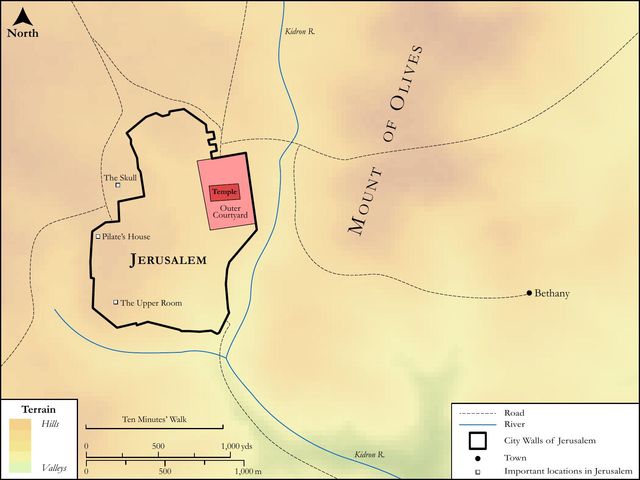
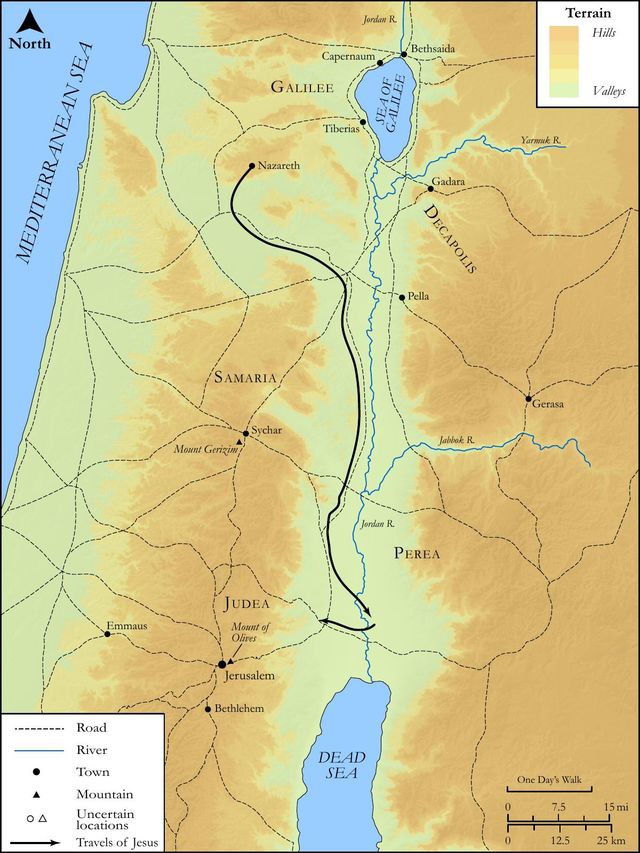
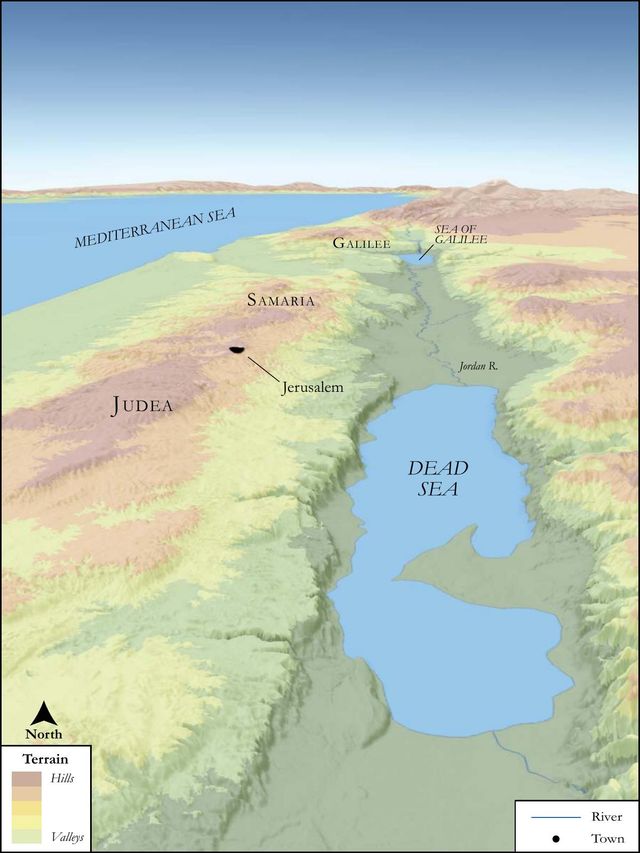
See on the biblical-era map
Study this verse
Public-domain commentary
Matthew Henry
From his Commentary on the Whole Bible. Henry comments on passages, not single verses — this entry covers Mark 1:9–13. His three-level outline is real structure in the source text, so it is rendered as structure.
We have here a brief account of Christ's baptism and temptation, which were largely related Mt. 3 and 4.
I.His baptism, which was his first public appearance, after he had long lived obscurely in Nazareth.
O how much hidden worth is there, which in this world is either lost in the dust of contempt and cannot be known, or wrapped up in the veil of humility and will not be known! But sooner or later it shall be known, as Christ's was.
1.See how humbly he owned God, by coming to be baptized of John; and thus it became him to fulfil all righteousness. Thus he took upon him the likeness of sinful flesh, that, though he was perfectly pure and unspotted, yet he was washed as if he had been polluted; and thus for our sakes he sanctified himself, that we also might be sanctified, and be baptized with him, Joh 17:19.
2.See how honourably God owned him, when he submitted to John's baptism. Those who justify God, and they are said to do, who were baptized with the baptism of John, he will glorify, Luk 7:29, Luk 7:30.
(1.)He saw the heavens opened; thus he was owned to be the Lord from heaven, and had a glimpse of the glory and joy that were set before him, and secured to him, as the recompence of his undertaking. Matthew saith, The heavens were opened to him. Mark saith, He saw them opened. Many have the heavens opened to receive them, but they do not see it; Christ had not only a clear foresight of his sufferings, but of his glory too.
(2.)He saw the Spirit like a dove descending upon him. Note, Then we may see heaven opened to us, when we perceive the Spirit descending and working upon us. God's good work in us is the surest evidence of his good will towards us, and his preparations for us. Justin Martyr says, that when Christ was baptized, a fire was kindled in Jordan: and it is an ancient tradition, that a great light shone round the place; for the Spirit brings both light and heat.
(3.)He heard a voice which was intended for his encouragement to proceed in his undertaking, and therefore it is here expressed as directed to him, Thou art my beloved Son. God lets him know, [1.] That he loved him never the less for that low and mean estate to which he had now humbled himself; "Though thus emptied and made of no reputation, yet he is my beloved Son still." [2.] That he loved him much the more for that glorious and kind undertaking in which he had now engaged himself. God is well pleased in him, as referee of all matters in controversy between him and man; and so well pleased in him, as to be well pleased with us in him.
II.His temptation.
The good Spirit that descended upon him, led him into the wilderness, Mar 1:12. Paul mentions it as a proof that he had his doctrine from God, and not from man - that, as soon as he was called, he went not to Jerusalem, but went into Arabia, Gal 1:17. Retirement from the world is an opportunity of more free converse with God, and therefore must sometimes be chosen, for a while, even by those that are called to the greatest business. Mark observes this circumstance of his being in the wilderness - that he was with the wild beasts. It was an instance of his Father's care of him, that he was preserved from being torn in pieces by the wild beasts, which encouraged him the more that his Father would provide for him when he was hungry. Special protections are earnests of seasonable supplies. It was likewise an intimation to him of the inhumanity of the men of that generation, whom he was to live among - no better than wild beasts in the wilderness, nay abundantly worse. In that wilderness,
1.The evil spirits were busy with him; he was tempted of Satan; not by any inward injections (the prince of this world had nothing in him to fasten upon), but by outward solicitations. Solicitude often gives advantages to the tempter, therefore two are better than one. Christ himself was tempted, not only to teach us, that it is no sin to be tempted, but to direct us whither to go for succour when we are tempted, even to him that suffered, being tempted; that he might experimentally sympathize with us when we are tempted.
2.The good spirits were busy about him; the angels ministered to him, supplied him with what he needed, and dutifully attended him. Note, The ministration of the good angels about us, is matter of great comfort in reference to the malicious designs of the evil angels against us; but much more doth it befriend us, to have the indwelling of the spirit in our hearts, which they that have, are so born of God, that, as far as they are so, the evil one toucheth them not, much less shall be triumph over them.
Historical interpretation
Three Centuries of Reception
6 surviving comments on this verse. Each one is dated, so this reads as a timeline rather than a list.
Select a marker to jump to its quote. Markers stagger vertically where authors wrote within a few decades of each other.
Morally also it may be interpreted; we also, drawn aside from the fleeting world by the smell and purity of flowers, run with the young maidens after the bridegroom, (v. Cant. 1:2. 3.) and are washed in the sacrament of baptism, from the two fountains of the love of God, and of our neighbour, by the grace of remission, and mounting up by hope gaze upon heavenly mysteries with the eyes of a clean heart. Then we receive in a contrite and lowly spirit, with simplicity of heart, the Holy Spirit, who comes down to the meek, and abides in us, by a never-failing charity. And the voice of the Lord from heaven is directed to us the beloved of God; Blessed are the peacemakers, for they shall be called the sons of God; (Matt. 5:9) and then the Father, with the Son and the Holy Spirit, is well-pleased with us, when we are made one spirit with God.
Or, then the beasts dwell with us in peace, as in the ark clean animals with the unclean, when the flesh lusts not against the spirit. After this, ministering Angels are sent to us, that they may give answers and comforts to hearts that watch.
Wherefore I allow that the evil one exists, because my Teacher, who spoke the truth in all things, has frequently asserted that he exists. For instance, then, he acknowledges that he conversed with Him, and tempted Him for forty days.
(Hom in Matt. xiii) Because all that Christ did and suffered was for our teaching, He began after His baptism to dwell in the wilderness, and fought against the devil, that every baptized person might patiently sustain greater temptations after His baptism, nor be troubled, as if this which happened to Him was contrary to His expectation, but might bear up against all things, and come off conqueror. For although God allows that we should be tempted for many other reasons, yet for this cause also He allows it, that we may know, that man when tempted is placed in a station of greater honour. For the Devil approaches not save where he has beheld one set in a place of greater honour; and therefore it is said, And immediately the Spirit drove him into the wilderness. And the reason why He does not simply say, that He went into the wilderness, but was driven, is, that thou mayest understand that it was done according to the word of Divine Providence. By which also He shows, that no man should thrust himself into temptation, but that those who from some other state are as it were driven into temptation, remain conquerors.
(in Mat. Hom. xiii) But the Spirit drove Him into the wilderness, because He designed to provoke the devil to tempt Him, and thus gave Him an opportunity not only by hunger, but also by the place. For then most of all does the devil thrust himself in, when he sees men remaining solitary.
(Vict. Ant. e Cat. in Marc.) But He says this to show of what nature was the wilderness, for it was impassable by man and full of wild beasts. It goes on; and angels ministered unto him. For after temptation, and a victory against the devil, He worked the salvation of man. And thus the Apostle says, Angels are sent to minister for them who shall be heirs of salvation. (Heb. 1:14) We must also observe, that to those who conquer in temptation angels stand near and minister.
The ancient enemy raised himself against the first man, our parent, in three temptations, because he tempted him with gluttony, vainglory, and avarice; but by tempting he overcame him, because he subjected him to himself through consent. But by the same means by which he overthrew the first man, by those same means he was overcome when he tempted the second man, so that he might depart from our hearts, captured at the very entrance by which he had entered and held us.
But it should be noted what follows: that when the devil departed, angels ministered to him. By this, what else is shown but both natures in one person? For he is man whom the devil tempts, and he is the same God to whom angels minister. Let us therefore recognize our nature in him, for unless the devil perceived him to be man, he would not have tempted him. Let us venerate his divinity in him, for unless he were God above all things, angels would in no way minister to him.
(in Marc. i. 5) And that no one might doubt, by what spirit he said that Christ was driven into the wilderness, Luke has on purpose premised, that Jesus being full of the Spirit returned from Jordan, (Luke 4:12) and then has added, and was led by the Spirit into the wilderness; lest the evil spirit should be thought to have any power over Him, who, being full of the Holy Spirit, departed whither He was willing to go, and did what He was willing to do.
(ubi sup.) But He retires into the desert that He may teach us that, leaving the allurements of the world, and the company of the wicked, we should in all things obey the Divine commands. He is left alone and tempted by the devil, that He might teach us, that all that will live godly in Christ Jesus shall suffer persecution; (2 Tim. 3:12) whence it follows, And he was in the wilderness forty days and forty nights, and was tempted of Satan. But He was tempted forty days and forty nights, that He might show us, that as long as we live here and serve God, whether prosperity smile upon us, which is meant by the day, or adversity smite us, which agrees with the figure of night, at all times our adversary is at hand, who ceases not to trouble our way by temptations. For the forty days and forty nights imply the whole time of this world, for the globe in which we are serving God is divided into four quarters. Again, there are Ten Commandments, by observing which we fight against our enemy, but four times ten are forty.
There follows, and he was with the wild beasts.
(ubi sup.) Consider also that Christ dwells among the wild beasts as man, but, as God, uses the ministry of Angels. Thus, when in the solitude of a holy life we bear with unpolluted mind the bestial manners of men, we merit to have the ministry of Angels, by whom, when freed from the body, we shall be transferred to everlasting happiness.
Continue studying Mark 1:13 across the web’s major study libraries — every link below opens this exact verse, chapter, or book on the destination site.
Read & Compare
 BibleGatewayThis verse in more than 200 translations and 70 languages.
 Bible.comThe YouVersion reader — hundreds of translations, reading plans, and highlights.
 ESV.orgCrossway's official English Standard Version reader.
 NET BibleThe NET translation with 60,000+ translators' notes on every rendering decision.
 STEP BibleTyndale House's free study tool — original text, vocabulary, and scholarly resources.
 BibliaLogos Bible Software's free web reader.
 USCCBThe New American Bible (Revised Edition) with the U.S. bishops' study notes.
Commentaries
 BibleHub CommentariesDozens of classic commentaries on this verse, gathered on one page.
 StudyLightMore than 100 commentary sets — the largest collection on the web.
 BibleRefPlain-English commentary on what this verse means, verse by verse.
 Enduring WordDavid Guzik's free commentary on this chapter, widely used by Bible teachers.
 Bible Study ToolsVerse commentary alongside Greek and Hebrew study aids.
Original Language & Research
- BibleHub InterlinearThe verse word by word — original language, transliteration, and English.
- BibleHub LexiconEvery word's original-language definition and Strong's entry.
 Blue Letter BibleDeep-study tools — Strong's numbers, concordance, and word studies.
 CNTR CollationThe earliest Greek manuscripts of this verse, collated letter by letter.
Sermons, Hymns & Audio


TrulyRandomVerse is not affiliated with these sites and doesn’t control their content. They’re linked because they’re genuinely useful.
Summary
Mark 1:13 offers a concise yet profoundly significant account of Jesus' time in the wilderness immediately following His baptism. It describes a period of intense spiritual testing where Jesus, empowered by the Holy Spirit, confronted Satan, endured the harshness of the wild, and received divine sustenance through ministering angels, thereby setting the stage for His public ministry and demonstrating His perfect obedience and authority over evil.
Context
ShowHideLiterary Context
This verse serves as a crucial transition point in Mark's Gospel, bridging Jesus' baptism and the divine affirmation of His sonship in Mark 1:9-11 with the commencement of His public ministry in Galilee. The preceding verse, Mark 1:12, explicitly states that "the Spirit immediately drove Him out into the wilderness," emphasizing the divine imperative behind this period of testing. Mark's account is notably brief compared to the more detailed narratives in Matthew 4:1-11 and Luke 4:1-13, focusing on the essential facts of Jesus' confrontation with Satan, His vulnerability, and His divine support, rather than the specific temptations. This brevity aligns with Mark's characteristic fast-paced narrative, highlighting action and authority.
Historical & Cultural Context
The "wilderness" (Greek: erēmos) in biblical thought is a multifaceted place. Historically, it was a desolate, uninhabited region, often a refuge but also a place of danger, scarcity, and spiritual encounter. For the Israelites, the wilderness was the crucible of their national identity, a place of testing, purification, and divine revelation during their forty years of wandering. Culturally, figures like John the Baptist emerged from the wilderness, signifying a prophetic call to repentance and preparation. Jesus' forty days in the wilderness echoes significant periods of testing and preparation in Israel's history, such as Moses' forty days on Mount Sinai (Exodus 34:28) and Elijah's forty-day journey to Horeb (1 Kings 19:8). This period establishes Jesus as the new Israel, perfectly fulfilling the covenant where the old Israel failed, and as a prophet greater than Moses or Elijah, prepared by God for His messianic mission.
Key Themes
ShowHideMark 1:13 introduces several foundational themes that resonate throughout the Gospel. Firstly, it underscores Jesus' humanity and perfect obedience, demonstrating that even the Son of God faced intense temptation, yet remained sinless. Secondly, it highlights the reality of spiritual warfare and the cosmic conflict between God's kingdom and Satan's domain, with Jesus directly confronting the adversary. This encounter foreshadows Jesus' ultimate triumph over evil, a central focus of Mark's narrative. Thirdly, the mention of "wild beasts" emphasizes Jesus' vulnerability and isolation, yet the "angels ministered unto him" reveals divine provision and unwavering support even in the direst circumstances. Finally, the "forty days" and the wilderness setting contribute to the theme of typological fulfillment, positioning Jesus as the new Adam and the true Israel, succeeding where humanity and the nation had failed, thereby inaugurating a new covenant and a new creation.
Exposition and Analysis
ShowHideKey Word Analysis
ShowHideMeaning "lonesome, i.e. (by implication) waste (usually as a noun, χώρα being implied):--desert, desolate, solitary, wilderness." In this context, it signifies a place of isolation, desolation, and spiritual testing, often associated with divine encounter and purification in biblical narratives.
Meaning "to test (objectively), i.e. endeavor, scrutinize, entice, discipline:--assay, examine, go about, prove, tempt(-er), try." This word denotes a trial or testing, which can be for good (to prove faithfulness) or for evil (to entice to sin). Here, it clearly refers to Satan's malicious efforts to cause Jesus to sin.
Meaning "to be an attendant, i.e. wait upon (menially or as a host, friend, or (figuratively) teacher); technically, to act as a Christian deacon:--(ad-)minister (unto), serve, use the office of a deacon." This word implies active, practical service and care, indicating that the angels provided sustenance and support to Jesus after His intense ordeal.
Verse Breakdown
ShowHide"And he was there in the wilderness forty days"
This clause establishes the setting and duration of Jesus' initial period of preparation for public ministry. The "wilderness" is a place of solitude and harshness, while "forty days" carries significant biblical weight, symbolizing a period of testing, purification, and divine encounter, echoing Israel's wilderness wanderings and the experiences of Moses and Elijah.
"tempted of Satan"
This is the central action of the clause, identifying the primary antagonist and the nature of the encounter. Jesus' time in the wilderness was not merely a period of reflection but an active, spiritual confrontation with Satan, the ultimate adversary of God and humanity. This highlights the reality of spiritual warfare and Jesus' direct engagement with the forces of evil.
"and was with the wild beasts"
This detail underscores the extreme vulnerability and isolation of Jesus' situation. The presence of "wild beasts" (Greek: thēríon, G2342, "a dangerous animal") emphasizes the hostile and untamed nature of the environment, suggesting a complete lack of human comfort or protection. Some scholars also see a symbolic connection to the restoration of creation, where the Messiah would live in harmony with creation, or a heightened sense of danger.
"and the angels ministered unto him"
In stark contrast to the temptation and the wild environment, this final clause reveals divine intervention and provision. The "angels" (Greek: ángelos, G32, "messenger") provided sustenance, comfort, or strength to Jesus, signifying God's unwavering care and support for His Son even in the midst of intense spiritual battle and physical deprivation. This demonstrates that God does not abandon His Anointed One in times of trial.
Literary Devices
ShowHideMark 1:13, despite its brevity, employs several effective literary devices. The most prominent is Conciseness, characteristic of Mark's Gospel. Unlike Matthew and Luke, Mark omits the details of the specific temptations, focusing instead on the essential facts: the duration, the tempter, the harsh environment, and the divine aid. This brevity creates a sense of immediacy and emphasizes the significance of the event without lingering on specifics. Symbolism is also heavily at play: the "wilderness" symbolizes a place of testing, purification, and confrontation with evil; the "forty days" alludes to significant periods of divine testing and preparation in Israel's history; and the "wild beasts" can symbolize the untamed, hostile nature of the fallen world or even demonic forces, while the "angels" symbolize divine care and intervention. Finally, there is a powerful Contrast between the intense spiritual conflict with Satan and the physical vulnerability among wild beasts on one hand, and the divine comfort and provision from angels on the other, highlighting God's sovereignty and care amidst adversity.
Theological and Thematic Connections
ShowHideMark 1:13 profoundly shapes our understanding of Jesus' identity and mission. His victory over Satan in the wilderness, immediately following His baptism and anointing by the Spirit, marks Him as the perfectly obedient Son of God, the new Adam who succeeds where the first Adam failed in the garden. This triumph is not merely personal but cosmic, demonstrating His authority over the forces of evil and foreshadowing His ultimate victory on the cross. The experience also highlights Jesus' solidarity with humanity, as He faced temptation in every way, yet without sin, making Him a sympathetic High Priest who understands our struggles. The divine provision through angels underscores God's faithfulness to His Son and, by extension, to His people, assuring us that He will sustain us in our own wilderness experiences.
Reflection and Application
ShowHideMark 1:13 offers profound lessons for every believer navigating the complexities of life. Just as Jesus was led by the Spirit into a period of intense testing, we too can expect to encounter trials, temptations, and spiritual opposition. These "wilderness" experiences are not signs of God's absence but often serve as crucibles for spiritual growth and deeper reliance on Him. Jesus' perfect obedience in the face of Satan's assaults assures us that victory over temptation is possible through Him. Furthermore, the presence of "wild beasts" reminds us of the harsh realities and dangers of a fallen world, yet the "angels ministered unto him" provides immense comfort, illustrating God's unwavering commitment to sustain and support His children, often through unexpected means, even in our most vulnerable moments. This passage calls us to embrace spiritual warfare with confidence, knowing that our Lord has already triumphed over the enemy and provides us with the strength to stand firm.
Questions for Reflection
ShowHideFAQ
ShowHideWhy is Mark's account of the temptation so brief compared to Matthew and Luke?
ShowHideMark's Gospel is characterized by its fast-paced, action-oriented narrative, often referred to as the "Gospel of action." Unlike Matthew and Luke, who include detailed dialogues of the specific temptations Jesus faced (e.g., turning stones into bread, jumping from the temple, worshipping Satan), Mark focuses on the essential facts and their theological implications. Mark's primary aim is to present Jesus as the powerful Son of God, the Messiah who immediately begins His work of confronting evil and establishing God's kingdom. The brevity of Mark 1:13 highlights the immediate transition from divine affirmation at His baptism to His direct confrontation with Satan, emphasizing the cosmic significance of this encounter without dwelling on the specifics. It succinctly communicates that Jesus was tested, He was in a hostile environment, and He received divine support, demonstrating His unique authority and readiness for ministry.
What is the significance of the "forty days" in this context?
ShowHideThe "forty days" carries profound typological and symbolic significance within biblical narratives. It immediately brings to mind Israel's forty years of wandering in the wilderness, a period of testing, purification, and reliance on God. It also echoes Moses' forty days on Mount Sinai receiving the Law, and Elijah's forty-day journey to Horeb. In each case, forty days/years signifies a period of intense trial, preparation, and divine encounter. By enduring forty days in the wilderness, Jesus is presented as the new Israel, perfectly obedient where the old Israel failed, and as the ultimate prophet and covenant mediator. This period serves as His personal preparation and validation for His public ministry, demonstrating His perfect humanity and divine power to overcome temptation.
Christ-Centered Fulfillment
ShowHideMark 1:13, though concise, is replete with Christ-centered fulfillment. Jesus' victory over Satan in the wilderness is a foundational act that foreshadows His ultimate triumph over the powers of darkness. As the perfectly obedient Son of God, He succeeds where the first Adam failed in the garden, and where Israel failed in their wilderness wanderings, thereby inaugurating a new humanity and a new covenant. His endurance of temptation, even to the point of vulnerability among "wild beasts," demonstrates His full solidarity with humanity, making Him our sympathetic High Priest who can truly empathize with our struggles, yet without sin (Hebrews 4:15). The ministering angels underscore His divine nature and the Father's unwavering support, affirming that the Son, though tested, remains eternally God. This wilderness victory is a vital step toward the cross, where Jesus would decisively disarm the powers and authorities (Colossians 2:15), securing redemption and empowering believers to overcome temptation through Him (Romans 8:37). The wilderness, a place of testing, becomes a prelude to the kingdom's arrival, signifying that through Christ, even the most desolate places can become arenas for divine triumph and provision.