


Judges 6:16
“The Angel Appears to Gideon”Judges 6:11–24
Bible text: King James Version (1769 Blayney text) · Public domain
Bible text: Berean Standard Bible · Public domain
Bible text: American Standard Version (1901) · Public domain
Bible text: World English Bible, Messianic edition · Public domain
Bible text: Geneva Bible (1599) · Public domain
Bible text: Young's Literal Translation · Public domain
- וַיֹּאמֶרvai·Yo·merand he saidH559Conj-w ¦ V-Qal-ConsecImperf-3msVerb Qal Consecutive Imperfect 3rd Singular Masculineוַandיֹּאמֶרhe said
- אֵלָיו'e·Lavto himH413Prep ¦ 3msPreposition Definiteאֵלָיtoוhim
- יְהוָהYah·wehYahwehH3068N-properNoun Proper Title
- כִּיkithatH3588PrtParticle Conditional
- אֶהְיֶה'eh·YehI will beH1961V-Qal-Imperf-1csVerb Qal Imperfect 1st Singular common gender
- עִמָּךְ'i·Makhwith youH5973Prep ¦ 2msPreposition Definiteעִמָּwithךְyou
- וְהִכִּיתָve·hi·ki·Taand you will strike downH5221Conj-w ¦ V-Hiphil-ConsecPerf-2msVerb Hiphil Consecutive Perfect 2nd Singular Masculineוְandהִכִּיתָyou will strike down
- אֶת'et[obj.]H853DirObjMParticle Object Indicator
- מִדְיָןmid·YanMidianH4080N-properNoun Proper Location
- כְּאִישׁke·'Ishlike a manH376Prep-k ¦ N-msNoun Singular Masculine Absoluteכְּlikeאִישׁa man
- אֶחָד'e·ChadoneH259N-fsNoun Singular Feminine Absolute
English is a literal word-by-word gloss of the Hebrew, not the KJV's wording. Why?
This is the original text the KJV's translators worked from — each Hebrew word with its own literal English meaning in this verse, prepared by scholars at Tyndale House, Cambridge. The KJV translates whole sentences, not word by word, so its wording differs: one Hebrew word can become several English words, and the KJV may choose “the LORD” where the gloss reads “Yahweh”. Both are faithful — they answer different questions. For the KJV's own rendering, switch to the KJV text.
Words in [ ] are added by the English.
Details
See on the biblical-era maps
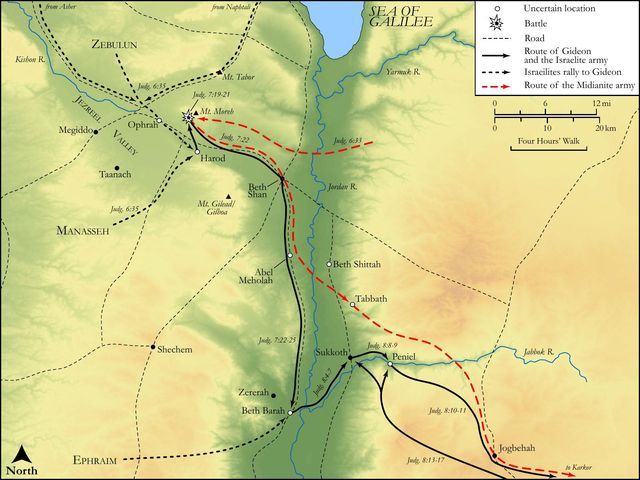
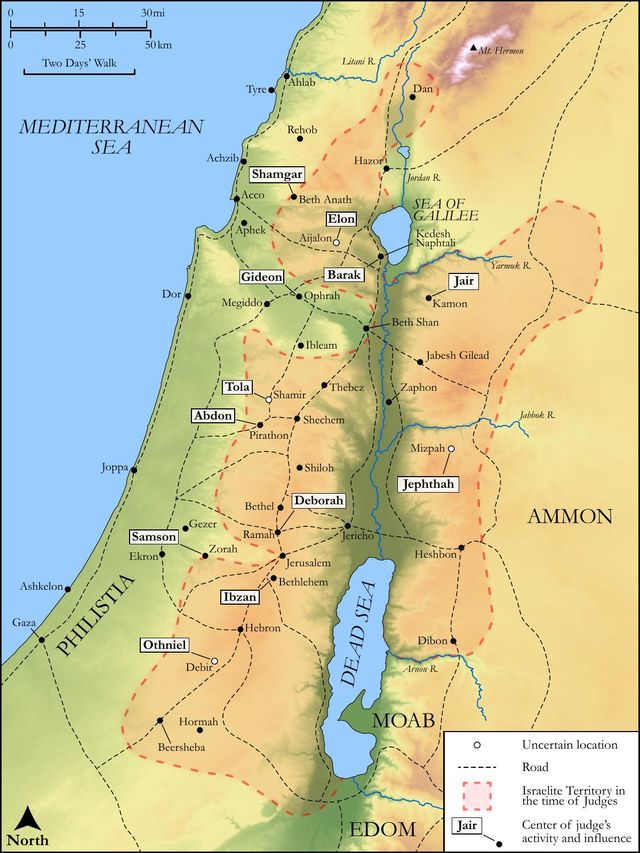
Study this verse
Public-domain commentary
Matthew Henry
From his Commentary on the Whole Bible. Henry wrote on whole passages, and this entry covers Judges 6:11–24. He set out his notes in a four-level outline, kept here as he numbered it.
It is not said what effect the prophet's sermon had upon the people, but we may hope it had a good effect, and that some of them at least repented and reformed upon it; for here, immediately after, we have the dawning of the day of their deliverance, by the effectual calling of Gideon to take upon him the command of their forces against the Midianites.
I.The person to be commissioned for this service was Gideon, the son of Joash, Judges 6:14.
The father was now living, but he was passed by, and this honour put upon the son, for the father kept up in his own family the worship of Baal (Judges 6:25), which we may suppose this son, as far as was in his power, witnessed against. He was of the half tribe of Manasseh that lay in Canaan, of the family of Abiezer; the eldest house of that tribe, Joshua 17:2. Hitherto the judges were raised up out of that tribe which suffered most by the oppression, and probably it was so here.
II.The person that gave him the commission was an angel of the Lord; it should seem not a created angel, but the Son of God himself, the eternal Word, the Lord of the angels, who then appeared upon some great occasions in human shape, as a prelude (says the learned bishop Patrick) to what he intended in the fulness of time, when he would take our nature upon him, as we say, for good and all. This angel is here called Jehovah, the incommunicable name of God (Judges 6:14, Judges 6:16), and he said, I will be with thee.
1.This divine person appeared here to Gideon, and it is observable how he found him,
(1.)Retired - all alone. God often manifests himself to his people when they are out of the noise and hurry of this world. Silence and solitude befriend our communion with God.
(2.)Employed in threshing wheat, with a staff or rod (so the word signifies), such as they used in beating out fitches and cummin (Isaiah 28:27), but now used for wheat, probably because he had but little to thresh, he needed not the oxen to tread it out. It was not then looked upon as any diminution to him, though he was a person of some account and a mighty man of valour, to lay his hand to the business of the husbandman. He had many servants (Judges 6:27), and yet would not himself live in idleness. We put ourselves in the way of divine visits when we employ ourselves in honest business. Tidings of Christ's birth were brought to the shepherds when they were keeping their flocks. The work he was about was an emblem of that greater work to which he was now to be called, as the disciples' fishing was. From threshing corn he is fetched to thresh the Midianites, Isaiah 41:15.
(3.)Distressed; he was threshing his wheat, not in the threshing-floor, the proper place, but by the wine-press, in some private unsuspected corner, for fear of the Midianites. He himself shared in the common calamity, and now the angel came to animate him against Midian when he himself could speak so feelingly of the heaviness of their yoke. The day of the greatest distress is God's time to appear for his people's relief.
2.Let us now see what passed between the angel and Gideon, who knew not with certainty, till after he was gone, that he was an angel, but supposed he was a prophet.
(1.)The angel accosted him with respect, and assured him of the presence of God with him, Judges 6:12. He calls him a mighty man of valour, perhaps because he observed how he threshed his corn with all his might; and seest thou a man diligent in his business? whatever his business is, he shall stand before kings. He that is faithful in a few things shall be ruler over many. Gideon was a man of a brave active spirit, and yet buried alive in obscurity, through the iniquity of the times; but he is here animated to undertake something great, like himself, with that word, The Lord is with thee, or, as the Chaldee reads it, the Word of the Lord is thy help. It was very sure that the Lord was with him when this angel was with him. By this word,
[1.]He gives him his commission. If we have God's presence with us, this will justify us and bear us out in our undertakings.
[2.]He inspires him with all necessary qualifications for the execution of his commission. "The Lord is with thee to guide and strengthen thee, to animate and support thee." [3.] He assures him of success; for, if God be for us, who can prevail against us? If he be with us, nothing can be wanting to us. The presence of God with us is all in all to our prosperity, whatever we do. Gideon was a mighty man of valour, and yet he could bring nothing to pass without the presence of God, and that presence is enough to make any man mighty in valour and to give a man courage at any time.
(2.)Gideon gave a very melancholy answer to this joyful salutation (Judges 6:13): O my Lord! if the Lord be with us (which the Chaldee reads, Is the Shechinah of the Lord our help? making that the same with the Word of the Lord) why then has all this befallen us? "all this trouble and distress from the Midianites' incursions, which force me to thresh wheat here by the wine-press - all this loss, and grief, and fright; and where are all the miracles which our fathers told us of?" Observe, In his reply he regards not the praise of his own valour, nor does this in the least elevate him or give him any encouragement, though it is probable the angel adapted what he said to that which Gideon was at the same time thinking of; while his labouring hands were employed about his wheat, his working head and daring heart were meditating Israel's rescue and Midian's ruin, with which thought he that knows the heart seasonably sets in, calls him a man of valour for his brave projects, and open him a way to put them in execution; yet Gideon, as if not conscious to himself of any thing great or encouraging in his own spirit, fastens only on the assurance the angel had given him of God's presence, as that by which they held all their comfort. Observe, The angel spoke in particular to him: The Lord is with thee; but he expostulates for all: If the Lord be with us, herding himself with the thousands of Israel, and admitting no comfort but what they might be sharers in, so far is he from the thoughts of monopolizing it, though he had so fair an occasion given him. Note, Public spirits reckon that only an honour and joy to themselves which puts them in a capacity of serving the common interests of God's church. Gideon was a mighty man of valour, but as yet weak in faith, which makes it hard to him to reconcile to the assurances now given him of the presence of God,
[1.]The distress to which Israel was reduced: Why has all this (and all this was no little) befallen us? Note, It is sometimes hard, but never impossible, to reconcile cross providences with the presence of God and his favour.
[2.]The delay of their deliverance: "Where are all the miracles which our fathers told us of? Why does not the same power which delivered our fathers from the yoke of the Egyptians deliver us out of the hands of the Midianites?" As if because God did not immediately work miracles for their deliverance, though they had by their sins forfeited his favour and help, it must be questioned whether ever he had wrought the miracles which their fathers told them of, or, if he had, whether he had now the same wisdom, and power, and good-will to his people, that he had had formerly. This was his weakness. We must not expect that the miracles which were wrought when a church was in the forming, and some great truth in the settling, should be continued and repeated when the formation and settlement are completed: no, nor that the mercies God showed to our fathers that served him, and kept close to him, should be renewed to us, if we degenerate and revolt from him. Gideon ought not to have said either, First, That God had delivered them into the hands of the Midianites, for by their iniquities they had sold themselves, or, Secondly, That now they were in their hands he had forsaken them, for he had lately sent them a prophet (Judges 6:8), which was a certain indication that he had not forsaken them.
(3.)The angel gave him a very effectual answer to his objections, by giving him a commission to deliver Israel out of the hands of the Midianites, and assuring him of success therein, Judges 6:14. Now the angel is called Jehovah, for he speaks as one having authority, and not as a messenger.
[1.]There was something extraordinary in the look he now gave to Gideon; it was a gracious favourable look, which revived his spirits that dropped, and silenced his fears, such a look as that with which God's countenance beholds the upright, Psalm 11:7. He looked upon him, and smiled at the objections he made, which he gave him no direct answer to, but girded and clothed him with such power as would shortly enable him to answer them himself, and make him ashamed that ever he had made them. It was a speaking look, like Christ's upon Peter (Luke 22:61), a powerful look, a look that strangely darted new light and life into Gideon's breast, and inspired him with a generous heat, far above what he felt before.
[2.]But there was much more in what he said to him. First, He commissioned him to appear and act as Israel's deliverer. Such a one the few thinking people in the nation, and Gideon among the rest, were now expecting to be raised up, according to God's former method, in answer to the cries of oppressed Israel; and now Gideon is told, "Thou art the man: Go in this thy might, this might wherewith thou art now threshing wheat; go and employ it to a nobler purpose; I will make thee a thresher of men." Or, rather, "this might wherewith thou art now endued by this look." God gave him his commission by giving him all the qualifications that were necessary for the execution of it, which is more than the mightiest prince and potentate on earth can do for those to whom he gives commissions. God's fitting men for work is a sure and constant evidence of his calling them to it. "Go, not in thy might, that which is natural, and of thyself, depend not on thy own valour; but go in this thy might, this which thou hast now received, go in the strength of the Lord God, that is, the strength with which thou must strengthen thyself." Secondly, He assured him of success. This was enough to put courage into him; he might be confident he should not miscarry in the attempt; it should not turn either to his own disgrace or the damage of his people (as baffled enterprises do), but to his honour and their happiness: Thou shalt save Israel from the hand of the Midianites, and so shalt not only be an eye-witness, but a glorious instrument, of such wonders as thy fathers told thee of. Gideon, we may suppose, looked as one astonished at this strange and surprising power conferred upon him, and questions whether he may depend upon what he hears: the angel ratifies his commission with a teste meipso - an appeal to his own authority; there needed no more. "Have not I commanded thee - I that have all power in heaven and earth, and particular authority here as Israel's King, giving commissions immediately - I who am that I am, the same that sent Moses?" Exodus 3:14.
(4.)Gideon made a very modest objection against this commission (Judges 6:15): O my Lord! wherewith shall I save Israel? This question bespeaks him either,
[1.]Distrustful of God and his power, as if, though God should be with him, yet it were impossible for him to save Israel. True faith is often weak, yet it shall not be rejected, but encouraged and strengthened. Or,
[2.]Inquisitive concerning the methods he must take: "Lord, I labour under all imaginable disadvantages for it; if I must do it, thou must put me in the way." Note, Those who receive commissions from God must expect and seek for instructions from him. Or rather,
[3.]Humble, self-diffident, and self-denying. The angel had honoured him, but see how meanly he speaks of himself: "My family is comparatively poor in Manasseh" (impoverished, it may be, more than other families by the Midianites), "and I am the least, that have the least honour and interest, in my father's house; what can I pretend to do? I am utterly unfit for the service, and unworthy of the honour." Note, God often chooses to do great things by those that are little, especially that are so in their own eyes. God delights to advance the humble.
(5.)This objection was soon answered by a repetition of the promise that God would be with him, v. 16. "Object not thy poverty and meanness; such things have indeed often hindered men in great enterprises, but what are they to a man that has the presence of God with him, which will make up all the deficiencies of honour and estate. Surely I will be with thee, to direct and strengthen thee, and put such a reputation upon thee that, how weak soever thy personal interest is, thou shalt have soldiers enough to follow thee, and be assured thou shalt smite the Midianites as one men, as easily as if they were but one man and as effectually. All the thousands of Midian shall be as if they had but one neck, and thou shalt have the cutting of it off."
(6.)Gideon desires to have his faith confirmed touching this commission; for he would not be over-credulous of that which tended so much to his own praise, would not venture upon an undertaking so far above him, and in which he must engage many more, but he would be well satisfied himself of his authority, and would be able to give satisfaction to others as to him who gave him that authority. He therefore humbly begs of this divine person, whoever he was,
[1.]That he would give him a sign, Judges 6:17. And, the commission being given him out of the common road of providence, he might reasonably expect it should be confirmed by some act of God out of the common course of nature: "Show me a sign to assure me of the truth of this concerning which thou talkest with me, that it is something more than talk, and that thou art in earnest." Now, under the dispensation of the Spirit, we are not to expect signs before our eyes, such as Gideon here desired, but must earnestly pray to God that, if we have found grace in his sight, he would show us a sign in our heart, by the powerful operations of his Spirit there, fulfilling the work of faith, and perfecting what is lacking in it.
[2.]In order hereunto, that he would accept of a treat, and so give him a further and longer opportunity of conversation with him, Judges 6:18. Those who know what it is to have communion with God desire the continuance of it, and are loth to part, praying with Gideon, Depart not hence, I pray thee. That which Gideon desired in courting his stay was that he might bring out some provision of meat for this stranger. He did not take him into the house to entertain him there, perhaps because his father's house were not well affected to him and his friends, or because he desired still to be in private with this stranger, and to converse with him alone (therefore he calls not for a servant to bring the provision, but fetches it himself), or because thus his father Abraham entertained angels unawares, not in his tent, but under a tree, Genesis 18:8. Upon the angel's promise to stay to dinner with him, he hastened to bring out a kid, which, it is likely, was ready boiled for his own dinner, so that in making it ready he had nothing to do but to put it in the basket (for here was no sauce to serve it up in, nor the dish garnished) and the broth in a vessel, and so he presented it, Judges 6:19. Hereby he intended, First, To testify his grateful and generous respects to this stranger, and, in him, to God who sent him, as one that studied what he should render. He had pleaded the poverty of his family (Judges 6:15) to excuse himself from being a general, but not here to excuse himself from being hospitable. Out of the little which the Midianites had left him he would gladly spare enough to entertain a friend, especially a messenger from heaven. Secondly, To try who and what this extraordinary person was. What he brought out is called his present, Judges 6:18. It is the same word that is used for a meat-offering, and perhaps that word is used which signifies both because Gideon intended to leave it to this divine person to determine which it should be when he had it before him: whether a feast or a meat-offering, and accordingly he would be able to judge concerning him: if he ate of it as common meat, he would suppose him to be a man, a prophet; if otherwise, as it proved, he should know him to be an angel.
(7.)The angel gives him a sign in and by that which he had kindly prepared for his entertainment. For what we offer to God for his glory, and in token of our gratitude to him, will be made by the grace of God to turn to our own comfort and satisfaction. The angel ordered him to take the flesh and bread out of the basket, and lay it upon a hard and cold rock, and to pour out the broth upon it, which, if he brought it hot, would soon be cold there; and Gideon did so (Judges 6:20), believing that the angel appointed it, not in contempt of his courtesy, but with an intention to give him a sign, which he did, abundantly to his satisfaction. For,
[1.]He turned the meat into an offering made by fire, of a sweet savour unto himself, showing hereby that he was not a man who needed meat, but the Son of God who was to be served and honoured by sacrifice, and who in the fulness of time was to make himself a sacrifice.
[2.]He brought fire out of the rock, to consume this sacrifice, summoning it, not by striking the rock, as we strike fire out of a flint, but by a gentle touch given to the offering with the end of his staff, Judges 6:21. Hereby he gave him a sign that he had found grace in his sight, for God testified his acceptance of sacrifices by kindling them, if public, with fire from heaven, as those of Moses and Elias, if private, as this, with fire out of the earth, which was equivalent: both were the effect of divine power; and this acceptance of his sacrifice evidenced the acceptance of his person, confirmed his commission, and perhaps was intended to signify his success in the execution of it, that he and his army should be a surprising terror and consumption to the Midianites, like this fire out of the rock.
[3.]He departed out of his sight immediately, did not walk off as a man, but vanished and disappeared as a spirit. Here was as much of a sign as he could wish.
(8.)Gideon, though no doubt he was confirmed in his faith by the indications given of the divinity of the person who had spoken to him, yet for the present was put into a great fright by it, till God graciously pacified him and removed his fears.
[1.]Gideon speaks peril to himself (Judges 6:22): When he perceived that he was an angel (which was not till he had departed, as the two disciples knew not it was Jesus they had been talking with till he was going, Luke 24:31), then he cried out, Alas! O Lord God! be merciful to me, I am undone, for I have seen an angel, as Jacob, who wondered that his life was preserved when he had seen God, Genesis 32:30. Ever since man has by sin exposed himself to God's wrath and curse an express from heaven has been a terror to him, as he scarcely dares to expect good tidings thence; at least, in this world of sense, it is a very awful thing to have any sensible conversation with that world of spirits to which we are so much strangers. Gideon's courage failed him now.
[2.]God speaks peace to him, Judges 6:23. It might have been fatal to him, but he assures him it should not. The Lord had departed out of his sight, Judges 6:21. But though he must no longer walk by sight he might still live by faith, that faith which comes by hearing; for the Lord said to him, with an audible voice (as bishop Patrick thinks) these encouraging words, "Peace be unto thee, all is well, and be thou satisfied that it is so. Fear not; he that came to employ thee did not intend to slay thee; thou shalt not die." See how ready God is to revive the hearts of those that tremble at his word and presence, and to give those that stand in awe of his majesty assurances of his mercy.
3.The memorial of this vision which Gideon set up was a monument in form of an altar, the rather because it was by a kind of sacrifice upon a rock, without the solemnity of an altar, that the angel manifested his acceptance of him; then an altar was unnecessary (the angel's staff was sufficient to sanctify the gift without an altar), but now it was of use to preserve the remembrance of the vision, which was done by the name Gideon gave to this memorial, Jehovah-shalom (Judges 6:24) - The Lord peace. This is,
(1.)The title of the Lord that spoke to him. Compare Genesis 16:13. The same that is the Lord our righteousness is our peace (Ephesians 2:14), our reconciler and so our Saviour. Or,
(2.)The substance of what he said to him: "The Lord spoke peace, and created that fruit of the lips, bade me be easy when I was in that agitation." Or,
(3.)A prayer grounded upon what he had said, so the margin understands it: The Lord send peace, that is, rest from the present trouble, for still the public welfare lay nearest his heart.
Continue studying Judges 6:16 across the web’s major study libraries — every link below opens this exact verse, chapter, or book on the destination site.
Read & Compare
 BibleGatewayThis verse in more than 200 translations and 70 languages.
 Bible.comThe YouVersion reader — hundreds of translations, reading plans, and highlights.
 ESV.orgCrossway's official English Standard Version reader.
 NET BibleThe NET translation with 60,000+ translators' notes on every rendering decision.
 STEP BibleTyndale House's free study tool — original text, vocabulary, and scholarly resources.
 BibliaLogos Bible Software's free web reader.
 USCCBThe New American Bible (Revised Edition) with the U.S. bishops' study notes.
Commentaries
 BibleHub CommentariesDozens of classic commentaries on this verse, gathered on one page.
 StudyLightMore than 100 commentary sets — the largest collection on the web.
 BibleRefPlain-English commentary on what this verse means, verse by verse.
 Enduring WordDavid Guzik's free commentary on this chapter, widely used by Bible teachers.
 Bible Study ToolsVerse commentary alongside Greek and Hebrew study aids.
Original Language & Research
- BibleHub InterlinearThe verse word by word — original language, transliteration, and English.
- BibleHub LexiconEvery word's original-language definition and Strong's entry.
 Blue Letter BibleDeep-study tools — Strong's numbers, concordance, and word studies.
 SefariaThe Hebrew text with Rashi and centuries of Jewish commentary.
Sermons, Hymns & Audio


TrulyRandomVerse is not affiliated with these sites and doesn’t control their content. They’re linked because they’re genuinely useful.
Written with AI assistance. Always check it against Scripture.
This verse
The LORD answers Gideon’s weakness with his own presence and promises that Gideon will strike down the Midianites as one man.
“And the LORD said unto him,”
The LORD answers the objection with a promise.
“Surely I will be with thee,”
The answer to “wherewith” is “I”. God’s presence is the means.
“and thou shalt smite the Midianites as one man.”
nâkâh (smite) and ʼechâd (one). The victory will be complete, and it will plainly be God’s.
Passage studyJudges 6:11–24
The LORD Calls Gideon and Gives Him Peace
Summary
For seven years Midian has stripped Israel bare, and Gideon, the least in a small clan of Manasseh, is beating out his wheat in a winepress where the raiders will miss it. The angel of the LORD sits down under the oak at Ophrah and greets him: “The LORD is with thee, thou mighty man of valour.” Gideon answers with Israel’s grief and asks where the miracles of the Exodus have gone. The LORD sends him to save Israel, and when Gideon pleads that he is the least in a poor family, the LORD promises, “Surely I will be with thee.” Gideon asks for a sign, brings out a meal, and watches fire rise out of the rock and consume it. Afraid that he must die for having seen the angel of the LORD face to face, he hears, “Peace be unto thee; fear not: thou shalt not die,” and he builds an altar called Jehovahshalom, “the LORD is peace.” Here the LORD comes looking for a frightened man, calls him by what he will make of him, bears patiently with his questions, and gives him peace.
Why Gideon was threshing wheat in a winepress
The story begins in a dark time. After forty years of rest under Deborah and Barak, Israel again did evil in the sight of the LORD, and he delivered them into the hand of Midian for seven years. The Midianites came with the Amalekites and the children of the east, as many as grasshoppers, destroyed the crops and the livestock, and drove Israel into dens, caves and strongholds in the mountains (Judges 6:1–6). The Midianites were descended from Abraham through Keturah, whose son Midian, Midyân, gave them their name (Genesis 25:2). When Israel cried out, the LORD first sent a prophet to tell them why all this had happened (Judges 6:7–10). Now he comes in person, to one man.
Wheat was normally threshed on an open threshing floor (goren), usually on high ground, where the wind could carry the chaff away from the grain. A winepress, gath, was built for grapes. It was usually cut into the rock and partly below ground, with an upper floor where the grapes were trodden and a lower vat that caught the juice. Gideon “threshed wheat by the winepress” (châbaṭ, to beat out grain, and chiṭṭâh, wheat) because down in that pit the little grain he had stayed out of sight. The verse gives the reason in its last words: “to hide it from the Midianites”. The verb nûwç means to flee or escape, and behind “from” stands pânîym, the face or presence, so Gideon is bringing his grain away to safety from the face of Midian. A whole nation had been reduced to hiding its bread.
The man is named here for the first time. Gidʻôwn comes from a root meaning to fell or cut down, so his name means “feller” or “hewer”, a name that fits a warrior. The man who bears it is hiding from his enemies, and the LORD is about to make him the one who cuts them down.
The angel “came, and sat under an oak”. The tree, ʼêlâh, stood at Ophrah, ʻOphrâh, a town of the clan of Abiezer in the tribe of Manasseh, and it belonged to Gideon’s father, Joash (Yôwʼâsh) the Abiezrite (ʼĂbîy hâ-ʻEzrîy). The LORD knows the very farm and the very tree. The verb for sat, yâshab, pictures someone settled and unhurried, and the same verb returns in verse 18, where the angel promises to “tarry” while Gideon prepares his gift. The LORD came looking for Gideon, and he was ready to wait for him.
The angel of the LORD is the LORD himself
The word mal’akh (also written malʼâk) means a messenger, from a root meaning to send someone as a deputy, and it can be used of a prophet, a priest or another envoy as well as an angel. Joined to Yᵉhôvâh, the covenant name of God that the KJV prints as “the LORD”, it gives mal’akh Yᵉhôvâh, “the angel of the LORD”.
The passage itself shows who this messenger is. He is called the angel of the LORD (verses 11, 12, 21 and 22) and the angel of God (verse 20), and the narrator also calls him simply “the LORD” (verses 14, 16 and 23). He speaks as the One who sends (“have not I sent thee?”) and promises his own presence (“Surely I will be with thee”). He brings fire out of a rock to consume the offering laid before him, and when Gideon realises who he is, he fears he will die for having seen him. Angels who are only creatures turn worship away, as the angel in Revelation tells John to worship God (Revelation 22:8–9), but this Angel receives an offering as the LORD.
The same Angel meets Hagar in the wilderness and speaks to her as God (Genesis 16:7–13), appears to Moses in the burning bush (Exodus 3:2–6), and meets Joshua before Jericho (Joshua 5:13). These appearances are best understood as the Son of God showing himself before he took flesh, which is called a Christophany. John writes, “No man hath seen God at any time; the only begotten Son, which is in the bosom of the Father, he hath declared him” (John 1:18). When the LORD lets himself be seen, as he does at Ophrah, it is the Son who makes him known, and Gideon met under his father’s oak the Lord who would one day be born at Bethlehem.
God calls a frightened man mighty
“And the angel of the LORD appeared unto him, and said unto him, The LORD is with thee, thou mighty man of valour.” The first words are the heart of it. “The LORD is with thee” is the promise that steadies God’s servants all through Scripture. Joshua was told to be strong and of a good courage because the LORD his God was with him (Joshua 1:9), Israel heard “Fear thou not; for I am with thee” (Isaiah 41:10), and Jesus sent his disciples out with the words “lo, I am with you alway, even unto the end of the world” (Matthew 28:19–20).
Then comes the title. gibbôwr chayil joins two words. gibbôwr is a strong or mighty man, a warrior, champion or chief, and chayil is strength, ability, wealth or an army. Together they describe a man of strength, courage and standing, often a valiant fighter. Spoken to a man crouched over his wheat in a pit, the words carry an irony that Gideon himself will feel in a moment.
Was Gideon a mighty man of valour when the angel found him?
He was the man God was about to make mighty, and the angel called him by that name. At that moment he was afraid and hidden, and the next verses are full of his doubts. The title comes after “The LORD is with thee” because the LORD’s presence is where his valour would come from. The LORD looks on the heart and sees what is hidden from others (1 Samuel 16:7), and he chooses “the weak things of the world to confound the things which are mighty”, so that the glory is his alone (1 Corinthians 1:27–29).
“Why then is all this befallen us?”
Gideon answers with the grief of a whole people. The angel spoke to him alone (“with thee”), and Gideon replies for everyone: “if the LORD be with us”. He calls the stranger bî ʼâdôwn, “Oh my Lord”. bî is a word of entreaty, and ʼâdôwn means lord or master and is used of men as well as of God, so this is a respectful way to address an important stranger. Gideon is courteous, and he has yet to recognise who is speaking to him.
His questions come quickly. “Why then is all this befallen us?” covers the seven years of raids, the ruined fields and the caves. “Where be all his miracles which our fathers told us of” looks back to the Exodus (Exodus 12). The word pâlâʼ means wonders, things too great or hard for man, the kind of works only God can do, and Israel’s fathers had handed down the story of the plagues, the sea and the food in the wilderness. Gideon knows those works by report and wants to know why they have stopped. His last words are the bitterest: “but now the LORD hath forsaken us”. The verb nâṭash means to leave, abandon or neglect.
Had the LORD forsaken Israel?
The LORD had given Israel into Midian’s hand because of their sin, and the One standing under the oak had come to set them free. The book of Judges shows this pattern again and again: Israel forsakes the LORD and serves other gods, and the LORD delivers them into the hands of their enemies (Judges 2:11–15). Gideon is right that the LORD “delivered us into the hands of the Midianites”, for the chapter opens by saying the same. What he calls being forsaken was the LORD’s discipline, meant to bring his people back to him, and the prophet of verses 7 to 10 had already told them the reason. Moses had promised Israel that the LORD “will not fail thee, nor forsake thee” (Deuteronomy 31:6), and through Isaiah God says that a mother may forget her nursing child, yet he will remember Zion, whose walls are continually before him (Isaiah 49:15–16).
Gideon’s complaint has a place in Scripture too. The psalms let God’s people pray, “Awake, why sleepest thou, O Lord?” (Psalm 44:23–24), and the LORD meets Gideon’s honest lament with patience and a commission.
“Go in this thy might”
“And the LORD looked upon him.” The narrator now names the speaker the LORD, and the look is a purposeful one, the LORD giving Gideon his full attention before he gives him his task. A command, a promise and a question follow.
“Go in this thy might” uses kôach, strength, power or ability. Gideon feels only weakness, so “this thy might” is the strength that goes with the LORD’s sending, given to him for this work. The LORD is with him, and that is his might. “Thou shalt save Israel from the hand of the Midianites” answers his complaint directly. He asked where God’s wonders had gone, and God tells him that he, Gideon, will be the means of the next one.
“Have not I sent thee?” uses shâlach, to send or stretch out. The question carries its own answer, and it moves the weight of the mission from the one sent to the One who sends. Moses heard the same when he asked who he was to go to Pharaoh (Exodus 3:10–12), and so did Jeremiah when he said he was only a child (Jeremiah 1:6–9). In both calls God answered with his presence. Paul learned the same truth from the Lord: “my strength is made perfect in weakness” (2 Corinthians 12:9–10).
“Wherewith shall I save Israel?”
Gideon’s second answer turns from the nation’s trouble to his own smallness. He again says “Oh my Lord”, and the English is the same as in verse 13, but here the Hebrew is ʼĂdônây, the form used as a title of God, and it may show Gideon beginning to sense whom he is speaking to. “Wherewith shall I save Israel?” uses yâshaʻ, from a root meaning to be open, wide or free, and so to deliver, rescue or save. Gideon wants to know by what means.
He gives two reasons. “My family is poor in Manasseh”: dal means poor, weak, thin or low, properly dangling, and it describes a clan with little strength or standing in its tribe. “I am the least in my father’s house”: tsâʻîyr means little, young, or small in rank, so Gideon is the youngest, or the one of least account, in his household. In Israel a man’s family, clan and tribe largely decided his influence and how many would follow him, so by every measure Gideon knew, he lacked what a deliverer needed. God had answered Moses’ “who am I” in the same way, and he would later choose David, the youngest of Jesse’s sons, to be king.
“Surely I will be with thee”
The LORD answers Gideon’s “wherewith” with himself. The verse opens in Hebrew with kî, which the KJV renders “Surely”, and the promise is plain: “I will be with thee.” Gideon will do the smiting, and the LORD’s presence is what will make it possible.
“Thou shalt smite the Midianites as one man.” nâkâh is the ordinary word for striking or smiting, used here for defeat in battle, and ʼechâd is the number one. “As one man” can be read two ways. Midian’s huge army will fall as easily as if it were a single man, or Gideon, with the LORD beside him, will strike with the strength of a whole army. Both readings promise a complete victory that belongs to God. That is how it turned out. With three hundred men Gideon saw the Midianites turn their swords on one another (Judges 7:22).
“Shew me a sign that thou talkest with me”
“If now I have found grace in thy sight” is a courteous way to ask a favour, much like “if you would be so kind”. chên means graciousness or favour, the kindness a greater person shows to a lesser. Then comes the request: “shew me a sign that thou talkest with me”. ʼôwth is a sign, token or mark, often a miracle that confirms a message or the one who brings it. Gideon wants to know for certain who is speaking with him, because everything he has been asked to do rests on that. The LORD had given Moses the signs of the rod and the leprous hand when Moses feared Israel would doubt him (Exodus 4:1–9).
Was it wrong for Gideon to ask for a sign?
Gideon’s request came from human weakness and from a real need, and the LORD answered it with patience. The task was enormous and the meeting was unlike anything he had known, so it was natural for him to want proof of who was speaking. The LORD gave the sign at once, and later in the chapter he bore with Gideon again over the fleece (Judges 6:36–40). Scripture also shows a demanding kind of asking. When the scribes and Pharisees demanded a sign, Jesus gave them only the sign of Jonah, his death and his rising on the third day (Matthew 12:38–40), and Paul writes, “For the Jews require a sign, and the Greeks seek after wisdom” (1 Corinthians 1:22). Gideon asked humbly, for assurance so that he could obey.
The present that became an offering
Gideon asks the visitor to stay: “Depart not hence, I pray thee, until I come unto thee, and bring forth my present, and set it before thee.” mûwsh means to withdraw or move away, and the plea shows how badly Gideon wants this meeting to go on until he has his answer. yâtsâʼ means to go out, and here to bring out. The word for present, minchâh, means a gift or tribute and is also the regular word for an offering to God. It names the grain offering of the law (Leviticus 2:1) and the offering Cain brought (Genesis 4:3). Gideon is offering the courtesy a host owes an honoured guest, and the word he uses leaves room for an offering.
The answer is short and gracious: “I will tarry until thou come again.” The verb is yâshab again, to sit, stay or remain. The LORD of heaven agrees to wait under a farmer’s oak while the farmer cooks.
Verse 19 shows how much Gideon put into it. He “made ready a kid”, gᵉdîy, a young goat, a valuable animal kept for food, for honoured guests and for sacrifice, and one the law speaks of (Exodus 23:19). He baked “unleavened cakes of an ephah of flour”. An ʼêyphâh was a dry measure of grain, about 22 litres or two-thirds of a bushel, a great deal of flour for a man hiding his wheat from raiders. matstsâh is unleavened bread, thin bread made without yeast. Israel ate it with the Passover lamb (Exodus 12:8) and baked it when they left Egypt in haste (Exodus 12:39), and unleavened cakes could make up the grain offering (Leviticus 2:4). He put the meat in a basket and the broth in a pot, carried it all out to the oak, and “presented it” (vayyaggesh, he brought it near). Abraham served his three visitors with the same care (Genesis 18:1–8).
Was Gideon’s present a meal or an offering?
It began as the generous meal a host sets before an honoured guest, and it became an offering the LORD accepted with fire. The word minchâh can carry both meanings, the unleavened cakes suited an offering, and verse 21 settles what it was.
The angel of God, mal’akh Elohim, now tells Gideon what to do: “Take the flesh and the unleavened cakes, and lay them upon this rock, and pour out the broth.” The rock, çelaʻ, is a craggy rock or cliff, a word also used of a fortress. Laid on bare rock, the food is now on a natural altar, the kind used for sacrifice before Israel had one central sanctuary. Pouring out the broth may have been a kind of drink offering, or simply part of making ready for what the LORD was about to do. Then the verse ends, “And he did so.” ʻâsâh is the common verb to do or make, and the plain words fit the moment. Gideon, who had questioned every step so far, now does exactly as he is told. Samuel would later tell Saul that “to obey is better than sacrifice” (1 Samuel 15:22), and Jesus said, “If ye love me, keep my commandments” (John 14:15).
Fire out of the rock
“Then the angel of the LORD put forth the end of the staff that was in his hand, and touched the flesh and the unleavened cakes.” The staff, mishʻênâh, is a support or walking-stick, an ordinary thing in a traveller’s hand, and it recalls the rod in Moses’ hand by which God worked his signs. At its touch “there rose up fire out of the rock, and consumed the flesh and the unleavened cakes.” The fire, ʼêsh, came straight out of the bare rock, and it burned up the whole offering at once, a plain sign that this was the LORD’s doing.
Fire from God on an offering is how he showed his acceptance at great moments in Israel’s worship. It fell on the first offerings at the tabernacle (Leviticus 9:24), on Solomon’s sacrifices when the temple was dedicated (2 Chronicles 7:1), and on Elijah’s offering on Mount Carmel (1 Kings 18:30–38). At Ophrah the fire answered Gideon’s request: the One who had been talking with him was the LORD.
“Then the angel of the LORD departed out of his sight.” He vanished as suddenly as he had come, something only a heavenly visitor could do, and he left Gideon with the answer he had asked for.
“I have seen an angel of the LORD face to face”
“Perceived” is râʼâh, the common verb to see, which also means to perceive or understand. Gideon sees at last who has been sitting under his father’s oak, and his cry comes at once: “Alas, O Lord GOD!” The Hebrew is ʼăhâhh ʼĂdônây Yᵉhôvih. ʼăhâhh is a cry of pain or dismay. ʼĂdônây is “my Lord”, and Yᵉhôvih is the form the name of God takes after ʼĂdônây, so that the same sound is kept from repeating, which the KJV prints as “GOD”.
“Face to face” (pânîym el-pânîym) means directly, in person. Gideon expects to die, because the LORD had told Moses, “Thou canst not see my face: for there shall no man see me, and live” (Exodus 33:20). Jacob said after Peniel, “I have seen God face to face, and my life is preserved” (Genesis 32:30). Isaiah cried woe upon himself when he saw the Lord, because he was a man of unclean lips (Isaiah 6:5), and Samson’s father Manoah said, “We shall surely die, because we have seen God” (Judges 13:22). God is so holy that sinful people know at once they deserve to perish in his presence, and Gideon’s terror is a reverent one.
“Peace be unto thee; fear not: thou shalt not die”
The angel has gone from Gideon’s sight, yet “the LORD said unto him”, so the LORD is still there and still speaking. He answers Gideon’s terror at once: “Peace be unto thee; fear not: thou shalt not die.”
shâlôwm names a state of completeness, soundness, welfare, peace and safety. When the LORD says “Peace be unto thee”, he tells Gideon that all is well between them and that he is safe. yârêʼ means to fear or be afraid, and also to revere or stand in awe, and “fear not” (al-tira) tells Gideon to let his terror go. mûwth means to die, and the promise “thou shalt not die” answers the very thing Gideon dreaded. The LORD appeared to him to call him, and his life is kept for the work ahead in Judges 7.
God has spoken this way to his servants before and since. He told Abram, “Fear not, Abram: I am thy shield, and thy exceeding great reward” (Genesis 15:1), and Jesus told his disciples, “Peace I leave with you, my peace I give unto you” (John 14:27).
Jehovahshalom: the LORD is peace
“Then Gideon built an altar there unto the LORD, and called it Jehovahshalom.” The altar, mizbêach, is a structure for burning sacrifices, and the same word names both the LORD’s altar and the heathen altars Israel was told to destroy. Gideon’s altar was an act of worship and a memorial, marking the place where the LORD had met him. Abraham built an altar where the LORD appeared to him (Genesis 12:7), and Jacob built one at Bethel (Genesis 35:7).
The name, Yᵉhôvâh shâlôwm, joins the covenant name of God to the word for peace, and it means “the LORD is peace”. Gideon began the day afraid of Midian, then feared he would die before God, and ended it comforted by God. The name he chose says what he had learned: the LORD himself is the source of his peace and safety. It is the peace the priests spoke over Israel in the blessing, “The LORD lift up his countenance upon thee, and give thee peace” (Numbers 6:26).
“Unto this day it is yet in Ophrah of the Abiezrites.” The altar was still standing when the book was written, in Gideon’s home town, so the account is anchored to a place its first readers could visit. The name ʻOphrâh comes from a root meaning a female fawn.
Christ in the call of Gideon
The God who came to Ophrah has come to us in Jesus, Immanuel, “God with us” (Isaiah 7:14, Matthew 1:23). The angel told Gideon, “The LORD is with thee,” and in Christ the Word was made flesh and dwelt among us (John 1:14). He also came to the lowly. He grew up as a tender plant out of a dry ground, despised and rejected of men (Isaiah 53:2–3), “made himself of no reputation, and took upon him the form of a servant” (Philippians 2:7–8), and came for the poor in spirit and the sick (Matthew 5:3, Mark 2:17).
The LORD sent Gideon to save Israel from Midian, and the Father sent his Son to save the world (John 3:16–17). The Son sends his disciples in turn, with the power of the Holy Spirit (Acts 1:8) poured out at Pentecost (Acts 2:1–4), and through him the weak are “more than conquerors” (Romans 8:37).
Gideon felt forsaken by God. Jesus cried on the cross, “My God, my God, why hast thou forsaken me?” (Matthew 27:46), bearing our sin, and now God says to his people, “I will never leave thee, nor forsake thee” (Hebrews 13:5).
Gideon’s offering was consumed by fire from the LORD. Christ, the Lamb of God who takes away the sin of the world (John 1:29), put away sin by the sacrifice of himself once for all (Hebrews 9:26), and he was raised again for our justification (Romans 4:25). After he rose he gave his doubting disciples proof as patiently as the LORD gave Gideon his sign. He ate before them (Luke 24:36–43) and showed Thomas his wounds (John 20:27).
Gideon feared that seeing the LORD meant death. In Jesus the invisible God is seen. He is the image of the invisible God (Colossians 1:15) and the brightness of his glory (Hebrews 1:3), and he said, “he that hath seen me hath seen the Father” (John 14:9). By his death he destroyed him that had the power of death and delivered those who through fear of death were all their lifetime subject to bondage (Hebrews 2:14–15), triumphing over principalities and powers (Colossians 2:15). He calmed his frightened disciples on the sea (Matthew 14:27), told his little flock to fear not (Luke 12:32), and promised life that outlasts death to all who believe in him (John 11:25–26). Those who are in him are free from condemnation (Romans 8:1–2).
Gideon named his altar “the LORD is peace”. Isaiah foretold a child who would be called the Prince of Peace (Isaiah 9:6). Christ is our peace (Ephesians 2:14), he made peace through the blood of his cross (Colossians 1:20), and being justified by faith we have peace with God through him (Romans 5:1), a peace of God which passeth all understanding (Philippians 4:7).
The LORD who finds Gideon
At Ophrah the LORD went looking for a frightened man in a hidden place and spoke to him by the name of what he would become. He heard Gideon’s complaint patiently, answered his weakness with his own presence, waited while he cooked, and gave him the sign he asked for. When the sight of God’s holiness filled Gideon with terror, the LORD spoke peace to him. From the winepress to the altar, Gideon’s strength, courage and safety came from the LORD, and Gideon gathered it all into one name: the LORD is peace. That name holds for us as well, because the Lord who met Gideon under the oak has made our peace by his cross and is with those he sends.
Judges 6:11
“And there came an angel of the LORD,”
The LORD takes the first step. After the prophet’s rebuke in verses 7 to 10, he comes himself.
“and sat under an oak which was in Ophrah,”
The ʼêlâh was a landmark on Joash’s land at ʻOphrâh. The angel sits (yâshab), calm and unhurried.
“that pertained unto Joash the Abiezrite:”
Joash (Yôwʼâsh) belonged to the clan of Abiezer (ʼĂbîy hâ-ʻEzrîy) in Manasseh, the poor family Gideon speaks of in verse 15.
“and his son Gideon threshed wheat by the winepress,”
châbaṭ is to beat out grain and chiṭṭâh is wheat. A winepress (gath) was a sunken, hidden place, a strange one for threshing.
“to hide it from the Midianites.”
Literally to bring it to safety from the face (pânîym) of Midyân. Gideon’s own name, “feller”, waits to be fulfilled.
Judges 6:12
“And the angel of the LORD appeared unto him,”
The visitor under the oak now makes himself known to Gideon.
“and said unto him, The LORD is with thee,”
The first words Gideon hears from heaven are a promise of presence, the ground of all that follows.
“thou mighty man of valour.”
gibbôwr chayil, a man of strength and courage. God names Gideon by what his presence will make of him.
Judges 6:13
“And Gideon said unto him, Oh my Lord,”
bî ʼâdôwn, a courteous plea to someone Gideon has yet to recognise.
“if the LORD be with us, why then is all this befallen us?”
Gideon turns a personal greeting into a national question and sets it beside seven years of loss.
“and where be all his miracles which our fathers told us of,”
The pâlâʼ, the wonders of the Exodus, were the story every generation was told. Gideon knows them by report and asks for them now.
“saying, Did not the LORD bring us up from Egypt?”
Gideon quotes the fathers’ own words, the confession that made Israel a people.
“but now the LORD hath forsaken us, and delivered us into the hands of the Midianites.”
nâṭash, to leave or abandon. Gideon is right that the LORD gave Israel to Midian, and mistaken about what it meant.
Judges 6:14
“And the LORD looked upon him,”
The narrator now calls the angel “the LORD”, and his look comes before the charge.
“and said, Go in this thy might,”
kôach, strength or ability: the strength that goes with being sent by the LORD.
“and thou shalt save Israel from the hand of the Midianites:”
A promise of success. Gideon asked where God’s wonders had gone, and he is to be the means of the next.
“have not I sent thee?”
shâlach. The question answers itself, and the One who sends stands behind the mission.
Judges 6:15
“And he said unto him, Oh my Lord, wherewith shall I save Israel?”
Here the Hebrew is ʼĂdônây. Gideon asks about means, the practical how of yâshaʻ, saving a whole nation.
“behold, my family is poor in Manasseh,”
dal, weak, thin or low. His clan had little standing in its tribe.
“and I am the least in my father’s house.”
tsâʻîyr, little or young. Gideon is the smallest part of a small clan, the kind of person God delights to use.
Judges 6:16 This verse
“And the LORD said unto him,”
The LORD answers the objection with a promise.
“Surely I will be with thee,”
The answer to “wherewith” is “I”. God’s presence is the means.
“and thou shalt smite the Midianites as one man.”
nâkâh (smite) and ʼechâd (one). The victory will be complete, and it will plainly be God’s.
Judges 6:17
“And he said unto him, If now I have found grace in thy sight,”
chên, favour. A polite form for asking a kindness.
“then shew me a sign”
ʼôwth, a token that confirms. Gideon asks humbly.
“that thou talkest with me.”
The sign is about the speaker. Gideon wants to know who is talking to him before he stakes his life on the message.
Judges 6:18
“Depart not hence, I pray thee,”
mûwsh, to move away. “I pray thee” (na) makes it a gentle plea.
“until I come unto thee, and bring forth my present,”
yâtsâʼ (bring forth) and minchâh (present), a gift for a guest that is also the word for an offering.
“and set it before thee.”
The language of a host serving a guest.
“And he said, I will tarry until thou come again.”
yâshab again. The LORD waits for Gideon.
Judges 6:19
“And Gideon went in, and made ready a kid,”
A gᵉdîy, a young goat, precious in a land stripped by Midian.
“and unleavened cakes of an ephah of flour:”
matstsâh and ʼêyphâh. A large amount of flour, generously given.
“the flesh he put in a basket, and he put the broth in a pot,”
Meat and broth were carried separately, which matters in the next verse.
“and brought it out unto him under the oak, and presented it.”
The angel was still waiting where he had sat down.
Judges 6:20
“And the angel of God said unto him,”
Here he is “the angel of God”, mal’akh Elohim, another name for the same visitor.
“Take the flesh and the unleavened cakes, and lay them upon this rock,”
The çelaʻ becomes an altar and the meal becomes an offering.
“and pour out the broth.”
The broth is poured out, so the whole meal is given up.
“And he did so.”
ʻâsâh. Gideon obeys at once and without argument.
Judges 6:21
“Then the angel of the LORD put forth the end of the staff that was in his hand,”
The mishʻênâh, a walking-stick, an ordinary thing.
“and touched the flesh and the unleavened cakes;”
A touch is all it takes.
“and there rose up fire out of the rock,”
ʼêsh rising from the rock itself, the sign Gideon asked for.
“and consumed the flesh and the unleavened cakes.”
The whole offering is taken up, as fire from the LORD took up the offerings at the tabernacle (Leviticus 9:24).
“Then the angel of the LORD departed out of his sight.”
He goes as he came, by his own will.
Judges 6:22
“And when Gideon perceived that he was an angel of the LORD,”
râʼâh, seeing that becomes understanding. The sign has done its work.
“Gideon said, Alas, O Lord GOD!”
ʼăhâhh ʼĂdônây Yᵉhôvih, a cry of dismay addressed to God himself.
“for because I have seen an angel of the LORD face to face.”
He expects to die for it (Exodus 33:20).
Judges 6:23
“And the LORD said unto him,”
The angel has vanished, and the LORD still speaks.
“Peace be unto thee;”
shâlôwm, safety and welfare.
“fear not:”
yârêʼ. Gideon’s fear was reverent, and God lifts its terror from him.
“thou shalt not die.”
mûwth. The LORD answers exactly what Gideon dreaded.
Judges 6:24
“Then Gideon built an altar there unto the LORD,”
mizbêach. The place of fear becomes a place of worship.
“and called it Jehovahshalom:”
Yᵉhôvâh shâlôwm, “the LORD is peace”, the name of the altar and a confession about God.
“unto this day it is yet in Ophrah of the Abiezrites.”
The altar still stood when the book was written, at ʻOphrâh where the story began.
Last revised