


Job 24:23
Bible text: King James Version (1769 Blayney text) · Public domain
Bible text: Berean Standard Bible · Public domain
Bible text: American Standard Version (1901) · Public domain
Bible text: World English Bible, Messianic edition · Public domain
Bible text: Geneva Bible (1599) · Public domain
Bible text: Young's Literal Translation · Public domain
- יִתֶּןyi·tenhe givesH5414V-Qal-Imperf-3msVerb Qal Imperfect 3rd Singular Masculine
- לוֹloto himPrep-l ¦ 3msSuffix Personal 3rd Singular Masculineלtoוֹhim
- לָבֶטַחLa·ve·tachto securityH983Prep-l ¦ N-msNoun Singular Masculine Absoluteלָtoבֶטַחsecurity
- וְיִשָּׁעֵןve·yi·sha·'Enso he may support himselfH8172Conj-w ¦ V-Niphal-ConjImperf-3msVerb Niphal Conjunction+Imperfect 3rd Singular Masculineוְsoיִשָּׁעֵןhe may support himself
- וְעֵינֵיהוּve·'ei·Nei·huand his eyesH5869Conj-w ¦ N-fdc ¦ 3msNoun Dual Feminine Constructוְandעֵינֵיeyesהוּhis
- עַל'al[are] onH5921PrepPreposition
- דַּרְכֵיהֶםdar·khei·Hemtheir waysH1870N-mpc ¦ 3mpNoun Plural Masculine Constructדַּרְכֵיwaysהֶםtheir
English is a literal word-by-word gloss of the Hebrew, not the KJV's wording. Why?
This is the original text the KJV's translators worked from — each Hebrew word with its own literal English meaning in this verse, prepared by scholars at Tyndale House, Cambridge. The KJV translates whole sentences, not word by word, so its wording differs: one Hebrew word can become several English words, and the KJV may choose “the LORD” where the gloss reads “Yahweh”. Both are faithful — they answer different questions. For the KJV's own rendering, switch to the KJV text.
Details
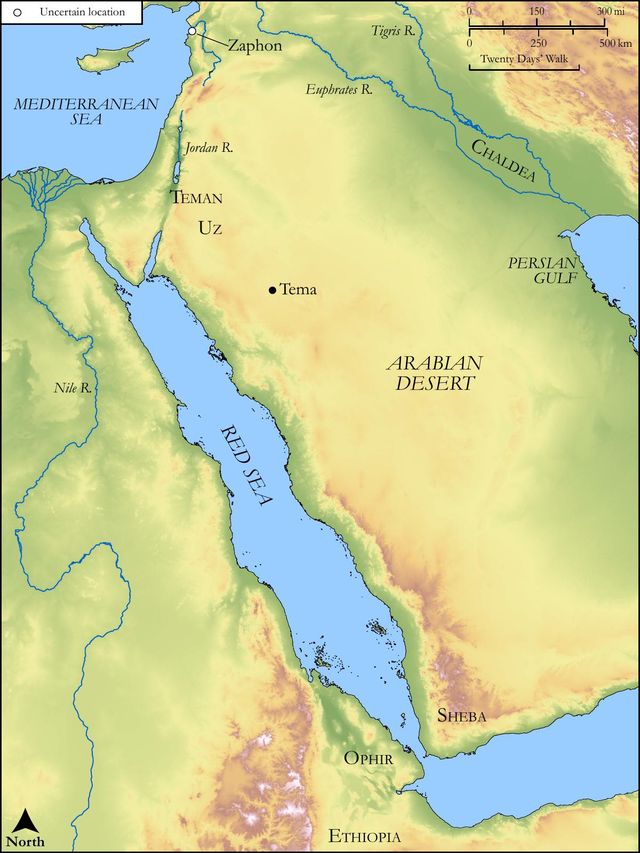
See on the biblical-era map
Study this verse
Public-domain commentary
Matthew Henry
From his Commentary on the Whole Bible. Henry comments on passages, not single verses — this entry covers Job 24:18–25. His two-level outline is real structure in the source text, so it is rendered as structure.
Job here, in the conclusion of his discourse,
I.Gives some further instances of the wickedness of these cruel bloody men.
1.Some are pirates and robbers at sea. To this many learned interpreters apply those difficult expressions (Job 24:18), He is swift upon the waters. Privateers choose those ships that are the best sailors. In these swift ships they cruise from one channel to another, to pick up prizes; and this brings them in so much wealth that their portion is cursed in the earth, and they behold not the way of the vineyards, that is (as bishop Patrick explains it), they despise the employment of those who till the ground and plant vineyards as poor and unprofitable. But others make this a further description of the conduct of those sinners that are afraid of the light: if they be discovered, they get away as fast as they can, and choose to lurk, not in the vineyards, for fear of being discovered, but in some cursed portion, a lonely and desolate place, which nobody looks after.
2.Some are abusive to those that are in trouble, and add affliction to the afflicted. Barrenness was looked upon as a great reproach, and those that fall under that affliction they upbraid with it, as Peninnah did Hannah, on purpose to vex them and make them to fret, which is a barbarous thing. This is evil entreating the barren that beareth not (Job 24:21), or those that are childless, and so want the arrows others have in their quiver, which enable them to deal with their enemy in the gate, Psa 127:5. They take that advantage against and are oppressive to them. As the fatherless, so the childless, are in some degree helpless. For the same reason it is a cruel thing to hurt the widow, to whom we ought to do good; and not doing good, when it is in our power, is doing hurt.
3.There are those who, by inuring themselves to cruelty, come at last to be so exceedingly boisterous that they are the terror of the mighty in the land of the living (Job 24:22): "He draws the mighty into a snare with his power; even the greatest are not able to stand before him when he is in his mad fits: he rises up in his passion, and lays about him with so much fury that no man is sure of his life; nor can he at the same time be sure of his own, for his hand is against every man and every man's hand against him," Gen 16:12. One would wonder how any man can take pleasure in making all about him afraid of him, yet there are those that do.
II.He shows that these daring sinners prosper, and are at ease for a while, nay, and often end their days in peace, as Ishmael, who, though he was a man of such a character as is here given, yet both lived and died in the presence of all his brethren, as we are told, Gen 16:12; Gen 25:18 : Of these sinners here it is said,
1.That it is given them to be in safety, Job 24:23. They seem to be under the special protection of the divine Providence; and one would wonder how they escape with life through so many dangers as they run themselves into.
2.That they rest upon this, that is, they rely upon this as sufficient to warrant all their violences. Because sentence against their evil works is not executed speedily they think that there is no great evil in them, and that God is not displeased with them, nor will ever call them to an account. Their prosperity is their security.
3.That they are exalted for a while. They seem to be the favourites of heaven, and value themselves as making the best figure on earth. They are set up in honour, set up (as they think) out of the reach of danger, and lifted up in the pride of their own spirits.
4.That, at length, they are carried out of the world very silently and gently, and without any remarkable disgrace or terror. "They go down to the grave as easily as snow-water sinks into the dry ground when it is melted by the sun;" so bishop Patrick explains Job 24:19. To the same purport he paraphrases Job 24:20, The womb shall forget him, etc. "God sets no such mark of his displeasure upon him but that his mother may soon forget him. The hand of justice does not hang him on a gibbet for the birds to feed on; but he is carried to his grave like other men, to be the sweet food of worms. There he lies quietly, and neither he nor his wickedness is any more remembered than a tree which is broken to shivers." And Job 24:24, They are taken out of the way as all others, that is, "they are shut up in their graves like all other men; nay, they die as easily (without those tedious pains which some endure) as an ear of corn is cropped with your hand." Compare this with Solomon's observation (Ecc 8:10), I saw the wicked buried, who had come and gone from the place of the holy, and they were forgotten.
III.He foresees their fall however, and that their death, though they die in ease and honour, will be their ruin.
God's eyes are upon their ways, Job 24:23. Though he keep silence, and seem to connive at them, yet he takes notice, and keeps account of all their wickedness, and will make it to appear shortly that their most secret sins, which they thought no eye should see (Job 24:15), were under his eye and will be called over again. Here is no mention of the punishment of these sinners in the other world, but it is intimated in the particular notice taken of the consequences of their death.
1.The consumption of the body in the grave, though common to all, yet to them is in the nature of a punishment for their sin. The grave shall consume those that have sinned; that land of darkness will be the lot of those that love darkness rather than light. The bodies they pampered shall be a feast for worms, which shall feed as sweetly on them as ever they fed on the pleasures and gains of their sins.
2.Though they thought to make themselves a great name by their wealth, and power, and mighty achievements, yet their memorial perished with them, Psa 9:6. He that made himself so much talked of shall, when he is dead, be no more remembered with honour; his name shall rot, Pro 10:7. Those that durst not give him his due character while he lived shall not spare him when he is dead; so that the womb that bore him, his own mother, shall forget him, that is, shall avoid making mention of him, and shall think that the greatest kindness she can do him, since no good can be said of him. That honour which is got by sin will soon turn into shame.
3.The wickedness they thought to establish in their families shall be broken as a tree; all their wicked projects shall be blasted, and all their wicked hopes dashed and buried with them.
4.Their pride shall be brought down and laid in the dust (Job 24:24); and, in mercy to the world, they shall be taken out of the way, and all their power and prosperity shall be cut off. You may seek them, and they shall not be found. Job owns that wicked people will be miserable at last, miserable on the other side death, but utterly denies what his friends asserted, that ordinarily they are miserable in this life.
IV.He concludes with a bold challenge to all that were present to disprove what he had said if they could (Job 24:25):
"If it be not so now, as I have declared, and if it do not thence follow that I am unjustly condemned and censured, let those that can undertake to prove that my discourse is either,
1.False in itself, and then they prove me a liar; or,
2.Foreign, and nothing to the purpose, and then they prove my speech frivolous and nothing worth." That indeed which is false is nothing worth; where there is not truth, how can there be goodness? But those that speak the words of truth and soberness need not fear having what they say brought to the test, but can cheerfully submit it to a fair examination, as Job does here.
Historical interpretation
Historical reception
2 surviving comments on this verse. Each one is dated, so this reads as a timeline rather than a list.
Select a marker to jump to its quote. Markers stagger vertically where authors wrote within a few decades of each other.
“Therefore when he has risen, he will not feel secure of his own life.” For these reasons the impious, after rising every day not really believing that he will live, remains in fear and is frightened. As the wise Solomon stated, “Fear, indeed, is nothing other than the abandonment of the supports offered by reason.” “When he has fallen sick, let him not hope to recover, but let him perish by disease.” The diseases of the body, in fact, often occur because of sin. “Let him not hope,” that is, the lack of hope is due to the consciousness of his sins. “Let him perish” by disease, that is, by the blows of calamity. “For his exaltation has hurt many.”For this reason, “let him perish,” because his exaltation has hurt many. “But he has withered as mallows in the heat or as an ear of corn falling off of itself from the stalk.” Other examples [from the Greek Bible] read “like grass.” In a similar way, the psalmist also says, “Quick as the grass they wither, fading like the green in the field.” And he rightly says, “falling off of itself,” indeed, for everybody sin itself becomes a punisher.
8. Whosoever commits sin and lives, such a person Divine Appointment for this reason bears with in iniquity, that it may withhold him from iniquity. But he that is borne with for a longer time, and yet is not withholden from iniquity, is vouchsafed indeed the benefit of the patience Above, yet with the chains of his guilt is by that very benefit binding himself the tighter. For because the times of repentance vouchsafed he diverts to sin, the strict Judge in the end converts the instances of mercy bestowed into punishment. Hence it is said by Paul; Or knowest thou not that the longsuffering of God leadeth thee to repentance? But after thy hardness and impenitent heart treasurest up unto thyself wrath against the day of wrath and revelation of the righteous judgment of God. [Rom. 2, 4.5.] Hence Isaiah saith, For the child shall die an hundred years old, but the sinner being an hundred years old shall be accursed. [Is. 65, 20] As though he deterred us in plain words, saying, ‘The life of a child indeed is drawn to a great length, in order that he may be corrected of childish doings, but if he be not even by length of time restrained from the commission of sin, this very length of life, which he received in pitifulness, is made to grow to him into an aggravation of cursing.’ Whence it is necessary that the longer time that we see ourselves to be waited for, we fear the very seasons of pitifulness before granted [praerogatae] as the grounds of condemnation, lest by the clemency of the Judge the punishment of the sinner should be heightened, and by the same means whereby anyone might have been rescued from death, he should tend to death in a manner the more disastrous. Which is for this reason very often brought to pass, because the eye of the mind is not in the least degree weaned from things present. For the sinner is careless to regard the ways of the Redeemer, and so he grows old in his own paths without stopping. Hence it is added;
For his eyes are upon his ways.
9. For the sinner ‘regards his own ways,’ because he sets himself to mind only, to have an eye only for, things which may stand him in stead for temporal advantage. Thus it is hence Paul saith, All seek their own, not the things which are Jesus Christ’s. [Phil. 2, 21] For the way of the highminded is pride; the way of the robber, avarice; the way of the lecherous, carnal concupiscence. Thus every bad man bends his eyes down on his own ways, in that he is intent on vicious pursuits alone, that by these he may satisfy his mind. Whence it is said by Solomon, The eyes of a fool are in the ends of the earth; because that only they regard with the whole bent of the heart, whereby they may attain to the end of earthly desire. Now the sinner would never fix the gaze of his looking on earth, if he lifted up the eyes of the mind to the holy paths of his Redeemer. Whence it is again said by Solomon, The wise man’s eyes are in his head; [Eccl. 2, 14] in this way, viz. that with undivided intentness the wise man regards Him, of Whom he reflects by faith that he is a member. For these ways of man’s walk and conversation, he had deemed it little worth to have in his eye, who said, I will meditate in Thy statutes, and have respect unto Thy ways. [Ps. 119, 15] As if he gave his word in plain terms, saying, ‘The things which are mine own I henceforth eschew the seeing of, in that by the path of the imitating of Thee I burn to go on in the steps of behaviour.’ For he who henceforth withstands the present world, by the continual inciting of love presents the ways of his Redeemer to the eyes of the heart, that so the mind may eschew what is prosperous, be in readiness for what is adverse, desire nought that soothes down, dread nought that is supposed to dismay, account sorrow joy, estimate the delights of the present life as the ills of woe, not fear the diminutions of a state of scorn, but thereby-seek room for enduring glory. For these ways Truth showed to the eyes of those that were following Him, when He said, If any man serve Me, let him follow Me. [John 12, 26] To these ways he recalled the swelling hearts of the Disciples, when they were already seeking room for glory, but knew not the pathway of that glory, saying, Are ye able to drink of the cup that I shall drink of? For they had been seeking the height of that session with Him on the right hand and on the left hand, but how great the narrowness of the pathway thereunto they did not see; and hence the cup of the Passion is at once presented to their eyes as a thing for them to imitate, that, surely, if they were making for the joys of exaltedness, they should first find the way of humility. And therefore because the sinner is careless to have an eye to the ways of God, but is bent on those only wherein he may be made to delight in a carnal manner, it is rightly said in this place, For his eyes are upon his ways.
Continue studying Job 24:23 across the web’s major study libraries — every link below opens this exact verse, chapter, or book on the destination site.
Read & Compare
 BibleGatewayThis verse in more than 200 translations and 70 languages.
 Bible.comThe YouVersion reader — hundreds of translations, reading plans, and highlights.
 ESV.orgCrossway's official English Standard Version reader.
 NET BibleThe NET translation with 60,000+ translators' notes on every rendering decision.
 STEP BibleTyndale House's free study tool — original text, vocabulary, and scholarly resources.
 BibliaLogos Bible Software's free web reader.
 USCCBThe New American Bible (Revised Edition) with the U.S. bishops' study notes.
Commentaries
 BibleHub CommentariesDozens of classic commentaries on this verse, gathered on one page.
 StudyLightMore than 100 commentary sets — the largest collection on the web.
 BibleRefPlain-English commentary on what this verse means, verse by verse.
 Enduring WordDavid Guzik's free commentary on this chapter, widely used by Bible teachers.
 Bible Study ToolsVerse commentary alongside Greek and Hebrew study aids.
Original Language & Research
- BibleHub InterlinearThe verse word by word — original language, transliteration, and English.
- BibleHub LexiconEvery word's original-language definition and Strong's entry.
 Blue Letter BibleDeep-study tools — Strong's numbers, concordance, and word studies.
 SefariaThe Hebrew text with Rashi and centuries of Jewish commentary.
Sermons, Hymns & Audio


TrulyRandomVerse is not affiliated with these sites and doesn’t control their content. They’re linked because they’re genuinely useful.
Summary
Job 24:23 offers a profound insight into the divine perspective on human actions, particularly those of the wicked, within Job's complex discourse on suffering and justice. It highlights the apparent paradox where the wicked may experience temporary security and peace, seemingly unhindered, yet simultaneously emphasizes that God's omniscient gaze remains fixed upon their every deed and life's course. This verse serves as a powerful affirmation of divine awareness and ultimate accountability, even when immediate judgment is not evident, providing a crucial counterpoint to the perplexing reality of unpunished evil.
Context
ShowHideLiterary Context
Job 24:23 is situated within Job's final and most impassioned response to his friends (Job 23-24), where he continues to grapple with the perplexing problem of evil and suffering. Throughout chapters 21-24, Job directly challenges the conventional wisdom espoused by Eliphaz, Bildad, and Zophar, which rigidly asserts that suffering is always a direct consequence of sin and that the wicked are swiftly and visibly punished. Job's own observations contradict this simplistic theology; he repeatedly points out that the wicked often prosper, live long lives, and die peacefully, seemingly escaping divine retribution. This verse specifically articulates Job's observation of the wicked enjoying apparent safety and rest, while simultaneously asserting that God's watchful eye is perpetually upon their "ways," hinting at a future reckoning despite present appearances.
Historical & Cultural Context
The Book of Job belongs to the wisdom books of Scripture, which frequently explore themes of justice, suffering, and the nature of God's governance. In this cultural milieu, there was a prevailing belief in immediate divine retribution—that righteousness led to prosperity and wickedness to calamity. Job's struggle, therefore, is not merely personal but a profound theological debate challenging this deeply ingrained retributional theology. The verse reflects a common human experience across cultures and times: the apparent success and impunity of the wicked, which often causes moral perplexity and despair among the righteous. It speaks to a universal human question about the fairness of divine justice and the timing of its execution.
Key Themes
ShowHideThis verse contributes significantly to several overarching themes within the Book of Job and biblical theology. Firstly, it underscores the Divine Omniscience and Sovereignty of God; despite His seeming inactivity or hiddenness, God is intimately aware of all human conduct, including the most clandestine actions and intentions of the wicked. This provides comfort to the righteous who feel unseen or unheard in their suffering, echoing the sentiment that "the eyes of the Lord are in every place, keeping watch on the evil and the good" as found in Proverbs 15:3. Secondly, it highlights the Temporary Prosperity of the Wicked, a recurring biblical theme that acknowledges the perplexing reality that unrighteous individuals often enjoy periods of peace, wealth, and influence. This observation is explored in depth in other wisdom texts, such as Psalm 73, where the psalmist grapples with the same issue before finding resolution in God's ultimate justice. Finally, the verse powerfully affirms the Certainty of Divine Accountability, implying that the wicked's apparent safety is an illusion, and their every "way" is meticulously recorded by God, leading inevitably to a future judgment. This resonates with the broader biblical teaching that "God will bring every deed into judgment, with every secret thing, whether good or evil," as stated in Ecclesiastes 12:14.
Exposition and Analysis
ShowHideKey Word Analysis
ShowHideThis noun (H983) signifies security, confidence, trust, or a place of refuge. In this context, it refers to the wicked person's perceived state of peace and freedom from danger or fear. It implies a false sense of invulnerability, a mistaken belief that their actions have no immediate negative repercussions or that they are beyond divine reach.
Derived from the primitive root (H8172) meaning "to support one's self; lean, lie, rely, rest (on, self), stay." Here, it vividly portrays the wicked person's comfortable repose, their leaning into their perceived security. It suggests a state of self-assuredness and lack of concern, reinforcing the idea that they feel completely at ease and unthreatened by any impending judgment.
This versatile noun (H1870) literally means "path" or "road," but biblically, it extends to encompass one's conduct, lifestyle, moral character, and overall course of life. When the text states God's eyes are "upon their ways," it implies a comprehensive divine observation of their entire life's trajectory, their choices, intentions, and moral direction, not merely isolated actions. It signifies a holistic assessment of their character and deeds.
Verse Breakdown
ShowHide"Though it be given him to be in safety, whereon he resteth;"
This clause acknowledges the perplexing reality that the wicked often experience periods of peace, security, and prosperity. The passive construction "it be given him" (from H5414, nâthan') suggests that this temporary state of safety is divinely permitted or allowed, rather than earned. It highlights the wicked person's comfortable and confident reliance on this perceived security, indicating a lack of fear or immediate consequence for their unrighteous actions. This observation is central to Job's argument against his friends' simplistic retribution theology.
"yet his eyes are upon their ways."
This contrasting clause delivers the profound theological truth that immediately refutes the illusion of the wicked's impunity. Despite their apparent safety and rest, God's omniscient "eyes" (H5869, ʻayin') are perpetually fixed upon their "ways"—their entire conduct, moral choices, and life's course. The phrase "his eyes are upon" is an anthropomorphism emphasizing God's perfect awareness, constant scrutiny, and intimate knowledge of every detail. This implies that no deed, no matter how hidden or seemingly successful, escapes divine notice, ensuring ultimate accountability.
Literary Devices
ShowHideJob 24:23 masterfully employs several Literary Devices to convey its powerful message. The most prominent is Contrast, which is central to the verse's meaning. It starkly juxtaposes the wicked person's perceived state of "safety" and "rest" with the unwavering, watchful "eyes" of God upon "their ways." This creates a tension between human perception and divine reality, highlighting the illusion of security for those who live unrighteously. Closely related is Irony, as the very "safety" the wicked lean upon is under the constant scrutiny of the One who will ultimately judge them. Their confidence is built on a foundation that God sees through entirely. Furthermore, the phrase "his eyes are upon" is an example of Anthropomorphism, attributing human physical characteristics (eyes, seeing) to God. This device makes the abstract concept of divine omniscience more relatable and impactful, emphasizing God's personal and direct engagement with human affairs, particularly His comprehensive knowledge of all actions.
Theological and Thematic Connections
ShowHideJob 24:23 resonates deeply with the broader biblical narrative concerning divine justice, human accountability, and God's sovereign oversight of creation. It serves as a powerful reminder that while God's timing and methods of justice may often seem inscrutable to human understanding, His awareness of all things is absolute. The verse affirms that no act, whether good or evil, escapes His notice, and that the apparent prosperity or impunity of the wicked is merely temporary, a prelude to an inevitable reckoning. This truth provides both a warning to those who might presume upon God's patience and profound comfort to the righteous who suffer under injustice, assuring them that their plight is seen and that ultimate justice will prevail.
Reflection and Application
ShowHideJob 24:23 offers a profound anchor for faith in a world where injustice often seems to triumph and the wicked appear to prosper. For those who feel disheartened by the apparent success of unrighteousness or burdened by the weight of unpunished evil, this verse provides a powerful reassurance: God sees. No hidden deed, no subtle manipulation, no act of oppression goes unnoticed by the Almighty. This truth should cultivate patience and perseverance in righteousness, trusting that God's justice operates on a timeline and according to a wisdom far beyond our comprehension. Conversely, for anyone tempted to engage in wrongdoing under the illusion of secrecy or impunity, the verse serves as a sober warning. Our perceived "safety" is a fragile illusion, for every "way" we walk is under the constant, discerning gaze of the One who will ultimately bring every secret thing to light. It calls us to live with integrity, knowing that our true audience is God Himself, and that genuine security is found only in aligning our "ways" with His righteous path.
Questions for Reflection
ShowHideFAQ
ShowHideDoes this verse imply that God actively gives safety to the wicked?
ShowHideThe phrase "Though it be given him to be in safety" (KJV) or "Though he is granted security" (ESV) suggests that the wicked's temporary peace and prosperity are permitted or allowed by God, rather than actively bestowed as a reward. It acknowledges a reality that God, in His sovereign will, allows certain circumstances to unfold, even if they seem to contradict immediate justice. This permission does not equate to approval or endorsement of their "ways." Instead, it often serves to highlight the depth of human depravity or to provide a longer period for repentance, while simultaneously affirming that God's watchful eye never leaves them, ensuring that this temporary reprieve is not a final state. It is part of God's mysterious patience, as seen in passages like Romans 2:4.
Christ-Centered Fulfillment
ShowHideJob 24:23, with its stark contrast between the wicked's perceived security and God's unwavering gaze, finds its ultimate fulfillment and resolution in the person and work of Jesus Christ. While the Old Testament often wrestled with the delayed justice for the wicked, the New Testament reveals that God's "eyes upon their ways" culminates in the final, perfect judgment executed by Christ. Jesus himself declared that "nothing is covered up that will not be revealed, or hidden that will not be known" (Luke 12:2), echoing Job's theme of divine omniscience. The temporary "safety" of the wicked is shattered by the reality of Christ's return, when "every eye will see him, even those who pierced him" (Revelation 1:7). Christ is the appointed judge, who will "repay each person according to what they have done" (Romans 2:6), bringing to light all the "ways" that were once hidden. For the righteous, this verse foreshadows the comfort found in Christ, who perfectly understood suffering and injustice, and whose ultimate victory ensures that the Lamb of God will indeed take away the sin of the world and establish a kingdom where "righteousness dwells" (2 Peter 3:13). Thus, the tension of Job 24:23 is resolved in the cross and resurrection, which guarantee both the judgment of sin and the vindication of the righteous through Christ.