


Jeremiah 49:5
- הִנְנִיhi·Nihere IH2005Prt ¦ 1csParticle InterjectionהִנְhereנִיI
- מֵבִיאme·Vi'[am] about to bringH935V-Hiphil-Prtcpl-msVerb Hiphil Participle Singular Masculine Absolute
- עָלַיִךְ'a·La·yikhon youH5921Prep ¦ 2fsPreposition Definiteעָלַיִonךְyou
- פַּחַדPa·chadterrorH6343N-msNoun Singular Masculine Absolute
- נְאֻםne·'um[the] utterance ofH5002N-mscNoun Singular Masculine Construct
- אֲדֹנָי'a·do·Nai[the] LordH136N-properNoun Proper Title
- יְהוִהYah·wehYahwehH3069N-properNoun Proper Title
- צְבָאוֹתtze·va·'otof hostsH6635N-fpNoun Plural Feminine Absolute
- מִכָּלmi·kolfrom allH3605Prep-m ¦ N-mscNoun Singular Masculine Constructמִfromכָּלall
- סְבִיבָיִךְse·vi·Va·yikharound youH5439N-mpc ¦ 2fsNoun Plural Masculine Constructסְבִיבָיִaroundךְyou
- וְנִדַּחְתֶּםve·ni·dach·Temand you will be driven awayH5080Conj-w ¦ V-Niphal-ConsecPerf-2mpVerb Niphal Consecutive Perfect 2nd Plural Masculineוְandנִדַּחְתֶּםyou will be driven away
- אִישׁ'isheveryoneH376N-msNoun Singular Masculine Absolute
- לְפָנָיוle·fa·Nav<to> before itH6440Prep-l ¦ N-mpc ¦ 3msNoun Plural Masculine Constructלְ<to>פָנָיbeforeוit
- וְאֵיןve·'Einand notH369Conj-w ¦ N-mscNoun Singular Masculine Constructוְandאֵיןnot
- מְקַבֵּץme·ka·Betz[one who] gathers togetherH6908V-Piel-Prtcpl-msVerb Piel Participle Singular Masculine Absolute
- לַנֹּדֵדla·no·Ded[belongs] to the fugitiveH5074Prep-l ¦ V-Qal-Prtcpl-msVerb Qal Participle Singular Masculine Absoluteלַ[belongs] to theנֹּדֵדfugitive
English is a literal word-by-word gloss of the Hebrew, not the KJV's wording. Why?
This is the original text the KJV's translators worked from — each Hebrew word with its own literal English meaning in this verse, prepared by scholars at Tyndale House, Cambridge. The KJV translates whole sentences, not word by word, so its wording differs: one Hebrew word can become several English words, and the KJV may choose “the LORD” where the gloss reads “Yahweh”. Both are faithful — they answer different questions. For the KJV's own rendering, switch to the KJV text.
Details
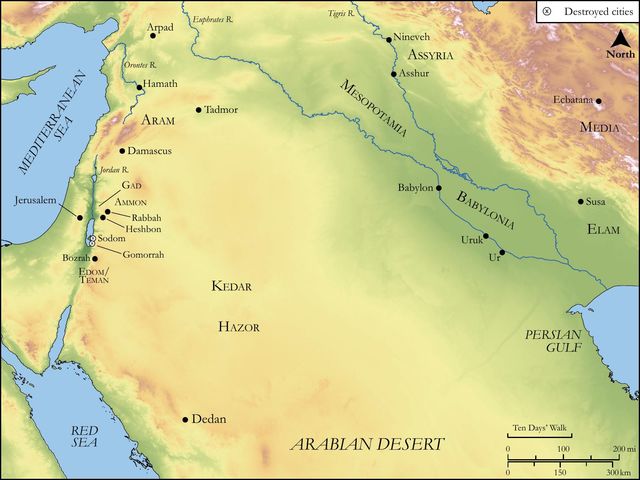
See on the biblical-era map
Study this verse
Public-domain commentary
Matthew Henry
From his Commentary on the Whole Bible. Henry comments on passages, not single verses — this entry covers Jeremiah 49:1–6.
The Ammonites were next, both in kindred and neighbourhood, to the Moabites, and therefore are next set to the bar. Their country joined to that of the two tribes and a half, on the other side Jordan, and was but a bad neighbour; however, being a neighbour, they shall have a share in these circular predictions. 1. An action is here brought, in God's name, against the Ammonites, for an illegal encroachment upon the rightful possessions of the tribe of Gad, that lay next them, Jer 49:1. A writ of enquiry is brought to discover what title they had to those territories, which, upon the carrying away of the Gileadites, by the king of Assyria (Kg2 15:29, Ch1 5:26), were left almost dispeopled, at least unguarded, and an easy prey to the next invader. "What! Does it escheat ob defectum sanguinis - for what of an heir? Hath Israel no sons? Hath he no heir? Are there no Gadites left, to whom the right of inheritance belongs? Or, if there were not, are there no Israelites, none left of Judah, that are nearer akin to them than you are?" Why then does their king, as if he were entitled to the forfeited estates, or Milcom, their idol, as if he had the right to dispose of it to his worshippers, inherit Gad, and his people dwell in the cities which fell by lot to that tribe of God's people. Nay, there were sons and heirs of their own body, en ventre de sa mere - in their mother's womb, and the Ammonites, to prevent their claim, most barbarously murdered them (Amo 1:13): They ripped up the women with child of Gilead, that they might enlarge their border, that, having seized it, none might rise up hereafter to recover it from them. Thus they magnified themselves against their border and boasted it was their own, Zep 2:8. Note, Though among men might often prevails against right, yet that might shall be controlled by the Almighty, who sits in the throne, judging right; and those will find themselves mistaken who think every thing their own which they can lay their hands on, or which none yet appears to lay claim to. As there is justice owing to owners, so also to their heirs, when they are dead, whom it is a great sin to defraud, though they either know not their right or know not how to come at it. This shall be reckoned for particularly, when injuries of this kind are done to God's people. 2. Judgment is here given against them for this violence. (1.) Terrors shall come upon them: God will cause an alarm of war to be heard, even in Rabbah, their capital city and a very strong one, Jer 49:2. The Lord God of hosts, who has all armies at his command, will bring a fear upon them from all that be about them, Jer 49:5. Note, God has many ways to terrify those who have been a terror to his people. (2.) Their cities shall be laid in ruins: Rabbah, the mother-city, shall be a desolate heap, and her daughters, the other cities that have a dependence upon her, and receive law from her as daughters, shall be burnt with fire; so that the inhabitants shall be forced to quit them, and they shall cry, and gird themselves with sackcloth, as having lost all they had, and not knowing whither to betake themselves. (3.) Their country, which they were so proud of, shall be wasted (Jer 49:4): Wherefore gloriest thou in the valleys, and trustest in thy treasures, O backsliding daughter? They are charged with backsliding or turning away from God and from his worship, for they were the posterity of righteous Lot. It is true, they had never been so in covenant with God as Israel was; yet all idolaters may be called backsliders, for the worship of the true God was prior to that of false gods. They were untoward and refractory (so some read it); and, when they had forsaken their God, they gloried in their valleys, particularly one that was called the flowing valley, because it flowed with all good things. These they had violently taken away from Israel, and gloried in it when they had done so. They gloried in the strength of their valleys, so surrounded with mountains that they were inaccessible, gloried in the products of them, gloried in the treasures they got together out of them, saying, Who shall come unto me? While they bathed themselves in the pleasures of their country, they flattered themselves with a conceit that they should never be disturbed in the enjoyment of them: Tomorrow shall be as this day; therefore they set God and his judgments at defiance; they are proud, voluptuous, and secure; but wherefore dost thou do so: Note, Those who backslide and turn away from God have little reason either to take complacency or to put confidence in any worldly enjoyments whatsoever, Hos 9:1. (4.) Their people, from the least to the greatest, shall be forced out of the country. Some shall flee to seek for shelter, others shall be carried into captivity, so that their land shall be quite evacuated: Their king and his princes, nay, and Milcom, their god, and his priests, shall go into captivity (Jer 49:3), and every man shall be driven out right forth, shall take the next way, and make the best of it in his flight (Jer 49:5), forgetting the valleys, the flowing valleys, which now fail them. And, to complete their misery, none shall gather up him that wanders, none shall open their doors to them, as Jael to Sisera, to entertain them; and those that flee shall be so much in care to secure themselves that they shall not take notice of others, no, not of those that are nearest to them, that wander, and are at a loss which way to go, as Jer 47:3. (5.) Then the country of the Ammonites shall fall into the hands of the remaining Israelites (Jer 49:2): Then shall Israel be heir to those that were his heirs, shall possess himself of their land who had possessed themselves of his, by way of reprisal. Note, The equity of divine Providence is to be acknowledged when the losses of the injured are recompensed out of the unjust gains of the injurious. Though the enemies of God's Israel may make a prey of them for a while, the tables will shortly be turned. 3. Yet there is a prospect given them of mercy hereafter (Jer 49:6), as before to Moab. The day will come when the captivity of the children of Ammon will be brought again; for so it is in human affairs: the wheel goes round.
Continue studying Jeremiah 49:5 across the web’s major study libraries — every link below opens this exact verse, chapter, or book on the destination site.
Read & Compare
 BibleGatewayThis verse in more than 200 translations and 70 languages.
 Bible.comThe YouVersion reader — hundreds of translations, reading plans, and highlights.
 ESV.orgCrossway's official English Standard Version reader.
 NET BibleThe NET translation with 60,000+ translators' notes on every rendering decision.
 STEP BibleTyndale House's free study tool — original text, vocabulary, and scholarly resources.
 BibliaLogos Bible Software's free web reader.
 USCCBThe New American Bible (Revised Edition) with the U.S. bishops' study notes.
Commentaries
 BibleHub CommentariesDozens of classic commentaries on this verse, gathered on one page.
 StudyLightMore than 100 commentary sets — the largest collection on the web.
 BibleRefPlain-English commentary on what this verse means, verse by verse.
 Enduring WordDavid Guzik's free commentary on this chapter, widely used by Bible teachers.
 Bible Study ToolsVerse commentary alongside Greek and Hebrew study aids.
Original Language & Research
- BibleHub InterlinearThe verse word by word — original language, transliteration, and English.
- BibleHub LexiconEvery word's original-language definition and Strong's entry.
 Blue Letter BibleDeep-study tools — Strong's numbers, concordance, and word studies.
 SefariaThe Hebrew text with Rashi and centuries of Jewish commentary.
Sermons, Hymns & Audio


TrulyRandomVerse is not affiliated with these sites and doesn’t control their content. They’re linked because they’re genuinely useful.
Summary
Jeremiah 49:5 delivers a potent divine judgment against the Ammonites, declaring that the Lord GOD of hosts will supernaturally inflict a pervasive fear upon them, originating from their surrounding adversaries. This profound terror will precipitate their chaotic and complete expulsion from their land, with every individual driven out in disarray. The prophecy culminates in a chilling pronouncement of utter desolation and a complete lack of refuge, emphasizing that no one will be able to gather or provide aid to those scattered and wandering, underscoring the finality and severity of God's wrath against their pride and hostility.
Context
ShowHideLiterary Context
Jeremiah 49 is situated within the "Oracles Against the Nations" (Jeremiah 46-51), a significant section of the book that underscores Yahweh's universal sovereignty. These prophecies demonstrate that God's authority extends beyond Israel, holding all nations accountable for their actions, particularly their pride, idolatry, and hostility towards His covenant people. Specifically, Jeremiah 49:1-6 focuses on Ammon, following the oracle against Moab (Jeremiah 48) and preceding judgments against Edom, Damascus, Kedar, Hazor, and Elam. This strategic placement within the prophetic collection reinforces a consistent divine pattern: God is the supreme ruler who executes justice upon any nation that opposes His purposes or oppresses His chosen people, affirming that no earthly power is exempt from His scrutiny and retribution.
Historical & Cultural Context
The Ammonites were an ancient Semitic people, descendants of Lot through his younger daughter, as recorded in the ancestral narrative of Genesis 19:38. Their territory was located east of the Jordan River, directly bordering Israel. Throughout their history, Ammon proved to be a persistent adversary of Israel, frequently engaging in conflict and opportunistically exploiting Judah's misfortunes, such as during the devastating Babylonian invasions. They were notorious for their nationalistic pride, aggressive expansionism into Israelite lands (as alluded to in Jeremiah 49:1), and the abhorrent worship of Molech, a deity associated with child sacrifice, which was a profound abomination to Yahweh (e.g., 1 Kings 11:7). The prophecy in Jeremiah 49:5 anticipates the impending invasion by Nebuchadnezzar's Babylonian forces, whom God would use as instruments of His judgment to bring about the desolation of Ammon, including their capital city, Rabbah.
Key Themes
ShowHideThis verse powerfully contributes to several overarching themes prevalent in Jeremiah and broader prophetic literature. Foremost is the theme of Divine Sovereignty and Judgment, illustrating that God is the ultimate ruler over all nations, not merely Israel, and that He justly executes punishment upon those who defy His moral order or oppress His people. The majestic phrase "saith the Lord GOD of hosts" powerfully conveys this absolute authority. Another critical theme is the Consequences of Pride and Hostility, as Ammon's downfall is directly attributed to their arrogance and continuous antagonism towards Judah. The prophecy also highlights the theme of Scattering and Desolation as a severe form of divine punishment, a stark contrast to God's promises of gathering and restoration for His covenant people, as seen in passages like Jeremiah 29:14. The complete lack of refuge for the scattered Ammonites underscores the severity and finality of this particular judgment, emphasizing the hopelessness of those outside God's covenant grace.
Exposition and Analysis
ShowHideKey Word Analysis
ShowHideThis word (H6343) denotes a sudden alarm, terror, or dread. In Jeremiah 49:5, it signifies a divinely instilled, overwhelming terror that will seize the Ammonites. This is not merely a natural anxiety but a profound, paralyzing dread that originates directly from God Himself. This "fear" serves as a precursor to their impending destruction, indicating a complete loss of courage and the onset of utter chaos.
This primitive root (H5080) means "to push off," "expel," "mislead," or "thrust away." It conveys a forceful, involuntary expulsion. When applied to the Ammonites, it describes their violent and sudden removal from their land, emphasizing that their displacement is not a voluntary migration but a compelled, chaotic scattering at the hands of an external, irresistible force, orchestrated by God.
Meaning "to grasp" or "collect" (H6908), this word implies assembling, gathering together, or providing refuge. In the negative "none shall gather up," it underscores the absolute desolation and hopelessness of the Ammonites' plight. It signifies that there will be no one to offer aid, shelter, or restoration to the displaced and scattered, contrasting sharply with God's covenant promises to gather His own people from exile.
Verse Breakdown
ShowHide"Behold, I will bring a fear upon thee"
This opening declaration serves as a solemn and emphatic pronouncement of divine judgment. "Behold" (KJV) functions as an interjection, drawing immediate attention to the certainty and gravity of what is about to be revealed. The Lord explicitly states His active role ("I will bring") in inflicting a profound, paralyzing terror upon Ammon, indicating that their impending doom is not a random occurrence but a direct act of God's sovereign will.
"saith the Lord GOD of hosts, from all those that be about thee"
This phrase identifies both the divine source of the prophecy and the instrument of judgment. "The Lord GOD of hosts" (Hebrew: ʼĂdônây Yᵉhôvih tsâbâʼ) is a majestic title emphasizing God's supreme authority, power, and sovereignty over all creation, including celestial and earthly armies. This reinforces that the judgment is not arbitrary but comes from the one who controls all forces. The terror will arise "from all those that be about thee," signifying that Ammon's surrounding neighbors, likely instruments of God's wrath (such as the Babylonians), will be the immediate cause of their fear and destruction, leaving them no escape.
"and ye shall be driven out every man right forth"
This clause vividly describes the chaotic and complete expulsion of the Ammonite population. "Driven out" (Hebrew: nâdach) conveys a forceful, involuntary scattering. "Every man right forth" emphasizes the suddenness, disorganization, and universality of their flight; each person will be expelled directly forward, without a planned destination, unity, or ability to resist, signifying the utter collapse of their national structure and social order.
"and none shall gather up him that wandereth."
This chilling final clause highlights the severity and finality of the judgment. It means there will be no one to offer aid, shelter, or restoration to the displaced and scattered Ammonites. Unlike God's covenant people, whom He promises to gather even from far-off lands, Ammon will find no such mercy or protector in their time of distress. The "wandereth" (Hebrew: nâdad) emphasizes their aimless, desperate flight, devoid of hope or help.
Literary Devices
ShowHideJeremiah 49:5 employs several potent literary devices to convey its message of impending judgment with dramatic force. The phrase "Behold, I will bring a fear upon thee, saith the Lord GOD of hosts" utilizes Divine Oracle, immediately signaling that the words are a direct, authoritative pronouncement from God Himself, lending them absolute certainty and gravity. The title "Lord GOD of hosts" functions as a powerful epithet, emphasizing God's omnipotence and His absolute command over all forces, both heavenly and earthly, thereby underscoring the inevitability and overwhelming nature of the judgment against Ammon. The description of the Ammonites being "driven out every man right forth" and the subsequent "none shall gather up him that wandereth" employs vivid Imagery of chaotic flight and utter desolation, painting a stark picture of a nation utterly dismantled and abandoned. Furthermore, the stark contrast between God's promise to gather His scattered covenant people (a recurring theme in Jeremiah) and the Ammonites' fate of having "none shall gather up him that wandereth" functions as a powerful juxtaposition, highlighting the unique covenant relationship God has with Israel versus His righteous judgment on other nations.
Theological and Thematic Connections
ShowHideJeremiah 49:5 profoundly illustrates God's universal sovereignty and His unwavering commitment to justice. It reveals that no nation, regardless of its perceived strength or autonomy, is beyond the reach of divine accountability. The Ammonites, known for their persistent pride, idolatry, and consistent hostility towards God's people, serve as a stark example that such defiance ultimately incurs severe consequences. This verse underscores the theological truth that God is not merely the God of Israel, but the "Lord GOD of hosts," actively involved in the affairs of all nations, orchestrating their rise and fall according to His righteous purposes. The judgment on Ammon serves as a perpetual reminder that national pride and opposition to God's will inevitably lead to destruction and desolation, a fate characterized by terror, scattering, and a complete lack of refuge.
Reflection and Application
ShowHideJeremiah 49:5, though a prophecy of judgment against an ancient nation, carries enduring truths for contemporary reflection and application. It compels us to acknowledge God's absolute sovereignty over all of creation and history, reminding us that no power, human or national, can ultimately defy His will. We are soberly reminded that pride, self-reliance, and hostility towards God's purposes, whether manifested on a national or individual level, inevitably lead to a state of fear, scattering, and spiritual desolation. The chilling image of "none shall gather up him that wandereth" serves as a powerful warning against rejecting the only true source of refuge and security. It challenges us to examine where we place our trust: in fleeting human strength, worldly alliances, or the unfailing protection of the Lord GOD of hosts. This verse calls us to humility, repentance, and a profound reverence for God's justice, while simultaneously inviting us to seek His mercy and find our ultimate refuge in Him, knowing that He is the one who gathers His own and provides lasting peace.
Questions for Reflection
ShowHideFAQ
ShowHideWhat was the primary sin of the Ammonites that led to this severe judgment?
ShowHideThe Ammonites' judgment stemmed from a combination of factors, including their persistent nationalistic pride, their aggressive expansionism into Israelite territory (specifically Gilead, mentioned in Jeremiah 49:1), their idolatry (particularly the worship of Molech, which involved child sacrifice, a grave abomination to Yahweh), and their consistent hostility towards God's covenant people, often exploiting Judah's weaknesses and misfortunes. Their actions demonstrated a profound disregard for God's justice and His chosen nation, leading to divine retribution.
How does "the Lord GOD of hosts" emphasize God's power in this context?
ShowHideThe title "Lord GOD of hosts" (Hebrew: ʼĂdônây Yᵉhôvih tsâbâʼ) is a majestic and powerful designation for God. ʼĂdônây signifies absolute mastership, Yᵉhôvih is God's covenant name YHWH, and tsâbâʼ means "armies" or "hosts" (referring to celestial armies, earthly armies, or the entire created order). When used together, especially in a context of judgment, it profoundly emphasizes God's supreme authority and His command over all forces in heaven and earth. It declares that the judgment against Ammon is not merely a political or military outcome, but a direct, irresistible act of the Almighty, who marshals all creation to accomplish His will. This title assures that the prophecy will be fulfilled because it is spoken by the one who controls all things, as also seen in the awe-inspiring vision of Isaiah 6:3.
Christ-Centered Fulfillment
ShowHideWhile Jeremiah 49:5 directly prophesies judgment against the ancient Ammonites, its ultimate Christ-centered fulfillment lies in how it illuminates profound truths about God's universal sovereignty, the nature of judgment, and the glorious provision of salvation, all of which find their ultimate expression and resolution in Jesus Christ. The "fear" brought upon Ammon foreshadows the spiritual terror and ultimate judgment awaiting all who reject God's authority and persist in rebellion against Him. However, in Christ, this judgment is transformed for those who believe. Jesus, as the true "Lord GOD of hosts" (a title implicitly applied to Him as the sovereign King and warrior in passages like Revelation 19:11-16), is the one who ultimately defeats all hostile powers and gathers His scattered people. Unlike the Ammonites, who had "none shall gather up him that wandereth," Christ is the Good Shepherd who lays down His life for His sheep and promises to gather them into one flock, ensuring that none are lost (as declared in John 10:16 and John 6:39). He provides the ultimate refuge from divine wrath, taking the judgment upon Himself on the cross, so that those who trust in Him are no longer "driven out" by fear but are brought near and adopted into God's family (Ephesians 2:13). Thus, the terrifying desolation pronounced against Ammon serves as a stark backdrop against which the glorious gathering and salvation offered in Christ shine all the more brightly, revealing Him as the only true source of security and hope.