


Jeremiah 44:15
Bible text: King James Version (1769 Blayney text) · Public domain
Bible text: King James Version with Strong's numbers · Public domain
Bible text: Berean Standard Bible · Public domain
Bible text: American Standard Version (1901) · Public domain
Bible text: World English Bible, Messianic edition · Public domain
Bible text: Geneva Bible (1599) · Public domain
Bible text: Young's Literal Translation · Public domain
- וַיַּעֲנוּvai·ya·'a·Nuand they answeredH6030Conj-w ¦ V-Qal-ConsecImperf-3mpVerb Qal Consecutive Imperfect 3rd Plural Masculineוַandיַּעֲנוּthey answered
- אֶת'et<obj.>H853DirObjMParticle Object Indicator
- יִרְמְיָהוּyir·me·Ya·huJeremiahH3414N-proper-mNoun Proper Masculine
- כָּלkolallH3605N-mscNoun Singular Masculine Construct
- הָאֲנָשִׁיםha·'a·na·Shimthe menH582Art ¦ N-mpNoun Plural Masculine Absoluteהָtheאֲנָשִׁיםmen
- הַיֹּדְעִיםhai·yo·de·'Imwho knewH3045Art ¦ V-Qal-Prtcpl-mpVerb Qal Participle Plural Masculine Absoluteהַwhoיֹּדְעִיםknew
- כִּיkithatH3588PrtParticle Conditional
- מְקַטְּרוֹתme·ka·te·Rot[were] making smokeH6999V-Piel-Prtcpl-fpVerb Piel Participle Plural Feminine Absolute
- נְשֵׁיהֶםne·shei·Hemtheir wivesH802N-mpc ¦ 3mpNoun Plural Masculine Constructנְשֵׁיwivesהֶםtheir
- לֵאלֹהִיםle·lo·Himto godsH430Prep-l ¦ N-mpNoun Plural Masculine Absoluteלֵtoאלֹהִיםgods
- אֲחֵרִים'a·che·RimotherH312Adj-mpAdjective Plural Masculine Absolute
- וְכָלve·kholand allH3605Conj-w ¦ N-mscNoun Singular Masculine Constructוְandכָלall
- הַנָּשִׁיםha·na·Shimthe womenH802Art ¦ N-mpNoun Plural Masculine Absoluteהַtheנָּשִׁיםwomen
- הָעֹמְדוֹתha·'o·me·Dotwho were standing byH5975Art ¦ V-Qal-Prtcpl-fpVerb Qal Participle Plural Feminine Absoluteהָwhoעֹמְדוֹתwere standing by
- קָהָלka·Hala companyH6951N-msNoun Singular Masculine Absolute
- גָּדוֹלga·DolgreatH1419Adj-msAdjective Singular Masculine Absolute
- וְכָלve·kholand allH3605Conj-w ¦ N-mscNoun Singular Masculine Constructוְandכָלall
- הָעָםha·'Amthe peopleH5971Art ¦ N-msNoun Singular Masculine Absoluteהָtheעָםpeople
- הַיֹּשְׁבִיםhai·yo·she·Vimwho were dwellingH3427Art ¦ V-Qal-Prtcpl-mpVerb Qal Participle Plural Masculine Absoluteהַwhoיֹּשְׁבִיםwere dwelling
- בְּאֶרֶץbe·'e·retzin [the] land ofH776Prep-b ¦ N-fscNoun Singular Feminine Constructבְּinאֶרֶץ[the] land of
- מִצְרַיִםmitz·Ra·yimEgyptH4714N-properNoun Proper Location
- בְּפַתְרוֹסbe·fat·Rosin PathrosH6624Prep-b ¦ N-properNoun Proper LocationבְּinפַתְרוֹסPathros
- לֵאמֹרle·Mor<to> sayingH559Prep-l ¦ V-Qal-InfVerb Qal Infinitive Constructלֵ<to>אמֹרsaying
English is a literal word-by-word gloss of the Hebrew, not the KJV's wording. Why?
This is the original text the KJV's translators worked from — each Hebrew word with its own literal English meaning in this verse, prepared by scholars at Tyndale House, Cambridge. The KJV translates whole sentences, not word by word, so its wording differs: one Hebrew word can become several English words, and the KJV may choose “the LORD” where the gloss reads “Yahweh”. Both are faithful — they answer different questions. For the KJV's own rendering, switch to the KJV text.
Details
See on the biblical-era map
Study this verse
Public-domain commentary
Matthew Henry
From his Commentary on the Whole Bible. Henry comments on passages, not single verses — this entry covers Jeremiah 44:15–19. His four-level outline is real structure in the source text, so it is rendered as structure.
We have here the people's obstinate refusal to submit to the power of the word of God in the mouth of Jeremiah. We have scarcely such an instance of downright daring contradiction to God himself as this, or such an avowed rebellion of the carnal mind. Observe,
I.The persons who thus set God and his judgments at defiance; it was not some one that was thus obstinate, but the generality of the Jews; and they were such as knew either themselves or their wives to be guilty of the idolatry Jeremiah had reproved, Jer 44:15. We find,
1.That the women had been more guilty of idolatry and superstition than the men, not because the men stuck closer to the true God and the true religion than the women, but, I fear, because they were generally atheists, and were for no God and no religion at all, and therefore could easily allow their wives to be of a false religion, and to worship false gods.
2.That it was consciousness of guilt that made them impatient of reproof: They knew that their wives had burnt incense to other gods, and that they had countenanced them in it, and the women that stood by knew that they had joined with them in their idolatrous usages; so that what Jeremiah said touched them in a sore place, which made them kick against the pricks, as children of Belial, that will not bear the yoke.
II.The reply which these persons made to Jeremiah, and in him to God himself; it is in effect the same with theirs who had the impudence to say to the Almighty, Depart from us; we desire not the knowledge of thy ways.
1.They declare their resolution not to do as God commanded them, but what they themselves had a mind to do; that is, they would go on to worship the moon, here called the queen of heaven; yet some understand it of the sun, which was much worshipped in Egypt (Jer 43:13) and had been so at Jerusalem (Kg2 23:11), and they say that the Hebrew word for the sun being feminine it may not unfitly be called the queen of heaven. And others understand it of all the host of heaven, or the frame of heaven, the whole machine, Jer 7:18. These daring sinners do not now go about to make excuses for their refusal to obey, nor suggest that Jeremiah spoke from himself and not from God (as before, Jer 43:2), but they own that he spoke to them in the name of the Lord, and yet tell him flatly, in so many words, "We will not hearken unto thee; we will do that which is forbidden and run the hazard of that which is threatened." Note, Those that live in disobedience to God commonly grow worse and worse, and the heart is more and more hardened by the deceitfulness of sin. Here is the genuine language of the rebellious heart: We will certainly do whatsoever thing goes forth out of our own mouth, let God and his prophets say what they please to the contrary. What they said many think who yet have not arrived at such a degree of impudence as to speak it out. It is that which the young man would be at in the days of his youth; he would walk in the way of his heart and the sight of his eyes, and would have and do every thing he has a mind to, Ecc 11:9.
2.They give some sort of reasons for their resolution; for the most absurd and unreasonably wicked men will have something to say for themselves, till the day comes when every mouth shall be stopped.
(1.)They plead many of those things which the advocates for Rome make the marks of a true church, and not only justify but magnify themselves with; and these Jews have as much right to them as the Romanists have.
[1.]They plead antiquity: We are resolved to burn incense to the queen of heaven, for our fathers did so; it is a practice that pleads prescription; and why should we pretend to be wiser than our fathers?
[2.]They plead authority. Those that had power practised it themselves and prescribed it to others: Our kings and our princes did it, whom God set over us, and who were of the seed of David.
[3.]They plead unity. It was not here and there one that did it, but we, we all with one consent, we that are a great multitude (Jer 44:15), we did it.
[4.]They plead universality. It was not done here and there, but in the cities of Judah.
[5.]They plead visibility. It was not done in a corner, in dark and shady groves only, but in the streets, openly and publicly.
[6.]They plead that it was the practice of the mother-church, the holy see; it was not now learned first in Egypt, but it had been done in Jerusalem.
[7.]They plead prosperity: They had we plenty of bread, and of all good things; we were well and saw no evil. All the former pleas, I fear, were too true in fact; God's witnesses against their idolatry were few and hid; Elijah though that he was left alone: and this last might perhaps be true as to some particular persons, but, as to their nation, they were still under rebukes for their rebellions, and there was no peace to those that went out or came in, Ch2 15:5. But, supposing all to be true, yet this does not at all excuse them from idolatry; it is the law of God that we must be ruled and judged by, hot the practice of men.
(2.)They suggest that the judgments they had of late been under were brought upon them for leaving off to burn incense to the queen of heaven, Jer 44:18. So perversely did they misconstrue providence, though God, by his prophets, had so often explained it to them, and the thing itself spoke the direct contrary. Since we forsook our idolatries we have wanted all things, and have been consumed by the sword, the true reason of which was because they still retained their idols in their heart and an affection to their old sins; but they would have it thought that it was because they had forsaken the acts of sin. Thus the afflictions which should have been for their welfare, to separate between them and their sins, being misinterpreted did but confirm them in their sins. Thus, in the first ages of Christianity, when God chastised the nations by any public calamities for opposing the Christians and persecuting them, they put a contrary sense upon the calamities, as if they were sent to punish them for conniving at the Christians and tolerating them, and cried, Christianos ad leones - Throw the Christians to the lions. Yet, if it had been true, as they said here, that since they returned to the service of the true God, the God of Israel, they had been in want and trouble, was that a reason why they should revolt from him again? That was as much as to say that they served not him, but their own bellies. Those who know God, and put their trust in him, will serve him, though he starve them, though he slay them, though they never see a good day with him in this world, being well assured that they shall not lose by him in the end.
(3.)They plead that, though the women were most forward and active in their idolatries, yet they did it with the consent and approbation of their husbands; the women were busy to make cakes for meat-offerings to the queen of heaven and to prepare and pour out the drink-offerings, Jer 44:19. We found, before, that this was their work, Jer 7:18. "But did we do it without our husbands, privately and unknown to them, so as to give them occasion to be jealous of us? No; the fathers kindled the fire while the women kneaded the dough; the men that were our heads, whom we were bound to learn of and to be obedient to, taught us to do it by their example." Note, It is sad when those who are in the nearest relation to each other, who should quicken each other to that which is good and so help one another to heaven, harden each other in sin and so ripen one another for hell. Some understand this as spoken by the husbands (Jer 44:15), who plead that they did not do it without their men, that is, without their elders and rulers, their great men, and men in authority; but, because the making of the cakes and the pouring out of the drink-offerings are expressly spoken of as the women's work (Jer 7:18), it seems rather to be understood as their plea: but it was a frivolous plea. What would it avail them to be able to say that it was according to their husbands' mind, when they knew that it was contrary to their God's mind?
Continue studying Jeremiah 44:15 across the web’s major study libraries — every link below opens this exact verse, chapter, or book on the destination site.
Read & Compare
 BibleGatewayThis verse in more than 200 translations and 70 languages.
 Bible.comThe YouVersion reader — hundreds of translations, reading plans, and highlights.
 ESV.orgCrossway's official English Standard Version reader.
 NET BibleThe NET translation with 60,000+ translators' notes on every rendering decision.
 STEP BibleTyndale House's free study tool — original text, vocabulary, and scholarly resources.
 BibliaLogos Bible Software's free web reader.
 USCCBThe New American Bible (Revised Edition) with the U.S. bishops' study notes.
Commentaries
 BibleHub CommentariesDozens of classic commentaries on this verse, gathered on one page.
 StudyLightMore than 100 commentary sets — the largest collection on the web.
 BibleRefPlain-English commentary on what this verse means, verse by verse.
 Enduring WordDavid Guzik's free commentary on this chapter, widely used by Bible teachers.
 Bible Study ToolsVerse commentary alongside Greek and Hebrew study aids.
Original Language & Research
- BibleHub InterlinearThe verse word by word — original language, transliteration, and English.
- BibleHub LexiconEvery word's original-language definition and Strong's entry.
 Blue Letter BibleDeep-study tools — Strong's numbers, concordance, and word studies.
 SefariaThe Hebrew text with Rashi and centuries of Jewish commentary.
Sermons, Hymns & Audio


TrulyRandomVerse is not affiliated with these sites and doesn’t control their content. They’re linked because they’re genuinely useful.
Summary
Jeremiah 44:15 powerfully captures a moment of profound and unyielding defiance from the Jewish remnant who had sought refuge in Egypt after the catastrophic fall of Jerusalem. Despite the prophet Jeremiah's consistent and divinely-commissioned warnings, this substantial assembly of men and women, residing in Pathros, collectively and explicitly rejected the Lord's word, choosing instead to persist in their deeply ingrained idolatrous practices, particularly the burning of incense to "other gods." This pivotal verse not only sets the stage for their direct declaration of rebellion but also tragically underscores the severe and inevitable consequences of unrepentant disobedience to God's revealed truth.
Context
ShowHideLiterary Context
Jeremiah 44:15 is strategically placed within the concluding chapters of the book of Jeremiah, which meticulously document the prophet's ministry to the Judahite remnant. This remnant, against God's explicit command, had fled to Egypt following the destruction of Jerusalem in 586 BC. The verses immediately preceding this passage (Jeremiah 44:1-14) recount Jeremiah's impassioned indictment of their continued idolatry in Egypt. He sternly reminds them that their flight would not grant them safety, but rather lead to their demise if they persisted in their rebellion, echoing the very sins that brought about Judah's downfall. Verse 15 marks the dramatic turning point where the people, in a unified and hardened front, directly confront Jeremiah, setting the stage for their explicit, defiant declaration to continue their idolatrous practices, thereby sealing their tragic and divinely ordained fate (Jeremiah 44:16-19).
Historical & Cultural Context
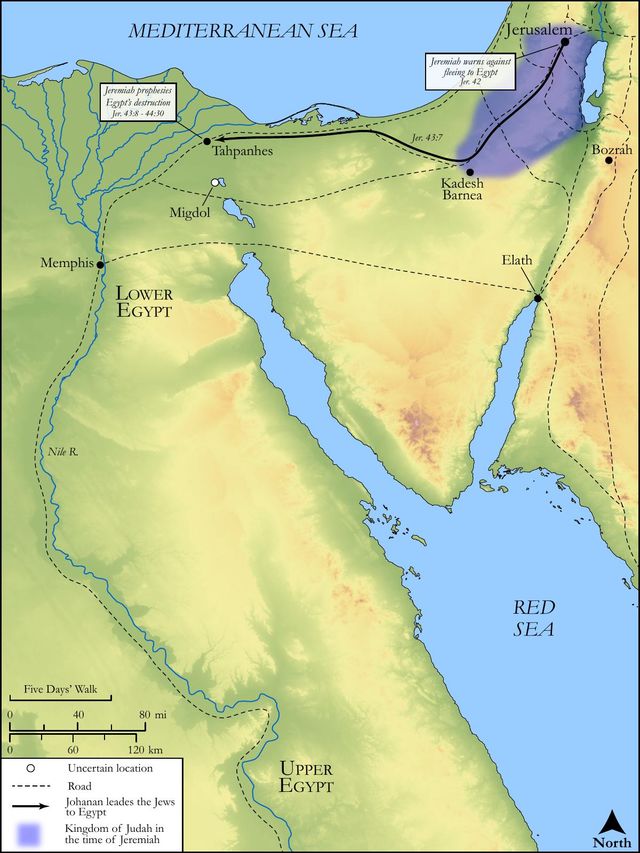
Following the Babylonian conquest and the destruction of Jerusalem, a significant portion of the Jewish population, including Jeremiah, was either forcibly taken or voluntarily fled to various parts of Egypt. These settlements included Migdol, Tahpanhes, Noph (Memphis), and Pathros (Upper Egypt), as detailed in Jeremiah 44:1. Pathros, located in southern Egypt, was a fertile region, indicating the broad geographical dispersion of these exiles. Culturally, ancient Egypt was saturated with polytheism, featuring a vast pantheon of deities. The burning of incense was a pervasive act of worship among the nations, symbolizing devotion, prayer, and sacrifice to various gods. For the Jewish people, who were bound by covenant to worship Yahweh alone, the act of burning incense to "other gods"—specifically mentioned as the "Queen of Heaven" in Jeremiah 44:17—constituted a direct and grievous violation of the first two commandments of the Decalogue (Exodus 20:3-6). This was a profound act of apostasy, made even more egregious given that they had just witnessed the devastating divine judgment exacted upon Judah for these very sins.
Key Themes
ShowHideJeremiah 44:15 powerfully amplifies several critical themes woven throughout the book of Jeremiah. Firstly, it starkly illustrates the theme of persistent idolatry and spiritual apostasy. Despite experiencing the direct consequences of divine judgment, the people's deep-seated rebellion remained unyielding, demonstrating the human heart's capacity for hardened sin. Secondly, the verse underscores the theme of open defiance against God's revealed word. The collective response of the people is not one of repentance, or even hesitant questioning, but an outright, vocal rejection of Jeremiah's prophetic authority and, by extension, God's sovereign will. This highlights the perilous nature of spiritual stubbornness. Finally, it emphasizes the theme of collective guilt and complicity. The explicit mention of "all the men which knew that their wives had burned incense" and "all the women that stood by" reveals a widespread, communal embrace of sin. The men were complicit through their inaction or tacit approval, while the women were active participants, demonstrating a pervasive societal rejection of God's truth. This communal rebellion inevitably leads to the judgment that follows, reinforcing the consistent biblical principle that disobedience brings severe consequences, a principle vividly portrayed throughout the entire book of Jeremiah.
Exposition and Analysis
ShowHideKey Word Analysis
ShowHideThis term (H3045) signifies more than mere intellectual awareness; it often denotes a deep, experiential, and intimate knowledge, implying recognition, observation, and even a certain level of care or designation. In this context, the men were not merely bystanders but possessed a profound understanding and awareness of their wives' idolatrous actions. Their "knowing" suggests a conscious cognizance of the sin being committed, making their failure to intervene or repent a deliberate act of complicity and defiance, thereby heightening their culpability.
The word "other" (H312, ʼachêr) properly means "hinder" or "next," but generally refers to something different, subsequent, or strange, emphasizing that these deities were foreign and distinct from Yahweh, the one true God of Israel. "Gods" (H430, ʼĕlôhîym), while sometimes used for the singular Supreme God, is here explicitly used in its plural sense for pagan deities. The combination unequivocally highlights the direct violation of the First Commandment, the worship of false gods, which was the primary catalyst for Judah's downfall and remained their persistent spiritual stumbling block in Egypt.
This word (H6951) refers to an assemblage, company, or congregation, often used concretely. Its application here, particularly when coupled with "great" (H1419, gâdôwl), emphasizes the sheer number and the collective, unified nature of the people involved in this defiant act. It was not a small, isolated group but a substantial portion, if not the majority, of the Jewish remnant in Pathros, indicating a pervasive and communal rejection of God's word, which underscores the gravity and widespread nature of their rebellion.
Verse Breakdown
ShowHide"Then all the men which knew that their wives had burned incense unto other gods"
This clause reveals the deliberate and informed nature of the rebellion. The men possessed a deep awareness ("knew") of their wives' idolatrous practices, implying not just intellectual understanding but a conscious recognition and, by extension, tacit approval or even active participation. The act of burning incense was a profound ritual of worship, and directing it toward "other gods" constituted a blatant violation of the covenant with Yahweh, indicating a deep-seated apostasy that permeated the family unit.
"and all the women that stood by, a great multitude"
This segment underscores the widespread and communal aspect of the sin. The women were not passive observers but active participants ("stood by" suggesting presence, support, and likely direct involvement, as confirmed by their later statements in Jeremiah 44:17-19). The phrase "a great multitude" further emphasizes the sheer number of people involved, indicating that this was a collective, pervasive rejection of God's warnings, rather than an isolated incident.
"even all the people that dwelt in the land of Egypt, in Pathros"
This part of the verse precisely defines the scope and location of the rebellion. It specifies that the defiance encompassed the entire community of Jewish exiles who had settled in the region of Pathros in Upper Egypt, demonstrating that this widespread rejection of God's truth was characteristic of the remnant who had fled there, encompassing both men and women.
"answered Jeremiah, saying"
This final clause dramatically sets the stage for the explicit declaration of rebellion that immediately follows in Jeremiah 44:16. It signifies a direct, verbal, and unified response to Jeremiah's prophetic message, indicating their conscious and vocal rejection of God's word delivered through His chosen prophet. Their "answer" is not one of repentance or submission, but of hardened resolve in their idolatrous practices.
Literary Devices
ShowHideJeremiah 44:15 masterfully employs several potent literary devices to convey the profound gravity and tragic nature of the situation. The use of Amplification or Hyperbole is striking in phrases such as "all the men," "all the women," "a great multitude," and "all the people." While not necessarily implying every single individual, this rhetorical emphasis highlights the overwhelming and pervasive nature of the rebellion, underscoring its communal scope rather than isolated acts of disobedience. There is a profound sense of Irony in the Jewish remnant, having just endured the cataclysmic consequences of idolatry in Judah, now defiantly continuing the very practices that led to their ruin, even while seeking refuge in a foreign land. The verse also functions as a powerful form of Foreshadowing, as the people's unyielding defiance directly sets the stage for the dire prophecies of judgment that Jeremiah subsequently pronounces upon them, confirming that their chosen path will inevitably lead to their destruction in Egypt. Finally, the stark Contrast between Jeremiah, as God's faithful and solitary messenger, and the unified, rebellious stance of the entire community vividly underscores the profound spiritual chasm between divine truth and entrenched human stubbornness.
Theological and Thematic Connections
ShowHideJeremiah 44:15 stands as a stark and sobering testament to the profound depth of human rebellion and the tragic consequences of persistent idolatry. Theologically, it reveals a people so deeply entrenched in their sin that even direct divine warnings, delivered through a trusted prophet and underscored by recent catastrophic judgment (the fall of Jerusalem), fail to elicit genuine repentance. This vividly illustrates the hardening effect of sin on the human heart, where spiritual blindness and defiance become deeply ingrained and self-perpetuating. It simultaneously underscores God's unwavering faithfulness in sending His word, even to a rebellious people, and His unyielding justice in executing judgment when His warnings are defiantly spurned. The communal nature of the sin highlights the corporate responsibility and pervasive influence within a society, where complicity and active participation in idolatry inevitably lead to collective ruin. This passage serves as a timeless reminder that true worship demands exclusive and undivided devotion to the one true God, and any deviation—whether ancient paganism or contemporary forms of idolatry—invites divine displeasure and ultimately destructive outcomes.
Reflection and Application
ShowHideJeremiah 44:15 offers a profound and challenging mirror for contemporary believers, compelling us to critically examine the subtle and overt forms of idolatry that may exist in our own lives and communities. The stubbornness of the Jewish remnant, their refusal to heed clear divine warnings despite overwhelming evidence of judgment, serves as a powerful and timeless cautionary tale. In an age saturated with distractions, competing allegiances, and self-serving narratives, we must vigilantly guard against anything that displaces God from His rightful, supreme position in our hearts and lives. This vigilance extends beyond overt worship of false gods to encompass the more insidious idolatries of materialism, the relentless pursuit of success, an insatiable craving for comfort, an over-reliance on self, or even the elevation of relationships to an ultimate source of security, identity, or joy. The passage calls us to cultivate a posture of profound humility and immediate responsiveness to God's Word, whether it comes through the direct revelation of Scripture, faithful and challenging preaching, or the convicting work of the Holy Spirit. It reminds us that true repentance involves not merely acknowledging sin but a radical turning away from it, embracing radical obedience and wholehearted devotion, lest we, too, find ourselves doubling down on destructive patterns, tragically oblivious to the divine warnings that seek to lead us to life and flourishing.
Questions for Reflection
ShowHideFAQ
ShowHideWhat was the "Pathros" mentioned in this verse?
ShowHidePathros (H6624) was a significant region located in Upper (southern) Egypt. It was one of several areas where the Jewish remnant, who had fled from Judah after the Babylonian destruction of Jerusalem, settled. Jeremiah 44:1 lists various locations in Egypt where these exiles resided, indicating their widespread dispersion throughout the land. Pathros was known for its fertility and was a substantial settlement for the Jewish diaspora.
Why were the men complicit in their wives' idolatry?
ShowHideThe verse explicitly states that "all the men which knew (H3045, yâdaʻ') that their wives had burned incense unto other gods" were present and answered Jeremiah. This implies that the men were fully aware of their wives' idolatrous practices, yet they did not prevent them or actively lead them back to the exclusive worship of Yahweh. In ancient patriarchal societies, men typically held significant authority within the household and were responsible for the spiritual well-being and moral conduct of their families. Their inaction, tacit approval, or perhaps even active participation, made them deeply complicit in the sin, highlighting a pervasive collective failure of spiritual leadership and integrity within the community of exiles.
What was the significance of "burning incense unto other gods"?
ShowHideBurning incense (H6999, qâṭar) was a common and profound act of worship among the nations, signifying devotion, prayer, and sacrifice to a deity. For the Israelites, it was a sacred act reserved exclusively for the worship of Yahweh alone, often performed by priests in the Temple. Directing this act to "other gods" (H312, ʼachêr H430, ʼĕlôhîym) was a profound and blatant act of apostasy, a direct violation of the First and Second Commandments (Exodus 20:3-6). It represented a complete spiritual unfaithfulness and a turning away from the covenant God of Israel, often associated with the worship of pagan deities like the "Queen of Heaven," as explicitly mentioned later in Jeremiah 44:17. This act was a clear manifestation of their rejection of Yahweh's unique sovereignty and their embrace of foreign religious practices.
Christ-Centered Fulfillment
ShowHideJeremiah 44:15, with its stark portrayal of unyielding human rebellion and the tragic consequences of idolatry, finds its ultimate resolution and profound fulfillment in the person and work of Jesus Christ. The stubborn refusal of the Jewish remnant to heed Jeremiah's warnings, even in the face of overwhelming divine judgment, profoundly underscores the deep-seated sinfulness of humanity and its innate, pervasive tendency to reject God's authority and embrace "other gods." This persistent rebellion, so vividly depicted here, highlights the desperate and universal need for a radical transformation of the human heart—a transformation that no prophet, law, or external warning could ever fully achieve. Jesus, as the perfect Lamb of God and the ultimate High Priest, entered into this broken human condition not merely to warn of judgment, but to bear its full weight on the cross. His sacrificial death at Calvary atoned for the very idolatry and rebellion that plagued Israel and continues to plague humanity, offering a path to reconciliation and spiritual cleansing that was utterly beyond their reach through their own efforts. In Christ, the devastating cycle of sin and judgment is broken for all who believe; He provides the true spiritual cleansing and the new heart, as prophesied in Ezekiel 36:26, that enables genuine obedience and exclusive worship of the one true God. Furthermore, Christ embodies the ultimate prophetic word, the "Word made flesh" (John 1:14), whom humanity can no longer defiantly reject without sealing their eternal fate. Unlike Jeremiah, whose warnings were spurned, Jesus offers not just warnings but the very grace and empowering Spirit to overcome the idolatrous inclinations of the heart, leading His followers into true worship and eternal life (John 14:6). He is the faithful remnant, the obedient Son, who perfectly fulfilled God's will where Israel failed, offering salvation to all who turn from their "other gods" and trust in Him alone (Acts 4:12).