


Isaiah 44:7
Bible text: King James Version (1769 Blayney text) · Public domain
Bible text: King James Version with Strong's numbers · Public domain
Bible text: Berean Standard Bible · Public domain
Bible text: American Standard Version (1901) · Public domain
Bible text: World English Bible, Messianic edition · Public domain
Bible text: Geneva Bible (1599) · Public domain
Bible text: Young's Literal Translation · Public domain
- וּמִיu·miand who?H4310Conj-w ¦ InterrogPronoun Interrogativeוּandמִיwho?
- כָמוֹנִיkha·Mo·ni[is] like meH3644Prep ¦ 1csPrepositionכָמוֹ[is] likeנִיme
- יִקְרָאyik·Ra'let him proclaim [it]H7121V-Qal-Imperf-3msVerb Qal Imperfect 3rd Singular Masculine
- וְיַגִּידֶהָve·ya·gi·De·haand let him declare itH5046Conj-w ¦ V-Hiphil-ConjImperf-3ms ¦ 3fsVerb Hiphil Conjunction+Imperfect 3rd Singular Masculineוְandיַגִּידֶlet him declareהָit
- וְיַעְרְכֶהָve·ya'·re·Khe·haand let him recount in order itH6186Conj-w ¦ V-Qal-ConjImperf-3ms ¦ 3fsVerb Qal Conjunction+Imperfect 3rd Singular Masculineוְandיַעְרְכֶlet him recount in orderהָit
- לִיLito mePrep-l ¦ 1csSuffix Personal 1st Singular common genderלִtoיme
- מִשּׂוּמִיmi·su·Mifrom I when establishedH7760Prep-m ¦ V-Qal-Inf ¦ 1csVerb Qal Infinitive Constructמִfromשּׂוּמִwhen establishedיI
- עַם'ama people ofH5971N-mscNoun Singular Masculine Construct
- עוֹלָםo·LamantiquityH5769N-msNoun Singular Masculine Absolute
- וְאֹתִיּוֹתve·'o·ti·Yotand [the] coming [things]H857Conj-w ¦ V-Qal-Prtcpl-fpVerb Qal Participle Plural Feminine Absoluteוְandאֹתִיּוֹת[the] coming [things]
- וַאֲשֶׁרva·'a·Sherand [the things] whichH834Conj-w ¦ RelParticle Relativeוַandאֲשֶׁר[the things] which
- תָּבֹאנָהta·Vo·nahthey will comeH935V-Qal-Imperf-3fpVerb Qal Imperfect 3rd Plural Feminine
- יַגִּידוּya·Gi·dulet them declareH5046V-Hiphil-Imperf-3mpVerb Hiphil Imperfect 3rd Plural Masculine
- לָמוֹla·moto themPrep-l ¦ 3mpSuffix Personal 3rd Plural Masculineלָtoמוֹthem
English is a literal word-by-word gloss of the Hebrew, not the KJV's wording. Why?
This is the original text the KJV's translators worked from — each Hebrew word with its own literal English meaning in this verse, prepared by scholars at Tyndale House, Cambridge. The KJV translates whole sentences, not word by word, so its wording differs: one Hebrew word can become several English words, and the KJV may choose “the LORD” where the gloss reads “Yahweh”. Both are faithful — they answer different questions. For the KJV's own rendering, switch to the KJV text.
Details
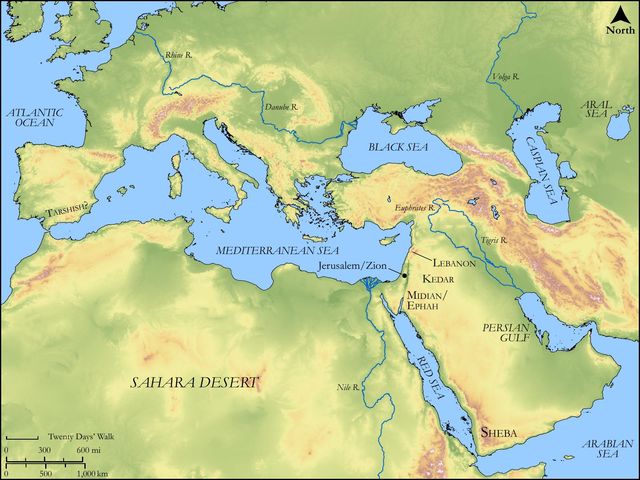
See on the biblical-era map
Study this verse
Public-domain commentary
Matthew Henry
From his Commentary on the Whole Bible. Henry comments on passages, not single verses — this entry covers Isaiah 44:1–8. His three-level outline is real structure in the source text, so it is rendered as structure.
Two great truths are abundantly made out in these verses: -
I.That the people of God are a happy people, especially upon account of the covenant that is between them and God.
The people of Israel were so as a figure of the gospel Israel. Three things complete their happiness: -
1.The covenant-relations wherein they stand to God, Isa 44:1, Isa 44:2. Israel is here called Jeshurun - the upright one; for those only, like Nathanael, are Israelites indeed, in whom is no guile, and those only shall have the everlasting benefit of these promises. Jacob and Israel had been represented, in the close of the foregoing chapter, as very provoking and obnoxious to God's wrath, and already given to the curse and to reproaches; but, as if God's bowels yearned towards him and his repentings were kindled together, mercy steps in with a non-obstante - notwithstanding, to all these quarrels: "Yet now, hear, O Jacob my servant! thou and I will be friends again for all this." God had said (Isa 43:25), I am he that blotteth out thy transgression, which is the only thing that creates this distance; and when that is taken away the streams of mercy run again in their former channel. The pardon of sin is the inlet of all the other blessings of the covenant. So and so I will do for them, says God (Heb 8:12), for I will be merciful to their unrighteousness. Therefore hear, O Jacob! hear these comfortable words; therefore fear not, O Jacob! fear not thy troubles, for by the pardon of sin the property of them too is altered. Now the relations wherein they stand to him are very encouraging.
(1.)They are his servants; and those that serve him he will own and stand by and see that they be not wronged.
(2.)They are his chosen, and he will abide by his choice; he knows those that are his, and those whom he has chosen he takes under special protection.
(3.)They are his creatures. He made them, and brought them into being; he formed them, and cast them into shape; he began betimes with them, for he formed them from the womb; and therefore he will help them over their difficulties and help them in their services.
2.The covenant-blessings which he has secured to them and theirs, Isa 44:3, Isa 44:4.
(1.)Those that are sensible of their spiritual wants, and the insufficiency of the creature to supply them, shall have abundant satisfaction in God: I will pour water upon him that is thirsty, that thirsts after righteousness; he shall be filled. Water shall be poured out to those who truly desire spiritual blessings above all the delights of sense.
(2.)Those that are barren as the dry ground shall be watered with the grace of God, with floods of that grace, and God will himself give the increase. If the ground be ever so dry, God has floods of grace to water it with.
(3.)The water God will pour out is his Spirit (Joh 7:39), which God will pour out without measure upon the seed, that is, Christ (Gal 3:16), and by measure upon all the seed of the faithful, upon all the praying wrestling seed of Jacob, Luk 11:13. This is the great New Testament promise, that God, having sent his servant Christ, and upheld him, will send his Spirit to uphold us.
(4.)This gift of the Holy Ghost is the great blessing God had reserved the plentiful effusion of for the latter days: I will pour my Spirit, that is, my blessing; for where God gives his Spirit he will give all other blessings.
(5.)This is reserved for the seed and offspring of the church; for so the covenant of grace runs: I will be a God to thee and to thy seed. To all who are thus made to partake of the privileges of adoption God will give the spirit of adoption.
(6.)Hereby there shall be a great increase of the church. Thus it shall be spread to distant places. Thus it shall be propagated and perpetuated to after-times: They shall spring up and grow as fast as willows by the watercourses, and in every thing that is virtuous and praiseworthy shall be eminent and excel all about them, as the willows overtop the grass among which they grow, Isa 44:4. Note, It is a great happiness to the church, and a great pleasure to good men, to see the rising generation hopeful and promising. And it will be so if God pour his Spirit upon them, that blessing, that blessing of blessings.
3.The consent they cheerfully give to their part of the covenant, Isa 44:5. When the Jews returned out of captivity they renewed their covenant with God (Jer 50:5), particularly that they would have no more to do with idols, Hos 14:2, Hos 14:3, Hos 14:8. Backsliders must thus repent and do their first works. Many of those that were without did at that time join themselves to them, invited by that glorious appearance of God for them, Zac 8:23; Est 8:17. And they say, We are the Lord's and call themselves by the name of Jacob; for there was one law, one covenant, for the stranger and for those that were born in the land. And doubtless it looks further yet, to the conversion of the Gentiles, and the multitudes of them who, upon the effusion of the Spirit, after Christ's ascension, should be joined to the Lord and added to the church. These converts are one and another, very many, of different ranks and nations, and all welcome to God, Col 3:11. When one does it another shall by his example be invited to do it, and then another; thus the zeal of one may provoke many. (1.) They shall resign themselves to God: not one in the name of the rest, but every one for himself shall say, "I am the Lord's; he has an incontestable right to rule me, and I submit to him, to all his commands, to all his disposal. I am, and will be, his only, his wholly, his for ever, will be for his interests, will be for his praise; living and dying I will be his." (2.) They shall incorporate themselves with the people of God, call themselves by the name of Jacob, forgetting their own people and their fathers' house, and desirous to wear the character and livery of God's family. They shall love all God's people, shall associate with them, give them the right hand of fellowship, espouse their cause, seek the good of the church in general and of all the particular members of it, and be willing to take their lot with them in all conditions. (3.) They shall do this very solemnly. Some of them shall subscribe with their hand unto the Lord, as, for the confirming of a bargain, a man sets his hand to it, and delivers it as his act and deed. The more express we are in our covenanting with God the better, Exo 24:7; Jos 24:26, Jos 24:27; Neh 9:38. Fast bind, fast find.
II.That, as the Israel of God are a happy people, so the God of Israel is a great God, and he is God alone.
This also, as the former, speaks abundant satisfaction to all that trust in him, Isa 44:6-8. Observe here, to God's glory and our comfort,
1.That the God we trust in is a God of incontestable sovereignty and irresistible power. He is the Lord, Jehovah, self-existent and self-sufficient; and he is the Lord of hosts, of all the hosts of heaven and earth, of angels and men.
2.That he stands in relation to, and has a particular concern for, his church. He is the King of Israel and his Redeemer; therefore his Redeemer because his King; and those that take God for their King shall have him for their Redeemer. When God would assert himself God alone he proclaims himself Israel's God, that his people may be encouraged both to adhere to him and to triumph in him.
3.That he is eternal - the first and the last. He is God from everlasting, before the worlds were, and will be so to everlasting, when the world shall be no more. If there were not a God to create, nothing would ever have been; and, if there were not a God to uphold, all would soon come to nothing again. He is all in all, is the first cause, from whom are all things, and the last end, to and for whom are all things (Rom 11:36), the Alpha and the Omega, Rev 1:11.
4.That he is God alone (Isa 44:6): Besides me there is no God. Is there a God besides me? Isa 44:8. We will appeal to the greatest scholars. Did they ever in all their reading meet with any other? To those that have had the largest acquaintance with the world. Did they ever meet with any other? There are gods many (Co1 8:5, Co1 8:6), called gods, and counterfeit gods: but is there any besides our God that is infinite and eternal, any besides him that is the creator of the world and the protector and benefactor of the whole creation, any besides him that can do that for their worshippers which he can and will do for his? "You are my witnesses. I have been a nonsuch to you. You have tried other gods; have you found any of them all-sufficient to you, or any of them like me? Yea, there is no god," no rock (so the word is), none besides Jehovah that can be a rock for a foundation to build on, a rock for shelter to flee to. God is the rock, and their rock is not as ours, Deu 32:4, Deu 32:31. I know not any; as if he had said, "I never met with any that offered to stand in competition with me, or that durst bring their pretensions to a fair trial; if I did know of any that could befriend you better than I can, I would recommend you to them; but I know not any." There is no God besides Jehovah. He is infinite, and therefore there can be no other; he is all-sufficient, and therefore there needs no other. This is designed for the confirming of the hopes of God's people in the promise of their deliverance out of Babylon, and, in order to that, for the curing of them of their idolatry; when the affliction had done its work it should be removed. They are reminded of the first and great article of their creed, that the Lord their God is one Lord, Deu 6:4. And therefore,
(1.)They needed not to hope in any other god. Those on whom the sun shines need neither moon nor stars, nor the light of their own fire.
(2.)They needed not to fear any other god. Their own God was more able to do them good than all the false and counterfeit gods of their enemies were to do them hurt.
5.That none besides could foretel these things to come, which God now by his prophet gave notice of to the world, above 200 years before they came to pass (Isa 44:7): "Who, as I, shall call, shall call Cyrus to Babylon? Is there any but God that can call effectually, and has every creature, every heart, at his beck? Who shall declare it, how it shall be, and by whom, as I do?" Nay, God goes further; he not only sees it in order, as having the foreknowledge of it, but sets it in order, as having the sole management and direction of it. Can any other pretend to this? He has always set things in order according to the counsel of his own will, ever since he appointed the ancient people, the people of Israel, who could give a truer and fuller account of the antiquities of their own nation than any other kingdom in the world could give of theirs. Ever since he appointed that people to be his peculiar people his providence was particularly conversant about them, and he told them beforehand the events that should occur respecting them - their bondage in Egypt, their deliverance from it, and their settlement in Canaan. All was set in order in the divine predictions as well as in the divine purposes. Could any other have done so? Would any other have been so far concerned for them? He challenges the pretenders to show the things that shall come hereafter: "Let them, if they can, tell us the name of the man that shall destroy Babylon ad deliver Israel? Nay, if they cannot pretend to tell us the things that shall come hereafter, let them tell us the things that are coming, that are nigh at hand and at the door. Let them tell us what shall come to pass tomorrow; but they cannot do that; fear them not therefore, nor be afraid of them. What harm can they do you? What hindrance can they give to your deliverance, when I have told thee it shall be accomplished in its season, and I have solemnly declared it?" Note, Those who have the word of God's promise to depend upon need not be afraid of any adverse powers or policies whatsoever.
Historical interpretation
Historical reception
2 surviving comments on this verse. Each one is dated, so this reads as a timeline rather than a list.
Select a marker to jump to its quote. Markers stagger vertically where authors wrote within a few decades of each other.
(Verse 6 and following) This is what the Lord, the king of Israel and his redeemer, the Lord of hosts, says: I am the first and I am the last, and there is no God besides me. Who is like me? Let him call and declare, and lay out the order for me, since I established the ancient people: what is coming and what will happen, let them declare to them. Do not be afraid, nor be troubled: from that time I have made you hear and announced it; you are my witnesses. Is there any God besides me, and a creator whom I do not know? All the idols of the nations are worthless, and the things they love do not profit them. They themselves are witnesses to their own worthlessness, for they do not see or understand, so that they may be put to shame. Who formed a god or cast an idol that is profitable for nothing? Look, all his companions shall be put to shame; the craftsmen are mere men. Let them all assemble, let them stand forth. They shall be terrified; they shall be put to shame together. The blacksmith takes a tool and works it with the coals; he fashions it with hammers and works it with his strong arm. He will be hungry and will become weak, he will not drink water, and he will grow weary. The carpenter extends the rule (or the form), he shapes it on the plane, he forms it with angles, and rounds it off with a compass. And he makes an image of a man, like a handsome man dwelling in a house. He cuts down cedars, he takes an oak, and a tree that stood among the woods. He plants a pine, which the rain nourishes, and it becomes fuel for men. He takes from them, and warms himself; he kindles it, and bakes bread. But the rest of it he made into a god and worshipped; he made an idol and bowed down to it. He burned half of it in the fire and cooked meat on it; he roasted a stew and ate it, and then he was satisfied. He warmed himself and said, 'Ah! I am warm; I see the fire.' The rest of the wood he made into a god, his idol. He bows down to it and worships; he prays to it and says, 'Save me, for you are my god.' They do not know, nor do they understand; for their eyes are too dim to see, and their hearts too dull to perceive. They do not recognize in their mind, nor do they know, nor do they feel to say: I burnt its middle with fire, and I baked bread on its coals. I cooked meat, and I ate, and from the rest of it I will make an idol, I will prostrate before the trunk of a tree, a part of it is ashes: the foolish heart worshipped it: and it did not save its soul, nor will it say: perhaps there is a lie in my right hand. After the preaching of the Apostles, the calling of the Gentiles, the coming of the Savior, and the outpouring of the Holy Spirit, which he promised to give to all who believe, when another will say, I belong to the Lord: another will call himself in the name of Jacob: another will write with his own hand that he belongs to the Lord, and when he has arisen from the unbelieving crowd of the Gentiles, he will be likened to Israel, so that having abandoned idols, he may be a worshipper of one God: it begins another section, which we have presented in its entirety, so as not to divide the unity of its meaning. And because the Septuagint in this chapter, with the exception of a few words, does not differ from the Hebrew, we are satisfied with our edition, by understanding which, the others will be understood as well. And this is a discourse against the idolaters of that time, to whom the prophet Isaiah proclaimed the coming things for the people, and he reproves those who, despising the religion of Almighty God, incline to wooden idols and worship the works of their own hands. Let us therefore run through each point. Thus says the Lord, the king of Israel, who is to be believed in me, and his redeemer, who will receive the coming of my Son: The Lord of hosts and virtues, and Almighty. For in Hebrew, it means Sabaoth (). I am the first and the last, I am Α and Ω; and there is no God without me, for the child whom I have chosen is God in me. Of whom I said above: Behold my child, whom I have chosen: my chosen one, whom my soul has received: he will bring judgment to the nations: and in his name the nations will hope. He does not say that he alone exists, but that apart from his own virtue and wisdom there is no external God, and condemns the belief in many gods and images: Who, he says, is like me? Let him call those things which are not as though they were, and explain the order of my creation, which I have balanced with reason, since I made man upon the earth. And not only do I desire this, but I also seek knowledge of the future. Therefore, you, Israel, of whom I am both king and redeemer, do not fear the images that you have learned are nothing on Mount Sinai. Is there perhaps another Creator, whom I do not know? Or is there another world beyond this one, which reveals the power of an unknown God? And not only the things that are made, but also those who make them, will be considered worthless. And when the time of vengeance comes, they will not be able to free themselves from the works of their own hands, which blind and senseless artisans confuse. For who can believe that God is formed by an axe, file, drill, or hammer? And are there statues made of thorns; or do the plumb-line, plow, and corner-squares, and the compass suddenly rise up into gods? Especially since the poverty of the artist is shown by hunger and thirst. For a wooden statue is made, representing human form, and the more beautiful it is, the narrower is the God thought to be. It is placed in a shrine, and is enclosed in eternal prison, which grew for a long time in the woods, and depending on the variety of trees, was either a cedar or an oak or a pine. And in a wondrous manner, its segments and scratches are thrown into the hearth, so that they may warm the artisan of God and cook different dishes. But the other part is fashioned into a god, so that, with the work complete, the creator may adore it and seek assistance from his own creation. Yet he does not understand or consider, indeed, he does not even look upon it with the eyes of the flesh or the mind, that it cannot be God, whose part has been consumed by fire, nor can the divine majesty be made by the hand of man. Moreover, the prophetic language is more fully covered with ridicule, which is easily understood and does not require a verbose, rather superfluous commentary. This is what Horace also writes about in his Satire, mocking the idols of the nations (Satire VIII, Book I).
Once I was a fig tree trunk, useless wood: When a craftsman was unsure whether to make a bench or Priapus. He preferred it to be a god: I became a god, the greatest fear of thieves and birds. . . . . . . . . . . . . Whatever is said about idols can also be applied to the leaders of heresies, who create images of their doctrines and lies with cunning hearts and worship things that they know are made by themselves. And their own error is not enough for them, unless they deceive even the simplest of their followers with their worship. Those who think that gain is godliness and devour the homes of widows (I Tim. VI), taking advantage of the ignorance of the common people, in this way, with dialectic art, as if with an axe and drill, they shape their own god, and they forge with a hammer, and they gild with the elegance of rhetorical language: of whom their god is their belly, and their glory is in their shame (Philipp. III).
Having made mention of the knowledge in Christ, recapping things for our benefit, he now turns his address to something else that is very necessary. For at the time when the godly prophet Isaiah composed the words about such things, offensive and irresistible temptations ruled over them. For what “God” and “honor” meant seemed to be up to the judgment of each individual. So God needs to provide them with some rousing encouragement and arguments tailored to their situation. He turns them away from polytheism and the sicknesses that troubled them and summons them through a change of mind to a knowledge of the truth and of his glory and brings them back to the awareness of his incomparable power.
Continue studying Isaiah 44:7 across the web’s major study libraries — every link below opens this exact verse, chapter, or book on the destination site.
Read & Compare
 BibleGatewayThis verse in more than 200 translations and 70 languages.
 Bible.comThe YouVersion reader — hundreds of translations, reading plans, and highlights.
 ESV.orgCrossway's official English Standard Version reader.
 NET BibleThe NET translation with 60,000+ translators' notes on every rendering decision.
 STEP BibleTyndale House's free study tool — original text, vocabulary, and scholarly resources.
 BibliaLogos Bible Software's free web reader.
 USCCBThe New American Bible (Revised Edition) with the U.S. bishops' study notes.
Commentaries
 BibleHub CommentariesDozens of classic commentaries on this verse, gathered on one page.
 StudyLightMore than 100 commentary sets — the largest collection on the web.
 BibleRefPlain-English commentary on what this verse means, verse by verse.
 Enduring WordDavid Guzik's free commentary on this chapter, widely used by Bible teachers.
 Bible Study ToolsVerse commentary alongside Greek and Hebrew study aids.
Original Language & Research
- BibleHub InterlinearThe verse word by word — original language, transliteration, and English.
- BibleHub LexiconEvery word's original-language definition and Strong's entry.
 Blue Letter BibleDeep-study tools — Strong's numbers, concordance, and word studies.
 SefariaThe Hebrew text with Rashi and centuries of Jewish commentary.
Sermons, Hymns & Audio


TrulyRandomVerse is not affiliated with these sites and doesn’t control their content. They’re linked because they’re genuinely useful.
Summary
Isaiah 44:7 presents a profound divine challenge, where the Lord God uniquely asserts His incomparable sovereignty, omniscient foreknowledge, and absolute control over all of history. Through a rhetorical question, God invites any rival deity or human to demonstrate the ability to call forth, declare, and meticulously arrange future events from ancient times, thereby contrasting His singular power and faithfulness with the impotence and silence of idols. This declaration serves as a powerful reassurance to Israel, His "ancient people," affirming His unwavering commitment to His covenant promises and His ultimate orchestration of their destiny and the world's.
Context
ShowHideLiterary Context
Isaiah 44:7 is embedded within the "Book of Comfort" (Isaiah 40-55), a section primarily addressed to the Jewish exiles in Babylon. Chapters 40-48 specifically focus on God's incomparable nature, His role as the sole Creator and Redeemer, and a sustained polemic against idolatry. This verse immediately follows God's declaration of Himself as the first and the last, the only God, and His challenge to idols to prove their existence or power by foretelling the future (e.g., Isaiah 44:6). The surrounding verses, such as Isaiah 44:8 and Isaiah 44:9-20, further elaborate on the foolishness of idol worship, emphasizing that only the Lord can truly save and reveal what is to come. The verse, therefore, functions as a direct, unanswerable challenge to all false gods and their adherents, solidifying God's unique claim to divinity and His exclusive right to worship.
Historical & Cultural Context
The historical backdrop for Isaiah 44 is the Babylonian exile (586-538 BCE), a period of immense national trauma and spiritual crisis for the people of Israel. Uprooted from their homeland and temple, they were exposed to the polytheistic culture of Babylon, with its magnificent temples and powerful deities like Marduk. The temptation to assimilate and worship these seemingly potent gods was strong, especially given their own perceived abandonment by their God. Isaiah's prophecies, delivered through the prophet, served to counter this temptation by unequivocally declaring the Lord's absolute supremacy over all other gods and empires. The reference to "ancient people" (Israel) harks back to God's foundational covenant with Abraham (e.g., Genesis 12:1-3) and the establishment of Israel as His chosen nation, reminding them of their unique history and relationship with the one true God, who has always guided their path and will continue to do so.
Key Themes
ShowHideThis verse powerfully contributes to several overarching themes in Isaiah. Foremost is Divine Uniqueness and Incomparability, as God challenges anyone to match His power and knowledge, particularly His ability to declare future events (e.g., Isaiah 40:25). This directly relates to the theme of Foreknowledge and Prophecy, where God's capacity to predict and bring to pass "the things that are coming, and shall come" is presented as irrefutable proof of His divinity, in stark contrast to the mute and powerless idols (e.g., Isaiah 41:21-24). The phrase "set it in order for me" highlights God's absolute Sovereignty and Orchestration of History, demonstrating that He not only foresees but actively directs all events according to His divine purpose. Finally, the mention of "since I appointed the ancient people" underscores God's Covenant Faithfulness and Special Relationship with Israel, reminding them that their history and destiny are divinely ordained and secured by His unchanging promises (e.g., Isaiah 43:1-7).
Exposition and Analysis
ShowHideKey Word Analysis
ShowHideA primitive root meaning to call out to, address by name, summon, proclaim, or invite. In this context, it signifies God's authoritative utterance that brings something into being or declares His sovereign decrees, implying an act of summoning events into existence rather than merely predicting them.
A primitive root meaning to front, i.e., stand boldly out opposite; by implication, to manifest, announce, or make known. Here, it refers to God's unique ability to explicitly reveal future events, often in detail, long before they occur, emphasizing a clear, public, and undeniable proclamation of what is to come.
A primitive root meaning to set in a row, i.e., arrange, or put in order. This word highlights God's meticulous, purposeful, and active arrangement of historical events. It conveys that God not only foresees but also orchestrates and controls the sequence and outcome of all things according to His divine plan.
Verse Breakdown
ShowHide"And who, as I, shall call, and shall declare it, and set it in order for me"
This opening phrase is a profound rhetorical question, implying that no one—no idol, no human ruler, no other power—possesses the unique attributes of the Lord God. The triple action ("call," "declare," "set in order") underscores God's singular ability to initiate, reveal, and meticulously arrange events. The phrase "for me" emphasizes that this divine orchestration serves His own purposes and glory, demonstrating His absolute sovereignty over all creation and history.
"since I appointed the ancient people?"
This clause provides the historical grounding for God's claim, serving as irrefutable evidence of His foreknowledge and control. It reminds Israel of their unique origin and destiny, tracing God's active involvement in their history from the very beginning. God's appointment of Israel as His chosen people long ago serves as a testament to His continuous guidance over their entire trajectory, from their inception to their current state of exile and future restoration.
"and the things that are coming, and shall come, let them shew unto them."
This is God's direct challenge to any rival. If there is another god or power, let them demonstrate their divinity by accurately predicting and bringing to pass future events, both those immediately "coming" and those more distant ("shall come"). This serves as the ultimate test of true deity, a test that only the Lord can pass, further highlighting the futility and silence of idols.
Literary Devices
ShowHideIsaiah 44:7 is rich in literary devices that amplify its theological message. The most prominent is the Rhetorical Question ("And who, as I...?"), which serves not to elicit an answer, but to powerfully assert God's unparalleled uniqueness and the impossibility of any rival. This question establishes a direct Challenge to other gods, demanding they prove their existence and power by demonstrating foreknowledge, a capability exclusively held by the Lord. There is a strong element of Contrast woven throughout the passage, implicitly pitting the active, speaking, and ordering God against the mute, passive, and impotent idols. The phrase "the things that are coming, and shall come" employs Merism, a figure of speech where two contrasting parts represent the whole, signifying all future events, both near and far. Finally, the verse exhibits Divine Self-Attestation, where God Himself declares His own attributes and power, reinforcing His authority and truthfulness.
Theological and Thematic Connections
ShowHideIsaiah 44:7 is a cornerstone passage for understanding God's unique attributes as revealed in the Old Testament. It establishes His absolute sovereignty, His omniscience (specifically His foreknowledge), and His active control over the unfolding of history. This verse is not merely a statement about God's power but a crucial theological polemic against all forms of idolatry, whether the physical idols of Babylon or the functional idols of our own hearts. It asserts that true worship belongs only to the One who can declare the future and bring it to pass, the God who has meticulously "set in order" the entire drama of creation and human history from eternity past to eternity future. His appointment of "the ancient people" (Israel) serves as a historical testament to His enduring faithfulness and the reliability of His prophetic word, providing a firm foundation for trust in His ongoing plan for redemption.
Reflection and Application
ShowHideIn a world characterized by uncertainty, rapid change, and often overwhelming chaos, Isaiah 44:7 offers a profound anchor for the soul. This verse reminds us that our God is not surprised by global events, personal crises, or the shifting tides of culture. He is the one who "calls," "declares," and "sets in order" all things, not merely observing history but actively orchestrating it according to His perfect and eternal plan. This truth invites us to a deeper level of trust, recognizing that even when circumstances seem beyond our control or understanding, they are never beyond His. It calls us to abandon any "idols" in our lives—whether they be wealth, power, human approval, or self-reliance—that promise security but ultimately deliver nothing. Instead, we are invited to worship and rely solely on the God who knows the end from the beginning, whose promises are unfailing, and whose sovereign hand guides all things for His glory and our good. This truth should inspire both humble submission and bold confidence in our daily walk, knowing that our future is secured by the omniscient and omnipotent God.
Questions for Reflection
ShowHideFAQ
ShowHideWhat is the main point of Isaiah 44:7?
ShowHideThe main point of Isaiah 44:7 is to unequivocally assert the Lord God's unique and incomparable nature as the only true God. He demonstrates this by challenging any other supposed deity or power to match His ability to foreknow, declare, and meticulously orchestrate all future events from ancient times, contrasting His active sovereignty with the utter powerlessness and silence of idols. It's a declaration of His absolute control over history and prophecy.
How does this verse relate to idolatry?
ShowHideThis verse is a central part of Isaiah's strong polemic against idolatry. By challenging any other "god" to predict and control the future, God highlights the fundamental difference between Himself and the manufactured idols of other nations. Idols are mute, blind, and powerless; they cannot declare what is to come, nor can they bring anything to pass (compare Isaiah 41:23-24). Only the Lord possesses true foreknowledge and sovereign power, thereby proving Himself to be the one and only God worthy of worship.
Who are "the ancient people" mentioned in the verse?
ShowHide"The ancient people" refers to Israel. This phrase emphasizes God's long-standing, covenantal relationship with them, dating back to their very origins as a nation, particularly through the call of Abraham (e.g., Genesis 12:1-3). By reminding them that He "appointed" them from antiquity, God underscores His continuous, sovereign guidance over their history, providing comfort and assurance to the exiles that His plans for them are deeply rooted and will be fulfilled.
Christ-Centered Fulfillment
ShowHideIsaiah 44:7, with its emphasis on God's unique foreknowledge and His sovereign orchestration of history, finds its ultimate and most profound fulfillment in the person and work of Jesus Christ. The "things that are coming, and shall come" are precisely those redemptive purposes of God that culminate in Christ. From the earliest prophecies of a coming Redeemer (e.g., Genesis 3:15) to the detailed predictions of His birth, life, death, and resurrection, God "declared" and "set in order" every aspect of salvation history. Jesus Himself is the living embodiment of God's declared plan, the "Word made flesh" (e.g., John 1:14), through whom all things were created and in whom all things hold together (e.g., Colossians 1:16-17). His first coming was the precise fulfillment of countless prophecies, demonstrating God's perfect foreknowledge and ability to "call" and "set in order" His redemptive agenda. Furthermore, Christ's future return and the establishment of His eternal kingdom represent the final "things that are coming, and shall come," proving that God's sovereign plan, declared from ancient times, is meticulously unfolding towards its glorious, Christ-centered conclusion (e.g., Revelation 21:1-7).