


Isaiah 41:22
- יַגִּישׁוּya·Gi·shulet them bring [them] nearH5066V-Hiphil-Imperf-3mpVerb Hiphil Imperfect 3rd Plural Masculine
- וְיַגִּידוּve·ya·Gi·duand they may tellH5046Conj-w ¦ V-Hiphil-ConjImperf-3mpVerb Hiphil Conjunction+Imperfect 3rd Plural Masculineוְandיַגִּידוּthey may tell
- לָנוּLa·nuto usPrep-l ¦ 1cpSuffix Personal 1st Plural common genderלָtoנוּus
- אֵת'et<obj.>H853DirObjMParticle Object Indicator
- אֲשֶׁר'a·Sher[the things] whichH834RelParticle Relative
- תִּקְרֶינָהtik·Rei·nahthey will happenH7136V-Qal-Imperf-3fpVerb Qal Imperfect 3rd Plural Feminine
- הָרִאשֹׁנוֹתha·ri·sho·Notthe former [things]H7223Art ¦ Adj-fpAdjective Numerical Position Plural Feminine Absoluteהָtheרִאשֹׁנוֹתformer [things]
- מָהmahwhat?H4100InterrogPronoun Interrogative
- הֵנָּהHe·nah[were] theyH2007Pro-3fpPronoun Personal 3rd Plural Feminine
- הַגִּידוּha·Gi·dutellH5046V-Hiphil-Imp-2mpVerb Hiphil Imperative 2nd Plural Masculine
- וְנָשִׂימָהve·na·Si·mahso let us take [them]H7760Conj-w ¦ V-Qal-Imperf-1cpVerb Qal Imperfect 1st Plural common genderוְsoנָשִׂימָהlet us take [them]
- לִבֵּנוּli·Be·nuour heartH3820N-msc ¦ 1cpNoun Singular Masculine Constructלִבֵּheartנוּour
- וְנֵדְעָהve·ne·de·'Ahso we may knowH3045Conj-w ¦ V-Qal-Imperf-1cpVerb Qal Imperfect 1st Plural common genderוְsoנֵדְעָהwe may know
- אַחֲרִיתָן'a·cha·ri·Tantheir endH319N-fsc ¦ 3fpNoun Singular Feminine Constructאַחֲרִיתָendןtheir
- אוֹ'oorH176ConjConjunction
- הַבָּאוֹתha·ba·'otthe coming [things]H935Art ¦ V-Qal-Prtcpl-fpVerb Qal Participle Plural Feminine Absoluteהַtheבָּאוֹתcoming [things]
- הַשְׁמִיעֻנוּhash·mi·'U·nuproclaim to usH8085V-Hiphil-Imp-2mp ¦ 1cpVerb Hiphil Imperative 2nd Plural Masculineהַשְׁמִיעֻproclaim toנוּus
English is a literal word-by-word gloss of the Hebrew, not the KJV's wording. Why?
This is the original text the KJV's translators worked from — each Hebrew word with its own literal English meaning in this verse, prepared by scholars at Tyndale House, Cambridge. The KJV translates whole sentences, not word by word, so its wording differs: one Hebrew word can become several English words, and the KJV may choose “the LORD” where the gloss reads “Yahweh”. Both are faithful — they answer different questions. For the KJV's own rendering, switch to the KJV text.
Details
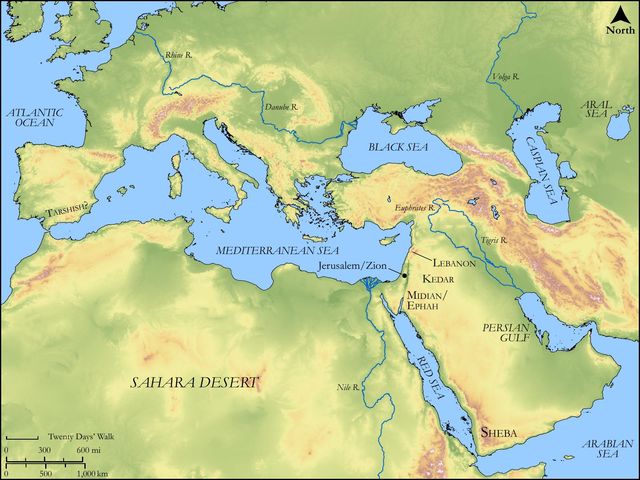
See on the biblical-era map
Study this verse
Public-domain commentary
Matthew Henry
From his Commentary on the Whole Bible. Henry comments on passages, not single verses — this entry covers Isaiah 41:21–29. His three-level outline is real structure in the source text, so it is rendered as structure.
The Lord, by the prophet, here repeats the challenge to idolaters to make out the pretentions of their idols: "Produce your cause (Isa 41:21) and make your best of it; bring forth the strongest reasons you have to prove that your idols are gods, and worthy of your adoration." Note, There needs no more to show the absurdity of sin than to produce the reasons that are given in defence of it, for they carry with them their own confutation.
I.The idols are here challenged to bring proofs of their knowledge and power.
Let us see what they can inform us of, and what they can do. Understanding and active power are the accomplishments of a man. Whoever pretends to be a god must have these in perfection; and have the idols made it to appear that they have? No;
1."They can tell us nothing that we did not know before, so ignorant are they. We challenge them to inform us," (1.) "What has been formerly: Let them show the former things, and raise them out of the oblivion in which they were buried" (God inspired Moses to write such a history of the creation as the gods of the heathen could never have dictated to any of their enthusiasts); or "let the defenders of idols tell us what mighty achievements they can boast of as performed by their gods in former times. What did they ever do that was worth taking notice of? Let them specify any thing, and it shall be considered, its due weight shall be given it, and it shall be compared with the latter end of it; and if, in the issue, it prove to be as great as it pretended to be, they shall have the credit of it." (2.) "We challenge them to tell us what shall happen, to declare to us things to come (Isa 41:22), and again (Isa 41:23), show the things that are to come hereafter. Give this evidence of your omniscience, that nothing can be hidden from you, and of your sovereignty and dominion. Make it to appear that you have the doing of all, by letting us know beforehand what you deign to do. Do this kindness to the world; let them know what is to come, that they may provide accordingly. Do this, and we will own that you are gods above us, and gods to us, and worthy of our adoration." No creature can foretel things to come, otherwise than by divine information, with any certainty.
2."They can do nothing that we cannot do ourselves, so impotent are they." He challenges them to do either good or evil, good to their friends or evil to their enemies: "Let them do, if they can, any thing extraordinary, that people will admire and be affected with. Let them either bless or curse, with power. Let us see them either inflict such plagues such as God brought on Egypt or bestow such blessings as God bestowed on Israel. Let them do some great thing, and we shall be amazed when we see it, and frightened into a veneration of them, as many have been into a veneration of the true God." That which is charged upon these idols, and let them disprove it if they can, is that they are of nothing, Isa 41:24. Their claims have no foundation at all, nor is there any ground or reason in the least for men's paying them the respect they do; there is nothing in them worthy our regard. "They are less than nothing, worse than nothing;" so some read it. "The work they do is of nought, and so is the ado that is made about them. There is no pretence or colour for it; it is all a jest; it is all a sham put upon the world; and therefore he that chooses you, and so give you your deity, and" (as some read it) "that delights in you, is an abomination;" so some take it. A servant is at liberty to choose his master, but a man is not at liberty to choose his God. He that chooses any other than the true God chooses an abomination; his choosing it makes it so.
II.God here produces proofs that he is the true God, and that there is none besides him. Let him produce his strong reasons.
1.He has an irresistible power. This he will shortly make to appear in the raising up of Cyrus and making him a type of Christ (Isa 41:25): He will raise him up from the north and from the rising of the sun. Cyrus by his father was a Mede, by his mother a Persian; and his army consisted of Medes, whose country lay north, and Persians, whose country lay east, from Babylon. God will raise him up to great power, and he shall come against Babylon with ends of his own to serve. But,
(1.)He shall proclaim God's name; so it may be read. He shall publish the honour of the God of Israel; so he did remarkably when, in his proclamation for the release of the Jews out of their captivity, he acknowledged that the Lord God of Israel was the Lord God of heaven, and the God: and he might be said to call on his name when he encouraged the building of his temple, and very probably did himself call upon him and pray to him, Ezr 1:2, Ezr 1:3.
(2.)All opposition shall fall before him: He shall come upon the princes of Babylon, and all others that stood in his way, as mortar, and trample upon them as the potter treads clay, to serve his own purposes with it. Christ, as man, was raised up from the north, for Nazareth lay in the northern parts of Canaan; as the angel of the covenant, he ascends from the east. He maintained the honour of heaven (he shall call upon my name), and broke the powers of hell, came upon the prince of darkness as mortar and trod him down.
2.He has an infallible foresight. He would not only do this, but he did now, by his prophet, foretel it. Now the false gods not only could not do it, but they could not foresee it.
(1.)He challenges them to produce any of their pretended deities, or their diviners, that had given notice of this, or could (Isa 41:26): "Who has declared from the beginning any thing of this kind, or has told it before-time? Tell us if there be any that you know of, for we know not any; if there be any, we will say, He is righteous, he is true, his cause is just, his claims are proved, and he is in the right in demanding to be worshipped." This agrees with Isa 41:22, Isa 41:23.
(2.)He challenges to himself the sole honour of doing it and foretelling it (Isa 41:27): I am the first (so it may be read) that will say to Zion, Behold, behold them, that will let the people of Israel know their deliverers are at hand (for there were those who understood by books, God's books, the approach of the time, Dan 9:2), and I am he that will give to Jerusalem one that brings good tidings, these good tidings of their enlargement. This is applicable to the work of redemption, in which the Lord showed himself much more than in the release of the Jews out of Babylon: he it was that contrived our salvation, and he brought it about, and he has given to us the glad tidings of reconciliation.
III.Judgment is here given upon this trial.
1.None of all the idols had foretold, or could foresee, this work of wonder. Other nations besides the Jews were released out of captivity in Babylon by Cyrus, or at least were greatly concerned in the revolution of the monarchy and there transferring of it to the Persians; and yet none of them had any intelligence given them of it beforehand, by any of their gods or prophets: "There is none that shows (Isa 41:26), none that declares, none that gives the least intimation of it; there is none of the nations that hears your words, that can pretend to have heard from their gods such words as you, O Israelites! have heard from your God, by your prophets," Psa 147:20. None of all the gods of the nations have shown their worshippers the way of salvation, which God will show by the Messiah. The good tidings which the Lord will send in the gospel is a mystery hidden from ages and generations, Rom 16:25, Rom 16:26.
2.None of those who pleaded for them could produce any instance of their knowledge or power that had in it any colour of proof that they were gods. All their advocates were struck dumb with this challenge (Isa 41:28): "I beheld, and there was no man that could give evidence for them, even among those that were their most zealous admirers; and there was no counsellor, none that could offer any thing for the support of their cause. Even among the idols themselves there was none fit to give counsel in the most trivial matters, and yet there were those that asked counsel of them in the most important and difficult affairs. When I asked them what they had to say for themselves they stood mute; the case was so plain against them that there was none who could answer a word." Judgment must therefore be given against the defendant upon Nihil dicit - He is mute. He has nothing to say for himself. He was speechless, Mat 22:12.
3.Sentence is therefore given according to the charge exhibited against them (Isa 41:24): "Behold, they are all vanity (Isa 41:29); they are a lie and a cheat; they are not in themselves what they pretend to be, nor will their worshippers find that in them which they promise themselves. Their works are nothing, of no force, of no worth; their enemies need fear no hurt from them; their worshippers can hope for no good from them. Their molten images, and indeed all their images, are wind and confusion, vanity and vexation; those that worship them will be deceived in them, and will reflect upon their own folly with the greatest bitterness. Therefore, dearly beloved, flee from idolatry," Co1 10:14.
Historical interpretation
Historical reception
3 surviving comments on this verse. Each one is dated, so this reads as a timeline rather than a list.
Select a marker to jump to its quote. Markers stagger vertically where authors wrote within a few decades of each other.
“Tell us what is to come hereafter, that we may know that you are gods; do good or do harm, that we may be dismayed and terrified.” … It is a further sign that the idols are not gods that they can do neither good nor evil. It is not saying that the idols or the demons inhabiting idols do not do evil frequently, but that unless God permits them to have power they cannot do so. So in the Gospel demons ask that they might have power over a herd of pigs, and in Job we read that without the Lord’s command the devil is not able to destroy livestock or goods.
(Verse 21 and following) Make your case, says the Lord: bring forth if you have anything to say, says the king Jacob. Let them come near and declare to us what has happened: declare the past events, and we will set our hearts and know their outcome; and reveal to us what is yet to come. Announce what will happen in the future, and we will know that you are gods. Do good or do evil, if you can, and let us talk and see together. Behold, you are nothing (from nothing): and your work is from something that does not exist: an abomination is he who chooses you. LXX: Your judgment is near, says the Lord God: they have come and drawn near your counsels, says the king of Jacob. Let them draw near and announce to us what is to come: or tell us the former things that have happened, and we will set our minds on them: and we will know the last things. Also, tell us what is to come, and announce to us what will happen in the end: and we will know that you are gods. Do good and evil, and we will admire: and we will see at the same time where you are, and where your work is: they have chosen you from the land of abominations. As we said above, Jacob and Israel are two, those who do not believe and those who believe in the Lord Savior: thus the nations are called, and they flow in rivers and springs in the once desert Church, and with a wonderful abundance of a variety of trees, all most abundantly fruitful, those who refused to believe in Christ from the nations are provoked to judgment, that they may answer why they did not want to see, and know and understand, because the hand of the Lord has done this, and the Holy One of Israel has created all things. He says, 'Let your idols approach, which you think are the strongest. Or bring forward, if you have anything by chance within you; and reveal your plans, in what way, with what understanding, you have not wanted to accept the revealed truth. At the same time, there is a direct challenge to the idols themselves, which are insensible, and have neither the ability to hear nor to respond. Tell us,' he says, 'either about the past or the future, and demonstrate your power from the events of things.' However, this signifies that after the coming of Christ, all the idols fell silent: where is Apollo of Delphi, and Loxias, and Delius, and Clarus, and the other idols, promising knowledge of the future, which deceived the most powerful kings? Why could they not predict anything about Christ; nothing about his Apostles; nothing about the ruin and destruction of the temples? If they could not predict their own demise, how could they announce the fate of others, whether good or evil? But if someone were to say that many things have been predicted by idols, it must be understood that they have always joined falsehood with truth, and thus moderated their statements, so that whatever happened, whether good or bad, could be interpreted in either way. Like the saying of King Pyrrhus of the Epirotes:
I assure you, descendant of Aeacus, that you are able to conquer the Romans. And as for Croesus: Craesus, having crossed the river Halys, will lose his vast kingdom. Another indication is that idols are not gods, because they can neither do good nor do evil. Not that idols, or demons sitting on idols, have often not done evil; but rather, unless power has been granted to them by the Lord, they cannot do this. Finally, they implore in the Gospel to have power over a herd of pigs (Matthew VIII). And in Job we read, without the Lord's command (Diabolus) that a holy man was not even able to destroy animals and possessions. And it is not surprising that this is true about God, for the Apostle Paul also teaches that certain people belong to Satan, so that they may learn not to blaspheme. Or this may be said, that mute images of humans and insensible things are neither able to do good nor evil, nor to know the past nor the future, because they are made out of nothing and out of that which does not exist, and not they themselves, but rather the one who worships them, is deserving of abomination. For the idols of the nations are silver and gold, the work of human hands. They have mouths, but do not speak; they have eyes, but do not see (Psalm 115: 4-6). So how can they know and proclaim the future or recount the past, and do good or evil, when they have no understanding like humans and animals? It does not matter what material they appear to be made of, since they are all earthly.
If you do not want to demonstrate your personal strength from your knowledge or prescience, then do so through a demonstration of your power. Demonstrate your power, whether it be kind or punishing. “It is I who will put to death and I who will bring to life, I who will strike down and I who will heal. There is no one who can deliver out of my hands.” But because you are lacking in knowledge and in power, I will now expose your emptiness. “They have dug you from the ground as an abomination.” For whether they are wooden or from gold, silver or bronze, they all have their origin from the earth.
Continue studying Isaiah 41:22 across the web’s major study libraries — every link below opens this exact verse, chapter, or book on the destination site.
Read & Compare
 BibleGatewayThis verse in more than 200 translations and 70 languages.
 Bible.comThe YouVersion reader — hundreds of translations, reading plans, and highlights.
 ESV.orgCrossway's official English Standard Version reader.
 NET BibleThe NET translation with 60,000+ translators' notes on every rendering decision.
 STEP BibleTyndale House's free study tool — original text, vocabulary, and scholarly resources.
 BibliaLogos Bible Software's free web reader.
 USCCBThe New American Bible (Revised Edition) with the U.S. bishops' study notes.
Commentaries
 BibleHub CommentariesDozens of classic commentaries on this verse, gathered on one page.
 StudyLightMore than 100 commentary sets — the largest collection on the web.
 BibleRefPlain-English commentary on what this verse means, verse by verse.
 Enduring WordDavid Guzik's free commentary on this chapter, widely used by Bible teachers.
 Bible Study ToolsVerse commentary alongside Greek and Hebrew study aids.
Original Language & Research
- BibleHub InterlinearThe verse word by word — original language, transliteration, and English.
- BibleHub LexiconEvery word's original-language definition and Strong's entry.
 Blue Letter BibleDeep-study tools — Strong's numbers, concordance, and word studies.
 SefariaThe Hebrew text with Rashi and centuries of Jewish commentary.
Sermons, Hymns & Audio


TrulyRandomVerse is not affiliated with these sites and doesn’t control their content. They’re linked because they’re genuinely useful.
Summary
Isaiah 41:22 presents a dramatic divine challenge within a cosmic courtroom, where the Lord God of Israel confronts the utter futility and impotence of pagan idols and their false claims of power and knowledge. This verse serves as a direct dare to these man-made deities and their adherents to demonstrate any genuine ability to predict future events or to accurately explain the ultimate meaning and outcome of past occurrences. It meticulously sets the stage for God's subsequent, undeniable demonstration of His unique omniscience and sovereignty over all history, thereby affirming His singular status as the only true and living God.
Context
ShowHideLiterary Context
This verse is strategically placed within the second major division of the Book of Isaiah (chapters 40-55), often termed "The Book of Comfort" or "Deutero-Isaiah." This section primarily addresses the exiled people of Judah, offering profound words of hope, restoration, and assurance of God's unwavering faithfulness amidst their despair. Chapters 40-48 specifically focus on God's incomparable nature, repeatedly contrasting His omnipotence, omniscience, and unique control over history with the utter futility and powerlessness of idols. The passage immediately preceding Isaiah 41:22 involves God summoning the nations and their gods to a legal dispute, challenging them to present their case. Verse 22 forms the very core of this divine challenge, demanding irrefutable proof of their supposed divine claims through either genuine foreknowledge of future events or profound retrospective understanding of past ones, thus setting up God's own declarations in subsequent verses as the irrefutable evidence of His sole deity and absolute control over all creation and history.
Historical & Cultural Context
The historical backdrop for this powerful prophetic discourse is the Babylonian exile, or the anticipation of it, a period of immense national and spiritual crisis for Israel. During this time, Israel was surrounded by powerful nations that worshipped numerous gods, often associated with natural phenomena, celestial bodies, or human endeavors like war and fertility. These cultures frequently consulted oracles, diviners, astrologers, and soothsayers to gain insight into the future or to discern the will of their gods. The pervasive practice of idolatry was a constant temptation and a profound spiritual threat to Israel's unique monotheistic faith. Isaiah's direct challenge to "shew the former things" and "declare us things for to come" directly confronts these prevalent pagan practices of divination and the supposed predictive powers of their idols, highlighting their utter inability to genuinely know or control history, in stark contrast to the God of Israel. This context underscores the radical nature of Israel's faith in a God who alone declares the end from the beginning.
Key Themes
ShowHideIsaiah 41:22 powerfully articulates several foundational themes central to Isaiah's prophecy and the broader biblical narrative. Firstly, it underscores Divine Sovereignty and Omniscience, presenting God as the sole orchestrator and knower of all history, from its inception to its culmination. He alone possesses perfect foreknowledge, a hallmark of true divinity that false gods conspicuously lack. Secondly, the verse exposes the Futility of Idolatry, revealing that man-made deities are utterly powerless, incapable of speech, action, or genuine prophecy, thus proving their non-existence as true gods. This theme is extensively developed throughout Isaiah, as seen in the biting satire of idol-makers in Isaiah 44:9-20. Thirdly, it highlights God's Unique Predictive Power, asserting that His ability to declare "things for to come" is the ultimate, undeniable proof of His identity as the one true God. Unlike the empty pronouncements of pagan oracles, God's prophecies are always fulfilled, demonstrating His active control over history, as He declares in Isaiah 46:10, "declaring the end from the beginning, and from ancient times the things that are not yet done." Finally, by exposing the emptiness of idols, the verse implicitly serves as a Call to Trust in God alone, encouraging His people to place their complete reliance on the One who truly holds the future in His hands and whose word is utterly reliable.
Exposition and Analysis
ShowHideKey Word Analysis
ShowHideThis primitive root (H5046) properly means "to front, i.e. stand boldly out opposite." By implication, it means "to manifest," and figuratively, "to announce (always by word of mouth to one present)." Specifically, it means "to expose, predict, explain, praise." In Isaiah 41:22, it carries the strong sense of challenging the idols to "declare" or "make known" their supposed knowledge, demanding a public manifestation of their power through revelation. The repeated use emphasizes the direct, confrontational nature of God's challenge, demanding a clear and public demonstration.
Derived from a root meaning "head" or "beginning," this word (H7223) signifies "first, in place, time or rank; ancestor, (that were) before(-time), beginning, eldest, first, fore(-father) (-most), former (thing), of old time, past." In this context, "former things" refers to past events or prophecies, particularly those God has already accomplished. The challenge to the idols is not merely to recount history, but to explain their ultimate purpose and outcome, demonstrating a comprehensive understanding of God's unfolding plan and the "latter end" of these events.
A primitive root (H3045), "to know (properly, to ascertain by seeing)." It is used in a great variety of senses, figuratively, literally, euphemistically, and inferentially, including observation, care, recognition, and causatively, instruction, designation, and punishment. In this verse, when God challenges the idols to "know the latter end of them," it demands a profound, comprehensive, and insightful understanding of the ultimate purpose and conclusion of past events, not just a superficial awareness. This depth of knowledge is a divine attribute.
From a root meaning "after," this word (H319) refers to "the last or end, hence, the future; also posterity." It signifies the conclusion, outcome, or ultimate purpose. When coupled with "know," as in "know the latter end of them," it demands an understanding of the final result or ultimate significance of past events, demonstrating a complete grasp of history's trajectory and divine purpose.
This word (H935), from a primitive root meaning "to go or come (in a wide variety of applications)," refers to "things that are coming" or "future events." It directly contrasts with "former things," demanding predictive prophecy. The challenge is for the idols to declare what will happen in the future, a power that only the omniscient God possesses, as He alone can ordain and bring events to pass.
Verse Breakdown
ShowHide"Let them bring [them] forth, and shew us what shall happen:"
This opening clause is a direct, confrontational challenge to the pagan gods and their devotees. "Bring forth" implies presenting evidence or testimony in a legal setting, demanding a public display of their supposed power. The demand "shew us what shall happen" directly calls for predictive prophecy, daring the idols to demonstrate their foreknowledge of immediate or near-future events, thereby proving their divinity.
"let them shew the former things, what they [be], that we may consider them, and know the latter end of them;"
Here, the divine challenge extends to the past. The idols are commanded not merely to recount historical facts ("what they be"), but to "shew" or explain the ultimate significance, purpose, and "latter end" (outcome or conclusion) of these past events. This requires not just memory or historical record, but profound understanding and divine insight into the overarching plan of history, something only God possesses. The phrases "that we may consider them, and know the latter end of them" underscore the depth of understanding being demanded—a comprehensive grasp of cause, effect, and ultimate divine purpose.
"or declare us things for to come."
This final clause reiterates and broadens the challenge to the distant future. It demands a clear, authoritative declaration of "things for to come"—comprehensive, long-range prophecies that only the true God can utter with certainty because He is the one who ordains and brings them to pass. This serves as the ultimate, undeniable test of divinity, distinguishing the true God from all false pretenders.
Literary Devices
ShowHideIsaiah 41:22 masterfully employs several literary devices to convey its powerful theological message. The entire passage (Isaiah 40-48) is framed as a Divine Lawsuit or Courtroom Scene, with God acting as the plaintiff, judge, and ultimately, the vindicated party, while the idols and their worshippers are the defendants. Within this legal framework, verse 22 uses Apostrophe, a figure of speech where the speaker directly addresses an absent or imaginary person or thing—in this case, the silent, impotent idols. The repeated imperatives ("Let them bring... shew... declare") function as a potent Rhetorical Challenge, a question posed not for an actual answer from the idols (as they are incapable), but for effect, highlighting their profound inadequacy. This anticipated failure then underscores the profound Contrast between the emptiness and powerlessness of man-made gods and the omnipotent, omniscient nature of the Lord God of Israel. The sophisticated structure of the challenge, moving from "what shall happen" (immediate future) to "former things" (past) and then to "things for to come" (distant future), demonstrates a comprehensive test of divine knowledge across all of time.
Theological and Thematic Connections
ShowHideIsaiah 41:22 stands as a cornerstone declaration of God's unique sovereignty over time and history, a theological truth that reverberates throughout Scripture. It asserts that true divinity is intrinsically linked to perfect foreknowledge and the absolute power to bring about what has been declared. This challenges any alternative source of truth or power, whether ancient idols, modern ideologies, or humanistic philosophies, by setting an impossible standard for anything less than the Creator. The verse underscores that God's prophecies are not mere predictions but divine decrees that reveal His active governance of the universe, providing a firm foundation for faith in His promises and His ultimate plan for humanity. It teaches us that to truly "know" God is to recognize His unparalleled ability to declare and accomplish what is to come, and to understand the "latter end" of all things, thereby inviting us to place our complete trust in Him alone.
Reflection and Application
ShowHideIn a world saturated with information, predictions, and competing narratives, Isaiah 41:22 serves as a timeless anchor, reminding us where true authority and knowledge reside. We are constantly bombarded by voices claiming to know the future—from economic forecasts to political pundits, from self-help gurus to spiritual charlatans. This verse calls us to a profound discernment, urging us to question the source and substance of such claims. It challenges us to recognize that only the God who declares the end from the beginning, and who has faithfully brought "former things" to their intended "latter end," is worthy of our ultimate trust and allegiance. Finding peace in His sovereignty means releasing our anxieties about the unknown and resting in the assurance that His plans for us are for welfare, not for evil, to give us a future and a hope, as profoundly promised in Jeremiah 29:11. This divine foreknowledge invites us not to passive resignation, but to active, confident obedience, knowing that our lives are held securely in the hands of the One who holds all of history, both past and future.
Questions for Reflection
ShowHideFAQ
ShowHideWhy does God challenge idols in this way, demanding they "shew" past and future events?
ShowHideGod challenges idols in this specific manner to expose their utter impotence and non-existence as true deities, thereby validating His own unique claim as the one true God. In ancient cultures, the ability to predict the future or to reveal hidden knowledge was a hallmark of divine power, often sought through divination and oracles. By demanding that idols perform these feats, God highlights their inherent inability to do so, proving that they are merely human constructs, "the work of men's hands" (Psalm 115:4). This challenge is part of a larger divine lawsuit where God presents His irrefutable case against idolatry, demonstrating that only He can declare the end from the beginning and bring His purposes to pass (Isaiah 46:10). It serves to comfort His exiled people, assuring them that their God is in complete control of history, unlike the false gods of their oppressors.
What is the significance of "former things" and "things for to come" in this verse?
ShowHide"Former things" (Hebrew: riʼshôwn) refers to past events or prophecies that God has already fulfilled, such as the deliverance from Egypt or earlier prophetic declarations concerning Israel's history. The challenge to the idols is not merely to recount these historical facts, but to explain their ultimate meaning and "latter end" (their purpose and outcome within God's grand redemptive plan). "Things for to come" (Hebrew: bôwʼ) refers to future events, specifically the predictive prophecies that only God can make with absolute certainty because He is the one who orchestrates and brings them to pass. This dual challenge covers all of time—past, present, and future—and serves as the ultimate test of divinity. Only the God of Israel can demonstrate comprehensive knowledge and control over both what has been and what will be, proving His absolute sovereignty and unique identity.
Christ-Centered Fulfillment
ShowHideIsaiah 41:22, with its profound challenge to declare past and future, finds its ultimate and most glorious fulfillment in the person and work of Jesus Christ. He is the very embodiment of God's perfect knowledge and sovereign control over history. As the eternal Word of God, existing before all things and through whom all things were made, Jesus inherently knows "the former things" in their deepest meaning and "latter end." He did not merely recount history but revealed its divine purpose and trajectory, explaining how all of Scripture pointed to Him, from Moses and the Prophets to the Psalms. Furthermore, Jesus Himself declared "things for to come" with absolute authority, speaking of His own impending death and resurrection (Matthew 16:21), the destruction of the Temple (Matthew 24:2), and His glorious second coming. His life, death, and resurrection are the ultimate "latter end" of God's redemptive plan, perfectly foretold and perfectly executed. In Christ, we see God's prophetic word made flesh, demonstrating that the One who challenges the idols is indeed the One who holds all time and eternity in His hands, making Him the wisdom and power of God for all who believe, and the Alpha and Omega, the beginning and the end (Revelation 1:8).