


Isaiah 23:5
- כַּאֲשֶׁרka·'a·Sher<just> whenH834Prep-k ¦ RelParticle Relativeכַּ<just>אֲשֶׁרwhen
- שֵׁמַעShe·ma'a reportH8088N-msNoun Singular Masculine Absolute
- לְמִצְרָיִםle·mitz·Ra·yim[is] to EgyptH4714Prep-l ¦ N-properNoun Proper Locationלְ[is] toמִצְרָיִםEgypt
- יָחִילוּya·Chi·lupeople will be in anguishH2342V-Qal-Imperf-3mpVerb Qal Imperfect 3rd Plural Masculine
- כְּשֵׁמַעke·She·ma'like [the] report ofH8088Prep-k ¦ N-mscNoun Singular Masculine Constructכְּlikeשֵׁמַע[the] report of
- צֹרTzorTyreH6865N-properNoun Proper Location
English is a literal word-by-word gloss of the Hebrew, not the KJV's wording. Why?
This is the original text the KJV's translators worked from — each Hebrew word with its own literal English meaning in this verse, prepared by scholars at Tyndale House, Cambridge. The KJV translates whole sentences, not word by word, so its wording differs: one Hebrew word can become several English words, and the KJV may choose “the LORD” where the gloss reads “Yahweh”. Both are faithful — they answer different questions. For the KJV's own rendering, switch to the KJV text.
Details
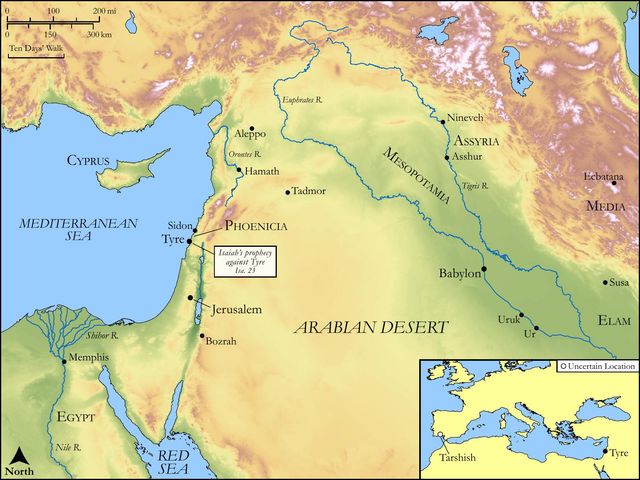
See on the biblical-era map
Study this verse
Public-domain commentary
Matthew Henry
From his Commentary on the Whole Bible. Henry comments on passages, not single verses — this entry covers Isaiah 23:1–14. His four-level outline is real structure in the source text, so it is rendered as structure.
Tyre being a sea-port town, this prophecy of its overthrow fitly begins and ends with, Howl, you ships of Tarshish; for all its business, wealth, and honour, depended upon its shipping; if that be ruined, they will be all undone. Observe,
I.Tyre flourishing. This is taken notice of that her fall may appear the more dismal.
1.The merchants of Zidon, who traded at sea, had at first replenished her, Isa 23:2. Zidon was the more ancient city, situated upon the same sea-cost, a few leagues more to the north, and Tyre was at first only a colony of that; but the daughter had outgrown the mother, and become much more considerable. It may be a mortification to great cities to think how they were at first replenished.
2.Egypt had helped very much to raise her, Isa 23:3. Sihor was the river of Egypt: by that river, and the ocean into which it ran, the Egyptians traded with Tyre; and the harvest of that river was her revenue. The riches of the sea, and the gains by goods exported and imported, are as much the harvest to trading towns as that of hay and corn is to the country; and sometimes the harvest of the river proves a better revenue than the harvest of the land. Or it may be meant of all the products of the Egyptian soil, which the men of Tyre traded in, and which were the harvest of the river Nile, owing themselves to the overflowing of that river.
3.She had become the mart of the nations, the great emporium of that part of the world. Some of every known nation might be found there, especially at certain times of the year, when there was a general rendezvous of merchants. This is enlarged upon by another prophet, Eze 27:2, Eze 27:3, etc. See how the hand of the diligent, by the blessing of God upon it, makes rich. Tyre became rich and great by industry, though she had no other ploughs going than those that plough the waters.
4.She was a joyous city, noted for mirth and jollity, Isa 23:7. Those that were so disposed might find there all manner of sports and diversions, all the delights of the sons and daughters of men, balls, and plays, and operas, and every thing of that kind that a man had a fancy to. This made them secure and proud, and they despised the country people, who neither knew nor relished any joys of that nature. This also made them very loth to believe and consider what warnings God gave them by his servants; they were too merry to mind them. Her antiquity likewise was of ancient days, and she was proud of that, and that helped to make her secure; as if because she had been a city time out of mind, and her antiquity had been of ancient days, therefore she must continue a city time without end, and her continuance must be to the days of eternity.
5.She was a crowning city (Isa 23:8), that crowned herself. Such were the power and pomp of her magistrates that they crowned those who had dependence on her and dealings with her. It is explained in the following words: Her merchants are princes, and live like princes for the ease and state they take; and her traffickers, whatever country they go to, are the honourable of the earth, who are respected by all. How slightly soever some now speak of tradesmen, it seems formerly, and among the wisest nations, there were merchants, and traders, and men of business, that were the honourable of the earth.
II.Here is Tyre falling.
It does not appear that she brought trouble upon herself by provoking her neighbours with her quarrels, but rather by tempting them with her wealth; but, if it was this that induced Nebuchadnezzar to fall upon Tyre, he was disappointed; for after it had stood out a siege of thirteen years, and could hold out no longer, the inhabitants got away by sea, with their families and goods, to other places where they had an interest, and left Nebuchadnezzar nothing but the bare city. See a history of Tyre in Sir Walter Raleigh's History of the World, lib. 2. cap. 7. sect. 3, 43. page. 283, which will give much light to this prophecy and that in Ezekiel concerning Tyre.
1.See how the destruction of Tyre is here foretold.
(1.)The haven shall be no convenient harbour for the reception of the ships of Tarshish, but all laid waste (1.), so that there shall be no house, no dock for the ships to ride in, no inns, or public houses for the seamen, no entering into the port. Perhaps it was choked with sand or blocked up by the enemy. Or, Tyre being destroyed and laid waste, the ships that used to come from Tarshish and Chittim into that port shall now no more enter in; for it is revealed or made known to them, they have received the dismal news, that Tyre is destroyed and laid waste; so that there is now no more business for them there. See how it is in this world; those that are spoiled by their enemies are commonly slighted by their old friends.
(2.)The inhabitants are struck with astonishment. Tyre was an island. The inhabitants of it, who had made a mighty noise and bustle in the world, and revelled with loud huzzas, shall now be still and silent (Isa 23:2); they shall sit down as mourners, so overwhelmed with grief that they shall not be able to express it. Their proud boasts of themselves, and defiances of their neighbours, shall be silenced. God can soon quiet those, and strike them dumb, that are the noisy busy people of the world. Be still; for God will do his work (Psa 46:10; Zac 2:13), and you cannot resist him.
(3.)The neighbours are amazed, blush, and are in pain for them: Zidon is ashamed (Isa 23:4), by whom Tyre was at first replenished; for the rolling waves of the sea brought to Zidon this news from Tyre; and there the strength of the sea, a high spring-tide, proclaimed saying, "I travail not, nor bring forth children now, as I have done. I do not now, as I used to do, bring ship-loads of young people to Tyre, to be bred up there in trade and business," which was the thing that had made Tyre so rich and populous. Or the sea, that used to be loaded with fleets of ships about Tyre, shall not be as desolate as a sorrowful widow that is bereaved of all her children, and has none about her to nourish and bring up. Egypt indeed was a much larger and more considerable kingdom than Tyre was; and yet Tyre had so large a correspondence, upon the account of trade, that all the nations about shall be as much in pain, upon the report of the ruin of that one city, as they would have been, and not long after were, upon the report of the ruin of all Egypt, Isa 23:5. Or, as some read it, When the report shall reach to the Egyptians they shall be sorely pained to hear it of Tyre, both because of the loss of their trade with that city and because it was a threatening step towards their own ruin; when their neighbour's house was on fire their own was in danger.
(4.)The merchants, as many as could, should transmit their effects to other places, and abandon Tyre, where they had raised their estates, and thought they had made them sure (Isa 23:6): "You that have long been inhabitants of this isle" (for it lay off in the sea about half a mile from the continent); "It is time to howl now, for you must pass over to Tarshish. The best course you can take is to make the best of your way to Tarshish, to the sea" (to Taressus, a city in Spain; so some), "or to some other of your plantations." Those that think their mountain stands strong, and cannot be moved, will find that here they have no continuing city. The mountains shall depart and the hills be removed.
(5.)Those that could not make their escape must expect no other than to be carried into captivity; for it was the way of conquerors, in those times, to take those they conquered to be bondmen in their own country, and send of their own to be freemen in theirs (Isa 23:7): Her own feet shall carry her afar off to sojourn; they shall be hurried away on foot into captivity, and many a weary step they shall take towards their own misery. Those that have lived in the greatest pomp and splendour know not what hardships they may be reduced to before they die.
(6.)Many of those that attempted to escape should be pursued and fall into the hands of the enemy. Tyre shall pass through her land as a river (Isa 23:10), running down, one company after another, into the ocean or abyss of misery. Or, though they hasten away as a river, with the greatest swiftness, hoping to outrun the danger, yet there is no more strength; they are quickly tired, and cannot get forward, but fall an easy prey into the hands of the enemy. And, as Tyre has no more strength, so her sister Zidon has no more comfort (Isa 23:12): "Thou shalt no more rejoice, O oppressed virgin, daughter of Zidon, that art now ready to be overpowered by the victorious Chaldeans! Thy turn is next; therefore arise; pass over to Chittim; flee to Greece, to Italy, any where to shift for thy own safety; yet there also shalt thou have no rest; thy enemies shall disturb thee, and thy own fears shall disquiet thee, where thou hopedst to find some repose." Note, We deceive ourselves if we promise ourselves rest any where in this world. Those that are uneasy in one place will be so in another; and, when God's judgments pursue sinners, they will overtake them.
2.But whence shall all this trouble come?
(1.)God will be the author of it; it is a destruction from the Almighty. It will be asked (Isa 23:8), "Who has taken this counsel against Tyre? Who has contrived it? Who has resolved it? Who can find in his heart to lay such a stately lovely city in ruins? And how is it possible that its ruin should be effected?" To this it will be answered,
[1.]God has designed it, who is infinitely wise and just, and never did, nor ever will do, any wrong to any of his creatures (Isa 23:9). The Lord of hosts, that has all things at his disposal and gives not account of any of his matters, he has purposed it. It shall be done according to the counsel of his will; and that which he aims at herein is to stain the pride of all glory, to pollute it, profane it, and throw it to be trodden upon; and to bring into contempt and make despicable all the honourable ones of the earth, that they may not admire themselves and be admired by others as usual. God did not bring those calamities upon Tyre in a way of sovereignty, to show an arbitrary and irresistible power; but he did it to punish the Tyrians for their pride. Many other sins, no doubt, reigned among them - idolatry, sensuality, and oppression; but the sin of pride is fastened upon as that which was the particular ground of God's controversy with Tyre; for he resists the proud. All the world observing and being surprised at the desolation of Tyre, we have here an exposition of it. God tells the world what he meant by it. First, He designed to convince men of the vanity and uncertainty of all earthly glory, to show them what a withering, fading, perishing thing it is even when it seems most substantial. It were well if men would be thoroughly taught this lesson, though it were at the expense of so great a destruction. Are men's learning and wealth, their pomp and power, their interest in, and influence upon, all about them, their glory? Are their stately houses, rich furniture, and splendid appearances, their glory? Look upon the ruins of Tyre, and see all this glory stained, and sullied, and buried in the dust. The honourable ones of heaven will be for ever such; but see the grandees of Tyre, some fled into banishment, others forced into captivity, and all impoverished, and you will conclude that the honourable of the earth, even the most honourable, know not how soon they may be brought into contempt. Secondly, He designed hereby to prevent their being proud of that glory, their being puffed up, and confident of the continuance of it. Let the ruin of Tyre be a warning to all places and persons to take heed of pride; for it proclaims to all the world that he who exalts himself shall be abased.
[2.]God will do it, who has all power in his hand and can do it effectually (Isa 23:11): He stretched out his hand over the sea. He has done so many a time, witness the dividing of the Red Sea and the drowning of Pharaoh in it. He has often shaken the kingdoms that were most secure; and he has now given commandment concerning this merchant-city, to destroy the strongholds thereof. As its beauty shall not intercede for it, but that shall be stained, so its strength shall not protect it, but that shall be broken. If any think it strange that a city so well fortified, and that has so many powerful allies, should be so totally ruined, let them know that it is the Lord of hosts that has given a commandment to destroy the strongholds thereof: and who can gainsay his orders or hinder the execution of them?
(2.)The Chaldeans shall be the instruments of it (Isa 23:13): Behold the land of the Chaldeans; how easily they and their land were destroyed by the Assyrians. Though their own hands founded it, set up the towers of Babylon, and raised up its palaces, yet the Assyrians brought it to ruin, whence the Tyrians might infer that as easily as the old Chaldeans were subdued by the Assyrians so easily shall Tyre be vanquished by those new Chaldeans. Babel was built by the Assyrians for those that dwelt in the wilderness. It may be rendered for the ships (the Assyrians founded it for ships and shipmen that traffic upon those vast rivers Tigris and Euphrates to the Persian and Indian seas), for men of the desert, for Babylon is called the desert of the sea, Isa 21:1. Thus Tyrus was built upon the sea for the like purpose. But the Assyrians (says Dr. Lightfoot) brought that to ruin, now lately, in Hezekiah's time, and so shall Tyre hereafter be brought to ruin by Nebuchadnezzar. If we looked more upon the falling and withering of others, we should not be so confident as we commonly are of the continuance of our own flourishing and standing.
Historical interpretation
Historical reception
2 surviving comments on this verse. Each one is dated, so this reads as a timeline rather than a list.
(Verse 5) When it is heard in Egypt, they will grieve when they hear about Tyre. This is clear, that after the Egyptians hear about the most powerful and neighboring nation being destroyed by a long siege, they will also know that their own destruction is approaching.
(Verse 4-5) Blush, Sidon, said the sea; but the strength of the sea says, I have not given birth, nor have I brought forth, nor have I nourished young men, nor have I exalted virgins. But when it is heard in Egypt, sorrow will seize them over Tyre. The sea of this age, in which small creatures dwell with large ones, and the dragon which God created to mock it, seeing the hunters of Christ, who hunt from every mountain and hill, captured those who had been previously captured by demons, speaks to the opposing strength of the hunters, which is interpreted as Sidon, and says to it: Blush, Sidon; for I have not given birth, nor have I brought forth, nor have I nourished young men captured by you, nor have I exalted virgins, whose foolishness is condemned in the Gospel (Matthew 25). For by my travail, and travail, and nourishing, and the raising of virgins, is the travail of the Apostles of Christ abolished; of whom one spoke: My little children, of whom I travail in birth again until Christ be formed in you (Gal. IV, 19). And: I have given you milk to drink, not meat (I Cor. III, 2). And again: But I would have you to be without solicitude. He that is without a wife is solicitous for the things that belong to the Lord, how he may please God. But he that is with a wife is solicitous for the things of the world, how he may please his wife: and he is divided (I Cor. VII, 32-34). Also: Woman is saved by bearing children, if she continue in faith, and love, and sanctification, with sobriety (I Tim. II, 15). When Egypt shall hear this, which is called in Hebrew Mesraim, which is interpreted as pressing out, that is, afflicting, and oppressing, she shall be disturbed, understanding that she herself shall suffer the same things that Tyre endured. And when it is referred to all vices, it can be understood in the diversity of heresies, when one captivates through heresy, another trembles, and in the confusion of one, another feels that it must be captured. However, as it is said about Sodom: For if the miracles that were done in you had been done in Sodom, it would have remained until this day; and it is inferred: Nevertheless, it will be more tolerable for Sodom on the day of judgment than for you: thus we learn about Tyre and Sidon from the Savior saying: Nevertheless, it will be lighter for Tyre and Sidon on the day of judgment than for that city (Matthew 11:21 ff.). Now the Canaanite woman, who understood that her daughter, that is, her soul, was being severely vexed by a most fierce demon, is said to have come out from the borders of Tyre and Sidon. For she could not encounter the Savior otherwise, unless she had left the borders of Tyre and Sidon.
Continue studying Isaiah 23:5 across the web’s major study libraries — every link below opens this exact verse, chapter, or book on the destination site.
Read & Compare
 BibleGatewayThis verse in more than 200 translations and 70 languages.
 Bible.comThe YouVersion reader — hundreds of translations, reading plans, and highlights.
 ESV.orgCrossway's official English Standard Version reader.
 NET BibleThe NET translation with 60,000+ translators' notes on every rendering decision.
 STEP BibleTyndale House's free study tool — original text, vocabulary, and scholarly resources.
 BibliaLogos Bible Software's free web reader.
 USCCBThe New American Bible (Revised Edition) with the U.S. bishops' study notes.
Commentaries
 BibleHub CommentariesDozens of classic commentaries on this verse, gathered on one page.
 StudyLightMore than 100 commentary sets — the largest collection on the web.
 BibleRefPlain-English commentary on what this verse means, verse by verse.
 Enduring WordDavid Guzik's free commentary on this chapter, widely used by Bible teachers.
 Bible Study ToolsVerse commentary alongside Greek and Hebrew study aids.
Original Language & Research
- BibleHub InterlinearThe verse word by word — original language, transliteration, and English.
- BibleHub LexiconEvery word's original-language definition and Strong's entry.
 Blue Letter BibleDeep-study tools — Strong's numbers, concordance, and word studies.
 SefariaThe Hebrew text with Rashi and centuries of Jewish commentary.
Sermons, Hymns & Audio


TrulyRandomVerse is not affiliated with these sites and doesn’t control their content. They’re linked because they’re genuinely useful.
Summary
This powerful prophetic declaration within Isaiah's oracles against the nations foretells the devastating downfall of Tyre, a prominent maritime city. The verse vividly portrays the widespread shock and profound distress that will accompany the news of Tyre's collapse, likening the intensity of this reaction to the anguish previously felt at the report of judgment upon ancient Egypt. It underscores the far-reaching impact of divine judgment on a major economic and political power, demonstrating God's universal sovereignty over all earthly kingdoms and the transient nature of human pride and material security.
Context
ShowHideLiterary Context
Isaiah 23 is situated within a broader collection of "burdens" or prophetic pronouncements (chapters 13-23) directed against various nations, including Babylon, Assyria, Philistia, Moab, Damascus, Ethiopia, and Egypt, culminating with Tyre. These oracles collectively serve to demonstrate God's absolute sovereign control over the entire ancient Near East, asserting His authority not only over His covenant people but also over the surrounding pagan nations. Chapter 23 specifically targets Tyre, a wealthy and influential Phoenician city-state renowned for its extensive trade networks, formidable naval power, and opulent lifestyle. The immediate verses preceding Isaiah 23:5 describe the initial shock and lament of the merchants and mariners whose livelihoods were inextricably linked to Tyre's prosperity, while subsequent verses detail the extent of its destruction and eventual, albeit limited, restoration. The comparison to Egypt in this verse functions as a potent rhetorical device, drawing on a widely recognized historical precedent of divine judgment to emphasize the certainty, severity, and widespread impact of Tyre's impending doom.
Historical & Cultural Context
Tyre, strategically located on the coast of modern-day Lebanon, was a dominant Phoenician city during the 8th and 7th centuries BCE. It comprised both a mainland settlement and a formidable island fortress, which contributed to its reputation for impregnability. Its economic power was immense, built upon vast maritime trade routes that spanned the Mediterranean, skilled craftsmanship (e.g., purple dye, cedar wood), and an extensive network of colonies and trading posts. This immense wealth often fostered a spirit of pride, self-sufficiency, and moral corruption, leading to a disregard for divine authority, as further elaborated in other prophecies against Tyre (e.g., Ezekiel 26). Egypt, conversely, was a long-standing regional superpower whose periods of divine judgment—most notably the Exodus events and later prophecies (e.g., Isaiah 19)—were widely known and served as a benchmark for significant national calamity in the ancient Near East. Thus, the prophecy in Isaiah 23:5 speaks to a world intricately interconnected by trade and political alliances, where the fall of a major player like Tyre would inevitably send profound economic and psychological shockwaves across the entire region.
Key Themes
ShowHideThis verse contributes significantly to several overarching themes prevalent throughout the Book of Isaiah and broader prophetic literature. Firstly, it underscores the theme of Divine Judgment on Pride and Materialism, illustrating that God will humble even the most powerful and self-reliant nations whose trust is placed in their wealth, human ingenuity, and perceived invincibility rather than in Him. Tyre's commercial success and seemingly unassailable position had cultivated an arrogance that God would not tolerate. Secondly, it highlights the Universality of God's Sovereignty, demonstrating unequivocally that no nation, regardless of its economic might or military strength, exists beyond God's ultimate control and jurisdiction. The fall of Tyre, mirroring that of Egypt before it, serves as a stark reminder that "the Most High is sovereign over all kingdoms on earth and gives them to anyone he wishes" (Daniel 4:17). Thirdly, the description of the "sorely pained" reaction emphasizes the Widespread Impact of Judgment, revealing that the downfall of a major economic hub like Tyre would not be an isolated event but would send ripples of distress and disruption through the interconnected world of ancient trade, affecting countless individuals and nations who relied on its commerce and stability. This profound theme is powerfully echoed in later biblical prophecies concerning the fall of great commercial powers, such as the lament over "Babylon the Great" in Revelation 18.
Exposition and Analysis
ShowHideKey Word Analysis
ShowHideFrom the root meaning "to hear," this word signifies something heard, a sound, rumor, or announcement. In this context, it refers specifically to the devastating news or tidings of Tyre's downfall. The impact described is not merely from the event itself, but from the hearing of it, emphasizing the sudden shock and widespread communication of the disaster that will cause profound distress across the region.
This powerful primitive root denotes twisting or whirling, specifically to writhe in pain (especially like childbirth) or to tremble from fear. It conveys a deep, visceral anguish and distress, far beyond mere sadness or regret. The use of this word highlights the extreme suffering, grief, and perhaps even physical manifestations of pain that will grip those who hear of Tyre's destruction, reflecting the profound economic, social, and psychological repercussions.
Meaning "rock," this refers to the ancient Phoenician city, renowned for its impregnable island fortress, vast maritime trade, and immense wealth. Its very name, "Rock," speaks to its perceived invincibility and unassailability. The prophecy of its fall, therefore, is all the more striking, as it targets a city that believed itself secure and unassailable, underscoring God's absolute power to humble the proudest and most seemingly secure human constructs.
Verse Breakdown
ShowHide"As at the report concerning Egypt,"
This opening clause establishes a powerful and immediate point of comparison. The prophet draws a parallel to a previous, widely known, and historically significant instance of divine judgment and its consequent impact—the "report" or news of calamity befalling Egypt. This reference immediately sets the tone for the severity and widespread recognition of what is to come upon Tyre, suggesting a similar, if not greater, level of shock and distress that had previously resonated throughout the ancient world following Egypt's humbling.
"so shall they be sorely pained"
This is the core declaration of the verse, describing the intense, visceral reaction to Tyre's impending doom. The "they" refers to those who hear the news, predominantly the surrounding nations, merchants, and allies who had greatly benefited from or were intricately connected to Tyre's vast commercial empire. The pain described is not merely sorrow or economic loss but a deep, agonizing anguish, akin to the writhing of one in severe physical distress or childbirth, indicating a profound and pervasive sense of loss, disruption, and even despair that will grip those affected.
"at the report of Tyre."
This final clause specifies the precise object of the devastating news. It is the "report" of Tyre's destruction, its precipitous fall from power, and the catastrophic collapse of its economic might that will trigger this widespread and agonizing reaction. The deliberate repetition of "report" emphasizes that the tidings themselves are the immediate catalyst for this collective suffering, highlighting the shockwaves that will ripple through the ancient world upon hearing of the demise of such a dominant and seemingly invincible city.
Literary Devices
ShowHideIsaiah 23:5 masterfully employs several literary devices to convey its powerful and sobering message. The most prominent is Simile, explicitly drawing a comparison using the structure "As... so..." The profound pain felt at the news of Tyre's fall is directly likened to the anguish experienced at the report concerning Egypt. This comparison serves to underscore the magnitude, certainty, and widespread impact of Tyre's judgment, leveraging a well-known historical event of divine intervention to vividly illustrate the future shock. Furthermore, the verse utilizes Parallelism, specifically a form of synonymous or staircase parallelism, by repeating the phrase "at the report" in both clauses. This repetition emphasizes that the news or tidings of judgment, rather than just the event itself, is the immediate catalyst for the widespread distress. It creates a rhythmic and emphatic structure, reinforcing the idea of a propagated shockwave of sorrow and fear. Finally, the phrase "sorely pained" contains an element of Hyperbole. While the distress would undoubtedly be genuine and severe, describing it as "sorely pained" (implying writhing, as in childbirth) conveys an extreme, almost unbearable level of anguish. This exaggeration highlights the profound disruption, economic devastation, and existential crisis that Tyre's collapse would unleash on the interconnected ancient world, affecting all who relied on its commercial stability and perceived invincibility.
Theological and Thematic Connections
ShowHideIsaiah 23:5 powerfully articulates the foundational principle of divine sovereignty over all earthly powers and the inevitable judgment that awaits nations built on pride, materialism, and self-sufficiency. The stark comparison to Egypt underscores that God's justice is impartial and universal, extending even to the most formidable empires and economic strongholds. This verse serves as a profound reminder that worldly success, perceived invincibility, and accumulated wealth are ultimately fleeting and subject to divine oversight. It highlights the intricate interconnectedness of human societies, demonstrating how the fall of a major economic power can send ripples of distress far beyond its immediate borders, affecting many who had placed their trust in its stability rather than in the divine provider. The "sorely pained" reaction described is not merely economic loss but a deep existential shock at the collapse of a seemingly unshakeable foundation, pointing to the ultimate fragility of all human constructs apart from God's enduring truth and power.
Reflection and Application
ShowHideIsaiah 23:5 transcends its ancient context to offer timeless spiritual lessons for individuals and societies today. It challenges us to critically examine where we place our ultimate trust and security. In a world often defined by economic prowess, technological advancement, and material accumulation, this verse serves as a potent reminder that all human constructs, no matter how grand, seemingly unassailable, or economically vital, are ultimately transient and subject to divine oversight. It calls us to cultivate profound humility, recognizing that pride and self-reliance, particularly when rooted in material abundance, can inevitably lead to spiritual and societal downfall. Furthermore, it encourages a sober assessment of our dependencies, urging us to shift our focus from fleeting earthly treasures to eternal values and the unwavering sovereignty of God, who alone provides true and lasting security. The "sorely pained" reaction to Tyre's fall should prompt us to consider the spiritual implications of our attachments to worldly systems and to actively seek a foundation that cannot be shaken, anchoring our hope in God's unchanging character and promises.
Questions for Reflection
ShowHideFAQ
ShowHideWhy is Tyre compared to Egypt in this prophecy?
ShowHideThe comparison to Egypt serves to profoundly emphasize the magnitude and widespread impact of Tyre's impending judgment. Egypt was a long-standing regional superpower whose periods of divine judgment (as seen in the Exodus narrative or prophecies like Isaiah 19 and Jeremiah 46) were well-known and deeply felt throughout the ancient Near East. By likening Tyre's fall to Egypt's, Isaiah highlights that Tyre's collapse will be equally, if not more, impactful and widely lamented, indicating the profound disruption its demise will cause to the global economy and political landscape of the time. It underscores God's universal sovereignty over all nations, regardless of their perceived strength or historical prominence.
Who are "they" who will be "sorely pained"?
ShowHide"They" refers broadly to the various peoples, nations, and especially the merchants, mariners, and trading partners who were economically intertwined with Tyre. Tyre was a central hub of ancient maritime trade, and its immense prosperity directly impacted numerous other cities, regions, and commercial enterprises across the Mediterranean world. Therefore, the news of its destruction would not only signify a major geopolitical shift but also a severe economic blow and a source of profound distress for all who relied on its commerce, stability, and supply chains. This widespread pain underscores the far-reaching consequences of divine judgment on a major world power, affecting all who had placed their confidence in its earthly security and material provisions.
Christ-Centered Fulfillment
ShowHideThe lament over Tyre's fall in Isaiah 23:5, with its depiction of widespread anguish over a collapsing economic empire, powerfully foreshadows a greater reality concerning the ultimate judgment of all worldly systems built on pride and opposition to God. This culminates in the destruction of "Babylon the Great" in the New Testament, where the fall of the spiritual Babylon described in Revelation 18 elicits similar lamentation from the "merchants of the earth" who grew rich through her. Yet, this judgment is not the final word, but a pointer to a greater truth. The "sorely pained" reaction in Isaiah points to the deep human attachment to earthly security and wealth, a security that is ultimately found only in Christ. He is the true and unshakeable Rock, unlike the city of Tyre, whose very name meant "Rock" but proved vulnerable to divine judgment. Through His atoning sacrifice on the cross and His glorious resurrection, Christ offers a kingdom that "cannot be shaken" (Hebrews 12:28), inviting all to place their trust not in fleeting earthly empires or transient material prosperity, but in His eternal reign and the secure hope of salvation found in Him alone. The pain of earthly loss, therefore, serves as a poignant reminder of humanity's desperate need for the Lamb of God who takes away the sin of the world, offering true peace, lasting security, and an enduring inheritance amidst the inevitable collapse of all human constructs.