


Isaiah 10:33
Bible text: King James Version (1769 Blayney text) · Public domain
Bible text: King James Version with Strong's numbers · Public domain
Bible text: Berean Standard Bible · Public domain
Bible text: American Standard Version (1901) · Public domain
Bible text: World English Bible, Messianic edition · Public domain
Bible text: Geneva Bible (1599) · Public domain
Bible text: Young's Literal Translation · Public domain
- הִנֵּהhi·Nehthere!H2009PrtParticle Interjection
- הָאָדוֹןha·'a·dOnthe lordH113Art ¦ N-msNoun Singular Masculine Absoluteהָtheאָדוֹןlord
- יְהוָהYah·wehYahwehH3068N-properNoun Proper Title
- צְבָאוֹתtze·va·'otof hostsH6635N-fpNoun Plural Feminine Absolute
- מְסָעֵףme·sa·'Ef[is] about to lop offH5586V-Piel-Prtcpl-msVerb Piel Participle Singular Masculine Absolute
- פֻּארָהpu·Rahbough[s]H6288N-fsNoun Singular Feminine Absolute
- בְּמַעֲרָצָהbe·ma·'a·ra·Tzahwith a crashH4637Prep-b ¦ N-fsNoun Singular Feminine Absoluteבְּwithמַעֲרָצָהa crash
- וְרָמֵיve·ra·Meiand [the] exalted [ones] ofH7311Conj-w ¦ V-Qal-Prtcpl-mpVerb Qal Participle Plural Masculine Constructוְandרָמֵי[the] exalted [ones] of
- הַקּוֹמָהha·ko·Mah<the> heightH6967Art ¦ N-fsNoun Singular Feminine Absoluteהַ<the>קּוֹמָהheight
- גְּדוּעִיםge·du·'Im[will be] cut downH1438V-Qal-PassPrtcpl-mpVerb Qal Participle Passive Plural Masculine Absolute
- וְהַגְּבֹהִיםve·ha·ge·vo·Himand the tall [ones]H1364Conj-w ¦ Art ¦ Adj-mpAdjective Plural Masculine Absoluteוְandהַtheגְּבֹהִיםtall [ones]
- יִשְׁפָּלוּyish·Pa·luthey will become lowH8213V-Qal-Imperf-3mpVerb Qal Imperfect 3rd Plural Masculine
English is a literal word-by-word gloss of the Hebrew, not the KJV's wording. Why?
This is the original text the KJV's translators worked from — each Hebrew word with its own literal English meaning in this verse, prepared by scholars at Tyndale House, Cambridge. The KJV translates whole sentences, not word by word, so its wording differs: one Hebrew word can become several English words, and the KJV may choose “the LORD” where the gloss reads “Yahweh”. Both are faithful — they answer different questions. For the KJV's own rendering, switch to the KJV text.
Details
See on the biblical-era map
Study this verse
Public-domain commentary
Matthew Henry
From his Commentary on the Whole Bible. Henry comments on passages, not single verses — this entry covers Isaiah 10:24–34. His three-level outline is real structure in the source text, so it is rendered as structure.
The prophet, in his preaching, distinguishes between the precious and the vile; for God in his providence, even in the same providence, does so. He speaks terror, in Sennacherib's invasion, to the hypocrites, who were the people of God's wrath, Isa 10:6. But here he speaks comfort to the sincere, who were the people of God's love. The judgment was sent for the sake of the former; the deliverance was wrought for the sake of the latter. Here we have,
I.An exhortation to God's people not to be frightened at this threatening calamity, nor to be put into any confusion or consternation by it.
Let the sinners in Zion be afraid (Isa 33:14): but O my people, that dwellest in Zion, be not afraid of the Assyrian, Isa 10:24. Note, It is against the mind and will of God that his people, whatever may happen, should give way to that fear which has torment and amazement. Those that dwell in Zion, where God dwells and where his people attend him, and are employed in his service, that are under the protection of the bulwarks that are round about Zion (Psa 48:13), need not be afraid of any enemy. Let their souls dwell at ease in God.
II.Considerations offered for the silencing of their fear.
1.The Assyrian shall do nothing against them but what God has appointed and determined. They are here told before hand what he shall do, that it may be no surprise to them: "He shall smite thee by the divine permission, but it shall be only with a rod to correct thee, not with a sword to wound and kill; nay, he shall but lift up his staff against thee, threaten thee, and frighten thee, and shake the rod at thee, after the manner of Egypt, as the Egyptians shook their staff against your fathers at the Red Sea, when they said, We will pursue, we will overtake (Exo 15:9), but could not reach to do them any hurt." Note, We should not be frightened at those enemies that can do no more than frighten us.
2.The storm shall soon blow over (Isa 10:25): Yet a very little while - a little, little while (so the word is), and the indignation shall cease, even my anger, which is the staff in their hand (Isa 10:5), so that when that ceases they are disarmed and disabled to do any further mischief. Note, God's anger against his people is but for a moment (Psa 30:5), and when that ceases, and is turned away from us, we need not fear the fury of any man, for it is impotent passion.
3.The enemy that threatens them shall himself be reckoned with. God's anger against his people shall cease in the destruction of their enemies; when he turns away his wrath from Israel he shall turn it against the Assyrian; and the rod with which he corrected his people shall not only be laid aside, but thrown into the fire. He lifted up his staff against Zion, but God shall stir up a scourge for him (Isa 10:26); he is a terror to God's people, but God will be a terror to him. The destroying angel shall be this scourge, which he can neither flee from nor contend with. The prophet, for the encouragement of God's people, quotes precedents, and puts them in mind of what God had done formerly against the enemies of his church, who were very strong and formidable, but were brought to ruin. The destruction of the Assyrian shall be,
(1.)According to the slaughter of Midian (which was effected by an invisible power, but effected suddenly, and it was a total rout); and as, at the rock of Oreb, one of the princes of Midian, after the battle, was slain, so shall Sennacherib be in the temple of his god Nisroch, after the defeat of his forces, when he thinks the bitterness of death is past. Compare with this Psa 83:11, Make their nobles like Oreb and like Zeeb; and see how God's promises and his people's prayers agree.
(2.)As his rod was upon the sea, the Red Sea, as Moses' rod was upon that, to divide it first for the escape of Israel and then to close it again for the destruction of their pursuers, so shall his rod now be lifted up, after the manner of Egypt, for the deliverance of Jerusalem and the destruction of the Assyrian. Note, It is good to observe a resemblance between God's latter and former appearances for his people, and against his and their enemies.
4.They shall be wholly delivered from the power of the Assyrian, and from the fear of it, Isa 10:27. "They shall not only be eased of the Assyrian army, which is now quartered upon them and which is a grievous yoke and burden to them, but they shall no more pay that tribute to the king of Assyria which before this invasion he exacted from them (Kg2 18:14), shall be no longer at his service, nor lie at his mercy, as they have done; nor shall he ever again put the country under contribution." Some think it looks further, to the deliverance of the Jews out of their captivity in Babylon; and further yet, to the redemption of believers from the tyranny of sin and Satan. The yoke shall not only be taken away, but it shall be destroyed. The enemy shall no more recover his strength, to do the mischief he has done; and this because of the anointing, for their sakes who were partakers of the anointing.
(1.)For Hezekiah's sake, who was the anointed of the Lord, who had been an active reformer, and was dear to God.
(2.)For David's sake. This is particularly given as the reason why God would defend Jerusalem from Sennacherib (Isa 37:35), For my own sake, and for my servant David's sake.
(3.)For his people Israel's sake, the good people among them that had received the unction of divine grace.
(4.)For the sake of the Messiah, the Anointed of God, whom God had an eye to in all the deliverances of the Old Testament church, and hath still an eye to in all the favours he shows to his people. It is for his sake that the yoke is broken, and that we are made free indeed.
III.A description both of the terror of the enemy and the terror with which many were struck by it, and the folly of both exposed, Isa 10:28, to the end. Here observe,
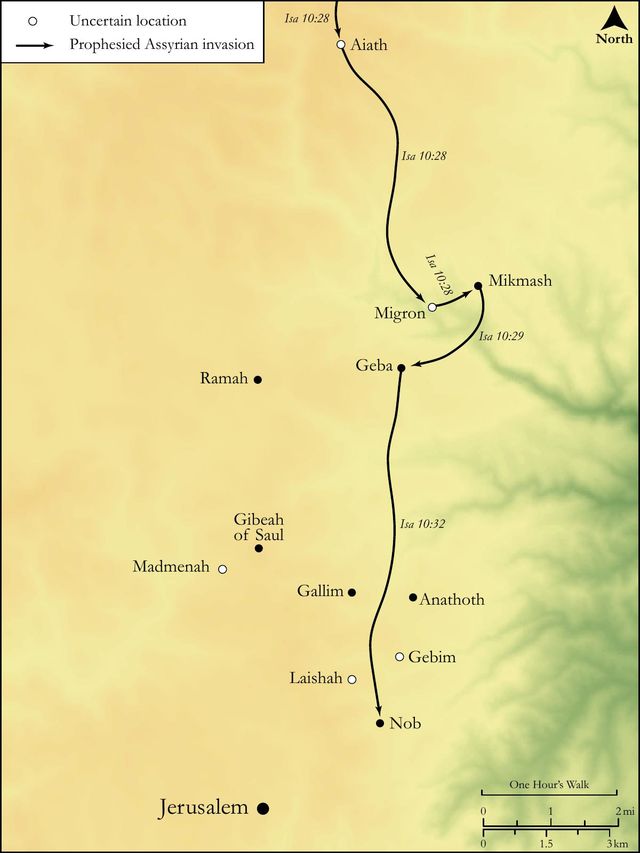
1.How formidable the Assyrians were and how daring and threatening they affected to appear. Here is a particular description of the march of Sennacherib, what course he steered, what swift advances he made: He has come to Aiath, etc. "This and the other place he has made himself master of, and has met with no opposition." At Michmash he has laid up his carriages, as if he had no further occasion for his heavy artillery, so easily was every place he came to reduced; or the store-cities of Judah, which were fortified for that purpose, had now become his magazines. Some remarkable pass, and an important one, he had taken: They have gone over the passage.
2.How cowardly the men of Judah were, the degenerate seed of that lion's whelp. They were afraid; they fled upon the first alarm, and did not offer to make any head against the enemy. Their apostasy from God had dispirited them, so that one chased a thousand of them. Instead of a valiant shout, to animate one another, nothing was heard by lamentation, to discourage and weaken one another. And poor Anathoth, a priests' city, that should have been a pattern of courage, shrieks louder than any, Isa 10:30. With respect to those that gathered themselves together, it was not to fight, but to flee by consent, Isa 10:31. This is designed either,
(1.)To show how fast the news of the enemy's progress flew through the kingdom: He has come to Aiath, says one; nay, says another, He has passed to Migron, etc. And yet, perhaps, it was not altogether so bad as common fame represented it. But we must watch against the fear, not only of evil things, but of evil tidings, which often make things worse than really they are, Psa 112:7. Or,
(2.)To show what imminent danger Jerusalem was in, when its enemies made so many bold advances towards it and its friends could not make one bold stand to defend it. Note, The more daring the church's enemies are, and the more dastardly those are that should appear for her, the more will God be exalted in his own strength, when, notwithstanding this, he works deliverance for her.
3.How impotent his attempt upon Jerusalem shall be: he shall remain at Nob, whence he may see Mount Zion, and there he shall shake his hand against it, Isa 10:32. He shall threaten it, and that shall be all; it shall be safe, and shall set him at defiance. The daughter of Jerusalem, to be even with him, shall shake her head at him, Isa 37:22.
4.How fatal it would prove, in the issue, to himself. When he shakes his hand at Jerusalem, and is about to lay hands on it, then is God's time to appear against him; for Zion is the place of which God has said, This is my rest for ever; therefore those who threaten it affront God himself. Then the Lord shall lop the bough with terror and cut down the thickets of the forest, Isa 10:33, Isa 10:34.
(1.)The pride of the enemy shall be humbled, the boughs that are lifted up on high shall be lopped off, the high and stately trees shall be hewn down; that is, the haughty shall be humbled. Those that lift up themselves in competition with God or opposition to him shall be abased.
(2.)The power of the enemy shall be broken: The thickets of the forest he shall cut down. When the Assyrian soldiers were under their arms, and their spears erect, they looked like a forest, like Lebanon; but, when in one night they all became as dead corpses, the pikes were laid on the ground, and Lebanon was of a sudden cut down by a mighty one, by the destroying angel, who in a little time slew so many thousands of them: and, if this shall be the exit of that proud invader, let not God's people be afraid of him. Who art thou, that thou shouldst be afraid of a man that shall die?
Historical interpretation
Two Centuries of Reception
2 surviving comments on this verse. Each one is dated, so this reads as a timeline rather than a list.
Select a marker to jump to its quote. Markers stagger vertically where authors wrote within a few decades of each other.
And who are these but the rich? Because they have indeed received their consolation, glory and honor, and a lofty position from their wealth.
(Verse 28 and following) He will come to Aiath, he will pass through Migron: at Machmas he will deposit his baggage. They went with haste to Geba, our city (or as we find elsewhere written: they stayed at the lodging place); Ramah was astonished, Gibeah of Saul fled. Cry out with your voice, daughter of Gallim; listen, Laishah, poor Anathoth: Medemena has taken flight; the inhabitants of Gebim, gather yourselves together. There is still a day, to stand at Nob: he will shake his hand against the mount of the daughter of Zion, the hill of Jerusalem. LXX: For He will come into the city of Aggai, and will pass through Mageddo: and in Machmas He will set His vessels: and He will pass through the valley, and will come into Aggai. Fear shall seize Rama, the city of Saul: the daughter of Gallim shall flee: listen, O Laisa: there shall be heard in Anathot: Medemena will be astonished, and the inhabitants of Gebim. Comfort yourselves today along the way, that He may remain: comfort the mountain of the daughter of Zion, and the hill of Jerusalem. In this place, the LXX differs greatly from the Hebrew: for this reason, we have included both editions, so that, with the inspiration of Christ, we may express what seems to us in each. He is describing the prophetic speech of the Assyrian about his journey and return from Egypt to Jerusalem, and how he will come with great noise and speed to attack the city. And first, he says, he will come to Aiath, where, due to excessive haste, he will not want to stay and will pass through to Magron, and he will have such confidence in capturing the city that he will leave his luggage at Machmas, as if he will quickly return after the city is destroyed. After leaving his luggage, he will pass through quickly and will have a resting place in Geba, where he will stay for a short time to revive his tired army, and the nearby city of Ramah will be terrified, and the city of Gibeah, once the city of Saul, will flee. Then both Gallim's daughter, who is called Beth Gallim in Hebrew, will wail so loudly that you would think it is the neighing of horses. Therefore, oh Laisa, whether you are poor or obedient, or humble Anathoth (for it can be interpreted in three ways), pay close attention and declare the approaching onslaught, if you can; for the city of Medemena has already migrated from its dwelling places. But you who dwell in the hills, which are interpreted as Gebim, be reassured by the safety of your elevated location, that is, take up arms. So far, only the end of the day remained, as he stood in the small town of Nob, overlooking the city of Jerusalem. He waved his hand and shook it over Mount Zion, either looking down on it with disdain and contempt, or insulting and threatening it, and marveling that such a small city would dare to resist his power, with the entire East under his control. These things, according to the Hebrews, as they have been handed down to us, we have briefly described. Now let us present what the Ecclesiastical men of the Seventy have to say about this passage. When the yoke of Assyria, or as some wrongly believe, the Babylonians, is removed from your shoulders and corrupted, the Assyrian Sennacherib, fleeing with a few remnants, will come to Aggai, which is not found in Hebrew. And there will be such trembling of the fugitive that he will not dare to stay there, but will pass through to Mageddo, which is not mentioned in Scripture itself. And because he will not be able to flee more quickly burdened with his baggage, he will deposit his vessels in Machmas and swiftly pass through the valley, which the Hebrew language does not even mention; and he will come again to Aggai, which is mentioned twice in this place and is not found in Hebrew. At the sound of his flight, Rama, the city of Saul, will tremble, which is clearly false. For the city of Saul is called Gaba, as is stated in Hebrew. Then he will come to Gallim; Laisa will hear, Anathoth will hear, Medemena will tremble. But the inhabitants of Gebim and the hills, which are in Jerusalem, that is, the lofty and mighty men, will be stirred up to console Jerusalem: not long afterwards, but at present, and on the same day while the Assyrian is on the way; so they may remain in their places, and, disturbed by fear, in no way flee. This word for word. However, some in this place, when they cannot find false names according to the etymology of the Septuagint, nor can they find themselves in the book of Hebrew Names, send us to uncertainty, so that they say that in the end of the world and in the consummation of this age, with impending punishments, the great meaning, the prince of the Assyrians, will flee; and desiring to escape from the anger of God, they will travel through different places and various destinations. And when he flees, let the inhabitants of Gebim, that is, the lofty virtues, be urged by prophetic speech to console the one fleeing and to teach them not to flee but to stay on the path and await the mercy of God; and not only to console the one fleeing or to recall the daughter of Zion from mourning and to provoke her to the salvation of repentance, but also to be these hills in Jerusalem of which we read in the later part of this prophet: Comfort, comfort my people, says the priests; speak to the heart of Jerusalem (Isa. XL, 1). He said this because he was bound by the truth of the matter and had nothing else to say.
Behold the Lord of hosts will break the jar in terror, and the lofty stature will be cut down, and the exalted will be brought low, and the dense forests will be destroyed by the sword, and Lebanon with its heights will fall. Some people think that this passage is still speaking of the Assyrians, and that when they are crushed, all the nations around them that were subject to their rule will be cut down and humbled, and the dense forests will be destroyed. They understand this metaphorically as referring to the people and rulers. Moreover, even Lebanon with its lofty cedars can fall, so that no power of Assyria remains at all. But others want this place to be about Christ, especially since what follows, and we ourselves, and the Circumcision Scriptures, testify about him. Above, it was mentioned that the name of the child to be born of a Virgin would be called Emmanuel; and later the prophetess in her conception in the womb would proclaim, 'Hurry, plunder, hasten to prey' (Isa. 8:3), and he himself would be a stone of stumbling and a rock of offense to the two houses of Israel; his dominion would be on his shoulder, and he would be called by six names: Wonderful, Counselor, God, Strong, Father of the future age, and Prince of peace; and his empire would multiply, and there would be no end to peace. Now in the prologue of his coming, before it is said that he will be born of the descendants of Jesse and David, the passion of him is demonstrated through the symbol of the broken vessel: that, by the will of God, his flesh was handed over to death so that the pride of the Jews may be destroyed and those who were once lofty may fall to the ground; and Lebanon with its cedars may be cut down, of which we read in Zachariah: Open your gates, O Lebanon, and let fire devour your cedars; wail, O cypress, for the cedar has fallen, because the noble have been devastated (Zach. XI, 1, 2). But that he is said to be contrite and struck by the Father, and that is indicated by this: I will strike the shepherd, and the sheep will be scattered (Zech. XIII, 7). And another testimony: For they have persecuted him whom you have struck (Ps. LXVIII, 2). The Hebrew word פורע (Phura), which Aquila has interpreted as κεραμεῖον, and Theodotion and Symmachus translated as ληνὸν, that is, winepress, which also signifies the Lord's Passion according to the inscription of three psalms, with the Lord himself saying in Isaiah: I have trodden the winepress alone, and no man of the nations was with me (Isa. LXIII, 3). However, they interpreted LXX as meaning 'for the wine press,' introducing a new sense.
Continue studying Isaiah 10:33 across the web’s major study libraries — every link below opens this exact verse, chapter, or book on the destination site.
Read & Compare
 BibleGatewayThis verse in more than 200 translations and 70 languages.
 Bible.comThe YouVersion reader — hundreds of translations, reading plans, and highlights.
 ESV.orgCrossway's official English Standard Version reader.
 NET BibleThe NET translation with 60,000+ translators' notes on every rendering decision.
 STEP BibleTyndale House's free study tool — original text, vocabulary, and scholarly resources.
 BibliaLogos Bible Software's free web reader.
 USCCBThe New American Bible (Revised Edition) with the U.S. bishops' study notes.
Commentaries
 BibleHub CommentariesDozens of classic commentaries on this verse, gathered on one page.
 StudyLightMore than 100 commentary sets — the largest collection on the web.
 BibleRefPlain-English commentary on what this verse means, verse by verse.
 Enduring WordDavid Guzik's free commentary on this chapter, widely used by Bible teachers.
 Bible Study ToolsVerse commentary alongside Greek and Hebrew study aids.
Original Language & Research
- BibleHub InterlinearThe verse word by word — original language, transliteration, and English.
- BibleHub LexiconEvery word's original-language definition and Strong's entry.
 Blue Letter BibleDeep-study tools — Strong's numbers, concordance, and word studies.
 SefariaThe Hebrew text with Rashi and centuries of Jewish commentary.
Sermons, Hymns & Audio


TrulyRandomVerse is not affiliated with these sites and doesn’t control their content. They’re linked because they’re genuinely useful.
Summary
Isaiah 10:33 serves as a dramatic prophetic declaration of God's decisive intervention against the seemingly invincible Assyrian Empire. Following a vivid description of Assyria's relentless advance towards Jerusalem, this verse abruptly shifts focus to the Lord's absolute sovereignty, portraying Him as the divine woodsman who will "lop" and "hew down" the proud and powerful, bringing their arrogance to a swift and terrifying end. It underscores the transient nature of human might in the face of God's ultimate authority and His unwavering commitment to humble the haughty, assuring His people of ultimate deliverance.
Context
ShowHideLiterary Context
Isaiah 10:33 concludes a powerful prophetic oracle (Isaiah 10:5-34) primarily directed against Assyria, which God had used as an instrument of judgment against Israel and Judah. The preceding verses (Isaiah 10:28-32) paint a vivid, almost breathless, picture of the Assyrian army's rapid and terrifying march through various towns north of Jerusalem, drawing ever closer to the city itself. This narrative builds a sense of impending doom and human helplessness, creating a palpable tension for the reader. Verse 33, however, marks an abrupt and dramatic shift. It is a sudden divine interjection, moving from the earthly perspective of Assyria's seemingly unstoppable might to the heavenly perspective of God's sovereign and decisive action. It functions as a climactic reversal, signaling that despite Assyria's temporary success and self-exaltation, their ultimate fate is entirely in the hands of the Lord of hosts, who will cut them down at the very threshold of their perceived victory. This passage is part of the broader "Book of Immanuel" (Isaiah 7-12), which weaves together themes of judgment, deliverance, and the coming Messiah.
Historical & Cultural Context
The historical backdrop for Isaiah 10 is the late 8th century BCE, a period dominated by the aggressive expansion of the Neo-Assyrian Empire. Under formidable kings like Tiglath-Pileser III, Shalmaneser V, Sargon II, and Sennacherib, Assyria had conquered vast territories, including the Northern Kingdom of Israel (722 BCE). Judah, the Southern Kingdom, faced an existential threat, often attempting to appease Assyria through tribute or forming alliances against them. The Assyrians were known for their brutal military tactics, their overwhelming siege warfare, and their policy of mass deportation. Their might seemed unstoppable, fostering a sense of terror and despair among smaller nations like Judah. Culturally, the imagery of "lopping the bough" or "hewing down" tall trees would have been readily understood as a metaphor for the destruction of powerful entities or leaders, as trees often symbolized strength, prominence, and even kingdoms in Hebrew thought. The title "Lord of hosts" (Yahweh Sabaoth) was particularly significant in times of war, emphasizing God's role as the supreme commander of all armies, both earthly and heavenly, and His ultimate control over the destiny of nations.
Key Themes
ShowHideIsaiah 10:33 powerfully contributes to several overarching themes within the book of Isaiah and the broader biblical narrative. Firstly, it underscores the Divine Sovereignty and Judgment of God. The repeated use of the divine titles "the Lord, the LORD of hosts" unequivocally declares God's absolute authority over all earthly powers, including the seemingly invincible Assyrian Empire. This verse highlights that God is the ultimate arbiter of history, using nations as His instruments but also holding them accountable for their pride and wickedness, as seen in Isaiah's pronouncements against other nations. Secondly, it vividly portrays the Humbling of Pride. The imagery of "lopping the bough" and "hewing down" the "high ones of stature" directly addresses the theme of divine opposition to human arrogance. Assyria, represented by tall trees and proud leaders, will be utterly humbled and brought low by God's hand, a principle echoed throughout Scripture, as seen in Proverbs 16:18 and James 4:6. Lastly, the verse illustrates a dramatic Reversal of Fortune. The powerful, the tall, and the haughty are suddenly cut down, signifying the abrupt end of their dominion and the restoration of God's justice. This serves as a potent reminder that no earthly power can ultimately stand against the will of God, a truth powerfully articulated in Daniel 4:17, which states that the Most High is sovereign over the kingdoms of men.
Exposition and Analysis
ShowHideKey Word Analysis
ShowHideThis triple appellation for God is profoundly significant. ʼâdôwn (H113) signifies "sovereign, i.e., controller (human or divine); lord, master, owner," emphasizing God's ultimate dominion. Yᵉhôvâh (H3068), the covenant name of God, "the self-Existent or Eternal," highlights His unchanging, faithful nature. Coupled with tsâbâʼ (H6635), meaning "a mass of persons... especially regularly organized for war (an army); by implication, a campaign," this title "LORD of hosts" (Yahweh Sabaoth) portrays God as the supreme commander of all heavenly and earthly armies, demonstrating His irresistible power and authority to execute judgment. The combination underscores His absolute control over all creation and history, particularly in the context of warfare and national destinies.
The verb çâʻaph (H5586), meaning "to disbranch (a tree); top," and gâdaʻ (H1438), a primitive root meaning "to fell a tree; generally, to destroy anything; cut (asunder, in sunder, down, off), hew down," convey a violent, decisive, and irreversible act of destruction. This imagery of a tree being forcefully cut down emphasizes the sudden and complete dismantling of the Assyrian power, which had previously been depicted as a towering, seemingly indestructible force. It is not a gradual decline but a swift, terrifying felling, indicating the finality of God's judgment.
The word gâbôahh (H1364) describes those who are "elevated (or elated), powerful, arrogant; haughty, high(-er), lofty, proud, exceeding proudly." It captures the essence of Assyria's self-exaltation and pride, reflecting their belief in their own invincibility. In stark contrast, shâphêl (H8213), meaning "to depress or sink (expectation figuratively, to humiliate, intransitive or transitive); abase, bring (cast, put) down, debase, humble (self), be (bring, lay, make, put) low(-er)," signifies the complete and utter abasement that God will inflict upon the proud. This pairing highlights the divine reversal: those who exalt themselves will be brought low by the sovereign hand of God, demonstrating His justice against human arrogance.
Verse Breakdown
ShowHide"Behold, the Lord, the LORD of hosts"
This opening exclamation, "Behold," serves as a dramatic summons, drawing immediate attention to the divine actor and the gravity of the impending event. The formidable title "the Lord, the LORD of hosts" (Adonai Yahweh Sabaoth) establishes God's absolute sovereignty and immense power as the one who commands all heavenly and earthly forces. It signals that the following action is not merely a human event but a direct, terrifying act of divine judgment, executed by the supreme commander of the universe.
"shall lop the bough with terror"
The imagery shifts to God acting as a mighty woodsman. The "bough" (pᵉʼôrâh) represents the powerful, flourishing strength of Assyria, often symbolized by a majestic tree, indicative of its prominence and reach. To "lop" (çâʻaph) it signifies a severe cutting back, a reduction of its power and influence. This action is performed "with terror" (maʻărâtsâh), indicating the overwhelming and fearful manner in which God's judgment will manifest, striking fear into the hearts of those who witness or experience it, and demonstrating the awe-inspiring nature of His power.
"and the high ones of stature shall be hewn down"
This clause reinforces the previous imagery, making explicit that the "bough" and "high ones of stature" (rûwm qôwmâh) refer to the prominent, powerful, and arrogant leaders or elements within Assyria. These are the individuals or groups who have elevated themselves. To be "hewn down" (gâdaʻ) is a violent and complete act of destruction, signifying the utter demolition of their strength, authority, and very existence as a dominant force.
"and the haughty shall be humbled"
This final clause serves as a powerful summary and theological punchline, articulating the core principle behind the divine action. It reiterates the central theme of divine judgment against human pride. The "haughty" (gâbôahh), those who have exalted themselves in their own strength and arrogance, will be "humbled" (shâphêl), brought low and utterly abased by the sovereign hand of God. This is the inevitable outcome for all who oppose God's will and refuse to acknowledge His supremacy, a universal truth that transcends the specific historical context.
Literary Devices
ShowHideIsaiah 10:33 is rich in literary devices that enhance its prophetic impact and convey its powerful message. The most prominent is Metaphor and Imagery, where Assyria's formidable power is vividly depicted as a towering, majestic tree, and God's judgment is portrayed as the decisive action of a divine woodsman wielding an axe. The specific terms "bough," "high ones of stature," and their being "lopped" and "hewn down" are powerful visual representations of a mighty empire being utterly dismantled and brought to ruin. This employs Anthropomorphism, attributing human-like actions (lopping, hewing) to God, making His intervention tangible and relatable to human experience. The passage also employs strong Contrast and Antithesis, juxtaposing the "high ones of stature" and the "haughty"—symbols of elevated power and arrogance—with their ultimate fate of being "hewn down" and "humbled." This stark opposition emphasizes the dramatic and complete reversal brought about by divine intervention. The term "terror" (maʻărâtsâh) injects an element of Hyperbole, suggesting an overwhelming and awe-inspiring display of God's power that evokes profound fear. Finally, the opening word "Behold" functions as a Prophetic Declaration, a direct command to attention that underscores the certainty, authority, and divine origin of the pronouncement.
Theological and Thematic Connections
ShowHideIsaiah 10:33 stands as a profound theological statement on God's absolute sovereignty over all earthly powers and His unwavering opposition to human pride. It reveals that no nation, no matter how mighty or self-assured, can ultimately withstand the divine will. God, as "the Lord, the LORD of hosts," is not merely an observer of history but its ultimate orchestrator, capable of raising up and casting down kingdoms according to His righteous purposes. This truth offers both a stern warning to the proud and a deep comfort to the oppressed, assuring them that divine justice will prevail. The verse underscores that true power resides not in human strength or military might, but solely in the hands of the Almighty God, who delights in humbling the arrogant and exalting the humble, demonstrating His perfect justice and control over all creation.
Reflection and Application
ShowHideIsaiah 10:33 offers timeless lessons for both individuals and nations, calling us to a profound re-evaluation of where we place our trust and how we view power. In a world often dominated by displays of human strength, wealth, and self-assertion, this verse serves as a stark reminder that all earthly might is transient and ultimately subject to the sovereign hand of God. It challenges us to cultivate genuine humility, recognizing that any talent, position, or success we possess is a gift from above, not a basis for pride or self-exaltation. For those who feel overwhelmed by oppressive practices or arrogant individuals, this prophecy provides immense comfort and hope, assuring them that God sees injustice and will, in His perfect timing, bring down the proud and exalt the humble. It encourages us to place our ultimate reliance and security not in human achievements or alliances, but in the unfailing strength and wisdom of the Lord, who alone is worthy of all glory and who alone can bring true and lasting justice.
Questions for Reflection
ShowHideFAQ
ShowHideWho is "the high ones of stature" and "the haughty" referring to in this context?
ShowHideIn the immediate context of Isaiah 10, "the high ones of stature" and "the haughty" primarily refer to the Assyrian Empire, its formidable military, and its arrogant leaders. Assyria, at this time, was the dominant world power, known for its ruthless conquests and self-exaltation. God had used Assyria as an instrument of judgment against disobedient nations, including Israel. However, Assyria itself became proud, attributing its victories to its own might rather than acknowledging God's sovereign hand. This verse declares that despite their perceived invincibility and towering pride, God would decisively bring them down, as famously fulfilled in the miraculous destruction of Sennacherib's army outside Jerusalem (see Isaiah 37:36). Beyond Assyria, the verse also carries a universal principle: God opposes all forms of human pride and self-exaltation.
How does this verse relate to God's character?
ShowHideIsaiah 10:33 powerfully reveals several facets of God's character. Firstly, it highlights His absolute sovereignty as "the Lord, the LORD of hosts," demonstrating His ultimate control over all nations, armies, and historical events. Secondly, it showcases His righteous justice, as He brings judgment upon those who are arrogant and oppressive, even if He initially used them for His purposes. God is not indifferent to the pride and wickedness of humanity, but actively intervenes. Thirdly, it underscores His immense power and ability to execute His will decisively, symbolized by the violent "lopping" and "hewing down." Finally, it implicitly reveals His faithfulness to His covenant people, as this judgment on Assyria ultimately serves to protect Jerusalem and preserve a remnant for Judah, demonstrating His role as a divine protector (see Deuteronomy 32:4).
Is this prophecy only about Assyria, or does it have broader implications?
ShowHideWhile Isaiah 10:33 is specifically directed at the Assyrian Empire in its historical context, it carries profound and enduring universal implications. It serves as an archetypal prophecy demonstrating God's consistent principle of opposing human pride and bringing down those who exalt themselves against Him. Throughout biblical history and beyond, we see this pattern repeated: empires rise and fall, and powerful individuals are humbled. Therefore, while its immediate fulfillment was against Assyria, the verse stands as a timeless declaration of God's unchanging character and His ultimate dominion over all earthly powers. It assures believers that no human arrogance or oppressive regime can ultimately thwart God's plans or escape His righteous judgment, a truth echoed in Psalm 75:7.
Christ-Centered Fulfillment
ShowHideIsaiah 10:33, with its vivid imagery of God "lopping" and "hewing down" the proud, finds its ultimate Christ-centered fulfillment in both the first and second comings of Jesus. In His first advent, Christ perfectly embodied the antithesis of the "haughty" described here. Though He was "in the form of God," He "did not count equality with God a thing to be grasped, but emptied himself, by taking the form of a servant, being born in the likeness of men" (Philippians 2:6-7). The divine humility of the Lamb of God, who takes away the sin of the world, stands in stark contrast to the pride that God promises to humble. Through His sacrificial death on the cross, Jesus disarmed and triumphed over the spiritual powers of darkness that often fuel human arrogance and oppression, "having disarmed the powers and authorities, he made a public spectacle of them, triumphing over them by the cross" (Colossians 2:15). In His second coming, the "lopping" and "hewing down" will reach its final, universal culmination. The King of kings and Lord of lords will return to judge the nations and execute righteous judgment, bringing all rebellious and haughty powers to their knees. Every knee will bow, and every tongue confess that Jesus Christ is Lord, to the glory of God the Father (Philippians 2:10-11). Thus, Isaiah 10:33 foreshadows the ultimate victory of Christ over all pride and opposition, establishing His eternal kingdom where only the humble will inherit the earth, as promised in Matthew 5:5.