


Hosea 2:10
Bible text: King James Version (1769 Blayney text) · Public domain
Bible text: Berean Standard Bible · Public domain
Bible text: American Standard Version (1901) · Public domain
Bible text: World English Bible, Messianic edition · Public domain
Bible text: Geneva Bible (1599) · Public domain
Bible text: Young's Literal Translation · Public domain
- וְעַתָּהve·'a·Tahand nowH6258Conj-w ¦ AdvAdverbוְandעַתָּהnow
- אֲגַלֶּה'a·ga·LehI will uncoverH1540V-Piel-Imperf-1csVerb Piel Imperfect 1st Singular common gender
- אֶת'et<obj.>H853DirObjMParticle Object Indicator
- נַבְלֻתָהּnav·lu·Tahher lewdnessH5040N-fsc ¦ 3fsNoun Singular Feminine Constructנַבְלֻתָlewdnessהּher
- לְעֵינֵיle·'ei·Neito [the] eyes ofH5869Prep-l ¦ N-fdcNoun Dual Feminine Constructלְtoעֵינֵי[the] eyes of
- מְאַהֲבֶיהָme·'a·ha·Vei·halovers herH157V-Piel-Prtcpl-mp ¦ 3fsVerb Piel Participle Plural Masculine Constructמְאַהֲבֶיloversהָher
- וְאִישׁve·'Ishand anyoneH376Conj-w ¦ N-msNoun Singular Masculine Absoluteוְandאִישׁanyone
- לֹאlo'notH3808NegParticle Negative
- יַצִּילֶנָּהya·tzi·Le·nahhe will deliver herH5337V-Hiphil-Imperf-3ms ¦ 3fsVerb Hiphil Imperfect 3rd Singular Masculineיַצִּילֶhe will deliverנָּהher
- מִיָּדִיmi·ya·Difrom my handH3027Prep-m ¦ N-csc ¦ 1csNoun Singular common gender Constructמִfromיָּדִhandיmy
English is a literal word-by-word gloss of the Hebrew, not the KJV's wording. Why?
This is the original text the KJV's translators worked from — each Hebrew word with its own literal English meaning in this verse, prepared by scholars at Tyndale House, Cambridge. The KJV translates whole sentences, not word by word, so its wording differs: one Hebrew word can become several English words, and the KJV may choose “the LORD” where the gloss reads “Yahweh”. Both are faithful — they answer different questions. For the KJV's own rendering, switch to the KJV text.
Details
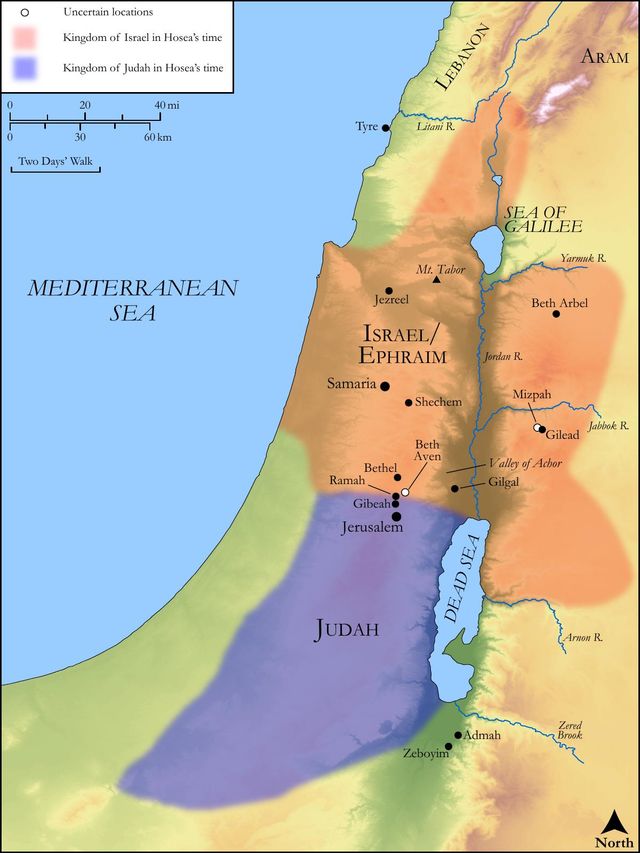
See on the biblical-era map
Study this verse
Public-domain commentary
Matthew Henry
From his Commentary on the Whole Bible. Henry comments on passages, not single verses — this entry covers Hosea 2:6–13. His three-level outline is real structure in the source text, so it is rendered as structure.
God here goes on to threaten what he would do with this treacherous idolatrous people; and he warns that he may not wound, he threatens that he may not strike. If he turn not, he will whet his sword (Psa 7:12); but, if he turn, he will sheathe it. They did not turn, and therefore all this came upon them: and its being threatened before shows that it was the execution of a divine sentence upon them for their wickedness; and it is written for admonition to us.
I.They shall be perplexed and embarrassed in all their counsels, and disappointed in all their expectations.
This is threatened Hos 2:6, Hos 2:7. But to the threatening is annexed a promise that this shall be a means to convince them of their folly, and bring them home to their duty; and so good shall be brought out of evil, in token of the mercy God has yet in reserve for them. And, this being the happy fruit and effect of the distress, it is hard to say whether the prediction, or the distress itself, should be called a threatening or a promise.
1.God will raise up difficulties and troubles in their way, so that their public counsels and affairs shall have no success, nor shall they be able to get forward in them: I will hedge up thy way with thorns, with such crosses as, like thorns and briers, are the product of sin and the curse, and are scratching, and tearing, and vexing, and, when the way we are in is hedged up with them, stop our progress, and force us to turn back. She said, "I will go after my lovers; I will pursue my leagues and alliances with foreign powers, and depend upon them." But God says, "She shall be frustrated in these projects, and not be able to proceed in them. I will hedge up thy way with thorns, and, if that do not serve, I will make a wall." If some smaller difficulties be got over, and prevail not to break her measures, God will raise greater, for he will overcome when he judges. It shall be such a hedge, and such a wall, that she shall not find her paths. The change of the person here, I will hedge up thy way, and then, She shall not find it, is usual in scripture, especially in an earnest way of speaking. "Sinner, do thou take notice, I will hedge up thy way, and all you that are bystanders take notice what will be the effect of this, you may observe that she cannot find her paths." She shall be as a traveller that not only knows not which way to go, of many that are before him, but that finds no way at all to go forward. And then she shall follow after her lovers, but she shall not overtake them; she shall endeavour to make an interest in the Assyrians and Egyptians, and to have them for her protectors, but she shall not gain her point; they shall either not come into confederacy with her or not do her any service, shall help in vain and be as the staff of a broken reed. She shall seek them, but shall not find them, shall seek to her idols, but shall not find that satisfaction in them which she promised herself; the gods whom she trusted and courted not only can do nothing for her, but have nothing to say to her to encourage her. Now,
(1.)This is such a just judgment as the Sodomites met with, that were struck with blindness, and wearied themselves to find the door (Gen 19:11), and the Syrians, Kg2 6:18. Note, Those that are most resolute in their sinful pursuits are commonly most crossed in them. Thorns and snares are in the way of the froward (Pro 22:5); and thus with them God shows himself froward (Psa 18:26), and walks contrary to those that walk contrary to him, Lev 26:23, Lev 26:24. The lamenting prophet complains, He has enclosed my ways, Lam 3:7, Lam 3:9. The way of God and duty is often hedged about with thorns, but we have reason to think it is a sinful way that is hedged up with thorns.
(2.)This is such a kind rebuke, and indeed such a mercy, as Balaam met with, when the angel stood in his way, to hinder his going forward to curse Israel, Num 22:22. Note, Crosses and obstacles in an evil course are great blessings, and are so to be accounted. They are God's hedges, to keep us from transgressing, to restrain us from wandering out of the green pastures, to withdraw man from his purpose (Job 33:17), to make the way of sin difficult, that we may not go on in it, and to keep us from it whether we will or not. We have reason to bless God both for restraining grace and for restraining providences.
2.These difficulties that God raises up in their way shall raise up in their minds thoughts of turning back: "Then shall she say, Since I cannot overtake my lovers, I will even go and return to my first husband, that is, will return to God, and humble myself to him, and desire him to take me in again; for, when I kept close to him, it was every way better with me than now." Two things are here extorted from this degenerate apostate people: - (1.) A just acknowledgement of the folly of their apostasy. They are now brought to own that it was better with them while they kept close to their God than ever it was since they forsook him. Note, Whoever have exchanged the service of God for the services of the world and the flesh have, sooner or later, been made to own that they changed for the worse, and that while they continued in good company, and went on in the way of good duties, and made conscience how they spent their time and what they said or did, it was better with them; they had more true comfort and enjoyment of themselves than ever they had since they went astray. (2.) A good purpose, to come back again to their duty: I will go, and return to my first husband; and she knows so much of his goodness and readiness to forgive that she speaks without any doubt of his receiving her again into favour and making her condition as good as ever. Note, The disappointments we meet with in our pursuits of satisfaction in the creature should, if nothing else will do it, drive us at length to the Creator, in whom alone it is to be had. When Moab is weary of the high place he shall go to the sanctuary, Isa 16:12. And when the prodigal son is reduced to husks, short allowance indeed, and remembers that in his father's house there is bread enough, then he says, I will arise and go to my father's house, Luk 15:17, Luk 15:18.
II.The necessary supports and comforts of life shall be taken from them, because they had dishonoured God with them, Hos 2:8, Hos 2:9.
Their land was plenteous. Now see here, 1. How graciously their plenty was given to them. God gave them not only corn for necessity, but wine for delight, and oil for ornament. Nay, he multiplied their silver and gold, wherewith to traffic with other nations and bring home their products, and which they might hoard up for posterity. Silver and gold will keep longer than corn, and wine, and oil. He gave them wool and flax too, to cover their nakedness, and to serve for ornament enough to them, Eze 16:10. Note, God is a bountiful benefactor even to those who, he foresees, will be ungrateful and unthankful to him.
2.How basely their plenty was abused by them.
(1.)They robbed God of the honour of his gifts: She did not know that I gave her corn and wine; she did not remember it. The law and the prophets had told them, again and again, that all their comforts they received from God's bountiful providence; but they were so often told by their false prophets and idolatrous priests that they had their corn from such an idol, and their wine from such an idol, etc., that they had quite forgotten their relation to their great benefactor and their obligations to him. She did not consider it; she would not acknowledge it. This they were willingly ignorant of, and more brutish than the ox, that knows his owner, and the ass, that knows his master's crib. She did not know it, for she did not return thanks to him for his gifts, nor study what she should render; nor did she give him his dues out of them, but acted as if she were ignorant who was the donor.
(2.)They served and honoured his enemies with them: They prepared them for Baal; they adorned their images with gold and silver (Jer 10:4), and adorned themselves for the worship of their images, Hos 2:13. See Eze 16:17-19. Wherewith they made Baal (so the margin reads it), that is, the image of Baal. Note, It is a very great dishonour to the God of heaven to make those gifts of his providence the food and fuel of our lusts which he gave us for our support in his service, and to be oil to the wheels of our obedience.
3.How justly their plenty should be taken from them: "Therefore will I return; I will alter my dealings with them, will take another course, and will take away my corn and other good things that I gave her." I will recover them, a law term, as a man by due course of law recovers what is unjustly detained from him, or as, when the tenant has committed waste, the landlord recovers locum vastatum - dilapidations. Observe, God calls their abundance my corn and my wine, my wool and my flax. They called it theirs (my bread and my water, Hos 2:5), but God lets them know that it is not theirs; he only allowed them the use of it as tenants, entrusted them with the management of it as stewards, but still reserved the property in himself. "It is my corn and my wine." God will have us to know, not only that we have all our creature-comforts and enjoyments from him, but that he has still an incontestable right and title to them, that they are more his than ours, and therefore are to be used for him, and accounted for to him. He will therefore take their plenty away from them, because they have forfeited it by disowning his right, as a tenant by copy of court-roll, who holds at the will of his lord, forfeits his estate if he makes a feoffment of it as though he were a freeholder. He will recover it, will free or deliver it, that it may be no longer abused, as the creature is said to be delivered from the bondage of corruption under which it groans, Rom 8:21. He will take it away in the time thereof, and in the season thereof, just when they expected it, and thought that they were sure of it. It shall suffer shipwreck in the harbour; and the harvest shall be a heap. He will take it away by unseasonable weather or by unreasonable men. Note, Those that abuse the mercies God gives them, to his dishonour, cannot expect to enjoy them long.
III.They shall lose all their honour, and be exposed to contempt (Hos 2:10):
"I will discover her lewdness, will bring to light all her secret wickedness, and make it public, to her shame; I will show by the punishment of it how heinous, how odious, how offensive it is. The fact has been denied, but now it shall appear; the fault has been diminished, but now it shall appear exceedingly sinful. And this in the sight of her lovers, in the sight of the neighbouring nations, with whom she courted an alliance, and on whom she had a dependence; they shall despise her and be ashamed of her because of her weakness, and poverty, and ill conduct; they shall not think her any longer worthy of their friendship." See this fulfilled, Lam 1:8, All that honoured her despise her, because they have seen her nakedness. Or in the sight of the sun and moon, which she worshipped as her lovers; before them shall her lewdness be discovered. Compare this with Jer 7:1, Jer 7:2, They shall bring out the bones of their kings and princes, and spread them before the sun and moon, whom they have loved and served. Note, Sin will have shame; let those expect it that have done shamefully. What other lot can this impudent adulteress expect but that of a common harlot, to be carted through the town? And, when God comes to deal thus with her, none shall deliver her out of his hands, neither the gods nor the men they confide in. Note, Those who will not deliver themselves into the hand of God's mercy cannot be delivered out of the hand of his justice.
IV.They shall lose all their pleasure, and shall be left melancholy (Hos 2:11):
I will cause her mirth to cease. It seems, then, though they had gone a whoring from their God, yet they could find in their hearts to rejoice as other people, which is forbidden, Hos 9:1. Note, Many who lie under guilt and wrath are yet very jocund and merry, and live jovially; but, whether in their laughter their hearts be sad or no, it is certain that the end of their mirth will be heaviness; for God will cause all their mirth to cease. It is as Mr. Burroughs observes here, Sin and mirth can never hold long together; but, if men will not take away sin from their mirth, God will take away mirth from their sin.
1.God will take away the occasions of their sacred mirth - their feast-days, their new moons, their sabbaths, and all their solemn feasts. These God instituted to be observed in a religious manner, and they were to be observed with rejoicing; and, it seems, though they had departed from the pure worship of God, yet they kept up the observance of these, not at God's temple at Jerusalem, for they had long since forsaken that, but probably at Dan and Bethel, where the calves were, or in some other places of meeting that they had. They observed them, not for the honour of God, nor with any true devotion towards him, but only because they were times of mirth and feasting, music and dancing, and meeting of friends, received by tradition from their fathers. Thus, when they had lost the power of godliness, and denied that, yet, for the pleasing of a vain and carnal mind, they kept up the form of it; and by this means their new-moons and their sabbaths became an iniquity which God could not away with, Isa 1:13. Now observe,
(1.)God calls them their new-moons and their sabbaths, not his (he disowns them), but theirs.
(2.)He will cause them to cease. Note, When men by their sins have caused the life and substance of ordinances to cease it is just with God by his judgments to cause the remaining show and shadow of them to cease.
2.He will take away the supports of their carnal mind. They loved the new-moons and the sabbaths only for the sake of the good cheer that was stirring then, not for the sake of any religious exercises then performed; these they had dropped long ago; and now God will take away their provisions for these solemnities (Hos 2:12): I will destroy her vines and her fig-trees. Note, If men destroy God's words and ordinances, by which he should be honoured on their feast-days, it is just with him to destroy their vines and fig-trees, with which they regale themselves. While they took the pleasure of these, they gave their lovers the praise of them: "These are my rewards which my lovers have given me; I may thank my stars for these, and my worship of them; I may thank my neighbours for these, and my alliance with them." And therefore God will destroy them, will wither them with a blast, or bring in a foreign enemy that shall lay the country waste, so that their vineyards shall become a forest; the enclosures shall be thrown down, as is usual in war; all shall be laid in common, so that the beasts of the field shall eat their grapes and their figs. Or they shall be so blasted with the east wind that fruit-trees shall be of no more use than forest-trees; but, being withered and good for nothing, what fruit there is shall be left to the beasts of the field. Or it shall be devoured by their enemies, by men as barbarous as wild beasts. Now,
(1.)This shall be the ruin of their mirth: God will cause all her mirth to cease. How will he do it? Taking away the new-moons and the sabbaths will not do it; they can very easily part with them, and find no loss; but "I will destroy her vines and her fig-trees, will take away her sensual pleasures, and then she will think herself undone indeed." Note, The destruction of the vines and the fig-trees causes all the mirth of a carnal heart to cease; it will say, as Micah, You have taken away my gods, and what have I more?
(2.)This shall be the punishment of her idolatry (Hos 2:13): "I will visit upon her the days of Baalim; I will reckon with her for all the worship of all the Baals they have made gods of, from the days of their fathers unto this day." We read of their worshipping Baal as long ago as the time of the Judges, and, for aught I know, this may look as far back as those times, those days of Baalim; for it is in the second commandment, which forbids idolatry, that God threatens to visit the iniquities of the fathers upon the children; and justly is that sin so visited, more than any other, because it commonly supports itself by prescription and long usage. Now that the measure of the iniquity of Israel was full all their former sins came into the account, and shall be required of this generation. Or the days of Baalim are the solemn festival days which they kept in honour of their idols. Days of sinful mirth must be visited in days of mourning. These were the days wherein she burnt incense to idols, and, to grace the solemnity, decked herself with her ear-rings and her jewels, that, appearing honourable, the honour she did to Baal might be thought the greater. Or she was as a wife that decks herself with the ear-rings and jewels that her husband gave her, to make herself amiable to her lovers, whom she follows after, and is ever mindful of. But she forgot me, saith the Lord. Note, Our treacherous departures from God are owing to our forgetfulness of him, of his nature and attributes, his relation to us and our obligations to him. Many who plead that they have weak memories, and forget the things of God, can remember other things well enough; nay, it is because they are so mindful of lying vanities that they are so forgetful of their own mercies.
Historical interpretation
Historical reception
1 surviving comment on this verse from the historical church.
"And now I will reveal her folly in the eyes of her lovers: and no man shall deliver her out of my hand: and I will cause all her mirth to cease, her solemnities, her new moons, her sabbaths, and all her festival times. And I will destroy her vines, and her fig-trees, of which she said: These are my rewards, which my lovers have given me: and I will make her a forest, and the beasts of the field shall devour her." LXX: "And now I will reveal her uncleanness in the sight of her lovers; and no one shall take her out of my hand. And I will turn away all her mirth, her feasts, her new moons, her sabbaths, and all her solemnities. And I will destroy her vines and her fig-trees, of which she said: These are my rewards, which my lovers have given me. And I will make her a forest, and the beasts of the field shall devour her." What follows: "The birds of the sky and the reptiles of the earth," must be marked with an obelus. Also, concerning the place that is called Jar in Hebrew, and from which comes the name of the city Cariath Jarim, which means "the city of the forests," the LXX translated it "testimony." The similarity of the letters Res and Daleth are false. For if the Res is read as Daleth, it is said "testimony," given that Jod letter does not precede. Therefore, having been freed from clothing and underwear, lest they should no longer cover the shame of the whore, all the foulness of Jerusalem, or the foolishness through which the foulness had been performed, will be revealed in the sight of her lovers, so that they may scorn openly that which they covertly desired. And when she is handed over to her lovers, the Assyrians or demons, to whom both she and the Assyrians serve, no one, he says, will be able to take her from my hand because of her proven demonic weakness, namely that they who had received all good things are not able to liberate those oppressed by evils. But being handed over to the servitude of Babylon, she will not be able to celebrate the three solemnities of Passover, Pentecost, and Tabernacles. She will not observe the new moons, that is, the kalends, nor the Sabbaths with joy, nor all the festivals which are comprehended in one name. The vineyard, fig, and abundance of all things will also be corrupted: understand joy in the vineyard, sweetness and pleasantness in the fig, which are taken away by the evils of the most difficult servitude: and they will be taken away for this reason, because they were not given to themselves by God as a spouse, but they were considered as a prostitute by their lovers for the payment of lust. Then it will by no means have fruiting trees, but all will turn into a wooded thicket. And because it had once taken a metaphor from the forests, it ends in the rest, calling enemies, from whom all things are being devoured, beasts. Unhappy Judea suffered this both in history and metaphor; all of its ugliness was revealed to the eyes of the gentiles, and no one was able to rescue it from the hands of God. All ceremonies ceased, festivity was turned to mourning: everything which it thought would be given to it by demons, it now recognizes was taken away on account of the offense to God. First, Assyrians and Chaldeans devoured it, then the Medes and Persians and Macedonians; at the end, the most savage beast, the Roman Empire, tore it to pieces, whose name is hushed in Daniel so that greater fear may be increased for those who are to be devoured. Refer what we have said about Judaea to the heretics, who promising doctrines and knowledge at first, are abandoned by God after leaving the Church, and all their shame is placed in front of those whom they had previously deceived, and given to beasts which the prophet avoids, saying: "Do not give the soul confessing to you to beasts" (Psalm 73, 19), and by their bites they are abandoned.
Continue studying Hosea 2:10 across the web’s major study libraries — every link below opens this exact verse, chapter, or book on the destination site.
Read & Compare
 BibleGatewayThis verse in more than 200 translations and 70 languages.
 Bible.comThe YouVersion reader — hundreds of translations, reading plans, and highlights.
 ESV.orgCrossway's official English Standard Version reader.
 NET BibleThe NET translation with 60,000+ translators' notes on every rendering decision.
 STEP BibleTyndale House's free study tool — original text, vocabulary, and scholarly resources.
 BibliaLogos Bible Software's free web reader.
 USCCBThe New American Bible (Revised Edition) with the U.S. bishops' study notes.
Commentaries
 BibleHub CommentariesDozens of classic commentaries on this verse, gathered on one page.
 StudyLightMore than 100 commentary sets — the largest collection on the web.
 BibleRefPlain-English commentary on what this verse means, verse by verse.
 Enduring WordDavid Guzik's free commentary on this chapter, widely used by Bible teachers.
 Bible Study ToolsVerse commentary alongside Greek and Hebrew study aids.
Original Language & Research
- BibleHub InterlinearThe verse word by word — original language, transliteration, and English.
- BibleHub LexiconEvery word's original-language definition and Strong's entry.
 Blue Letter BibleDeep-study tools — Strong's numbers, concordance, and word studies.
 SefariaThe Hebrew text with Rashi and centuries of Jewish commentary.
Sermons, Hymns & Audio


TrulyRandomVerse is not affiliated with these sites and doesn’t control their content. They’re linked because they’re genuinely useful.
Summary
Hosea 2:10 powerfully declares God's impending judgment against unfaithful Israel, promising to publicly expose their spiritual adultery and emphasizing His absolute sovereignty over their destiny. This verse serves as a stark warning that Israel's reliance on false gods and foreign alliances, rather than on the Lord, would lead to profound humiliation and an inescapable divine reckoning, designed to reveal the futility of their unfaithfulness.
Context
ShowHideLiterary Context
The book of Hosea uses the profound and painful metaphor of a marital covenant to illustrate God's relationship with Israel. Just as Hosea's wife, Gomer, repeatedly proved unfaithful, so too did the nation of Israel commit spiritual adultery by pursuing idolatry and relying on foreign powers instead of their covenant Lord. Chapter 2 specifically details God's disciplinary actions, which are not merely punitive but are designed to strip Israel of her illicit gains and lead her back to Him through a process of purification and restoration. Verse 10 marks a critical turning point in this disciplinary phase, where God declares His intention to publicly expose Israel's shame, building on the initial charges laid out in Hosea 1 and preceding the promises of renewed covenant in Hosea 2:14-23 and Hosea 3.
Historical & Cultural Context
Hosea prophesied to the Northern Kingdom of Israel (often called Ephraim) during a period of significant political instability and moral decay, roughly from 750-715 BC. This era was characterized by a syncretistic blend of Yahweh worship with the idolatrous practices of Baal, the Canaanite storm and fertility god, whom Israel believed was the source of their agricultural prosperity. Furthermore, Israel frequently sought military and political alliances with powerful nations like Egypt and Assyria, rather than trusting in God's protection, viewing these alliances as their "lovers" or providers. In that day, public shame and humiliation were potent forms of punishment, often involving the stripping and exposure of the guilty, especially unfaithful women. God's threat to "discover her lewdness in the sight of her lovers" would have resonated deeply with Israel's understanding of public disgrace and the devastating consequences of betrayal, mirroring the public shaming of unfaithful wives or conquered nations.
Key Themes
ShowHideHosea 2:10 contributes significantly to several overarching themes within the book and broader biblical narrative. Firstly, it underscores the theme of Divine Judgment and Exposure, where God actively reveals the hidden spiritual depravity and idolatry of His people. This public unveiling before their "lovers"—the false gods and foreign nations they trusted—serves as a profound humiliation, demonstrating the utter futility and emptiness of their unfaithfulness, as seen in passages like Jeremiah 2:19. Secondly, the verse highlights the Inevitable Consequences of Unfaithfulness to the covenant. Israel's pursuit of other deities and worldly comforts led them away from their true source of blessing, and God's judgment is designed to expose the barrenness of such choices. Finally, the declaration "none shall deliver her out of mine hand" powerfully emphasizes God's Inescapable Sovereignty and Absolute Control. Once God initiates judgment, no human or divine power can intervene or rescue Israel from the consequences of their actions, a truth echoed in Deuteronomy 32:39 and Isaiah 43:13, affirming God's ultimate authority and the certainty of His word.
Exposition and Analysis
ShowHideKey Word Analysis
ShowHideA primitive root meaning "to denude (especially in a disgraceful sense); by implication, to exile; figuratively, to reveal." In this context, it signifies a forceful and public unveiling of Israel's hidden shame, not merely a passive discovery but an active, intentional act of exposure by God.
Meaning "disgrace, i.e. the (female) pudenda; lewdness." This word carries a strong connotation of moral depravity, sexual indecency, and scandalous behavior. Applied to Israel, it vividly portrays their spiritual adultery as a morally repugnant and shameful act in God's sight.
Meaning "a hand (the open one (indicating power, means, direction, etc.),; power, dominion." Here, "mine hand" refers to God's absolute power, authority, and control. It signifies His unchallengeable ability to execute judgment and His firm grip on the destiny of Israel, from which no one can snatch them away.
Verse Breakdown
ShowHide"And now will I discover her lewdness in the sight of her lovers"
This clause declares God's imminent and decisive action. "Now" emphasizes the immediacy of the judgment. God, as the wronged husband, will actively "discover" or expose Israel's "lewdness"—her spiritual infidelity and idolatrous practices, which are likened to shameful sexual acts. This exposure will occur "in the sight of her lovers," meaning before the very false gods (Baal, Asherah) and foreign nations (Egypt, Assyria) that Israel pursued and trusted, thereby humiliating her by revealing the emptiness and futility of her illicit affections.
"and none shall deliver her out of mine hand"
This second clause underscores God's absolute sovereignty and the inescapability of His judgment. Once God's hand of judgment is set in motion, no entity—neither Israel's pagan deities, nor her powerful human allies, nor even any internal strength—will be able to rescue or snatch her away from the consequences of her actions. This emphasizes the finality and omnipotence of divine justice, asserting that God's will is supreme and His judgment is irresistible.
Literary Devices
ShowHideHosea 2:10 employs several potent literary devices to convey its message. Metaphor is central, with Israel personified as an unfaithful wife, and her idolatrous pursuits and foreign alliances as "lovers." This vivid imagery transforms abstract theological concepts into a relatable, emotionally charged narrative of betrayal and covenant breaking. The phrase "discover her lewdness" uses Personification to attribute human-like shameful behavior to the nation of Israel, emphasizing the moral depravity of their spiritual adultery. The declaration "none shall deliver her out of mine hand" utilizes Hyperbole to underscore the absolute and unchallengeable nature of God's power and judgment; it's an emphatic statement that no force, however seemingly powerful, can counteract God's sovereign will. Furthermore, there's an element of Divine Irony in God exposing Israel's shame before the very "lovers" from whom she sought security and satisfaction, revealing their impotence and her folly.
Theological and Thematic Connections
ShowHideHosea 2:10 is a profound statement on God's holiness, justice, and unwavering commitment to His covenant. It reveals that God, as the divine husband, will not tolerate spiritual infidelity. His act of "discovering" Israel's lewdness is not arbitrary cruelty but a just consequence for their betrayal, intended to strip away their false securities and expose the emptiness of idolatry. This judgment underscores the seriousness of the covenant relationship and God's righteous indignation against sin. It also highlights His absolute sovereignty, demonstrating that His plans and judgments cannot be thwarted by any human or spiritual power. This divine exposure serves as a necessary, painful step towards ultimate restoration, forcing Israel to confront the reality of their sin and the true source of their blessing.
Reflection and Application
ShowHideHosea 2:10 serves as a timeless and sobering reminder that God sees all, and that spiritual idolatry, in any form, carries severe consequences. For believers today, "lewdness" can manifest as anything that subtly or overtly takes precedence over our devotion to God—be it the pursuit of wealth, career success, relationships, worldly pleasures, or even self-righteousness. This verse powerfully reminds us that our hidden "lovers" or spiritual compromises are known to God, and while His discipline is often painful, it is purposeful. God's judgment aims to expose our sin, strip away our false securities, and lead us back to a right and exclusive relationship with Him, prompting genuine repentance and renewed allegiance. We cannot outrun or evade God's justice; His hand is supreme, and His will ultimately prevails. This truth should not evoke fear in the repentant heart, but rather encourage a life of sincere devotion, humility, and obedience, recognizing the profound seriousness and privilege of our covenant with Him. We are called to examine our hearts continually, ensuring that our primary allegiance is unequivocally to the Lord, avoiding anything that might become a "lover" drawing us away from His perfect love and provision.
Questions for Reflection
ShowHideFAQ
ShowHideWhy does God "discover her lewdness" publicly?
ShowHideGod's public exposure of Israel's "lewdness" or spiritual adultery serves multiple crucial purposes. Firstly, it is a demonstration of divine justice and holiness, revealing the true nature and ugliness of their sin. God, as the wronged covenant partner, publicly vindicates His righteousness. Secondly, it aims to shame Israel before the very "lovers" (idols and foreign nations) they trusted, thereby demonstrating the utter impotence of these false gods and the futility of their alliances. This public humiliation was a common practice for unfaithful wives or conquered nations, designed to break their pride and attachment to their illicit ways. Finally, and most importantly, this painful exposure is intended to lead Israel to repentance, showing them the barrenness of their choices and driving them back to the Lord, their true source of life and blessing, as seen in Jeremiah 2:19, where Israel's own wickedness is said to correct them.
Does "none shall deliver her out of mine hand" imply there's no hope for Israel?
ShowHideWhile the phrase "none shall deliver her out of mine hand" powerfully emphasizes God's absolute control over the judgment process and the inevitability of its execution, it does not imply an absence of ultimate hope for Israel. In the immediate context of Hosea 2:10, it underscores that no one can prevent or escape the divine discipline once it has begun. However, the broader message of Hosea, and indeed the entire biblical narrative, is one of ultimate restoration following judgment. God's discipline is often a means to an end: to purify His people, to expose their sin, and to draw them back into a right relationship with Him. The very next verses in Hosea, such as Hosea 2:14-23, speak of God wooing Israel back, restoring their covenant, and showering them with blessings. Therefore, "none shall deliver her out of mine hand" highlights God's unchallengeable power to bring judgment, but it is a judgment that ultimately paves the way for His redemptive purposes.
Christ-Centered Fulfillment
ShowHideHosea 2:10, with its stark portrayal of Israel's spiritual adultery and God's inescapable judgment, finds profound Christ-centered fulfillment. Israel's "lewdness" and unfaithfulness serve as a powerful metaphor for humanity's pervasive sin and rebellion against God, a condition that leaves all under divine condemnation, as Romans 3:23 declares. The verse's declaration that "none shall deliver her out of mine hand" highlights the absolute inability of humanity, or any other power, to rescue itself from the just wrath of God. It underscores the desperate need for a divine deliverer, one who could stand in the gap and bear the judgment. This is precisely what Jesus Christ accomplished. He, the perfect Lamb of God, came to take away the sin of the world, as proclaimed in John 1:29. By His crucifixion, Jesus bore the public shame and judgment for our spiritual "lewdness," enduring the full weight of God's righteous wrath so that we might be delivered, not from God's hand in defiance, but through His hand of mercy and grace. Through faith in Christ, we are delivered from condemnation, and there is now no condemnation for those who are in Christ Jesus. He is the faithful Bridegroom who cleanses and sanctifies His Church, making her holy and blameless, as depicted in Ephesians 5:25-27, ultimately restoring the broken covenant relationship that Israel's unfaithfulness had shattered.