


Ezekiel 21:31
Bible text: King James Version (1769 Blayney text) · Public domain
Bible text: King James Version with Strong's numbers · Public domain
Bible text: Berean Standard Bible · Public domain
Bible text: American Standard Version (1901) · Public domain
Bible text: World English Bible, Messianic edition · Public domain
Bible text: Geneva Bible (1599) · Public domain
Bible text: Young's Literal Translation · Public domain
- וְשָׁפַכְתִּיve·sha·fakh·Tiand I will pour outH8210Conj-w ¦ V-Qal-ConsecPerf-1csVerb Qal Consecutive Perfect 1st Singular common genderוְandשָׁפַכְתִּיI will pour out
- עָלַיִךְ'a·La·yikhon youH5921Prep ¦ 2fsPrepositionעָלַיִonךְyou
- זַעְמִיza'·Mimy indignationH2195N-msc ¦ 1csNoun Singular Masculine Constructזַעְמִindignationיmy
- בְּאֵשׁbe·'Eshwith [the] fire ofH784Prep-b ¦ N-cscNoun Singular common gender Constructבְּwithאֵשׁ[the] fire of
- עֶבְרָתִי'ev·ra·Timy wrathH5678N-fsc ¦ 1csNoun Singular Feminine Constructעֶבְרָתִwrathיmy
- אָפִיחַ'a·Fi·achI will blowH6315V-Qal-Imperf-1csVerb Qal Imperfect 1st Singular common gender
- עָלָיִךְ'a·La·yikhon youH5921Prep ¦ 2fsPrepositionעָלָיִonךְyou
- וּנְתַתִּיךְu·ne·ta·Tikhand I will give youH5414Conj-w ¦ V-Qal-ConsecPerf-1cs ¦ 2fsVerb Qal Consecutive Perfect 1st Singular common genderוּandנְתַתִּיI will giveךְyou
- בְּיַדbe·Yadin [the] hand ofH3027Prep-b ¦ N-cscNoun Singular common gender Constructבְּinיַד[the] hand of
- אֲנָשִׁים'a·na·ShimmenH582N-mpNoun Plural Masculine Absolute
- בֹּעֲרִיםbo·'a·RimbrutishH1197V-Qal-Prtcpl-mpVerb Qal Participle Plural Masculine Absolute
- חָרָשֵׁיcha·ra·Sheicraftsmen ofH2796N-mpcNoun Plural Masculine Construct
- מַשְׁחִיתmash·ChitdestructionH4889N-msNoun Singular Masculine Absolute
English is a literal word-by-word gloss of the Hebrew, not the KJV's wording. Why?
This is the original text the KJV's translators worked from — each Hebrew word with its own literal English meaning in this verse, prepared by scholars at Tyndale House, Cambridge. The KJV translates whole sentences, not word by word, so its wording differs: one Hebrew word can become several English words, and the KJV may choose “the LORD” where the gloss reads “Yahweh”. Both are faithful — they answer different questions. For the KJV's own rendering, switch to the KJV text.
Details
See on the biblical-era map
Study this verse
Public-domain commentary
Matthew Henry
From his Commentary on the Whole Bible. Henry comments on passages, not single verses — this entry covers Ezekiel 21:28–32. His two-level outline is real structure in the source text, so it is rendered as structure.
The prediction of the destruction of the Ammonites, which was effected by Nebuchadnezzar about five years after the destruction of Jerusalem, seems to come in here upon occasion of the king of Babylon's diverting his design against Rabbath, when he turned it upon Jerusalem. Upon this the Ammonites grew very insolent, and triumphed over Jerusalem; but the prophet must let them know that forbearance is no acquittance; the reprieve is not a pardon; their day also is at hand; their turn comes next, and it will be but a poor satisfaction to them that they are to be devoured last, to be last executed.
I.The sin of the Ammonites is here intimated; it is their reproach, Eze 21:28.
1.The reproach they put upon themselves when they hearkened to their false prophets (for such it seems there were among them as well as among the Jews), who pretended to foretel their perpetual safety in the midst of the desolations that were made of the countries round about them: "They see vanity unto thee and divine a lie, Eze 21:29. They flatter thee with promises of peace, and thou art such a fool as to suffer thyself to be imposed upon by them and to encourage them therein by giving credit to them." Note, Those that feed themselves with a self-conceit in the day of their prosperity prepare matter for a self-reproach in the day of their calamity.
2.The reproach they put upon the Israel of God, when they triumphed in their afflictions, and thereby added affliction to them, which was very barbarous and inhuman. Their divines, by puffing them up with a conceit that they were a better people than Israel, being spared when they were cut off, and with a confidence that their prosperity should always continue, made them so very haughty and insolent that they did even tread on the necks of the Israelites that were slain, slain by the wicked Chaldeans, who had commission to execute God's judgments upon them when their iniquity had an end, that is, when the measure of it was full. We shall meet with this again, Eze 25:3, etc. Note, Those are ripening apace for misery who trample upon the people of God in their distress, whereas they ought to tremble when judgment begins at the house of God.
II.The utter destruction of the Ammonites is threatened.
For the reproach cast on the church by her neighbours will be returned into their own bosom, Psa 79:12. Let us see how terrible the threatening is and the destruction will be.
1.It shall come from the wrath of God, who resents the indignities and injuries done to his people as done to himself (Eze 21:31): I will pour out my indignation as a shower of fire and brimstone upon thee. The least drop of divine indignation and wrath will create tribulation and anguish enough to the soul of man that does evil; what then would a full stream of that indignation and wrath do? "I will blow against thee in the fire of my wrath; that is, I will blow up the fire of my wrath against thee; it shall burn with the utmost vehemence." Thou shalt be for fuel to this fire, Eze 21:32. Note, Wicked men make themselves fuel to the fire of God's wrath; they are consumed by it, and it is inflamed by them.
2.It shall be effected by the sword of war; to them he must cry, as before to Israel, because they had triumphed in Israel's overthrow: The sword, the sword is drawn (Eze 21:28, compare Eze 21:9, Eze 21:10); it is drawn to consume because of the glittering, because it is brandished and glitters, and is fit to be made use of. God's executions will answer his preparations. This sword, when it is drawn, shall not return into its sheath (Eze 21:30) till it has done the work for which it was drawn. When the sword is drawn it does not return till God causes it to return, and he is in one mind and who can turn him? Who can change his purpose?
3.The persons employed in it are brutish men, and skilful to destroy. Men of such a bad character as this, who have the wit of men to do the work of wild beasts - human reason, which makes them skilful, but no human compassion, which makes them skilful only to destroy - though they are the scandal of mankind, yet sometimes are made use of to serve God's purposes. God delivers the Ammonites into the hands of such, and justly, for they themselves were brutish, and delighted in the destruction of God's Israel. We have reason to pray, as Paul desired to be prayed for, that we may be delivered from wicked and unreasonable men (Th2 3:2), men that seem made for doing mischief.
4.The place where they should thus be reckoned with: "I will judge thee where thou wast created, where thou wast first formed into a people, and where thou hast been settled ever since, and therefore where thou seemest to have taken root; the land of thy nativity shall be the land of thy destruction." Note, God can bring ruin upon us even where we are most secure, and turn us out of that land which we thought we had a title to not to be disputed and a possession of not to be disturbed. Thy blood shall be shed not only in thy borders, but in the midst of thy land. Lastly, I shall be an irreparable ruin: "Though thou mayest think to recover thyself, it is in vain to think of it; thou shalt be no more remembered with any respect," Psa 9:6. Justly is their name blotted out who would have Israel's name for ever lost.
Historical interpretation
Historical reception
4 surviving comments on this verse. Each one is dated, so this reads as a timeline rather than a list.
(Verse 35, 36, and following) And I will bring you into a desert of peoples, and there I will judge you face to face. Just as I contended with your fathers in the desert of the land of Egypt, so I will judge you, says the Lord. And I will subject you to my scepter, and I will bring you into the bonds of the covenant, and I will choose from among you the transgressors and the wicked: from their place of residence I will bring them out, and they will not enter the land of Israel, and you will know that I am the Lord. Thus says the Lord: I will do for you who are in Babylon, and now serve idols, what I did for your ancestors in Egypt. I will lead you into the desert of the peoples, and there I will judge you face to face, just as I contended with them in judgment when they came out of Egypt. And after I have judged you, I will subject you to my scepter and rule, and I will make a covenant with you and bring you into your land with the bonds of love, so that bound by my love, you will never be able to depart from me. But I will choose from among you the transgressors and the wicked, who persist in the hardness of their hearts in evil deeds, not for possession, but for rejection. And I will indeed bring them out of the land of their dwelling, so that when they are brought out, they will not enter the land of Israel; but they will perish in various regions. And by the distinction between good and evil, you shall know that I am the Lord, who judges all things. The rest of the discourse hastens, and we briefly go through each point, in order to provide only the meaning to the readers.
(Ver. 23, 24 onwards) Again, I raised my hand against them in the wilderness, to scatter them among the nations and disperse them in the lands, because they had not performed my judgments, and had rejected my commandments, and had violated my Sabbaths, and their eyes had been after the idols (or thoughts) of their fathers. Therefore, I also gave them statutes that were not good, and judgments in which they would not live, and I defiled them in their offerings (or transgressions), as they offered (or led astray) everything that opens the womb because of their sins (for which the Septuagint translated, to destroy them and what they had overlooked): and they will know that I am the Lord. Where in the Old Testament, against their children, who fell in the wilderness, the Lord lifted up His hand to scatter them among the nations, Scripture does not say; but it is to be believed that this was done in accordance with what is reported here. Or he signifies by this, that after they entered the promised land, they were given over at various times, for many sins, to different nations and kings, and at that time the commandments of the Lord, which were good according to their nature, and the judgments by which believers could live, were made not good for them, since they were in no way able to keep the precepts of the law in captivity, and to do what the divine word commanded. He did not say, 'I gave them evil commandments,' but, 'not good commandments.' For it does not immediately follow that what is not good is evil, as the Apostle teaches, it is good for a man not to touch a woman; but because of incontinence, let each possess his own vessel in sanctification and honor (I Cor. VII). And if he does not do this, it is neither good nor evil. Therefore, God gave them, dispersed among the nations, not good commandments, that is, he allowed them to follow their own thoughts and desires, to do what is not appropriate. And he defiled them in his gifts: just as a Priest separates lepers from the people, and shows that they are defiled; while they offer to idols what they should offer to God. And they pass everything that opens the womb through the fire of Baal, that is, the firstborn; so that after they have deserted God and been handed over to the worship of idols, then they may understand that He is the Lord whom they have provoked to anger by their own fault. Symmachus interpreted this passage more explicitly, treating the future as past. Therefore, I will also give them bad precepts and judgments for which they will not live, and I will defile them because of their gifts, as they consecrate and offer everything that opens the womb, so that I may destroy them, and they will know that I am the Lord. And the meaning is this: because I have seen the sons of the fathers equaling the wickedness of their ancestors and doing the same things for which they offended God, I wanted to divide them into nations and disperse them throughout the whole world, and give them bad precepts and judgments in which they would not live, so that I may defile them with their gifts, for they consecrated everything that opens the womb to idols, and I may destroy them forever, and they will know that I am the Lord. Through which he showed that he had not given them good commandments who dwelt in the wilderness, but to those whom he wanted to scatter among the nations, and to make foreigners in the whole world, he gave them a desire for things that he did not give: so that there they would do good commandments of God, not good because of their own fault, while they exhibited to idols what God had commanded to be exhibited. This can also be said, that before the offense, they received only the Ten Commandments; but after idolatry and blasphemy, they received multiple ceremonies of the law, so that they would offer victims to God rather than to demons, and by comparison with sacrilege, what was not good in itself became lighter, and by no means evil, because it was offered to God, and yet not good, because they offended the author of good.
(Verse 27, 29 onwards) Therefore speak to the house of Israel, son of man, and tell them: Thus says the Lord God: Moreover, your fathers have blasphemed against me and have treated me with contempt, even as they spurned me. And I brought them into the land that I had lifted my hand to give them ((Vulgate adds: that land)): they saw every high hill and every leafy tree, and there they offered their sacrifices and presented there the irritation of their offerings, and they placed there the fragrance of their sweetness, and they poured out their ((Vulgate is silent on this)) libations there. And I said to them, 'What is the high place to which you are going?' And its name was called the High Place until this day. Therefore speak to the house of Israel, son of man, and say to them, 'Thus says the Lord God: As for your fathers, they have provoked Me to anger by their iniquities, by the fact that they have fallen away from Me. So I brought them into the land that I had lifted My hand in an oath to give them.' They saw every high hill and every leafy tree, and there they offered their sacrifices. They also presented there the provocation of their gifts, and they set there their pleasing aroma, and they poured out there their drink offerings. And I said to them: What is abbana, because you enter there? And they called its name abbana until this day. I wanted, he said, to scatter them in the wilderness, and to give them not good precepts, so that they would sacrifice to idols what they should have offered to me, and consecrate all their first-fruits to them by fire, so that I might kill them and destroy them. But when he says, I wanted, he shows that he did not do what he wanted. And that which follows: 'And they shall know that I am the Lord,' is not found in the Septuagint. For it did not seem fitting to them to know after their destruction that he himself is the Lord. But you, son of man, speak again to them, that is, to the elders of the house of Israel, who have come to inquire of you: Your fathers, from whom you have descended, have also blasphemed against me and held me in contempt; after I brought them into the land which I had given them to possess, they turned against me to provoke me. For when they saw every high hill and leafy tree, they would sacrifice on the mountains and in the groves and thickets, and offer victims to the idols, and pour out libations. And when I saw this, I said to them: What is this, Bama? for it is called high: or why do you enter into such a place which you have chosen for yourselves in all the hills, so that even today these places are called Bamoth, and the ancient error retains its original name? Regarding Bama, which we translate as excelsum, there is an error in the Septuagint edition, where it is written as ἀββανὰ, which does not resonate in the Hebrew language. Bama can mean 'in which' if the two syllables are divided into two words, but in the present context, that sense does not fit. However, wherever it is written in the Books of Kings and Chronicles: 'The people still sacrificed and offered incense on the high places,' Bama in the singular and Bamoth in the plural mean 'high places.'
(Verse 28 and following) And you, son of man, prophesy and say: Thus says the Lord God to the sons of Ammon and to their disgrace. And you shall say: Sword, sword, draw yourself out for slaughter: hone yourself to kill and to shine. Although they seem vain to you and their divinations are lies, so that you may be given over to the necks of the wicked wounded, whose appointed day has come in the time of iniquity. Return to your sheath, in the place where you were created: in the land of your birth I will judge you. And I will pour out my indignation upon you; I will blow upon you the fire of my wrath, and I will deliver you into the hands of brutish men, skillful to destroy. You shall be fuel for the fire; your blood shall be in the midst of the land; you shall be forgotten, for I the Lord have spoken.” The sword of the king of Babylon has been at the head of the two roads, in the fork of the two ways, to use divination. He has shaken the arrows; he has consulted the household gods; he has looked at the liver. When it is conquered and captured, it is predicted that both his kingdom and priesthood shall perish forever. The rest belonged to the sons of Ammon, and the order of division itself demanded what had happened on the left path. Therefore, the prophet is commanded to speak to the sons of Ammon, and to their reproach, that they themselves are to be captured, and he directs the same sword speech to them: Oh sword, sword, which is ready for slaughter, which is sharpened, so that you may shine and kill: although idols may have responded to you, and everything that is answered by demons is empty, so that you may threaten the necks of the wounded, and fulfill what the Lord had threatened long ago; nevertheless, after completing your work, which you have done against the sons of Ammon, return to your sheath, that is, to Babylon, to the place where you were made and created: so that in the land of your birth I may judge you, and I will pour out my indignation upon you, and you shall be captured by the power of the Medes and Persians. What is said more fully in the book of Isaiah, in a vision against Babylon: Behold, I will stir up the Medes against them. And a little later: And Babylon, that glorious one among kingdoms, renowned for its pride among the Chaldeans, as God overthrew Sodom and Gomorrah, it shall never be inhabited until the end (Isa. XIII, 17 et seqq.). And because once he was speaking in the person of the sword about the king, or rather the kingdom of Babylon, it retains the metaphor. In the fire, he says, of my wrath I will blow upon you; to make you be consumed by fire and delivered into the hands of ignorant and foolish men, who do not have the skill to forge swords and sharpen them; so that you may no longer be sharpened, polished, and shine for killing; but be the food of fire, and let your blood, which you have shed before all who watch, overflow within you; and be consigned to eternal oblivion, and perish forever, for I the Lord have spoken, and what I have spoken, I have done.
Continue studying Ezekiel 21:31 across the web’s major study libraries — every link below opens this exact verse, chapter, or book on the destination site.
Read & Compare
 BibleGatewayThis verse in more than 200 translations and 70 languages.
 Bible.comThe YouVersion reader — hundreds of translations, reading plans, and highlights.
 ESV.orgCrossway's official English Standard Version reader.
 NET BibleThe NET translation with 60,000+ translators' notes on every rendering decision.
 STEP BibleTyndale House's free study tool — original text, vocabulary, and scholarly resources.
 BibliaLogos Bible Software's free web reader.
 USCCBThe New American Bible (Revised Edition) with the U.S. bishops' study notes.
Commentaries
 BibleHub CommentariesDozens of classic commentaries on this verse, gathered on one page.
 StudyLightMore than 100 commentary sets — the largest collection on the web.
 BibleRefPlain-English commentary on what this verse means, verse by verse.
 Enduring WordDavid Guzik's free commentary on this chapter, widely used by Bible teachers.
 Bible Study ToolsVerse commentary alongside Greek and Hebrew study aids.
Original Language & Research
- BibleHub InterlinearThe verse word by word — original language, transliteration, and English.
- BibleHub LexiconEvery word's original-language definition and Strong's entry.
 Blue Letter BibleDeep-study tools — Strong's numbers, concordance, and word studies.
 SefariaThe Hebrew text with Rashi and centuries of Jewish commentary.
Sermons, Hymns & Audio


TrulyRandomVerse is not affiliated with these sites and doesn’t control their content. They’re linked because they’re genuinely useful.
Summary
Ezekiel 21:31 is a potent declaration of God's unyielding judgment against the Ammonites, a nation that consistently opposed Israel. It vividly portrays divine wrath as an active, consuming force, emphasizing God's sovereign control over the instruments of His justice. The verse underscores that even ruthless, destructive human agents are ultimately employed by God to execute His righteous indignation, highlighting the inescapable consequences for those who persist in rebellion and hostility against His purposes.
Context
ShowHideLiterary Context
Ezekiel 21, often called the "Prophecy of the Sword," is a chilling oracle detailing God's judgment, primarily against Jerusalem and Judah. The chapter begins with the Lord's "sharpened sword" poised to strike the land of Israel, as declared in Ezekiel 21:3. After addressing the house of Israel and their leaders through Ezekiel 21:1-27, the prophetic focus shifts in verses 28-32 to the Ammonites. This transition highlights that God's judgment is not confined to His own people but extends to all nations that defy Him, especially those who gloat over Israel's suffering. The verse immediately preceding Ezekiel 21:31 speaks of the Ammonites' false visions and lying divinations, setting the stage for the specific pronouncement of their doom.
Historical & Cultural Context
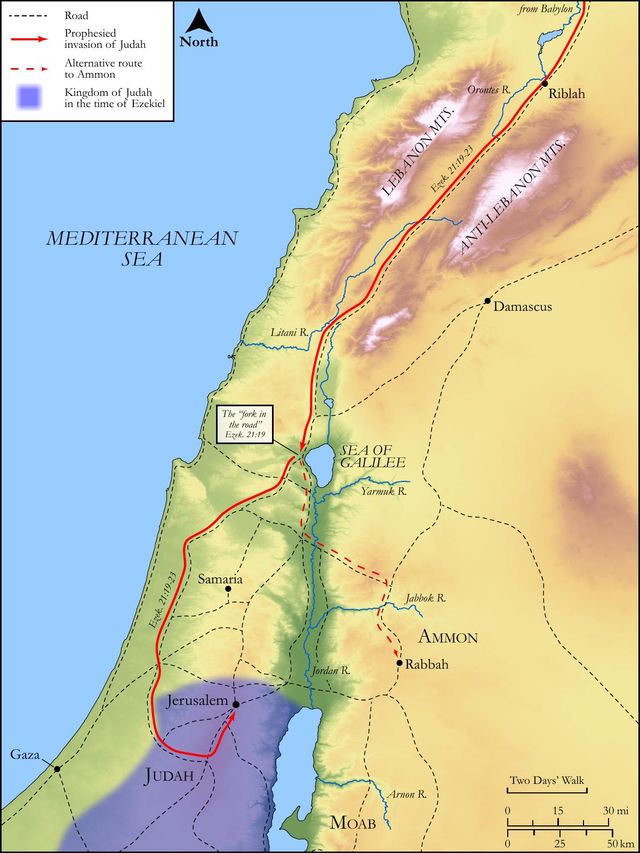
The Ammonites were a Semitic people, descendants of Ben-Ammi, Lot's son, as recorded in Genesis 19:38, who inhabited the land east of the Jordan River. They were perennial adversaries of Israel, frequently engaging in conflict and exhibiting deep-seated hostility, as evidenced in Judges 10:6-9. During the Babylonian invasions of Judah, the Ammonites, rather than showing solidarity, rejoiced at Jerusalem's downfall and even participated in the plundering, believing their own nation was secure. Their capital, Rabbah (modern Amman), was a significant regional center. The imagery of "brutish men" and "skilful to destroy" likely refers to the Babylonian forces under Nebuchadnezzar, who, though acting out of their own imperial ambitions, were unknowingly serving as God's instruments of judgment against both Judah and surrounding nations like Ammon.
Key Themes
ShowHideThis verse powerfully contributes to several overarching themes in Ezekiel and the broader prophetic literature. Foremost is the theme of Divine Sovereignty, demonstrating that God is the ultimate ruler over all nations and their destinies. Even the actions of hostile empires like Babylon are orchestrated by Him to fulfill His purposes, as seen in passages like Isaiah 10:5-7. Another prominent theme is God's Righteous Judgment and Wrath. The language of "indignation" and "fire of my wrath" underscores that God's anger is not arbitrary but a just response to sin, rebellion, and the malicious gloating of the Ammonites over His chosen people. Finally, the verse highlights the Consequences of Persistent Rebellion. The Ammonites' unrepentant hostility and idolatry lead to their inevitable destruction, serving as a stark warning that God's patience has limits and His justice will ultimately prevail against all who oppose Him.
Exposition and Analysis
ShowHideKey Word Analysis
ShowHideThis term (H2195) signifies a strong, vehement displeasure or fury, specifically associated with God's righteous anger against sin. It implies a deep, moral outrage and a just wrath, not a capricious outburst. In this context, it signifies the profound displeasure God feels towards the Ammonites' persistent rebellion and their malicious joy over Judah's destruction.
Derived from H1197, this word describes those who are senseless, ignorant, or animal-like in their understanding and behavior. It suggests a lack of moral discernment, restraint, or compassion. When applied to the "men" God uses, it emphasizes their ruthless, unthinking, and destructive nature, making them perfectly suited as instruments of severe judgment.
This word (H2796) refers to a fabricator or artificer, someone adept or proficient in a craft. Here, it implies that the "men" are not merely destructive but are highly effective and competent in their work of ruin. They are not haphazard in their violence but possess a deadly proficiency "to destroy," fulfilling God's specific purpose of devastation.
Verse Breakdown
ShowHide"And I will pour out mine indignation upon thee"
This clause reveals God's active and direct involvement in the judgment. The imagery of "pouring out" (H8210, shâphak') suggests an abundant, unrestrained, and unavoidable outpouring of His intense, righteous wrath (H2195, zaʻam'), specifically directed at the Ammonites. It signifies a complete and overwhelming release of divine displeasure.
"I will blow against thee in the fire of my wrath"
This powerful metaphor intensifies the previous statement. "Blow" (H6315, pûwach') combined with "fire" (H784, ʼêsh') and "wrath" (H5678, ʻebrâh') depicts God's judgment as an all-consuming, unquenchable inferno. It evokes the image of a furnace or forge, where intense heat purifies or utterly consumes, emphasizing the destructive and purifying nature of God's judgment.
"and deliver thee into the hand of brutish men"
Here, God declares His sovereign act of "delivering" (H5414, nâthan') or handing over the Ammonites. The phrase "into the hand" (H3027, yâd') signifies being placed under the power and control of another. The instruments of this judgment are described as "brutish men" (H1197, bâʻar' and H582, ʼĕnôwsh'), emphasizing their lack of reason, compassion, and their animalistic ferocity in executing destruction.
"[and] skilful to destroy"
This final phrase elaborates on the nature of these "brutish men." They are not merely destructive but are "skilful" (H2796, chârâsh') and proficient in their capacity "to destroy" (H4889, mashchîyth'). This highlights their effectiveness and the thoroughness with which they will execute God's judgment, ensuring complete ruin for the Ammonites.
Literary Devices
ShowHideEzekiel 21:31 is rich in Anthropomorphism, attributing human actions and emotions to God. Phrases like "I will pour out" and "I will blow against thee" vividly portray God as an active agent in judgment, making His wrath tangible and immediate. The verse also employs potent Imagery and Metaphor, most notably "the fire of my wrath." This metaphor depicts divine judgment not as a distant decree but as an intense, consuming, and purifying blaze, akin to a furnace that utterly destroys what is cast into it. The description of the instruments of judgment as "brutish men, and skilful to destroy" uses Personification and Hyperbole to emphasize their ruthless efficiency and the comprehensive nature of the impending devastation. The overall tone is one of stark Divine Declaration, leaving no doubt about the source and certainty of the judgment.
Theological and Thematic Connections
ShowHideThis verse profoundly underscores the biblical truth of God's righteous character, which encompasses both boundless love and unyielding justice. While God is "slow to anger and abounding in steadfast love" (Psalm 145:8), He is also a God who will not tolerate unrepentant sin indefinitely. His "indignation" and "wrath" are not capricious outbursts but a holy response to persistent rebellion, idolatry, and hostility against His people and His moral order. The fact that God "delivers" the Ammonites into the hands of "brutish men, and skilful to destroy" demonstrates His absolute sovereignty over all nations and even over the wicked actions of humanity. He uses even those who are morally corrupt to achieve His divine purposes, ensuring that justice is ultimately served and His name is glorified. This serves as a sobering reminder that all nations are accountable to the Creator and that defiance of His will carries severe consequences.
Reflection and Application
ShowHideEzekiel 21:31, though a prophecy of ancient judgment, offers timeless truths for reflection and application today. It calls us to a profound reverence for God's holiness and justice, reminding us that His character is not solely defined by love and mercy, but also by righteous indignation against sin. This understanding should cultivate a healthy fear of the Lord, prompting us to examine our own lives for areas of unrepentant rebellion or hostility towards God's ways. Furthermore, the verse highlights God's ultimate sovereignty, even in the midst of chaos and destruction. It assures us that no event, no matter how brutal or senseless it may seem from a human perspective, falls outside of God's overarching plan. This can bring comfort in turbulent times, knowing that God remains on His throne, orchestrating even the actions of "brutish men" to fulfill His purposes. Ultimately, this passage serves as a powerful call to repentance, urging us to turn from our sin and seek the abundant mercy and grace that God freely offers.
Questions for Reflection
ShowHideFAQ
ShowHideWho are the "brutish men, and skilful to destroy" mentioned in this verse?
ShowHideWhile the verse doesn't explicitly name them, the most likely historical candidates are the Babylonian forces under King Nebuchadnezzar. Throughout the book of Ezekiel and other prophetic books, God consistently uses powerful empires like Babylon as His instruments to execute judgment on nations, including Judah and its neighbors. These forces were indeed "brutish" in their methods, known for their ruthlessness and lack of compassion, and "skilful to destroy" given their military prowess and effectiveness in conquering and devastating cities and lands, as seen in their siege of Jerusalem described in 2 Kings 25.
Is God's wrath arbitrary or unjust?
ShowHideAbsolutely not. The Bible consistently portrays God's wrath as a righteous and holy response to sin, rebellion, and ungodliness, never as an arbitrary outburst. In the context of Ezekiel 21, God's indignation is directed at the Ammonites for their persistent hostility towards His people and their gloating over Jerusalem's destruction. This wrath is a manifestation of His perfect justice, ensuring that sin does not go unpunished and that His moral order is upheld. It is a just consequence for unrepentant evil, as indicated in passages like Romans 2:5-6.
How can a God of love also be a God of such fierce wrath?
ShowHideThe Bible presents God as perfectly holy, just, and loving. These attributes are not contradictory but complementary. God's love is demonstrated in His patience and His desire for all to repent and live, as stated in Ezekiel 33:11. However, His holiness demands that sin be addressed. His wrath is the active expression of His opposition to all that is unholy and unrighteous. It is because He is perfectly loving that He must also be perfectly just, and therefore, His wrath is directed at anything that harms His creation or defies His perfect will. The ultimate demonstration of both His love and His justice is found in the cross of Christ, where His wrath against sin was poured out on His Son, making a way for humanity to receive His love and mercy.
Christ-Centered Fulfillment
ShowHideEzekiel 21:31, with its stark imagery of divine indignation and consuming wrath, finds its ultimate and most profound fulfillment in the person and work of Jesus Christ. The "fire of my wrath" that God promised to pour out upon rebellious nations was, in an ultimate sense, poured out upon His own Son on the cross. Jesus, the innocent Lamb of God who takes away the sin of the world, bore the full weight of God's righteous indignation against humanity's sin, becoming a curse for us, as Galatians 3:13 declares. Through His atoning sacrifice, Christ absorbed the judgment that we, like the Ammonites in our rebellion, justly deserved, thereby offering an escape from the "hand of brutish men" – the spiritual forces of destruction and the ultimate judgment of God. His resurrection demonstrates His triumph over these destructive powers, as celebrated in Colossians 2:15. For those who believe in Him, the wrath of God has been appeased, and they are reconciled to God, no longer facing the terrifying prospect of divine judgment but rather receiving eternal life and peace, according to Romans 5:9-10. Thus, Ezekiel 21:31, while a terrifying prophecy of judgment, ultimately points to the glorious provision of salvation found in Christ, who perfectly fulfilled the demands of God's justice and opened the way for mercy.