


2 Kings 22:3
- וַיְהִיvay·Hiand it wasH1961Conj-w ¦ V-Qal-ConsecImperf-3msVerb Qal Consecutive Imperfect 3rd Singular Masculineוַandיְהִיit was
- בִּשְׁמֹנֶהbish·mo·Nehin eight-H8083Prep-b ¦ N-csNoun Singular common gender Absoluteבִּinשְׁמֹנֶהeight-
- עֶשְׂרֵה'es·RehteenH6240N-csNoun Singular common gender Absolute
- שָׁנָהsha·NahyearH8141N-fsNoun Singular Feminine Absolute
- לַמֶּלֶךְla·Me·lekhof the kingH4428Prep-l ¦ N-msNoun Singular Masculine Absoluteלַof theמֶּלֶךְking
- יֹאשִׁיָּהוּyo·shi·Ya·huJosiahH2977N-proper-mNoun Proper Masculine
- שָׁלַחsha·Lachhe sentH7971V-Qal-Perf-3msVerb Qal Perfect 3rd Singular Masculine
- הַמֶּלֶךְHa·Me·lekhthe kingH4428Art ¦ N-msNoun Singular Masculine Absoluteהַtheמֶּלֶךְking
- אֶת'et<obj.>H853DirObjMParticle Object Indicator
- שָׁפָןsha·FanShaphanH8227N-proper-mNoun Proper Masculine
- בֶּןben[the] son ofH1121N-mscNoun Singular Masculine Construct
- אֲצַלְיָהוּ'a·tzal·Ya·huAzaliahH683N-proper-mNoun Proper Masculine
- בֶןven[the] son ofH1121N-mscNoun Singular Masculine Construct
- מְשֻׁלָּםme·shu·LamMeshullamH4918N-proper-mNoun Proper Masculine
- הַסֹּפֵרha·so·Ferthe scribeH5608Art ¦ N-msNoun Singular Masculine Absoluteהַtheסֹּפֵרscribe
- בֵּיתbeit[the] house ofH1004N-mscNoun Singular Masculine Construct
- יְהוָהYah·wehYahwehH3068N-properNoun Proper Title
- לֵאמֹרle·Mor<to> sayingH559Prep-l ¦ V-Qal-InfVerb Qal Infinitive Constructלֵ<to>אמֹרsaying
English is a literal word-by-word gloss of the Hebrew, not the KJV's wording. Why?
This is the original text the KJV's translators worked from — each Hebrew word with its own literal English meaning in this verse, prepared by scholars at Tyndale House, Cambridge. The KJV translates whole sentences, not word by word, so its wording differs: one Hebrew word can become several English words, and the KJV may choose “the LORD” where the gloss reads “Yahweh”. Both are faithful — they answer different questions. For the KJV's own rendering, switch to the KJV text.
Details
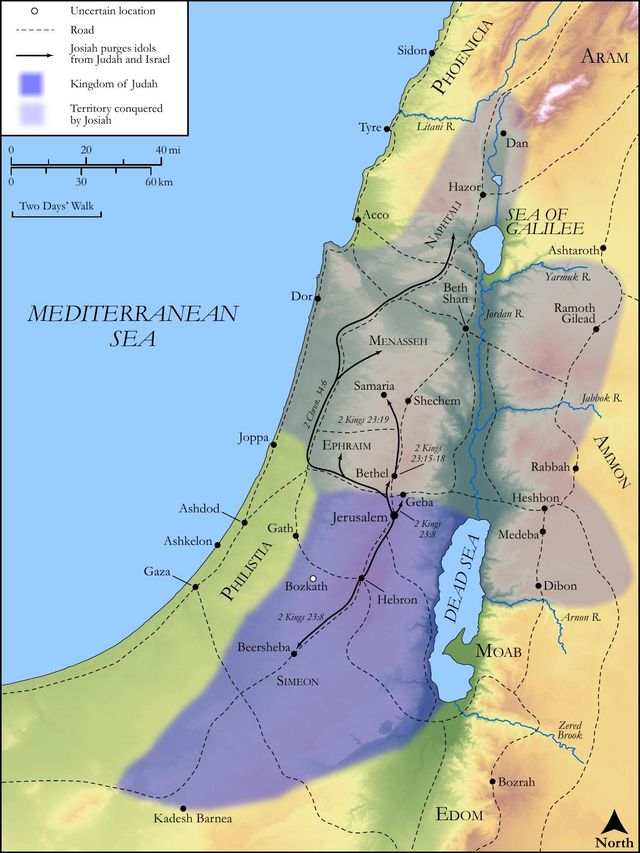
See on the biblical-era map
Study this verse
Public-domain commentary
Matthew Henry
From his Commentary on the Whole Bible. Henry comments on passages, not single verses — this entry covers 2 Kings 22:1–10. His two-level outline is real structure in the source text, so it is rendered as structure.
Concerning Josiah we are here told,
I.That he was very young when he began to reign (Kg2 22:1), only eight years old.
Solomon says, Woe unto thee, O land! when thy king is a child; but happy art thou, O land! when thy king is such a child. Our English Israel had once a king that was such a child, Edward VI. Josiah, being young, had not received any bad impressions from the example of his father and grandfather, but soon saw their errors, and God gave his grace to take warning by them. See Eze 18:14, etc.
II.That he did that which was right in the sight of the Lord, Kg2 22:2.
See the sovereignty of divine grace - the father passed by and left to perish in his sin, the son a chosen vessel. See the triumphs of that grace - Josiah born of a wicked father, no good education nor good example given him, but many about him who no doubt advised him to tread in his father's steps and few that gave him any good counsel, and yet the grace of God made him an eminent saint, cut him off from the wild olive and grafted him into the good olive, Rom 11:24. Nothing is too hard for that grace to do. He walked in a good way, and turned not aside (as some of his predecessors had done who began well) to the right hand nor to the left. There are errors on both hands, but God kept him in the right way; he fell neither into superstition nor profaneness.
III.That he took care for the repair of the temple.
This he did in the eighteenth year of his reign, Kg2 22:3. Compare Ch2 34:8. He began much sooner to seek the Lord (as appears, Ch2 34:3), but it is to be feared the work of reformation went slowly on and met with much opposition, so that he could not effect what he desired and designed, till his power was thoroughly confirmed. The consideration of the time we unavoidably lost in our minority should quicken us, when we have come to years, to act with so much the more vigour in the service of God. Having begun late we have need work hard. He sent Shaphan, the secretary of state, to Hilkiah the high priest, to take an account of the money that was collected for this use by the door-keepers (Kg2 22:4); for, it seems, they took much the same way of raising the money that Joash took, Kg2 12:9. When people gave by a little at a time the burden was insensible, and, the contribution being voluntary, it was not complained of. This money, so collected, he ordered him to lay out for the repair of the temple, Kg2 22:5, Kg2 22:6. And now, it seems, the workmen (as in the days of Joash) acquitted themselves so well that there was no reckoning made with them (Kg2 22:7), which is certainly mentioned to the praise of the workmen, that they gained such a reputation for honesty, but whether to the praise of those that employed them I know not; a man should count money (we say) after his own father; it would not have been amiss to have reckoned with the workmen, that others also might be satisfied of their honesty.
IV.That, in repairing the temple, the book of the law was happily found and brought to the king, Kg2 22:8, Kg2 22:10.
Some think this book was the autograph, or original manuscript, of the five books of Moses, under his own hand; others think it was only an ancient and authentic copy. Most likely it was that which, by the command of Moses, was laid up in the most holy place, Deu 31:24, etc.
1.It seems, this book of the law was lost or missing. Perhaps it was carelessly mislaid and neglected, thrown by into a corner (as some throw their Bibles), by those that knew not the value of it, and forgotten there; or it was maliciously concealed by some of the idolatrous kings, or their agents, who were restrained by the providence of God or their own consciences from burning and destroying it, but buried it, in hopes it would never see the light again; or, as some think, it was carefully laid up by some of its friends, lest it should fall into the hands of its enemies. Whoever were the instruments of its preservation, we ought to acknowledge the hand of God in it. If this was the only authentic copy of the Pentateuch then in being, which had (as I may say) so narrow a turn for its life and was so near perishing, I wonder the hearts of all good people did not tremble for that sacred treasure, as Eli's for the ark, and I am sure we now have reason to thank God, upon our knees, for that happy providence by which Hilkiah found this book at this time, found it when he sought it not, Isa 65:1. If the holy scriptures had not been of God, they would not have been in being at this day; God's care of the Bible is a plain indication of his interest in it.
2.Whether this was the only authentic copy in being or no, it seems the things contained in it were new both to the king himself and to the high priest; for the king, upon the reading of it, rent his clothes. We have reason to think that neither the command for the king's writing a copy of the law, nor that for the public reading of the law every seventh year (Deu 17:18; Deu 31:10, Deu 31:11), had been observed for a long time; and when the instituted means of keeping up religion are neglected religion itself will soon go to decay. Yet, on the other hand, if the book of the law was lost, it seems difficult to determine what rule Josiah went by in doing that which was right in the sight of the Lord, and how the priests and people kept up the rites of their religion. I am apt to think that the people generally took up with abstracts of the law, like our abridgements of the statutes, which the priests, to save themselves the trouble of writing and the people of reading the book at large, had furnished them with - a sort of ritual, directing them in the observances of their religion, but leaving out what they thought fit, and particularly the promises and threatenings (Lev. 26 and Deu. 28, etc.), for I observe that these were the portions of the law which Josiah was so much affected with (Kg2 22:13), for these were new to him. No summaries, extracts, or collections, out of the Bible (though they may have their use) can be effectual to convey and preserve the knowledge of God and his will like the Bible itself. It was no marvel that the people were so corrupt when the book of the law was such a scarce thing among them; where that vision is not the people perish. Those that endeavoured to debauch them no doubt used all the arts they could to get that book out of their hands. The church of Rome could not keep up the use of images but by forbidding the use of the scripture.
3.It was a great instance of God's favour, and a token for good to Josiah and his people, that the book of the law was thus seasonably brought to light, to direct and quicken that blessed reformation which Josiah had begun. It is a sign that God has mercy in store for a people when he magnifies his law among them and makes that honourable, and furnishes them with means for the increase of scripture-knowledge. The translating of the scriptures into vulgar tongues was the glory, strength, and joy of the Reformation from Popery. It is observable that they were about a good work, repairing the temple, when they found the book of the law. Those that do their duty according to their knowledge shall have their knowledge increased. To him that hath shall be given. The book of the law was an abundant recompence for all their care and cost about the repair of the temple.
4.Hilkiah the priest was exceedingly well pleased with the discovery. "O," says he to Shaphan, "rejoice with me, for I have found the book of the law, heurēka, heurēka, - I have found, I have found, that jewel of inestimable value. Here, carry it to the king; it is the richest jewel of his crown. Read it before him. He walks in the way of David his father, and, if he be like him, he will love the book of the law and bid that welcome; that will be his delight and his counsellor."
Historical interpretation
Historical reception
1 surviving comment on this verse from the historical church.
“Josiah was eight years old when he began to reign; and he did what was right in the sight of the Lord” for the thirty-one years in which he reigned. In the eighteenth year from the beginning of his rule, he began to purify Judah and the inhabitants of Jerusalem. In fact, he removed the foreign religions introduced by Manasseh and overturned the sanctuaries and altars. In the same eighteenth year he ordered an expiation of the temple and commanded the priests to make repairs. He brought in workers, gathered stones, materials and other things useful to building and supplied the money for the expected expenses, and in this case he religiously emulated the pious zeal of his great-grandfather Jehoash. And at that time the refurbishment of the temple was not less necessary than it had been before, because for the fifty years in which Manasseh had reigned, it had been neglected or given to profane uses.
Continue studying 2 Kings 22:3 across the web’s major study libraries — every link below opens this exact verse, chapter, or book on the destination site.
Read & Compare
 BibleGatewayThis verse in more than 200 translations and 70 languages.
 Bible.comThe YouVersion reader — hundreds of translations, reading plans, and highlights.
 ESV.orgCrossway's official English Standard Version reader.
 NET BibleThe NET translation with 60,000+ translators' notes on every rendering decision.
 STEP BibleTyndale House's free study tool — original text, vocabulary, and scholarly resources.
 BibliaLogos Bible Software's free web reader.
 USCCBThe New American Bible (Revised Edition) with the U.S. bishops' study notes.
Commentaries
 BibleHub CommentariesDozens of classic commentaries on this verse, gathered on one page.
 StudyLightMore than 100 commentary sets — the largest collection on the web.
 BibleRefPlain-English commentary on what this verse means, verse by verse.
 Enduring WordDavid Guzik's free commentary on this chapter, widely used by Bible teachers.
 Bible Study ToolsVerse commentary alongside Greek and Hebrew study aids.
Original Language & Research
- BibleHub InterlinearThe verse word by word — original language, transliteration, and English.
- BibleHub LexiconEvery word's original-language definition and Strong's entry.
 Blue Letter BibleDeep-study tools — Strong's numbers, concordance, and word studies.
 SefariaThe Hebrew text with Rashi and centuries of Jewish commentary.
Sermons, Hymns & Audio


TrulyRandomVerse is not affiliated with these sites and doesn’t control their content. They’re linked because they’re genuinely useful.
Summary
In the eighteenth year of King Josiah's reign, a pivotal moment in Judah's spiritual history unfolds as the righteous monarch dispatches Shaphan, his trusted royal scribe, to the Temple, also known as "the house of the LORD." This seemingly administrative directive to initiate repairs on the long-neglected sacred edifice sets in motion a chain of events that would lead to the rediscovery of the Book of the Law and ignite one of the most significant spiritual revivals in the Southern Kingdom, marking a decisive turning point in the nation's relationship with Yahweh.
Context
ShowHideLiterary Context
This verse immediately follows the introduction of King Josiah, establishing his unique righteousness among the kings of Judah. 2 Kings 22:1-2 sets the stage by affirming that he "did what was right in the eyes of the LORD and walked in all the ways of David his father, and did not turn aside to the right or to the left." Verse 3 then transitions from his character to his decisive actions, specifically detailing the first major initiative of his eighteenth year. This act of sending Shaphan to the Temple is the direct precursor to the monumental discovery of the Book of the Law by Hilkiah the high priest, as narrated in 2 Kings 22:8, which subsequently triggers the profound national repentance, covenant renewal, and extensive reforms described in the remainder of the chapter and throughout 2 Kings 23. The initial command to repair the Temple, therefore, serves as the narrative catalyst for the entire reformation, demonstrating how a seemingly administrative task can open the door to divine revelation and national transformation.
Historical & Cultural Context
Josiah's reign (640-609 BC) occurred during a period of significant geopolitical flux, as the dominant Assyrian Empire was in decline, providing smaller nations like Judah a window of opportunity for greater autonomy and internal reform. Judah had suffered under decades of intense idolatry and spiritual apostasy, particularly during the lengthy reign of Josiah's grandfather, Manasseh (2 Kings 21:1-18), and the brief, wicked reign of his father, Amon (2 Kings 21:19-26). The Temple, once the glorious center of Israelite worship, had fallen into severe disrepair and likely desecration, reflecting the nation's profound spiritual decay. Josiah, who began his reign at age eight, had already initiated religious reforms earlier (at age 12 and 20, as detailed in 2 Chronicles 34:3-7), but the actions in his eighteenth year represent a more comprehensive, official, and state-sponsored effort to purify and restore the national worship. The role of the "scribe" (Hebrew sopher) like Shaphan was crucial in ancient Near Eastern courts, serving as a high-ranking royal official responsible for administration, record-keeping, and communication, underscoring the official and serious nature of the king's command.
Key Themes
ShowHideThis verse introduces and reinforces several key themes prevalent in the Books of Kings and the broader Deuteronomistic History. Firstly, it powerfully highlights Righteous Leadership, showcasing Josiah as a king who actively seeks to honor God and reverse generations of spiritual decline, setting a stark contrast to many of his predecessors. His proactive decision to repair the Temple demonstrates a profound commitment to restoring proper worship and the physical dwelling place of God, underscoring the theme of Care for God's House. The dilapidated state of the Temple itself functions as a potent Symbol of Spiritual Neglect, while Josiah's initiative to repair it symbolizes a renewed commitment to the covenant and a desire for national spiritual restoration. Most significantly, this seemingly mundane administrative act serves as a Preparation for Revival. The sending of Shaphan to the Temple for repairs directly leads to the discovery of the Book of the Law (2 Kings 22:8), which becomes the catalytic event for a profound national repentance and covenant renewal, demonstrating God's sovereign hand in using ordinary actions to bring about extraordinary spiritual transformation.
Exposition and Analysis
ShowHideKey Word Analysis
ShowHideThis word signifies a revolution of time, a complete cycle of seasons. Its use here, in conjunction with "eighteenth," precisely dates the commencement of Josiah's most significant reforms. The specific mention of the "eighteenth year" is not merely chronological but highlights a mature and decisive phase of Josiah's reign, indicating a deliberate, comprehensive, and state-sponsored effort at religious renewal, distinct from earlier, more personal reforms.
While the name literally means "rock badger" or "hyrax," in this context, Shaphan is identified as "the son of Azaliah, the son of Meshullam," establishing his prominent lineage and position within the royal court. As a trusted and high-ranking official, King Josiah's choice of Shaphan for this sensitive mission to the Temple underscores his reliability, administrative competence, and the official nature of the king's command. His integrity would prove crucial in the subsequent events.
In ancient Israel, a "scribe" (sopher) was far more than a mere copyist. This was a highly educated and influential official, often serving as a royal secretary, treasurer, or even a legal expert and advisor to the king. Shaphan's designation as "the scribe" emphasizes the authoritative, administrative, and formal nature of Josiah's decree concerning the Temple repairs. His role was central to the king's administration, making him the ideal person to oversee such a vital national initiative.
Verse Breakdown
ShowHide"And it came to pass in the eighteenth year of king Josiah,"
This introductory phrase meticulously sets the precise chronological context for the monumental events that are about to unfold. The "eighteenth year" is not an arbitrary detail; it signifies a mature phase of Josiah's reign, when he was approximately 26 years old, old enough to take decisive action after years of personal spiritual growth and earlier, more localized reforms. It marks the commencement of the most significant and comprehensive phase of his national reformation efforts.
"that the king sent Shaphan the son of Azaliah, the son of Meshullam, the scribe,"
This clause identifies the specific agent of the king's will and highlights the official nature of the mission. King Josiah, exercising his royal authority, dispatches a named individual—Shaphan—who is further identified by his distinguished lineage and, crucially, by his esteemed office as "the scribe." This detail underscores the formality and deliberate intent behind the mission, emphasizing that it was a formal royal directive carried out by a trusted and high-ranking administrator.
"to the house of the LORD, saying,"
This final clause specifies both the destination and the immediate purpose of Shaphan's mission. "The house of the LORD" refers to the Temple in Jerusalem, the central sanctuary for the worship of Yahweh, which had fallen into great disrepair. The concluding phrase "saying" indicates that Shaphan was sent with a specific message or detailed instructions, which are then elaborated upon in the subsequent verses (2 Kings 22:4-7), detailing the collection of funds and the commencement of repair work. This seemingly simple act of sending a messenger to the Temple is the initial, divinely orchestrated step in a sequence of events that would lead to profound national spiritual renewal.
Literary Devices
ShowHideThe verse primarily employs Narrative Pacing and Foreshadowing. The deliberate and somewhat formal introduction of Josiah's "eighteenth year" and the detailed identification of Shaphan and his lineage contribute to a slow, measured narrative pacing, building anticipation for the significant events that are about to unfold. This measured pace emphasizes the weight and importance of the king's command, signaling that this is no ordinary administrative task. More importantly, the verse functions as a powerful instance of Foreshadowing. While it merely describes the dispatch of a scribe for Temple repairs, the reader familiar with the subsequent narrative knows that this seemingly administrative act is the direct catalyst for the discovery of the Book of the Law (2 Kings 22:8), leading to the great national revival. The mundane act of sending a messenger subtly hints at the monumental spiritual transformation that will follow, demonstrating God's ability to work through ordinary means to achieve extraordinary ends. Additionally, the implied dilapidated state of the Temple functions as Symbolism, representing the spiritual decay of Judah, and Josiah's initiative to repair it symbolizes his righteous desire for national spiritual restoration.
Theological and Thematic Connections
ShowHideThis verse, though brief, is pregnant with theological significance, underscoring the importance of righteous leadership in fostering national spiritual health and the divine orchestration of events. Josiah's initiative to repair the Temple demonstrates a profound understanding of the sacredness of God's dwelling place and the necessity of maintaining proper worship. It highlights that true spiritual revival often begins with practical acts of obedience and a renewed focus on God's presence and commands. The subsequent discovery of the Book of the Law during these repairs is not a mere coincidence but a testament to God's providence, revealing His word to a people who had long neglected it. This narrative reminds us that God often works through the faithfulness of His servants, even in seemingly administrative tasks, to bring about His greater purposes of restoration and covenant renewal.
Reflection and Application
ShowHideThe account of Josiah sending Shaphan to the Temple serves as a powerful reminder that genuine spiritual renewal often begins with a proactive, intentional commitment to God's priorities, even in seemingly mundane tasks. Josiah's action was not a spontaneous whim but a deliberate step rooted in his righteous character and profound desire to honor God. For us today, this translates into a call to examine our "temples" – our local church communities, our homes, and our individual lives as temples of the Holy Spirit (1 Corinthians 6:19-20). Are there areas of neglect, disrepair, or spiritual apathy that need attention and proactive care? Just as Josiah initiated physical repairs, we are called to address spiritual and relational "repairs" through sincere repentance, genuine reconciliation, and a renewed dedication to God's word and His purposes. Furthermore, Shaphan's faithful service, though not the central figure of the revival, was instrumental in facilitating its commencement. This reminds us that every act of obedience, no matter how small or administrative, can be a vital link in God's grand plan, contributing significantly to a larger work of spiritual awakening and transformation in our communities and beyond.
Questions for Reflection
ShowHideFAQ
ShowHideWhy is the "eighteenth year" of Josiah's reign specifically mentioned?
ShowHideThe mention of the "eighteenth year" is significant for several reasons. Chronologically, it indicates Josiah was approximately 26 years old, having begun his reign at age eight (2 Kings 22:1). While he had initiated some reforms earlier in his reign (at age 12 and 20, according to 2 Chronicles 34:3-7), the eighteenth year marks a more mature, comprehensive, and official state-sponsored effort at religious renewal. It signifies a decisive turning point where the king, now a seasoned ruler, commits the full weight of his royal authority to a national reformation, setting the stage for the rediscovery of the Book of the Law (2 Kings 22:8) and the subsequent widespread covenant renewal.
Who was Shaphan, and why was he chosen for this mission?
ShowHideShaphan was a highly trusted and influential royal scribe, a high-ranking official in King Josiah's administration. His full title, "Shaphan the son of Azaliah, the son of Meshullam," indicates his prominent lineage and established position. As a scribe (sopher), he was not merely a copyist but a key administrator, likely involved in royal correspondence, records, and even advising the king. He was chosen for this mission to the Temple due to his position of trust, his administrative competence, and his ability to accurately convey the king's instructions to Hilkiah the high priest. His involvement underscores the official and serious nature of Josiah's command to initiate Temple repairs, which would ultimately lead to the momentous discovery of the Book of the Law (2 Kings 22:8).
Christ-Centered Fulfillment
ShowHideThe seemingly administrative act of King Josiah sending Shaphan to repair the dilapidated Temple in 2 Kings 22:3 finds its ultimate Christ-centered fulfillment in several profound ways. The physical Temple in Jerusalem was the dwelling place of God among His people, a type and shadow of God's desire to dwell with humanity. Yet, like the Temple in Josiah's day, humanity had become dilapidated and defiled by sin, unable to truly host the divine presence. Jesus Christ is the true and ultimate Temple, the very embodiment of God dwelling among us, as declared in John 1:14 ("the Word became flesh and dwelt among us"). He is the one who came not merely to repair a physical structure but to restore the broken relationship between God and humanity, cleansing the true "house of the LORD" through His perfect life, atoning death, and resurrection. Just as the Temple repair led to the rediscovery of the Law and a national revival, Christ's work leads to the full revelation of God's truth and the spiritual renewal of all who believe, making them living temples of the Holy Spirit (1 Corinthians 6:19). He is the greater Josiah, the righteous King who initiates the ultimate restoration, not just of a building, but of the very hearts and lives of His people, ushering in an eternal covenant of grace and establishing a spiritual kingdom where God truly dwells among His redeemed.