


1 Kings 16:32
Bible text: King James Version (1769 Blayney text) · Public domain
Bible text: Berean Standard Bible · Public domain
Bible text: American Standard Version (1901) · Public domain
Bible text: World English Bible, Messianic edition · Public domain
Bible text: Geneva Bible (1599) · Public domain
Bible text: Young's Literal Translation · Public domain
- וַיָּקֶםvai·Ya·kemand he set upH6965Conj-w ¦ V-Hiphil-ConsecImperf-3msVerb Hiphil Consecutive Imperfect 3rd Singular Masculineוַandיָּקֶםhe set up
- מִזְבֵּחַmiz·Be·achan altarH4196N-msNoun Singular Masculine Absolute
- לַבָּעַלla·Ba·'alto <the> BaalH1168Prep-l ¦ N-msNoun Title Singular Masculine Absoluteלַto <the>בָּעַלBaal
- בֵּיתbeit[the] house ofH1004N-mscNoun Singular Masculine Construct
- הַבַּעַלha·Ba·'al<the> BaalH1168Art ¦ N-msNoun Title Singular Masculine Absoluteהַ<the>בַּעַלBaal
- אֲשֶׁר'a·SherwhichH834RelParticle Relative
- בָּנָהba·Nahhe builtH1129V-Qal-Perf-3msVerb Qal Perfect 3rd Singular Masculine
- בְּשֹׁמְרוֹןbe·sho·me·Ronin SamariaH8111Prep-b ¦ N-properNoun Proper LocationבְּinשֹׁמְרוֹןSamaria
English is a literal word-by-word gloss of the Hebrew, not the KJV's wording. Why?
This is the original text the KJV's translators worked from — each Hebrew word with its own literal English meaning in this verse, prepared by scholars at Tyndale House, Cambridge. The KJV translates whole sentences, not word by word, so its wording differs: one Hebrew word can become several English words, and the KJV may choose “the LORD” where the gloss reads “Yahweh”. Both are faithful — they answer different questions. For the KJV's own rendering, switch to the KJV text.
Details
See on the biblical-era maps
Study this verse
Public-domain commentary
Matthew Henry
From his Commentary on the Whole Bible. Henry comments on passages, not single verses — this entry covers 1 Kings 16:29–34. His two-level outline is real structure in the source text, so it is rendered as structure.
We have here the beginning of the reign of Ahab, of whom we have more particulars recorded than of any of the kings of Israel. We have here only a general idea given us of him, as the worst of all the kings, that we may expect what the particulars will be. He reigned twenty-two years, long enough to do a great deal of mischief.
I.He exceeded all his predecessors in wickedness, did evil above all that were before him (Kg1 16:30), and, as if it were done with a particular enmity both to God and Israel, to affront him and ruin them, it is said, He did more purposely to provoke the Lord God of Israel to anger, and, consequently, to send judgments on his land, than all the kings of Israel that were before him, Kg1 16:33. It was bad with the people when every successive king was worse than his predecessor. What would they come to at last? He had seen the ruin of other wicked kings and their families; yet, instead of taking warning, his heart was hardened and enraged against God by it. He thought it a light thing to walk in the sins of Jeroboam, Kg1 16:31. It was nothing to break the second commandment by image-worship, he would set aside the first also by introducing other gods; his little finger should fall heavier upon God's ordinances than Jeroboam's loins. Making light of less sins makes way for greater, and those that endeavour to extenuate other people's sins will but aggravate their own.
II.He married a wicked woman, who he knew would bring in the worship of Baal, and seemed to marry her with that design.
As if it had been a light thing to walk in the sins of Jeroboam, he took to wife Jezebel (Kg1 16:31), a zealous idolater, extremely imperious and malicious in her natural temper, addicted to witchcrafts and whoredoms (Kg2 9:22), and every way vicious. The false prophetess spoken of Rev 2:20 is there called Jezebel, for a wicked woman could not be called by a worse name than hers; what mischiefs she did, and what mischief at last befel her (Kg2 9:33), we shall find in the following story; this one strange wife debauched Israel more than all the strange wives of Solomon.
III.He set up the worship of Baal, forsook the God of Israel and served the god of the Sidonians, Jupiter instead of Jehovah, the sun (so some think), a deified hero of the Phoenicians (so others): he was weary of the golden calves, and thought they had been worshipped long enough; such vanities were they that those who had been fondest of them at length grew sick of them, and, like adulterers, much have variety. In honour of this mock deity, whom they called Baal - lord, and for the convenience of his worship,
1.Ahab built a temple in Samaria, the royal city, because the temple of God was in Jerusalem, the royal city of the other kingdom. He would have Baal's temple near him, that he might the better frequent it, protect it, and put honour upon it.
2.He reared an altar in that temple, on which to offer sacrifice to Baal, by which they acknowledged their dependence upon him and sought his favour. O the stupidity of idolaters, who are at a great expense to make one their friend whom they might have chosen whether they would make a god of or no!
3.He made a grove about his temple, either a natural one, by planting shady trees there, or, if those would be too long in growing, an artificial one in imitation of it; for it is not said he planted, but he made a grove, something that answered the intention, which was to conceal and so countenance the abominable impurities that were committed in the filthy worship of Baal. Lucus, lucendo, quia non lucet - He that doeth evil hateth the light.
IV.One of his subjects, in imitation of his presumption, ventured to build Jericho, in defiance of the curse Joshua had long since pronounced on him that should attempt it, Kg1 16:34. It comes in as an instance of the height of impiety to which men had arrived, especially at Bethel, where one of the calves was, for of that city this daring sinner was. Observe,
1.How ill he did. Like Achan he meddled with the accursed thing, turned that to his own use which was devoted to God's honour. He began to build, in defiance of the curse well known in Israel, jesting with it perhaps as a bugbear, or fancying its force worn out by length of time, for it was above 500 years since it was pronounced, Jos 6:26. He went on to build, in defiance of the execution of the curse in part; for, though his eldest son died when he began, yet he would proceed in contempt of God and his wrath revealed from heaven against his ungodliness.
2.How ill he sped. He built for his children, but God wrote him childless; his eldest son died when he began, the youngest when he finished, and all the rest (it is supposed) between. Note, Those whom God curses are cursed indeed; none ever hardened his heart against God and prospered. God keep us back from presumptuous sins, those great transgressions!
Continue studying 1 Kings 16:32 across the web’s major study libraries — every link below opens this exact verse, chapter, or book on the destination site.
Read & Compare
 BibleGatewayThis verse in more than 200 translations and 70 languages.
 Bible.comThe YouVersion reader — hundreds of translations, reading plans, and highlights.
 ESV.orgCrossway's official English Standard Version reader.
 NET BibleThe NET translation with 60,000+ translators' notes on every rendering decision.
 STEP BibleTyndale House's free study tool — original text, vocabulary, and scholarly resources.
 BibliaLogos Bible Software's free web reader.
 USCCBThe New American Bible (Revised Edition) with the U.S. bishops' study notes.
Commentaries
 BibleHub CommentariesDozens of classic commentaries on this verse, gathered on one page.
 StudyLightMore than 100 commentary sets — the largest collection on the web.
 BibleRefPlain-English commentary on what this verse means, verse by verse.
 Enduring WordDavid Guzik's free commentary on this chapter, widely used by Bible teachers.
 Bible Study ToolsVerse commentary alongside Greek and Hebrew study aids.
Original Language & Research
- BibleHub InterlinearThe verse word by word — original language, transliteration, and English.
- BibleHub LexiconEvery word's original-language definition and Strong's entry.
 Blue Letter BibleDeep-study tools — Strong's numbers, concordance, and word studies.
 SefariaThe Hebrew text with Rashi and centuries of Jewish commentary.
Sermons, Hymns & Audio


TrulyRandomVerse is not affiliated with these sites and doesn’t control their content. They’re linked because they’re genuinely useful.
Summary
1 Kings 16:32 vividly portrays King Ahab's deliberate and public establishment of Baal worship in Samaria, the capital of the northern kingdom of Israel. This act was not merely an acceptance of foreign religious practices but an official, state-sponsored endorsement of paganism, marking a profound and defiant rejection of Yahweh and His covenant. By constructing a dedicated altar and temple for Baal, Ahab solidified Israel's descent into apostasy, setting the stage for divine confrontation and judgment.
Context
ShowHideLiterary Context
This verse is strategically positioned within the Deuteronomistic history's detailed account of the divided monarchy, specifically highlighting the reign of King Ahab, often depicted as the most wicked king of Israel. It immediately follows the stark declaration that Ahab "did more to provoke the Lord God of Israel to anger than all the kings of Israel that were before him" (1 Kings 16:33). The narrative preceding this verse introduces Ahab's politically motivated marriage to Jezebel, a zealous Phoenician princess whose influence is explicitly cited as the catalyst for his turn to Baal worship (1 Kings 16:31). The construction of the house and altar for Baal is presented as the culmination of Ahab's wickedness, serving as the dramatic prelude to the epic confrontation with the prophet Elijah, which commences in the very next chapter (1 Kings 17). This act is thus portrayed as the ultimate betrayal of the covenant, directly challenging Yahweh's exclusive claim over Israel.
Historical & Cultural Context
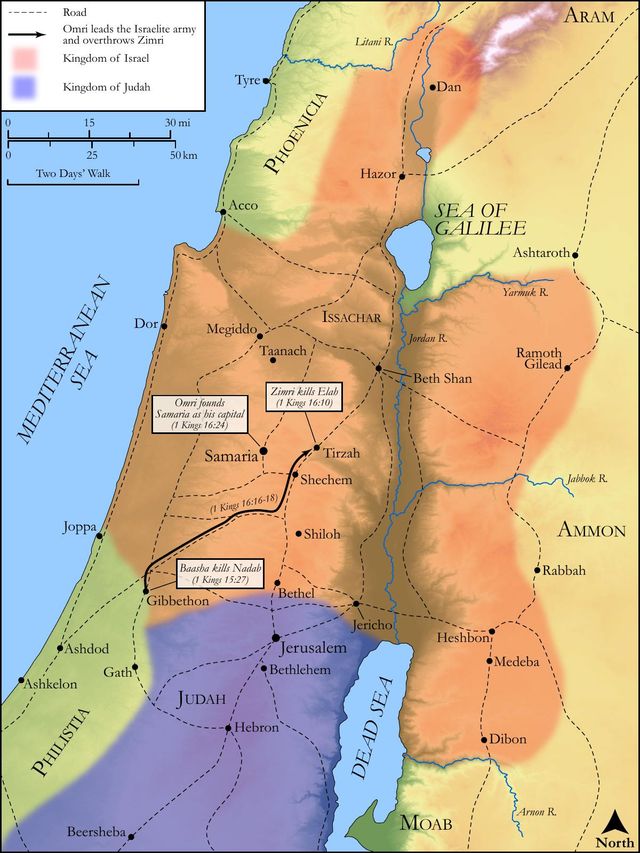
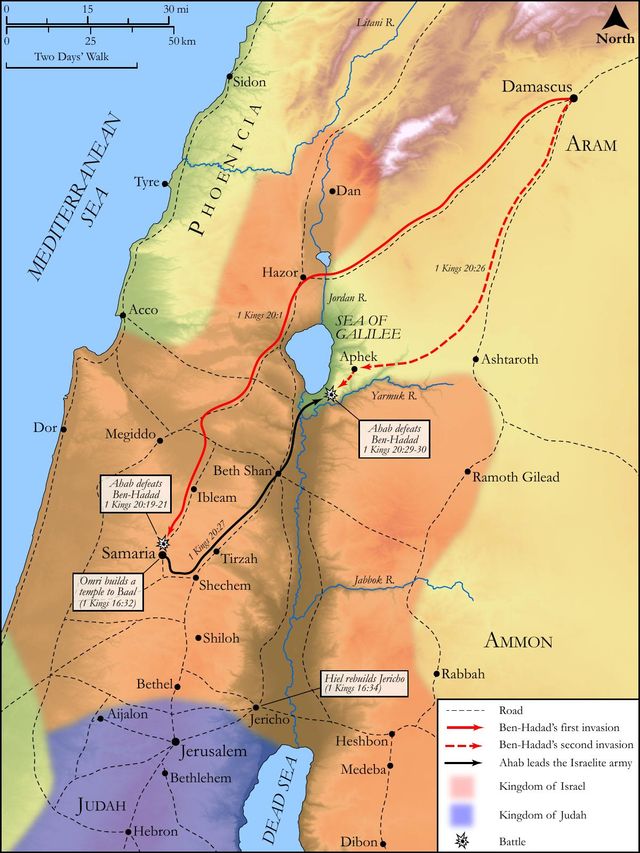
King Ahab reigned over the northern kingdom of Israel from approximately 874-853 BC, establishing Samaria as his capital. His marriage to Jezebel, daughter of Ethbaal, king of Tyre and Sidon, was a significant political alliance that inadvertently introduced and aggressively promoted Phoenician Baal worship into the heart of Israel. Baal was a dominant Canaanite storm and fertility god, whose cultic practices often involved ritual prostitution, self-mutilation, and, in extreme cases, child sacrifice. For Ahab to "rear up an altar for Baal" and construct a "house of Baal" in Samaria, the very center of Israelite political and religious life, constituted an act of profound national apostasy. It signified a state-sponsored embrace of a foreign deity, directly contravening the foundational commandments of the Mosaic Law, particularly the prohibition against idolatry and having other gods before Yahweh (Exodus 20:3-5). This was not mere syncretism but a deliberate attempt to supplant the worship of Yahweh with that of Baal, aligning Israel with the pagan religious practices of its powerful neighbors.
Key Themes
ShowHideThe verse powerfully underscores several critical themes prevalent throughout 1 Kings and the broader Deuteronomistic history. Foremost is Blatant Idolatry and Apostasy, as Ahab's actions represent a deliberate, public, and institutionalized rejection of the covenant God of Israel in favor of a false deity. This act is presented as the epitome of Ungodly Leadership's Destructive Influence, demonstrating how a king's personal choices, especially when swayed by unrighteous counsel like Jezebel's, can lead an entire nation astray from God's commands and into spiritual ruin (Proverbs 29:2). The building of Baal's house in Samaria also highlights the ongoing Conflict Between Yahweh and False Gods, setting the stage for dramatic divine intervention and a powerful demonstration of Yahweh's ultimate sovereignty and power over the impotent idols, as climactically evidenced later on Mount Carmel (1 Kings 18).
Exposition and Analysis
ShowHideKey Word Analysis
ShowHideThis verb signifies "to rise, to stand up, to establish, to confirm." Its use here emphasizes Ahab's active, intentional, and deliberate initiative in setting up the altar. It was not a passive acceptance of foreign worship but a forceful, public act of establishment, indicating his full commitment to promoting this pagan cult within the capital of Israel. The action implies a permanent, foundational installation.
An altar is a designated structure for offering sacrifices and engaging in worship. In the Israelite tradition, altars were exclusively for the worship of Yahweh. The construction of an altar specifically "for Baal" signifies a direct transfer of worship and allegiance from Yahweh to this Canaanite deity, making it a focal point for illicit religious practices and a potent symbol of Israel's spiritual rebellion and covenant infidelity.
Meaning "lord" or "master," Baal was the chief male deity in the Canaanite pantheon, worshipped as the god of storms, rain, and fertility. His worship was antithetical to the monotheistic worship of Yahweh, as it often involved practices condemned by the Mosaic Law. Naming the altar and house specifically for Baal underlines the specific pagan deity Ahab chose to elevate above the God of Israel, highlighting the direct challenge to Yahweh's exclusive claim.
Verse Breakdown
ShowHide"And he reared up an altar for Baal"
This initial clause immediately establishes King Ahab's direct responsibility and active role in initiating and institutionalizing the worship of Baal. It was not merely tolerated but actively promoted and established by the king himself, signifying a profound and public shift in national allegiance from Yahweh to a foreign god. The erection of an altar indicates the intention to offer sacrifices and engage in the full ritualistic practices associated with Baal worship.
"in the house of Baal"
This phrase indicates the construction of a dedicated temple or shrine, a permanent structure specifically designed for Baal worship, rather than just a temporary outdoor altar. The existence of a "house" suggests a fully established cultic center, complete with priests, idols, rituals, and a regular congregation, solidifying Baal worship as an official state religion within Israel, mirroring the legitimate temple worship of Yahweh.
"which he had built in Samaria"
The geographical and political location is crucial. Samaria (H8111, Shômᵉrôwn') was the capital city of the northern kingdom, a symbol of its political and national identity. By building this pagan temple in the capital, Ahab made a public and undeniable statement of his and the nation's apostasy. It was a defiant act, broadcasting his rejection of Yahweh's covenant to the entire kingdom and beyond, making the idolatry a central and inescapable feature of the nation's life and governance.
Literary Devices
ShowHideThe verse employs several potent Literary Devices to convey its profound theological implications. Foreshadowing is prominent, as Ahab's egregious act of establishing Baal worship in the capital sets the stage for the epic confrontation with Elijah, particularly on Mount Carmel, where the true power of Yahweh will be dramatically contrasted with the impotence of Baal. There is also a strong element of Irony in the king, who is meant to be the guardian and upholder of God's covenant with Israel, actively leading his people into its direct violation. The "altar for Baal" and "house of Baal" function as powerful Symbolism, representing the depth of Israel's spiritual rebellion and the king's utter devotion to false gods. This stands in stark Contrast to the legitimate worship of Yahweh, emphasizing the clear and deliberate choice Ahab made against the God who delivered Israel.
Theological and Thematic Connections
ShowHideThe construction of the altar and house for Baal in Samaria represents the pinnacle of Israel's national apostasy under Ahab, revealing a profound theological truth: idolatry is not merely a deviation from proper worship but a direct act of rebellion against the living God. It is a betrayal of the covenant relationship, where Yahweh demands exclusive devotion as the one true King and God of Israel. By elevating Baal, Ahab effectively dethroned Yahweh in the public sphere, inviting divine judgment upon himself and the nation. This act underscores God's unwavering jealousy for His glory and His absolute intolerance for rivals. The narrative consistently portrays idolatry as spiritual adultery, breaking the sacred bond between God and His people, and inevitably leading to societal decay and divine discipline.
Reflection and Application
ShowHide1 Kings 16:32 serves as a stark and enduring warning against the insidious nature of idolatry, a temptation that transcends ancient Canaanite practices and manifests in myriad forms today. While we may not build physical altars to Baal, anything that usurps God's rightful place as supreme in our lives becomes an idol. This could be the relentless pursuit of wealth, power, status, comfort, or even the worship of self and personal desires. Ahab's public declaration of allegiance to Baal reminds us that our choices, especially those of leaders, have far-reaching consequences, impacting not only personal spirituality but also the spiritual health of communities and nations. The call to exclusive devotion to the one true God remains paramount, urging us to constantly examine our hearts, identify our "altars to Baal," and dismantle them, ensuring that our worship, allegiance, and trust are directed solely to the Lord. Our spiritual vitality, and indeed the well-being of our communities, depends on our unwavering commitment to God alone.
Questions for Reflection
ShowHideFAQ
ShowHideWhy was Baal worship so attractive to King Ahab and the Israelites?
ShowHideBaal worship was attractive for several reasons. Firstly, it was deeply intertwined with agricultural fertility. As a god of rain and storms, Baal was believed to control the harvest, a vital concern for an agrarian society. Israelites, facing the practicalities of farming in a new land, might have been tempted to adopt Canaanite practices to ensure good yields, leading to syncretism. Secondly, political alliances, such as Ahab's marriage to Jezebel, often necessitated religious tolerance or even adoption of the foreign deity's cult to solidify diplomatic ties. Jezebel, being a zealous devotee, actively promoted Baal, making it a state-sponsored religion. Lastly, Baal worship often involved sensuous rituals and practices, which could appeal to human desires for pleasure and immediate gratification, in contrast to the demanding ethical and moral strictures of the Mosaic Law.
What was the significance of building the house of Baal in Samaria?
ShowHideBuilding the house of Baal in Samaria, the capital city of the northern kingdom, carried immense symbolic and practical significance. Symbolically, it was a public and official declaration of apostasy. It was not merely a private act of worship but a state-sanctioned establishment of a foreign cult at the very heart of Israelite national identity. This act directly challenged Yahweh's sovereignty in the most visible way possible. Practically, it meant that Baal worship was institutionalized and accessible to everyone in the capital, making it easier for the populace to be drawn into idolatry. It signaled a complete departure from the covenant obligations to Yahweh and set the stage for the dramatic confrontation between God's prophet Elijah and the prophets of Baal, demonstrating Yahweh's ultimate power and the emptiness of the false gods (1 Kings 18).
Christ-Centered Fulfillment
ShowHideThe narrative of Ahab's profound idolatry in 1 Kings 16:32, where he establishes an altar and house for Baal, finds its ultimate Christ-centered fulfillment in the person and work of Jesus Christ. The Old Testament's relentless struggle against idolatry, epitomized by Ahab's rebellion, points to humanity's inherent tendency to worship created things rather than the Creator (Romans 1:25). Jesus, as the true and perfect King, stands in stark contrast to Ahab. While Ahab led his people into idolatry, Jesus perfectly embodies exclusive devotion to God the Father, declaring, "You shall worship the Lord your God, and him only shall you serve" (Matthew 4:10). He confronts and defeats all "Baals" of this world—every false god, every power, every worldly philosophy that seeks to enslave humanity, triumphing over them through His cross (Colossians 2:8-15). Through His atoning sacrifice, Jesus cleanses us from the "dead works" of idolatry, enabling us to serve the living God with a pure conscience (Hebrews 9:14). He inaugurates the New Covenant, where true worship is no longer confined to physical altars or temples, but is offered "in spirit and truth" by those who are made new in Him (John 4:23-24). Thus, Christ is the ultimate answer to humanity's idolatrous heart, calling us to turn from every false master and find our sole allegiance, life, and hope in Him (1 John 5:21).