


1 Corinthians 1:5
Bible text: King James Version (1769 Blayney text) · Public domain
Bible text: Berean Standard Bible · Public domain
Bible text: American Standard Version (1901) · Public domain
Bible text: World English Bible, Messianic edition · Public domain
Bible text: Geneva Bible (1599) · Public domain
Bible text: Young's Literal Translation · Public domain
- ὅτιhotiforG3754CONJConjunction
- ἐνeninG1722PREPPreposition
- παντὶpantieverythingG3956A-DSNAdjective Dative Singular Neuter
- ἐπλουτίσθητεeploutisthēteyou have been enrichedG4148V-API-2PVerb Aorist Passive Indicative 2nd Plural
- ἐνeninG1722PREPPreposition
- αὐτῷautōHimG846P-DSMPersonal pronoun Dative Singular Masculine
- ἐνeninG1722PREPPreposition
- παντὶpantiallG3956A-DSMAdjective Dative Singular Masculine
- λόγῳlogōspeechG3056N-DSMNoun Dative Singular Masculine
- καὶkaiandG2532CONJConjunction
- πάσῃpasēin allG3956A-DSFAdjective Dative Singular Feminine
- γνώσειgnōseiknowledgeG1108N-DSFNoun Dative Singular Feminine
English is a literal word-by-word gloss of the Greek, not the KJV's wording. Why?
This is the original text the KJV's translators worked from — each Greek word with its own literal English meaning in this verse, prepared by scholars at Tyndale House, Cambridge. The KJV translates whole sentences, not word by word, so its wording differs: one Greek word can become several English words, and the KJV may choose “charity” where the gloss reads “love”. Both are faithful — they answer different questions. For the KJV's own rendering, switch to the KJV text.
Details
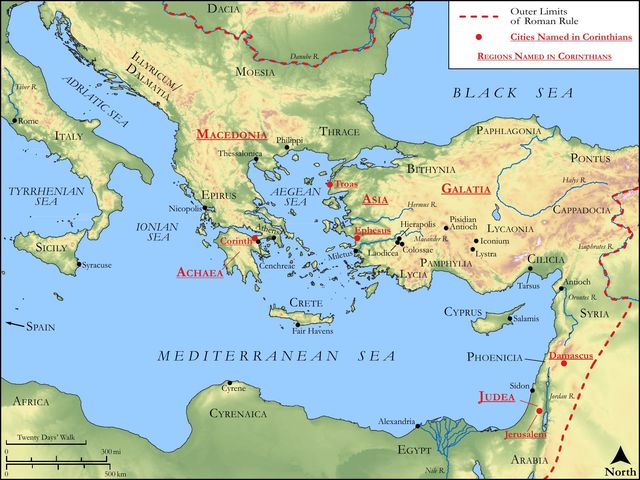
See on the biblical-era maps

Study this verse
Public-domain commentary
Matthew Henry
From his Commentary on the Whole Bible. Henry comments on passages, not single verses — this entry covers 1 Corinthians 1:1–9. His two-level outline is real structure in the source text, so it is rendered as structure.
We have here the apostle's preface to his whole epistle, in which we may take notice,
I.Of the inscription, in which, according to the custom of writing letters then, the name of the person by whom it was written and the persons to whom it was written are both inserted. 1. It is an epistle from Paul, the apostle of the Gentiles, to the church of Corinth, which he himself had planted, though there were some among them that now questioned his apostleship (Co1 9:1, Co1 9:2), and vilified his person and ministry, Co2 10:10. The most faithful and useful ministers are not secure from this contempt. He begins with challenging this character: Paul, called to be an apostle of Jesus Christ, through the will of God. He had not taken this honour to himself, but had a divine commission for it. It was proper at any time, but necessary at this time, to assert his character, and magnify his office, when false teachers made a merit of running him down, and their giddy and deluded followers were so apt to set them up in competition with him. It was not pride in Paul, but faithfulness to his trust, in this juncture, to maintain his apostolical character and authority. And, to make this more fully appear, he joins Sosthenes with him in writing, who was a minister of a lower rank. Paul, and Sosthenes his brother, not a fellow-apostle, but a fellow-minister, once a ruler of the Jewish synagogue, afterwards a convert to Christianity, a Corinthian by birth, as is most probable, and dear to this people, for which reason Paul, to ingratiate himself with them, joins them with himself in his first salutations. There is no reason to suppose he was made a partaker of the apostle's inspiration, for which reasons he speaks, through the rest of the epistle, in his own name, and in the singular number. Paul did not in any case lessen his apostolical authority, and yet he was ready upon all occasions to do a kind and condescending thing for their good to whom he ministered. The persons to whom this epistle was directed were the church of God that was at Corinth, sanctified in Christ Jesus, and called to be saints. All Christians are thus far sanctified in Christ Jesus, that they are by baptism dedicated and devoted to him, they are under strict obligations to be holy, and they make profession of real sanctity. If they be not truly holy, it is their own fault and reproach. Note, It is the design of Christianity to sanctify us in Christ. He gave himself for us, to redeem us from all iniquity, and purify us to himself a peculiar people, zealous of good works. In conjunction with the church at Corinth, he directs the epistle to all that in every place call on the name of Christ Jesus our Lord, both theirs and ours. Hereby Christians are distinguished from the profane and atheistical, that they dare not live without prayer; and hereby they are distinguished from Jews and Pagans, that they call on the name of Christ. He is their common head and Lord. Observe, In every place in the Christian world there are some that call on the name of Christ. God hath a remnant in all places; and we should have a common concern for and hold communion with all that call on Christ's name.
II.Of the apostolical benediction.
Grace be to you, and peace, from God our Father, and from the Lord Jesus Christ. An apostle of the prince of peace must be a messenger and minister of peace. This blessing the gospel brings with it, and this blessing every preacher of the gospel should heartily wish and pray may be the lot of all among whom he ministers. Grace and peace - the favour of God, and reconciliation to him. It is indeed the summary of all blessings. The Lord lift up his countenance upon thee, and give thee peace, was the form of benediction under the Old Testament (Num 6:26), but this advantage we have by the gospel,
1.That we are directed how to obtain that peace from God: it is in and by Christ. Sinners can have no peace with God, nor any good from him, but through Christ.
2.We are told what must qualify us for this peace; namely, grace: first grace, then peace. God first reconciles sinners to himself, before he bestows his peace upon them.
III.Of the apostle's thanksgiving to God on their behalf.
Paul begins most of his epistles with thanksgiving to God for his friends and prayer for them. Note, The best way of manifesting our affection to our friends is by praying and giving thanks for them. It is one branch of the communion of saints to give thanks to God mutually for our gifts, graces, and comforts. He gives thanks,
1.For their conversion to the faith of Christ: For the grace which was given you through Jesus Christ, Co1 1:4. He is the great procurer and disposer of the favours of God. Those who are united to him by faith, and made to partake of his Spirit and merits, are the objects of divine favour. God loves them, bears them hearty good-will, and bestows on them his fatherly smiles and blessings.
2.For the abundance of their spiritual gifts. This the church of Corinth was famous for. They did not come behind any of the churches in any gift, Co1 1:7. He specifies utterance and knowledge, Co1 1:5. Where God has given these two gifts, he has given great capacity for usefulness. Many have the flower of utterance that have not the root of knowledge, and their converse is barren. Many have the treasure of knowledge, and want utterance to employ it for the good of others, and then it is in a manner wrapped up in a napkin. But, where God gives both, a man is qualified for eminent usefulness. When the church of Corinth was enriched with all utterance and all knowledge, it was fit that a large tribute of praise should be rendered to God, especially when these gifts were a testimony to the truth of the Christian doctrine, a confirmation of the testimony of Christ among them, Co1 1:6. They were signs and wonders and gifts of the Holy Ghost, by which God did bear witness to the apostles, both to their mission and doctrine (Heb 2:4), so that the more plentifully they were poured forth on any church the more full attestation was given to that doctrine which was delivered by the apostles, the more confirming evidence they had of their divine mission. And it is no wonder that when they had such a foundation for their faith they should live in expectation of the coming of their Lord Jesus Christ, Co1 1:7. It is the character of Christians that they wait for Christ's second coming; all our religion has regard to this: we believe it, and hope for it, and it is the business of our lives to prepare for it, if we are Christians indeed. And the more confirmed we are in the Christian faith the more firm is our belief of our Lord's second coming, and the more earnest our expectation of it.
IV.Of the encouraging hopes the apostle had of them for the time to come, founded on the power and love of Christ, and the faithfulness of God, Co1 1:8, Co1 1:9. He who had begun a good work in them, and carried it on thus far, would not leave it unfinished. Those that wait for the coming of our Lord Jesus Christ will be kept by him, and confirmed to the end; and those that are so will be blameless in the day of Christ: not upon the principle of strict justice, but gracious absolution; not in rigour of law, but from rich and free grace. How desirable is it to be confirmed and kept of Christ for such a purpose as this! How glorious are the hopes of such a privilege, whether for ourselves or others! To be kept by the power of Christ from the power of our own corruption and Satan's temptation, that we may appear without blame in the great day! O glorious expectation, especially when the faithfulness of God comes in to support our hopes! He who hath called us into the fellowship of his Son is faithful, and will do it, Th1 5:24. He who hath brought us into near and dear relation to Christ, into sweet and intimate communion with Christ, is faithful; he may be trusted with our dearest concerns. Those that come at his call shall never be disappointed in their hopes in him. If we approve ourselves faithful to God, we shall never find him unfaithful to us. He will not suffer his faithfulness to fail, Psa 89:33.
Historical interpretation
Two Centuries of Reception
4 surviving comments on this verse. Each one is dated, so this reads as a timeline rather than a list.
Select a marker to jump to its quote. Markers stagger vertically where authors wrote within a few decades of each other.
Knowledge shows what there is to know. Speech goes further and explains it.
This means that the Corinthians have remained steadfast in the grace which they have received and in the preaching of the doctrine of truth, because they have acquired spiritual knowledge. Paul therefore gives thanks to God for these things.
"That in every thing ye were enriched." Again, by whom? By Him, is the reply. And not merely "ye were enriched, but "in every thing." Since then it is first of all, "riches" then, "riches of God," next, "in every thing," and lastly, "through the Only-Begotten," reflect on the ineffable treasure!
"In all utterance, and all knowledge." "Word" or "utterance," not such as the heathen, but that of God. For there is knowledge without "word," and there is knowledge with "word." For so there are many who possess knowledge, but have not the power of speech; as those who are uneducated and unable to exhibit clearly what they have in their mind. Ye, saith he, are not such as these, but competent both to understand and to speak.
When the Corinthians came to faith in Christ they were blessed with all grace. But now that they were no longer living according to their faith, they had made void the grace which they had received.
Continue studying 1 Corinthians 1:5 across the web’s major study libraries — every link below opens this exact verse, chapter, or book on the destination site.
Read & Compare
 BibleGatewayThis verse in more than 200 translations and 70 languages.
 Bible.comThe YouVersion reader — hundreds of translations, reading plans, and highlights.
 ESV.orgCrossway's official English Standard Version reader.
 NET BibleThe NET translation with 60,000+ translators' notes on every rendering decision.
 STEP BibleTyndale House's free study tool — original text, vocabulary, and scholarly resources.
 BibliaLogos Bible Software's free web reader.
 USCCBThe New American Bible (Revised Edition) with the U.S. bishops' study notes.
Commentaries
 BibleHub CommentariesDozens of classic commentaries on this verse, gathered on one page.
 StudyLightMore than 100 commentary sets — the largest collection on the web.
 BibleRefPlain-English commentary on what this verse means, verse by verse.
 Enduring WordDavid Guzik's free commentary on this chapter, widely used by Bible teachers.
 Bible Study ToolsVerse commentary alongside Greek and Hebrew study aids.
Original Language & Research
- BibleHub InterlinearThe verse word by word — original language, transliteration, and English.
- BibleHub LexiconEvery word's original-language definition and Strong's entry.
 Blue Letter BibleDeep-study tools — Strong's numbers, concordance, and word studies.
 CNTR CollationThe earliest Greek manuscripts of this verse, collated letter by letter.
Sermons, Hymns & Audio


TrulyRandomVerse is not affiliated with these sites and doesn’t control their content. They’re linked because they’re genuinely useful.
Summary
Serves as a foundational statement within Paul's opening thanksgiving to the Corinthian church, underscoring the comprehensive spiritual endowment they had received from God through Christ. Despite the significant moral and theological challenges that would later be addressed in the epistle, Paul begins by affirming God's abundant grace and faithfulness in enriching them "in every thing," specifically highlighting their proficiency "in all utterance, and in all knowledge," which were prominent spiritual gifts within their community.
Context
ShowHideLiterary Context
This verse is an integral part of Paul's introductory thanksgiving, immediately following his declaration of gratitude for 1 Corinthians 1:4. It elaborates on the nature of this divine grace, specifying how the Corinthians were enriched. This positive opening, detailing their spiritual abundance, serves as a rhetorical strategy. By acknowledging their gifts and God's faithfulness before addressing their numerous shortcomings (such as divisions, immorality, and misuse of spiritual gifts detailed from 1 Corinthians 1:10 onward), Paul establishes a pastoral tone. He reminds them of the divine source of their spiritual capabilities, thereby setting the stage for his subsequent corrections and exhortations regarding the proper use and stewardship of these very gifts, particularly in 1 Corinthians 12 through 1 Corinthians 14.
Historical & Cultural Context
The city of Corinth was a bustling, prosperous Roman port city, a melting pot of diverse cultures, philosophies, and religions. Its strategic location fostered a vibrant commercial hub but also contributed to a reputation for moral laxity and intellectual pride. The Corinthian church, though founded by Paul, comprised a mix of Jewish and Gentile converts, many from lower social strata, but also some of influence. Within this environment, spiritual gifts, particularly those involving public display like "utterance" (prophecy, speaking in tongues) and "knowledge" (insight into mysteries), were highly valued and, at times, misused or boasted about. The emphasis on these specific gifts in 1 Corinthians 1:5 reflects the actual spiritual dynamics and tendencies within this particular congregation, which Paul would later need to regulate and reorient towards love and edification (1 Corinthians 13).
Key Themes
ShowHide1 Corinthians 1:5 contributes significantly to several key themes woven throughout the epistle. Foremost is the theme of Divine Grace and Empowerment, emphasizing that all spiritual blessings and abilities are gracious endowments from God, not earned human achievements. This directly counters any potential Corinthian pride in their gifts or intellectual prowess. Secondly, it highlights the Abundance of Spiritual Gifts, particularly those related to communication and understanding divine truth, which were evidently prominent in Corinth. This sets up Paul's extensive teaching on the nature, diversity, and proper use of spiritual gifts in later chapters, asserting their purpose is for the common good of the body of Christ, as seen in 1 Corinthians 12:7. Finally, the verse subtly introduces the theme of God's Faithfulness, implying His unwavering commitment to equip His people for ministry, even when they struggle with spiritual maturity and unity, as He promises to sustain them "unto the end" in 1 Corinthians 1:8.
Exposition and Analysis
ShowHideKey Word Analysis
ShowHideFrom the noun ploutos (wealth), this verb means "to make wealthy," "to furnish abundantly," or "to make rich." In this context, it signifies God's overflowing spiritual provision, bestowing spiritual riches and abundance upon believers. It emphasizes that this spiritual wealth is a divine gift, not something earned or accumulated through human effort.
While broadly meaning "word," "reason," or "discourse," here lógos specifically refers to the faculty or gift of speech, particularly in the context of proclaiming, teaching, or speaking divine truth. It encompasses various forms of inspired communication, such as prophecy, teaching, or speaking in tongues, which were highly valued and sometimes contentious gifts within the Corinthian church.
Derived from ginōskō (to know), gnōsis denotes understanding, spiritual insight, or discernment of divine mysteries. It refers to a deeper, experiential understanding of God's truth and spiritual realities, rather than mere intellectual apprehension. In Corinth, this gift was often associated with a sense of superiority, which Paul addresses later in the epistle (e.g., 1 Corinthians 8:1).
Verse Breakdown
ShowHide"That in every thing ye are enriched by him,"
This opening clause establishes the comprehensive nature of God's blessing. The phrase "in every thing" (Greek, en pantí) underscores the all-encompassing scope of this divine enrichment. It is not limited to a few areas but extends to every aspect of their spiritual lives. The source of this enrichment is explicitly stated as "by him" (referring to Christ, as per 1 Corinthians 1:4), highlighting the divine origin and Christocentric nature of these spiritual gifts.
"in all utterance,"
This specifies one primary area of their enrichment. "All utterance" (Greek, en pantí lógō) points to a comprehensive ability in spoken communication of divine truth. This would include gifts like prophecy, teaching, and perhaps even speaking in tongues, all of which involve verbal expression of spiritual realities. The Corinthians were evidently gifted communicators of spiritual matters.
"and [in] all knowledge;"
This second specific area of enrichment complements the first. "All knowledge" (Greek, kai en pasē gnōsei) refers to a comprehensive understanding and spiritual insight into God's truth and mysteries. This is not merely intellectual accumulation but a divinely granted discernment. Together with "utterance," it indicates that the Corinthians possessed both the ability to understand divine truth and the capacity to articulate it.
Literary Devices
ShowHidePaul employs several literary devices in 1 Corinthians 1:5 to emphasize his point. The use of Hyperbole or Emphasis is evident in the repeated use of "every thing" (en pantí) and "all" (pasē) when describing their enrichment in "utterance" and "knowledge." This repetition underscores the comprehensive and abundant nature of the spiritual gifts bestowed upon the Corinthians, highlighting that they lacked nothing in terms of spiritual endowment. Furthermore, there is clear Parallelism between "in all utterance" and "in all knowledge," linking these two specific spiritual gifts as primary manifestations of their divine enrichment. This pairing suggests that the Corinthians were particularly strong in both the ability to articulate spiritual truth and the capacity to comprehend it. The underlying Metaphor of "enriched" (from ploutízō) likens spiritual blessings to material wealth, effectively conveying the idea of God's lavish provision and the valuable nature of these spiritual endowments.
Theological and Thematic Connections
ShowHide1 Corinthians 1:5 is a powerful testament to the New Testament theology of divine grace and spiritual empowerment. It asserts that all genuine spiritual capabilities and insights within the believer are not self-generated but are sovereignly bestowed by God through Christ. This truth forms the bedrock for understanding the nature of spiritual gifts, emphasizing that they are not earned merits but gracious endowments intended for the building up of the body of Christ. The specific mention of "utterance" and "knowledge" foreshadows Paul's extensive discourse on spiritual gifts in 1 Corinthians 12-14, where he will correct the Corinthians' misuse and misunderstanding of these very gifts, redirecting their focus from self-exaltation to mutual edification and love. This verse, therefore, establishes the premise that the Corinthians were indeed spiritually gifted, making their subsequent failings all the more poignant and highlighting the critical importance of stewardship and humility in the exercise of God's grace.
Reflection and Application
ShowHide1 Corinthians 1:5 offers profound insights for contemporary believers, serving as a vital reminder that our spiritual capacities are not products of our own intellect or effort, but gracious gifts from God. This truth should cultivate a deep sense of gratitude, shifting our focus from self-reliance to divine dependence. It calls us to humility, recognizing that any ability we possess to articulate God's truth or to grasp spiritual knowledge is a direct result of His generous provision, thereby preventing pride or self-congratulation. Furthermore, this verse implicitly challenges us to be faithful stewards of these divine endowments. Just as Paul would later instruct the Corinthians on the proper use of their gifts for the edification of the church (1 Corinthians 14:26), we too are called to deploy our "utterance" and "knowledge" not for personal gain or display, but for the glory of God, the strengthening of fellow believers, and the advancement of His kingdom. It encourages a posture of continuous learning and faithful service, recognizing that we have been abundantly equipped for every good work.
Questions for Reflection
ShowHideFAQ
ShowHideWhat does "enriched by him" mean in this context?
ShowHide"Enriched by him" means that the Corinthians received an abundance of spiritual blessings and gifts directly from God through Jesus Christ. The Greek word for "enriched" (ploutízō) signifies being made wealthy or abundantly furnished. It emphasizes that their spiritual capabilities, particularly in "utterance" (speaking divine truth) and "knowledge" (spiritual insight), were not self-acquired but were gracious, overflowing provisions from a divine source. This highlights God's generosity and faithfulness in equipping His people.
Why does Paul specifically mention "utterance" and "knowledge"?
ShowHidePaul specifically mentions "utterance" (lógos) and "knowledge" (gnōsis) because these were evidently prominent and perhaps problematic spiritual gifts within the Corinthian church. The Corinthians highly valued eloquent speech, intellectual prowess, and mystical insights. While these were genuine gifts from God, the Corinthians often misused them, leading to pride, divisions, and a focus on outward display rather than humble service and love. By acknowledging their possession of these gifts upfront, Paul sets the stage for his later teaching in 1 Corinthians 12-14, where he corrects their understanding and application of spiritual gifts, emphasizing that love is the "more excellent way" (1 Corinthians 12:31).
Christ-Centered Fulfillment
ShowHide1 Corinthians 1:5 finds its ultimate Christ-centered fulfillment in the person and work of Jesus Christ, who is the very source and embodiment of all spiritual enrichment. He is the "him" by whom believers are enriched. Christ himself is the Logos, the divine "utterance" incarnate, through whom God speaks His ultimate word to humanity (John 1:1-3 and Hebrews 1:1-2). All true "knowledge" finds its hidden treasures in Christ, for "in whom are hid all the treasures of wisdom and knowledge" (Colossians 2:3). The spiritual gifts of utterance and knowledge, bestowed upon believers, are manifestations of the Holy Spirit, whom Christ sends from the Father (John 15:26). Therefore, the Corinthians' enrichment was not merely a set of abilities, but a participation in the very life and ministry of Christ, empowering them to declare His truth and understand His mysteries, all for the purpose of building up His body, the church, until they come to the "unity of the faith and of the knowledge of the Son of God" (Ephesians 4:13).