


Numbers 24:8
Bible text: King James Version (1769 Blayney text) · Public domain
Bible text: King James Version with Strong's numbers · Public domain
Bible text: Berean Standard Bible · Public domain
Bible text: American Standard Version (1901) · Public domain
Bible text: World English Bible, Messianic edition · Public domain
Bible text: Geneva Bible (1599) · Public domain
Bible text: Young's Literal Translation · Public domain
- אֵל'elGodH410N-msNoun Singular Masculine Absolute
- מוֹצִיאוֹmo·tzi·'O[is] bringing out itH3318V-Hiphil-Prtcpl-ms ¦ 3msVerb Hiphil Participle Singular Masculine Constructמוֹצִיא[is] bringing outוֹit
- מִמִּצְרַיִםmi·mitz·Ra·yimfrom EgyptH4714Prep-m ¦ N-properNoun Proper LocationמִfromמִּצְרַיִםEgypt
- כְּתוֹעֲפֹתke·to·'a·Fotlike [the] horns ofH8443Prep-k ¦ N-fpcNoun Plural Feminine Constructכְּlikeתוֹעֲפֹת[the] horns of
- רְאֵםre·'Ema wild oxH7214N-msNoun Singular Masculine Absolute
- לוֹlo[belong] to <the> himPrep-l ¦ 3msSuffix Personal 3rd Singular Masculineל[belong] to <the>וֹhim
- יֹאכַלyo·Khalit will consumeH398V-Qal-Imperf-3msVerb Qal Imperfect 3rd Singular Masculine
- גּוֹיִםgo·YimnationsH1471N-mpNoun Plural Masculine Absolute
- צָרָיוtza·Ravits opponentsH6862N-mpc ¦ 3msNoun Plural Masculine Constructצָרָיopponentsוits
- וְעַצְמֹתֵיהֶםve·'atz·mo·tei·Hemand their bonesH6106Conj-w ¦ N-fpc ¦ 3mpNoun Plural Feminine Constructוְandעַצְמֹתֵיbonesהֶםtheir
- יְגָרֵםye·ga·Remit will breakH1633V-Piel-Imperf-3msVerb Piel Imperfect 3rd Singular Masculine
- וְחִצָּיוve·chi·Tzavand its arrowsH2671Conj-w ¦ N-mpc ¦ 3msNoun Plural Masculine Constructוְandחִצָּיarrowsוits
- יִמְחָץyim·Chatzit will wound [them]H4272V-Qal-Imperf-3msVerb Qal Imperfect 3rd Singular Masculine
English is a literal word-by-word gloss of the Hebrew, not the KJV's wording. Why?
This is the original text the KJV's translators worked from — each Hebrew word with its own literal English meaning in this verse, prepared by scholars at Tyndale House, Cambridge. The KJV translates whole sentences, not word by word, so its wording differs: one Hebrew word can become several English words, and the KJV may choose “the LORD” where the gloss reads “Yahweh”. Both are faithful — they answer different questions. For the KJV's own rendering, switch to the KJV text.
Details
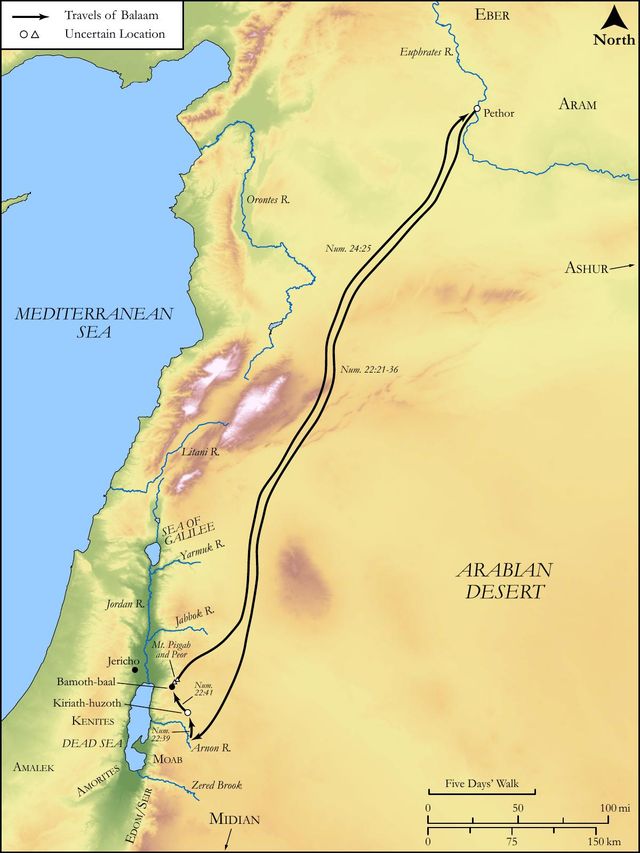
See on the biblical-era map
Study this verse
Public-domain commentary
Matthew Henry
From his Commentary on the Whole Bible. Henry comments on passages, not single verses — this entry covers Numbers 24:1–9. His three-level outline is real structure in the source text, so it is rendered as structure.
The blessing itself which Balaam here pronounces upon Israel is much the same with the two we had in the foregoing chapter; but the introduction to it is different.
I.The method of proceeding here varies much in several instances.
1.Balaam laid aside the enchantments which he had hitherto depended on, used no spells, or charms, or magic arts, finding they did him no service; it was to no purpose to deal with the devil for a curse, when it was plain that God was determined immovably to bless, Num 24:1. Sooner or later God will convince men of their folly in seeking after lying vanities, which cannot profit. To what purpose should he seek for enchantment? He knew that God was out of the reach of them.
2.He did not now retire into a solitary place as before, but set his face directly towards the wilderness where Israel lay encamped; and, since there is no remedy, but they must be blessed, he will design nothing else, but will submit by compulsion.
3.Now the Spirit of God came upon him, that is, the Spirit of prophecy, as upon Saul to prevent him from taking David, Sa1 19:23. He spoke not his own sense, but the language of the Spirit that came upon him.
4.He used a different preface now from what he had used before (Num 24:3, Num 24:4), much like that of David (Sa2 23:1-3), yet savouring very much (as some think) of pride and vain-glory, taking all the praise of this prophecy to himself, and magnifying himself as one of the cabinet-council of heaven. Two things he boasts of: - (1.) The favour God did him in making known himself to him. He heard the words of God, and saw the vision of the Almighty. God himself had met him and spoken to him (Num 23:16), and with this he was greatly puffed up. Paul speaks with humility of his visions and revelations (Co2 12:1), but Balaam speaks of his with pride. (2.) His own power to receive and bear those revelations. He fell into a trance indeed, as other prophets did, but he had his eyes open. This he mentions twice; but the words in the original are not the same. The man whose eyes were shut, some think it may be read so (Num 24:3-9), but now having his eyes open, Num 24:4. When he attempted to curse Israel, he owns, he was in a mistake, but now he began to see his error, and yet still he remained blinded by covetousness and ambition, those foolish and hurtful lusts. Note, [1.] Those that oppose God and his people will sooner or later be made to see themselves wretchedly deceived. [2.] Many have their eyes open that have not their hearts open, are enlightened, but not sanctified; and that knowledge which puffs men up with pride will but serve to light them to hell, whither many go with their eyes open.
II.Yet the blessing is for substance the same with those before. Several things he admires in Israel: -
1.Their beauty (Num 24:5): How goodly are thy tents, O Jacob! Though they dwelt not in stately palaces, but in coarse and homely tents, and these, no doubt, sadly weather-beaten, yet Balaam sees a beauty in those tents, because of their admirable order, according to their tribes, Num 24:2. Nothing recommends religion more to the good opinion of those that look upon it at a distance than the unity and harmony of its professors, Psa 133:1. The amiableness of this people, and the great reputation they should gain among their neighbours, are compared (Num 24:6) to the beauty and sweetness of fruitful valleys and fine gardens, flourishing trees and fragrant spices. Note, Those whose eyes are open see the saints on the earth to be excellent ones, and their delight is accordingly in them. The righteous, doubtless, is more excellent than his neighbour. They are trees which the Lord has planted; that is their excellency. The branches of righteousness are the planting of the Lord. See Hos 14:5-7.
2.Their fruitfulness and increase. This may be intended by those similitudes (Num 24:6) of the valleys, gardens, and trees, as well as by those expressions (Num 24:7), He shall pour the water out of his buckets; that is, God shall water them with his blessing like rain from heaven, and then his seed shall be in many waters. Compare Hos 2:23, I will sow her unto me in the earth. And waters are in scripture put for peoples, and multitudes, and nations. This has been fulfilled in the wonderful increase of that nation and their vast multitude even in their dispersion.
3.Their honour and advancement. As the multitude of the people is the honour of the prince, so the magnificence of the prince is the honour of the people; Balaam therefore foretells that their king shall be higher than Agag. Agag, it is probable, was the most potent monarch in those parts; Balaam knew of none more considerable than he was; he rose above the rest of his neighbours. But Balaam foretells that Israel's chief commander, who, after Moses, was Joshua, should be more great and honourable than ever Agag was, and make a far better figure in history. Saul, their first king, triumphed over Agag, though, it is said, he came delicately.
4.Their power and victory, Num 24:8.
(1.)He looks back upon what they had done, or rather what had been done for them: God brought them forth out of Egypt; this he had spoken of before, Num 23:22. The wonders that attended their deliverance out of Egypt contributed more to their honour, and the terror of their adversaries, than any thing else, Jos 2:10. He that brought them out of Egypt will not fail to bring them into Canaan, for, as for God, his work is perfect.
(2.)He looks down upon their present strength. Israel hath, as it were, the strength of a unicorn, of which creature it is said (Job 39:9, Job 39:10), Will he be willing to serve thee, or abide by thy crib? Canst thou bind him with his band in the furrow? "No, Israel is too powerful to be checked or held in by my curses or thy armies." (3.) He looks forward to their future conquests: He shall eat up the nations his enemies; that is, "he shall not only destroy and devour them as easily and irresistibly as a lion does his prey, but he shall himself be strengthened, and fattened, and enriched, by their spoils."
5.Their courage and security: He lay down as a lion, as a great lion, Num 24:9. Now he does so in the plains of Moab, and asks no leave of the king of Moab, nor is he in fear of him; shortly will he do so in Canaan. When he has torn his prey, he will take his repose, quiet from the fear of evil, and bid defiance to all his neighbours; for who shall stir up a sleeping lion? It is observed of lions (as the learned bishop Patrick takes notice here) that they do not retire into places of shelter to sleep, but lie down any where, knowing that none dares meddle with them: thus secure were Israel in Canaan, chiefly in the days of David and Solomon; and thus is the righteous bold as a lion (Pro 28:1), not to assault others, but to repose themselves, because God maketh them to dwell in safety, Psa 4:8.
6.Their interest, and influence upon their neighbours. Their friends, and those in alliance with them, were happy: Blessed is he that blesseth thee; those that do them any kindness will certainly fare the better for it. But their enemies, and those in arms against them, were certainly miserable: Cursed is he that curseth thee; those that do them any injury do it at their peril; for God takes what is done to them, whether good or evil, as done to himself. Thus he confirms the blessing of Abraham (Gen 12:3), and speaks as if therefore he did at this time bless Israel, and not curse them, because he desired to share in the blessing of Israel's friends and dreaded the curse on Israel's enemies.
Historical interpretation
Historical reception
1 surviving comment on this verse from the historical church.
The oracle in the previously quoted prophecy, in saying that the Lord would come into Egypt, foretold the journey of our Lord Jesus Christ when he went into Egypt with his parents. Here we have the prophecy of his return from Egypt in its natural order, when he came back with his parents into the land of Israel, in the words “God led him out of Egypt.” For our Lord and Savior Jesus, the Christ of God, was the only one of the seed of Israel and of the Jewish race who has rule over many nations, so that it is indisputable that he is the fulfillment of the prophecy which says, literally, “that a man will come from the Jewish race and rule over many nations.” If he is not, let him who will suggest some other famous man among the Hebrews who has ruled over many nations. But this he cannot do, for such a man never existed. But with regard to our Savior, truth itself will shout and cry aloud, even if we say nothing. This shows plainly that his divine power has ruled, through the human he took of the seed of Israel according to the flesh, and even now will rule many nations.
Continue studying Numbers 24:8 across the web’s major study libraries — every link below opens this exact verse, chapter, or book on the destination site.
Read & Compare
 BibleGatewayThis verse in more than 200 translations and 70 languages.
 Bible.comThe YouVersion reader — hundreds of translations, reading plans, and highlights.
 ESV.orgCrossway's official English Standard Version reader.
 NET BibleThe NET translation with 60,000+ translators' notes on every rendering decision.
 STEP BibleTyndale House's free study tool — original text, vocabulary, and scholarly resources.
 BibliaLogos Bible Software's free web reader.
 USCCBThe New American Bible (Revised Edition) with the U.S. bishops' study notes.
Commentaries
 BibleHub CommentariesDozens of classic commentaries on this verse, gathered on one page.
 StudyLightMore than 100 commentary sets — the largest collection on the web.
 BibleRefPlain-English commentary on what this verse means, verse by verse.
 Enduring WordDavid Guzik's free commentary on this chapter, widely used by Bible teachers.
 Bible Study ToolsVerse commentary alongside Greek and Hebrew study aids.
Original Language & Research
- BibleHub InterlinearThe verse word by word — original language, transliteration, and English.
- BibleHub LexiconEvery word's original-language definition and Strong's entry.
 Blue Letter BibleDeep-study tools — Strong's numbers, concordance, and word studies.
 SefariaThe Hebrew text with Rashi and centuries of Jewish commentary.
Sermons, Hymns & Audio


TrulyRandomVerse is not affiliated with these sites and doesn’t control their content. They’re linked because they’re genuinely useful.
Summary
Numbers 24:8, a pivotal declaration within Balaam's third oracle, powerfully articulates God's unwavering sovereignty and commitment to Israel. It anchors the prophecy in Israel's miraculous deliverance from Egypt and foretells their divinely endowed, formidable strength. This strength will enable them to utterly conquer and dismantle their adversaries, serving as a vivid testament to God's protective hand over His chosen people and the certainty of their victory, orchestrated entirely by Him.
Context
ShowHideLiterary Context
This verse is deeply embedded within the third of four prophetic oracles delivered by Balaam, a diviner of Pethor, as recounted in Numbers 23 and Numbers 24. King Balak of Moab had desperately sought to curse Israel, driven by fear of their immense numbers and recent military successes. However, in a profound display of divine sovereignty, God repeatedly intervened, compelling Balaam to utter blessings and prophecies concerning Israel's future greatness instead. This particular oracle, following Balaam's direct observation of Israel encamped by tribes, transitions from a general blessing to a more aggressive, militaristic depiction of Israel's future might. It starkly contrasts Balak's desire for their defeat, building upon established themes of divine favor and national destiny, particularly the foundational truth that "God is not a man, that he should lie; neither the son of man, that he should repent" (Numbers 23:19).
Historical & Cultural Context
The narrative unfolds with Israel positioned on the plains of Moab, east of the Jordan River, on the cusp of entering the Promised Land. The Moabites, allied with the Midianites, perceived Israel's presence and their recent victories over the Amorites (detailed in Numbers 21) as an existential threat. Among the nations of that day, it was a widespread cultural practice for kings to employ diviners or prophets to invoke curses upon their enemies or blessings upon their own forces before engaging in conflict. Balak's hiring of Balaam precisely reflects this custom. The vivid imagery of nations being "eaten up" or having their "bones broken" powerfully reflects the brutal realities of ancient warfare and conquest, where the complete subjugation, if not annihilation, of enemies was often the explicit objective. The explicit reference to Egypt firmly grounds the prophecy in the historical reality of the Exodus, the defining event of Israel's national formation and a perpetual reminder of God's unparalleled power and faithfulness.
Key Themes
ShowHideNumbers 24:8 powerfully reinforces several core themes prevalent throughout the book of Numbers and the broader Pentateuch. Firstly, it profoundly underscores Divine Sovereignty and Faithfulness, unequivocally demonstrating that God's immutable plan for Israel cannot be thwarted by any human or demonic opposition. Balaam, despite his initial intentions, becomes an unwilling instrument of God's prophetic word, thereby highlighting God's ultimate and unassailable control over all circumstances. Secondly, the verse emphasizes Israel's Unique Status and Divine Protection. The Exodus, explicitly mentioned, stands as the foundational act of God's covenant with Israel, establishing them as His chosen people whom He actively defends, empowers, and preserves. Finally, the verse vividly portrays God's Judgment on Israel's Enemies. The aggressive imagery is not merely a testament to Israel's military prowess but serves as a dramatic depiction of God's righteous judgment being executed through His people against those who defiantly oppose His divine will and His chosen nation. This powerful theme recurs throughout the Old Testament, particularly evident in the accounts of the conquest of Canaan, as seen in passages like Joshua 10:42.
Exposition and Analysis
ShowHideKey Word Analysis
ShowHideThis term, a shortened form of ʼayil (אַיִל), denotes "strength" and, as an adjective, "mighty." It specifically refers to the Almighty, but can also be used for any deity. In this context, its use emphasizes the divine source of Israel's power. It is "God" (H410), the supreme, mighty one, who initiates and empowers Israel's deliverance and subsequent strength, ensuring that their formidable power is not inherent but divinely bestowed.
The primitive root yâtsâʼ (יָצָא) means "to go out" or, causatively, "to bring out." Here, it specifically refers to God's decisive act of leading Israel out of Egypt. This verb encapsulates the entire miraculous event of the Exodus, highlighting God's active, powerful intervention to liberate His people from bondage. It sets the precedent for God's ongoing, active involvement in Israel's destiny and their future victories.
The Hebrew word gôwy (גּוֹי) refers to a "foreign nation" or "Gentile." In this context, it signifies the various peoples and kingdoms hostile to Israel. The use of this plural term underscores the multitude and collective identity of Israel's adversaries. The prophecy declares that Israel, empowered by God, will not merely defeat individual enemies but will "eat up" and "break" entire foreign nations that stand in opposition to God's plan for His people.
Verse Breakdown
ShowHide"God brought him forth out of Egypt;"
This foundational clause immediately grounds the prophecy in the defining historical event of Israel's national identity: the Exodus. The "him" refers to Israel collectively. This act of divine deliverance from the most powerful empire of that day serves as the ultimate proof of God's omnipotence and His unwavering commitment to His people, setting the stage for all future victories. It unequivocally declares that Israel's existence, freedom, and power are not self-derived but are entirely a result of God's mighty and sovereign hand.
"he hath as it were the strength of an unicorn:"
This vivid simile attributes an extraordinary, formidable, and almost mythical strength to Israel. As discussed in the Key Word Analysis, the "unicorn" (Hebrew re'em, likely the aurochs) symbolizes an immensely powerful, wild, and unstoppable force. This strength is not inherent to Israel, a relatively small and often vulnerable nation, but is a supernatural endowment from God. It suggests an untamed, overwhelming power that will enable them to overcome any opposition, far exceeding their natural capabilities and ensuring their invincibility in battle.
"he shall eat up the nations his enemies, and shall break their bones, and pierce [them] through with his arrows."
This series of violent and graphic metaphors describes the decisive and complete victory Israel would achieve over its adversaries. "Eat up the nations" signifies total consumption, absorption, and annihilation, implying a thorough and irreversible conquest. "Break their bones" emphasizes the utter destruction and dismemberment of the enemy's power, structure, and very being, leaving them utterly broken and incapable of resistance. "Pierce [them] through with his arrows" adds to the imagery of a relentless, lethal, and inescapable assault, ensuring no survival or recovery for those who oppose God's people. These are not merely human actions but divinely empowered acts of judgment and conquest, executed through Israel.
Literary Devices
ShowHideNumbers 24:8 is rich in Imagery and Metaphor, painting a vivid and powerful picture of Israel's divinely empowered might. The phrase "strength of an unicorn" (referring to the formidable aurochs) is a striking Simile, comparing Israel's formidable power to that of an untamed, immensely strong beast, emphasizing their unstoppable nature and ferocity. The subsequent actions—"eat up the nations," "break their bones," and "pierce [them] through with his arrows"—are potent Metaphors and Hyperbole, describing a complete, devastating, and irreversible victory. These are not literal acts of consumption or bone-breaking by Israelite individuals but rather hyperbolic expressions of total military, political, and existential conquest. The entire verse functions as a profound Prophecy, a divinely inspired declaration of future events, demonstrating God's sovereign control over history and the destiny of nations, ensuring the fulfillment of His covenant promises to Israel.
Theological and Thematic Connections
ShowHideThis verse profoundly underscores the theme of divine sovereignty and the certainty of God's promises. It reveals that Israel's strength and success are not dependent on their own military might or strategic prowess, but entirely on God's active presence and empowerment. The Exodus, referenced at the beginning, serves as the ultimate historical precedent for God's ability to deliver and empower His people against overwhelming odds. This divine enablement ensures that God's covenant purposes for Israel will be fulfilled, despite human opposition. The aggressive imagery, while stark, reflects God's righteous judgment against those who stand in opposition to His chosen people and His redemptive plan. It is a powerful declaration that God fights for His people and will ultimately secure their victory, ensuring that His will prevails over all human and demonic resistance.
Reflection and Application
ShowHideNumbers 24:8 offers profound encouragement and a powerful reminder for believers today, echoing timeless truths about God's character and His relationship with His people. Just as God miraculously delivered Israel from the bondage of Egypt and empowered them to overcome formidable enemies, He continues to be our ultimate Deliverer and Defender. This verse calls us to place our trust not in our own strength, resources, or strategic cunning, but in the omnipotence of God who has "brought us forth" from the dominion of sin and spiritual darkness, translating us into the kingdom of His beloved Son. In our spiritual battles against temptation, doubt, fear, and the forces of evil, we are reminded that our strength is "as it were the strength of an unicorn"—a divinely endowed, supernatural power that enables us to stand firm and achieve victory. We are called to walk in unwavering confidence, knowing that the same God who fought for ancient Israel fights for us, equipping us to "eat up" (overcome) the challenges and adversaries that stand in the way of His purposes for our lives and the advancement of His kingdom. Our victories are ultimately His victories, secured by His might, not ours, leading us to live in humble dependence and bold faith.
Questions for Reflection
ShowHideFAQ
ShowHideWhat does "the strength of an unicorn" truly mean in this context?
ShowHideThe term "unicorn" in the King James Version translates the Hebrew word re'em (רְאֵם), which does not refer to the mythical single-horned horse of European folklore. Instead, it almost certainly refers to a powerful, wild bovine, such as the now-extinct aurochs (Bos primigenius). These animals were renowned for their immense size, untamed ferocity, and formidable horns. Therefore, "the strength of an unicorn" signifies Israel's divinely endowed, untamed, and overwhelming power, far beyond their natural capabilities, enabling them to crush their enemies. It emphasizes a formidable, unstoppable force, not a fantastical one, consistent with other biblical references to the re'em as a symbol of power and wildness, as seen in Deuteronomy 33:17.
Does the violent imagery of "eat up nations" and "break their bones" reflect God's character?
ShowHideThe violent imagery in Numbers 24:8, while stark and graphic, must be understood within the setting of Israel's coming conquest and as a prophetic declaration of God's righteous judgment. It reflects the brutal realities of ancient warfare and conquest, where the complete subjugation or annihilation of enemies was often the norm. Theologically, this imagery underscores God's absolute sovereignty and His unwavering commitment to defending His chosen people and fulfilling His covenant promises. When God's people faced nations that actively opposed God's will and sought to destroy Israel, these actions were seen as instruments of divine judgment. It demonstrates that God is not passive but actively intervenes in human history to uphold justice and protect His redemptive plan, even if it involves the decisive defeat of hostile nations. This is consistent with God's character as both loving and just, who will not allow evil to triumph unchecked, as seen in passages like Psalm 7:11.
Christ-Centered Fulfillment
ShowHideNumbers 24:8, with its powerful declaration of Israel's divinely endowed strength and ultimate victory over enemies, finds its profound and ultimate spiritual fulfillment in Jesus Christ and His Church. The opening phrase, "God brought him forth out of Egypt," powerfully foreshadows Christ's ultimate deliverance of humanity from the bondage of sin, death, and the dominion of darkness—a far greater exodus (Colossians 1:13). The "strength of an unicorn" and the vivid imagery of consuming and breaking enemies are profoundly realized in Christ's decisive triumph over all spiritual adversaries. He is not only the true "Lamb of God, who takes away the sin of the world!" (John 1:29), but also the conquering Lion of the tribe of Judah (Revelation 5:5). Through His sacrificial death and glorious resurrection, Christ decisively defeated Satan, sin, and death, "disarming the powers and authorities and putting them to open shame by triumphing over them in him" (Colossians 2:15). Believers, united with Christ by faith, share in this victory and are empowered by the Holy Spirit to overcome spiritual enemies (Ephesians 6:10-18). The Church, as the body of Christ, is called to advance God's kingdom, not through physical warfare, but through the spiritual weapons of truth, righteousness, and the gospel, ultimately triumphing over the very gates of Hades (Matthew 16:18). Thus, the prophecy of Israel's invincible strength points forward to the ultimate, spiritual, and eternal victory secured by Christ for all who believe.