


Numbers 13:19
Bible text: King James Version (1769 Blayney text) · Public domain
Bible text: Berean Standard Bible · Public domain
Bible text: American Standard Version (1901) · Public domain
Bible text: World English Bible, Messianic edition · Public domain
Bible text: Geneva Bible (1599) · Public domain
Bible text: Young's Literal Translation · Public domain
- וּמָהu·Mahand what?H4100Conj-w ¦ InterrogPronoun Interrogativeוּandמָהwhat?
- הָאָרֶץha·'A·retz[is] the landH776Art ¦ N-fsNoun Singular Feminine Absoluteהָ[is] theאָרֶץland
- אֲשֶׁר'a·SherwhichH834RelParticle Relative
- הוּאhu'itH1931Pro-3msPronoun Personal 3rd Singular Masculine
- יֹשֵׁבyo·Shev[is] dwellingH3427V-Qal-Prtcpl-msVerb Qal Participle Singular Masculine Absolute
- בָּהּBahin <the> itPrep-b ¦ 3fsSuffix Personal 3rd Singular Feminineבָּin <the>הּit
- הֲטוֹבָהha·to·Vah¿ goodH2896Interrog ¦ Adj-fsAdjective Singular Feminine Absoluteהֲ¿טוֹבָהgood
- הִואhi'[is] itH1931Pro-3fsPronoun Personal 3rd Singular Feminine
- אִם'imor?H518PrtParticle Conditional
- רָעָהra·'AhbadH7451Adj-fsAdjective Singular Feminine Absolute
- וּמָהu·Mahand what?H4100Conj-w ¦ InterrogPronoun Interrogativeוּandמָהwhat?
- הֶעָרִיםhe·'a·Rim[are] the citiesH5892Art ¦ N-mpNoun Plural Masculine Absoluteהֶ[are] theעָרִיםcities
- אֲשֶׁר'a·SherwhichH834RelParticle Relative
- הוּאhu'itH1931Pro-3msPronoun Personal 3rd Singular Masculine
- יוֹשֵׁבyo·Shev[is] dwellingH3427V-Qal-Prtcpl-msVerb Qal Participle Singular Masculine Absolute
- בָּהֵנָּהba·He·nahin themPrep-b ¦ Pro-3fpPronoun Personal 3rd Plural Feminineבָּinהֵנָּהthem
- הַבְּמַחֲנִיםha·be·ma·cha·Nim¿ in campsH4264Interrog ¦ Prep-b ¦ N-mpNoun Plural Masculine Absoluteהַ¿בְּinמַחֲנִיםcamps
- אִם'imor?H518PrtParticle Conditional
- בְּמִבְצָרִיםbe·miv·tza·Rimin fortressesH4013Prep-b ¦ N-mpNoun Plural Masculine Absoluteבְּinמִבְצָרִיםfortresses
English is a literal word-by-word gloss of the Hebrew, not the KJV's wording. Why?
This is the original text the KJV's translators worked from — each Hebrew word with its own literal English meaning in this verse, prepared by scholars at Tyndale House, Cambridge. The KJV translates whole sentences, not word by word, so its wording differs: one Hebrew word can become several English words, and the KJV may choose “the LORD” where the gloss reads “Yahweh”. Both are faithful — they answer different questions. For the KJV's own rendering, switch to the KJV text.
Details
See on the biblical-era maps
Study this verse
Public-domain commentary
Matthew Henry
From his Commentary on the Whole Bible. Henry comments on passages, not single verses — this entry covers Numbers 13:1–20. His two-level outline is real structure in the source text, so it is rendered as structure.
Here we have, I. Orders given to send spies to search out the land of Canaan. It is here said, God directed Moses to send them (Num 13:1, Num 13:2), but it appears by the repetition of the story afterwards (Deu 1:22) that the motion came originally from the people; they came to Moses, and said, We will send men before us; and it was the fruit of their unbelief. They would not take God's word that it was a good land, and that he would, without fail, put them in possession of it. They could not trust the pillar of cloud and fire to show them the way to it, but had a better opinion of their own politics than of God's wisdom. How absurd was it for them to send to spy out a land which God himself had spied out for them, to enquire the way into it when God himself had undertaken to show them the way! But thus we ruin ourselves by giving more credit to the reports and representations of sense than to divine revelation; we walk by sight, not by faith; whereas, if we will receive the witness of men, without doubt the witness of God is greater. The people making this motion to Moses, he (perhaps not aware of the unbelief at the bottom of it) consulted God in the case, who bade him gratify the people in this matter, and send spies before them: "Let them walk in their own counsels." Yet God was no way accessory to the sin that followed, for the sending of these spies was so far from being the cause of the sin that if the spies had done their duty, and the people theirs, it might have been the confirmation of their faith, and of good service to them.
II.The persons nominated that were to be employed in this service (Num 13:4, etc.), one of each tribe, that it might appear to be the act of the people in general; and rulers, person of figure in their respective tribes, some of the rulers of thousands or hundreds, to put the greater credit upon their embassy. This was designed for the best, but it proved to have this ill effect that the quality of the persons occasioned the evil report they brought up to be the more credited and the people to be the more influenced by it. Some think that they are all named for the sake of two good ones that were among them, Caleb and Joshua. Notice is taken of the change of Joshua's name upon this occasion, Num 13:16. He was Moses's minister, but had been employed, though of the tribe of Ephraim, as general of the forces that were sent out against Amalek. The name by which he was generally called and known in his own tribe was Oshea, but Moses called him Joshua, in token of his affection to him and power over him; and now, it should seem, he ordered others to call him so, and fixed that to be his name henceforward. Oshea signifies a prayer for salvation, Save thou; Joshua signifies a promise of salvation, He will save, in answer to that prayer: so near is the relation between prayers and promises. Prayers prevail for promises, and promises direct and encourage prayers. Some think that Moses designed, by taking the first syllable of the name Jehovah and prefixing it to his name, which turned Hoshea into Jehoshua, to put an honour upon him, and to encourage him in this and all his future services with the assurances of God's presence. Yet after this he is called Hoshea, Deu 32:44. Jesus is the same name with Joshua, and it is the name of our Lord Christ, of whom Joshua was a type as successor to Moses, Israel's captain, and conqueror of Canaan. There was another of the same name, who was also a type of Christ, Zac 6:11. Joshua was the saviour of God's people from the powers of Canaan, but Christ is their Saviour from the powers of hell.
III.The instructions given to those spies.
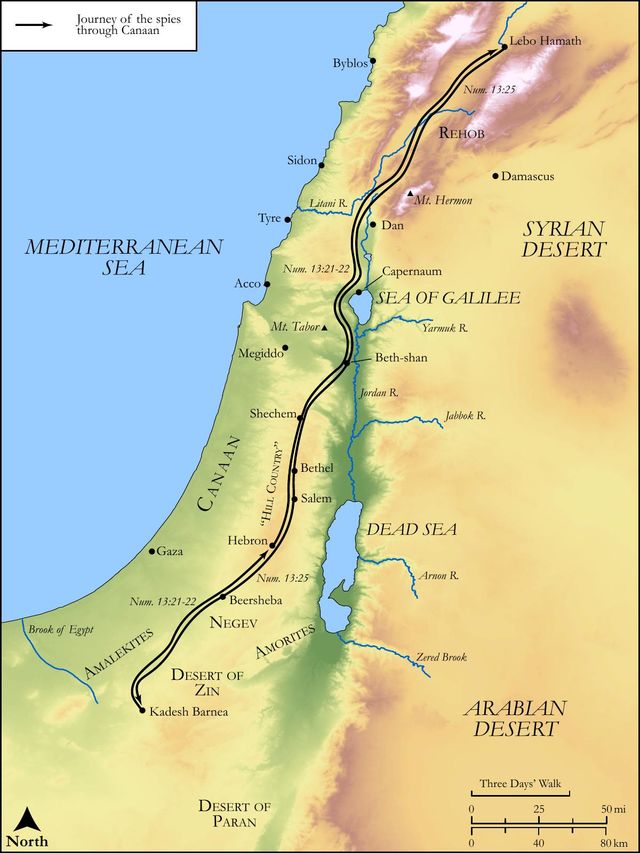
They were sent into the land of Canaan the nearest way, to traverse the country, and to take account of its present state, Num 13:17. Two heads of enquiry were given them in charge,
1.Concerning the land itself: See what that is (Num 13:18, and again, Num 13:19), see whether it be good or bad, and (Num 13:20) whether it be fat or lean. All parts of the earth do not share alike in the blessing of fruitfulness; some countries are blessed with a richer soil than others. Moses himself was well satisfied that Canaan was a very good land, but he sent these spies to bring an account of it for the satisfaction of the people; as John Baptist sent to Jesus, to ask whether he was the Christ, not to inform himself, but to inform those he sent. They must take notice whether the air was healthful or no, what the soil was, and what the productions; and, for the better satisfaction of the people, they must bring with them some of the fruits.
2.Concerning the inhabitants - their number, few or many - their size and stature, whether strong able-bodied men or weak, - their habitations, whether they lived in tents or houses, whether in open villages or in walled towns, - whether the woods were standing as in those countries that are uncultivated, through the unskillfulness and slothfulness of the inhabitants, or whether the woods were cut down, and the country made champaign, for the convenience of tillage. These were the things they were to enquire about. Perhaps there had not been of late years such commerce between Egypt and Canaan as there was in Jacob's time, else they might have informed themselves of these things without sending men on purpose to search. See the advantage we may derive from books and learning, which acquaint those that are curious and inquisitive with the state of foreign countries, at a much greater distance than Canaan was now from Israel, without this trouble and expense.
IV.Moses dismisses the spies with this charge, Be of good courage, intimating, not only that they should be themselves encouraged against the difficulties of this expedition, but that they should bring an encouraging account to the people and make the best of every thing. It was not only a great undertaking they were put upon, which required good management and resolution, but it was a great trust that was reposed in them, which required that they should be faithful.
Continue studying Numbers 13:19 across the web’s major study libraries — every link below opens this exact verse, chapter, or book on the destination site.
Read & Compare
 BibleGatewayThis verse in more than 200 translations and 70 languages.
 Bible.comThe YouVersion reader — hundreds of translations, reading plans, and highlights.
 ESV.orgCrossway's official English Standard Version reader.
 NET BibleThe NET translation with 60,000+ translators' notes on every rendering decision.
 STEP BibleTyndale House's free study tool — original text, vocabulary, and scholarly resources.
 BibliaLogos Bible Software's free web reader.
 USCCBThe New American Bible (Revised Edition) with the U.S. bishops' study notes.
Commentaries
 BibleHub CommentariesDozens of classic commentaries on this verse, gathered on one page.
 StudyLightMore than 100 commentary sets — the largest collection on the web.
 BibleRefPlain-English commentary on what this verse means, verse by verse.
 Enduring WordDavid Guzik's free commentary on this chapter, widely used by Bible teachers.
 Bible Study ToolsVerse commentary alongside Greek and Hebrew study aids.
Original Language & Research
- BibleHub InterlinearThe verse word by word — original language, transliteration, and English.
- BibleHub LexiconEvery word's original-language definition and Strong's entry.
 Blue Letter BibleDeep-study tools — Strong's numbers, concordance, and word studies.
 SefariaThe Hebrew text with Rashi and centuries of Jewish commentary.
Sermons, Hymns & Audio


TrulyRandomVerse is not affiliated with these sites and doesn’t control their content. They’re linked because they’re genuinely useful.
Summary
Numbers 13:19 presents Moses' critical instructions to the twelve tribal leaders dispatched to reconnoiter the land of Canaan. This verse precisely directs the spies to assess two fundamental aspects: the intrinsic quality of the land itself, determining its suitability for life and agriculture as "good or bad," and the nature of the inhabitants' settlements, observing whether they reside in temporary "tents" or formidable "strong holds." These directives were foundational for gathering comprehensive intelligence, enabling the Israelite nation to strategically prepare for their impending conquest and settlement of the divinely promised land.
Context
ShowHideLiterary Context
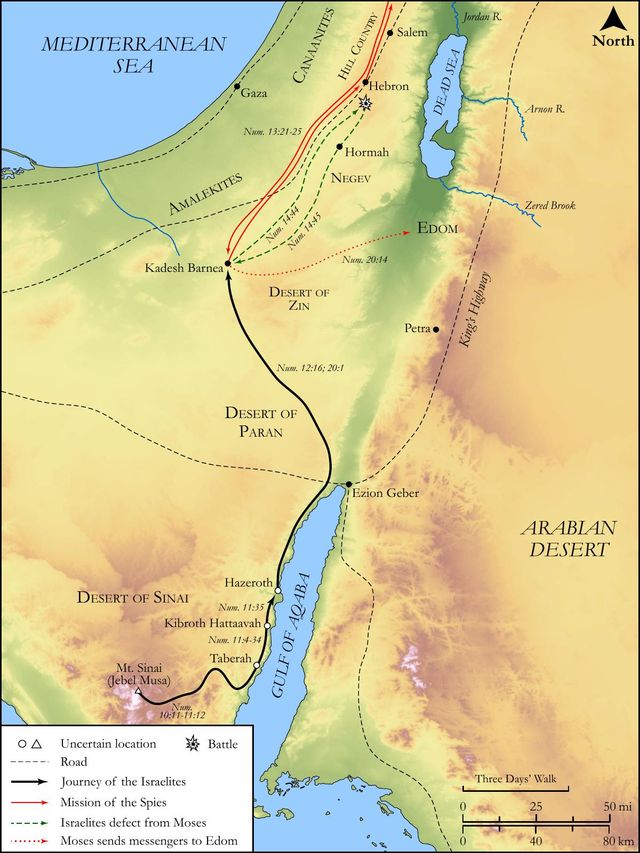
Numbers chapter 13 marks a pivotal turning point in the Israelites' wilderness journey, following their departure from Mount Sinai and arrival at Kadesh-barnea. The narrative details God's command to Moses to send one leader from each of the twelve tribes to explore Canaan, though Deuteronomy 1:22 indicates the people's request also played a role. Verses 17-20 encapsulate Moses' detailed instructions for this crucial reconnaissance mission. Specifically, Numbers 13:19 focuses on evaluating the land's inherent value and the strategic nature of the enemy's settlements. This immediate context sets the stage for the spies' forty-day mission and their subsequent, faithless report found in Numbers 13:26-33, which tragically led to the people's rebellion and the ensuing forty years of wilderness wandering, postponing their entry into the Promised Land.
Historical & Cultural Context
At the time of this event, the Israelites were encamped at Kadesh-barnea, strategically positioned on the southern border of Canaan, poised to enter the land promised to their ancestors. The land of Canaan was a mosaic of various city-states and tribal groups, many of whom maintained fortified settlements to defend against external threats and to secure resources. Military reconnaissance was a standard and indispensable practice before any significant campaign or migration. Understanding the terrain, available resources, and the strength of enemy fortifications was paramount for strategic planning and assessing the scale of the challenge. The stark contrast between "tents" (implying nomadic, less organized, or transient populations) and "strong holds" (indicating well-established, fortified cities) provided vital intelligence about the nature of the inhabitants and the military challenge that lay ahead, reflecting the realities of warfare, conquest, and settlement in that era.
Key Themes
ShowHideNumbers 13:19 contributes significantly to several overarching themes within the book of Numbers and the broader Pentateuch. Firstly, it highlights the theme of Divine Promise and Human Prudence. While God had promised a "land flowing with milk and honey" (as described in Exodus 3:8), Moses' detailed instructions demonstrate that divine promises do not negate the necessity of human diligence, strategic preparation, and a sober assessment of reality. God works through, not instead of, human wisdom. Secondly, the verse underscores the Nature of the Promised Land itself, which, though divinely appointed and ultimately good, was not without its challenges. The spies were tasked with objectively evaluating its "good or bad" aspects, setting up the subsequent tension between the land's inherent goodness and the formidable obstacles presented by its inhabitants. Finally, the focus on "strong holds" emphasizes the theme of Conquest and Warfare, reminding Israel that inheriting their covenantal land would require military engagement and a steadfast reliance on God's power to overcome formidable adversaries, a reliance beautifully exemplified later by Caleb's unwavering faith in Numbers 14:7-9.
Exposition and Analysis
ShowHideKey Word Analysis
ShowHideThis word possesses a wide semantic range, extending beyond mere moral goodness to encompass suitability, pleasantness, prosperity, and inherent quality. In the context of the land, it refers to its fertility, abundance, and overall suitability for supporting a large population. It indicates a land of blessing, provision, and desirable conditions for settlement and flourishing.
As the direct antonym of ṭôwb, this term denotes what is undesirable, difficult, harmful, or poor in quality. When applied to the land, it would suggest barrenness, scarcity of vital resources, challenging or inhospitable terrain, or conditions that would significantly hinder settlement and sustenance for a large nation.
This noun specifically refers to fortified places, fortresses, or well-defended, walled cities. It signifies locations that are militarily defensible and inherently difficult to conquer, implying the strength, organization, and established nature of the inhabitants. The assessment of these "strong holds" was crucial for understanding the formidable military challenge Israel would inevitably face in taking possession of the land.
Verse Breakdown
ShowHide"And what the land [is] that they dwell in, whether it [be] good or bad;"
This initial clause instructs the spies to conduct a comprehensive and objective evaluation of the land's intrinsic quality. They were to determine its agricultural potential, its water sources, its general habitability, and its overall capacity to sustain the entire Israelite nation. This was not a superficial glance but a detailed assessment of its inherent value and potential challenges from a practical, economic, and ecological perspective. The "good or bad" dichotomy served as a fundamental criterion for assessing the land's overall desirability and viability for a large, settled population.
"and what cities [they be] that they dwell in, whether in tents, or in strong holds;"
The second clause shifts the focus from the land's natural attributes to the human element—the inhabitants and their settlements. The spies were commanded to observe the nature of the cities and dwellings. Were the people nomadic, living in temporary "tents," which might suggest a less organized, perhaps more vulnerable or transient population? Or were they settled in formidable, well-defended "strong holds" (fortified cities), indicating a powerful, established, and militarily capable enemy? This intelligence was paramount for Moses and the Israelite leadership to formulate an effective strategic plan for conquest and settlement.
Literary Devices
ShowHideNumbers 13:19 effectively employs several literary devices to convey its precise and comprehensive instructions. The most prominent is Dichotomy, presenting two clear opposing options for assessment: "good or bad" for the land's quality and "tents or strong holds" for the nature of the dwellings. This binary structure emphasizes the thoroughness and objective nature of the reconnaissance mission, requiring the spies to categorize their observations clearly and without ambiguity. There is also an implied Interrogative Tone within the instructions, as Moses is essentially posing a series of critical questions that the spies are tasked with answering through their diligent observations. This highlights the information-gathering purpose and the strategic importance of the mission. Furthermore, the verse exhibits a subtle form of Parallelism in its two main clauses, both beginning with the interrogative "And what..." and proceeding to inquire about a key aspect of the land (its quality) and its inhabitants (their dwellings), reinforcing the two primary, interconnected areas of intelligence gathering.
Theological and Thematic Connections
ShowHideNumbers 13:19, though seemingly a practical military instruction, carries profound theological weight. It profoundly underscores the delicate yet crucial balance between divine promise and human responsibility. God had unconditionally promised Israel a "good land," yet Moses' instructions reveal that this divine promise did not negate the need for human diligence, strategic planning, and a sober, realistic assessment of the challenges ahead. The "good or bad" assessment of the land relates directly to God's character as a faithful provider and sustainer, while the "strong holds" represent the formidable obstacles that would inevitably test Israel's faith and absolute reliance on God's power. This tension between what God has promised and the challenges humans face in realizing that promise is a recurring biblical theme, culminating in the ultimate spiritual battles believers are called to engage.
Reflection and Application
ShowHideNumbers 13:19 offers enduring and vital lessons for believers today, emphasizing the critical balance between unwavering faith in God's sovereign promises and the practical wisdom of diligent preparation. Just as Moses instructed the spies to assess the "good or bad" of the land and the nature of the "strong holds," we are likewise called to discern the realities of our own "promised lands"—whether they manifest as new opportunities, ministries, personal callings, or significant life challenges. This involves a sober and prayerful evaluation of both the blessings and the potential difficulties, recognizing that God often works powerfully through our informed efforts and strategic planning. While we must trust implicitly in God's ultimate provision and assured victory, we are not called to be naive or reckless. Instead, we are to be prayerful, discerning, and strategic, identifying both the inherent goodness of God's gifts and the "strong holds" of spiritual opposition, cultural challenges, or personal weaknesses that might impede our progress. This verse profoundly encourages us to engage with our realities, not from a place of fear, but with wisdom, courage, and a deep reliance on divine guidance, so that we can walk confidently into the inheritance God has prepared for us, equipped for both blessing and spiritual battle.
Questions for Reflection
ShowHideFAQ
ShowHideWas it wrong for Moses to send spies if God had already promised the land to Israel?
ShowHideNo, sending the spies was not inherently an act of unfaithfulness or a questioning of God's divine promise. While God had indeed promised the land, He consistently works through human means and wisdom throughout biblical history. This reconnaissance mission was intended for strategic planning, understanding the practical challenges ahead, and building confidence among the people, not to determine if God's promise was true or achievable. The fundamental error lay not in the mission itself, but in the majority of the spies' fearful report and the people's subsequent lack of faith and rebellion, as vividly recounted in Numbers 14. Moses' detailed instructions in Numbers 13:17-20 reflect the actions of a wise and responsible leader preparing his people for a significant and challenging undertaking, trusting that God would empower them through their preparation.
Christ-Centered Fulfillment
ShowHideNumbers 13:19, in its call to assess the "good or bad" of the land and the nature of its "strong holds," finds its profound and ultimate fulfillment in Jesus Christ. The "good land" that Israel was poised to inherit serves as a powerful foreshadowing of the spiritual inheritance and abundant life found exclusively in Jesus Christ, which is truly "good" beyond all human measure, filled with "every spiritual blessing" (Ephesians 1:3). Moreover, the "strong holds" that the spies were tasked with identifying represent the spiritual strongholds of sin, death, and the powers of darkness that have held humanity captive throughout history. Jesus, as the ultimate "scout" and divine conqueror, entered the human condition, fully assessed the spiritual landscape of fallen humanity, and triumphed decisively over every "strong hold" of the enemy through His sacrificial death and glorious resurrection (Colossians 2:15). He has disarmed the rulers and authorities, making a public spectacle of them. Believers, united in Christ, are now empowered to pull down spiritual strongholds in their own lives and in the world, not by their own might or strategic reconnaissance, but by the divine power of the gospel (2 Corinthians 10:4-5). The true Promised Land is the rest and eternal inheritance we have in Him, a reality secured by His complete victory, not by human military might or earthly assessment (Hebrews 4:1-11).