


Nahum 3:9
Bible text: King James Version (1769 Blayney text) · Public domain
Bible text: Berean Standard Bible · Public domain
Bible text: American Standard Version (1901) · Public domain
Bible text: World English Bible, Messianic edition · Public domain
Bible text: Geneva Bible (1599) · Public domain
Bible text: Young's Literal Translation · Public domain
- כּוּשׁkushCushH3568N-properNoun Proper Location
- עָצְמָה'a·tze·Mah[was] its strengthH6109N-fs ¦ 3fsNoun Singular Feminine Absoluteעָצְמָ[was] strengthהits
- וּמִצְרַיִםu·mitz·Ra·yimand EgyptH4714Conj-w ¦ N-properNoun Proper LocationוּandמִצְרַיִםEgypt
- וְאֵיןve·'Einand there notH369Conj-w ¦ N-mscNoun Singular Masculine Constructוְandאֵיןthere not
- קֵצֶהKe·tzeh[was] an endH7097N-msNoun Singular Masculine Absolute
- פּוּטputPutH6316N-properNoun Proper Location
- וְלוּבִיםve·lu·Vimand [the] LibyansH3864Conj-w ¦ N-mpNoun Gentilic Plural Masculine Absoluteוְandלוּבִים[the] Libyans
- הָיוּha·Yuthey wereH1961V-Qal-Perf-3cpVerb Qal Perfect 3rd Plural common gender
- בְּעֶזְרָתֵךְbe·'ez·ra·Tekh<in> your helpH5833Prep-b ¦ N-fsc ¦ 2fsNoun Singular Feminine Constructבְּ<in>עֶזְרָתֵhelpךְyour
English is a literal word-by-word gloss of the Hebrew, not the KJV's wording. Why?
This is the original text the KJV's translators worked from — each Hebrew word with its own literal English meaning in this verse, prepared by scholars at Tyndale House, Cambridge. The KJV translates whole sentences, not word by word, so its wording differs: one Hebrew word can become several English words, and the KJV may choose “the LORD” where the gloss reads “Yahweh”. Both are faithful — they answer different questions. For the KJV's own rendering, switch to the KJV text.
Details
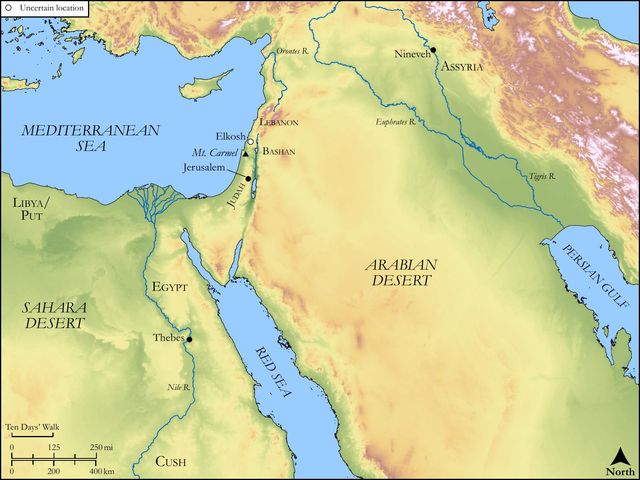
See on the biblical-era map
Study this verse
Public-domain commentary
Matthew Henry
From his Commentary on the Whole Bible. Henry comments on passages, not single verses — this entry covers Nahum 3:8–19. His three-level outline is real structure in the source text, so it is rendered as structure.
Nineveh has been told that God is against her, and then none can be for her, to stand her in any stead; yet she sets God himself at defiance, and his power and justice, and says, I shall have peace. Threatened folks live long; therefore here the prophet largely shows how vain her confidences would prove and insufficient to ward off the judgment of God. To convince them of this,
I.He shows them that other places, which had been as strong and as secure as they, could not keep their ground against the judgments of God.
Nineveh shall fall unpitied and uncomforted (for miserable comforters will those prove who speak peace to those on whom God will fasten trouble), and she shall not be able to help herself: Art thou better than populous No? Nah 3:8. He takes them off from their vain confidences by quoting precedents. The city mentioned is No, a great city in the land of Egypt (Jer 46:25), No-Ammon, so some read it both there and here. We read of it, Eze 30:14-16. Some think it was Diospolis, others Alexandria. As God said to Jerusalem, Go, see what I did to Shiloh (Jer 7:12), so to Nineveh that great city, Go, see what I did to populous No. Note, It will help to keep us in a holy fear of the judgments of God to consider that we are not better than those that have fallen under those judgments before us. We deserve them as much, and are as little able to grapple with them. This also should help to reconcile us to afflictions. Are we better than such and such, who were in like manner exercised? Nay, were not they better than we, and less likely to be afflicted? Now, concerning No, observe,
1.How firm her standing seemed to be, Nah 3:8. She was fortified both by nature and art, was situate among the rivers. Nile, in several branches, not only watered her fields, but guarded her wall. Her rampart was the sea, the lake of Mareotis, an Egyptian sea, like the sea of Tiberias. Her wall was from the sea; it was fenced with a wall which was thought to make the place impregnable. It was also supported by its interests and alliances abroad, Nah 3:9. Ethiopia, or Arabia, was her strength, either by the wealth brought to her in a way of trade or by the auxiliary forces furnished for military service. The whole country of Egypt also contributed to the strength of this populous city; so that it was infinite, and there was no end of it (so it might be rendered); She set no bounds to her ambition and knew no end of her wealth and strength; people flocked to her endlessly, and she thought there never would be any end of it; but it is God's prerogative to be infinite. Put and Lubim were thy helpers, two neighbouring countries of Africa, Mauritania and Libya, that is, Libya Cyrenica, a country that Egypt had much dependence upon. No, thus helped, seemed to sit as a queen, and was not likely to see any sorrow. But,
2.See how fatal her fall proved to be (v, 10): Yet was she carried away, and her strength failed her; even she that was so strong, so secure, yet went into captivity. This refers to some destruction of that city which was then well-known, and probably fresh in memory, though not recorded in history; for the destruction of it by Nebuchadnezzar (if we should understand this prophetically) could not be made an example to Nineveh; for the reducing of Nineveh was one of the first of his victories and that of Egypt one of the last. The strength and grandeur of that great city could not be its protection from military execution.
(1.)Not from that which was most barbarous; for her young children had no compassion shown them, but were dashed in pieces at the top of all the streets by the merciless conquerors.
(2.)Not from that which was most inglorious and disgraceful: They cast lots for her honourable men that were made prisoners of war, who should have them for their slaves. So many had they of them that they knew not what to do with them, but they made sport with throwing dice for them; all her great men, that used to be adorned on state-days with chains of gold, were now bound in chains of iron; they were pinioned or handcuffed (so the word properly signifies), not only as slaves, but as condemned malefactors. What a mortification was this to populous No, to have her honourable men and great men, that were her pride and confidence, thus abused! Now hence he infers against Nineveh (Nah 3:11), "Thou also shalt be intoxicated, infatuated; thou also shalt reel and stagger, as drunk with the cup of the Lord's fury, that shall be put into thy hand" (see Jer 25:17, Jer 25:27); "Thou shalt fall and rise no more. The cup shall go round, and come to thy turn, O Nineveh! to drink off at last, and shall be to thee as the waters of jealousy."
II.He shows them that all those things which they reposed a confidence in should fail them.
1.Did the men of Nineveh trust to their own magnanimity and bravery? Their hearts should sink and fail them. They shall be hid, shall abscond for shame, being in disgrace, abscond for fear, being in distress and danger, and not able to face the enemies, because of whose strength and terror, having no strength of their own, they shall seek strength, shall come sneaking to their neighbours to beg their assistance in a time of need. Thus God can cut off the spirit of princes, and take away their heart.
2.Did they depend upon their barrier, the garrisons and strongholds they had, which were regularly fortified and bravely manned? Those shall prove but paper-walls, and like the first-ripe figs, which, if you give the tree but a little shake, will fall into the mouth of the eater that gapes for them; so easily will all their strongholds be made to surrender to the advancing enemy, upon the first summons, Nah 3:12. Note, Strongholds, even the strongest, are no fence against the judgments of God, when they come with commission. The rich man's wealth is his strong city, and a high wall, but only in his own conceit, Pro 18:10. They are supposed to make their strongholds as strong as possible, and are challenged to do their utmost to make them tenable, and serviceable to them against the invader (Nah 3:14): Draw thee water for the siege; lay in great quantities of water, that that which is so necessary to the support of human life may not be wanting; it is put here for all manner of provision, with which Nineveh is ironically told to furnish herself, in expectation of a siege. "Take ever so much care that thou mayest not be starved out, and forced by famine to surrender, yet that shall not avail. Fortify the strongholds, by adding out-works to them, or putting men and arms into them," as with us by planting cannon upon them. "Go into clay, and tread the mortar, and make strong the brick-kiln; take all the pains thou canst in erecting new fortifications; but it shall be all in vain, for (Nah 3:15) there shall even the fire devour thee if it be taken by storm." It is by fire and sword that in time of war the great devastations are made.
3.Did they put confidence in the multitude of their inhabitants? Were they, from their number and valour, reckoned their strongest walls and fortifications? Alas! these shall stand them in no stead; they shall but sink the sooner under the weight of their own numbers (Nah 3:13): Thy people in the midst of thee are women; they have no wisdom, no courage; they shall be fickle, feeble, and faint-hearted, as women commonly are in such times of danger and distress; they shall be at their wits' end, adding to their griefs and fears by the power of their own imagination, and utterly unable to do any thing for themselves; the valiant men shall become cowards. O ver Phrygiae, neque enim Phryges - Phrygian dames, not Phrygian men. Though they make themselves many (Nah 3:15), as the canker-worm and as the locust, that come in vast swarms, though thou hast multiplied thy merchants above the stars of heaven, though thy exchange be thronged with wealthy traders, who, having so much money to stand up in defence of and so much to lay out in the means of their defence, should, one would think, give the enemy a warm reception, yet their hearts shall fail them too; though they be numerous as caterpillars, yet the fire and sword shall eat them up easily and irresistibly as the canker-worm, Nah 3:15. They are as numerous as those wasting insects, but their enemies shall be mischievous like them. He adds (Nah 3:16), The canker-worm spoils, or spreads herself, and flies away. Both the merchants and the enemies were compared to canker-worms. The enemies shall spoil Nineveh, and carry away the spoil, without opposition, or any hope of recovering it. Or the rich merchants, who have come from abroad to settle in Nineveh, and have raised vast estates there, out of which it was hoped they would contribute largely for the defence of the city, when they see the country invaded and the city likely to be besieged, will send away their effects, and remove to some other place, will spread their wings and fly away where they may be safe, and Nineveh shall be never the better for them. Note, It is rare to find even those that have shared with us in our joys willing to share with us in our griefs too. The canker-worms will continue upon the field while there is any thing to be had, but they are gone when all is gone. Those that men have got by they do not care to lose by. Nineveh's merchants bid her farewell in her distress. Riches themselves are as the canker-worms, which on a sudden fly away as the eagle towards heaven, Pro 23:5.
4.Did they put a confidence in the strength of their gates and bars? What fence will those be against the force of the judgments of God? Nah 3:13. The gates of thy land shall be set wide open unto thy enemies, the gates of thy rivers (Nah 2:6), the flood-gates, or the passes and avenues, by which the enemy would make his entrance into the country, or the gates of the cities; these, though ever so strong and well-guarded, shall not answer their end: The fire shall devour thy bars, the bars of thy gates, and then they shall fly open.
5.Did they put a confidence in their king and princes? They should do them no service (Nah 3:17): Thy crowned heads are as the locusts; those that had pomp and power, as crowned heads, were enfeebled, and had no power to make resistance, when the enemy came in like a flood. "Thy captains, that should lead thy forces into the field, are great indeed, and look great, but they are as the great grasshoppers, the maximum quod sic - the largest specimens of that species; still they are but grasshoppers, worthless things, that can do no service. They encamp in the hedges, in the cold day, the cold weather, but, when the sun arises, they flee away, and are gone, nobody knows whither. So these mercenary soldiers that lay slumbering about Nineveh, when any trouble arises, flee away, and shift for their own safety. The hireling flees, because he is a hireling." The king of Assyria is told, and it is a shame he needs to be told it (who might observe it himself), that his shepherds slumber; they have no life or spirit to appear for the flock, and are very remiss in the discharge of the duty of their place and the trust reposed in them: Thy nobles shall dwell in the dust, and be buried in silence.
6.Did they hope that they should yet recover themselves and rally again? In this also they should be disappointed; for, when the shepherds are smitten, the sheep are scattered; the people are dispersed upon the mountains and no man gathers them, nor will they ever come together of themselves, but will wander endlessly, as scattered sheep do. The judgment they are under is as a wound, and it is incurable; there is no relief for it, "no healing of thy bruise, no possibility that the wound, which is so grievous and painful to thee, should be so much as skinned over; thy case is desperate (Nah 3:19) and thy neighbours, instead of lending a hand to help thee, shall clap their hands over thee, and triumph in thy fall; and the reason is, because thou hast been one way or other injurious to them all: Upon whom has not thy wickedness passed continually? Thou hast been always doing mischief to those about thee; there is none of them but what thou hast abused and insulted; and therefore they shall be so far from pitying thee that they shall be glad to see thee reckoned with." Note, Those that have been abusive to their neighbours will, one time or another, find it come home to them; they are but preparing enemies to themselves against their day comes to fall: and those that dare not lay hands on them themselves will clap their hands over them, and upbraid them with their former wickedness, for which they are now well enough served and paid in their own coin. The troublers shall be troubled will be the burden of many, as it is here the burden of Nineveh.
Historical interpretation
Historical reception
1 surviving comment on this verse from the historical church.
(Verse 8 and following) Are you better than Amon ((Vulgate: Alexandria of the nations)), who lived by the rivers? Her water was like a sea, her walls were like fortifications, Ethiopia and Egypt were her strength, and there was no end to her wealth; Africa and Libya were her allies. But she too was led into captivity, her young children were dashed to pieces at every street corner, her nobles were cast lots upon, and all her dignitaries were bound in chains. And so you will be intoxicated and despised; and you will seek your help from your enemies, all your fortresses like fig trees with their ripe fruit, if they are shaken, will fall into the mouth of the eater. LXX: Aptly did Ammon, who dwells in rivers, water surrounding it, whose beginning is the sea, and its water is a wall. Ethiopia is its strength and Egypt, and there is no end to your flight. Put and the Libyans have become its helpers, and it itself will go into exile, and its little ones will be dashed to pieces at the head of its roads, and they will cast lots over all its noble men, and all its princes will be bound in fetters; and you will be intoxicated and despised, and you will seek there to stand against your enemies; all your fortresses, like fig trees with ripe fruit, if they are shaken, will fall into the mouth of the eater. Because in the Septuagint it is read, Apta chordam, the part of Ammon; and the other interpreters have translated: Are you better than Amon? The Hebrew scholar who instructed me in the Scriptures asserted that it could be read as: Are you better than No, Amon? And he said, in Hebrew No is called Alexandria: but Amon means multitude, or peoples, and is the order of reading: Are you better than populous Alexandria, or the peoples that dwell by its rivers, with water surrounding it? Not because at that time it was called Alexandria, since it received its name long after Alexander the Great, the Macedonian; but because under its first name, that is, No, it was always the metropolis of Egypt and exceedingly populated. Finally, even those who recorded the deeds of Alexander believe that it was the chief city of Egypt. Moreover, the prophet Jeremiah, understanding by Amon or No Alexandria in his vision against Egypt, to which he says: Beautiful heifer Egypt, a destroyer comes from the north to her (Jer. 46:20), also adds more clearly: The daughter of Egypt is put to shame, given into the hand of the people of the north, says the Lord God of hosts, the God of Israel. Behold, I will visit upon Amon of Menno () , that is, upon the mound (or tomb) of Alexandria (Ibid., 24 ff.): For Amon, as we said, signifies peoples; But Men the preposition de signifies; And No signifies Alexandria. And he says, I will visit upon Pharaoh, and upon Egypt, and upon its gods, and upon its kings, and upon Pharaoh, and upon those who hope in it; and I will give into the hand of those seeking their souls, and into the hand of Nebuchadnezzar, king of Babylon, and into the hand of his servants. Therefore it is said to Nineveh: Are you richer or more powerful than Alexandria? And the location of Alexandria is described, which is situated on the Nile and the sea, surrounded by waters and rivers on both sides. Water surrounds it, the wealth of the sea; its walls are made of water: on one side by the Nile River, on the other side by Lake Mareotis, and on another side by the sea. The fact that Ethiopia and Egypt, and Africa, which is called Phut in Hebrew, and Libya are under its protection, demonstrates the location of the provinces and the city. And so, as the prophet says, this is how your speech describes it, will be captured by the Babylonian king, and he will be both your devastator and his. This is also recounted by Josephus, a writer of Jewish history, in his books. Her little ones will be dashed in the streets, her nobles will be divided by the lot of the victors, and the once mighty princes will be led away in chains. Therefore, as Alexandria suffers these things, you, O Nineveh, will drink from the same cup, and you will be intoxicated and despised while lying in a state of unconsciousness, and you will come to such great necessity that you will seek help from the Babylonians or against the Babylonians, from your enemies. All your firmaments and walls stretching high, and the heights of towers, which you now think are impregnable, and your strong men and warriors will be compared to primitive figs, which if shaken with a light touch, will fall and be devoured. For what is read in the Septuagint: 'Fit, or compose a chord,' is still said to Nineveh. And the meaning is: Your disorderly and unarranged, and discordant in different ways, is fitted to the likeness of chords, Nineveh, because your appearance and greatness, which you believe to be exceptional, will be of no use to you unless you fit yourself for singing. Consider then all the part of the lot of the sons of Ammon, and whatever possessions are considered good, how did they not defend them so that they would not go into captivity, and so that their little ones would not stumble in the ways? What good were the rivers near which the city of Ammon was situated? What, besides the rivers, did the multitude of wells and springs, beginning from the Dead Sea and surrounding its region, provide to it? What help did Ethiopia and Egypt, once its allies, provide to it? How then did the help of the allies not benefit her? In this way, Ninive, there will be no end to your fleeing, but you will be devastated here and there. What can I say of the Ethiopians, and of the Egyptians who were rulers of the descendants of Ammon, when even the Libyans were allied with her? And so she will be led into captivity, and her little ones, because they will not be able to enter, will be killed in the streets, lying prostrate before their parents' eyes, and all her wealth will perhaps be divided among the victors. And no one of the leaders will escape, for they will be bound with iron and shackles. And so, o Nineveh, you will be intoxicated, and once rich and beautiful, who had so many lovers, you will be despised by all, and while your enemies pursue you, you will seek rest and not find it. All your warriors and all your allies will be plundered by the enemy, and without any effort they will be captured like ripe figs, which when shaken do not fall to the ground, so that at least there is some small labor for those gathering, but they will immediately fall into the mouth of the devourer. Let these words be paraphrased according to the Septuagint interpreters: for we have once proposed to follow the Vulgate edition, so that we do not appear to have given any occasion for reprehending the excetrae and Sardanapalus. Moreover, the example of the overthrow of Nineveh does not seem to me to be sufficiently congruent with the sons of Lot, who are called Ammon. For first, it is said Ammon (Genesis X), not Amman; secondly, Ammana, which is now called Philadelphia, is not situated beside rivers, nor are its riches gathered from the sea, since it is inland, neither does it have Ethiopia and Egypt and Africa and Libya as allies, when all these things, both according to power and according to example, and according to the description of the place and region, and the friendly nations, are more suited to being compared to Alexandria; and never would the most powerful city of Nineveh, compared to the lesser Philadelphia, have heard from the prophet: Are you better? But to whom is it said: Are you not better? It is shown that you are lesser than the one you are compared to, and you should not bear it unworthily if it is captured, since it was overcome by the same enemy who is greater, stronger, and more powerful both in the nature of the place and in brave men. But since we have interpreted Nineveh and this world, it is commanded to him to tune and compose his strings, and to prepare himself for a mournful song: for indeed the part of the sons of Ammon, which was much better than Nineveh and had dwelt over the rivers, because it was found in error, paid the penalties for its own crime. First, according to the history of Alexandria, it must be said that 'Ammon' interprets the people, and the meaning is according to the laws of allegory: Consider the people of the Church who dwell upon the rivers of the prophets, and it has teachers in its vicinity, from whose womb rivers flow, with its beginning being the sea. From the reading of the Law, which is bitter without the wood of Christ, we arrive at the likeness of Myrrh to its mystery, which has Ethiopia in its strength: Ethiopia indeed shall stretch out her hands to God (Ps. 68) : and Egypt into which the Lord came in a light cloud: and the Libyans who formerly dwelt in barrenness, but afterwards became his helpers. And if she does not realize this and guard her heart with all diligence, she will be taken captive and will mourn for her children. Her little ones, who are still in the early stages of their journey and have not reached the middle of the road, will be stumbled in their own beginnings. And the most cruel enemies will hasten to divide among themselves the splendid things of hers, and they will drag into captivity the noble ones whom we can understand as the leaders and governors, bound in chains and hindered by the weight of the heaviest fetters. And so, Nineveh, you, infidel men, who adhere completely to the world, will feel punishment, and you will drink from my cup and fall into the same vice as those who were on my side and fell by their own fault. And you will despise me; you will seek an end between the vices and disturbances that oppress you, and yet you will not be able to find a stop and an end to your evils. And all your desires and pleasures, and worldly powers, and the doctrines that you thought you had so firmly, will be devoured by the one who eats, as Samson says in a parable: 'Out of the eater came forth meat, and out of the strong came forth sweetness' (Judges 14:14). For then, all your strong things and the sweet fruits that promised delights to the eyes of the beholders will fall into the mouth of the devouring devil with the first shaking of the tree, by whom Nineveh had always been tested and possessed. Furthermore, what we have omitted: And there is no end to your flight, because it is said to Nineveh, and among those things which are written about Ammon, it is placed, and it seems extraordinarily inserted in a foreign place, as if we refer to Nineveh by way of excess: And you will be intoxicated, and there is no end to your flight, and you will be despised, and the rest of the things that are said to Nineveh. And we will interpret that there is no end to the flight of Nineveh from God, because it always makes progress in fleeing, and never wants to stop, according to what we said above: And those who flee did not stand, and there was no one to look back. And we will say that Holy Scripture is interwoven with these difficulties, especially the prophets who are full of riddles, so that the difficulty of meaning also involves the difficulty of language: so that the holy things may not easily be revealed to dogs, and pearls to pigs, and sacred things to the profane. And if we wish to interpret Ammon as referring to the sons of Lot, let us say that Lot had two sons from his two daughters, Moab and Ammon, of whom the older, Moab, is interpreted as from the father or paternal water, but the younger, Ammon, may be understood as either the son of my generation or our people (Genesis XIX). And I consider how (or in what manner) he who was born from Judah, because of sin, is said to him: Seed of Canaan, and not Judah (Dan. XIII, 56). And in Ezekiel to Jerusalem, the sinner (or harlot): Your root and your generation are from the land of Canaan, your father is an Amorite (or Canaanite), and your mother is a Hittite (Ezek. XVI, 3): thus those who were from the former people, that is, the Jews; and from the latter, that is, from us, Moabites and Ammonites are figuratively called. And because they had turned away from their father (for the name Lot means 'turning away'), they will be subjected to punishment and will suffer all that we have mentioned above. But if even those who were once holy incur the severity of God, and she who dwelt among the rivers will be purged by the fire of Gehenna, how much more will Nineveh, which had no law before and did not receive the yoke of God's commandments, fall in the end into the devouring mouth because of its pride!
Continue studying Nahum 3:9 across the web’s major study libraries — every link below opens this exact verse, chapter, or book on the destination site.
Read & Compare
 BibleGatewayThis verse in more than 200 translations and 70 languages.
 Bible.comThe YouVersion reader — hundreds of translations, reading plans, and highlights.
 ESV.orgCrossway's official English Standard Version reader.
 NET BibleThe NET translation with 60,000+ translators' notes on every rendering decision.
 STEP BibleTyndale House's free study tool — original text, vocabulary, and scholarly resources.
 BibliaLogos Bible Software's free web reader.
 USCCBThe New American Bible (Revised Edition) with the U.S. bishops' study notes.
Commentaries
 BibleHub CommentariesDozens of classic commentaries on this verse, gathered on one page.
 StudyLightMore than 100 commentary sets — the largest collection on the web.
 BibleRefPlain-English commentary on what this verse means, verse by verse.
 Enduring WordDavid Guzik's free commentary on this chapter, widely used by Bible teachers.
 Bible Study ToolsVerse commentary alongside Greek and Hebrew study aids.
Original Language & Research
- BibleHub InterlinearThe verse word by word — original language, transliteration, and English.
- BibleHub LexiconEvery word's original-language definition and Strong's entry.
 Blue Letter BibleDeep-study tools — Strong's numbers, concordance, and word studies.
 SefariaThe Hebrew text with Rashi and centuries of Jewish commentary.
Sermons, Hymns & Audio


TrulyRandomVerse is not affiliated with these sites and doesn’t control their content. They’re linked because they’re genuinely useful.
Summary
Nahum 3:9 vividly illustrates the immense, seemingly insurmountable strength and vast international alliances of No Amon (Thebes), a powerful Egyptian city, by listing Ethiopia, Egypt, Put, and Lubim as its formidable sources of power and aid. This verse serves as a crucial historical parallel within Nahum's prophecy, demonstrating that even such overwhelming human might, described as "infinite," was utterly incapable of preventing divine judgment and destruction, thereby setting a stark precedent for Nineveh's impending doom.
Context
ShowHideLiterary Context
Nahum 3:9 is situated within a scathing prophetic oracle against Nineveh, the capital of the Assyrian Empire, in the third and final chapter of the book. This chapter details the reasons for Nineveh's destruction—its idolatry, harlotry (political alliances), and oppressive cruelty—and vividly portrays its downfall. Verses 8-10 specifically reference the recent fall of No Amon (Thebes) as a historical precedent and a warning. Nahum draws a direct parallel: if a city as mighty and well-defended as No Amon, with its extensive network of allies, could fall, then Nineveh, despite its own perceived invincibility, would certainly suffer a similar fate. This comparison underscores the certainty of God's judgment and the futility of human strength against divine decree.
Historical & Cultural Context
The fall of No Amon (Thebes), a major religious and political center of ancient Egypt, occurred around 663 BCE when it was sacked by the Assyrian king Ashurbanipal. This event was a significant geopolitical upheaval, demonstrating Assyria's dominance. Nahum's prophecy, likely delivered shortly after this event, would have resonated powerfully with his audience, who were well aware of Thebes' immense wealth, strategic location, and formidable military. Ethiopia (Cush), Egypt (Mizraim), Put, and Lubim were powerful nations and regions, often allied with or under the influence of Egypt, providing significant military and economic support. Their inclusion emphasizes the vast resources and alliances Thebes could muster, making its fall all the more shocking and illustrative of God's supreme power over even the most dominant empires of that day.
Key Themes
ShowHideThis verse, within its broader context, powerfully contributes to several overarching themes in Nahum. First, it highlights the futility of human strength and alliances when confronted by divine judgment, emphasizing that no earthly power, however vast or "infinite," can withstand God's decree (see Psalm 33:16-17). Second, it underscores God's absolute sovereignty and unwavering judgment against wickedness. The destruction of No Amon, and by extension Nineveh, serves as a clear demonstration that the Lord alone holds ultimate authority over the rise and fall of nations, executing justice against those who persist in sin (compare Nahum 1:2-3). Finally, the use of No Amon's fate functions as a warning through historical precedent, urging Nineveh (and by extension, any nation) to recognize the consequences of rebellion against God.
Exposition and Analysis
ShowHideKey Word Analysis
ShowHideMeaning "powerfulness" or, by extension, "numerousness" and "abundance." This word emphasizes the sheer might and vast resources, particularly military and demographic, that No Amon possessed. It speaks to the quantitative and qualitative aspects of its formidable power base.
This KJV translation combines H369 (ʼayin), meaning "no" or "not," and H7097 (qâtseh), meaning "extremity," "end," or "limit." Together, "no end" or "without limit" vividly conveys the immeasurable, uncountable nature of No Amon's resources and the vastness of its allied support. It is a hyperbolic expression of overwhelming magnitude.
Meaning "aid" or "help." This term specifically denotes the assistance and support provided by the allied nations. It highlights the reliance of No Amon on external forces for its security and military advantage, underscoring the broad network of alliances it had cultivated.
Verse Breakdown
ShowHide"Ethiopia and Egypt [were] her strength"
This clause identifies the primary pillars of No Amon's (Thebes') power. Ethiopia (Cush) and Egypt (Mizraim) were major regional powers that historically influenced or controlled parts of the Nile Valley. Their inclusion signifies the vast geographical reach and formidable military and economic might that Thebes could command or draw upon, making it a seemingly impregnable fortress.
"and [it was] infinite"
This phrase modifies the "strength" previously mentioned, emphasizing its immeasurable quality. The resources, manpower, and strategic depth provided by Ethiopia and Egypt were perceived as boundless, without limit, and overwhelmingly vast. This hyperbole serves to magnify the extent of No Amon's perceived invincibility, making its subsequent fall all the more astounding and illustrative of God's power.
"Put and Lubim were thy helpers"
This clause expands on No Amon's network of support, identifying additional allies. Put (likely ancient Libya or a region in North Africa) and Lubim (another Libyan tribe or region) represent further military and possibly economic aid that bolstered Thebes' defenses. "Helpers" underscores their role as auxiliary forces or contributing nations, further illustrating the extensive web of alliances that contributed to No Amon's formidable, yet ultimately futile, strength.
Literary Devices
ShowHideNahum 3:9 employs several potent literary devices to amplify its message. Hyperbole is evident in the description of No Amon's strength as "infinite," an exaggeration designed to emphasize the immense, seemingly insurmountable power that God would nevertheless overcome. This serves to magnify God's sovereignty and the certainty of His judgment. The verse also utilizes Parallelism by explicitly drawing an Analogy between No Amon's fate and Nineveh's impending destruction, even though Nineveh is not directly named in this specific verse. The entire passage (Nahum 3:8-10) functions as a Historical Precedent, using a recent, well-known event (the fall of Thebes) to serve as a prophetic warning and a vivid illustration of the principle that no human power can ultimately withstand divine judgment. There is also an underlying Irony in the fact that such "infinite" strength and numerous "helpers" ultimately proved useless against the will of God, highlighting the futility of trusting in worldly might.
Theological and Thematic Connections
ShowHideNahum 3:9 powerfully underscores the theological truth that all human strength, alliances, and perceived invincibility are ultimately finite and subject to the sovereign will of God. The "infinite" power of No Amon, bolstered by mighty nations, crumbled under divine judgment, serving as a stark reminder that God alone is truly infinite in power and authority. This passage challenges any human tendency to place ultimate trust in military might, economic prowess, or political alliances, redirecting our gaze to the unchanging and all-powerful nature of the Lord, who raises up and brings down nations according to His righteous purposes. It reinforces the biblical theme that pride and self-reliance, especially when manifested in national power that opposes God, inevitably lead to destruction.
Reflection and Application
ShowHideNahum 3:9 serves as a profound spiritual mirror for individuals and nations alike, challenging where we place our ultimate trust and security. In a world that often values power, wealth, and strategic alliances, this verse reminds us that such foundations are inherently unstable and fleeting. Just as No Amon's "infinite" strength proved futile, so too will any human endeavor or system that operates outside of God's will. For believers, this is a call to radical dependence on God alone, recognizing that true security and lasting strength are found only in Him. It encourages humility, reminding us that our achievements, resources, or connections are ultimately gifts from God, not ends in themselves. This passage invites us to examine our own hearts: Do we subtly rely on our financial stability, our professional networks, our nation's military might, or even our own cleverness more than we rely on the Lord? True peace and confidence come from acknowledging God's supreme sovereignty and aligning our lives with His purposes, knowing that His power is truly infinite and His promises never fail.
Questions for Reflection
ShowHideFAQ
ShowHideWho were Put and Lubim, and why are they mentioned alongside Ethiopia and Egypt?
ShowHidePut (H6316, Pûwṭ) and Lubim (H3864, Lûwbîy) were ancient peoples and regions associated with North Africa, particularly Libya. Put is generally identified with Libya, a son of Ham (Genesis 10:6), and his descendants or their territory. Lubim refers to the Libyans, often mentioned in conjunction with Egypt and Ethiopia as military allies or mercenaries. They are mentioned alongside Ethiopia and Egypt in Nahum 3:9 to further emphasize the vast and diverse network of alliances and military support that No Amon (Thebes) commanded. Their inclusion highlights the sheer scale of the resources and manpower that Thebes could draw upon, reinforcing the idea that its strength was "infinite" and seemingly insurmountable. This detail magnifies the impact of Thebes' fall, demonstrating that even such extensive human power could not withstand divine judgment.
Why does Nahum use the example of No Amon's fall as a warning to Nineveh?
ShowHideNahum uses the fall of No Amon (Thebes) as a powerful historical precedent and a direct warning to Nineveh because Thebes was, in its time, considered one of the most formidable and secure cities of that day, much like Nineveh itself. Thebes had immense wealth, strategic defenses (surrounded by the Nile and its canals), and powerful allies like Ethiopia, Egypt, Put, and Lubim. Its recent destruction by the Assyrians (around 663 BCE) would have been a well-known and shocking event. By drawing this parallel, Nahum argues that if a city as mighty and seemingly invincible as Thebes could fall despite its "infinite" strength and numerous "helpers," then Nineveh, despite its own perceived invulnerability and notorious cruelty, would certainly suffer the same fate at the hands of the Lord. It serves as an undeniable object lesson in divine sovereignty and the futility of human strength against God's righteous judgment, vividly illustrating that no nation is exempt from accountability before Him (see Nahum 1:2-3).
Christ-Centered Fulfillment
ShowHideNahum 3:9, with its stark portrayal of the futility of "infinite" human strength and alliances against divine judgment, finds its ultimate Christ-centered fulfillment not in the defeat of a worldly empire, but in the paradoxical triumph of God's kingdom through the apparent weakness of the cross. While the Old Testament prophets often highlighted God's power in overthrowing earthly kingdoms, the New Testament reveals that God's true strength is perfected in weakness, culminating in Christ's crucifixion and resurrection. Jesus, the true King, did not rely on earthly armies or "infinite" human helpers; instead, He emptied Himself, taking the form of a servant, and became obedient to death, even death on a cross (Philippians 2:7-8). His victory over sin and death was not achieved through conventional displays of power, but through self-sacrificial love, demonstrating that God's kingdom operates on an entirely different principle than the world's. The "infinite" strength of God is not found in the might of nations, but in the redemptive power of the Lamb of God, who takes away the sin of the world (John 1:29). Thus, Nahum's message of human futility points forward to the ultimate and true strength found only in Christ, whose kingdom is not of this world, yet will ultimately prevail over all earthly powers and principalities (Colossians 2:15).