


Matthew 24:20
Bible text: King James Version (1769 Blayney text) · Public domain
Bible text: Berean Standard Bible · Public domain
Bible text: American Standard Version (1901) · Public domain
Bible text: World English Bible, Messianic edition · Public domain
Bible text: Geneva Bible (1599) · Public domain
Bible text: Young's Literal Translation · Public domain
- προσεύχεσθεproseuchesthedo prayG4336V-PNM-2PVerb Present Middle Or Passive Deponent Imperative 2nd Plural
- δὲdehoweverG1161CONJConjunction
- ἵναinathatG2443CONJConjunction
- μὴmēnotG3361PRT-NNegative Particle Negative
- γένηταιgenētaiit may happenG1096V-2ADS-3SVerb 2nd Aorist Middle Deponent Subjunctive 3rd Singular
- ἡhētheG3588T-NSFDefinite article Nominative Singular Feminine
- φυγὴphugēflightG5437N-NSFNoun Nominative Singular Feminine
- ὑμῶνhumōnof youG4771P-2GPPersonal pronoun Genitive 2nd Plural
- χειμῶνοςcheimōnosin winterG5494N-GSMNoun Genitive Singular Masculine
- μηδὲmēdenorG3366CONJ-NConjunction Negative
- ἐνeninG1722PREPPreposition
- σαββάτῳsabbatōon a SabbathG4521N-DSNNoun Dative Singular Neuter
English is a literal word-by-word gloss of the Greek, not the KJV's wording. Why?
This is the original text the KJV's translators worked from — each Greek word with its own literal English meaning in this verse, prepared by scholars at Tyndale House, Cambridge. The KJV translates whole sentences, not word by word, so its wording differs: one Greek word can become several English words, and the KJV may choose “charity” where the gloss reads “love”. Both are faithful — they answer different questions. For the KJV's own rendering, switch to the KJV text.
Details
See on the biblical-era maps
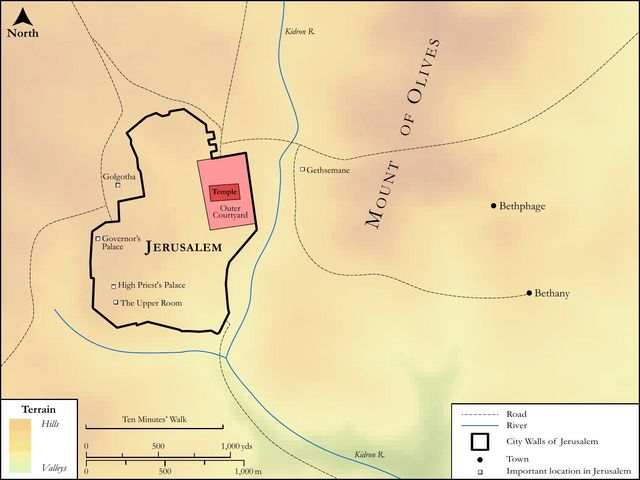
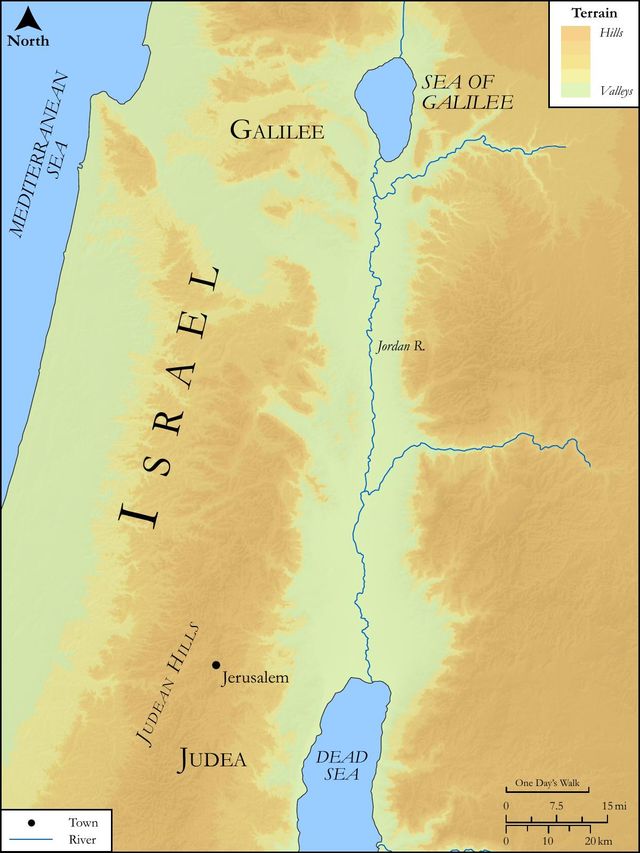
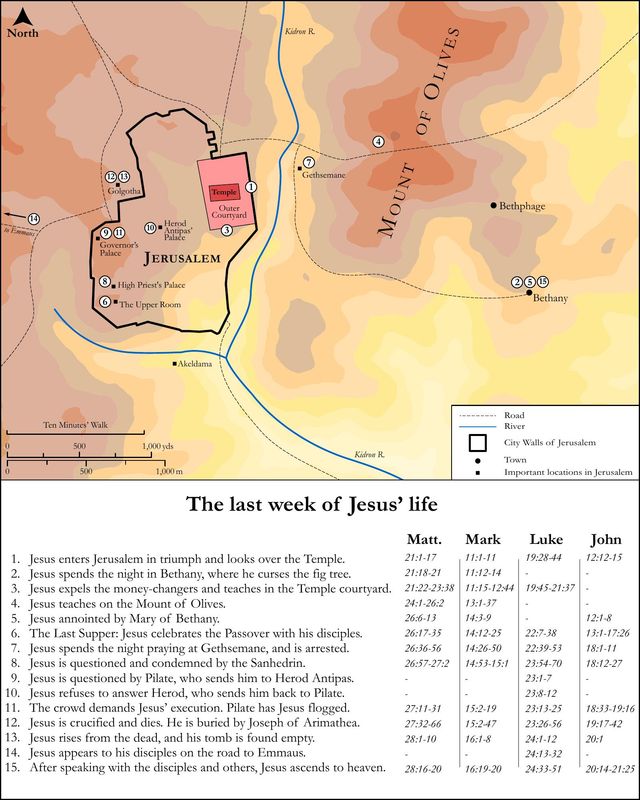
Study this verse
Historical interpretation
Ten Centuries of Reception
19 surviving comments on this verse. Each one is dated, so this reads as a timeline rather than a list.
Select a marker to jump to its quote. Markers stagger vertically where authors wrote within a few decades of each other.
(Aug. Serm. App. 75. 2.) Or, They that are with child, are they who covet what belongs to others; they that give suck, are they who have already forcibly taken that which they coveted; to them shall be woe in the day of judgment. Pray ye that your flight be not in the winter, or on the sabbath day; that is,
Watch for your life's sake. Let not your lamps be quenched, nor your loins unloosed; but be ye ready, for ye know not the hour in which our Lord cometh. But often shall ye come together, seeking the things which are befitting to your souls: for the whole time of your faith will not profit you, if ye be not made perfect in the last time. For in the last days false prophets and corrupters shall be multiplied, and the sheep shall be turned into wolves, and love shall be turned into hate; for when lawlessness increaseth, they shall hate and persecute and betray one another, and then shall appear the world-deceiver as Son of God, and shall do signs and wonders, and the earth shall be delivered into his hands, and he shall do iniquitous things which have never yet come to pass since the beginning. Then shall the creation of men come into the fire of trial, and many shall be made to stumble and shall perish; but they that endure in their faith shall be saved from under the curse itself. And then shall appear the signs of the truth; first, the sign of an out-spreading in heaven; then the sign of the sound of the trumpet; and the third, the resurrection of the dead; yet not of all, but as it is said: The Lord shall come and all His saints with Him. Then shall the world see the Lord coming upon the clouds of heaven.
Mystically; In the holy place of the Scriptures, both Old and New Testament, Antichrist, that is, false word, has often stood; let those who see this flee from the Judæa of the letter to the high mountains of truth. And whoso has been found to have gone up to the house-top of the word, and to be standing upon its summit, let him not come down thence as though he would fetch any thing out of his house. And if he be in the field in which the treasure is hid, and return thence to his house, he will run into the temptation of a false word; but especially if he have stripped off his old garment, that is, the old man, and should have returned again to take it up. Then the soul, as it were with child by the word, not having yet brought forth, is liable to a woe; for it casts that which it had conceived, and loses that hope which is in the acts of truth; and the same also if the word has been brought forth perfect and entire, but not having yet attained sufficient growth. Let them that flee to the mountains pray that their flight be not in the winter or on the sabbath-day, because in the serenity of a settled spirit they may reach the way of salvation, but if the winter overtake them they fall amongst those whom they would fly from. And there be some who rest from evil works, but do not good works; be your flight then not on such sabbath when a man rests from good works, for no man is easily overcome in times of peril from false doctrines, except he is unprovided with good works. But what sorer affliction is there than to see our brethren deceived, and to feel one's self shaken and terrified? Those days mean the precepts and dogmas of truth; and all interpretations coming of science falsely so called (1 Tim. 6:20.) are so many additions to those days, which God shortens by those whom He wills.
And as speaking to Jews who thought they might travel no more upon the sabbath than a sabbath-day's journey, He adds, But pray ye that your flight be not in the winter, neither on the sabbath.
Or otherwise; It is a sign of His future coming that the Lord gives, when He says, When ye shall see the abomination. For the Prophet spoke this of the times of Antichrist; and he calls abomination that which coming against God claims to itself the honour of God. It is the abomination of desolation, because it will desolate the earth with wars and slaughter; and it is admitted by the Jews, and set up in the holy place, that where God had been invoked by the prayers of the saints, into that same place admitted by the unbelievers it might be adored with the worship of God. And because this error will be peculiar to the Jews, that having rejected the truth they should adopt a lie, He warns them to leave Judæa, and flee to the mountains, that no pollution or infection might be gathered by admixture with a people who should believe on Antichrist. That He says, Let him which is on the housetop not come down to take ang thing out of his house, is thus understood. The roof is the highest part of the house, the summit and perfection of the whole building. He then who stands on the top of his house, i. e. in the perfection of his heart, aloft in the regeneration of a new spirit, ought not to come down to the lower desire of things of the world. Neither let him which is in the field return back to take his coat; i. e. He that has attained to obedience to the command, let him not return back to his former cares, to take on him again the coat of his former sins in which he once was clothed.
That which is said, Woe unto them that are with child, and to them that give suck, is not to be taken literally as an admonition to women pregnant, but as a description of souls burdened with the weight of sin, that neither in the house, nor in the field, may escape the storm of the wrath that is in store for them. Woe also to those that are being suckled; the weak souls, that is, who are being brought to the knowledge of God as by milk, to whom it shall be woe, because they are too laden to fly, and too inexperienced to resist Antichrist, having neither escaped sin, nor partaken of the food of true bread.
Or; That we be not taken in the frost of sins, or in discontinuance of good works, because of the soreness of the affliction; notwithstanding that for the sake of God's elect, those days shall be shortened, that the abridgment of the time may disarm the force of the calamities.
For in the last days false prophets shall be multiplied, and such as corrupt the word; and the sheep shall be changed into wolves, and love into hatred: for through the abounding of iniquity the love of many shall wax cold. For men shall hate, and persecute, and betray one another. And then shall appear the deceiver of the world, the enemy of the truth, the prince of lies, [2 Thessalonians 2:3-12] whom the Lord Jesus "shall destroy with the spirit of His mouth, who takes away the wicked with His lips; and many shall be offended at Him. But they that endure to the end, the same shall be saved. And then shall appear the sign of the Son of man in heaven;" [Isaiah 11:4; Matthew 24:1-51] and afterwards shall be the voice of a trumpet by the archangel; and in that interval shall be the revival of those that were asleep. And then shall the Lord come, and all His saints with Him, with a great concussion above the clouds, with the angels of His power, [Matthew 16:27] in the throne of His kingdom, to condemn the devil, the deceiver of the world, and to render to every one according to his deeds. "Then shall the wicked go away into everlasting punishment, but the righteous shall go into life eternal," [Matthew 25:46] to inherit those things "which eye has not seen, nor ear heard, nor have entered into the heart of man, such things as God has prepared for them that love Him;" [1 Corinthians 2:9] and they shall rejoice in the kingdom of God, which is in Christ Jesus.
For He brought in also a prophecy, to confirm their desolation, saying, "But when ye shall see the abomination of desolation, spoken of by Daniel the prophet, standing in the holy place, let him that readeth understand." He referred them to Daniel. And by "abomination" He meaneth the statue of him who then took the city, which he who desolated the city and the temple placed within the temple, wherefore Christ calleth it, "of desolation." Moreover, in order that they might learn that these things will be while some of them are alive, therefore He said, "When ye see the abomination of desolation."
Whence one may most marvel at Christ's power, and their courage, for that they preached in such times, in which most especially the Jewish state was warred against, in which most especially men regarded them as movers of sedition, when Caesar commanded all of them to be driven away. And the result was the same as if any one (when the sea was stirred up on every side, and darkness was filling all the air, and successive shipwrecks taking place, and when all their fellow-sailors were at strife above, and monsters were rising up from beneath, and with the waves devouring the mariners, and thunderbolts falling, and their being pirates, and those in the vessel plotting one against another), were to command men inexperienced in sailing, and who had not so much as seen the sea to sit at the rudder, and to guide and fight the vessel, and when an immense fleet was coming against them with a great array, making use of a single bark, with her crew in this disturbed state, to sink and subdue the fleet. For indeed by the heathens they were hated as Jews, and by the Jews were stoned, as waging war against their laws; and nowhere could they stand.
Thus were all things, precipices, and reefs, and rocks, the things in the cities, the things in the fields, the things in the houses, and every single person was at war with them; generals and rulers, and private persons, and all nations, and all people, and a turmoil which cannot be set forth by words. For the Jewish race was exceedingly detestable to the government of the Romans, as having occasioned them endless trouble; and not even from this did the preaching of the word take hurt; but the city was stormed and set on fire, and involved its inhabitants in countless evils; but the apostles that came from thence, introducing new laws, prevailed even over the Romans.
O strange and wonderful facts! Countless myriads of Jews did the Romans then subdue, and they did not prevail over twelve men fighting against them naked and unarmed. What language can set forth this miracle? For they that teach need to have these two things, to be worthy of credit, and to be beloved by them whom they are instructing; and together with these, and besides them, that their sayings should be easy of reception, and the time should be free from trouble and tumults.
But then were all the contraries to these. For while they did not seem worthy of credit, they were withdrawing from such as did seem worthy of it, those who had been deceived by them. So far from being loved, they were even hated, and were taking men away from what they loved, both habits, and hereditary customs, and laws.
Again, their injunctions had great difficulty; but the things, from which they were withdrawing men, much pleasure. And many were the perils, many the deaths, both themselves and they that obeyed them underwent, and together with all this, the time also occasioned them much difficulty, teeming with wars, tumults, disturbance, so that, even if there had been none of the things we have mentioned, it would have quite thrown all things into confusion.
As above He had obscurely intimated the end of Jerusalem; He now proceeds to a more plain announcement of it, citing a prophecy which should make them believe it.
Or because he who desolated the city and the temple placed his statue there. He says, When ye shall see, because these things were to happen while some of them were yet alive. Wherein admire Christ's power, and the courage of the disciples, who preached through those times in which all things Jewish were the object of attack. The Apostles, being Jews, introduced new laws in opposition to the Roman authority. The Romans conquered countless thousands of Jews, but could not overcome twelve unarmed unprotected men.
(Hom. lxxvi.) But because it had often happened to the Jews to be recovered in very desperate circumstances, as in the times of Sennacherib and Antiochus, that no man might look for any such event now, He gave command to His disciples to fly, saying, Then let them which are in Judæa flee to the mountains.
Then to show how inevitable the evils that should come upon the Jews, and how infinite their calamity, He adds, And let him which is on the housetop, not come down to take any thing out of his house, for it was better to be saved, and to lose his clothes, than to put on a garment and perish; and of him who is in the field He says the same. For if those who are in the city fly from it, little need is there for those who are abroad to return to the city. But it is easy to despise money, and not hard to provide other raiment; but how can one avoid natural circumstances? How can a woman with child be made active for flight, or how can she that gives suck desert the child she has brought forth? Woe, therefore, to them that are with child, and to them that give suck in those days; to the one, because they are encumbered, and cannot easily fly, bearing about the burden of the womb; to the other, because they are held by compassion for their children, and cannot save with them those whom they are suckling.
Note how this speech is directed against the Jews; for when these things were done by Vespasian, the Apostles could neither observe the Sabbath nor fly, seeing most of them were already dead, and those who survived were living in distant countries. And why they should pray for this He adds a reason, For then shall be great tribulation, such as was not since the beginning of the world to this time, no, nor shall be.
I ask the Jews, whence came upon them so grievous wrath from heaven more woful than all that had come upon them before? Plainly it was because of the desperate crime and the denial of the Cross. But He shows that they deserved still heavier punishment than they received, when He adds, And except those days should be shortened, there should no flesh he saved; that is, If the siege by the Romans should be continued longer, all the Jews would perish; for by all flesh, He means all the Jewish nation, those within and those without; for the Romans were at war not only with those in Judæa, but with the whole race wherever dispersed.
But that the Jews should not say that these evils came because of the preaching and the disciples of Christ, He shows them that had it not been for His disciples, they would have totally perished, but for the elect's sake those days shall be shortened.
Observe this economy of the Holy Spirit in this, that John wrote nothing of all this, that he might not seem to be writing a history after the event; for he survived sometime the taking of Jerusalem. But these who died before it, and saw nothing of it, these write it, that the power of prophecy may shine manifestly forth.
Then, to show again the greatness of the calamity, He saith, "Pray ye that your flight be not in the winter, neither on the Sabbath day. For then shall be great tribulation, such as was not since the beginning of the world until now, neither shall be."
Seest thou that His discourse is addressed to the Jews, and that He is speaking of the ills that should overtake them? For the apostles surely were not to keep the Sabbath day, neither to be there, when Vespasian did those things. For indeed the most part of them were already departed this life. And if any was left, he was dwelling then in other parts of the world.
But wherefore neither "in the winter, nor on the Sabbath day?" Not in the winter, because of the difficulty arising from the season; not on the Sabbath day, because of the absolute authority exercised by the law. For since they had need of flight, and of the swiftest flight, but neither would the Jews dare to flee on the Sabbath day, because of the law, neither in winter was such a thing easy; therefore, "Pray ye," saith He; "for then shall be tribulation, such as never was, neither shall be."
And let not any man suppose this to have been spoken hyperbolically; but let him study the writings of Josephus, and learn the truth of the sayings. For neither can any one say, that the man being a believer, in order to establish Christ's words, hath exaggerated the tragical history. For indeed He was both a Jew, and a determined Jew, and very zealous, and among them that lived after Christ's coming.
What then saith this man? That those terrors surpassed all tragedy, and that no such had ever overtaken the nation. For so great was the famine, that the very mothers fought about the devouring of their children, and that there were wars about this; and he saith that many when they were dead had their bellies ripped up.
I should therefore be glad to inquire of the Jews. Whence came there thus upon them wrath from God intolerable, and more sore than all that had befallen aforetime, not in Judaea only, but in any part of the world? Is it not quite clear, that it was for the deed of the cross, and for this rejection? All would say it, and with all and before all the truth of the facts itself.
But mark, I pray thee, the exceeding greatness of the ills, when not only compared with the time before, they appear more grievous, but also with all the time to come. For not in all the world, neither in all time that is past, and that is to come, shall any one be able to say such ills have been. And very naturally; for neither had any man perpetrated, not of those that ever have been, nor of those to come hereafter, a deed so wicked and horrible. Therefore He saith, "there shall be tribulation such as never was, nor shall be."
"And except those days should be shortened, there should no flesh be saved; but for the elect's sake those days shall be shortened." By these things He shows them to be deserving of a more grievous punishment than had been mentioned, speaking now of the days of the war and of that siege. But what He saith is like this. If, saith He, the war of the Romans against the city had prevailed further, all the Jews had perished (for by "no flesh" here, He meaneth no Jewish flesh), both those abroad, and those at home. For not only against those in Judaea did they war, but also those that were dispersed everywhere they outlawed and banished, because of their hatred against the former.
But whom doth He here mean by the elect? The believers that were shut up in the midst of them. For that Jews may not say that because of the gospel, and the worship of Christ, these ills took place, He showeth, that so far from the believers being the cause, if it had not been for them, all had perished utterly. For if God had permitted the war to be protracted, not so much as a remnant of the Jews had remained, but lest those of them who had become believers should perish together with the unbelieving Jews, He quickly put down the fighting, and gave an end to the war. Therefore He saith, "But for the elect's sake they shall be shortened." But these things He said to leave an encouragement to those of them who were shut up in the midst of them, and to allow them to take breath, that they might not be in fear, as though they were to perish with them. And if here so great is His care for them, that for their sakes others also are saved, and that for the sake of Christians remnants were left of the Jews, how great will be their honor in the time for their crowns?
By this He also encouraged them not to be distressed at their own dangers, since these others are suffering such things, and for no profit, but for evil upon their own head.
But He not only encouraged them, but also led them off secretly and unsuspectedly from the customs of the Jews. For if there is not to be a change afterwards, and the temple is not to stand, it is quite evident that the law also shall be made to cease.
However, He spake not this openly, but by their entire destruction He darkly intimated it. But He spake it not openly, lest He should startle them before the time. Wherefore neither at the beginning did He of Himself fall into discourse touching these things; but having first lamented over the city, He constrained them to show Him the stones, and question Him, in order that as it were in answering them their question, He might declare to them beforehand all the things to come.
But mark thou, I pray thee, the dispensation of the Spirit, that John wrote none of these things, lest he should seem to write from the very history of the things done (for indeed he lived a long time after the taking of the city), but they, who died before the taking, and had seen none of these things, they write it, in order that every way the power of the prediction should clearly shine forth.
(Verse 20.) Pray, however, that your flight may not be in winter or on a Sabbath. If we wish to receive the captivity of Jerusalem, when it was captured by Titus and Vespasian, they ought to pray that their flight may not be in winter or on a Sabbath; for in the former, the harshness of the cold prevents them from going to the desolate places and hiding in the mountains and deserts; in the latter, it is either a violation of the Law if they wish to flee, or imminent death if they remain. But if the end of the world is understood, this commands us, that our faith may not grow cold and our love for Christ may not grow dim, nor may we become idle in the work of God, languishing in the virtues of the Sabbath.
That, Let him that readeth understand, is said to call us to the mystic understanding of the place. What we read in Daniel is this; And in the midst of the week the sacrifice and the oblation shall be taken away, and in the temple shall be the abomination of desolations until the consummation of the time, and consummation shall be given upon the desolate. (Dan. 9:27. sec. LXX.)
Or it may be understood of the statue of Cæsar, which Pilate set up in the temple; or of the equestrian statue of Adrian, which stood to the present time in the very Holy of Holies. For, according to the Old Scripture, an idol is called 'abomination;' of desolation is added, because the idol was set up in the desolated and deserted temple.
Because in the one the severity of the cold prevents your flight to the deserts, and your lurking in mountains and wilds; in the other, you must either transgress the Law, if you will fly, or encounter instant death if you will stay.
Not remembering that which is written. The day continues according to thy ordinances. (Ps. 119:91.) We must understand it of their being shortened not in measure, but in number, lest the faith of believers should be shaken by lengthened affliction.
What is meant by the fact that it is written in the same Matthew, Woe to those who are pregnant and those who nurse in those days. And: Pray that your flight may not be in winter or on the Sabbath (Matthew 24:19-20). This is clearly dependent on the earlier statements. For when the Gospel of Christ has been preached to all nations and the end has come, and they see the abomination of desolation spoken of by Daniel the Prophet, standing in the holy place (Mark 13): then those who are in Judea are commanded to flee to the mountains; and those who are on the housetop, not to come down and take anything from their house; and those who are in the field, not to turn back and take their cloak. We have spoken more fully on these matters in the Commentaries of the same Matthew. And at once it is joined: Woe to the pregnant and nursing women in those days. In which days? when the abomination of desolation stands in the holy place. Indeed, it is not doubtful that this is preached according to the letter concerning the advent of Antichrist: when the magnitude of persecution compels them to flee, and heavy wombs, and nursing infants impede flight. Although some want it to mean the siege and battle against the Jews, and especially Jerusalem, by Titus and Vespasian. Winter and Sabbaths are also interpreted thus so as not to compel flight at that time when the severity of the cold in the fields and in desert places does not allow refugees to hide: and the observance of the Sabbath either makes deserters if they flee, or exposes them to the swords of the enemy if they keep Sabbath rest and commandments. But let us, hearing the Lord and Savior, flee to the mountains with those who are in Judea; let us also raise our eyes to the mountains, of which it is written: "I lift up my eyes to the hills, from whence cometh my help" (Psalm 120:1). And in another place: "His foundation is in the holy mountains" (Psalm 87:1). And, "The mountains are around him and the Lord is around his people" (Psalm 124). And, "A city set on a hill cannot be hidden" (Matthew 5:14). Let us also, taking off the skin of letters, and going up the mountain with bare feet with Moses, say: "I will go over and see this great sight" (Exodus 3:3); so that we may understand the pregnant souls, which conceived the beginnings of faith from the seed of doctrine and the Word of God, and say with Isaiah, "By your fear, O Lord, we have conceived, and have been in pain, and have brought forth the spirit of your salvation, which you have placed upon the earth" (Isaiah 26:14). For just as seeds are gradually formed in the womb, and a person is not considered or thought to be formed until the confused elements receive their shapes and members, so a sense concept conceived by reason, unless it breaks forth into works, is still retained in the womb; and it quickly perishes as an abortion, when it has seen the abomination of desolation standing in the Church (Dan. 9. 27, Mat. 24. 15, Mark. 13. 14) and Satan being transformed into an angel of light (2 Cor. 11.14). Of such fetuses Paul speaks when he says: "My little children, of whom I travail in birth until Christ be formed in you" (Galatians 4. 10). So I consider that women are akin to the mystical understanding, about whom the same Apostle writes: The woman was seduced and became a transgressor. But she will be saved by childbearing, if they remain in faith and love and sanctity with prudence (1 Tim. 2:14-15). For if she ever gives birth to anything related to divine teaching, it is necessary for what is born to grow; and to receive first the milk of infancy, until they reach solid food, and mature age in the fullness of Christ (1 Cor. 3:2; Eph. 4:13). For every one that is fed with milk, is unskillful in the word of justice: for he is a little child. Therefore, those souls which have not yet brought forth, or which, having brought forth, have not yet suckled them, seeing a heretical discourse standing in the Church, are presently scandalized and destroyed; they can’t endure in times of trials and persecutions, especially if they have had leisure to perform good works and have not walked in the way that is Christ’s (John 14:6). The Apostle said of this abomination of heretical and perverse doctrine that the man of iniquity and the adversary raises himself up against everything called God and religion, so that he dares to stand in the Temple of God, and show himself as if he were God (2 Thess. 2:4); whose coming is according to the working of Satan; and he destroys what is conceived by abortion; and what is born cannot reach childhood and perfect age. Therefore we must pray to the Lord, lest in the beginning of faith and growing age there arise a winter, of which it is written: Winter has passed, the rain is over and gone (Song of Solomon 2.11); lest we become sluggish in idleness, but with shipwreck imminent, let us awaken the sleeping Lord and say: Master, save us, we perish (Matthew 8.25).
(Ep. 199. 31.) Luke, in order to show that the abomination of desolation foretold by Daniel had reference to the time of the siege of Jerusalem, repeats these words of our Lord, When ye shall see Jerusalem encompassed by armies, then know ye that its desolation draweth nigh. (Luke 21:20.)
(Ep. 199. 30.) In Luke it is thus read, There shall be great distress upon the earth, and wrath upon this people, and they shall fall by the edge of the sword, and shall be led away captive into all nations. (Luke 21:23.) And so Josephus, who wrote the Jewish History, (B. J. vii.) relates evils so great happening to this people as to seem hardly credible. Whence it was not unreasonably said, that such tribulation had never been from the beginning of creation, nor should be; for though in the lime of Antichrist shall be such, or perhaps greater; yet to the Jews, of whom we must understand this, such shall never more befal. For if they shall be the first and the chief to receive Antichrist, they will then rather inflict than suffer tribulation.
Indeed some persons seem to me not unfitly to understand by these days the evils themselves, as in other places of divine Scripture evil days are spoken of; not that the days themselves are evil, but the things that are done on them. And they are said to be shortened, because they are less felt, God giving us endurance; so that even though grievous, they are felt as short.
For we ought not to doubt that when Jerusalem was overthrown, there were among that people elect of God who had believed out of the circumcision, or would have believed, elect before the foundation of the world, for whose sake those days should be shortened, and their evils made endurable. Some there are who suppose that the days will be shortened by a more rapid motion of the sun, as the day was made longer on the prayer of Jesus Naue.
(ubi sup.) For let us not suppose that the computation of Daniel's weeks was interfered with by this shortening of those days, or that they were not already at that time complete, but had to be completed afterwards in the end of all things, for Luke most plainly testifies that the prophecy of Daniel was accomplished at the time when Jerusalem was overthrown.
(ubi sup.) For in tribulations we must beware of coming down from the spiritual heights, and yielding ourselves to the carnal life; or of failing and looking behind us, after having made some progress forwards.
(Quæst. Ev. I. 37.) That no one be found in that day in either joy or sorrow for temporal things.
Perhaps this saying contains a puzzle. It admonishes us to pray that our departure from this body would not happen in the time of rest from good works, which the sabbath signifies, nor in the time of unfruitfullness, which is winter. It is notable, however, that God did not create the winter of misfortunes. Winter means the time that we are possessed by the fleshly passions.
Whence I think that by the abomination of desolation, He means the army by which the city of the holy Jerusalem was desolated.
And this we know was so done when the fall of Jerusalem drew near; for on the approach of the Roman army, all the Christians in the province, warned, as ecclesiastical history tells us (Euseb. H.E. iii. 5.), miraculously from heaven, withdrew, and passing the Jordan, took refuge in the city of Pella; and under the protection of that King Agrippa, of whom we read in the Acts of the Apostles, they continued some time; but Agrippa himself, with the Jews whom he governed, was subjected to the dominion of the Romans.
Remember what the Truth says: "Pray that your flight be not in winter or on the Sabbath." For by the commandment of the law it is not permitted to walk far on the Sabbath; winter also is a hindrance to walking, because the numbness of cold restrains the steps of those who walk. He says therefore: "Pray that your flight be not in winter or on the Sabbath." As if He were to say openly: See that you do not seek to flee your sins when it is no longer permitted to walk. That time therefore when flight is not permitted ought to be thought about now while it is permitted. That hour of our departure is always to be kept in view, this admonition of our Redeemer is always to be placed before the eyes of our mind, wherein He says: "Watch therefore, for ye know neither the day nor the hour."
He addressees these words to the Jews in the person of the apostles; for the apostles would have already departed from Jerusalem by the time that flight would be necessary. To the Jews, then, He says to pray that their flight not be in winter when they would not be able to flee on account of the severity of the weather; and that it would not be on the sabbath day when they rested according to the law and would not dare to flee. But you, O reader, understand it also in this manner: we must pray that our flight from this life, that is, our end, not be on the sabbath during idleness from good deeds, nor in winter, when no good fruit is brought forth, but rather in tranquility of soul, free from all disturbance.
Continue studying Matthew 24:20 across the web’s major study libraries — every link below opens this exact verse, chapter, or book on the destination site.
Read & Compare
 BibleGatewayThis verse in more than 200 translations and 70 languages.
 Bible.comThe YouVersion reader — hundreds of translations, reading plans, and highlights.
 ESV.orgCrossway's official English Standard Version reader.
 NET BibleThe NET translation with 60,000+ translators' notes on every rendering decision.
 STEP BibleTyndale House's free study tool — original text, vocabulary, and scholarly resources.
 BibliaLogos Bible Software's free web reader.
 USCCBThe New American Bible (Revised Edition) with the U.S. bishops' study notes.
Commentaries
 BibleHub CommentariesDozens of classic commentaries on this verse, gathered on one page.
 StudyLightMore than 100 commentary sets — the largest collection on the web.
 BibleRefPlain-English commentary on what this verse means, verse by verse.
 Enduring WordDavid Guzik's free commentary on this chapter, widely used by Bible teachers.
 Bible Study ToolsVerse commentary alongside Greek and Hebrew study aids.
Original Language & Research
- BibleHub InterlinearThe verse word by word — original language, transliteration, and English.
- BibleHub LexiconEvery word's original-language definition and Strong's entry.
 Blue Letter BibleDeep-study tools — Strong's numbers, concordance, and word studies.
 CNTR CollationThe earliest Greek manuscripts of this verse, collated letter by letter.
Sermons, Hymns & Audio


TrulyRandomVerse is not affiliated with these sites and doesn’t control their content. They’re linked because they’re genuinely useful.
Summary
Matthew 24:20, nestled within Jesus' profound Olivet Discourse, offers practical and compassionate counsel to His disciples concerning their desperate flight from Jerusalem during the impending tribulation. Amidst dire warnings of widespread destruction and persecution, Jesus instructs His followers to pray specifically that their urgent escape would not be hindered by the harsh conditions of winter or the religious restrictions imposed by the Sabbath day, thereby highlighting both divine foresight and the practical efficacy of prayer even in the most challenging circumstances.
Context
ShowHideLiterary Context
This verse is an integral part of the Olivet Discourse, Jesus' longest prophetic teaching, delivered on the Mount of Olives and recorded in Matthew 24. It immediately follows His vivid description of the "abomination of desolation" standing in the holy place (Matthew 24:15), which serves as the definitive sign for those in Judea to flee to the mountains. The preceding verses (Matthew 24:16-18) emphasize the extreme urgency of this flight, advising against retrieving possessions or even returning home, underscoring the dire necessity of immediate escape. Matthew 24:20 then provides a specific, practical prayer request within this urgent context, demonstrating Jesus' detailed concern for His followers' physical well-being amidst the chaos and transitioning from the command to flee to the conditions of that flight.
Historical & Cultural Context
The primary historical context for this prophecy is the impending destruction of Jerusalem and its Temple by the Roman armies in A.D. 70, a cataclysmic event that would devastate Jewish society. For Jews living in Judea, flight would entail navigating a landscape potentially occupied by Roman forces or fraught with civil unrest. Culturally, winter in Judea (roughly November to March) brought heavy rains, cold temperatures, and often impassable, muddy roads, making travel arduous and dangerous, especially for large groups or families. The Sabbath day (Saturday) was a strict day of rest, with travel limited to a "Sabbath day's journey" (approximately 2,000 cubits or less than a mile), making a longer, necessary flight a violation of religious law and potentially hindering access through city gates or assistance from others who observed the Sabbath. This dual challenge highlights the profound practical and religious obstacles faced by devout Jewish believers.
Key Themes
ShowHideThis verse contributes to several key themes within the Olivet Discourse and the broader Gospels. Firstly, it underscores the theme of Divine Providence and Practical Prayer. Even amidst prophecies of tribulation, Jesus encourages prayer for practical circumstances, demonstrating God's concern for the physical well-being and ease of His people, down to the weather and religious observance. This aligns with teachings on bringing all concerns to God, as seen in Philippians 4:6. Secondly, it highlights the theme of Foresight and Preparedness. Jesus provides specific warnings not to instill fear but to equip His disciples with knowledge and actionable advice, emphasizing that God's people are not left without guidance in times of crisis. This echoes the call to watchfulness found in Matthew 24:42. Finally, it touches upon the Tension between Law and Necessity, particularly regarding the Sabbath, foreshadowing how the urgency of survival might necessitate actions that, under normal circumstances, would be considered breaches of religious custom, a tension Jesus often addressed (e.g., Matthew 12:1-8).
Exposition and Analysis
ShowHideKey Word Analysis
ShowHideThis verb, derived from pros (to, toward) and euchomai (to wish, pray), signifies a deliberate act of supplication or worship directed toward God. It implies a conscious and earnest engagement in prayer, not merely a casual wish. Jesus' instruction here emphasizes the active role of believers in seeking divine intervention even in the face of predestined events, underscoring the power and purpose of intercessory prayer.
Meaning "a fleeing" or "escape," this noun vividly conveys the desperate, urgent nature of the movement Jesus describes. It's not a leisurely journey but a hurried, perhaps chaotic, departure from danger. The term highlights the necessity of immediate and rapid evacuation, making the conditions of travel (winter, Sabbath) all the more critical for survival.
This word, of Hebrew origin, refers to the weekly day of repose from secular avocations, an institution central to Jewish life and law. Its inclusion underscores the specific cultural and religious context of Jesus' audience. For devout Jews, strict limitations on travel and activity on the Sabbath would present a significant impediment to a necessary, urgent flight, forcing a difficult choice between religious observance and physical preservation.
Verse Breakdown
ShowHide"But pray ye"
This opening phrase, introduced by "But" (G1161, dé), signals a shift from the description of the tribulation to a direct command for action on the part of the disciples. The imperative "pray ye" (G4336, proseúchomai) is a call to earnest supplication, indicating that while the events are prophesied, human prayer can still influence the conditions under which they unfold, reflecting God's responsiveness to His people's petitions.
"that your flight be not in the winter"
The Greek phrase "hína mḗ" (G3363) translates to "in order that not" or "lest," emphasizing the specific purpose of their prayer. "Your flight" (G5216 hymōn G5437 phygḗ) refers to the urgent escape from Jerusalem. Praying against "winter" (G5494, cheimṓn) highlights the practical hardships of travel during the rainy, cold season in Judea, which would make rapid movement extremely difficult due to muddy roads, swollen rivers, and exposure to the elements, thereby increasing the danger and potential for delay.
"neither on the sabbath day:"
The conjunction "neither" (G3366, mēdé) extends the negative prayer request. "On the sabbath day" (G1722 en G4521 sábbaton) refers to the Jewish day of rest. For observant Jews, travel was severely restricted on the Sabbath, typically to a "Sabbath day's journey." Fleeing a city would necessitate traveling much further, violating religious law and potentially hindering access through closed city gates or the ability to receive help from others who strictly observed the Sabbath. This part of the prayer acknowledges the profound practical and religious dilemma for Jewish believers.
Literary Devices
ShowHideMatthew 24:20 employs several literary devices to convey its urgent message. The most prominent is Foreshadowing, as Jesus provides specific, practical warnings about future events, preparing His disciples for the difficulties they will face. This isn't abstract prophecy but concrete advice for a real, impending crisis. The mention of "winter" and "Sabbath day" serves as Specific Imagery, grounding the prophetic discourse in tangible, relatable obstacles that would have resonated deeply with a first-century Jewish audience. These specific conditions act as Synecdoche, where the parts (winter, Sabbath) represent the whole range of practical difficulties and religious dilemmas that would complicate their escape. Furthermore, the imperative "pray ye" functions as a Direct Command, emphasizing the active role of human agency and faith in navigating divinely ordained circumstances, highlighting the paradox of divine sovereignty and human responsibility.
Theological and Thematic Connections
ShowHideMatthew 24:20 profoundly illustrates God's compassionate concern for His people's practical well-being, even amidst severe tribulation. It reveals that divine providence extends beyond grand theological decrees to the minute details of human experience, such as weather and travel conditions. Jesus' instruction to pray for favorable circumstances during their flight underscores the efficacy of prayer not only for spiritual strength but also for tangible, physical relief. This verse challenges a fatalistic view of prophecy, demonstrating that while God's plan will unfold, human intercession can influence the manner of its unfolding, mitigating hardship and facilitating obedience. It also highlights the tension between religious law and the exigencies of survival, a theme Jesus frequently addressed, affirming that human life and well-being often take precedence in times of extreme necessity.
Reflection and Application
ShowHideMatthew 24:20 offers timeless principles for believers facing various forms of tribulation, whether personal, communal, or global. It encourages us to cultivate a posture of proactive prayer, recognizing that God cares about the practicalities of our lives as much as our spiritual state. In times of impending difficulty or crisis, we are called not to despair but to bring our specific concerns, even those seemingly mundane like travel conditions or timing, before God. This verse reminds us that wisdom involves both heeding divine warnings and actively seeking God's grace to navigate challenges with the least possible hardship. It fosters a deep trust in God's loving foresight and His willingness to respond to the earnest prayers of His children, empowering us to face an uncertain future with faith and practical preparedness, knowing that He is intimately involved in every detail of our journey.
Questions for Reflection
ShowHideFAQ
ShowHideWas Jesus predicting the destruction of Jerusalem in A.D. 70, or a future end-times event?
ShowHideWhile the Olivet Discourse (Matthew 24, Mark 13, Luke 21) contains elements that point to both the immediate future (the destruction of Jerusalem in A.D. 70) and the distant future (the end of the age and Christ's return), Matthew 24:20, with its specific references to "flight" from Judea, "winter," and "the Sabbath day," is primarily understood by scholars as referring to the events leading up to and including the Roman siege and destruction of Jerusalem in A.D. 70. The practical advice about fleeing from Judea and the specific mention of the Sabbath (a Jewish observance) strongly align with the historical context of that period. However, the principles of preparedness and prayer remain relevant for believers facing any tribulation, including those associated with the end times.
Why is praying about "winter" and "the Sabbath day" so important for flight?
ShowHideThese two conditions represent significant practical and religious obstacles for an urgent escape in first-century Judea. "Winter" (Matthew 24:20) refers to the rainy season (roughly November to March), when travel would be severely hampered by cold, heavy rains, muddy roads, and potentially flooded wadis, making rapid and safe movement extremely difficult, especially for families. "The Sabbath day" (Matthew 24:20) was a day of strict rest for devout Jews, with travel limited to a "Sabbath day's journey" (about half a mile). An urgent flight would necessitate traveling much further, forcing believers to choose between violating religious law and ensuring their survival. Jesus' instruction to pray for these specific conditions demonstrates His compassionate foresight regarding the real-world challenges His followers would face.
Christ-Centered Fulfillment
ShowHideWhile Matthew 24:20 directly addresses the practicalities of physical flight from Jerusalem, its deeper Christ-centered fulfillment lies in how Jesus, through His life, death, and resurrection, provides the ultimate "flight" or escape from the greater tribulation of sin and death. Jesus' compassionate concern for His disciples' physical well-being during the A.D. 70 judgment foreshadows His infinitely greater provision for humanity's spiritual salvation. He is the one who, through His sacrifice, has opened the way for us to flee from the wrath to come and find refuge in Him. Just as He warned His followers to prepare for a physical exodus, He calls all to prepare for His return, urging a spiritual vigilance that transcends mere physical circumstances. The "rest" found in Christ, a spiritual Sabbath, offers liberation from the burdensome legalism that could hinder true obedience, inviting us instead into a relationship where He is Lord of the Sabbath. Ultimately, Jesus Himself is our safe passage, our refuge, and the one who enables us to navigate the storms of life and the judgment to come, fulfilling the promise of salvation and eternal life.