


Matthew 19:15
Bible text: King James Version (1769 Blayney text) · Public domain
Bible text: Berean Standard Bible · Public domain
Bible text: American Standard Version (1901) · Public domain
Bible text: World English Bible, Messianic edition · Public domain
Bible text: Geneva Bible (1599) · Public domain
Bible text: Young's Literal Translation · Public domain
- καὶkaiAndG2532CONJConjunction
- ἐπιθεὶςepitheishaving laidG2007V-2AAP-NSMVerb 2nd Aorist Active Participle Nominative Singular Masculine
- τὰςtastheG3588T-APFDefinite article Accusative Plural Feminine
- χεῖραςcheirashandsG5495N-APFNoun Accusative Plural Feminine
- αὐτοῖςautoisupon themG846P-DPNPersonal pronoun Dative Plural Neuter
- ἐπορεύθηeporeuthēHe departedG4198V-AOI-3SVerb Aorist Passive Deponent Indicative 3rd Singular
- ἐκεῖθενekeithenfrom thereG1564ADVAdverb
English is a literal word-by-word gloss of the Greek, not the KJV's wording. Why?
This is the original text the KJV's translators worked from — each Greek word with its own literal English meaning in this verse, prepared by scholars at Tyndale House, Cambridge. The KJV translates whole sentences, not word by word, so its wording differs: one Greek word can become several English words, and the KJV may choose “charity” where the gloss reads “love”. Both are faithful — they answer different questions. For the KJV's own rendering, switch to the KJV text.
Details
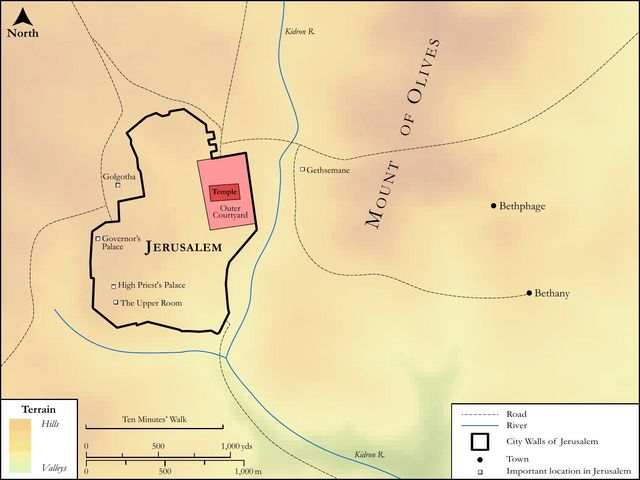
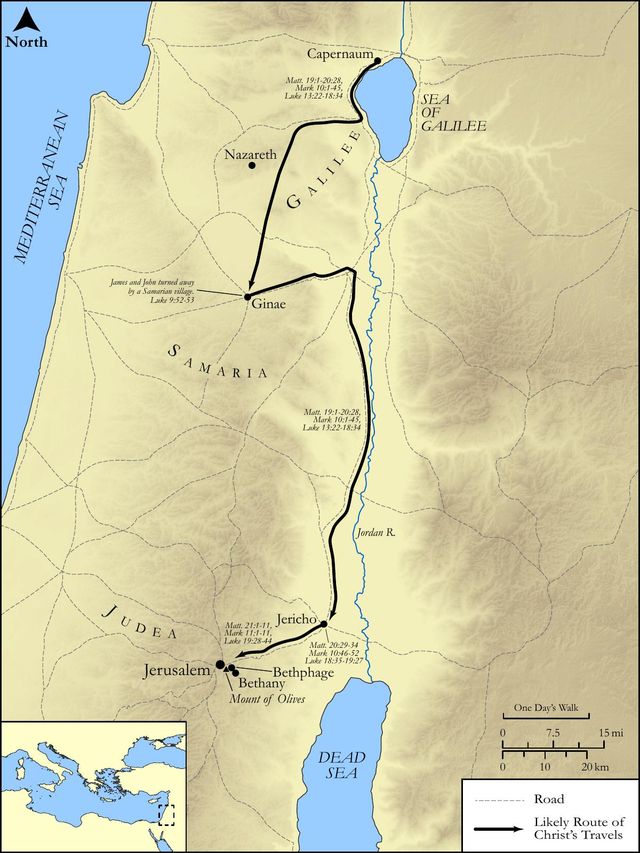
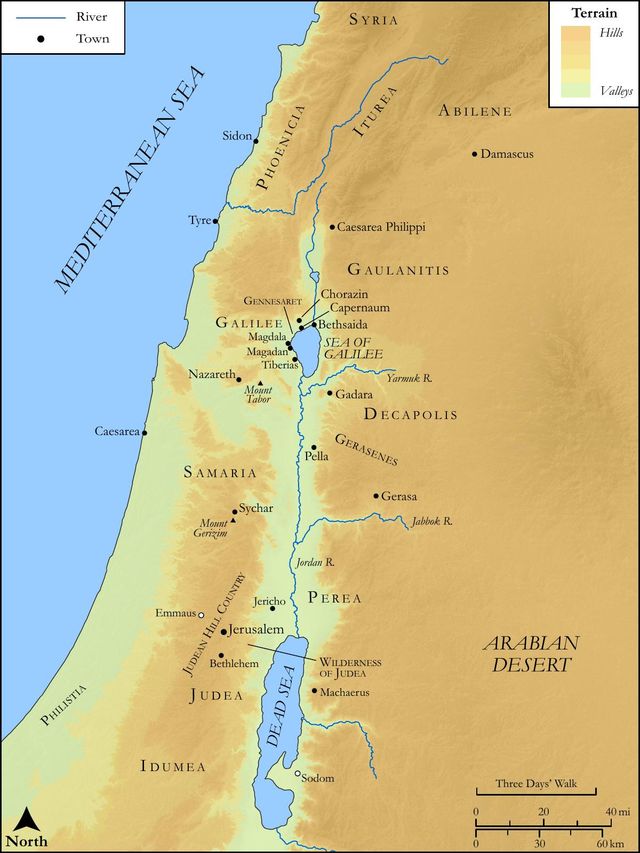
See on the biblical-era maps
Study this verse
Historical interpretation
Ten Centuries of Reception
10 surviving comments on this verse. Each one is dated, so this reads as a timeline rather than a list.
Select a marker to jump to its quote. Markers stagger vertically where authors wrote within a few decades of each other.
Mystically; We call them children who are yet carnal in Christ, having need of milk. They who bring the babes to the Saviour, are they who profess to have knowledge of the word, but are still simple, and have for their food children's lessons, being yet novices. They who seem more perfect, and are therefore the disciples of Jesus, before they have learnt the way of righteousness which is for children, rebuke those who by simple doctrine bring to Christ children and babes, that is, such as are less learned. But the Lord exhorting His disciples now become men to condescend to the needs of babes, to be babes to babes, that they may gain babes, says, For of such is the kingdom of heaven. For He Himself also, when He was in the form of God, was made a babe. These things we should attend to, lest in esteeming that more excellent wisdom, and spiritual advancement, as though we were become great we should despise the little ones of the Church, forbidding children to be brought to Jesus. But since children cannot follow all things that are commanded them, Jesus laid His hands upon them, and leaving virtue in them by His touch, went away from them, seeing they were not able to follow Him, like the other more perfect disciples.
The infants are a type of the Gentiles, to whom salvation is rendered by faith and hearing. But the disciples, in their first zeal for the salvation of Israel, forbid them to approach, but the Lord declares that they are not to be forbidden. For the gift of the Holy Ghost was to be conferred upon the Gentiles by laying on of hands, as soon as the Law had ceased.
Only the wickedness and corruption of the creature stands in the way of our approaching the Creator. Lack of wisdom should not prevent it. He seeks completeness, and your approach is welcome to him for this completeness. Therefore the words “For to such belongs the kingdom of heaven” are accurate. He did not say “of these” but “to such,” since lack of wisdom is a property of children. For the same reason the apostle said, “Do not be children in your thinking; be babes in evil.” And Mark also examines the cause, speaking and interpreting as follows: “To such belongs the kingdom of heaven” and “Truly I say to you, whoever does not receive the kingdom of God like a child shall not enter it.” Luke also said the same as Matthew above: “Whoever humbles himself like this child, he is the greatest in the kingdom of heaven.” For those qualities which the child has by nature, God wishes us to have by choice: simplicity, forgetfulness of wrongs done to us, love of our parents, even if struck by them. He laid his hands on the children because the laying on of hands signifies the arming of God’s power.
But mark thou, I pray, how from some men's wicked doings, other men gain. I mean, that the Jews went away having learnt nothing, for neither did they ask with the intent of learning, but the disciples gained even from hence.
"Then were there brought unto Him little children, that He should put His hands on them, and pray: and the disciples rebuked them. But He said unto them, Suffer the little children to come unto me, for of such is the kingdom of Heaven. And He laid His hands on them, and departed thence."
And wherefore did the disciples repel the little children? For dignity. What then doth He? Teaching them to be lowly, and to trample under foot worldly pride, He doth receive them, and takes them in His arms, and to such as them promises the kingdom; which kind of thing He said before also.
Let us also then, if we would be inheritors of the Heavens, possess ourselves of this virtue with much diligence. For this is the limit of true wisdom; to be simple with understanding; this is angelic life; yes, for the soul of a little child is pure from all the passions. Towards them who have vexed him he bears no resentment, but goes to them as to friends, as if nothing had been done; and how much soever he be beaten by his mother, after her he seeks, and her doth he prefer to all. Though thou show him the queen with a diadem, he prefers her not to his mother clad in rags, but would choose rather to see her in these, than the queen in splendor. For he useth to distinguish what pertains to him and what is strange to him, not by its poverty and wealth, but by friendship. And nothing more than necessary things doth he seek, but just to be satisfied from the breast, and then he leaves sucking. The young child is not grieved at what we are grieved, as at loss of money and such things as that, and he doth not rejoice again at what we rejoice, namely, at these temporal things, he is not eager about the beauty of persons.
Therefore He said, "of such is the kingdom of Heaven," that by choice we should practise these things, which young children have by nature. For since the Pharisees from nothing rise so much as out of craft and pride did what they did, therefore on every hand He charges the disciples to be single hearted, both darkly hinting at those men, and instructing these. For nothing so much lifts up unto haughtiness, as power and precedence. Forasmuch then as the disciples were to enjoy great honors throughout the whole world, He preoccupies their mind, not suffering them to feel anything after the manner of men, neither to demand honors from the multitude, nor to have men clear the way before them.
For though these seem to be little things, yet are they a cause of great evils. The Pharisees at least being thus trained were carried on into the very summit of evil, seeking after the salutations, the first seats, the middle places, for from these they were cast upon the shoal of their mad desire of glory, then from thence upon impiety. So therefore those men went away having drawn upon themselves a curse by their tempting, but the little children a blessing, as being freed from all these.
Let us then also be like the little children, and "in malice be we babes." For it cannot be, it cannot be for one otherwise to see Heaven, but the crafty and wicked must needs surely be cast into hell.
When he says, Who have made themselves eunuchs, He does not mean cutting off of members, but a putting away of evil thoughts. For he that cuts off a limb is under a curse, for such an one undertakes the deeds of murderers, and opens a door to Manicheans who depreciate the creature, and cut off the same members as do the Gentiles. For to cut off members is of the temptation of dæmons. But by the means of which we have spoken desire is not diminished but made more urgent; for it has its source elsewhere, and chiefly in a weak purpose and an unguarded heart, For if the heart be well governed, there is no danger from the natural motions; nor does the amputation of a member bring such peacefulness and immunity from temptation as does a bridle upon the thoughts.
Or the disciples would have thrust them away, from respect to Christ's dignity1. But the Lord teaching them holy thoughts, and to subdue the pride of this world, took the children into His arms, and promised to such the kingdom of heaven; But Jesus saith unto them, Suffer little children and forbid them not to come unto me, for of such is the kingdom of heaven.
Not because they liked not that they should have benediction of the Saviour's hand and mouth; but forasmuch as their faith was not yet perfect, they thought that He like other men would be wearied by the applications of those that brought them.
And He said distinctly, Of such is the kingdom of heaven, not Of these, to show that it was not years, but disposition that determined His judgment, and that the reward was promised to such as had like innocence and simplicity.
(Verse 15.) Allow the children, and do not prohibit them from coming to me: for such is the kingdom of heaven. And when he had laid his hands on them, he departed from there. He specifically said 'such', not 'these', to show that it is not age that reigns but character; and that those who have similar innocence and simplicity will be rewarded. The apostle also agrees with this sentiment: Brothers, do not be children in your thinking, but be infants in evil, and mature in your thinking (1 Corinthians 14:20).
The Lord had been holding discourse of chastity; and some of His hearers now brought unto Him infants, who in respect of chastity are the purest; for they supposed that it was the pure in body only whom He had approved; and this is that which is said, Then were brought unto him little children, that he should put his hands on them, and pray.
The flesh as it delights not in good, if it hear any good readily forgets it; but the evil that it has it retains ever. But a little while before Christ took a little child and said, Except ye become as this child, ye shall not enter into the kingdom of heaven, (Matt. 18:3.) yet His disciples, presently forgetting this innocence of children, now forbid children, as unworthy to come to Christ.
For who were worthy to come to Christ, if simple infancy were thrust away? Therefore he said, Forbid them not. For if they shall turn out saints, why hinder ye the sons from coming to their Father? And if sinners, why do ye pronounce a sentence of condemnation, before you see any fault in them?
The present passage instructs all parents to bring their children to the priests, for it is not the priest who lays his hands on them, but Christ, in whose name hands are laid. For if he that offers his food in prayer to God eats it sanctified, for it is sanctified by the word of God, and by prayer, as the Apostle speaks, how much rather ought children to be offered to God, and sanctified? (1 Tim. 4:5.) And this is the reason of blessing of food, Because the whole world lieth in wickedness; (1 John 5:19.) so that all things that have body, which are a great part of the world, lie in wickedness. Consequently infants when born, are as respects their flesh lying in wickedness.
For it was a custom among the ancients that little children should be brought to aged persons, to receive benediction by their hand or tongue, and according to this custom little children are now brought to the Lord.
Also laying His hands upon them, He blessed them, to signify that the lowly in spirit are worthy His grace and blessing.
(non occ.) He laid His hands upon them while men held them, to signify that the grace of His aid was necessary.
Continue studying Matthew 19:15 across the web’s major study libraries — every link below opens this exact verse, chapter, or book on the destination site.
Read & Compare
 BibleGatewayThis verse in more than 200 translations and 70 languages.
 Bible.comThe YouVersion reader — hundreds of translations, reading plans, and highlights.
 ESV.orgCrossway's official English Standard Version reader.
 NET BibleThe NET translation with 60,000+ translators' notes on every rendering decision.
 STEP BibleTyndale House's free study tool — original text, vocabulary, and scholarly resources.
 BibliaLogos Bible Software's free web reader.
 USCCBThe New American Bible (Revised Edition) with the U.S. bishops' study notes.
Commentaries
 BibleHub CommentariesDozens of classic commentaries on this verse, gathered on one page.
 StudyLightMore than 100 commentary sets — the largest collection on the web.
 BibleRefPlain-English commentary on what this verse means, verse by verse.
 Enduring WordDavid Guzik's free commentary on this chapter, widely used by Bible teachers.
 Bible Study ToolsVerse commentary alongside Greek and Hebrew study aids.
Original Language & Research
- BibleHub InterlinearThe verse word by word — original language, transliteration, and English.
- BibleHub LexiconEvery word's original-language definition and Strong's entry.
 Blue Letter BibleDeep-study tools — Strong's numbers, concordance, and word studies.
 CNTR CollationThe earliest Greek manuscripts of this verse, collated letter by letter.
Sermons, Hymns & Audio


TrulyRandomVerse is not affiliated with these sites and doesn’t control their content. They’re linked because they’re genuinely useful.
Summary
Matthew 19:15 serves as a tender and pivotal conclusion to Jesus' interaction with children, where He personally affirmed and blessed them by laying His hands upon them, immediately after rebuking His disciples for attempting to hinder their access. This verse visually encapsulates Jesus' profound compassion, His revolutionary valuation of the humble, and His direct impartation of divine favor, before He continued His journey, leaving a powerful example of Kingdom priorities.
Context
ShowHideLiterary Context
Matthew 19:15 directly follows Jesus' strong rebuke of His disciples in Matthew 19:13-14 for preventing parents from bringing their children to Him. The disciples, perhaps viewing children as insignificant or a distraction from more "important" theological discussions, tried to turn them away. Jesus, however, explicitly stated, "Suffer little children, and forbid them not, to come unto me: for of such is the kingdom of heaven" (Matthew 19:14). Verse 15 is the immediate, tangible action that demonstrates Jesus' teaching, showing that His words were not mere rhetoric but were followed by a personal, compassionate engagement. This episode is strategically placed within Matthew's narrative just before the encounter with the rich young ruler, highlighting a stark contrast between those who humbly receive the Kingdom and those who struggle with its demands.
Historical & Cultural Context
In the ancient world, and particularly in Jewish society of the first century, children generally held a low social status. They were not considered significant members of the community until they reached maturity and could contribute economically or socially. Their opinions were not sought, and their presence was often overlooked or even dismissed. The act of "laying on of hands" was a well-established practice in Judaism, signifying blessing, commissioning, healing, or the imparting of authority or spirit. By personally laying His hands on these children, Jesus was performing a deeply significant cultural act that conveyed a profound blessing and acceptance, elevating their status and demonstrating their inherent value in the eyes of God, contrary to prevailing societal norms.
Key Themes
ShowHideThis verse powerfully reinforces several key themes prevalent in Matthew's Gospel and Jesus' ministry. Firstly, it underscores the radical nature of the Kingdom of Heaven, where traditional social hierarchies are inverted, and the humble, vulnerable, and dependent are valued and welcomed, as articulated in Matthew 18:1-4. Secondly, it highlights Jesus' boundless compassion and accessibility, demonstrating that He is approachable by all, especially those often overlooked or deemed unimportant by others. His willingness to personally engage with children showcases His inclusive love. Thirdly, the act of blessing emphasizes the theme of divine impartation and favor, as Jesus bestows spiritual grace and peace upon the children, serving as a model for how His followers should approach and nurture the young.
Exposition and Analysis
ShowHideKey Word Analysis
ShowHideMeaning "to impose (in a friendly or hostile sense)." Here, it is clearly in a friendly sense, signifying a deliberate, physical act of placing hands upon someone. This action was commonly associated with blessing, healing, or the impartation of spiritual authority in biblical contexts, conveying a direct and personal connection.
Referring to "the hand (literally or figuratively (power); especially (by Hebraism) a means or instrument)." The use of "hands" here emphasizes the physicality and directness of Jesus' action, serving as the instrument through which His blessing and divine favor were conveyed. It represents His personal power and authority being extended to the children.
Meaning "to traverse, i.e. travel (literally or figuratively; especially to remove (figuratively, die), live, etc.)." This word indicates Jesus' continuation of His journey, signifying the ongoing nature of His ministry and His purposeful movement towards His ultimate destiny in Jerusalem. It marks the conclusion of this specific, tender interaction before moving to the next phase of His mission.
Verse Breakdown
ShowHide"And he laid his hands on them"
This clause describes Jesus' direct, physical action of blessing the children. The laying on of hands was a recognized gesture of imparting blessing, healing, or spiritual favor in ancient Jewish culture. Here, it signifies Jesus' personal affirmation, acceptance, and bestowing of divine grace upon the children, demonstrating their profound value in His eyes and in the Kingdom of God. It is a tangible expression of His earlier teaching that the Kingdom belongs to such as these.
"and departed thence"
This concluding clause indicates Jesus' movement away from that specific location and interaction. It marks the completion of this particular ministry moment, as Jesus continues His journey and mission. While seemingly a simple statement of movement, it underscores the purposeful and itinerant nature of Jesus' earthly ministry, always moving towards His ultimate redemptive goal.
Literary Devices
ShowHideMatthew 19:15, though brief, is rich in literary significance. The primary device employed is Action as Teaching, where Jesus' physical act of laying hands on the children serves as a powerful, non-verbal affirmation of His preceding verbal instruction in Matthew 19:14. This immediate follow-through reinforces the authenticity and depth of His message about the value of children and the nature of the Kingdom. Furthermore, there is profound Symbolism in the "laying on of hands," which represents divine blessing, acceptance, and the impartation of grace, transforming a common cultural gesture into a profound spiritual act. The verse also functions as a Culmination, bringing the preceding narrative of the disciples' rebuke and Jesus' correction to a tender, compassionate close before the narrative shifts to the encounter with the rich young ruler, providing a Contrast between those who humbly receive the Kingdom and those who struggle with its demands.
Theological and Thematic Connections
ShowHideMatthew 19:15 profoundly illustrates the nature of God's Kingdom and the character of its King. Jesus' deliberate act of blessing the children, despite His disciples' attempts to dismiss them, reveals a divine economy where humility, dependence, and simple faith are paramount, rather than status or worldly accomplishments. This act underscores God's deep care for the vulnerable and overlooked, challenging human tendencies to overlook those deemed insignificant. It teaches that access to God's presence and blessing is not earned through merit or sophistication, but is freely offered to those who approach with childlike trust and openness. This encounter serves as a timeless reminder that the Kingdom of Heaven is profoundly inclusive, welcoming all who come to Jesus in simple faith.
Reflection and Application
ShowHideMatthew 19:15 offers a timeless blueprint for how believers should embody the heart of Christ in their interactions and priorities. It calls us to cultivate an universal reach, challenging us to actively seek out and welcome those who might be overlooked or despised in our communities, just as Jesus welcomed the children. This includes fostering environments where children are not merely tolerated but are celebrated as integral members of the faith community, their spiritual development nurtured with intentionality and love. Furthermore, the passage invites us to examine our own hearts, asking whether we approach God with the humble, dependent, and trusting faith of a child, recognizing our profound need for His grace rather than relying on our own perceived strengths or accomplishments. Jesus' personal touch reminds us that genuine ministry is often characterized by compassionate, personal engagement, prioritizing connection over efficiency or external status.
Questions for Reflection
ShowHideFAQ
ShowHideWhy was it significant that Jesus laid His hands on the children?
ShowHideThe act of "laying on of hands" was a well-established practice in ancient Jewish culture with various meanings, including blessing, healing, and commissioning. In this context, Jesus' action was a profound gesture of personal blessing, acceptance, and the impartation of divine favor. It visually confirmed His earlier teaching that the Kingdom of Heaven belongs to those with childlike faith (Matthew 19:14) and demonstrated His deep compassion and personal engagement with the vulnerable, elevating their status contrary to societal norms. It was a tangible expression of His love and power.
What does "departed thence" signify in this verse?
ShowHide"Departed thence" simply means Jesus left that specific location. While seemingly a mundane detail, it serves several purposes. It marks the conclusion of this particular, tender interaction and signifies the continuous, purposeful nature of Jesus' itinerant ministry. He was always on the move, teaching, healing, and drawing closer to His ultimate destiny in Jerusalem. It transitions the narrative to the next significant encounter, which is with the rich young ruler, highlighting the ongoing flow of Jesus' earthly mission.
What is the broader theological message about children in this passage?
ShowHideThis passage fundamentally redefines the spiritual significance of children. Far from being insignificant, Jesus declares that the Kingdom of Heaven belongs to "such as these" (Matthew 19:14). This teaches that the qualities inherent in children—humility, dependence, trust, and lack of pretense—are precisely the qualities required to enter and inherit God's Kingdom. It challenges adults to shed their self-sufficiency and worldly wisdom, embracing a childlike faith to truly experience God's grace. It also underscores God's deep love and welcome for all, especially the vulnerable.
Christ-Centered Fulfillment
ShowHideMatthew 19:15, with Jesus' tender act of laying hands on the children before departing, beautifully foreshadows and embodies His overarching mission as the Christ. His welcoming of the children, whom society often overlooked, reveals the very heart of the Gospel: that salvation and access to God's Kingdom are not for the privileged or powerful, but for all who come in humble, childlike faith. This act of blessing is a microcosm of His entire redemptive work, where He, the Son of God, condescended to bless humanity, taking on flesh to impart grace and life. Just as He personally touched these children, Jesus, the Good Shepherd, continually extends His hand to gather and bless His flock, particularly those who are weak, lost, or overlooked. His departure "thence" signifies His purposeful journey towards the cross and resurrection, the ultimate act of blessing where He secured eternal life for all who would come to Him with simple trust, fulfilling His promise to welcome all who are weary and burdened. This verse reminds us that Christ's compassion is not just a historical anecdote but an enduring reality, as He, our sympathetic High Priest, continues to intercede for and bless His people.