


Mark 13:13
Bible text: King James Version (1769 Blayney text) · Public domain
Bible text: Berean Standard Bible · Public domain
Bible text: American Standard Version (1901) · Public domain
Bible text: World English Bible, Messianic edition · Public domain
Bible text: Geneva Bible (1599) · Public domain
Bible text: Young's Literal Translation · Public domain
- καὶkaiAndG2532CONJConjunction
- ἔσεσθεesestheyou will beG1510V-FDI-2PVerb Future Middle Deponent Indicative 2nd Plural
- μισούμενοιmisoumenoihatedG3404V-PPP-NPMVerb Present Passive Participle Nominative Plural Masculine
- ὑπὸhupobyG5259PREPPreposition
- πάντωνpantōnallG3956A-GPMAdjective Genitive Plural Masculine
- διὰdiaon account ofG1223PREPPreposition
- τὸtotheG3588T-ASNDefinite article Accusative Singular Neuter
- ὄνομάonomanameG3686N-ASNNoun Accusative Singular Neuter
- μουmouof MeG3165P-1GSPersonal pronoun Genitive 1st Singular
- ὁhothe [one]G3588T-NSMDefinite article Nominative Singular Masculine
- δὲdehoweverG1161CONJConjunction
- ὑπομείναςhupomeinashaving enduredG5278V-AAP-NSMVerb Aorist Active Participle Nominative Singular Masculine
- εἰςeistoG1519PREPPreposition
- τέλοςtelos[the] endG5056N-ASNNoun Accusative Singular Neuter
- οὗτοςhoutosheG3778D-NSMDemonstrative pronoun Nominative Singular Masculine
- σωθήσεταιsōthēsetaiwill be savedG4982V-FPI-3SVerb Future Passive Indicative 3rd Singular
English is a literal word-by-word gloss of the Greek, not the KJV's wording. Why?
This is the original text the KJV's translators worked from — each Greek word with its own literal English meaning in this verse, prepared by scholars at Tyndale House, Cambridge. The KJV translates whole sentences, not word by word, so its wording differs: one Greek word can become several English words, and the KJV may choose “charity” where the gloss reads “love”. Both are faithful — they answer different questions. For the KJV's own rendering, switch to the KJV text.
Details
See on the biblical-era maps

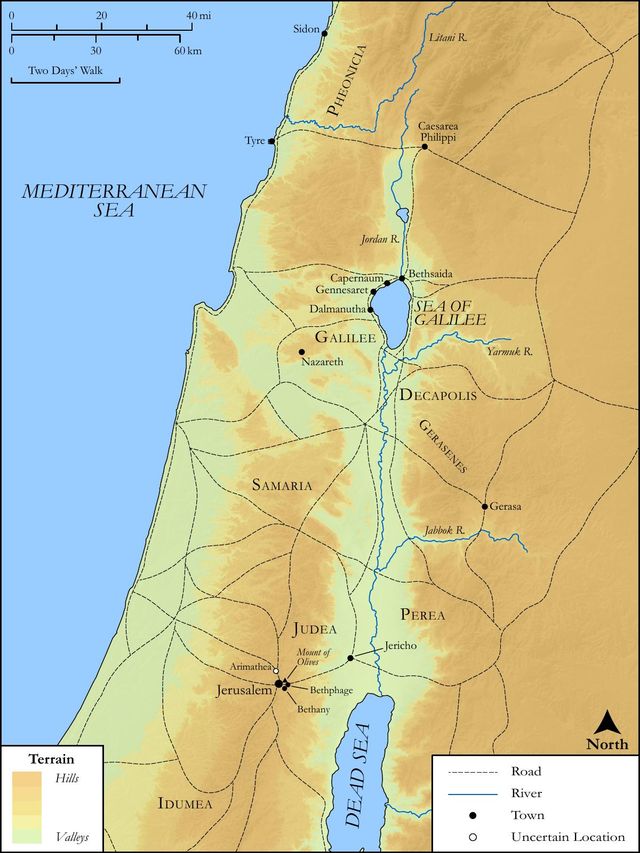
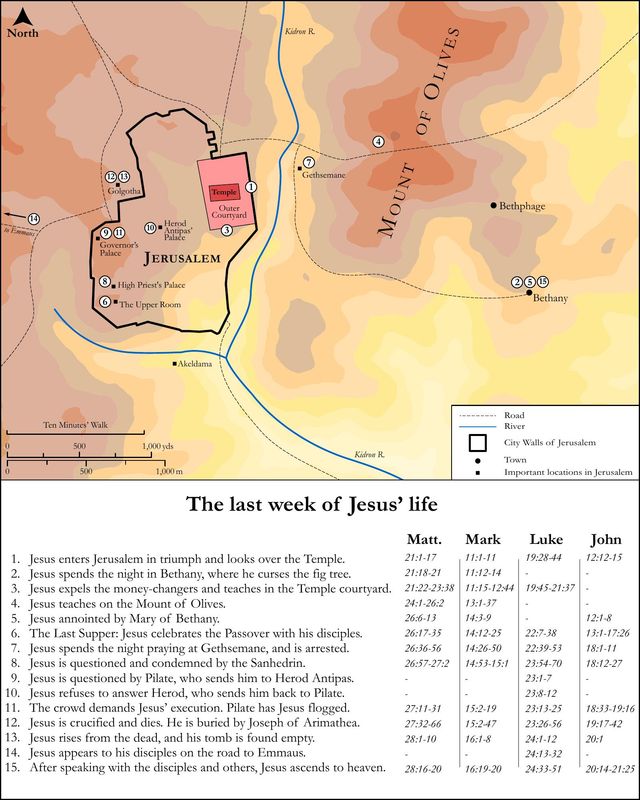
Study this verse
Public-domain commentary
Matthew Henry
From his Commentary on the Whole Bible. Henry comments on passages, not single verses — this entry covers Mark 13:5–13. His three-level outline is real structure in the source text, so it is rendered as structure.
Our Lord Jesus, in reply to their question, sets himself, not so much to satisfy their curiosity as to direct their consciences; leaves them still in the dark concerning the times and seasons, which the father has kept in his own power, and which it was not for them to know; but gives them the cautions which were needful, with reference to the events that should now shortly come to pass.
I.They must take heed that they be not deceived by the seducers and imposters that should now shortly arise (Mar 13:5, Mar 13:6); "Take heed lest any man deceive you, lest, having found the true Messiah, you lose him again in the crowd of pretenders, or be inveigled to embrace others in rivalship with him. Many shall come in my name (not in the name of Jesus), but saying, I am the Christ, and so claiming the dignities which I only an entitled to." After the Jews had rejected the true Christ, they were imposed upon, and so exposed by many false Christs, but never before; those false Christs deceived many; Therefore take heed lest they deceive you. Note, When many are deceived, we should thereby be awakened to look to ourselves.
II.They must take heed that they be not disturbed at the noise of wars, which they should be alarmed with, Mar 13:7, Mar 13:8.
Sin introduced wars, and they come from men's lusts. But at some times the nations are more distracted and wasted with wars than at other times; so it shall be now; Christ was born into the world when there was a general peace, but soon after he went out of the world there were general wars; Nation shall rise against nation, and kingdom against kingdom. And what will become of them then who are to preach the gospel to every nation? Inter arma silent leges - Amidst the clash of arms, the voice of law is not heard. "But be not troubled at it." 1. "Let it be no surprise to you; you are bid to expect it, and such things must needs be, for God has appointed them, in order to further accomplishment of his purposes, and by the wars of the Jews" (which Josephus has given us a large account of) "God will punish the wickedness of the Jews." 2. "Let it be no terror to you, as if your interest were in danger of being overthrown, or your work obstructed by these wars; you have no concern in them, and therefore need not be apprehensive of any damage by them." Note, Those that despise the smiles of the world, and do not court and covet them, may despise the frowns of the world, and need not fear them. If we seek not to rise with them that rise in the world, why should we dread falling with them that fall in the world? 3. "Let it not be looked upon as an omen of the approaching period of the world, for the end is not yet, Mar 13:7. Think not that these wars will bring the world to a period; no, there are other intermediate counsels to be fulfilled betwixt that end and the end of all things, which are designed to prepare you for the end, but not to hasten it out of due time." 4. "Let it not be looked upon as if in them God has done his worst; no, he has more arrows in his quiver, and they are ordained against the persecutors; be not troubled at the wars you shall hear of, for they are but the beginnings of sorrows, and therefore, instead of being disturbed at them, you ought to prepare for worse; for there shall also be earthquakes in divers places, which shall bury multitudes in the ruins of their own houses, and there shall be famines, by which many of the poor shall perish for want of bread, and troubles and commotions; so that there shall be no peace to him that goes out or comes in. The world shall be full of troubles, but be not ye troubled; without are fightings, within are fears, but fear not ye their fear." Note, The disciples of Christ, if it be not their own fault, may enjoy a holy security and serenity of mind, when all about them is in the greatest disorder.
III.They must take heed that they be not drawn away from Christ, and from their duty to him, by the sufferings they should meet with for Christ's sake. Again, he saith, "Take heed to yourselves, Mar 13:9. Though you may escape the sword of war, better than some of your neighbours, because you interest not yourselves in the public quarrels, yet be not secure; you will be exposed to the sword of justice more than others, and the parties that contend with one another, will unite against you. Take heed therefore lest you deceive yourselves with the hopes of outward prosperity, and such a temporal kingdom as you have been dreaming of, when it is through many tribulations that you must enter into the kingdom of God. Take heed lest you needlessly expose yourselves to trouble, and pull it upon your own head. Take heed what you say and do, for you will have many eyes upon you." Observe,
1.What the trouble is which they must expect.
(1.)They shall be hated of all men; trouble enough! The thoughts of being hated are grievous to a tender spirit, and the fruits of that hatred must needs be a constant vexation; those that are malicious, will be mischievous. It was not for any thing amiss in them, or done amiss by them, that they were hated, but for Christ's name sake, because they were called by his name, called upon his name, preached his name, and wrought miracles in his name. The world hated them because he loved them.
(2.)Their own relations shall betray them, those to whom they were most nearly allied, and on whom therefore they depended for protection; "They shall betray you, shall inform against you, and be your prosecutors." If a father has a child that is a Christian, he shall become void of natural affection, it shall be swallowed up in bigotry, and he shall betray his own child to the persecutors, as if he were a worshipper of other gods, Deu 13:6-10.
(3.)Their church-rulers shall inflict their censures upon them; "You shall be delivered up to the great Sanhedrim at Jerusalem, and to the inferior courts and consistories in other cities, and shall be beaten in the synagogues with forty stripes at a time, as offenders against the law which was read in the synagogue." It is no new thing for the church's artillery, through the treachery of its officers, to be turned against some of its best friends.
(4.)Governors and kings shall use their power against them. Because the Jews have not power to put them to death, they shall incense the Roman powers against them, as they did Herod against James and Peter; and they shall cause you to be put to death, as enemies to the empire. They must resist unto blood, and still resist.
2.What they shall have to comfort themselves with, in the midst of these great and sore troubles.
(1.)That the work they were called to should be carried on and prosper, notwithstanding all this opposition which they should meet with in it (Mar 13:10); "The gospel shall, for all this, be published among all nations, and before the destruction of Jerusalem the sound of it shall go forth into all the earth; not only through all the nation of the Jews, but to all the nations of the earth." It is comfort to those who suffer for the gospel, that, though they may be crushed and borne down, the gospel cannot; it shall keep its ground, and carry the day.
(2.)That their sufferings, instead of obstructing their work, should forward it; "Your being brought before governors and kings shall be for a testimony of them (so some read it, Mar 13:9); it shall give you an opportunity of preaching the gospel to those before whom you are brought as criminals, to whom otherwise you could not have access." Thus St. Paul's being brought before Felix, and Festus, and Agrippa, and Nero, was a testimony to them concerning Christ and his gospel. Or, as we read it, It shall be for a testimony against them, against both the judges and the prosecutors, who pursue those with the utmost rage that appear, upon examination, to be not only innocent but excellent persons. The gospel is a testimony to us concerning Christ and heaven. If we receive it, it will be a testimony for us: it will justify and save us; if not, it will be a testimony against us in the great day.
(3.)That, when they were brought before kings and governors for Christ's sake, they should have special assistance from heaven, to plead Christ's cause and their own (Mar 13:11); "Take no thought before-hand what he shall speak, be not solicitous how to address yourselves to great men, so as to obtain their favour; your cause is just and glorious, and needs not be supported by premeditated speeches and harangues; but whatsoever shall be given you in that hour, whatsoever shall be suggested to you, and put into your minds, and into your mouths" (pro re nat - on the spur of the occasion), "that speak ye, and fear not the success of it, because it is off-hand, for it is not ye that speak, purely by the strength of your own wisdom, consideration, and resolution, but it is the Holy Ghost." Note, Those whom Christ calls out to be advocates for him, shall be furnished with full instructions: and when we are engaged in the service of Christ, we may depend upon the aids of the Spirit of Christ.
(4.)That heaven at last would make amends for all; "You will meet with a great deal of hardship in your way, but have a good heart on it, your warfare will be accomplished, and your testimony finished, and he that shall endure to the end, the same shall be saved," Mar 13:13. Perseverance gains the crown. The salvation here promised is more than a deliverance from evil, it is an everlasting blessedness, which shall be an abundant recompence for all their services and sufferings. All this we have, Mat 10:17, etc.
Historical interpretation
Nine Centuries of Reception
5 surviving comments on this verse. Each one is dated, so this reads as a timeline rather than a list.
Select a marker to jump to its quote. Markers stagger vertically where authors wrote within a few decades of each other.
Therefore the Lord exhorts us to wait with patient and reverent faith until the end comes, for “Blessed is he that endures to the end.” It is neither a blessed nothingness that awaits us, nor is nonexistence the fruit, nor annihilation the appointed reward of faith. Rather the end is the final attainment of the promised blessedness. They are blessed who endure until the goal of perfect happiness is reached, when the expectation of faith reaches toward complete fulfillment. Their end is to abide with unbroken rest in that condition toward which they are presently pressing.
"And you shall be hated by all men for my name's sake, yet not a hair of your head shall perish. In your patience you shall possess your souls." The possession of the soul is placed in the virtue of patience because patience is the root and guardian of all virtues. Through patience we truly possess our souls, because while we learn to master ourselves, we begin to possess that very thing which we are.
Patience, however, is to endure the evils of others with equanimity, and to feel no sting of resentment even against the one who inflicts the evils. For whoever bears the evils of a neighbor in such a way that he nevertheless grieves silently and seeks an opportunity for fitting retribution does not display patience but merely shows it outwardly. For it is written: "Love is patient, love is kind." It is patient so as to bear the evils of others, and kind so as to love even those whom it bears. Hence Truth says through Himself: "Love your enemies, do good to those who hate you, pray for those who persecute and slander you." It is therefore a virtue before men to tolerate adversaries, but the virtue before God is to love them.
(ubi sup.) The Lord shows how Jerusalem and the province of Judæa merited the infliction of such calamities, in the following words: But take heed to yourselves: for they shall deliver you up to councils; and in the synagogues ye shall be beaten. For the greatest cause of destruction to the Jewish people was, that after slaying the Saviour, they also tormented the heralds of His name and faith with wicked cruelty.
Ecclesiastical historians testify that this was fulfilled, for they relate that all the Apostles long before the destruction of the province of Judæa were dispersed to preach the Gospel over the whole world, except James the son of Zebedee and James the brother of our Lord, who had before shed their blood in Judæa for the word of the Lord. Since then the Lord knew that the hearts of the disciples would be saddened by the fall and destruction of their nation, He relieves them by this consolation, to let them know that even after the casting away of the Jews, companions in their joy and heavenly kingdom should not be wanting, nay that many more were to be collected out of all mankind than perished in Judæa.
(ubi sup.) For when we are led before judges for Christ's sake, all our duty is to offer up our will for Christ. As for the rest, Christ Himself who dwells in us speaks for us, and the grace of the Holy Ghost shall be given us, when we answer. Wherefore it goes on: For it is not ye that shall speak, but the Holy Ghost.
(ubi sup.) This has often been seen in time of persecution, nor can there be any firm affection amongst men who differ in faith.
Fitly also did He premise a recital of those things which concerned the Apostles, that in their own tribulations they might find some consolation in the community of troubles and sufferings. There follows: And ye shall be brought before rulers and kings for my sake, for a testimony against them. He says kings and rulers, as, for instance, Agrippa, Nero, and Herod. Again, His saying, for my sake, gave them no small consolation, in that they were about to suffer for His sake. For a testimony against them, means, as a judgment beforehand against them, that they might be inexcusable, in that though the Apostles were labouring for the truth, they would not join themselves to it. Then, that they might not think that their preaching should be impeded by troubles and dangers, He adds: And the Gospel must first be published among all nations.
He also foretells to them a worse evil, that they should suffer persecution from their relations. Wherefore there follows: Now the brother shall betray the brother to death, and the father the son; and children shall rise up against their parents, and shall cause them to be put to death; and ye shall be hated of all men for my name's sake.
And this He says, that on hearing it, they might prepare themselves to bear persecutions and ills with greater patience. Then He brings them consolation, saying, And ye shall be hated of all men for my name's sake; for the being hated for Christ's sake is a sufficient reason for suffering persecutions patiently,1 for it is not the punishment, but the cause, that makes the martyr. Again, that which follows is no small comfort amidst persecution: But he that shall endure unto the end, the same shall be saved.
(non occ.) Another anxiety might also arise in the breasts of the disciples. Lest therefore after hearing that they were to be brought before kings and rulers, they should fear that their want of science and eloquence should render them unable to answer, our Lord consoles them by saying, But when they shall lead you and deliver you up, take no thought beforehand what ye shall speak, but whatsoever shall be given you in that hour, that speak ye.
Continue studying Mark 13:13 across the web’s major study libraries — every link below opens this exact verse, chapter, or book on the destination site.
Read & Compare
 BibleGatewayThis verse in more than 200 translations and 70 languages.
 Bible.comThe YouVersion reader — hundreds of translations, reading plans, and highlights.
 ESV.orgCrossway's official English Standard Version reader.
 NET BibleThe NET translation with 60,000+ translators' notes on every rendering decision.
 STEP BibleTyndale House's free study tool — original text, vocabulary, and scholarly resources.
 BibliaLogos Bible Software's free web reader.
 USCCBThe New American Bible (Revised Edition) with the U.S. bishops' study notes.
Commentaries
 BibleHub CommentariesDozens of classic commentaries on this verse, gathered on one page.
 StudyLightMore than 100 commentary sets — the largest collection on the web.
 BibleRefPlain-English commentary on what this verse means, verse by verse.
 Enduring WordDavid Guzik's free commentary on this chapter, widely used by Bible teachers.
 Bible Study ToolsVerse commentary alongside Greek and Hebrew study aids.
Original Language & Research
- BibleHub InterlinearThe verse word by word — original language, transliteration, and English.
- BibleHub LexiconEvery word's original-language definition and Strong's entry.
 Blue Letter BibleDeep-study tools — Strong's numbers, concordance, and word studies.
 CNTR CollationThe earliest Greek manuscripts of this verse, collated letter by letter.
Sermons, Hymns & Audio


TrulyRandomVerse is not affiliated with these sites and doesn’t control their content. They’re linked because they’re genuinely useful.
Summary
Mark 13:13, a pivotal verse within Jesus' Olivet Discourse, serves as both a stark warning and a profound promise to His disciples and all future followers. It prophesies that believers will face universal hatred and persecution specifically "for my name's sake," directly linking their suffering to their identification with Christ. However, it immediately balances this grim reality with a powerful affirmation: those who steadfastly endure through these trials "unto the end" will ultimately receive salvation, underscoring the indispensable role of perseverance in the Christian life.
Context
ShowHideLiterary Context
Mark 13:13 is situated within the broader framework of Jesus' eschatological discourse, often called the "Olivet Discourse," which begins in Mark 13:1. This chapter records Jesus' private teaching to His disciples on the Mount of Olives, prompted by their questions regarding the destruction of the Temple and the signs of His coming and the end of the age. Before addressing the signs in the heavens and the tribulation, Jesus provides a series of warnings about immediate and future persecutions. He describes how His followers will be delivered up to councils, beaten in synagogues, and stand before governors and kings for His sake, as detailed in Mark 13:9-12. Verse 13 specifically intensifies these warnings by emphasizing the universal nature of the hatred they will encounter and then pivots to highlight the absolute necessity of faithful endurance as the pathway to ultimate salvation.
Historical & Cultural Context
Jesus' words reflect the historical reality that His followers would soon face a world hostile to their message and allegiance. In the 1st century, early Christians experienced persecution from both Jewish authorities, who viewed them as heretical, and later from Roman authorities, who saw their exclusive worship of Christ as a threat to imperial cults and social order. The phrase "hated of all men" captures the pervasive suspicion and antagonism Christians would encounter, ranging from social ostracism to severe physical persecution, including martyrdom. This was not merely a theoretical warning but a prophetic insight into the trials that would characterize the early church's existence and continue throughout history. The cultural expectation of loyalty to one's family, community, and state made the exclusive devotion to Christ, which often required breaking these ties, particularly challenging and provocative.
Key Themes
ShowHideThis verse contributes significantly to several overarching themes in Mark's Gospel and biblical theology. Firstly, it underscores the cost of discipleship, making it clear that following Jesus is not a path to worldly ease but often involves suffering and opposition, a theme echoed in Jesus' call to take up one's cross in Mark 8:34. Secondly, it highlights the theme of persecution for Christ's name, emphasizing that opposition to believers is not arbitrary but directly stems from their identification with Jesus Christ and His message. This spiritual conflict is a recurring motif throughout the New Testament, as seen in John 15:18-20. Thirdly, the verse powerfully introduces the theme of perseverance and endurance, stressing that steadfast faithfulness through trials is essential for ultimate salvation. This is a vital component of true faith, distinguishing genuine commitment from superficial adherence, and is paralleled in other eschatological passages like Matthew 24:13. Finally, it reinforces the promise of salvation, assuring believers that despite the intense trials, God's ultimate deliverance awaits those who remain faithful to the very end, a promise that extends to eternal life and communion with God.
Exposition and Analysis
ShowHideKey Word Analysis
ShowHideThis term, G3404, signifies a deep-seated detestation, abhorrence, or active persecution. It conveys more than mere dislike, pointing to a profound spiritual antagonism against Christ and those who bear His name. The passive voice "ye shall be hated" indicates that this opposition is something inflicted upon believers, originating from a source external to them, namely "all men" (representing the world hostile to God).
hypoménō, is a crucial word meaning "to stay under," "to remain," "to stand firm," or "to bear up under." It implies not passive suffering but an active, courageous steadfastness in the face of adversity. This endurance is not merely about waiting for an end, but about actively maintaining faith, hope, and obedience despite trials, temptations, and persecution.
sṓzō, means to save, deliver, preserve, or heal. In this eschatological context, it primarily refers to ultimate spiritual salvation from divine judgment and entrance into God's eternal kingdom. While it can also encompass preservation through specific periods of tribulation, its ultimate scope is the eternal well-being of the faithful.
Verse Breakdown
ShowHide"And ye shall be hated of all [men] for my name's sake:"
This clause serves as a stark prophetic warning. Jesus predicts that His followers will experience widespread, intense animosity. The phrase "of all [men]" (G3956, pâs) suggests a universal or pervasive opposition, not necessarily every single individual, but a general societal or spiritual hostility. The crucial qualifier "for my name's sake" (G1223, diá, G3686, ónoma, G3450, moû) identifies the precise reason for this hatred: it is not for any personal failing or social misstep, but solely because of their allegiance to Jesus Christ and their identification with His authority and character. This highlights the spiritual nature of the conflict.
"but he that shall endure unto the end,"
This clause introduces a critical contrast and condition. The conjunction "but" (G1161, dé) shifts the focus from the certainty of persecution to the necessity of a specific response. "He that shall endure" (G5278, hypoménō) emphasizes the individual responsibility to persevere. The phrase "unto the end" (G1519, eis, G5056, télos) specifies the duration and scope of this endurance. It refers to the conclusion of the period of tribulation, the end of one's life, or the consummation of the age, implying a steadfastness that does not falter at any point before the appointed goal.
"the same shall be saved."
This final clause presents the glorious outcome and divine promise for those who meet the condition of endurance. "The same" (G3778, hoûtos) points back directly to the one who perseveres. "Shall be saved" (G4982, sṓzō) signifies ultimate deliverance and spiritual salvation. This is the ultimate reward, assuring believers that their faithfulness through suffering will not be in vain but will culminate in eternal life and security in God's kingdom.
Literary Devices
ShowHideMark 13:13 employs several significant literary devices to convey its powerful message. Antithesis is prominent, sharply contrasting the external reality of universal hatred and persecution with the internal necessity of endurance and the ultimate promise of salvation. This creates a dramatic tension that underscores the challenging nature of discipleship while simultaneously offering profound hope. The phrase "hated of all [men]" can be understood as hyperbole, a deliberate exaggeration to emphasize the pervasive and intense nature of the opposition believers will face, rather than a literal assertion that every single human will hate them. This rhetorical device effectively communicates the magnitude of the spiritual conflict. Furthermore, the entire verse functions as prophecy, with Jesus foretelling future events and the experiences of His followers, thereby establishing His divine foresight and authority. The structure also implies a conditional clause, where ultimate salvation is presented as the direct consequence of enduring faithfulness, emphasizing the active role of the believer in their spiritual journey.
Theological and Thematic Connections
ShowHideMark 13:13 stands as a foundational text for understanding the nature of Christian discipleship in a fallen world. It asserts that suffering and opposition are not anomalies but inherent aspects of following Jesus. This reality challenges any notion of a triumphalist or easy faith, instead calling believers to a resilient commitment rooted in Christ. The hatred experienced by believers is not random but directly linked to Jesus' "name," signifying their allegiance to His identity, authority, and mission. This highlights the spiritual warfare at play, where the kingdom of God clashes with the kingdom of darkness. The promise of salvation for those who endure unto the end underscores that genuine faith is characterized by perseverance, not merely initial belief. It is a faith that remains steadfast through trials, trusting in God's ultimate vindication and deliverance.
Reflection and Application
ShowHideMark 13:13 offers profound guidance for believers navigating the complexities of faith in a world that often stands in opposition to Christ. Firstly, it cultivates a realistic expectation: we should not be surprised when our commitment to Jesus elicits hostility, misunderstanding, or even active persecution. This prophetic warning helps prevent disillusionment and instead prepares us to face adversity with courage, understanding that our suffering is a participation in Christ's own. Secondly, the verse issues a powerful call to endurance. True faith is not merely about making a good start, but about finishing well. This requires spiritual discipline, a deep reliance on the Holy Spirit, and a clear, unwavering focus on the eternal hope that lies ahead. It challenges us to examine the depth of our commitment: are we fair-weather Christians, or are we rooted deeply enough in Christ to withstand the storms? Finally, the promise of salvation serves as an immense source of comfort and motivation. Knowing that our temporary sufferings are not in vain, but lead to ultimate deliverance and eternal glory, empowers us to persevere. It encourages a long-term, eternal perspective on our faith and life, reminding us that the transient difficulties of this world pale in comparison to the everlasting reward awaiting those who remain faithful to the very end.
Questions for Reflection
ShowHideFAQ
ShowHideDoes "all men" literally mean every single person will hate Christians?
ShowHideWhile the King James Version translates it as "all men," the Greek word pâs (G3956) can mean "all," "every," or "the whole." In this context, it is generally understood as a rhetorical hyperbole, emphasizing the widespread and pervasive nature of the opposition believers will face, rather than a literal assertion that every single individual on earth will harbor hatred. It signifies that hostility will come from various quarters and be a general characteristic of the world's response to those who follow Christ, as seen in the broader biblical narrative where Jesus also has followers and sympathetic individuals.
What kind of "salvation" is promised in this verse?
ShowHideThe "salvation" (Greek: sṓzō, G4982) promised here is primarily ultimate spiritual deliverance and eternal life with God. While it can encompass preservation through specific periods of tribulation or physical deliverance, its fullest meaning in this eschatological context points to the final vindication of believers, their rescue from divine judgment, and their entrance into God's eternal kingdom. It is the culmination of God's redemptive plan for those who remain faithful to Christ, a theme echoed in passages like Romans 10:9-10 and 1 Peter 1:9.
Christ-Centered Fulfillment
ShowHideMark 13:13 finds its profound Christ-centered fulfillment not only in Jesus' prophetic words but supremely in His own life, death, and resurrection. Jesus Himself endured the ultimate "hatred of all men" for His Father's name's sake, facing rejection, betrayal, and crucifixion at the hands of those He came to save. He perfectly exemplified what it means to "endure unto the end," steadfastly setting His face toward Jerusalem and the cross, submitting to the Father's will even unto death, as described in Philippians 2:8. His endurance was not passive suffering but an active, resolute commitment to His redemptive mission, "for the joy that was set before him," as Hebrews 12:2 beautifully articulates. In His resurrection, Jesus became the first to be "saved" in the ultimate sense, triumphing over sin, death, and the powers of darkness. Therefore, His promise in Mark 13:13 is not a mere moral exhortation but a divine assurance grounded in His accomplished work. Believers are empowered to endure precisely because Christ has already endured and triumphed, and the Holy Spirit indwells them, enabling them to walk in His footsteps and share in His victory. Our salvation is secured by His endurance, and our ability to endure is a gift of His grace, guaranteeing our participation in His ultimate salvation.